Earth-Space Science

Finding your place in the universe.

What can you do with your fascination of earth and space? Well, when you study the various cycles of Earth's landforms, oceans, and the solar system, you can discover how our planet is connected with the universe. Even as an undergraduate, you will engage in local geological research projects and other hands-on experiences. You'll discover where in the universe you want to take your career.

  • colleges of distinction 2025-2026
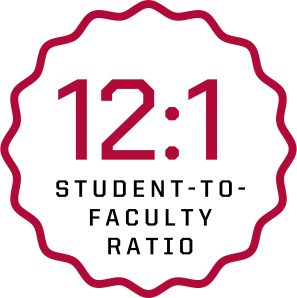
  • 12:1 student-to-faculty ratio
  • ranked as a national university by u.s. news and world report

Advantages

  • Small class sizes that foster individual research and growth
  • Expert professors who aim to fulfill your potential through research
  • Other science majors involved in courses to offer new perspectives
  • A vast Indiana paleontology collection open to study

Minors


Earth-Science Minor

If you are choosing another major but have a passion for the natural and life sciences, the earth-space science minor may be the perfect complement to your studies. Completion of this minor requires a minimum of 20 hours in required courses.

Geology Minor

This has a more intense focus in physical geology and soils than is required by our other major programs. It may prove to be particularly valuable to your studies if you think you want to pursue a graduate degree in geology. Or, if you are an archaeology student, a geology minor can help you differentiate yourself more from traditional anthropology students. Completion of this minor requires a minimum of 18 hours in required courses.

Paleontology Minor

If you are interested in past life, the fossil record, or the history of Earth and its life, the minor in paleontology might be for you! By taking a combination of biology and geology courses, this minor will allow you to better understand the coevolution of Earth and life. This minor pairs well with majors in Earth-Space Science, Biology, and Archeology and is also well-suited for students of all majors who are interested in paleontology. Paleontology students have the opportunity to participate in field trips, conduct paleontological research, and work with local museums. Completion of this minor requires a minimum of 21 credits.

Potential Careers

  • Petroleum geology
  • Geophysics
  • Geochemistry
  • Soil Science
  • Meteorology
  • Seismology
  • Paleontology
  • Planetary geology

Curriculum

The earth-space science program provides a dual approach to your education: theory and applied learning. Theory explores the way the earth forms, how rocks weather, and how climates change. Applied learning investigates the practical applications of these theories. You can expect to:

  • Research how soil and watersheds form
  • Map geological formations on local expeditions
  • Work with ongoing archaeological projects
  • Collect, identify and organize Indiana paleontological specimens

Curriculum Guides

These curriculum guides outline the different classes you will need to take as an Earth-Space Science major. The general education guide provides a list of all the classes you need in order to fulfill UIndy’s general education requirements. The Earth-Space Science guide lists the classes you'll need to take to fulfill your major’s requirements. Be sure to take a look at both guides in order to get a complete picture of what your classes will look like at UIndy.