Let's Tell the Whole Story with Florabelle Williams Wilson: A 1980s Retrospective of Black History
Curator's Comments
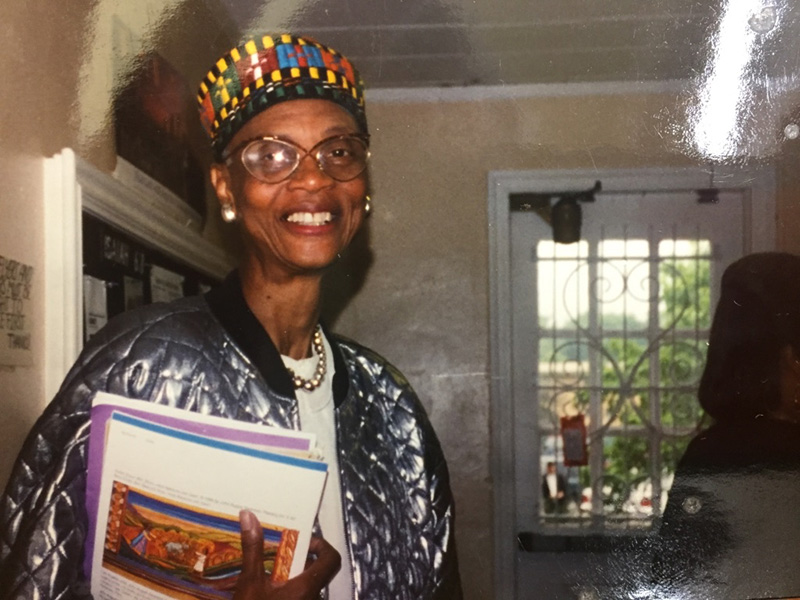
The Black History Projects that Mrs. Florabelle W. Wilson carried out during and after the 1979-1980 academic year had overlapping significance– as I explained in Mission Matters #77 where I gave an overview of the project for the purpose of explaining her significance for the university's present and the future. In this set of digital exhibits, my objective is more specific – to display what she did and how she did it over the course of a decade and more.
I have chosen the “exhibit” as my format because that was her own medium for conveying the message she was curating. Indeed, she tried to combat the stereotypes of her time and place by showing the ways that actual black families existed in the past and present. She had to combat two problems at the same time: 1) the cultural invisibility of the black family in America (as a viable institution) and 2) the stereotyped hypervisibility of Black women (as unwed parents, etc.) and Black men (as absent fathers, etc.) by presenting a transgenerational story of Black family life on the Southside of Indianapolis, which she called “The Invisible Sinew” (February 1980)."
The materials she gathered in the 1980s using the tools of oral history grew out of the already existing techniques of sociology and folklore studies and paralleled the rise of Black studies as a set of disciplines in higher education. The 21 displays in this digital exhibit reflect these developments and in many instances are products of that emerging body of knowledge, which has its origins in the Black Freedom struggle. For a list of permissions and acknowledgments, please see the final file in the sequence. – Michael G. Cartwright (July 20, 2022)
Biographical Sketch
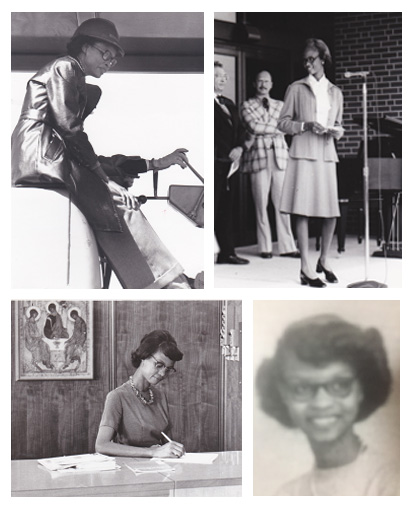
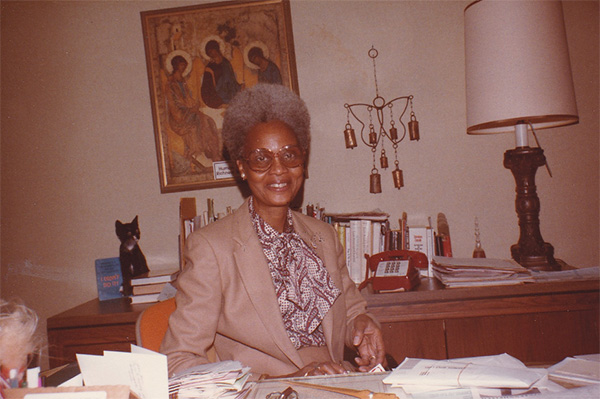
Photo collage, clockwise: Florabelle Williams Wilson operating controls of the bulldozer (1976); at an event outside the entrance of the Krannert Memorial Library; as a senior at Indiana Central College (1949); at desk in the new library with an icon of Andrei Rublev’s “Holy Trinity” behind her.
Florabelle Williams Wilson (1927–2008) was the daughter of James S. and Hattie Virginia Hollis Williams. She attended the local public schools including School #26 and Crispus Attucks High School. Wilson graduated from high school in 1944. She received a BS in Education from Indiana Central College (now University of Indianapolis) in 1949. She taught at Indianapolis Public School (IPS) #23 for eight years, later returning to school to work on a graduate degree in library science. In 1961, Wilson received an MLS from Indiana University. She married John A. Wilson (27 August 1920–22 June 1990) in 1964.
From 1957 to 1971 Wilson worked as an assistant librarian at the University of Indianapolis. She was director of the library from 1971 until her retirement in 1982. The first full-time African American faculty member at the university, she was also the first black director of an academic library in Indiana. In 1971 she helped plan the interior design and select furnishings for what became the university’s Krannert Memorial Library. A past member of the Indiana Library and Historical Board and the Soul People Repertory Board, she served on the Indiana Historical Society Library Committee for nearly two decades. She was a member of the Indianapolis chapter of Zonta International (a women’s service organization), Indiana Library Association, and the American Library Association. She was also a life member of the National Association for the Advancement of Colored People (NAACP) and an elder at Immanuel Presbyterian Church.
While at the University of Indianapolis, Wilson developed the exhibit and slide/lecture presentation “The Black Family in Indianapolis: Invisible Sinew.” She was a contributor to other exhibits created during the 1980s including “This Far by Faith: Black Hoosier Heritage,” edited by Emma Lou Thornbrough and “Bury Me in a Free Land,” developed by Gwendolyn Crenshaw. Wilson also mounted exhibits in conjunction with her West African travels to Senegal, Nigeria, Togo, Benin, Ghana, and the Ivory Coast. She also traveled to France, England, China, Japan, Hong Kong, the Scandinavian countries, Russia, Mexico, and the Caribbean. She presented talks and travelogues to schools, organizations, and historical societies. She created a puppet show titled "Let's Tell the Whole Story" that she used to present African American history programs to public school districts throughout Marion County. She did public service appearances on local television stations, WTTV-4, WFBM-6, WTHR-13, and WISH-8 and Indianapolis area radio stations, WIAN and WGRT.
The recipient of numerous honors, Wilson was named a distinguished alumnus of the University of Indianapolis in 1986 and awarded an honorary Doctor of Letters by the school in 1988. She received service awards from the Indiana Library and Historical Board and the Indiana Library Trustee Association in 1990. In 1993, IPS School #26 presented her with a Career Achievement Award.
Biographical Sketch Prepared by Wilma Gibbs for the Indiana Historical Society based on materials in the collection (1995, 2008).
Exhibits
- Exhibit A: Black History and/at Indiana Central University – Back in 1968 and Today
- Exhibit B: The Moynihan Report
- Exhibit C: Black History Week at ICU: 1975-1980
- Exhibit D: Indiana Historical Society Launches Black History Project: 1979
- Exhibit E: Responses and Interviews from Black Families of the Southside: 1979-1980
- Exhibit F: Local Guide for Black Family on the Southside Explorations
- Exhibit G: Overview of The Black Family in Indianapolis Southside Project and Exhibit
- Exhibit H: Sample Interview – Notes on Subject: Normal Merrifield, 626 Bernard Street
- Exhibit I: Rising Population of Indianapolis: The Problem of Housing in Indianapolis (After 1920)
- Exhibit J: Black Families and the Housing Shortage: The Woodlawn Gardens Sign
- Exhibit K: Flanner House and Other Housing Developments in Indianapolis
- Exhibit L: FWW's Own Family Journey as part of The Great Migration
- Exhibit M: ICU’s Black History Week – Opening Day Sunday Feb. 10, 1980
- Exhibit N: Indiana's Black Communities and Black Families
- Exhibit O: Education and the Black Family
- Exhibit P: FWW’s FINAL REPORT TO ICU & the Indiana Historical Society
- Exhibit Q: FWW’s Ongoing Quest: West African Pilgrimage (1983)
- Exhibit R: "Bury My Heart in a Free Land" (1986) and Other Black History Exhibits
- Exhibit S: FWW as Subject of Indiana Libraries Oral History Interview (1986)
- Exhibit T: Making Space for Black History in Retirement – FWW’s Stories for Children
- Exhibit U: Unfinished Research: Black Families on the Southside of Indianapolis
- Exhibit V: Making Space for Black History in Retirement – FWW’s HOH Presentation
- Exhibit W: Florabelle Williams Wilson: Collegial Icon for the University of Indianapolis
Exhibit A: Black History and/at Indiana Central University – Back in 1968 and Today
The emergence of Black History as a discipline of the University is often described as a post-1968 pattern of curricular innovation. Earlier generations of scholars, such as Carter Woodson and E. Franklin Fraxier had focused on the historic black church, and the role of institutions such as the Historic Black Colleges and Universities.
In the late 1960s this began to change as the evolving collection of “black studies” disciplines attempted to respond to the challenges of the Civil Rights movement and the emerging set of programs that developed in the wake of the War on Poverty during the administration of Lyndon Baines Johnson and the Voting Rights Act of 1965.
The History Department of Indiana Central College arranged for a series of speakers about Black History in 1969. Florabelle Williams Wilson’s own life and work were impacted by these developments in multiple ways during the period she served as Director of Krannert Memorial Library (1971-1985). As she later wrote, one of the things she was proud of about her association with Indiana Central was "the development of an annual Black History Program to which national figures are invited. Gwendolyn Brooks, the Pulitzer Prize-winning poet, was our speaker one year... Another [year] Mayor Richard Hatcher came...” Where some might have thought in terms of a "one-off" activity, FWW envisioned an ongoing program that began as a weeklong emphasis and eventually became a month.
Today, the University of Indianapolis Office of Inclusive Excellence and Retention Strategy offers programming throughout the academic year as well as sponsors public events such as the annual celebration of Juneteenth and the recent exhibit of art Ode to Blackness curated by Primrose Paul.
In the year 2022, Black History is a field of academic study that has developed for more than a half century. See for example, the recently published study African-Americans in Indianapolis by the public historian Dr. David Leander Williams (Indiana University Press, 2022).
Exhibit B: The Moynihan Report
One of the reports that informed these developments was The Negro Family, The Case for National Action (1965), aka “The Moynihan Report,” which was published by the U. S. Department of Labor in the context of the Civil Rights movement. Daniel Patrick Moynihan, who later became U.S. Senator from New York, wrote the report “hoping to persuade White House officials that civil-rights legislation alone would not produce racial equality.” In short: Freedom is not enough. The challenge is to find ways to achieve equality.
The political orientation of the Moynihan report was not straightforward. Benign in intent, it also displayed a kind of paternalism that treated African American – and their families – less as citizen agents who are capable of taking action than as historical victims as the following excerpt suggests.
“Individually, Negro Americans reach the highest peaks of achievement. But collectively, in the spectrum of American ethnic and religious and regional groups,... [they] are among the weakest. The most difficult fact for white Americans to understand is that in these terms the circumstances of the Negro American community in recent years has probably been getting worse, not better.”
Moynihan’s study focused on non-marital birth-rates, absent fathers, and single black mothers. He concluded:
“The fundamental problem... is that of family structure. The evidence... is that the Negro family in the urban ghettos is crumbling... for vast numbers of the unskilled, poorly educated city working class the fabric of conventional social relationships has all but disintegrated...So long as this situation persists, the cycle of poverty and disadvantage will continue to repeat itself... A national effort is required that will give a unity of purpose to the many activities of the Federal government in this area, directed to a new kind of national goal: the establishment of a stable Negro family structure.”
In the 1970s, “The Moynihan Report” was repeatedly cited as stereotypes developed as part of the resistance to the desegregation of American society in public contexts such as public schools. US governmental bureaucracies begin to identify social patterns that shaped social policies targeting the needs of the “black family.”
Meanwhile, groups such as the NAACP resisted such frameworks, and begin to offer counter-histories of the African-American culture, that stress the importance of extended families, etc. Still later, “people’s histories” of American culture expanded that resistance. And even more recently, follow up studies have shown that the patterns of non-marital birthrates in the 21st century are higher for all categories, not just African-Americans.
In retrospect, the biases of the 1965 study of “The Negro family” appear obvious to many citizens of the 21st century. But at the time, it was issued with the imprimatur of the Dept. of Labor. And the conundrums associated with the subject of The Moynihan Report would continue well into the 21st century. Indeed, the poignant stories that surfaced over and over again as part of the oral history project led by Florabelle Williams Wilson remain hauntingly familiar in the year 2022.
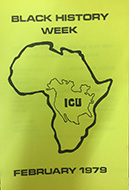
Exhibit C: Black History Week at ICU: 1975-1980
Black History Week began to be celebrated regularly at Indiana Central University in the mid-1970s in the context of the required “chapel” or convocation activities. FWW took on the responsibility of organizing the activities for Black History Week, which appears to have been more of an ongoing "program" than a one-off event each year.
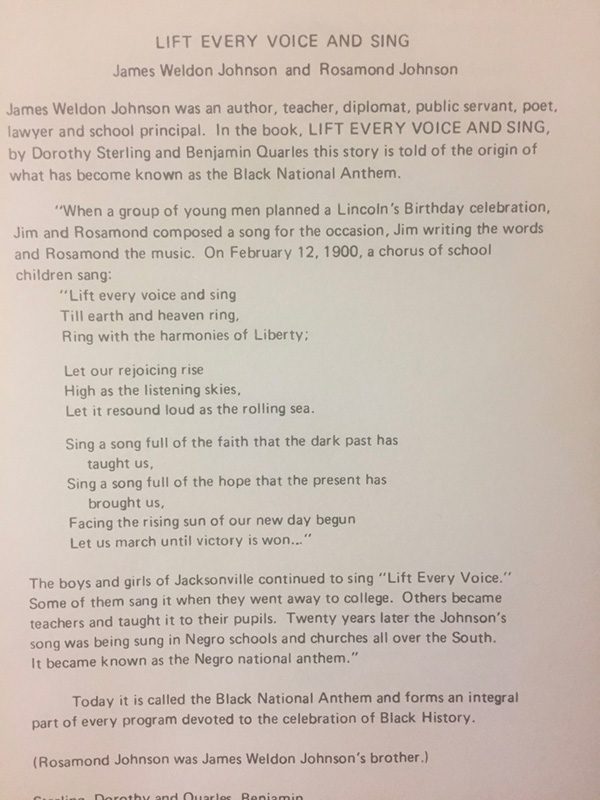
The annual celebration included singing the hymn “Lift Ev’ry Voice and Sing,” the hymn by James Weldon Johnson and his brother J. Rosamond Johnson. This song, which was originally written for the celebration of the Birthday of Abraham Lincoln in February 1900, and first performed by 500 children at the Stanton Elementary School in Jacksonville, Florida. In the 1970s, “Lift Ev’ry Voice and Sing” became better known as the Black National Anthem was one of the central features of celebrations of Black History at Indiana Central. Under the leadership of Mrs. Florabelle Williams Wilson.
The poster for the 1979 celebration of Black History Weeks, which juxtaposes the relationship of the university with the history of United States and the continent of Africa, is an indicator of one of the ways that FWW engaged students as an educator in the context of her role as the Director the University’s Krannert Memorial Library. There were questions to be pondered about personal identity, membership in the nation-state, African heritage and the identity of someone who was an African-American or "Black" student living in Indianapolis.
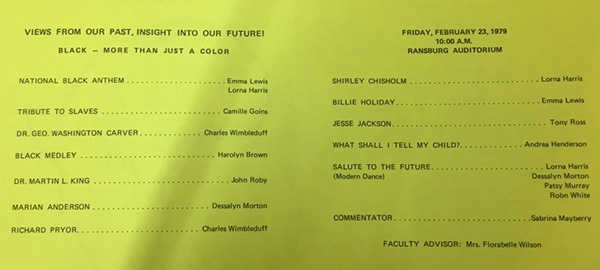
Exhibit D: Indiana Historical Society Launches Black History Project: 1979
In the late 1970s several different agencies provided funds to support Black History endeavors. In the state of Indiana, the Indiana Historical Society and the state government agency “Indiana History Bureau” constituted several different ventures. Some of these focused on the Indianapolis metropolitan area. Others explored the small settlements of African-American families in various locations in the state of Indiana ranging from the Southwestern area near the Ohio River to the counties adjacent to Richmond Indiana. One in particular, the Black community of Lyles Station in Southwest Indiana, was published the day that her own exhibit opened at ICU.
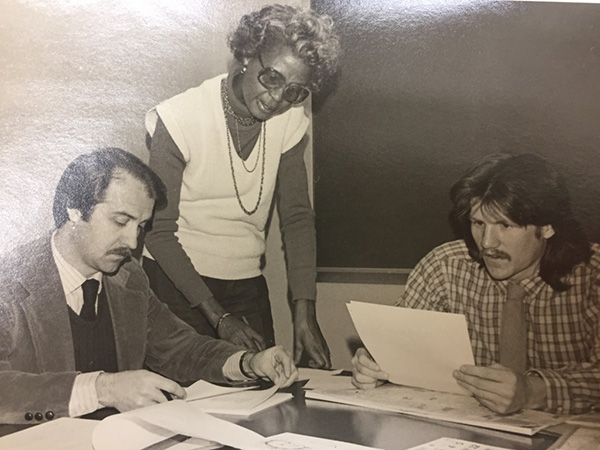
ca. 1980 FWW works with Thomas Bruner (left) Jeff Gunderson (right) from the Indiana Historical Society reviewing materials collected for the Black Families ‘Invisible Sinew’ Exhibit...Photograph by Syliva Henricks for the Indiana Central project
In the late 1970s several different agencies provided funds to support Black History endeavors. In the state of Indiana, the Indiana Historical Society and the state government agency “Indiana History Bureau” constituted several different ventures. Some of these focused on the Indianapolis metropolitan area. Others explored the small settlements of African-American families in various locations in the state of Indiana ranging from the Southwestern area near the Ohio River to the counties adjacent to Richmond Indiana. One in particular, the Black community of Lyles Station in Southwest Indiana, was published the day that her own exhibit opened at ICU.
FWW was one of the consultants (designated as “humanist”) assigned to the Indiana Avenue project. In a letter of response to the project director, she displayed eagerness to participate. Several related initiatives developed in the months that followed. Later, FWW explained the sequence this way. “In August, 1979, Indiana Historical Society Library initiated a Black History Project for the purpose of building a collection of interviews, papers, photographs, letters, documents, diaries, etc., about black residents of Indiana. The initial exhibit at the Indiana State Library featured Madame C. J. Walker, the first black self-made millionaire.” (FWW--Oral History Project report, p. 1)
FWW reported that two related events in the fall of 1979 evoked sufficient interest to propel the Indiana Central contribution to the Black History Project. “The first of these was the aforementioned exhibit. The second was an oral history workshop at which FWW had the opportunity to learn the techniques of oral history gathering. Her almost clinical language hardly cloaks her genuine enthusiasm for this venture”. “. . . the idea of searching for information on the oldest black families located on the Southside of Indianapolis came into being and developed into an absorbing project which became the nucleus for a Black History Exhibit at Indiana Central University.” (page 1)
Indiana Historical Society library provided the equipment for recording the oral histories. A copy of each of the interview was to be kept for the collection at Indiana Central University as well as copies of many of the photographs loaned to us for the Black History Exhibit in February 1980.” Indiana Central would receive copies of the transcriptions that the HIS library would produce. FWW conclude: “It is my understanding that we will continue joint efforts to collect information and data for the project.” The December 1979 edition of the Indiana Historical Society’s Newsletter provided an overview of the process and what kind of materials would be produced.
“Taped interviews will then be transcribed at the library and the transcriptions held for later editing by the interviewer and by students in the library’s 1980 summer intern program. The result will be a version fo the interview which will contain not only all significant information but also editorial commentary, an aid in understanding references and asides. This version will also include biographical information about the interviewee and a brief introduction to the interviewer. Thus the edited version become a valuable resource for the researcher.”
There was also a division of labor between the staff of Indiana Central Library and the Indiana Historical Society, Jeff Gunderson focused on congregations of the Historic Black Church on the Southside. Accordingly, FWW limited her commentary about the religious dimension of life on the Southside: ‘Struggling for survival, the black families relied heavily upon the black church for stability." Even so, FWW recorded notes i about the various Christian congregations to which the Black Families belonged.
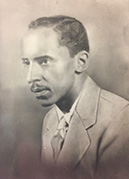
Exhibit E: Responses and Interviews from Black Families of the Southside: 1979-1980
We don’t know how the project was processed at ICU beyond the fact that FWW and her library colleague Mrs. Sylvia Henricks (spouse of a longtime faculty member) conceived of it as an exhibit for the celebration of Black History Month at the beginning of a year when ICU already was going to be celebrating its 75th anniversary. Together they wrote a letter inviting people in the wider community to participate and they began gathering names. The letter was mailed in mid-December.
We also have communications from some of the persons who received that communication. The fact that responses began to come in before the Christmas holidays is an indicator of the positive interest FWW and her colleagues encountered.
The Christmas Eve letter from Norman Merrifield that Florabelle Wilson ’49 received was notably grumpy. The 90-year-old musician, composer and longtime Crispus Attucks teacher objected that FWW and her colleagues were expecting him to interrupt his pile of correspondence left over from the Christmas holidays. However, that did not stop Mr. Merrifield, from producing an initial list of “outstanding families” that FWW could use in getting started with her project. She added a half dozen more addresses to the set of names that he gave her.
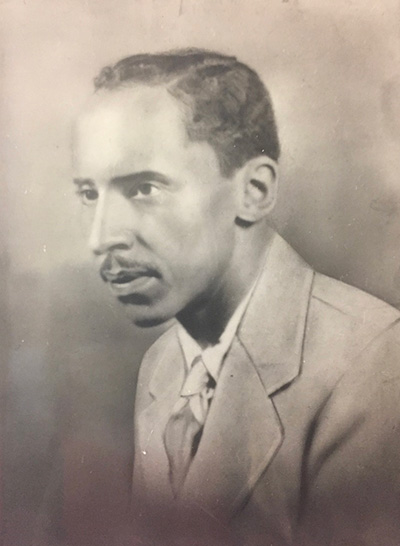
Norman Merrifield – undated photograph from FWW collection
In Norman Merrifield, FWW encountered someone who had longstanding familiarity with the Southside of Indianapolis and who appeared to have an extensive memory of the network of institutions and relationships that constituted a somewhat dispersed community.
“I lived on the Southeast side of town from 1913 to 1949 with severa...intervals (teaching out of town, 4 years in the armed forces and etc.) and summers in school. However, my family lived during that interval on Harlan Street, Linden Street, Wade Street and finally, we built our home (about 1915) on Finley Street. During most of the time our family belong (sic) to Olivet Baptist Church which is now located at Grove and Hosbrook Sts. During the period from about 1920 until I went into the armed forces (1942) my father had a coal and ice business and I carried papers (white and black) in the area East and South of Fountain Square. From 1933 to 1967 I was Dept. Head at Crispus Attucks High School...thus my interest in your endeavor."
Merrifield’s perspective of what counts as "the Southside of Indianapolis " in the early to mid-20th century is important to register from the beginning if we are to grasp FWW’s quest. The city limits changed several times during Merrifield’s lifetime. At the time he and FWW corresponded, the construction of I-65 had disrupted some of the historic neighborhoods between Fountain Square and Garfield Park. In addition, Uni-Gov had been implemented, and in effect “the Southside” now extended to Perry Township, and for some purposes all the way to the Johnson County line and the Greenwood city limits. But the mental map with which Norman Merrifield operated was one that extended north and south along Shelby Avenue to Troy Avenue, which comprised the limited housing options available to Black citizens of Indianapolis at that time.
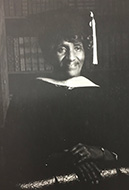
Exhibit F: Local Guide for Black Family on the Southside Explorations
In addition to reaching out to individuals and family units, FWW also checked historical sources. She identified the names of black pioneers such as Mark Harris and Hezekiah Smart, who established homesteads along Bluff Road near the intersection of Pleasant Run Parkway. Such pioneers did not have long lasting impact, however, due to the “Negrophobia” of other settlers in southern Marion County. By the middle of the 19th century, most of the early settlers had left Indiana but later in the 19th century, the flow of black migrants from the South and East resumed.
FWW received responses from enough people willing to be interviewed that she spent much of the month of January following up with a dozen or so families, including the Hadleys, Merrifields, Ashfords, Smiths, Cheathams, Grants, Brewers, and Langfords.
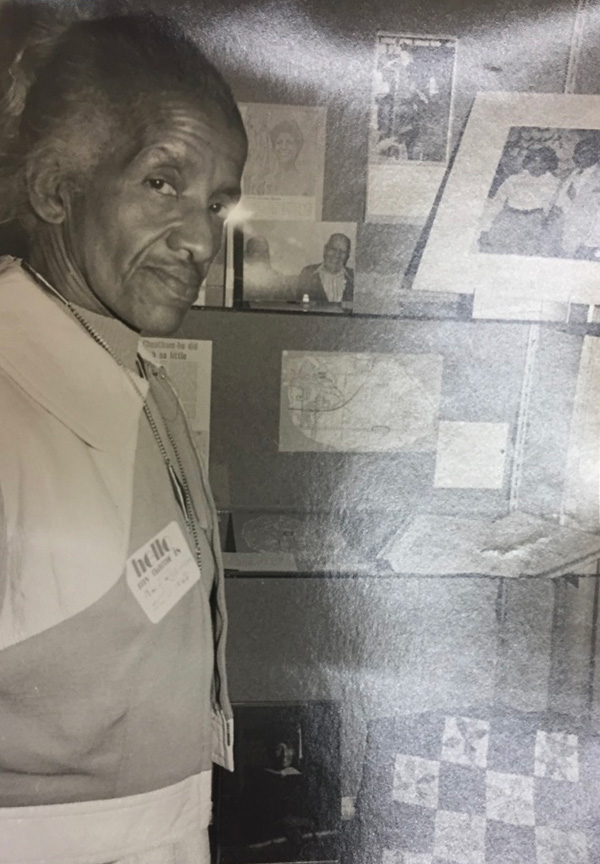
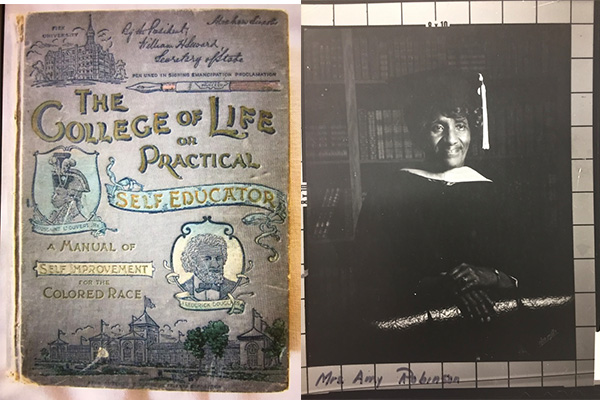
Photo of Amy Robinson '68 as with display at the Invisible Sinew exhibit, February 1980
On several occasions, she visited families with her acquaintance Amy Robinson ’68. In addition to reporting on “Southside Happenings” for The Indianapolis Recorder, Mrs. Robinson was an active leader in the African-American community who also had lived in the area (1600 Barrington), near Fountain Square, and within walking distance of the University of Indianapolis (3434 Asbury Street), on the near southside. The construction of I-65 cut through the neighborhood where Robinson's family lived, thereby disrupting longtime relationships that once had defined the neighborhoods of the southside of Indianapolis.
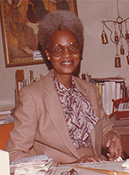
Exhibit G: Overview of The Black Family in Indianapolis Southside Project and Exhibit
FWW’s enthusiasm for limited goals of the Indiana Central contribution to the larger Black History Project was quite strong. She did not claim for herself the role of catalyst in the project, but it appears that she did play that role from the moment she embraced the opportunity to receive training to gather oral history. Mrs. Wilson must have started gathering names of families before she participated in the training in December 1979. And her involvement continued well after the original goals were met. Perhaps her engagement evolved in ways that surprised her.
That begins with the name that FWW gave to the project that she initiated in 1979: The– “The Black Family in Indianapolis: Invisible Sinew.” The name may have been in view all along, but it only appears in late January 1980 as part of the publicity for Black History Week. And I have not found a specific explication of the title [page one of FWW’s introduction to the exhibit appears to be missing from the files; perhaps it was in her original notes that she used over and over again across the years.)
Although I do not know of a specific allusion that FWW was making to the literary works of Ralph Ellison, the renowned author of Invisible Man, Richard Wright, Zora Neale Hurston or the writings of other Black writers, the conundrums of invisibility and hypervisibility are well-established tropes of the African-American literary tradition.. In this case, the problem was twofold: the strengths of the black family were not recognized by many white Americans. And the pathologies of the Black Family vis-à-vis the governmental bureaucracies had long been exaggerated. The title, the Invisible Sinew, then was a way of naming the strength of bondedness that was absent from public awareness, indeed that many wished to ignore, believing that it did not exist.
Not surprisingly, the project's overview even accounts for the origin of black families in the formation the African-American commercial interactions. “As the Black Community grew, its demand for services and goods prompted some aspiring individuals to establishing and manage their own businesses and professional offices. The heaviest concentration of these businesses in Indianapolis was on Indiana Avenue. Placing advertisements in the weekly newspaper, the Indianapolis Recorder, these businesses thrived on the patronage of the black community. In its heyday, there were more than fifty businesses within a ten-block stretch of the street which ‘began with a pawnshop and ended with a hospital.’...”

Exhibit H: Sample Interview – Notes on Subject: Normal Merrifield, 626 Bernard Street
Norman Merrifield’s somewhat grumpy response hid his own strong enthusiasm for the project. Less than a week after he received her mid-December letter, he produced a typewritten list of persons and addresses that he sent to Florabelle Wilson. She subsequently interviewed him. She recorded her impressions of Mr. Merrifield.
In the 1979, Sierra Club Calendar that she used to record information for the project, her notes from the visit with Norman Merrifield displayed her enthusiasm for what she was learning from this man who was highly regarded in the African American community.
“It was easy to find Mr. Merrifield’s house by following the explicit instructions he had given. Located at 626 Bernard, his home is just east of Clarendon Road – a small white frame with aluminum siding – a fenced lot adjoins the house on the west side. As I walked up on the porch, he opened the door and welcomed me to the inviting living room which is dominated by a Baldwin grand [piano]. Soft hues of green, gold and beige complement each other and enhance the atmosphere of good taste. He was well-prepared, having reviewed his life in detail and after we got the tape player plugged in and settled, he began to talk about himself and his life on the Southside. At intervals, he would signal to me to stop the recorder while he related experiences which he did not want included...”
“Although he is 73 years old, he is very alert and interesting to talk to , with ruddy skin the color of walnut, his Van Dyke beard complemented by a full head of wavy hair, not quite half gray, he could well be in his late 40’s or early 50’s. He moves with only a hint of stiffness and with surprising agility. He seems to know where to lay his hands on items quickly, and although he pleads a hearing loss, he still has a good ear and listens attentively to what one has to say. We completed both sides of the cassette and still had not talked about his music. So I took notes as he began to talk about the most important thing in life to him – his music—or as he put it, ‘That’s my soul! I am a musician!’...”
FWW’s notes in this instance are not representative of the records she kept of all the interviews, but it displays her deep well of enthusiasm for the project of gathering oral history. Like other volunteers, who had been trained by Indiana Historical Society staff, she may have made some unfounded assumptions about how much of the materials would be used in the actual artifacts that would be placed in the archives. What I found appear to be works-in-progress, not a fully developed report on each of the persons who were interviewed.
As Emma Lou Thornbrough patiently explained her 1994 article about the African-American community for the Encyclopedia of Indianapolis, “The increase put a strain on existing housing, schools and public services and led to an increase in prejudice and demands for legalized segregation. As middle class blacks, seeking better housing began to move into white neighborhoods they encountered opposition, sometimes intimidation and violence. In 1926, under pressure from white civic organizations, the city council, which was dominated by the Ku Klux Klan, passed a residential zoning ordinance intended to prevent blacks from moving into a city block without the consent of white residents. The ordinance was promptly declared unconstitutional, but efforts to restrict movement of African-Americans into white neighborhoods continued.” (p. 7)
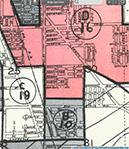
During the next decade a system of banking practices developed that created the matrix for discrimination against African Americans, like Norman Merrifield, who were trying to buy homes. See below for the 1937 map that was used to adjudicate loan applications for persons seeking to purchase property on the southside of Indianapolis. The area in C-19 along Shelby Avenue was viewed less risky than the area in D-16 which was colored red in the maps. The University Heights neighborhood (see B-10 in the gray or blue section) was more viable for loans. Significantly, in this case, the "red line" bordered the campus, which meant that families living in the Woodlawn Garden's neighborhood (north of Indiana Central College in 1937) were unable to secure loans through banks.
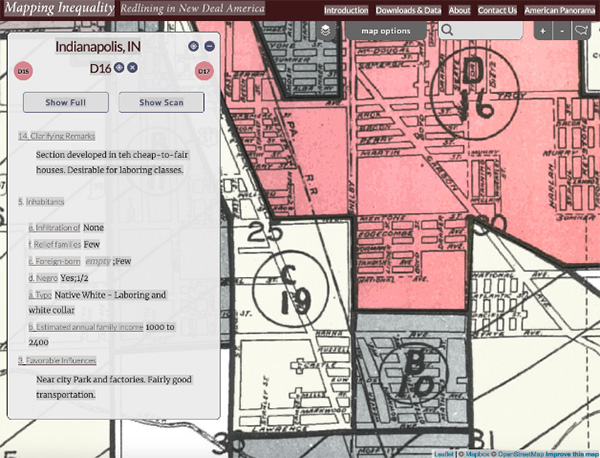
View interactive version of Mapping Inequality map
For details about the HOLC categorization and the associated discriminatory practices, see Richard Rothstein's study of The Color of Law: A Forgotten History of How Our Government Segregated America (W.W. Norton Company, 2017).
Exhibit J: Black Families and the Housing Shortage: The Woodlawn Gardens Sign
Over and over again over the decades, Black families confronted the absence of available housing, As Mr. Norman Merrifield’s oral history interview (see Exhibit H) made explicit, for some individuals this quest took decades. In his own case, he was not able to buy a home until 1949. The fact that there once was a neighborhood close to Indiana Central University that was the site of a real estate development that was advertised to be for Black Families was a striking discovery. Based on what I have been able to find out, this may very well have been as much of a surprise to FWW as to her colleague Sylva Henricks, although it is possible that there were others (such as Amy Robinson) who had previous knowledge.
The researcher from the Indiana History Center, Jeff Gunderson, appears to have turned up the sign in December 1979 in conjunction with his research about the historic black churches of the southside of Indianapolis. It was displayed alongside photographs of the locations of a half dozen congregations. Several were located in close proximity to Shelby Street between South Street and Sumner Avenue just north of the Indiana Central College campus. See enlarged section of lower right corner of the following map.
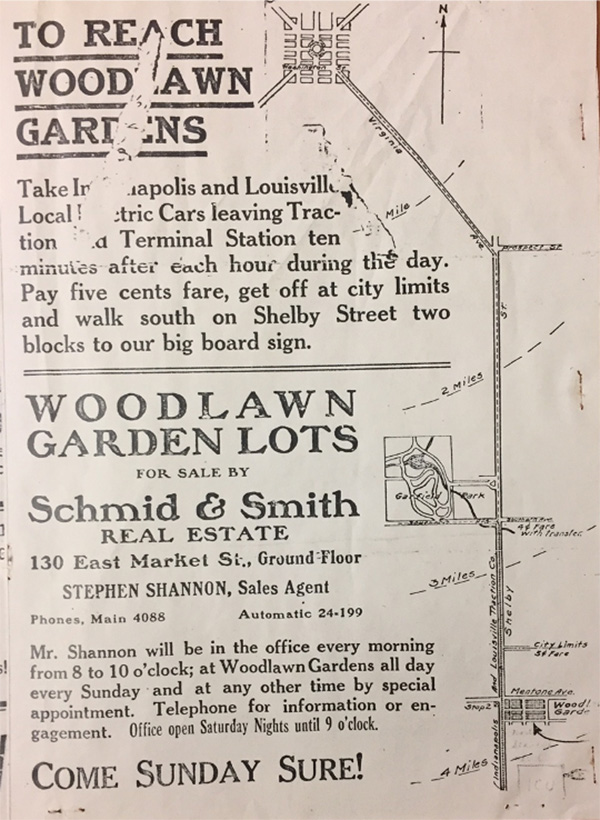
It appears that someone [FWW? Or perhaps Jeff Gunderson from Indiana Historical Society?) using a pencil drew a rectangular box with the letters I-C-U in the lower right corner of the advertisement to make it clear where this neighborhood was to be located in relation to the university. Just below the “4 mile” radius line from downtown Indianapolis.
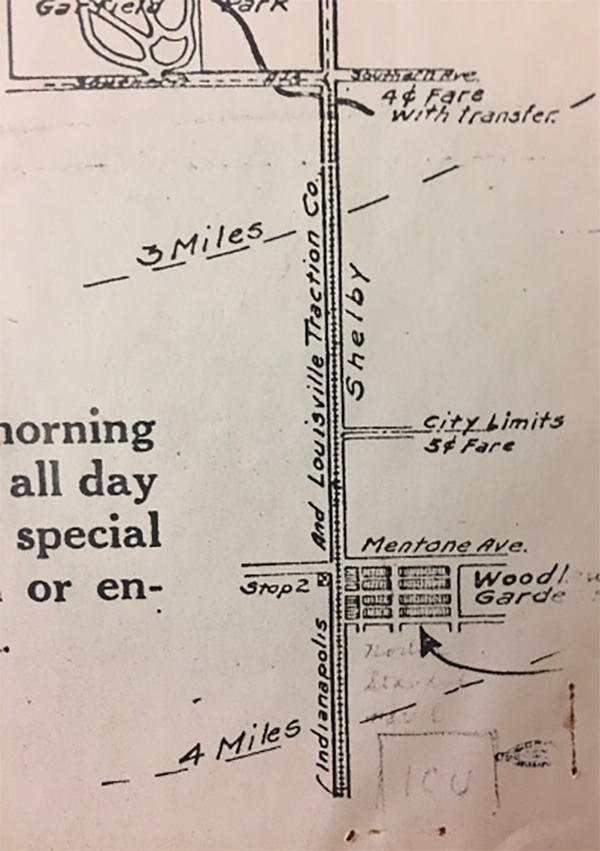
The plats for 128 lots from Shelby Street to Boyd Avenue the two streets on either side of Edgecombe Avenue. “Mentone” and “Norman” were the names listed on the real estate map of the neighborhood. Today, these two streets have different names: Sumner and Norton. In 2020, the neighborhood extends further east beyond Boyd to State Street and according to real estate listings, the neighborhood includes the property now located south to National Avenue. Obviously, the university now owns and/or controls much of this neighborhood, located just north of the campus. But in 1980, there would have been little overlap, and it is possible that there were very few families living in the neighborhood that had much interaction with the campus.
The advertisement is undated (one of very few undocumented items in the FWW collection).
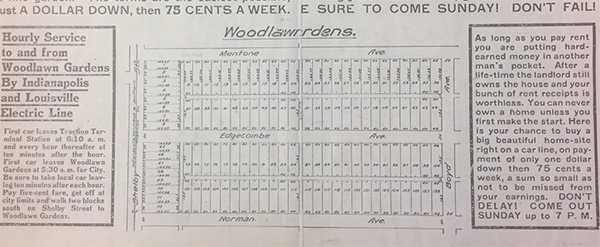
Woodlawn Gardens advertisement
“You Have Never Had Such An Offer Before! You will Never Have Such A Chance Again!
“The thrifty, home-loving Colored People of Indianapolis never before had an opportunity to buy high class, desirable building lots in a good location, in small weekly payments. We have bought and platted this beautiful tract on Shelby Street, right on the Indianapolis and Louisville Electric Line, and only two squares south of the city limits. The lots are 40 feet wide and 135 feet deep, and are high, level, and perfectly drained. The soil is good and will raise a fine garden. The terms are the easiest possible. Just A DOLLAR DOWN, then 75 CENTS A WEEK.”
“There are no extras of any kind. You can fence your lot and use it at once. The car fare is five cents and from the city limits. Magnificent Garfield Park is within walking distance and a Public School for your children is near. Here is a chance at last to stop being a renter, to get away from a closely built, crowded neighborhood, out where there is fresh air, sunshine and shade. An opportunity to get where you can raise a big part of your living by having your own chickens, garden, and cow. BE SURE TO COME SUNDAY! DON’T FAIL!”
A sidebar provided transportation information: “Hourly service to and from Woodlawn Gardens by Indianapolis and Louisville Electric Line.”
Was this an example of African-American entrepreneurism? Or was this a cruel attempt to exploit Black ... I have been unable to find information about the real estate company that was listed in the advertisement: Schmid and Smith. For the purposes of the “Invisible Sinew” exhibit, the sign represented the aspirations of Black Families. I suspect that people associated with Indiana Central University would have been as surprised as visitors to campus for this event about the fact that once upon a time there had been a neighborhood development project just a few blocks north of campus that had been designated for Negroes only.
FWW and her colleagues at IHS and ICU ultimately were not able to determine what became of the Woodlawn Gardens venture.
Exhibit K: Flanner House and Other Housing Developments in Indianapolis
Housing would have been but one of the discriminatory practices that Black families on the Southside of Indianapolis would have faced during the first half of the 20th century. As IUPUI demographer, Dr. Paul Mullins has reported, as of the 1940 Census, there were no Black home owners in the area just north of Indiana Central College. But Mrs. Wilson did provide a commentary about another way that the housing problem was addressed by leaders in the Black community in the city of Indianapolis before World War II.
“It was Cleo Blackburn, director of Flanner House, who introduced the concept of self-help housing so that wage-earning Blacks could afford new homes. The first group of Flanner House Homes was built in 19[__] in the heart of the Black community, west of North West Street and South of 16th Street. They still stand as mute testimony to the diligence of Blacks willing to train their labor for a ‘sweat equity’ down payment on a home. A second group of homes was built on the city’s northeast side, west of Douglass Park and north of 25th Street. In 1934-37, another major source of new housing was built facing Indiana Avenue near 10th Street. This was Indiana’s first public housing apartment project, Lockfield Gardens, which provided new apartments for 748 Black families.”
“Always aware of the limitations imposed upon them by the white community, Blacks soon perceived the need for utilizing organized methods of coping with their problems. Local chapters of the NAACP and later the Urban League were formed in the cities. These dedicated workers affiliated themselves with the national headquarters and with their guidance, did much to fight discriminatory practices which would impede progress of the Black community.”
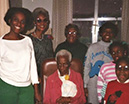
Exhibit L: FWW's Own Family Journey as part of The Great Migration
There is no evidence to indicate that FWW made her own family's experience the focus of the Invisible Sinew exhibit. However, there are ways that the story she was exploring fits with aspects of her own family's journey. She had traced her family’s genealogy to a rural community in Southwestern Georgia. She knew that her great-grandmother had survived slavery, and married following the Civil War. She and her husband were able to purchase property for a farm, and raised a family together.
Her parents were part of the Great Migration that brought James and Hattie Williams from the little community of Buena Vista in Southwestern Georgia to Indianapolis in the 1920s along with many other black families. Born on January 12, 1927 at 2070 Columbia Avenue, Flora and her family later rented a larger home on Martindale Avenue, and in 1948 the Williams family built a family home on Arsenal Avenue in Indianapolis, Indiana.
Florabelle Williams Wilson was named after her grandmother, Flora Etta Munford Hollis and her Aunt Carrie Bell Hollis (the older sister of Florabelle’s mother, Hattie Hollis Williams).
Family: (Father) James S. (Mother) Hattie Hollis Williams; (Sisters) Virginia Payne Clarke & Betty Ann Rhodes (mother of Crystal Rhodes). Since she was the last sister alive when her niece (Crystal V. Rhodes) and her nephew (Alexander Clarke, III) were grown with children of their own, FWW served as the family matriarch and surrogate grandparent to their children until her death in 2008.
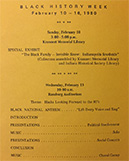
Exhibit M: ICU’s Black History Week – Opening Day Sunday Feb. 10, 1980
Although the event was originally advertised as Black History Week, the article indicates that the exhibit was on display through March 24, 1980 for Black History Month.” Henricks’ article included a photograph of Amy Robinson ’68 at the exhibit along with a note indicating that Mrs. Robinson had “brought photographs and a quilt top pieced by her grandmother.
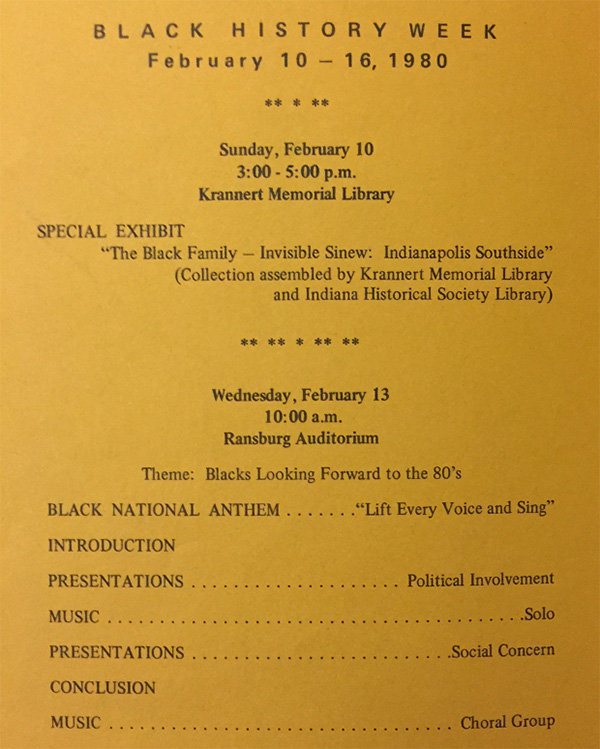
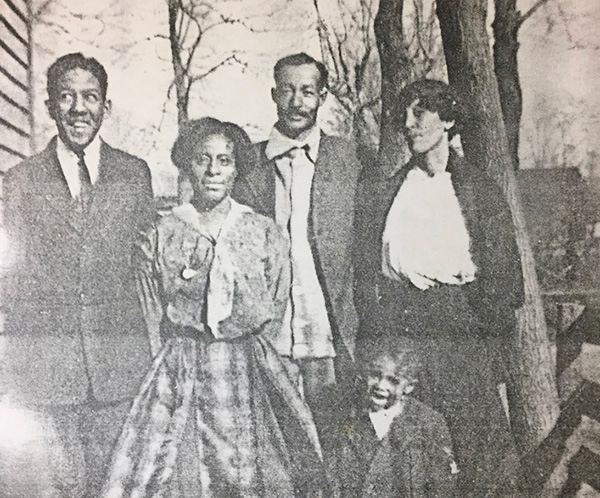
People from the community, some of which came to campus for the first time in their lives, attended the reception where they encountered photographs and excerpts from oral histories arranged around map that displayed where the families lived – and the institutions that helped to connect them in the midst of dislocations brought about by interstate construction (I-65) and red-lining discrimination and other disruptions to their lives – but most of the artifacts did not survive.
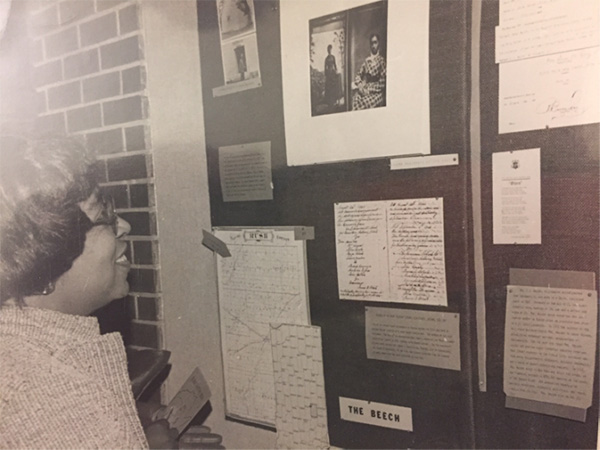
Photo of unidentified person at the Invisible Sinew Exhibit at Indiana Central Feb. 1980
Sylvia Henricks’s article in the ICU Alumni Magazine (Summer 1980) provides the only description of the exhibit:
“On display area featured the Hadley family. Born under slavery, Henry and Katie Hadley married in 1867, and in the 1890s came to southside Indianapolis to raise their 11 children. Mrs. Fannie Hadley Bartlette, a lively 92, is the only surviving child. She generously provided information and family photographs, and came to the opening of the exhibit on Sunday, Feb. 10, where she was interviewed by Derrik Thomas of Channel 6.”
“Another family featured was that of former southside William [sic] Merrifield, an accomplished musician and longtime music teacher at Attucks High School. Mr. Merrifield loaned photographs, copies of his published songs and articles, the manuscript of his symphony (performed Feb. 10., 1957 by the Lafayette Symphony Orchestra) and an autographed picture of W.C. Handy, his publisher.”
Regardless, we know that the Exhibit opened on February 10, 1980 as part of the Black History Month program for Convocation, etc. [see photographs] “The Black Family [on the Southside of Indianapolis]: The Invisible Sinew.” Photographs and memorabilia were displayed in Executive Wing of the KML [the area we have referred to as the Sease Wing since 1999], which at that time was still fairly new, having been completed in 1977.
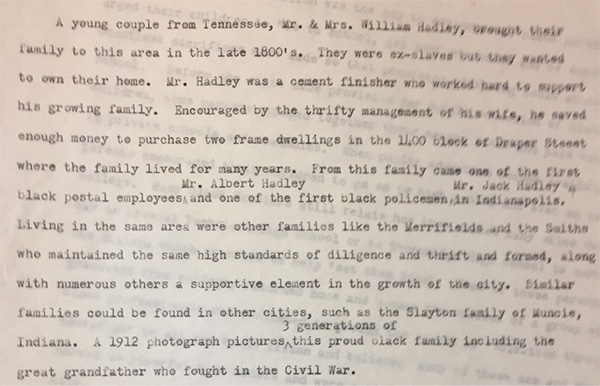
We have the notes that FWW used for her presentation at the opening of the exhibit on Feb. 10, 1980. She wisely chose to illustrate the transitions of Black Families who migrated to Marion County by telling the story of what transpired in the lives of one of the families.
“A young couple from Tennessee, Mr. and Mrs. William Hadley, brought their family to this area in the late 1800’s. They were ex-slaves but they wanted to own their home. Mr. Hadley was a cement finisher who worked hard to support his growing family. Encouraged by the thrifty management of this wife, he saved enough money to purchase two frame buildings in the 1400 Block of Draper Street where the family lived for many years. From this family came one of the first black postal employees, Mr. Albert Hadley and one of the first black policemen, Mr. Jack Hadley, in Indianapolis. Living in the same area were other families like the Merrifields and the Smiths who maintained the same high standards of diligence and thrift and formed, along with numerous others a supportive element in the growth of the city...”
Exhibit N: Indiana's Black Communities and Black Families
On the day the "Invisible Sinew" Black Family Exhibit opened, The Indianapolis Star newspaper did a feature article on the Black Families of Indiana, focusing on the families of the town of Lyles Station, one of the oldest black settlements in the state of Indiana.
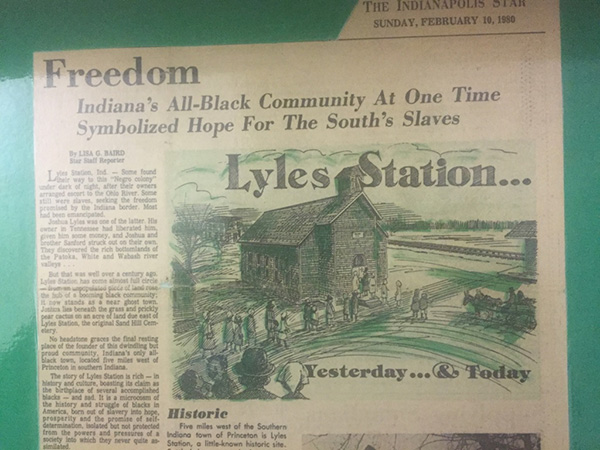
This press coverage was one of the early indications that the work FWW and her colleagues had done was timely for the wider effort of promoting Black History in the Hoosier state. See the following description of the family that FWW made the focus of her opening remarks during her presentation to open the exhibit.
“Convinced that education was the key to advancement, black parents urged their children to ‘Go to school, get your education and be somebody”. Countless sacrifices were made so that promising offspring could attend school. Before the state made provision for public education of Black children, some parents scraped together their meagre funds and paid tuition to private schools and academies. When public education became available, parents urged their children to go to high school and even on to college. Many Black Hoosiers still relate how they walked many miles each day to Arsenal Technical High School or to Shortridge High School to earn the diploma which promised to ‘set them free.’ Some of these persons graduated from college, returned home and became the nucleus of a group of Black professionals who continued to preach the gospel of ‘salvation through education’ to all who would listen and believe. Many of these men and women served as powerful role models and were a source of pride to the Black community.”
Several artifacts in the Black Families of the Southside exhibit demonstrated the personal depth of this concern.
FWW also discussed the role played by women in the Black community, both with respect to extended families and the institutions of the black community. This particular feature of her overview for the exhibit also reflected a recent emphasis. Her friend and fellow Indiana Central alumna Amy Robinson ’68 (see photo above), who had guided FWW’s search for Black Families on the Southside, also served on the Governor’s task force. Mrs. Robinson was an example of one of the first-generation college students who enrolled in college as non-traditional age students.
The fact that her photograph was placed alongside the title page of a book entitled The College of Life “Practical self-educator” served as a reminder that graduation from college was a hard-won achievement by those who chose to self-emancipate.
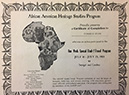
Exhibit P: FWW’s FINAL REPORT TO ICU & the Indiana Historical Society
We have the report that FWW wrote about the work that she and her colleague Sylvia Henricks did for Krannert Memorial Library during the 1979-80 academic year. They reported that six newspapers covered the event in addition to a news reporter from the Channel 6 television, who interviewed Mrs. Fannie Bartlett, a ninety-something matriarch who was identified as “the lone surviving member” of one of the Black Families of the Southside who settled in Marion County in the 19th century.
Participants in the project who had donated information and photographs or contributed oral histories and other memorabilia, were honored at a reception that was part of the opening.
“Interest generated in the black community brought many visitors to campus, some for the first time, to view the exhibit and to offer additional information about early settlers to the Southside. As the news spread, relatives of those persons who were featured in the exhibit visited the campus and brought others with them who could, in some instances, identify photographs or places not already known. Friends loaned books and photographs depicting the lives of blacks in the 1800’s, some of whom still live in Indianapolis area. Many leads to other family members who could serve as resource persons for continued study were called in, written in, or brought in by word of mouth. This confirmed my belief that there is a treasure of information which should be gathered while the descendants still live.”
As she wrapped up work on this short-term project, Florabelle Wilson imagined a long-term possibility for her and her colleagues:
“This information could serve as the nucleus of a Black History Collection which would be unique in that it will be based on actual interviews and personal contact with participants. At this point in time, I hold a pivotal position in that I know many of the persons and have established, I believe, a position of trust with them from which I may be able to develop a meaningful relationship in terms of gathering information which will preserve black history for posterity. Each encounter leads to another so that I realize that this must be viewed as a long-range project, beginning with the gathering of the interviews, transcribing and publishing, and making the information available to interested scholars at the Indiana Historical Society Library and faculty and students at Indiana Central University Library.”
FWW never uses the word “archive” in this report, but in effect that is what she is describing, a collection of oral histories and related materials that would be preserved in the context of an ongoing effort to collect, display and disseminate what would be learned through the ongoing collaboration with Indiana Historical Society.
As planned, Indiana Historical Society arranged for the exhibit to be displayed in various locations around the state of Indiana. I have found no indications that FWW’s interest in a longer-term project at ICU met with the kind of interest that would leverage action. I can imagine that some people on campus might have read the report and wondered if her estimate of the value of the materials that could be harvested was overstated or simply mistaken. It is also possible that her ideas were dismissed for other reasons, including racial prejudice.
Be that as it may, I am not sure what to make of the fact that in this report FWW never identified her faculty colleagues at ICU as potential collaborators. Perhaps she did not find them to be receptive to her initiatives. Perhaps she did not see possibilities for collaboration. Or perhaps she was all too aware of the many ways that the faculty already were overextended – many of them (like Professor Frederick Hill) teaching overloads. The following year, Frederick Hill and Roland Nelson led the search process that led to the hiring of both Charlie Guthrie and David Anderson. Guthrie’s area of specialization was in Africana history, and he was hired to bring more of an internationalist perspective.
The report that she put together in 1980 in the wake of the successful exhibit displays both her sense of satisfaction in the work she had accomplished working in collaboration with the staff of the Indiana Historical Society Library and her growing conviction that this was a long-term effort that should be carried forward as an ongoing project.
I do not have access to records that indicate if FWW pushed for the creation of such a collection at Indiana Central University. In retrospect, we can draw inferences about the short-lived nature of this project based on subsequent events. The Indiana Historical Society staff-person who worked with FWW on this project took a position in California in 1981 where he has spent the rest of his career. For much of the past 40 years, Jeff Gunderson has directed projects focusing on African-American heritage, his interests have been specific to California artists, etc. Sylvia Henricks retired a few years before FWW. In sum: no one other than FWW continued to carry this forward.
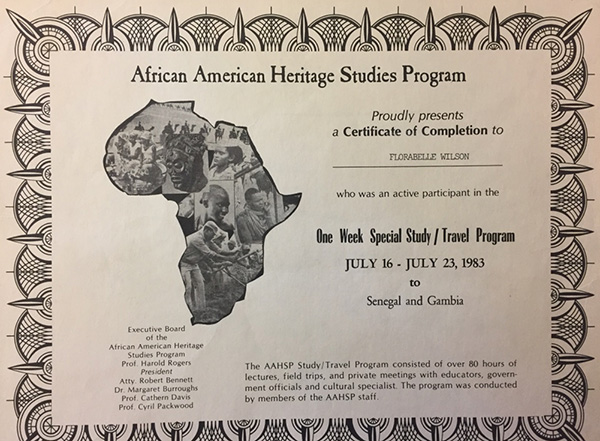
Participation in the July 16-23, 1983 African American Heritage Study/Travel Program to Senegal and Gambia
What we also know is that FWW continued to participante in activities of IHS long after she retired from our university.
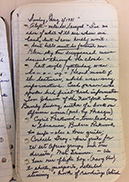
She scribbled notes in her journal about the trip, expressing excitement in the hours before landing in Senegal where she would visit Goree Island and “the point of no return” where enslaved Africans entered the ships for the “middle passage.”
She kept a powerful reflection written by Howard Thurman, “On Viewing the Coast of Africa,” (1921), which was later collected in his book For the Inward Journey (Friends United Press, Richmond, Indiana)
“From my cabin window I look out on the full moon, and the ghosts of my forefathers rise and fall with the undulating waves. Across these same waters how many years ago they came! What were the inchoate mutterings locked tight within the circle of their hearts? In the deep, heavy darkness of the foul-smelling hold of the ship, where they could not see the sky, nor hear the night noises, nor feel the warm compassion of the tribe, they held their breath against the agony.
“How does the human spirit accommodate itself to desolation?...There were no gods to hear, no magic spells of witch doctor to summon; even one's companion in chains muttered his quivering misery in a tongue unknown and a sound unfamiliar.
“O my Fathers, what was it like to be stripped of all supports of life save the beating of the heart and the ebb and flow of fetid air in the lungs? In a strange moment, when you suddenly caught your breath, did some intimation from the future give your spirits a hint of promise? In the darkness did you hear the silent feet of your children beating a melody of freedom to words you would never know, in a land where your bones would be warmed again in the depths of the cold earth in which you would sleep unknown, unrealized, and alone.” (Rev. Howard Thurman’s prayer)
Many other African-Americans have been inspired by Howard Thurman’s eloquent effort to retrospectively locate the hope of emancipation in the tortured souls of those who enduring the Middle Passage. In FWW’s case, these words inspired her imaginative efforts to engage children so that they could catch the tune of the “melody of freedom” associated with the Juneteenth promise of emancipation.
This Far By Faith: Black Hoosier Heritage is a 24-page book edited by Emma Lou Thornbrough (produced by the Indiana Committee for the Humanities, 1982). FWW prepared one of the sections of the original booklet, The following paragraph from the section dealing with the Black Urban Community maps closely with the typed text of the materials she wrote for the purpose of introducing the “Invisible Sinew” project exhibit at Indiana Central University (Feb. 10-16, 1980).
“Within the African American community, institutions developed which are counterparts of those in the white community but distinct from them. Underlying all Black community institutions is the Black family, which has survived seemingly overwhelming obstacles in slavery and freedom and has been a source of strength and pride. Families relied on the church for stability, and families in turn strengthened the churches. Often, members of the family belonged to the same congregation for generations. Parents, often at great sacrifice to themselves, encouraged children to go to school and secure an education which they believed would “set them free.”
She also served on the advisory board for the Indiana Historical Bureau’s project on “’Bury Me in a Free Land’: The Abolitionist Movement in Indiana: Feb. 7-August 9, 1986,” which resulted in a booklet that was published in 1986 and reissued in 1993 by the Indiana Historical Bureau.
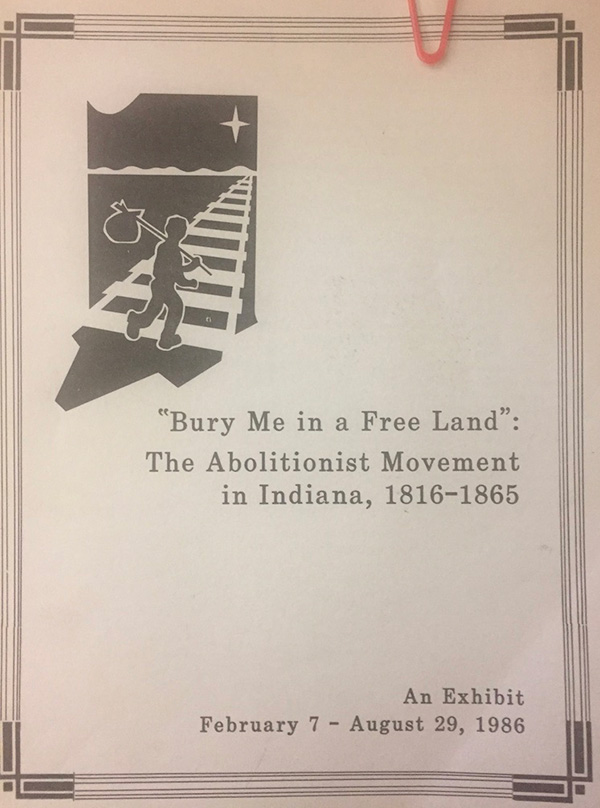
In this latter case it is not clear to me how much she contributed to the exhibits beyond what had already been gathered. On the other hand, she probably drew on those materials for the presentations she made in various settings over the next two decades.
In more informal ways, she continued to correspond with people like Norman Merrifield. A letter from Mr. Merrifield (Aug. 11, 1985) testified to his appreciation for FWW’s “inspiration and study” of the Merrifield family history. He wrote: “It not only inspired me to write the volume I shared with you but has since traveled and unbelievable circuit of some 150 relatives located in various parts of the U.S. That stimuli are a portion of the Merrifield family history which we believe our children shall cherish.”
On another occasion (Sept. 24, 1983), he mentioned mutual friends Mary Busch '62 and Rozelle Boyd, who had briefly attended Indiana Central College in the early 1950s. Merrifield recalled that after the choir that he led performed at Indiana Central College, Rozelle had “entered Indiana Central on music scholarships after our choir sang there long (long) time ago. . . “ This is an interesting memory that may connect with the 1941 Crispus Attucks choral performance at ICC (see Exhibit N).
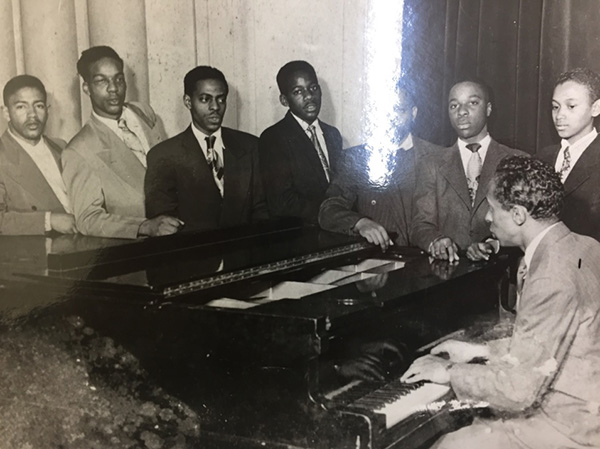
Undated Photograph of Mr. Norman Merrifield and Students from Crispus Attucks School
On the other hand, the brothers Boyd were actually younger than Florabelle Williams Wilson and would have attended ICC in the early 1950s. I have the impression that choral groups began performing at ICC in the 1940s, so it could have happened at several points. What is most striking however, is that this is another instance in which someone from outside the community helped FWW and her colleagues to discover something about the intersections of Black History and Indiana Central.
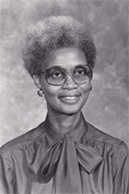
Exhibit S: FWW as Subject of Indiana Libraries Oral History Interview (1986)
The Oral History Interview FWW gave in 1986 displays a person of mature self-confidence. Her life had come full circle. Photos of her during her Indiana Central years (see below) display a more self-confident presentation. Like many students then and now, she struggled with the tension between parental desires that she take a course of study that would enable her to get a job and her own aspirations, which were notably bookish. Indeed, she described her undergraduate studies as “an effort to combine books, I guess, with children.”
Actually library work was my first love, but it was more practical economically to become a teacher. One of the things my mother seemed to want more than anything else was for me to become a teacher...And I could understand that, because in the Black community at that time when I was growing up and prior to that time, one of few jobs that women could aspire to was that of being a teacher. A teacher was looked up to as a role model and as a leader, and I think in my mother's eyes that was the kind of position she wanted for me. So as a result, I completed my work in education at Indiana Central. I opted for teaching and did for some time in the elementary schools. But I was teacher for my mother for some time. Then I decided it was time to be a librarian for me.
This reflection, which is excerpted from the 1986 interview by Susan A. Stussy for the Indiana Libraries Journal, illustrates the perspective of the mature FWW looking back at her younger self. I strongly encourage faculty and staff to read the whole article about Florabelle Wilson. I think you will be impressed by her candor about such topics as problems she encountered during library career because of her race during a season of her life when she was the only black person on the staff of the library and one of only a handful of black faculty and staff at Indiana Central University.
The interview describes how she made a special effort to have a multiracial staff.
“One summer we had Africans, Afro-Americans, Chinese, Taiwanese, and a fellow from India [as well as White students]. Finally that job became kind of a mission, because I was the only contact most of those students were going to have with a Black person in authority. Some of them had come from areas where they had not encountered Black people except on television or in a magazine. It was obvious in their reaction, in their response to your questions, in the way they looked at you, in the way they were surprised that if you cut yourself, you bled. I guess that's just true of Americans. I think that you could find that on any campus anywhere if you met enough people. But here I was kind of on the bubble. I represented a whole race of people, and sometimes I had to remind people who came to ask me questions about Black people that I could only speak for myself. I couldn't speak for how many million Black people in this country...”
The interviewer also asked FWW to comment on any “special interests as a Black woman” that informed her work as a librarian. Her response displays her strong sense of purpose as an educator who saw the library as a “treasure of the world’s wisdom”.
“One particular one was in terms of being sure that included in the library holdings were books by and about Black people that gave a true picture. We made an effort, not only using Title II funds, but using book funds from the Indiana Central Library book budget to build up a good collection. The thing that validates my opinion is that in using the OCLC system and calling for books by different authors and by different titles, ours would be one of the libraries that usually would have the book. Another area, too, of special interest to me was Black books for Black children written by Black authors. [I developed] a list of Black books for Black children. This was one of Indiana Central's efforts to be of service. Our motto was, "Education for Service." Another thing that I am proud of in my association with Indiana Central is the development of an annual Black History Program to which national figures are invited. Gwendolyn Brooks, the Pulitzer Prize-winning poet, was our speaker one year. . . . Another [year] Mayor Richard Hatcher came...”
FWW’s pride in her alma mater as well as in her work as librarian are grounded in a twofold sense of missional purpose. The first part aspect was the commitment to give “a true picture” of Black people, which she saw as part of the university’s service to the comm unity. The second was “the development of the Black History Program,” as she put it, which she registered as important for the students of the university. In this instance, she specifically mentioned the impact on black students, but in other contexts, she affirms the role of the head librarian as educator for the university as a whole.
Looking Back at FWW's Student Years
As FWW’s 1976 article in the Indiana Central Alumni Magazine illustrates, she was the kind of reflective person for whom memoir and biographical storytelling was congenial. I understand that for much of her adult life, FWW had the habit of writing entries in a journal that she kept. With the exception of the notes she kept in a Sierra Club calendar for the Invisible Sinew oral history project, I have not had access to those materials.
Very little survives of her perspectives prior to enrolling at Indiana Central College. When I looked at the Crispus Attucks high school yearbook photo from her senior year (January 1944), I found the visage and words of a self-conscious adolescent. Her earnest contribution to the January 1944 "class will" was all too aware of the social expectations of the majority culture.
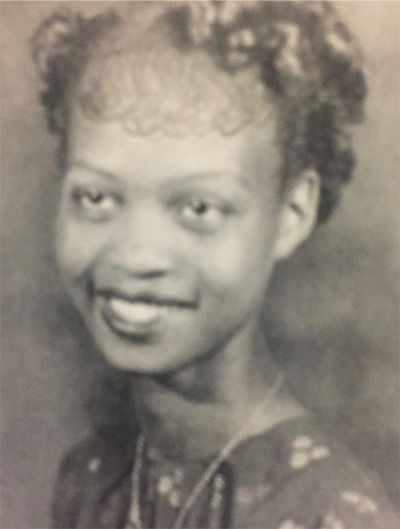
“I will to all Crispus Attucks students the ability to take advantage of all opportunities, so that they may take their place in the post-war world and be recognized by all as good American citizens.” Just a few years before, the editors of the Indiana Central College yearbook, 1942 Oracle, included the following statement: "...those little fellows from Crispus Attucks sure could sing...the Negro race certainly is earning a place in our country..."
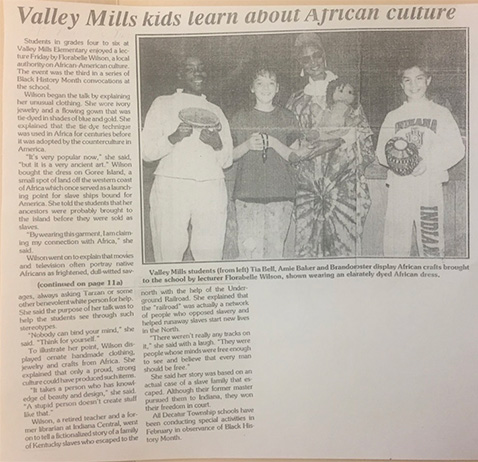
Exhibit T: Making Space for Black History in Retirement – FWW’s Stories for Children
FWW also served as a volunteer during Black History Month to go into elementary schools to tell stories (see the 2-28-?? article from the Mooresville newspaper) about her visit to the Valley Mills School. Scripts of her presentations and her “Brown Bag Kids” hand puppets can be found in the Indiana Historical Society collection of her memorabilia.
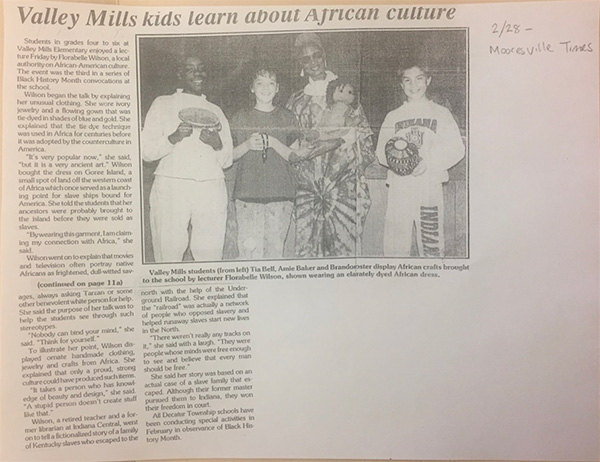
During Black History month, she made presentations to the children at Valley Mills Elementary School in Mooresville, IN. The reporter for the local newspaper described her this way: “She wore ivory jewelry and a flowing gown that was tie-dyed in shades of blue and gold.” Purchased at Goree Island, she told the students that she wore it as a way of celebrating African heritage. “By wearing this garment, I am claiming my connection with Africa.”
She made it clear to the class that her purpose of her talk was to help the students to be able to see through stereotypes.“Nobody can bind your mind. Think for yourself.”On other occasions, she would begin her stories about slavery, abolitionism and the underground railroad by gathering up what the children knew and then she would announce: “Now, let’s tell the whole story!”
On another occasion, FWW accompanied Gwen Crenshaw to Brownsburg for a presentation about Abolitionism. Crenshaw received a note of appreciation which she forwarded on to Florabelle.Sue Clarke, English Teacher, Brownsburg Jr. High, wrote:“Please tell the storyteller that despite the puppet show being intended for younger children, her message of freeing minds was very effective.”
No doubt FWW gathered material from various sources. The line about “freeing one’s mind” closely parallels the language used by Marcus Garvey and made even more famous in Bob Marley’sRedemption Song: “No one else can free your mind from mental slavery...”
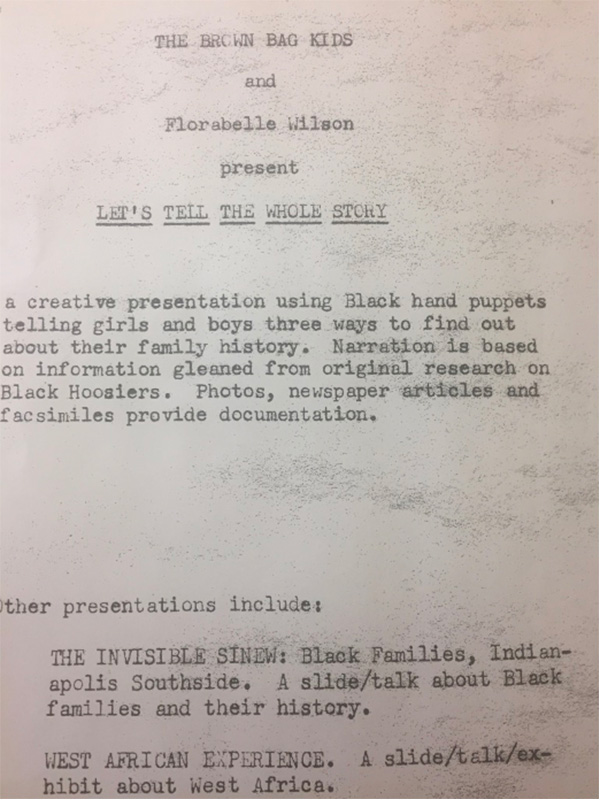
Exhibit U: Unfinished Research: Black Families on the Southside of Indianapolis
From the beginning, FWW tried to locate the addresses of as many Black Families living on the Southside as possible, but she faced obstacles due to dislocations of families due to various factors associated with "red-lining" and other forms of racial prejudice. In her interactions with the first person she interviewed, Norman Merrifield identified a problem that would come up at other points in FWW’s efforts to gather research. Namely, discriminatory practices in lending money to people of color for purposes of buying homes.
Merrifield recalls, “when I got out of the army in 1946, it took me three years to find and buy a reasonably decent home and it was in 1949 that I moved into our present home...The reason: just plain old unadulterated red lining by every major financial institution and racial prejudice of the rankest sort.” Merrifield erny into detail some of the ways this disrupted his life and his relationships with people on the southside of Indianapolis whom he considered to be friends. He reports that even though he had always considered himself a Christian, “There is a bitterness still present I have yet to be able to eliminate...in moving, I lost some contact with the southeast side of town.”
She penned a note after she learned about Jeff Gunderson’s discovery – a 1921 vintage sign advertising “Woodlawn Gardens.” Thomas Rumer indicated that he would be checking on property records in that matter. I found nothing else about the matter in the records. The sign is the only copy of that advertisement. I have found a few advertisements in The Indianapolis Recorder and The Indianapolis Star from that same year, but nothing thereafter. This venture disappeared.
What do you do with spaces that were at one point “set aside” for Black Families to live that turn out to be immediately north of the campus?
For Florabelle Williams Wilson and her colleagues at the Indiana Historical Society, some of the most nagging unanswered queries pertain to the Woodlawn Gardens neighborhood. Schmid and Smith Real Estate Company advertised the property available for sale to Negroes in Marion County.
As of 1940, there were no African Americans living in that neighborhood. It is unclear how many people of color may have attempted to buy land through this effort which appears to have disappeared in the mid 1920s perhaps in response to shifting laws of segregation. If you drive along the 1300 and 1400 blocks of Norton Street, you can see houses that might have been an example of the kind of aspirational dwelling that Black Families hoping to own their own home might have imagined living in 1921. Meanwhile just a few blocks away (Northeast of Woodlawn Gardens), there is an apartment complex where many African American children live. No doubt there are families living in Laurelwood Apartments who dream of owning their own home, but for most that aspect of "the American dream" continues to be deferred.
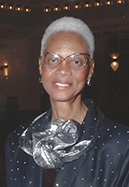
Exhibit V: Making Space for Black History in Retirement – FWW’s HOH Presentation
In her retirement years(1986-2008), Mrs. Florabelle W. Wilson pursued a rich variety of creative projects, participating in community theatre, practicing calligraphy, writing poetry, volunteering in public schools, etc. Making Space for Black History remained high on the list of her volunteer activities. She continued to do slide presentations about “The Black Families [on the Southside] of Indianapolis,” still using the metaphorical title “The Invisible Sinew” as a way of helping her audience to learn to see beyond the stereotypes.
During this later period, when she made slide presentations about the topic, she poked fun at herself for the ways in which she went overboard with her enthusiasm, as if she had developed symptoms of a strange malady she dubbed “Hooked on History”(or HOH). ‘The diagnosis is firm. I have an incurable case of Hooked on History. Try not to catch it, unless you want to embark on one of the most exciting phases of your life.”
In her slide shows and more informal presentations, she conveyed her fascination to learn about links between small towns like Lyles Station and prominent African-American citizens in Indianapolis. She wasn’t afraid to name her own ignorance as a person who had lived all of her life on the Northside of Indianapolis (as an adult she lived at 5344 N. Kenwood Avenue). “Although I had worked on the South side of Indianapolis for more than 20 years, I knew very little more than a few black families who” lived South’...” She summarized what she learned this way:“Strong familial relationships, pride in achievement and determination to succeed marked the families.”
Over and over again, she said: “We were continually amazed by the contradictions of accepted cultural myths, especially the one about the transition of neighborhoods – In every instance we learned about peaceful co-existence of black and white families living side by side, sharing life as friends and neighbors. We learned of stable families, structured in the traditional patriarchal patterns – exhibiting strong moral values, firm discipline, and religious convictions. A pattern of honest hardworking families evolved with the emphasis placed on living a decent life and encouraging the children to ‘get ahead’ and make something of themselves.”
This is as close as she comes to naming the reasons why she undertook the Black Families on the Southside of Indianapolis project. In the face of the cultural myth that black families were dysfunctional, she stressed the stability of traditional family patterns. Over against the prevailing prejudice against interracial neighborhoods, FWW told the story of the viability of such “peaceful coexistence.” And contrary to the view that the struggles of black families were pathological, she maintained the possibilities of social uplift via opportunities for education at all levels.
Earlier generations would have used a different language than FWW did. For example, W.E.B. DuBois talked about the role played by “the Talented Tenth,” who were called upon to “lift up the race” of black folks.FWW’s approach was to testify to the success of Black Families in the community of Indianapolis while poking fun at herself as someone who late in life became “Hooked on History.” She celebrated those around her, and she relished opportunities to participate in “telling the whole story” about the Black Families on the Southside of Indianapolis that in other contexts were presented in less favorable ways.
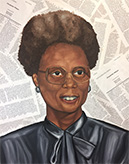
Exhibit W: Florabelle Williams Wilson: Collegial Icon for the University of Indianapolis
I believe Florabelle Williams Wilson was an icon of what it means for an institution like the University of Indianapolis to aspire to tell the whole story in both the individual and collective senses.There are not many people who can be that transparent or that hope-filled.
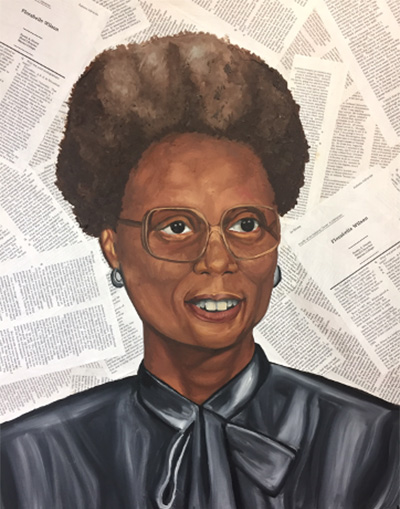
Aubrey Doyle’s portrait (2022) of Florabelle Williams Wilson
I suspect that FWW's enthusiasm for life-long learning made it possible for her to lose her self-consciousness in the course of exploring what it was possible to learn in any setting in which she found herself. That does not mean, I hasten to add, that she never struggled with the outcomes. I suspect she may have been disappointed when nothing came of her proposal to continue the Black History project as an ongoing program. She would have needed to have someone on campus to champion her cause, and that did not happen in a timely way, if it ever happened at all.
Like many other people who have worked at UIndy across the years, she was not able to achieve all that she dreamed of doing. Still, she persisted. She did "good work" from day to day, and in many ways anticipated by almost forty years the kinds of "diversity, equity, and inclusion" objectives that are now part of the university's practices and policies for university employees. From all that I have been able to gather, she was a wonderful colleague.
In my mind’s eye, I imagine her engaging people – of all races – from day to day with good humor and patience, inviting them to tell one another what they knew about Black History as well as other topics. From what I gather, FWW was animated by a hopeful disposition that was funded by a deep faith in God and a loving regard for people near and far. We need colleagues like that at the University of Indianapolis. I can name a few people with whom I have worked across the years who made that kind of contribution to my life, and I trust that other faculty and staff could add names of people who they found to be encouraging.
It occurs to me, however, that in the year 2022 those of us who live and work at the University of Indianapolis need a collegial icon, someone like FWW whose life and work can serve to illumine what it looks like to exercise institutional stewardship. I find the work FWW did during the season that the served as Director of Krannert Memorial Library to be inspiring because she engaged the opportunities she had and she made the university better in the process of doing so. I am fully aware of the fact that she was honored by the university in several ways. I also believe that the university will benefit from remembering her life in an ongoing way. All of which is another ways of saying that Florabelle is the kind of wise soul who helps us to remember what it means to be Wisdom's Children. We gather to hear the stories and as we do so we start to become a university, a community of storytellers who attempt to tell the whole truth of the matter.
I remain intrigued by the fact that what I have come to think of as FWW’s signature phrase – “Let’s tell the whole story...” appears to echo a few lines from the script for Deep Are the Roots, the 1945 play that was performed at ICC by her and a group of nine other students (see MM #74). Perhaps the emphasis on “the whole truth” in the play was unconscious. I don’t think we have to know either way to be able to appreciate the power of FWW’s moral witness. This woman, who obeyed parental wishes for her to get the kind of education that would ensure that she would be able to make a living in a world defined by Jim Crow segregation – but who also never stopped learning – believed that it was possible to exercise the agency of self-emancipation by telling the truth and for the sake of telling the truth. As such, FWW is iconic – in several senses. She exercised the kind of institutional stewardship that was exemplary in her time and place. She exhibited the confidence that her leadership on behalf of the university would be accepted.
I know that I am not alone in recognizing the remarkable life of FWW as iconic. There are other faculty and staff who concur that by embracing FWW's challenge – Let's tell the the whole story! – we come a bit closer to recognizing what the university is about at its best. I am so pleased that the effort to reincorporate the memory of FWW has resulted in several remarkable results. This past spring, the students in Jim Viewegh’s Portrait Painting class in UIndy’s Dept. of Art & Design on the challenge of painting FWW’s portrait. I understand that several of the paintings are still in the process of being completed, but on May 12, 2022, we exhibited a pair of portraits at the Open House for the UIndy Saga in the 21st Century.
Aubrey Doyle’s portrait, which exhibits FWW with the "Afro" hairdo that she wore during the latter part of her life, captures some of this iconic status. Copies of the first page of the FWW’s 1986 oral history form the background of the portrait – a fitting reminder that we all have stories to tell.
Sources
Persons who would like to read an overview of the history of African Americans in the city of Indianapolis are encouraged to read one of the following two texts. Although it is now a bit dated, Emma Lou Thornbrough's essay on "African-Americans" in The Encyclopedia of Indianapolis edited by David Bodenhamer and Robert Barrows (Indiana University Press, 1994), pp. 5-14, remains helpful. For a recent study of the Black community in Indianapolis, ,see David Leander Williams, African Americans in Indianapolis (Indiana University Press, 2022).
There are two primary locations of materials associated with the life and work of Florabelle Williams Wilson.
Some files are located at the University of Indianapolis where she was employed from 1957 to 1985. The greater part of her papers and memorabilia she collected related to her Black History projects are found in the following two collections.
The position of Archivist at the University of Indianapolis has been vacant since March 2020. For the past two years, Lucy Fields has helped folks like me gain access to materials in the Frederick D. Hill Archives. In this case, her interest in the project has gone beyond basic helpfulness to display her own sense of ownership and professional pride in the University's library.
The Williams Library at the Indiana Historical Society has two separate collections of memorabilia. Some of the materials associated with the "Invisible Sinew" exhibit about Black Families on the Southside of Indianapolis originally belonged to the University of Indianapolis so I have taken the liberty of regarding these materials as a shared legacy while also respecting the strictures of the Williams Library facility. I strongly encourage people who are interested in learning more about FWW to go to the Williams Library where they will find the staff to be both efficient and helpful.
- Florabelle Williams Wilson Collection, 1910-1995; Bulk 1980s #M0731
- Florabelle Wilson Collection Addition 1920-2008 M1133 OM0571 CT 2309-2317
- Sociological analysis of patterns of segregation have become increasingly sophisticated. See for example the resources assembled for study of specific communities.
- For detailed explanation about the Home Owners Loan Corporation categorization and the associated discriminatory practices, see Richard Rothstein's study of The Color of Law: A Forgotten History of How Our Government Segregated America (W.W. Norton Company, 2017).
- Paul Mullins at IUPUI knows more about the city of Indianapolis than anyone, I believe. Moreover, his anthropological insights as practitioner of historical archaeology are always thought-provoking. His website is an invaluable resource.
Acknowledgments
First, I am very grateful to Ms. Crystal Rhodes, the niece of Florabelle Williams Wilson for providing information to clarify the family lineage and relationships of the Williams family.
I am also very grateful to Garrison Carr and his colleagues in the Marketing and Communications Office for their assistance in assembling the digital exhibit that I dubbed the "FWW Retrospective." Special thanks to Kaye McClendon for her meticulous attention to detail in assembling the digital exhibit and to Corie Farnsley for connecting those pieces of the puzzle with the Mission Matters essay that I wrote about "The Witness of Florabelle Williams Wilson" in making space for Black History at our university in the 1980s.
I am grateful to Colleen Wynn for calling my attention to Richard Rothstein's book and guiding me to the Richmond website with examples from the HOLC administration.
Many of the photographs used in this set of exhibits were taken by me as part of my research. I regret that they are not more professional in quality, but I am reconciled to the fact that I must function within the limits of my own ability and the provisions of time and resources available to me in my current position as a member of the President's Cabinet.
I am also grateful to those who displayed interest in response to earlier presentations that I have made to audiences at UIndy over the past two years. This was initially suggested by an alumna who participated in the Hounds Chat in October 2020. I regret that it took me as much time to put this together as it did, but I am grateful that the UIndy Saga in the 21st Century provided the rationale for me to take the time to do this in the summer of 2022 as a featured example of oral history collection and analysis.