Master of Science in Human Biology

Discover your path.

With a Master of Science in Human Biology from UIndy, you can enter with broad interests in human variation and discover the specialization that is right for you. The UIndy program is one of only a few of its kind in the United States, combining elements of forensic science and biological anthropology to prepare you to work in forensic laboratories, death investigation, anatomy instruction or biomedical research and allowing you to hone your skills in the classroom and out in the field.

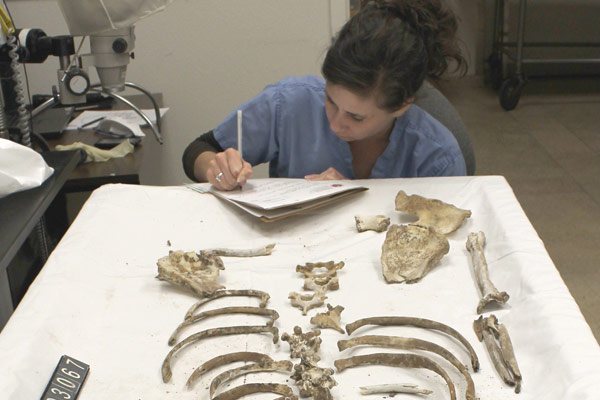
As a part of our program, you will receive training to assist in fieldwork and laboratory analyses through our Human Identification Center, conduct hands-on research and obtain valuable teaching experience. With this solid foundation, you can transition directly into the workforce or move on to doctoral work in anthropology or anatomy.

Advantages

  • Individualized attention, extracurricular instruction outside of the classroom, and hands-on learning
  • Opportunity to work in any of the following specialized labs: Human Identification Center (Processing Lab, Osteology Lab, and Forensic DNA Lab), Human Gross Anatomy Lab, and Anatomy & Physiology Learning Center
  • Professional training opportunities
  • Conduct independent research and present at scientific conferences
  • colleges of distinction 2025-2026
  • Ranked as a national university by u.s. news and world report
  • 10 mins to downtown Indy for internship opportunities

Nationally Renowned Forensic Lab

Up to six highly qualified students are accepted each year, receive specialized training, and work alongside professors on current forensic cases while completing their degree. The learning garnered through these opportunities enables you to enter the field of forensic science with a wealth of experience that is unparalleled by any other program.

Learn more about UIndy lab facilities

Traveling and Research Application

You'll find great ways to apply your course materials and research methods through independent graduate research projects. From exploring gorilla burials in Rwanda to creating population-specific equations in Chile to investigating human variation in US populations, previous students have explored the world, enriching their educational experiences.

Preparing for Your Future

While spending invaluable time in the forensic lab, teaching and assisting in the classroom, and gaining research presentation and publication experience, you’re also preparing to either enter the workforce or a PhD program upon graduation. The skills and practice our students develop in this master's program at UIndy have helped them get accepted into top-notch PhD programs and hired into competitive job positions across the country.

Caitlin headshot
Caitlin
Forensic Anthropologist, Pima County Office of the Medical Examiner

The human biology program provided me with the skills to not only become a better physical anthropologist, but also a better scientist. The program is unique in its approach to forensic anthropology in that it teaches the fundamentals of human biology and variation and also exposes students to actual field and laboratory casework. The program prepared me for the PhD program in anthropology at Michigan State University as well as becoming a Board-certified Forensic Anthropologist.

Beyond Borders

Twice a year, Professor Krista Latham and UIndy graduate students travel  to the Texas borderlands, to work with other organizations on a large-scale migrant identification initiative. They have conducted exhumations of undocumented migrants who died after crossing the U.S. border and have participated in search and recovery operations.

About the Beyond Borders Humanitarian Forensic Science Team

The short documentary-style film below, created by one of the teams, offers an unflinching but thoughtful firsthand look into the project's intent and its impact on the students, the local community, and the broader issues of the ongoing border crisis.

About the MS in Human Biology Program

The Master of Science in Human Biology is a full-time in-person program, with classes traditionally held during the day. We take a mentoring approach to education, with lots of individualized attention, informal instruction outside of the classroom, and interactive learning. Most students in a cohort rotate as a group through the same classes, which are generally small seminars with ample opportunity for discussion or hands-on lab activities.

Program Length

A minimum of 36 credit hours must be completed. The typical student is in residence for three years (six semesters), although some finish in two years (four semesters). The amount of time that will be required for you to finish the program depends on your future career or educational goals, including the type of research you engage in, the amount of teaching you plan to do, and your involvement with skeletal casework.

Cores

You will need to demonstrate proficiency, either through graduate coursework or other experiences, in each of three core areas within human biology:

  1. Anatomy and Physiology
  2. Human Variation
  3. Evolutionary Science

Areas of Specialization

You will explore these areas of specialization:

  • Anatomy and physiology
  • Human evolution
  • Human variation and adaptation
  • Forensic anthropology
  • Forensic DNA
  • Forensic field recovery techniques
  • Skeletal biology/human osteology
  • Taphonomy and trauma analysis

When Can I Start?

Students typically start in the Fall (August). The deadline for completed applications is January 15. While we do not automatically deny requests for January admission, we discourage such requests because one of our core courses, Gross Anatomy, begins in the Fall each year.

MS in Human Biology Admission Requirements

Applicants must submit their online application by January 15 to be eligible for the upcoming academic year starting in August. Late applications may still be considered, but those submitted prior to the deadline will have priority. The master's program accepts up to 6 highly qualified students each year. 

All materials must be uploaded via the online application management system. You may start the application process any time to begin entering your personal information and finish uploading application materials and submit on a later date. If a student is not admitted with their first application, they may re-apply to the program the following year.

Prospective students are strongly encouraged to contact the graduate program director, Dr. Amandine Eriksen (eriksena@uindy.edu) to schedule a personal interview or department visit (in-person or virtual) in the Fall (October through early December).

To apply, the following materials should be submitted:

  • Online graduate application
  • $30 application fee
  • Personal statement that outlines reasons for applying to the program, long-term career goals, research interests, and any experience relevant to your goals.
  • Resume or curriculum vitae (CV) that lists prior experience (e.g., work, volunteer, research), special training (e.g., field schools, certifications), publications, and presentations (see below for examples or prior experience)
  • Three (3) letters of recommendation. At least two must be from an academic source.
  • Official transcripts showing all undergraduate and graduate coursework
  • Official Graduate Record Examination (GRE) scores, submitted by the testing agencies (Note: the GRE is not required if your undergraduate GPA is above a 3.2)
  • TOEFL or IELTS scores (international students only)

Admission requirements set the precedent for the competitive nature of the program. To be strongly considered for admission, applicants must meet the following requirements:

  • A bachelor's degree in anthropology, biology, or a closely related field from a regionally accredited college or university in the United States, or the equivalent of a bachelor's degree for students applying from outside the United States. 
  • Several undergraduate or graduate courses taken in natural sciences and anthropology with grades above a C; Ideally, these should include biological anthropology, anatomy (human or vertebrate), chemistry, physiology, statistics, and physics. (Note: in order to take certain graduate courses, students must have completed prior college-level coursework – for example, to take a genetics course, at least one semester of chemistry is required)
  • A cumulative undergraduate GPA of 3.0 (on a 4.0 grade scale)
  • Official results from the GRE are optional for applicants that possess a cumulative undergraduate GPA of 3.2 or higher. For those submitting scores, a minimum combined score of 300 (Verbal & Quantitative Reasoning) and a Writing score of 4.0 or higher is preferred. 
  • Official scores from the GRE are required for all international applicants. The TOEFL or IELTS cannot substitute for the GRE.
  • International students for whom English is not their first language, and/or who did not attend an English-speaking university must provide one of the following as proof of English proficiency: 
    • TOEFL: a minimum score of 79
    • IELTS: a minimum score of 6.5 
  • Provide a course-by-course credential evaluation to show that you have completed the U.S. equivalent of a bachelor's degree. To view a list of agencies that offer this service, see the international student admissions page.
  • Provide certification of finances (for students who are applying for a visa), showing that you have adequate funds to support yourself during your time of study.
  • Copy of passport identity page (student applying for F-1 Student Visas only)

We are looking for highly-motivated students who have already had a hand in some aspect of skeletal analysis, archaeological fieldwork, or scientific laboratory work. The experience can be paid or volunteer, for credit or not-for-credit, for short durations or for extensive periods of time. Please be detailed in your application materials about any prior experience you have had. Specific examples that will make your application competitive include:

  • Being a teaching assistant for a science or anthropology course
  • Taking an archaeological, paleontological or geological field school class
  • Assisting with forensic or archaeological human remains casework
  • Volunteering in a professor's lab and assisting in scholarly research projects
  • Taking courses or training workshops in forensics
  • Completing an internship at a laboratory, museum, or other scientific facility
  • Taking advanced independent study courses in which you have conducted in-depth research
  • Attending or giving papers at student conferences of professional scientific meetings
  • Publishing articles in student or scholarly journals, or other significant writing experiences
  • Completing an undergraduate honors degree and finishing an honors project or thesis

Tuition & Aid

Stay Informed About This Program

Share your information and we'll be in touch soon with more details about how UIndy can help you meet your goals.

Loading...