Dr. Stanley Warren
Exhibits
The following are excerpts from the April 2022 University of Indianapolis (UIndy) Saga oral-history interview with Dr. Stanley Warren '59. The interview with Dr. Michael G. Cartwright covered his life and work, as well as the years that he studied at Indiana Central College in the late 1950s.
Stanley Warren’s story of how he came to enroll at Indiana Central College, ca. 1955-56
Initially, I contacted Dr. Stanley Warren because I realized that I did not know enough about the experiences of students like him and Florabelle Williams Wilson — students who graduated from Crispus Attucks High School in the 1940s and 1950s, enrolled at Indiana Central College and ultimately went on to have their own careers in higher education — to be able to tell their stories well. I had been trying follow the storyline that I had learned from UIndy predecessors Paul Washington-Lacey and Mark Weigand.
What I discovered during my conversations with Dr. Warren was that the patterns to which Washington-Lacey and Weigand had gestured existed at some points in the 1980s and 1990s (and to some extent in the 1970s) — but Florabelle Wilson (1970s) and Stanley Warren (1950s) had different experiences.
No doubt, this was something that Paul Washington-Lacey had understood, but because he had talked about “the pipeline” of students coming to Indiana Central College as if it primarily had to do with Coach Ray Crowe (whose career as a high school basketball coach was in the 1950s, the same time period when Stanley Warren was at ICC), I had overgeneralized and made an incorrect presumption. What I quickly learned was that students in that period were not so much recruited to become students at ICC as they found their own way to the ICC campus by word of mouth. Indeed, I was shocked to discover that a person as adept and intellectually gifted as Dr. Warren was not encouraged to go to college until well after he had graduated from high school.
We began the recorded portion of my conversation with Dr. Warren by talking about his educational background as a graduate of Crispus Attucks High School, for whom military service and work at RCA (an Indianapolis television-assembly factory, where he assembled 130 television sets per day), preceded enrollment at Indiana Central College. Warren’s story is fascinating. Given his distinguished career in higher education, many people would think that he would have been encouraged to go to college during his high school years, but that was not the case.
Let me say that again, using Stanley Warren’s own words: “At no time, did anyone encourage me to go to college.”
No one encouraged him to go to college until the mid-1950s, and when it did happen, it was the result of a casual conversation with a friend while riding a bus.
The way Dr. Warren tells his story:
There is a sequence of about nine years. … I finished high school in ’51, was drafted in ’53 [during the Korean War], and I got out of the service in 1955. Before I enrolled at Indiana Central, I was working at RCA. That was the job that I hated so-ooo much! At that time, I was just being a young man about town. Once I started working, of course, I couldn't just quit. If you were working and living with your parents, you were contributing to the household. And I wanted to quit the job at RCA, which I just couldn't do because of my commitment to my family.
I was on the bus one day, coming from work, and another person named Henry Taylor [ICC ‘59] was on that bus. And Henry and I had been in the service together. We were drafted on the same day. And he was telling me about Indiana Central and how he was attending college and had been there probably for a year, and how he was going thanks to the GI Bill. And I was inquiring, “Well, what is the GI Bill? What's … it all about?” And he told me about the GI Bill, how much money you got each month. And I was calculating, okay, I can still give some money to my parents with that. …So I decided I would quit. … This is mid-year, I quit the job. I came up [to Indiana Central]. I think Bob Jewel was one that kind of showed me where the place was, how to get here and so on. And I came here, mid-year, January, enrolled and he sort of shepherded me along, during the first couple of weeks, showing me how to do papers that were required. And then I was off. It's kind of like putting your sailboat in the water and pushing it off, you know, and I was off on my own.
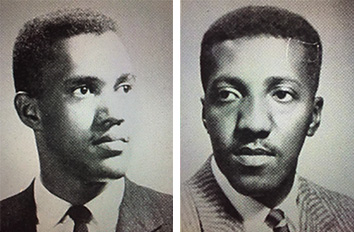
Henry Taylor (left) and Stanley Warren as they appeared in the 1959 edition of The Oracle yearbook
Dr. Warren’s story of his student experience at Indiana Central College, 1955 to 1959
This part of the conversation began with the question: Do you remember your first impressions of Indiana Central? In this case, we were talking about the period after 1955. Stanley Warren’s first words were, “It was so far out of my experience.” He continued:
You know, I lived in a neighborhood where there was, the only White person that you saw generally was like an insurance salesman. And the guy who delivered the milk from the milk company. Other than that, it was a Black community, and everybody that you saw was Black. And so getting out in this world was very different, even though I had been in [the military] service at the time [drafted during the Korean War].
But he elaborated on that in several different ways. He stated that there was only one building other than the residence halls and gymnasium on the Indiana Central College campus.
Of course, all the classes were in that one building and everything that we did — have lunch and so on — was in that building. ... But I enjoyed meeting some of the other students. And … since none of us [Black students] lived on campus, even the students didn't get to know each other that well, because we didn't see each other. You know, I could spend the day taking maybe three or four or five classes. And occasionally you'd bump into another student. Rarely did I have another Black student in the same class. So [I] just didn't get to know them very well. … So when I came here, there were lots of things that I had not experienced. I caught on to some of the things pretty quickly and sort of sailed through. It wasn't that bad, and I was getting money every month [from the GI Bill], contributing to my family. And I remember that I stayed here daily, long enough that I could do most of the work that I had from class, and when I left school, I was free. Didn't do much work on the weekends. I really didn’t work as diligently as a could have.
Another one of the questions that we typically ask people during oral-history conversations is: Did you have particular experiences during your Indiana Central years that stand out to you as either positive or negative?
Stanley Warren addressed this at several points during his visit. Early on in our conversation (before we began recording), Dr. Warren recalled that there was a faculty member at Indiana Central College in the 1950s who had a particular reputation for acting as if Black students were not capable of doing work beyond the average level. The faculty member in question also had a reputation on campus of one who would “give out Cs” to students. Some Black students took the path of least resistance, figuring they would get at best a C, regardless of the amount of work they did. “Don’t put in much effort. Take the C and move on,” Stanley Warren’s peers said. However, young Stanley Warren was confident in his ability and felt that he could perform at the above-average and excellent levels. So, he took the course in question, the one taught by that notorious professor. At the end of the semester, he received a C in the course, even though his performance indicated that he deserved an above-average grade. Stanley was very frustrated; his experience simply added to the rumored racial prejudice of the instructor. At the time, Black students at ICC did not feel that they had recourse to get their grades changed, and they found it difficult to assemble evidence that would demonstrate the discrepancy, given the limited documentation and feedback they received from instructors.
At another point, Dr. Warren talked about his experience in a business course that he took. Thanks to the audio recording, readers can access the story verbatim, but here’s a snippet:
Earlier, I told you about the grade that I received in our [typing] class. I received a B in a class where I should have gotten an A, quite clearly to me. And the year after that, the next year, [the teacher] called me to her office and apologized for the grade that I received, because she knew that I should have gotten [an A]. And we became very good friends after that, and remained so for the rest of my time here. In fact, she's the only faculty member that gave me a gift at graduation. And so I was quite pleased with that and kept in touch a bit after graduation. And her husband was quite kind to me as well.
At another point in the conversation, Dr. Warren added another detail: “You know, they never did change that grade in the typing class.”
The pronoun, in this instance, refers to administrators at the institution of Indiana Central College, the institution from which Stanley Warren graduated in 1959 and subsequently received Distinguished Alumnus recognition.
In other words, even in a circumstance in which a faculty member had acknowledged a mistake and offered a personal apology, a Black student in 1957-1958 could not expect that admission to translate into a change in the institution’s system. Somehow it seems to be all the more ironic that the context of the story in question has to do with a class in which attention to literal accuracy – the number of words typed correctly, without strikeovers, in a 60-second period of time – the standard of accountability to which students are held. In this instance, I understand why it is hard for Stanley Warren to accept that the administrators and faculty could not find a way to correct the letter placed in the box of the grade report in the typing class.
And yet, there is great prudence in the ancient scribal principle of not compounding mistakes by presuming to make corrections where doubts surround obscure circumstances. As a former Academic Dean at Depauw University in Greencastle, Ind., Dr. Warren knows well the importance of maintaining the integrity of records. That may be one of the reasons why, even now, he has never asked anyone at his alma mater to correct the error. I don’t know what policies and rules were in place in the late 1950s, but it is quite possible that the deadline had passed well before the instructor in the typing class accepted her responsibility for the mistake. (Associate Provost Dr. Mary Beth Bagg tells me that under our University’s current policies, a grade cannot be changed after three weeks.)
This is one of those instances, I am inclined to say, that serves as a reminder of systemic effects. We cannot act as if the shadows of the past can be erased by adhering to procedure. We have to hope that in the midst of following our procedures — with firmness and consistency — we can avoid perpetuating the prejudices of Jim Crow discrimination in the present and future.Stanley Warren’s story of his experience as a teacher in Indianapolis Public Schools: 1960-1971
MICHAEL G. CARTWRIGHT (MGC): Was it different when you went back to Crispus Attucks High School as a teacher? Did you have a different perspective on Attucks?
STANLEY: Yeah, you know, I sort of was in love with the place. I still am. But we had a bunch of young teachers there [in the 1960s], and they were all full of fire and brimstone. And they were hell-bent on making this a better place and giving these students opportunities, and so on. And because we were all involved in this effort to desegregate, we just started there. Most people don't realize it started back in the ‘50s.
And once the first desegregation order came about, the school board began trying to find ways to get around integrating the schools that was there. Our guess was that that was a topic of all the meetings, trying to find a way [to avoid integration]. And they did many things in an underhanded way. One of the most heinous, of course, was that they allowed other schools to come in to take the top faculty members. So they took the young faculty, myself included ... I was sent to Howe High school. I had many ... run-ins with the principal — because I wear a mustache. All Howe teachers were [supposed to be] clean shaven, and so on. I left after a year. ... As I mentioned to you before — Joseph Taylor — as my mentor, he brought me to IUPUI as a counselor. And that sort of put me on the road to higher education. So [I started] working on getting a master's degree and working on my way to getting a doctorate degree.
MGC: I think you described your colleagues as “kind of a fiery lot.” So you felt like you and they had a sense of what you were doing?
STANLEY: Yes, yes. Both, from the young teachers. And this was kind of a crossover from that whole group [of older teachers] that had come from the colleges in the south, and then we have these young teachers who were replacing them as they died, and retired, so on. And so I met a lot of the old-timers. I wish that we had sat down and talked about their early experiences, which we did not. They didn't talk about it. And we didn't have a good sense to question them. Because they knew all of the great civil rights leaders. They knew Booker T. Washington and so on. We missed an opportunity there.
MGC: Would you talk more about when you left Crispus Attucks to go to Howe High School, as part of the transfer of Black teachers to the predominately White high schools?
STANLEY: Well, I/we protested. We had a letter going around for people to sign this protest letter that we didn't want to leave, and so on, and sent it to the board. (And I've been in the board minutes doing research. I've never found that letter. So they probably just tore it up. … Nobody believes me when I tell them about that letter, but it did exist. And that was back then, of course, where you use typewriters and carbon paper. … So you didn't have a good record [of the document you typed].
MGC: At what point did the trajectory start to take shape in your mind in terms of what your career would be?
STANLEY: I think probably when I started teaching it out, I think I became inspired. I thought that I could really do some of the — I thought I could really help students. You know, I thought that was my life's work. I mean, I would have been [at Crispus Attucks] forever, had I not been transferred [to teach at Howe High School]. Yeah. Oh, yeah. And it was just a wonderful experience.
MGC: So you when you were getting your Ed.D [degree from IU] and so on, did you think of yourself as specializing, in any sense, with the work that you started doing about African-American institutions and Black history in Indiana? Is that something that you developed as a side interest? Or as part of your graduate studies? Or is that the right [way to] even ask the question?
STANLEY: Well, I'm just starting to think about that. I developed an interest in African-American history when I was teaching high school. I started an Afro-American — or call it a “Black History” — Club after school that I think created an interest in several students who went on to work a little bit in that field. But it sparked a great interest in me, because the students were really engaged, particularly Wilma. [Wilma Gibbs Moore would later serve as the longtime archivist for the Indiana Historical Society’s collection of Black History.] And so that I carried that with me.
So whatever I was teaching, Black history was really the thing that I was focusing on. I took that to DePauw. And I started a program there, as well. In fact, they hired me, as the Director of Black Studies. That was my first title there. … I loved teaching Black studies, because it was amazing how many White students are interested enrolling in this Black studies course.
MGC: Now, does that map back to your experience as a student at Crispus Attucks? Students took a course on Black history, correct?
STANLEY: Joseph C. Carroll — one of the five faculty members who did have a PhD; he earned his doctorate from Ohio State — he created the course on Black history in the 1930s as an integral part of the high school curriculum, and he taught it for decades. I was the next person in line to teach a course on Black history at the high school level.
This is one of the places where Warren’s matter-of-fact style of speaking and writing leaves much unsaid. To say that Stanley Warren is “the next person in line to teach a course on Black history” at Crispus Attucks High school simply does not do justice to the significance of his contributions across the decades. (In retrospect, I should have asked some follow-up questions that did not occur to me at the time.)
If you take the time to read one of Stanley Warren’s books about the major institutions of the Black community of Indianapolis, you can begin to see the ways in which the work that he embarked upon in the 1960s at Crispus Attucks grew over the decades into a set of definitive guides that have made it possible for the citizens of Indianapolis (like you and me) to grasp why it is that you cannot understand the history of Indianapolis in a truthful way without engaging the story of what transpired at Crispus Attucks High School and Senate Avenue YMCA.
Stanley Warren tells the story of the remarkable rise and decline of Senate Avenue YMCA
At the turn of the 20th century, the rise of the Young Men’s Christian Association (YMCA) was a very successful movement that drew many American youth and adults into fellowship activities defined by Christian ethos. It was also racially segregated in the city of Indianapolis. The problem of the color line defined the civic ethos, the neighborhood, etc.
Stanley-Warren alludes to W.E.B. DuBois’ famous words about the “double-consciousness” that African Americans experience: “One ever feels his twoness—an American, a Negro: two souls, two thoughts, two unreconciled strivings: two warring ideals in one dark body.” [page 5]
Warren offers a brief observation: “He might have added a third dimension: An African-American Christian. There is no facet of being Black in the United States that has not been a part of this struggle.” [page 5]
The fact that one of the most widespread pan-denominational – albeit largely Protestant – groups of Christians would have a fellowship defined by racial bias underlies Warren’s point. In a 1914 editorial in The Crisis, the leadership of the National Association for the Advancement of Colored People (NAACP) criticized the YMCA for “not acting in a Christian manner toward colored folk.” The same writer decried “the injustice which has made [the colored YMCA movement] an unfortunate necessity.” [page 4]
As Stanley Warren describes the matter, the prospects for Black community in Indianapolis were so bleak that it was hard to imagine how something good could be brought forth, but “a group of young Black professionals” began working together to build an infrastructure that would “alleviate the problems so prevalent in local Black families.” [24] By 1902, the Colored YMCA had been formed and was recognized by the State YMCA. Thanks to the opportunity to obtain up to $25,000 from the Rosenwald Fund, the two teams – one White and once Black – were able to raise the $75,000 necessary to erect the new YMCA building for Black men and boys.
The dedication festivities in 1913 featured none other than Booker T. Washington, who proclaimed: “This building should mean less crime, less drink, less association with bad characters, and should make its users more industrious, more ambitious, more economical.” [page 40]
As Stanley Warren explains:
The building included many amenities not found in other YMCA structures. Included were:
Basement – boys locker and shower room, senior and businessmen’s locker room, shower room, swimming pool, barber shop, barber school, and industrial training rooms, boiler and storage rooms. First floor – office, reading, billiards, checkers, staff, gymnasium and auditorium, dining, kitchen, refrigerator and pantry rooms. Second floor – six class and eleven dormitory rooms, baths, and running track. Third floor – fifty dormitory rooms. The cost of the building was $105,000.
The new conveniences were designed to appeal to a wide variety of patrons: businessmen, wayfarers, homeless men, and the general membership. Much was made of the fact that the dormitory rooms, which would sleep 130 men, were steam heated. Most of the sensation was caused by the Thermo-Vapor Bath with an attendant and masseur service available. Only a few visionaries recognized that the Senate Avenue YMCA was standing on the edge of greatness, ready to become a steadying influence on the community that surrounded it. Drawing children and men from all classes, the new Senate Avenue YMCA was finally able to realize the dreams of its founders.
By 1915, the recruitment effort had yielded 586 men and 250 boys [page 39]. And a decade later, 702 new members were recruited. At its height, Senate Avenue YMCA was the hub of a vital community, the gathering place for the Monster Meetings that brought in major speakers from around the country, including the leadership of the NAACP. Phyllis Wheatley YWCA and Flanner House worked with Senate Avenue YMCA “to serve the physical, social and spiritual needs of black residents” for almost four decades, before the interlocking set of programs and institutions no longer functioned well.
The story of the decline of the Senate Avenue YMCA is a complicated tale that has much to do with societal changes that brought an end to most forms of de jure segregation. As membership at Senate Avenue YMCA declined, the newly integrated institutions that were formerly all White took priority when it came to building new buildings. Personality conflicts and political disagreements added to the mix.
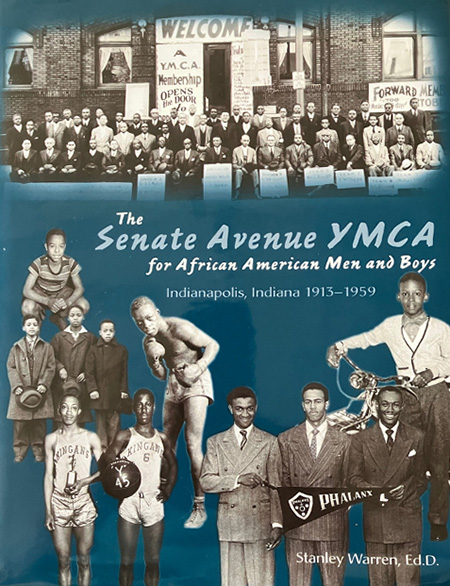
I learned a lot that I did not know from reading Dr. Warren’s book , The Senate Avenue YMCA for African American Men and Boys: Indianapolis, Indiana 1913-1959. It was not the first time that I had heard about this institution, but I knew very little beyond the fact that, in the early 1930s, a young history teacher at Indiana Central College (ICC), Donald Carmony, had crossed the color line to join Senate Avenue YMCA, shortly after he graduated from ICC. I now know enough about the institution to be able to ask more informed questions about the effects of segregation, and to be alert to the prospect that there were moments of engagement between ICC and the Senate Street “Y,” even during the worst of Jim Crow-era discrimination against Black people.
As a living witness, Stanley can draw upon aspects of his own experience as someone who was born in 1932 and for whom the first quarter of a century of his life was defined by segregation’s limits — the social fences that sharply circumscribed his experience as a youth and young man — so much so that he was unaware that higher education was a viable possibility.
But he is also an historian. He knows that if he is going to tell the story of The Senate Avenue YMCA for African-American Men and Boys, then he has to begin with the post-Civil War Reconstruction and its aftermath in Indiana. At the turn of the 20th century, he states in his book:
…the atmosphere in the state was not conducive to black citizens experiencing the full range of possibilities available. Not only were such inalienable rights as voting, owning property, moving about freely, and engaging in entrepreneurial enterprises in jeopardy, but the basic rudiments of living needed for spiritual development were retarded because of the harshness of everyday life. [page 23]
I cannot do justice to this remarkable book in this context. I came away from our conversation on April 28, 2022, even more painfully aware of the long shadow cast by the 19th-century patterns of Hoosier “Negrophobia” that were constitutive features of the landscape of the state of Indiana in virtually all areas of life, including education. As I re-read sections of this volume about the segregation of the YMCA in Indianapolis, my attention became more sharply focused.
This list of concerns overlaps with the concerns of the founders of Indiana Central University, but J.T. Roberts and his successors were not immune to the pressures of the Jim Crow era. Indeed, President Bonebrake appears to have given in to White supremacists at a key point. Only through the timely interventions of business manager Irby J. Good in January 1914 was the fledgling university saved from signing onto a proposal from a land developer to add a “no negroes” clause to the expanded version of a neighborhood covenant for an enlarged community of University Heights. But we cannot act as if the shadow of racism never touched the community of Indiana Central College. It most certainly did. We cannot change the facts any more than we can erase the evidence that the wrong grade was assigned to Stanley Warren in the 1950s.
What I can do is look for ways to reincorporate what we are learning about the interactions between segregated institutions such as “the colored YMCA” located on Senate Avenue and Indiana Central College in University Heights into the stories we tell in the present. I wish that I had taken the time to interview Don Carmony ’29, when he was still alive, about what he learned during the seasons of his life when he joined the YMCA and participated in the Monster Meetings that brought distinguished guest speakers to the city of Indianapolis. From SW’s book, I learned that there was a pattern of collaboration between the Senate Avenue YMCA that enriched Indiana Central College. Some of the speakers at the Monster Meetings also spoke at ICC during their visits to Indianapolis. One of my own heroes, the great mystic Howard Thurman, came to Indiana Central to speak after having spoken at Senate Avenue YMCA. I have never seen that information from any source before I read about it in Warren’s book. Indeed, it appears that it is not in the archives of the University. We only know that this was the case because of SW’s work in telling the story of what was made possible by Senate Avenue’s leadership from 1917 to 1959.
Stanley Warren continues to tell the story of Crispus Attucks: 1927-1986
Since retiring after a distinguished career as a teacher and administrator at Crispus Attucks, IUPUI, and DePauw University, Stanley Warren has written three books, all of which share a common purpose: to tell the story of the experience of the Black community of Indianapolis during the era of segregation. Telling the story of what transpired under the regime of “Jim Crow” involves the tricky problem of explaining the “before and after” aspects of integration. Before and after Brown v. Board of Education (1954). Before and after the integration of public schools in IPS (1971 and beyond).
At the end of our conversation, I asked Dr. Warren to comment about the work he has done over the past three decades. Since he retired from DePauw University in 1993, he has published three books, chapters in several anthologies and many articles about historically Black institutions and historical figures associated with the city of Indianapolis.
MICHAEL CARTWRIGHT (MGC): I'm curious about what the experience of writing about these topics was like for you. … In an earlier part of our conversation, you talked about your sense of ownership as a kind of guardian of this memory. And when I hear the word “guardian,” I think, well … there are threats. … So, would you mind commenting about being a guardian?
STANLEY: Right. Yeah, you know, I, I’ve thought about this, I talked with a Gilbert Taylor [ICC Class of ’58] about it. He was the head of the Crispus Attucks Museum. And we talked about it several times, and the idea started that we would try to get various people to write segments [of the history of the high school]. And that never worked out. Of course, writing by committee just doesn't seem to work. And so, I just took it on myself. I said, “Well, this is something that needs to be done. Because 10 years from now, all this will be gone. Nobody will remember.” So I decided I would just approach it like I was doing something as a college student, maybe writing an essay or something like that. And it began to expand. And I realized that it was going to be a valuable document as I moved on. … So I proceeded to work on it over a period of probably a year and a half, to pull it together.
MGC: So this was a post-retirement project for you. Was it in the mid-1990s that you started?
STANLEY: Yes. The [Crispus Attucks High School] book was published in 1998. Right, yeah, I probably started writing in 1995-96. … I'd written lots of stuff [before]. … But this book has followed me it's like I'm wagging its tail or its tail is a way you meet yourself because it’s everywhere I go. Somebody has mentioned this book, like it's the only thing I ever wrote. It's the talisman, but I'm really proud of that book.
MGC: So you, you've written the books, and you've consulted with people who are writing the books. And are there other ways you're involved in being a guardian of the memory these days?
STANLEY: Yes. I'm a member of the group of ex-athletes that give five scholarships each year. So we're working on keeping the neighborhood school in the forefront. I think Crispus Attucks is pretty much recognized as one of the national treasures, … [but] we’re [also] at another crossroads. … The school now is fully integrated [as a magnet school]. Lots of White, Hispanic students, but these students don't participate. The whites don't participate much in any after-school activities. ... Very few. They come to school, do the academic thing and they leave. And so they're going to have to find a way to get around that, … like the basketball team, which has done very well over the last few years. I can only remember one White student. … He was on the reserve basketball team a couple of years ago. … I think he transferred or something. But then they had a White student on the basketball team. They might have had one or two on the football team, which [has] not done well at all. So they've got to get over that hurdle of thinking of it as a Black school. ... I don't know what the percentages are. But I'd venture to say it's probably almost half-and-half, really good. A lot of White students there. Maybe not half-and-half, but they've got enough.
MGC: Sounds like you help people process the changing memory of Crispus Attucks.
STANLEY: [chuckles] “Well, it’s not working very well [at this point]. But this athletic group, I think they've done a good job. So the scholarship program is being well received. We've got students who are now in college. The scholarships aren't big enough to pay for college, but these are all good students, so they have other scholarships as well. One student went straight to Harvard. And they've had a couple of other students who have done very well.
MICHAEL CARTWRIGHT (MGC): I have one last question for you. It is a question we are asking everyone who does an oral history interview for the UIndy Saga in the 21st Century Project. … What are the factors that you think have led you to be a lifelong learner? The way you have described things, you weren't a lifelong learner in high school. And you weren't even sure you were going to go to college, and then your friend [Henry Taylor] told you about the GI Bill, which led to you to Indiana Central, where you graduated, etc. So how have you become a lifelong learner?”
STANLEY: Well, I've been asked that question before. And I've never answered it very well, because I really don't know. One of the things that happened when I was in service,
there was a fellow in there whose name was Greenfield. He was Jewish. And he encouraged me. He'd been to college, and he had traveled extensively. He had a lot of his pictures from places in Rome, various places, he was showing us. He says, “You know, you're a pretty smart guy, you should go to college.” ... And so that was kind of in the back of my mind, A seed was planted, but it hadn't sprouted at all. And I think that bumped up against these later experiences I had where I wanted to quit this job [working for RCA after leaving the military]. And I wanted to find something else to do. I think all that kind of came together.
I still wouldn't have considered myself a lifelong learner, because I was just busy having a good time as a young man around town ... [Later,] I got a grant as an anthropology student. That's why I went to Bloomington. I was majoring in anthropology. I was going to get a PhD in anthropology before moving to education, but that was going to take so long. ... And so, I switched over to education. ... A little later, I got offered a job at DePauw. And the offer was, if you finish your degree, come here, as the director Black Studies. We will start you at $15,000. ... I did the math ... and so I switched over, finished the degree before I went to DePauw and got the higher salary. So that was how limited I was in my thinking. I just couldn't project that and say, you know, anthropology is what I really loved and want to stick with it. I was thinking about the money.
MGC: I wonder if there isn’t another aspect to your story as a lifelong learner ... We know there's something of a tradition of the self-taught person that exists broadly in American culture, but [I understand] there are also versions of that story specific to the African-American community. ... So whatever the curriculum is that someone faces, they still have to develop their own habits of learning.
STANLEY: You know, I think about when I was a kid, teenager, some of the things that I did, and went through, people who know me now, as a guy, what I've been doing over the last 30 years, so you wouldn't believe some of the things that I did. I'm not [exaggerating], I literally stayed in the pool hall when I was in school here at University of Indianapolis. You know, that's what I brought with me, was what I had been introduced to [in] the pool hall — the life of the pool hall. I came here to go to school on the GI Bill, but I kept that life. That was my evenings and weekends. I didn't have any parental controls or being in at a certain time, as long as I just stayed out of jail, stayed out of trouble.
So I lived in these two different worlds for a long time. And I saw some things, but I learned a lot in a pool hall, you know, about honor, about fair play, and in this learning process, and you don't even realize it, until many years later. And some real friendships developed on that. The guy who taught me how to drive worked at the pool hall. You know, and the guys who know they have dice game where they got “crap” games, will never let me participate. They used me as a lookout for the crap games. And that side of my life was ... I can never forget it. But it's not something I talk about very often. Because as I said, people just don't really think [it is true]. They assume I'm making up stories, but I'm not.