The UIndy Saga: Looking Back to Move Forward
This podcast is about storytelling and storytellers. During each episode, our host Michael G. Cartwright as he explores the story of UIndy and interviews other people to tell their stories about their own UIndy experiences. As listeners will learn, past narratives often point to present patterns and future prospects. Indeed, this podcast aspires to cultivate 21st century conversations and storytelling.
A handful of 25-45 minute episodes have already been produced. We hope you will join us each month in 2022 and 2023 for the new episodes of “Looking Back to Move Forward.”
The University of Indianapolis, founded in 1902, has also worn the names of Indiana Central University, or I-C-U, and Indiana Central College, or I-C-C, and was once known to many late 20th century alumni as "U of I." These days it is known by the affectionate portmanteau "UIndy". In this debut episode of The UIndy Saga: Looking Back to Move Forward, our Host Michael G. Cartwright focuses on the different songs associated with the university. We hope to shed some light on the ways the UIndy’s thematic music reveals its saga, and what it is about our university that makes it such a distinctive learning community.
Audio Transcript
Announcer’s Introduction: The UIndy Saga – Looking back to move forward is a podcast about storytelling. During each episode, our host, Michael G. Cartwright takes listeners with him as he explores one or more ways that the saga of the University of Indianapolis has been performed. As listeners will learn, past narratives often point to present patterns and future prospects. Indeed, this podcast aspires to cultivate 21st century conversations and storytelling. This podcast is part of a larger set of initiatives designed to encourage the campus community to tell stories about the diverse people of this university. We are partnering with the Office of inclusion and Equity to involve students and faculty from the Shaheen College of Arts and Sciences, who are leading the two-year project. Ultimately, we will produce a documentary that illustrates the 21st century experience in rich detail. By listening carefully to the ways current faculty, staff, students and alumni tell the story of their und experiences. We hope to catch the tune of the university saga in the 21st century. We hope you'll join us each month for another episode of looking back to move forward.
Michael Cartwright: Hello, I'm Michael Cartwright, Vice President of university Mission and Associate Professor of Philosophy and Religion here at the University of Indianapolis welcome to looking back to move forward a new podcast for the UIndy community devoted to exploring the 12-decade-long saga that we know as the University of Indianapolis. As most listeners also know this university was founded in 1902. And has worn the names of Indiana Central University or I-C-U, and Indiana Central College or I-C-C, and was once known to many late 20th century alumni as U of I. And today we're focusing on the different songs associated with our university.
In this first episode of the podcast, I hope to shed some light on the ways the university's music could be said to reveal the saga, or what it is about und that makes it a distinctive learning community. Here I must digress just a bit. To clarify the use of this word “saga” in relation to the university's historical narrative. It has medieval origins with a long ancestry among the peoples of Norway and Iceland, very in Webster's Dictionary offers this definition for saga, a long and complicated story with many details a long and complicated series of events, a long story about past heroes. The tradition of the Sagas did not continue after the medieval era. But this extended literary form based on ancient recitations of the poetry and songs of the Nordic peoples has intrigued various modern writers, including Sigrid Undset and John Gallsworthy, both of whom wrote family sagas that are justly bound for what they convey about the changing institution of the family.
Indeed, the multi-generational family saga has proven to be very popular in the 21st century, the most recognizable example being the very successful Downton Abbey. Now I know that universities and families are very different kinds of social institutions. But I also know that some universities are more like families than others. The genre of the saga has proven to be elastic enough to tell stories of both in any event, and as we know, fascination with sagas is more popular than ever and the 21st century with no shortage of stories ranging from the Lord of the Rings to Game of Thrones, and The Hunger Games.
Younger generations are also attracted to such long form narratives as the saga. Consider the popular series of Harry Potter novels about a strange educational institution known as “Hogwarts,” where young wizards are trained to lead imaginative and fruitful lives, through games like Quidditch, as well as instructional practice in potions, and the proper use of a magic wand.
The Saga of Harry Potter is plausible, in part at least, because of the British educational heritage associated with residential boarding schools and colleges. Indeed, I was amused to discover recently that the Harry Potter saga has inspired traditions at a variety of colleges universities around the country, including my own alma mater in Arkansas, where there is a annual celebration of “Loomis Wednesday,” celebrated in mid-November at Hendrix College, when College faculty and staff read the last chapters of Harry Potter and the Deathly Hallows. And, of course, milk and cookies are served at this beloved annual event.
But interest in sagas is not limited to millennials in our midst, by which I mean students and younger faculty who have read about the odd academic community named Hogwarts.
Michael: I suppose it was inevitable that folks in higher education would begin to use the term saga for institutional purposes. almost 50 years ago, Burton Clark wrote a book called The Distinctive College in which he discussed the phenomenon of colleges that tell stories about themselves. He uses the word saga precisely because he's talking about the kind of historical narratives about events and heroes and often dense with details that pertain to the organization itself. Clark defined a “distinctive college saga as a collective understanding of unique accomplishment in a formally established group. University sagas then are multigenerational narratives about organizations. They span presidential tenures, strategic plans and reorganizations of the university, but they also encompass alumni affection, and loyalties. They are embellished through retelling and rewriting and they link stages in institutional development, as well as very different experiences, even where the built environment appears to be the same, but rarely is.”
You may be interested to know that Burton Clark was building on the already existing notion that university leaders such as presidents are persuasive storytellers are bards who sing the song of the university in ways that move the institution forward, while maintaining continuity with the past. The notion of the university as Bard has long fascinated me, Homer and Shakespeare are persons to whom the word is often applied. Of course, in both cases, there are long compositions, poetic texts, as well as multi act dramas that we associate with these literary greats. At the same time, there are signature phrases, and quotable texts, fragments of speech by King Lear, etc. that remind us of the larger, more involved stories, and something like that I think exist with respect to the university's alma mater, and fight song.
Michael: As the definition of the word saga suggests, the institutional narratives of colleges and universities are long and involved. The individual stories told by faculty, staff, students and alumni bear witness to periods of significant change, serving to expose the discontinuities, shifts and emphases and continuous cycles of name changes. These institutions are subject to and yet they also suggest enduring aspects, including a sense of shared identity that can exist across many different generations. By contrast, the typical college fight song or university alma mater is comparatively short. Let me illustrate by telling about the origins of the current und fight song.
Let's begin with this text written by Jim Stanton from the class of 1975. At Indiana Central. There are two standards the whole song is just a little more than that. Not long, but notice the way the performers cheer the team on while also bearing witness to their loyalty to the university as a whole.
Vocalist – Rachel McCoy:
Fight on, fight on, big team to victory.
To each of you we sing this song
On, U of I, may she remain
Everlasting, ever strong, fight, fight, fight.
Here’s to you our loyalty
To Grey and Crimson we’ll be true
U of I fight on, fight on.
Forever Greyhounds, we’re for you
Michael: According to the Wikipedia article I found on this subject of the UND fight song. It was written in 1975 by James in Stanton at the time that the university was undergoing change from a college to a university. Jim Stanton was a senior graduating that year, and he was invited to rewrite the song. The lyrics were rewritten when the university changed its name in 1986. And in 2006, the cheerleaders changed the UEFI portions of Stanton song to UND to reflect the preferred short name of the school. When I contacted Mr. Stanton earlier this year to talk with him about his role in writing the song he was very pleased, but frankly rather surprised to hear that his text that he wrote shortly after he graduated in 1975, is still being used, albeit in modified form. Some 46 years later, Stanton recalls that he was asked to come up with a substitute given that the name of the college was changing from Indiana Central College, to Indiana Central University. 18 years after Jim Stanton wrote the byte song, the editors of the reflective newspaper asked readers do you know these songs? The implication of the reflectors admonition that students should know the alma mater in the fight song was that many students had not learned the songs that previous generation used to display their affection and loyalty to the university. I will have plenty to say about that alma mater shortly but first let's talk about the UIndy Fight Song
I like the fact that the song has been successfully revised twice now to take into account the changing name of the university. The university does have an alma mater that someone sings that official occasions like graduation and opening convocation but not really easy to sing. I also agree with Jim Stanton that it says something fine about the university that it has the capacity to change, while finding ways to continue to affirm those things that are most central. But the same might be said of Jim Stanton himself. When I talked with this alumnus of the class of 1975. He told me a bit about his life since he graduated, Jim said I grew up Methodist in an Evangelical United Brethren family. My father was an EOB passer in Indiana. During Jim's college years he followed the pre professional path to be a high school band director. He majored in music education and in fact, that was his career for 36 years until he retired in 2011 from New Albany Floyds knob public schools.
Actually, that was his first retirement. Jim took four years to study and train to be an ordained deacon in the Episcopal Church. And in 2021, Reverend Stanton retired again, after serving congregations in southern Indiana for the past decade. On first glance, someone might be struck by the variations in Stanton's path. But if you stopped to look at his life as a whole You see a guiding thread connecting the segments of his journey.
So it is with the institutional saga of a thriving university where faculty, staff, students and alumni enjoy a vital interconnected community. Even in a season of challenges like those experience during COVID time, we are carrying the narrative thread forward. Hopefully in the future people associated with the university will be able to look back at us and see how this segment is connected to what came before and after having discussed the fight song let's back up and talk about the earliest songs university students saying Indiana central such songs were not particularly distinctive they were simply adaptations of a 20th century him that was known as the College National.
Vocalist - Rachel McCoy:
We come from the north we come from the south become from the east and west.
Of all the schools in all the land we love our own the best.
We’ll make for her a mighty name and loyal we will be.
We’ll make the people hear the same after all I-C-C.
Michael: Here is the refrain of the College National.
Vocalist - Rachel McCoy:
I-C-C, I-C-C, we will say it fervently
We’ll make for her a mighty name and loyal we will be
We’ll make the people hear the name of dear old I-C-C.
Michael: While we're at it. Let's go ahead and listen to the second and third verses.
Vocalist - Rachel McCoy:
There is no place to us more dear
There is no time more strong than that we form and friendship here
We love to linger long. In memory to Thee will cling through all the years to be wherever we go will proudly sing the praises of I-C-C.
Dear alma mater, while we sing thee praises loud and clear
The Strength of Youth we bring with all we hold most dear.
Our loyalty to Thee will give our love before Thee with grateful hearts.
While we shall live, We'll sing of I-C-C.
Michael: The themes of the College National are certainly generic. But I think I can imagine why it is that students would have been able to resonate with a song like this. Let me remind listeners that the word “Central” in the name of the university had something to do with the fact that the university was to be a collaboration of the three regional conferences of the United brethren in Christ Church in the state of Indiana. It's quite literally true that students at Indiana Central College came from north and south and east and west to attend college in Indianapolis. As the university's constituency expanded to include Illinois and Michigan and other places in the nation and world. The students simply located their personal origins to the different point of the compass.
Marvin Henricks is the relevant example here. He was a student who grew up in Minnesota, who studied at Indiana central from 1935 to 39 and later served as a professor at Indiana central from 1951 to 1982. In his book from parochialism to community, published in 1977, Henricks commented quote, “One rarely heard the second and third stanzas of the national and the 1930s. And now they are almost completely forgotten. I like their words better than the well-known words of the first stanza.” [end quote]
Marvin Hendrix was known for being a bit sarcastic, but he was also honest about the fact that like other alumni, he could be nostalgic about the past. Even so, as these comments demonstrate, Hendricks offered a balanced assessment of his alma mater, and it's passed with respect to the national. I haven't found these kinds of perspectives and commentaries in the 21st century. Although I suspect I simply don't know where these conversations might be occurring. I do hear jokes from time to time about the university songs and the ways they are perceived to be difficult to sing.
For example, President Rob Manuel jokes about how new members of the university Planning Commission are supposed to stand up and sing the alma mater at the first meeting they attend. When Rob does that, we all laugh of course, but the fact of the matter is that most of us don't don't know the Alma Mater well enough to sing it in my experience the exceptions tend to be alumni of the University of Indianapolis listen to this version of “Hail to Thee”
Vocalist - Luis Rivera:
“Hail to our Alma Mater, Hail to thee,
Here’s to the friendship we’ll keep faithfully.
Loyal to Crimson and the Gray we’ll be;
Forward with pride, U. of Indianapolis,
Hail to thee.”
Michael G. Cartwright: That was Luis Rivera und alum singing the first verse of the UIndy alma mater. Here's Rachel McCoy singing verses two and three
Vocalist - Rachel McCoy:
“Facing the future with our heads held high,
Always achieving through our strength and pride,
Prepared for tomorrow’s challenge we’ll be,
Forward with pride, U. of Indianapolis,
Hail to thee.
“Hail to our Alma Mater’s sacred goal,
Combining enrichment of mind and heart will be,
Faithfully saluting her we’ll always be,
Forward with pride, U of Indianapolis,
Hail to thee.”
Michael: The Alma Mater was written by Jack Wonnell, Class of 1938. Marvin Henricks, who graduated the following year, recalled that he was the person who introduced the song to the student body during his last year of college as an upperclassman. Henricks was a cheerleader for athletic events. And one of the reasons the song was readily adopted according to Hendricks was because it replaced an older song, he recalled: [quote] “we immediately liked it partly because one of our own had written it. It was original Intune as well as words and shorter and simpler than the national in quote. I was particularly interested in the third verse of Jack Wonnell’s original composition, which refers to the university's sacred goal, combining enrichment of mind and heart and faithfully saluting the alma mater, given the shifts in name and church affiliation that occurred between 1946 and 1986.
I can't say that I'm surprised that the third verse may have been mislaid even so I'm intrigued to see that once upon a time, there was something like a “grace note” in the university's alma mater, and I'm not at all surprised to learn that the Alma Mater would include this kind of sensibility. Given that the church affiliation we've enjoyed for past 12 decades, also emphasizes the conjunction of heart and mind, such as Charles Wesley's hymn about uniting “the pair so long disjoined, knowledge and vital piety.” It runs deep in the predecessor traditions of The United Methodist Church.
This was a prominent theme at the time the university was founded in 1902, by the United Brethren in Christ, and indeed, it is apt to say that it was the sacred goal of the founding generation to unite knowledge and vital piety in 2021, I think it's also understandably a bit difficult for folks on campus. was to locate the intention to affirm the conjunction of mind and heart as part of our university purposes. Whatever may be the case with the not-so-United United Methodist Church that we know these days. The final lines of Jack Wonnell’s hymn, like the first two verses convey the future oriented focus of such generations faithful salute forward with pride, University of Indianapolis hailed to the having looked at the lyrics of und official song of praise to the beloved alma mater.
Let's back up and think about some of its common usage just an alma mater is a song that is used in conjunction with various ritual gatherings. It performs a function of gathering people in the context of a common allegiance or loyalty and deed, the tune and the word spirit in a way that evokes memories of a shared time and place, or at least it's intended to do so.
For example, at Allegheny College in Meadville, Pennsylvania, the Alma Mater begins with the words: “Fair Allegheny, yonder on the hill.” Graduation is typically held outdoors in June in Meadville, when the rhododendrons are in bloom, and alumni parents, students who are about to graduate, join faculty, staff and trustees, and are actually present on a hill as they sing those words, memories suffused the scene from past and present. The Alma Mater is about special times as well as special places. On some campuses, it can be heard at a particular time each day, as the bell tower sounds the notes of a familiar song. On others, you will hear it performed either by a choral group, or the whole assembly, or both as part of commencement.
The Alma Mater is not always well known. As more than one observer has noticed. Nearly everyone can hum the tune of a college's alma mater, but most are grateful for the lyrics to be printed in the program. For commencement. I could be wrong, but I don't think that is necessarily problematic in some senses. Whenever faculty, staff, students and alumni come together, they are collecting their experiences and inevitably they do so in ways that are more and less. Institutional heritage is never tightly woven in all respects. It's always a little bit loose.
As President, Rob Manuel is fond of saying, the University of Indianapolis story is like a tapestry something woven that integrates diverse experiences into one hole that has a shared design that is recognizable as a family resemblance. On the other hand, the end story is also like a quilt, in which each participant adds his or her or their squares, to a larger composition. That is the sum of thousands of experiences.
We're talking about the mystery by which a community comes into being in the midst of many different lives. Not unlike that all American quote, e pluribus unum, out of many emerges a single community. Here it may be helpful to explain the origins of that quaint notion of the alma mater, the Latin phrase that means nourishing or kind or bounteous mother. It came into usage in the late 11th century at the University of Bologna, which is often described as the first university in Western culture. The University of Bologna’s official name happened to be alma mater studiorum. University di Bologna, although not all institutions of higher education, founded in the medieval period imitated that particular usage. The notion that an academic institution was like about the US mother became well-nigh universal, especially where it coincided with the existence of residential colleges.
Michael: As the innovative corporations called universities were founded across Europe, the phrase Alma Mater was inextricably bound to the ventures in particular cities, such as Oxford, Cambridge and Paris. Centuries later, these words signify something more particular now namely a university's signature song. And alma mater is lyrics often strain to fit rhyme to meter. And many amateurs are too thick with sentiment to be appreciated by those who are not forged within the respective institutions pattern of experiences. Even so the underlying tunes of such hymns are often familiar to thousands, who have never heard of the university that the Alma Mater. Several tunes crop up frequently across the United States.
One such example is a composition named Annie Lisle, based on the mid 19th century ballad about a young woman said to be pure as the forest Lily, who as she lives dying, hears the sound of angels singing, and whispers to her mother that God is love. Given such a lugubrious sentimentality, the original lyrics of Annie Lisle were quickly discarded, of course, but the tune has been been widely appropriated for use across the United States, by campuses for their own purposes.
The particular tune for UIndy's alma mater, as already noted, is an original tune written by Jack Wonnell in 1938. Mr. Wonnell later went on to have a career as Director of Music in the high school at Munster, Indiana. Regardless of the particularities of musical setting and authorship, whenever alumni gathered to sing their collegiate song or songs, they often featured lyrics of loyalty and fervent affirmations of friendships formed during the college years.
These widely shared values coexist with the fact that the tunes used for alma mater are not particularly distinctive. When alumni gather on campus to sing the lyrics. They remember the ties that bind in the context of particular pranks formed in the chapel under the watchful eyes of campus guardians, like Dean and Kramer, or Dean Cravens. They recall competitions, both athletic and academic, and they celebrate relationships that have continued across time, and other words, they are peopled as the fit songs that celebrate friendship, loyalty, and stories have transformed lives.
No one should be surprised then to discover that it is in the details that you find the distinctive stories, and that is also where you can usually catch the tune of the campus saga. The alma maters and fight songs coexist with the longer narratives as brief applications of those larger and longer and enduring sagas of distinctive colleges and universities like the University of Indianapolis.
My reflections on the alma mater and fight songs as expressions writ small of the UND saga have been prompted in part by a work of art that I recently discovered und alumna, Kalya Daily–class of 2018 and 2020–created a letterpress poster in collaboration with Katherine Fries, Associate Professor of Art and Design, and Director of Hullabaloo Press. Kalya and Catherine artfully arranged and circled quotations from the alma mater in und fight song on either side of a striking quotation taken from the first commencement in 1908.
Here are those words that are the focus of the poster: [quote] “The first graduates of an institution designed to be great a procession to be numbered by the hundreds and thousands” [end quote]. This statement is about the first two graduates of Indiana Central, and I believe this memorable statement is probably the earliest public articulation of our university’s saga. It's undeniably forward-looking. Indeed, it was voiced as an oracle or prophetic hope about what the university would come to be. These words by President John T. Robert spoken in June 1908. were addressed to Irby J. Good and C.P. Martin. This is the earliest instance of the practice of the “senior prophecy,” which later was incorporated in the annual yearbook, which was appropriately named The Oracle.
We know that this is the case because President John T Roberts reiterated his belief that Indiana central would one day thrive when he returned to campus to give the commencement address in 1921. I often think of that occasion, President Good may have had mixed feelings about being identified as the embodiment of his alma mater opes, especially at a time when he had just been notified that the state of Indiana was requiring Indiana central to shed the name of university. Because at that particular juncture, the institution did not have the capacity to carry out the extensive agenda associated with being a university. For the next 54 years. The aspiration to be a university had to be set aside. Irby Good shifted gears while calling upon students, faculty and staff to aspire to build what he called the greater Indiana Central College. Remarkably, in less than a decade, good and company were able to build four residence halls, the gymnasium known as the barn, and an observatory built by a member of the faculty, which increase the capacity of the college to 500 students.
Those additions were able to sustain the student body for the next three decades, until President ash developed a new agenda as part of the saga of Education for Service. By 1975. Under the leadership of Jean sees, the name University was re added, in the midst of yet another period of remarkable growth, marked by the introduction of graduate professional programs that have made it possible for the university to rebrand itself as part of the landscape of the city of Indianapolis. And five years later, when it was time to celebrate the university's 75th anniversary CSUN company would celebrate having achieved President Good’s dream of “the Greater Indiana Central,” and they imagined still other aspirations, including expansion of programs beyond the boundaries of the existing campus, and due course that resulted in a new name. As our institution became the University of Indianapolis. Notice, the notion of the UIndy saga that we're discussing is not a singular thing. It does not remain the same. It grows, it develops, it reflects generational sensibilities and emphases and it must endure shifts at various points.
In the 21st century, we are conscious of things that previous generations did not think of the saga in the same way. And yet, there are family resemblances that can also be discerned, like the notes of a familiar musical phrase that can be discerned amidst the changing generations of students, rotating memberships of the faculty and staff, successful presidential administrations and successive strategic plans. As I think of President Roberts’ senior prophecy about Irby Good as the first of a procession that was destined to number hundreds and thousands. The UIndy saga is almost always forward looking. Oddly enough that is particularly visible when we look back at the different expressions. It is taken across the years. Episodes of this podcast still to come. We'll explore still other examples
Well, friends, that concludes this first episode of telling UIndy Stories, Looking Back to Move Forward, which has been about the you UIndy Fight Song, and Alma mater of the University of Indianapolis as expressions “writ small” of the larger UIndy saga.
I want to take this opportunity to thank several people who have provided production assistance. Mr. Joshua lane is the producer for this series of podcast. Miss Kay McClendon, my UIndy colleague in the Marketing Communications Office is the person who set up the podcast on the anchor site. And I'm grateful to Rachel McCoy, who performed the fight song and alma mater for this episode, as well as recorded the announcer’s introduction for this series.
I realize there's more to the matter of the UIndy saga than what I have conveyed in this initial episode. Later this year, I hope to host a follow up conversation with Elizabeth Hoegberg and colleagues in the music department, where we can talk more about other ways that music contributes to our storied sense of community und and I hope you will join me for the next episode of this podcast. When I will be talking with Dr. James Brunnemer, a former UIndy administrator and very proud member of the University's Class of 1966.
In the meantime, I encourage you to consider what you know about the saga of the University of Indianapolis, a storied place where folks like you and me work and play, study and learn, where we enjoy one another's company as UIndy Greyhounds in the 21st century.
[Outro music: UIndy Alma Mater]
Michael G. Cartwright interviews the author of Distinction Without Pretension (2004)
Audio Transcript
The UIndy Saga. Looking Back to Move Forward is a podcast about storytelling. During each episode, our host, Michael G. Cartwright takes listeners with him as he explores one or more ways that the saga of the University of Indianapolis has been performed. As listeners will learn, past narratives often point to present patterns and future prospects. Indeed, this podcast aspires to cultivate 21st century conversations and storytelling. This podcast is part of a larger set of initiatives designed to encourage the campus community to tell stories about the diverse people of this university. We are partnering with the Office of inclusion and Equity to involve students and faculty from the Shaheen College of Arts and Sciences, who are leading the two year project. Ultimately, we will produce a documentary that illustrates the 21st century experience in rich detail. By listening carefully to the ways current faculty, staff, students and alumni tell the story of their UIndy experiences. We hope to catch the tune of the university saga in the 21st century. We hope you'll join us each month for another episode of Looking Back to Move Forward.
[Musical interlude–UIndy Fight Song]
Michael Cartwright: Hello, and welcome to Telling UIndy Stories, a 21st century podcast about the saga of the University of Indianapolis as an institution of higher education founded by the United Brethren in Christ in 1902. And now thriving well into its second century as a comprehensive university of more than 6000 students who are enrolled as undergraduates as well as graduate students in master's degree and coctoral programs. I'm Michael Cartwright, Vice President for University Mission and Director of the UIndy Saga in the 21st Century Project. And the first podcast in the series. Our focus was the university's music, particularly the fight song and the alma mater, as these are sung expressions of loyalty and reflect past versions of the university saga. Today we're talking with Dr. James Brunnemer, who is without a doubt one of UIndy's most enthusiastic storytellers, and alums, whose unbounded love for his alma mater has been displayed in multiple ways across the years. A graduate of Indiana Central College Class of 1966, he went on to earn his master's degree and doctorate from Indiana University in 1971 and 1980. Jim served in alumni affairs during the administration of President Gene Sease, before taking a position at St. Norbert College in Wisconsin, where he ran the advancement office. Later, Dr. Brunnemer returned to the university in the 1990s to oversee the Office of Development under President G. Benjamin Lantz. Jim retired in the late 1990s and moved to Brown County where he served as director of the Brown County Community Foundation. He's the author of two books, as well as articles and memorial reflections. Distinction Without Pretension, published in 2004 is the story of Jim's 40-year association with the University as student alumnus, and administrator. Welcome, Jim! I'm delighted to have this opportunity to talk with you. And I'd like to begin by asking you about the folks who you think of when it comes to you and the storytellers.
Dr. James Brunnemer: Okay, thank you, Michael. I'm pleased to be here. And I just want to say I appreciate and I think it's very important, the project you're leading in recording various aspects, various speakers and various aspects of the university's history.
Michael Cartwright: Thanks, Jim. When I think of students from the 1960s there is no shortage of rec and tours. You and Tom Anthony are well known for telling stories, some of which are more or less clean, and some of which are even about one another, such as the story about the prank in the chapel that was pinned on Tom, even though he said he didn't do it. And as it turns out, he was telling the truth about that. Dale Fletcher tells his own version of the story, which includes him being caught telling the story years later, and he was caught by none other than Dr. i. Lynd Esch himself. Jim when you think of und storytellers, who comes to mind From the previous generation, I know that some folks refer to Leo Miller and others might talk about Robert Brooker, both of which of course wrote memoirs about their time at the university. And before them, there were people like Irby Good and Marvin Henricks. But who do you recall?
Dr. James Brunnemer: Well, Michael, Leo Miller and Robert Brooker, as mentioned were indeed master storytellers. Leo never let facts get in the way of a good yarn. I'll never forget Leo's two-car crash, he being the driver both cars. Simply what happened was Leo backed one of his cars out of the garage and, and it was a kind of a steep driveway. And so the other he was getting out to have it washed. So he backed it up a certain distance and got out of the car. Well, he hadn't set the emergency brake. What happened was the second car smashed in through the first car. And when the insurance man came to examine it, he asked Leo: "Who's the driver of the first car?" And Leo says, "Why it was me." And he said, "Well, who is the second driver of the second car?" Leo said, "Well, that was me too." [laughter] confusing insurance man. to no end. I developed the firm friendship with Dr. Brooker when I returned to the school as Director of Alumni Relations sitting in the teacher's lounge one afternoon Dr. Brooker, myself and other faculty were having a conversation. I confessed to Dr. Brooker that I had given thought to becoming a medical doctor with nary a smile. Brooker retorted: "Brunnemer, the only way you could get in or med school would be as a cadaver." [Cartwright laughs]
Michael Cartwright: The book you wrote, Distinction Without Pretension is one form your storytelling about your alma mater has taken, but I know there are others. Jim, do you have a favorite story about your four years as an undergraduate?
Dr. James Brunnemer: I began actually I began my college experience at Butler University, which I've always considered one of the top four institutions in Marion County. I had joined a fraternity and one reason for my leaving Butler was is that it wasn't my style, to carry a cigarette lighter, to light snobbish sorority girls smokes, among other rules of the brotherhood. I transferred after the first semester to ICC. In terms of stories, there are just so many. At the time I was not a sterling studen. Athletics was my passion on our classes 50th reunion, Lou and I my wife went and the student rep for the university who would relate the current day events of the university was my granddaughter Julia. In recognizing Lou and I in the audience, Julia said, you know, grandma, and my dad, Kyle and I have all three have been distinctive students. We've gotten distinctive honors for academics. My grandfather, on the other hand, was not so academically in tune, actually, and this was her introduction of me is that "Grandpa wasn't very academically inclined. He graduated in the upper fourth of the lower third of his." [laughter] However, there was one professor who really changed my academic path, if you will. Dr. Ray Warden was an English teacher and a prof and I had enrolled in his writing class. When I got in the class, I saw that the academic scholars, the geniuses were in this class, there were seniors, juniors, of course, I was just a lowly freshman, from little Martinsville. And so we were to write something that really affected us emotionally. And you know, being the procrastinator that I am, it was like midnight, the day before the class that I finished, whatever I chose to write. And it was about the feeling I had after losing a sectional ballgame the previous year, my senior year. And I just scribbled it down real quick. And so the next day, when we arrived at class, and Dr. Warden congratulated class, there were a lot of very well written stories, but there was one that really evoked the emotion and the, the point of the whole exercise. Now I hadn't received my blue book. All the others had been handed theirs. But I thought mine was so bad, that he wouldn't even grade it or wouldn't even give it back to me. So anyway, lo and behold, he started reading from my story and congratulated me, and that was really the first time I ever felt that I had a story to tell and I told it well. And from that I wanted to become a writer. I am the wanted my vocabulary to increase. And I think as a result of Professor Warden's kindness, I managed published two books later in my life. So that was really a turning point for me academically.
Thank you for those wonderful stories from your student years. Jim, as you mentioned in your book, your association with your alma mater is extensive, due in part to the fact that you served a couple of stents as an administrator at Indiana Central University, University of Indianapolis At the time you wrote the book, it was already some 40 years of your association. And now you're closing in on the end of your sixth decade with yet another generation of Brunnemers having graduated from und recently. Are there particular stories that stand out?
Dr. James Brunnemer: Michael to attempt to come up with one favorite story during my association with the University is really not possible. There are a couple that I recall fondly, however. One involved Father Bannet, the president of St. Joseph College in Rensselaer, Indiana. One winter while reading the Indy Star Sports section. I was surprised to learn that the night before, St. Joseph, which is a small college, had beaten the University of Oklahoma, in Norman, Oklahoma in a basketball game. I assumed it was Division One St. Joseph of Connecticut, until I read the small article about the game that it was indeed SJC of Rensselaer, Indiana. I'd only met father Bennett once before the meeting of Indiana college universities. I made a call to his office to congratulate he and his college for playing a top 10 college team. His reply, "We've never played Oklahoma." "I may be mistaken, Mr. President, but I'm fairly certain that I saw a story about your college playing Oklahoma." "No," replied this stuff-shirted priest, we've played Notre Dame before and Marquette. I am the president after all." Now he had challenged my veracity. I couldn't help myself when I suggested a small wager. Father Bannet if your school did not play Oklahoma last evening, I'll send you a $100 check to the St. Joe Annual Fund. If I'm right, you will send $100 check to the annual fund at ICC. Several days past and I still haven't heard from the good father. When our mail arrive. One day our office manager brought an unusual letter to me marked St. Joseph College, Rensselaer, Indiana. Inside was a $100 donation to the ICC annual fund accompanied by the following note, "I'm going to find out how my damned athletic director slipped a flight to northern Oklahoma for the basketball team without my knowledge sincerely, father, Charles Bannet."
Dr. James Brunnemer: Another my favorite stories involve the infamous "Faculty Flops," so name from highly competitive lunch our basketball scrimmages among faculty and administrators. Public Relations Director Lou Gehrig, who later served on Senator Richard Lugar's staff and more in DC, was the chief organizer of the flop social calendar. One evening, about 10 of us gathered to attend a Pacers game, sitting high up in the cheap seats, we flops found ignominious ways of entertaining ourselves that night, whatever constitutes the deadly sins. I think that drinking smoking, gambling, cussing, blasphemy, gluttony, greed and lying are all in there somewhere. We committed all of them publicly and four quarters of pro basketball game. Near the end of the game, I noticed sitting about 10 seats to our left a smiling, congenial looking man leaning forward, observing us. I leaned back nudged Ken partridge and asked, "Does that guy look familiar to you?" "Oh, blank. That's Ted Murthy, one of the college trustees!" The information was duly passed and our group transformed itself into one that could password truth of choirboys. Only a week later, the trustees held one of their annual meetings. All administrators were required to attend the luncheon prior to the meeting. As we filed in the room, there stood Brother Murphy, a waggish grin on his face. As we pass by one by one Ted would say, coyly "Hi boys, no anywhere I can get a bet down on the Pacers?" [laughter]
Michael Cartwright: Clearly you enjoyed your time as an administrator. Are there particular figures who you think wore the university's identity well?
Dr. James Brunnemer: In my view, one man in the school's history made the greatest impact. Of course, that would be I. Lynd Esch. Without Dr. Esch's later worship and dedication, there would be no University of Indianapolis is academic record was superb, but it was his instincts for proper decision making and personal appeal to public figures that enabled him to turn a nearly bankrupt small Christian College to advance its mission. "Education for Service." That has been the bedrock of the college's impact locally, regionally, and nationally, is Dr. Esch posed the question to trustees at the time was hiring. "Are you ready to engage with the city of Indianapolis?" Until then, previous presidents of trust deeds were satisfied to be conclave removed from the den of iniquity, [the city of] Indianpolis. Dh correctly presented that the only path to survival was to become a respected educational entity in the capital city. A crucial meeting with Otto Frenzel and his associates at Merchants Bank resulted in the college receiving a pivotal loan $500,000 with one key requirement, the college was to execute a $500,000 insurance policy, not on the college, but on the life of its key player, Dr. Allen Desh. There are too many stories of the genius of this great man to be told. He was the identity of the university.
Michael Cartwright: I agree. I agree. And there are many stories of the ways in which he made a difference at a time when it could have gone another way. What stories do you think are most telling we might say with respect to the university's enduring identity?
Dr. James Brunnemer: When I think of my undergraduate years, I first I think first the fact that Indiana Dentral fit me among traits that I'm uncomfortable with perhaps even intolerant of is pretension. Pomposity and an inflated opinion of oneself sets me off. The title of my book refers to a college that is genuine humble, seriously engaged with its students. And its mission that challenges that students to understand that the degree is important, but more so is a sense of duty to our fellow man. I was not really an earnest scholar when it came to academic performance, as I've mentioned, more of an undisciplined free spirit who studied seriously what he liked and was able to make passing grades in classes he had little interest for. It was then I had to pay for my master's and doctorat that I came to be serious about academics. My ICC education was an amalgam of social acceptance, learning humility when confronting my relative ignorance and appreciation of the marvelous, kind faculty and administrators who made no judgments, but rescued you from yourself, experiences out of class that were as important as the books we studied, and the overall pleasant atmosphere on campus of ICC made it unique.
Michael Cartwright: Jim, as you may recall, about 15 years ago, a group of my colleagues at the University of Indianapolis were pulling together a collection of narratives about different exemplars of Education for Service, Jim Fuller from history, and Rebecca Blair from the class of 1980. Were working with me. We were trying to make sure that the collection included examples of persons from different social, ethnic and racial backgrounds and with your permission, we included a few excerpts from your book. Could you talk a little bit about what interested you about Dr. Moses Musa Mahoi and Dr. Henry Martinez?
Dr. James Brunnemer: Well, Michael, in the last chapter of the book, I asked the question, "Are there no more heroes?" in reference to the university's legacy. Two examples of exemplary alumni whom I would submit as examples contributing to the enduring legacy of our university are Moses Mahoi, a heroic physician, who at the behest of Indiana's central missionaries, Mr. and Mrs. Charles Leader came from his hometown in Freetown, Sierra Leone, Africa to enroll at ICC. After graduation, Moses studied medicine at Columbia University, and the Cleveland Medical School, ultimately earning his medical degree in London. He returned to his hometown in Africa as as chief physician at a mining company. When civil war broke out at severe danger to himself. Dr. McCoy continued to practice that for other citizens, many victims of wounds from the war. When Moses suffered from prostate cancer, he continued to serve until the cancer took his life. He was a noble man.
The second example was also a man of Medicine, Dr. Henry Martinez, who grew up in poverty. As a boy he attended the McCurdy school, a boarding school Espanola New Mexico that was founded and supported by Evangelical United Brethren Church ministries. He was awarded an academic scholarship at ICC. The legendary Dr. William P. Morgan found him to be a bright and eager learner who later recommended him to Indiana University Medical School. A recommendation by the highly is respected Dr. Morgan ushered many students into that institution. To short and long story Dr. Martinez studied the rather new field of thoracic and cardiovascular surgery at the University of Texas Medical School, where he served on a surgical team under the eminent Dr. Michael DeBakke. developing new techniques in open heart surgery. At his home, On October 14 1964, he performed the first successful operation on a 21 year old Richard Bill. Dr. Martinez died of Lou Gehrig's Disease only seven years later, but he is an example of the kind of person who so represented the University in his wonderful career.
Michael Cartwright: These are certainly impressive examples of Education for Service and I am grateful to you, Jim for calling them to our attention many years ago. This is a good example, I think, of the way different generations of alumni at the university can benefit from learning about the lives lived, that captured the imagination of people in different periods of the university's history. As I recall, both Mahoi and Martinez were figures who had already graduated well before you became a student, but they were storied individuals in your time at the University. Jim, I think we have time for one wrap up question. When you think of what makes UIndy distinctive, the university's saga, if you will, what comes to mind? If possible, please give some specific examples and spell out why you think the story of the university makes more sense when you tell it that way as opposed to other trajectories of storytelling.
Dr. James Brunnemer: To describe ICC-ICU-UIndy as distinctive, this comes to mind. Many institutions spend bags of money and seek prestige, hoping to make those artificial, distorted lists of the best colleges and universities in America and similar man-made presumptive checklists, the history of the UI tends to refute Matthew 5:14-16, which tells us that we are the light of the world, "a city set on a hill cannot be hidden. Nor do people light a lamp and put it under a basket, but on a stand, and it gives light to all the house." For the greater part of its existence, our educational institution has avoided seeking temporal praise. University focus has been on its students to be aware and dedicated to service to a greater cause. We are relevant among American college universities for adhering to a singular mission, without pandering to the popular culture for sometimes hollow temporary recognition. I have observed the spiritual aspect of the institution was in part in its subtle and not so subtle ways by the faculty, staff, alumni, and students. During my experience as an undergraduate, the leaders of ICC continue to maintain that it is not enough to be a learned people. We must integrate within the body of knowledge an awareness of our accountability to a higher calling, a sense of duty to our fellow travelers in the journey of life.
Michael Cartwright: What a wonderful way to sum up your alma mater Jim. Thanks so much for taking the time to join me for today's edition of Telling UIndy Stories. And thanks for all the stories you have told over the years both in print, and those you have shared in conversations with me and others across the years. And to our listeners. I hope you'll join with me for the third podcast in our series when I talk with Professor James Williams, who teaches medieval history and serves as Executive Director of the Ron and Laura Strain Honors College at UIndy. Now you may wonder what might the story of the university have to do with the middle ages? More than you might think. So please join us as we talk about Benedictines old and new, medievalism and what it might mean to claim creativity as one of UIndy's charisms along with our long standing tradition of Education for Service. Until then I encourage you to tell your own UIndy stories, along with other faculty, staff, students and alumni.
[outro music: UIndy Fight Song]
Michael G. Cartwright talks with Dr. Jim Williams, who is UIndy's Associate Professor of History and a steering committee member of the The UIndy Saga. The conversation will center around the particular perspective historians can offer this preservation project, and how the university resembles, at times, ninth century monkhood.
Audio Transcript
[Musical Intro: Excerpt from UIndy Fight Song]
Announcer's Introduction: The UIndy Saga. Looking Back to Move Forward is a podcast about storytelling. During each episode, our host, Michael G. Cartwright takes listeners with him as he explores one or more ways that the saga of the University of Indianapolis has been performed. As listeners will learn, past narratives often point to present patterns and future prospects. Indeed, this podcast aspires to cultivate 21st century conversations and storytelling. This podcast is part of a larger set of initiatives designed to encourage the campus community to tell stories about the diverse people of this university. We are partnering with the Office of inclusion and Equity to involve students and faculty from the Shaheen College of Arts and Sciences, who are leading the two-year project. Ultimately, we will produce a documentary that illustrates the 21st century experience in rich detail. By listening carefully to the ways current faculty, staff, students and alumni tell the story of their und experiences. We hope to catch the tune of the university saga in the 21st century. We hope you'll join us each month for another episode of looking back to move forward.
Michael Cartwright: Hello, and welcome to Looking Back to Move Forward in the 21st Century, a podcast about the University of Indianapolis, an institution of higher education founded by the United brethren in Christ Church and night to do and now thriving well into its second century as a comprehensive university have more than 5500 students who are enrolled as undergraduates as well as graduate students in Master's Degree and Doctoral programs. I am Michael Cartwright, Vice President of University Mission, and Director of the University Saga in the 21st century project. In today's episode, we're going to be talking about the kinds of alternative perspectives that historians can bring to this endeavor. As improbable as it may sound, we're going to be talking about ninth century monks. I'm glad to have as my guest for today's episode, Associate Professor Jim Williams, who by training is a medieval historian. Dr. Williams has a distinguished academic pedigree having grown up in close proximity to the domain of the University of South better known as Sewannee in Tennessee. He then graduated from the College of William and Mary, which has the distinction of being the second oldest college in the United States, founded in 1693. His second degree is from Oxford University, the oldest British university, which was founded in 1096. In fact, Oxford is the second oldest continuously operating university in the world. Jim completed his doctorate in history at Purdue University, which of course was founded in the 19th century as the first land grant university in the state of Indiana. By comparison with these ventures, our own University of Indianapolis is a mere youngster having been founded 120 years ago. Jim has been a member of the UIndy faculty in the Department of History and Political Science since 2009, and currently serves as the Executive Director of the Ron and Laura Strain Honors College. I'm also pleased to say that Jim is a member of the Steering Committee of the UIndy Saga in the 21st Century Project. In all these ways and more. Dr. Williams is well equipped to help us think about the challenges of narrating the UIndy Saga. Welcome, Jim.
Jim Williams: Thank you, Michael. I'm really happy to be here. I appreciate the opportunity to swap stories with you for a little bit and think about history and where we are. These are in some ways, I think, extensions of the many conversations you and I have had over the years pertaining to the university and its mission and its life. Fun fact, I think I should raise hopefully: The stereotype for historians is that they often love to barrage you with minutia of the past, probably until you pass out and fall asleep. That's of course done so elegantly in the Harry Potter series by Professor Bence, who loved telling stories so much to bored children that he stayed long after he died as a ghost continuing to teach Hopefully this conversation will not last that long. But I think the thing that I love most about historians, and that I hope we'll be able to dive into here is is that, you know, we really like thinking about the big important questions, you know, what are we doing here in the university? Right? How are the choices that we make in the university, governed by what's been created before us in the past? I'm really excited that the podcast and the project that we're working on here are exploring these kinds of questions.
Michael Cartwright: Thank you, Jim. As you know, better than I, historians are skilled storytellers. At their best anyway, you're experienced craftsmen who have spent years learning to use tools for investigation, which sometimes include developing the ability to read Latin and Greek and other languages. But you're also a writer, who's schooled in the narrative art of framing, and you're aware of some of the pitfalls of falling into ruts in the way in which you tell stories. These are important skills for us in the UIndy Saga in the 21st Century Project. As I know, you agree, we want to avoid acting as if what is happening now is simply the continuation of an already established storyline. Rather, we anticipate in this project that we will learn as we move forward. We're open to being surprised we might even change our minds about what has happened.
Jim Williams: Don't go too far, Michael!
Michael Cartwright: Let's begin, Jim, by having you talk about your research interests. How did you come to study the work have been Benedict of Aniane and Alcuin of York and company? What attracted your attention?
Jim Williams: That's a really good question, Michael. And before I answer it, I feel like I need to bring our audience up to date a little bit, because most of them probably have no idea who you just referenced. So then Benedict of Aniane is a monk who later went on to become sort of an orchestrator of whole renewal of the church that was occurring in the Carolingian period. That's the time of Charlemagne. That is around the year 800. That's an easy date for most people to remember. And Benedict's took his name because he also went on to establish essentially Benedictine monasticism as the ideal form of monasticism that should be practiced in Europe and his influence, in that sense, help set the stage for Benedictine monasticism to establish its supremacy in many ways. During the Middle Ages. Alcuin of York another character from that same period, was an architect to in many ways of of cultural exploration and expansion and definition or what the church was, he was seen as really sort of the key advisor to Charlemagne, navigating all kinds of difficult issues about about what Christianity was and what it should be, how I stumbled into them as an entirely different story. I guess that's really kind of going back to questions about, you know, why study the Middle Ages, right? Why should we explore that period of history? Or why am I drawn to that period of history? I'd say that as a kid, you know, I was always interested in medieval stuff, mostly nonsense around dragons and knights and those sorts of things. But when I got to college, I ended up reading the text in a history class that just struck me as amazing. And it was by this bishop by the name of Agobard of Lyons and I had decided to write up this account of how he had gone to confront these folks in this small little hamlet in Southern France. And they had given all of their money over to a con artist, who claimed to be able to stop hailstorms from destroying their crops, and these poor farmers had given over all of their money to them and ag apart comes in and acts as this enlightened rational character who can tell them no this is nonsense, right? This guy doesn't control the weather you know, you're not using your mind you're not using your reason. There's no way that he has that power. That's that power belongs to God. And I thought she was a remarkably rational guy this this person is this shows us like how the middle They just aren't all nonsense and irrational. And then as I studied him more, I found out that he in the same breath, you know, accused Jews in southern France of doing all kinds of ludicrous things like poisoning wells and other things. So here we have a character who on the one hand is incredibly skeptical and rational, and on the other hand, is steeped in all kinds of unfortunate misdirection and prejudices of his own that he couldn't escape. And I thought this is a really interesting period of history. Right. And it's, it's an interesting period of history, because it's also, it's when Europe comes to define itself. It's the first time in centuries since the fall of the Roman Empire, that they're really getting into ideas of self reflection about who they are, what they want to be defining themselves. And they can't do it without escaping this long shadow of the Roman Empire that had dominated the world for many centuries before that. So it's just a really dynamic and interesting period.
Michael Cartwright: Sounds like that. I mean, it sounds like you've got both continuity and discontinuity there to sort out and to rule out either of them is to refuse to tell the story. Well,
Jim Wlliams: So yes, well, and it's it's a good reminder, too, that we're all filled with contradictions, right.
Michael Cartwright: I resemble that remark!
Jim Wlliams: I hear you. We all resemble that remark.
Michael Cartwright: Well, Jim, a little more than five years ago, you published a very interesting article about a small group of monks whose theological stances were developed in the context of the bonds of friendship, I found it to be a very well documented study, which involved looking at a variety of texts and artifacts. And although I readily confess that I'm not competent to assess your analysis, I was very impressed by the way you went about the task. And as someone whose own training is in the field of theology and ethics, it was refreshing to me to read the work of a historian who dealt with questions of Christian doctrine, and the role of moral practices with such obvious care. So I'm curious, how did you determine how to frame that particular analysis? Well, I can imagine that it is but one of many articles published in the review Benedictine that takes up theological matters. My intuition is that you had to adapt your method to the limited materials to which you had access. Am I wrong about that?
Jim Wlliams: No, you're you're absolutely right. When you're studying history that is so far in the past, you are very limited by the materials that you can get access to. And you have to try to figure out how to how to craft the story from texts that may not always seem to give ready answers. In that sense. When I wrote that article, I didn't start from friendship, I didn't start from relationships. Like most historians, I was really an especially I should say, medieval historians, I was really grounded in a close examination of the text. And the text that we're referring to here. It's a–it's a manuscript, and it's called Munimenta verae fidei and that means the fences are fortifications, of the true faith. It's this manuscript that is an assemblage of all these different works by all these different authors. And so it's sort of like a selection of a lot of different things pulled together. And each one of those selection is supposed to be one of these fortifications of the truth face itself. It's an examination, this, this text that featured prominently, my dissertation work. But after grad school, I found myself freed from just the confines of the words in the text itself. And I really started to think a little more creatively about what I was wrestling with there. And that led me in the direction of trying to see how the text and the creation of the texts could be seen as a product of relationships, and not just of great intellectual feats of the authors who are in there, or masters of theological debates, you know, that there was something more personal about it in that sense. And that's where I really made connections between the person who compiled this Benedict of Aniane, how he connected with the work that he had done throughout his lifetime with Alcuin of York, but also how he was connecting with this one monk who was under his care, named Guarnarius, who was purportedly the intended audience, but of course, I think this was intended to be consumed much more broadly than just one person. But the end-product of this of this text and then thinking about this in terms of relationships, it's just that, you know, this is how practitioners of religion come to define orthodoxy. There's certainly justification that's in the written word, but it's also just as much about how do you persuade people and you bring them on board and you make the relationships and connections with them in order to establish what the right belief is, and like the zeitgeist of the Carolingian period is really one of these, these people in the church and and the government trying to determine what this thing called Christianity is, you'd think that since we're talking about 800, you know, over 700 years after the death of Christ, that there'd be some consensus around this stuff, but there isn't. There isn't at all. And if you, of course, follow any number of divisive issues, and contemporary Christian denominations, you'll, of course, quickly recognize that we still disagree about many of these things about what it means to be a Christian, right, right.
Michael Cartwright: You know, the Carolingian period, is not a period that I pretend to understand well, but it does intrigue me that under the reign of Charlemagne, you had all of these things going on with literacy and liturgy and standardization. And you had an empire that was being organized, right at the same time that orthodoxy was being extended across the Empire. And so the fact that you are imparting this friendship in inside the monuments of an orthodoxy is just fascinating to me. So, sometime, we'll have to extend the conversation about that further absolute for our purposes here, it seems to me that your project required you to develop a synchronic framework that enabled you to make sense of what was going on within this network of friends. And at the same time, you had to keep in mind the ways in which monasticism during that period in question is different than monastic cultures before and after the ninth century. These are the kinds of historical challenges that make it difficult for scholars to achieve coherence because you've got to sort of have an idea of what a monk is that you take into the text. And the danger is you might read into that text, a notion of monkhood that is at variance with the conditions at the time. So I just find this a fascinating kind of dialectic that you were wrestling with. So when I was reading your article, it really did remind me of this review essay that I had read. While on sabbatical back in 2002. The article in question, explored the question of how to think about the charism of particular religious communities. In the wake of the Second Vatican Council Pope Paul VI had issued a call for the various men's and women's Catholic communities of religious to renew their charisms, even as they attempted to interpret the signs of the times in response to God's call to faithful discipleship. This call to renewal gave communities like Our Lady of Grace monastery in Beech Grove, Indiana, and St. Meinrad Archabbey. In southern Indiana, both Benedictine communities gave them the opportunity to engage in focused exploration. It was both a time for traditioned innovation, as well as consideration of more radical challenges and changes. I find the conversation among Benedictine nuns to be particularly intriguing because the papal call for renewal resulted in some serious revisionists, thinking about how this monastic tradition has evolved across time and this course as you know better than anyone that I know closely here, we're talking about a millennium and a half of history.
Jim Wlliams: It's not a small time frame.
Michael Cartwright: It's fairly common among Benedictine nuns and among people outside the Benedictine tradition to use the motto Ora et Labora – pray and work – to talk about the missional charism of the Order of Saint Benedict. To use that one very common example Sister Joan Roccasalvo writes, [quote] "The monastic charism the minute and order bears witness to Jesus's mandate to pray always. For these men and women who followed the rule of Saint Benedict. Their primary mission is to live out this mandate, in addition to their traditional three vows, monastics take a vow of stability, that is the vow to live all their lives in one particular community monastery, instead of moving about from one place to another. So these monks chant in common, the Liturgy of the Hours, and they listen to the Lectio Divina the continuous reading of Sacred Scripture and patristic literature around the clock, they pray in the very early hours of the morning during the day at a point that hours and finally, before retiring." [end quote]
Based on your knowledge of Benedictine monasticism, what do you think of that way of summarizing the Benedictine charism? Jim?
Jim Wlliams: Well, in some ways, it's it's quite accurate, right? That these are things that monks do on a daily living basis. But what this and of course, Sister Rocha salvo is drawing from the rule of Saint Benedict in sort of explaining this in the first place. But you know, the one thing that it doesn't do is, is really account for all of the dynamism that we see in individual monastic communities as they've existed across time, you know, monasticism started out looking very different. It originated in in the East, in the Middle East, it coming out of the desert tradition, right, the Desert Fathers and these were folks who didn't live in communities in many cases, but actually tried to escape their their communities and to dwell as hermits and contemplatives and go through all kinds of arduous difficulties denying themselves, you know, the satisfactions of the flesh and, and that means everything from eating to drinking to everything else in between, you know, there were many "rules" that emerged about monasticism, not just the Rule of Saint Benedict, but many different kinds of forms of monasticism that came to be birthed all across the former remnants of the Roman Empire, then eventually we get the rule of Saint Benedict that crops up in Italy. But, you know, it stays kind of, you know, localized and a lot of ways and it's not till we get to Benedict Aniane that I spoke about previously that we get to raising Benedictine monasticism as this pinnacle monasticism. And then during the Middle Ages, and this is still just the Middle Ages, right? During the Middle Ages, then we have some radical redefinition of what monasticism is we have the Franciscans who challenged the very notion of monks separating themselves from the rest of the world and, and really, that their mission is to be out into the world in that sense. So there are all kinds of monumental debates about what monasticism is what it means to be a monk. How does one serve the community? How does one live a daily life? And in fact, even if you look just at the ninth century, where I do a lot of my research, right, you could ask a dozen medieval historians what it means to be a Benedictine in the ninth century, and you're likely to get a dozen different answers about what that means. It's complicated stuff, Michael.
Michael Cartwright: Thanks, Jim. Father Matthias Newman, Order of St. Benedict, a monk of Saint Meinrad Archabbey has served for many years as the Chaplain of Our Lady of Grace Monastery in Beech Grove, and he certainly agrees with your assessment that Benedictine history and Benedictine life is messy. Indeed, he objects to what he calls [quote] "the perennial temptation of scholarship to crunch complex realities into one universally true expression and dismiss all variants as aberrations" [end quote]. In his 1995 article in the American Benedictine Review, Father Matthias takes exception to this tendency to identify a singular expression of monasticism by reducing it to a few elements. He says that where a systematic loyalty to a particular pattern of monastic identity forces creates a forced uniformity in coherence, historical depth and breadth alike are lost. In his counter argument in his article, Newman redirects the attention of readers away from what he calls the integralist mode of thinking by naming nine men and women monastics who lived in different periods and then diverse called cultural context. Jim, would you please do the honors of reading Father Matthias's list of names?
Jim Wlliams: Yeah, I'd love to. Let me see. Father Matthias writes, “What marvelous diversity characterize the lifestyles of Venerable Bede, Ambrose Autpert, Benedict of Aniane, Angilbert of St. Riquier, Hroswitha of Gandersheim, Luigi Barbo, Dame Gertrude More, Jean Mabillion and Benedicta Riepp!”
Michael Cartwright: I'm not nearly as familiar with these folks as you would be Professor Williams, but even I know that the Venerable Bede, and Mother Benedicta Riepp had quite different lives and circumstances. The former was an Anglo Saxon, theologian, historian and chronologist, who lived in the eighth and ninth centuries and the latter was the 19th century founder of the Roman Catholic Sisters of the Order of St. Benedict in North America. All of these followers of the Rule of Saint Benedict prayed the daily office to be sure. But what impresses Matthias Neuman is how the lived applications of the Rule of St. Benedict were shaped by circumstances of space and time. He prefers to discuss what he calls "the actual history of Benedictine monastic movements." [end quote]. When we look at such examples, what you see is the fluidity of these communities of men and women that are, [quote] "evangelically, responsive to the signs of the times, while remaining faithful to its origins" [end quote].
So, Jim, I'm curious, what do you make of this scholarly debate about how to narrate the history of monasticism given your own dispositions and experience? As a historian of eighth and ninth century monasticism? How does this strike you? Is it true or has Father Matthias overstated the difference?
Jim Williams: That's a that's a complex question. We're we're we're dealing with two different viewpoints here. And it may sound a bit like I'm going to try some people pleasing here, but I'm going to be honest and say, I can see both viewpoints for what both of these folks are trying to tell us about what it means to be a Benedictine monk, right? Historians, especially ones who are teachers, primarily, will often encourage their students to really wrestle with the two aspects of what they both identify here that is to say, what can we identify about what remains the same? Right? What is the continuity? What is the tradition that carries on that, that extends across time and space? And the other part of that is what's changing, right? Where, where's where are we seeing complexity that's challenging this tradition, on the other side of our equation here. And every historian who's even remotely self aware will of course, know that whatever narrative we try to impose on the past, it is incomplete. It can never be complete, in many ways.
So if we look at what Sister Roccasalvo said, Right? To this point of modern debate on monasticism, she's really trying to emphasize the part of the Benedictine experience that is universal, that transmits across time and space, so that we can all understand that there's a common thread that holds our Benedictines together. And it doesn't matter whether you're in a community in Indiana, or you're a community in Poland, or you're in a community in South Africa, there is a thread that holds you together. And there's a thread that holds you together, not just in those places. But there's ones that transmit back across time, all the way to the original creation of the rule of Saint Benedict in the first place, right. And I can respect and understand that because as an institution, there is that continuous thread that holds them together, that binds them together.
On the other hand, I very much appreciate Father Newman's approach, and that is that Benedictine monasticism is not static. It is dynamic. It is inherently a force of change in order to continue to be relevant in the world here. And now. It has to have adapted and changed to be with us. And if we think of each Benedictine community itself, going through its own transitions and transformations. And when we, we take that and we replicate that across all of those different spaces where we have Benedictine monasteries, and then we replicate that across all of the span of centuries that we've had Benedictine, monasticism. Wow. Right. There's a lot of distinction that we're talking about with a lot of change a lot of transformation. And you know, his emphasis on fluid the makes a lot of sense.
Michael Cartwright: Thanks for those observations. Jim, your comments on both sides of this divide, remind me of a colleague of mine with whom I taught at Allegheny College 30 years ago, Jim Sheridan was a philosopher influenced by the phenomenological tradition, Merleau Ponty and Ernst, Cassierer and company. And he liked to tease me by saying that there were "two different kinds of philosophers, similarity freaks and difference nuts." And he would look at me and say, Michael Cartwright, you are a nut about difference. In response, I would grin and say to share it. "And Jim, I expect that is how a similarity freak sees the world, but why are there only two types?" He would laugh and wander back to his office, shaking his head muttering about how I was nut about difference.
Be that as it may, Matthias Newman is arguing that monastics need not be embarrassed by the fact that monastic communities have changed across time. Rather, he says, is the creativity displayed in their dialogue with their social context, and historical particularities that may account for the genius of the monastic charism. So when you take the time to look at the longer period of monastic communities, not only in Europe, but around the world, he says, you see a more intricate tapestry that displays great creativity, not sameness, within which every monastery has focused on learning. In both the scribal sense and the more intensive expression of scholarship. Some Benedictine communities have been missionary, others have been innovative.
Finally, the question is obviously existential. If you are a Benedictine. It really matters how you construe the past in relation to the present because it has to do with how we filter the future with our imaginations of what it's possible to do and to be. At the end of the day in the 21st century, Benedictine monasteries are facing challenges about how to reorganize communities with declining populations, due in part to the fact that there are fewer men and women who are making monastic professions to live out that religious vocation. And Father Matthias is concerned about those who might think that you need to repristinate Benedictine monasteries to look like Cluny. I've had the opportunity to visit Cluny. It's a an amazing place, but it's not the only kind of monasticism that has existed.
Michael Cartwright: Jim, I realized that historians are not in the business of ruling on the validity of arguments about what is the most definitive definition of a monastic charism. But as an outsider to the debate, what strikes you about this?
Jim Wlliams: Well, you know, I think this is the opportunity for us to really make a bridge from that discussion of monasticism to what we're talking about with the university. And I'm going to risk stating the obvious here, Michael, university, faculty, staff and students are decidedly not monastics. That being said, you know, I think they could all use with a little bit of a reminder that, of course, what we have with the monster university really would not exist, had it not been for the monks of the past, because the university itself is, of course, a medieval creation. And the creation of that university really came out of the monasteries, and the schools that existed within those monasteries. And those monasteries were the ones that really preserved and promoted learning for centuries, at a time when many areas especially in Europe, although learning was continuing elsewhere, but in Europe, these were the beacons of that preservation of knowledge. And then of course, you could also look at sort of the daily routines of, of monastic living and find echoes of those in our own daily living patterns, right. I'm sure some of our our friends who are anthropologists, or social scientists would be would be able to pinpoint some of those.
But I think you know, what's most intriguing about this discussion that we've been having is the historical parallels of thinking about institutions and How are we to understand how institutions evolve over time, institutions, some of them are marked by a phrase that you love to use. I know, Michael, "traditioned innovation." And so that means that they're trying to find ways that keep them very grounded within their own tradition to find renewal within that. And so you could look, for instance, at trying to evolve the way that say, monks pray for The Daily Office is a good example of that, right? There's, there's continual renewal, about thinking about how the daily office should be operated or brought, right. as well.
As you know, the other side of that coin is not just tradition and innovation, it is really "disruptive innovation," this idea that we are going to throw out the old order with our change, and really try to establish something new something novel, and that happens, you know, in institutions all the time, too. And if we go back to of course, our, our monastic tradition here, you know, you could see, St. Francis is someone who threw out the old order and disrupted things and created something entirely new. Or you can look at our modern examples, right? And think of social media. And boy, what does that mean, for you know, someone living in the monastery, who's trying to create an experience of a cloister that separates them from the outside world? The internet really is, is a tool that shatters that illusion of the cloister anyways.
Michael Cartwright: Well, this is the first of several episodes of the podcast in which we're going to be talking about alternative perspectives about the university's saga. And by that, I mean, we want to expand our awareness of various factors that are particularly salient in the 21st century experience. While there are multiple ways that we could accomplish that way that aim, drawing upon various fields of study, the way that appeals to me is to focus on the contributions of your discipline Jim, the discipline of history, and even then we have to still be specific.
But first, let me offer a quick review of what we discussed. In the first two conversations of the podcast and the first episode, we focused on the university's alma mater, and fight song, two pieces of music that display key aspects of one night loyalty. There, our focus was on what might be called "the university writ small."
In the second episode, listeners may recall that I engage Jim Brunnemer, who graduated from Indiana Central College in 1966, about the way he and other alumni from his era tell the story of the university in the context of Education for Service. From that perspective, Jim Brunnemer sees President I. Lynd Esch as the inimitable leader, and he sees the charism of the university being Education for Service. Indeed, Jim Brunnemer goes so far as to describe this as a "singular" approach to higher education. He paints on a canvas that invites many different profiles of service to be understood as part of one family experience. And that family experience is part of the humble but noble to use his word, "tradition" of education for service.
The tricky thing about this way of telling the story is that it can focus so much on one set of episodes, that it makes it difficult to register some of the intersections, other stories that have shaped you and these history, but I want to suggest that there are some other lenses that we may want to consider. In other words, there is more than one way to tell the story of the UIndy saga. Now, Jim, you've been part of the UIndy faculty for more than 12 years now. Do you have your own impressions about how people tend to narrate the university's history and identity?
Jim Wlliams: Again, a very good question, Michael, you mentioned history and identity. And so I'm actually going to take those in reverse order and talk about identity first. I'd say that my impression over the last decade plus is that UIndy has really struggled with identity. You know, I come from universities, as you noted in the introduction that are steeped in tradition, William and Mary and at Oxford, and those institutions have very strong traditions that have built up over the centuries and even though UIndy has been around for more than a century now, right? In many ways, it still lacks some of those strong traditions that help ground the campus into a rhythm of its own self.
I think we wrestle with identity in terms of thinking ourselves as a university. Are we a liberal arts institution? Or are we really geared primarily towards professional schools and creating students who go into profession? Are we primarily an undergraduate degree granting institution? Or are our grad schools really the thing that helped to define us and separate us out in the landscape? You can see debates that have occurred between faculty and administration and amongst faculty and amongst administration about the who are our peer institutions. And we even have a hard time, it seems at times agreeing on what those are, which also I think goes to an inability or a struggle to really fully define who we are in that sense.
And of course, you raised Education for Service, our very important motto for the university. But of course, it's easy for some folks to tie into that. And it's much harder for other folks to find their place within that motto. And so, again, all of that goes to this idea of struggling with identity. And, you know, I think if you take the other part of your question, which is, you know, how do we talk about the history of the institution, I think that struggle for identity is really reflected. In our own telling of our history, we've had several institutional name changes over the decades, that doesn't make it any easier to define yourself, right. We've been residential, we've been computer. And then we've been everything in between, it seems in terms of a place or a locus, you can look at our what I would say, is a sort of a tenuous tether to the very Christian denomination that established us, which of course, in itself has seen just an enormous amount of disruptive change over time, so founded by the Church of the United Brethren, which is then absorbed in the Evangelical United Brethren, which was then absorbed in the United Methodist Church, which, of course, if we're following things, now, the United Methodist Church is in the process of perhaps fracturing into something else, right.
So you know, I don't think we're necessarily a product of say that unstable church identity. But I do think that's reflective of the kind of lack of strong sense of self that we've struggled to overcome as a community. And I think how we've defined ourselves as a community continues to be an issue. And I think as a result, it's hard for us to identify a really dominant narrative to explain who we are to ourselves and to others. And I think there are pieces of our history that may come to have a real prominent role in a telling of our story at one point in time, but then they disappear, and something else may come in to replace it. So looking back over that long history of the university, right, it started out as an institution, really, of the Church of the United Brethren.
And correct me if I'm wrong, Michael, but much of the recruitment occurred through those parishes of the Church of the United Brethren trying to recruit the youth to come here. Is that right?
Michael Cartwright: That's correct.
Jim Wlliams: Right, right. And they might come here to join, for instance, the Bible Institute that we had, when we first started the university. Nowadays, of course, you're not going to find anyone from the Church of the Brethren here, right? You're not going to have many folks who've been directed to come here from the recruitment that occurred, for instance, in their United Methodist parish, because that's not a practice that admissions is actively taking part in these days. And no one's coming here to study at the Bible Institute, because it doesn't exist anymore. So these things that defined us from our earlier history are no longer here. And so that's that, that leads, I think, to that some sense of feeling untethered, right.
Michael Cartwright: Thanks, Jim, these kinds of astute observations about the contemporary culture of the University of Indianapolis against the backdrop of the past, illustrate well, why we need a historian on the steering committee. There's a second thing that I think we can learn from Matthias Neuman's creativity thesis. However, he frankly acknowledges that most monks in American Benedictine communities lack, [quote] "a wide knowledge of their own monastic history" [end quote]. This state of affairs leaves both the monks and their communities vulnerable to pictures of the monastic past that are the product of what Neuman calls "a selective forgetfulness" [end quote] about particular eras of Benedict in history. The result he fears is a romantic narrative that emphasizes a few time periods and what amounts to what he calls "historical Leap Frog.". I'm not sure that that's a technical distinction, but it may be a very common, historiographical problem. What is at stake here is the question about how to think about the mission of contemporary communities that have evolved out of the long history of monasticism. Newman is disturbed by the tendency to appeal to the pre-history of monasticism to judge the present, and he calls for monastic communities to engage in discerning dialogue with ecclesiastical as well as secular needs.
I found that particularly striking that Father Matthias acknowledges that women's Benedictine communities have tackled more directly the interface between the needs of the culture and the outright outreach of monastic life, as opposed to communities of men. That's especially interesting because he is chaplain to a women's community and therefore has had the opportunity to see this for now more than 30 years. At the end of his article, Newman expresses his personal hope that contemporary Benedictine nuns will tap the spiritual heritage as they dare to engage in creative missions in the coming decades. So if I understand him correctly, Father Matthias is not trying to ignore the traditions of monasticism so much as he's trying to make sure that Benedictines are remembering that there is more to the Benedictine charism than the slogan of ora et labora. I also think Neuman's call for a full memory of that rich legacy of 1500 years of monastic creativity provides a wonderful analogy. For those of us who are struggling to engage the challenges of the 21st century, in these "whitewater rapids days of higher education" as I like to think of them. In fact, Newman's article has influenced my own thinking about how to tell the story of the University of Indianapolis, particularly his contention that participants in these kinds of institutional projects need to be educated about the wider set of examples, we use to think about our own performance, our own sense of what quality stands for.
Jim Wlliams: That's interesting. You know, how do you – how do you -- think this matters, then to the university in that sense? Can you give me an example?
Michael Cartwright: Well, I haven't thought about it as deeply as I could and should but consider for a basic one, how we think about the origins and development of the universities motto "Education for Service." We know that President I. Lynd Esch created the motto in 1946 and 1947, in the context of what amounts to a re-founding of Indiana Central College, at approximately the same time as the denominational merger that created the Evangelical United rather than Church. The vision of outcomes is where Education for Service comes in as one kind of indicator that the university is being responsive to the needs of the communities that serves, which includes the United Methodist Church, and the civic community of Indianapolis. Some employees feel disappointment when they learn that the motto was created as part of the university's first ever successful marketing campaign.
Jim Wlliams: That was my first reaction when when when I heard that story from you.
Michael Cartwright: So if we acknowledge that Education for Service is an important tradition that was invented seventy years ago, we can also see it as an expression of the kind of creativity that has served the university well across the years. And while this is particularly telling example, it's by no means the only one, I think of the remarkably shrewd way that [President] Irby Good adroitly maneuvered in 1913 to 1914 to create a separate land development company to avoid collaboration with a group of advocates of Jim Crow segregation and of course, there is that famous stunt by President Gene Sease back in 1986. When he and a group of trustees had the chutzpah to claim the name "University of Indianapolis," after IUPUI's leadership failed to renew the claim upon that brand for their own institution of higher education. And a further example, one that I just love. is the example of the students in 1964, who thought that it was very, very important for the university to create a sign that would put the university on the mental map of people in the city of Minneapolis. So instead of the little sign that was at the corner of Otterbein and Hannah Avenue, rather modest little sign that's now up in the Alumni Affairs office, they wanted a granite sign that extended something like 30 feet, alongside Hannah Avenue. And this was actually against President Esch's own judgment, he wanted to have a portrait painted of a wealthy donor and have it over the fireplace in the Student Union. So when Gene Sease comes to campus in 1967, to visit, this sign had been newly put in place in granite there, and was right along side Hanna Avenue. Several years later, when he changes the address to 1400 East Han Avenue, he's simply following up on what the students have already done. Right? That's itself an example of wonderful innovation, in which the leadership is not only the students.
So what I want to do is to encourage us to tell the stories of creativity in multiple dimensions with multiple sense of agency. And when we do that, I think we can still pay tribute to "Education for Service." But I worry, when we tell the story of Education for Service as if always in everywhere, that's about altruism, or that's about Christian humility. Pretty soon it starts to create a problem because there are all these other things that are also approximations of that but don't fit the particular definition. At the same time, I think we can pay close attention to patterns of missional purpose that do not display the coherence of a singular focus. This is one of the reasons why I like to call attention to what transpired at Hartsville College in the second half of the 19th century, that predecessor of Indiana Central, the one published history about that pioneer College, founded by the United Brethren and Christ proudly touts the rigor of the instructors, which included laboratory science and field study.
But it's also clear that what led to the demise of the college in Bartholomew County was the fiery zeal of advocates of moral crusades. Anti slavery and temperance were the initial emphases. But after the Civil War and Reconstruction, the college split over the issue of whether there were exceptions to the rule against membership in masonic groups. This led to the kinds of sectarian conflict that made it difficult to sustain the mission of the college. The pre-history of Indiana Central University I think helps us to understand why it is that the founders of Indiana Central were committed to the vision of liberal education, including the aspiration to offer rigorous instruction in the liberal arts and scientific disciplines.
At the same time, over the past 12 decades, our institution has developed more than a few professional degrees and training programs. Indeed, on several occasions in recent years, we've had more master's degrees and doctorates conferred each spring than Ball State University. We're still coming to terms with what it means to be a comprehensive university, but I think most faculty and staff no longer act as if the university is solely a Christian liberal arts college as it was, during the years that President I. Lynd Esch led Indiana Central.
Where we are paying attention to both depth and breadth, as Father Matthias Neuman urges his Benedictine brothers and sisters to do, I think we're in a better position to make discerning judgments about where we are in the present and new directions as we move into the future. I readily grant this is never easy to do. Coherence is always hard won. It often involves a lot of puzzlement on the part of parties explains. But I do think we are more likely to succeed as faculty and staff of a comprehensive university if we have a robust understanding of our own institutional history. And that requires knowing a bit about our forebears. Although we may not have to go back to the ninth century, it has something to do with knowing about what's going on around us. Although I hope we don't have to be obsessed about what's going on across town, at a certain institution.
What, what strikes you, Jim, as most salient characteristics of the university in 2022?
Jim Wlliams: Well, first, Michael, I'll just begin by saying that we'll make a historian out of you yet, you clearly already have all the chops to be a historian. And because I asked you for one example, a few minutes ago, and you gave me four, and that's just very classically, a historian dancer there. So. But you know, you have such great mastery of this history of the university that it's wonderful to hear those stories to help us connect with those threads of the past that so many of us don't know. But on to your question. So you asked me, What strikes me as the most salient characteristics of the university in the year 2022. And I'll just note that it is hard, as a historian, to always measure where we are in the present, it's difficult to wrap your head around, because when you're in the present, you're in the swirl, right? You're in the stew. And it's harder to get that perspective. It's why I like history, History, it has been accomplished, it's been done. And so it's easier to sift through some of those patterns that otherwise might be harder to find. So I'm much more comfortable talking about the past.
But let's let's talk about the present, because you raised here. So what are the most salient characteristics of the university and in the year 2022, at UIndy here? And I would say, you know, one thing that stands out to me for certain is the aspect of urbanism, the aspect of us being tied to the city of Indianapolis, certainly with our name, right, there's the wonderful story you told us about a minute ago, but also just the fact of our location in the city. And I think that with the way that the country continues to change and evolve, I'm very thankful that I'm at a place where we are located in a city. And it's not just that we're located in a city, it's the fact that we've really tried to, as an institution, I think, deepen our ties and our commitments to the city itself. And I don't mean, the city government, I really mean the people of the city, the communities of the city. And I think it's I think it's really one of the things that we've tried to really define for ourselves. And I think President Manuel has done a good job of that by frequently referring to us as an as an anchor on the south side, to help us realize that. So I think urbanism is one of those things that really strikes me about University of Indianapolis in the year 2022.
You know, I think another thing that that you referenced just a minute ago, that also strikes me is this idea of, of coming into being as a comprehensive institution, because we are right, we are a comprehensive institution, you can get your doctorate here, you can get master's degrees in all kinds of fields here, you can obviously get your undergraduate degree, and you can pick one of any number of majors in doing so we are not narrowly focused in that sense. We have a broad base as an institution. But I think that still kind of perplexes us. And I think that's still, I think, coming to appreciate that and like what, like what you just noted, for instance, that we have more, you know, doctoral and master's degrees compared than Ball State University. You know, that's mind boggling, I think. And I think it's, it's something that shouldn't be mind boggling. Because if we embrace ourselves truly as a comprehensive institution, then that should be that should be an expectation, right? Rather than a point of note that that draws wonderment. In that sense.
I think in three's Michael, right? So I'd say the third thing that strikes me most probably about salient characteristics of the university in the year 2022, is really trying to create our identity as an affordable private school that provides access to students. And that's hard as a private institution. And it's hard when you look at the sticker price, for instance, for institution but as we know, of course, there is lots of generous aid that is provided to students in order to come here. So the sticker price is typically not what students pay in order to go here. But I think we have lived more and more into that, that that sense of mission of trying to be the place where we can, we can take first generation students and help them find some access, where we can do those things successfully.
And so I hope that's something that we continue to do. And I think that maybe ties into our idea of Education for Service more than anything else. And it cuts across all our disciplines. It cuts across all of our stations, and it cuts across whether your undergrad or grad, it can it can be a touch point for all of us in that sense. So those are the three things that I think about in terms of salient characteristics, but I should probably like you cheat and note a fourth as well. And that is, of course that we've got a world class Honors College, Michael.
Michael Cartwright: Absolutely, we do. Thanks, Jim for offering that additional perspective with clarification about the applicability of Newman's creativity thesis. I suspect that like many things associated with monasticism in the 21st century, the debate about how to interpret the saga of monasticism across space and time will continue. Just as to bring the analogy of the University of Annapolis into clearer focus. There is certainly a sense in which the model of Education for Service both pertains to the mission of the institution and yet does not contain the whole of that. Nor does it provide the kind of nuanced orientation to the variety of disciplinary practices. artistic projects are interprofessional engagements that can be seen on any given day by visitors to this campus.
So we face the challenge of institutional coherence in this second year of the third decade of the 21st century as we try to bring these features into focus. As the UIndy Saga and the 21st Century Project unfolds, I will be challenging the university's faculty and staff to consider what I'm calling "the creativity thesis," namely, that when we take the long view about our university, we see a terrain that's much more differentiated and therefore much more complex than can be described effectively under the heading of Education for Service.
In sum, you might say that we're suffering from a lack of appreciation for our own version of the creative charism, that in turn often occludes our vision of the ways that we have managed to reincorporate the institution and key moments in our history, moments we might very well have foundered due to disruptions that caused us to change the way we did things at the university. In his right, a written introduction to the article about the Benedictine charism Father, Matthias Newman quotes Peter Levy, [quote] "If a novice realized that the vocation of a young monk is to become an old monk, I think you would be terrified of both.”
Jim Wlliams: You can apply that to faculty too, right? If young faculty realized [what] it would be to become an old faculty, I think you'd be terrified.
Michael Cartwright: Back in the days when I taught courses in the Christian vocations program, I would try to get students to register the multiple ways in which that might be the case for them, by having them meet with elderly monks, like the calligrapher, Eric Lies, from St. meinrad archabbey, who worked in several different roles for the monastery over the course of his six decade long, monastic profession. The story father Eric, like to tell about himself, is that he was a mild-mannered teacher at St. Meinrad. College and the abbot came to him and "nodded." That's a metaphor there in the monastery, "the abbot's nod," is when the abbot gives you a new direction about how to, to live out your profession. And the abbot said, "Father Eric, what do you know about development?" and Father Eric said, "What's development?" And he went on to raise money for St. Meinrad's College, and did an outstanding job of acquiring skills to do that. And then there came a day when somebody embezzled money from The Abbey Press, the bookstore, that was a chie moneymaker, and father, Eric was called in to put that back into a financially viable situation. And he did that for a period of years, I think, almost 20 years. And he retired at 65. And he became a world class calligrapher, who in his in the last 20 to 25 years of his life, he went On the prize at the State Fair every year for his remarkable calligraphy.
And so our students would get a, a signed copy of one of his calligraphy projects as a reminder of how even in the space of a monastic life lived in a particular location, one could have very different profiles of a life lived. Certainly, there is that alternating engagement of prayer and work, the daily rhythm of the monastics mutatis mutandis. We might also say that it is true of those of us who inhabit the precincts of education, where some of us would be scholars and lifelong learners are still growing into our academic gowns.
Jim Wlliams: May it ever be so.
Michael Cartwright: Matthias Newman's reflections are not the last word in this matter. And even though you and I are coming to the end of this podcast, whatever you have left to say, Jim, will still be another but not the final word on this matter. What kinds of reflections would you like to see unfold on campus as we start to find our way into this two years spiraling conversation about the UIndy Saga,
Jim Wlliams: I would say that first I hope that people will find, find courage, and that they will feel empowered to share their own reflections and experiences about their past and how it connects to our collective past at the university. I'm particularly keen to hear voices that maybe haven't been welcomed or haven't been routinely heard. And I know that you and I have talked frequently about how the history of the university tends to be written or directed from the top down, that is to say, largely framed through the actions of past presidents, right, and presidential cabinets. And this project is really designed to counter that trend. It's designed to get voices to bubble up from the bottom right, and, and allow us to see a different perspective and viewpoint as a result.
You know, at the same time, I think, also, my greatest hope is that in listening to the reflections of the 21st century, or even going back into the 20th century, that we'll begin to find some patterns we haven't seen before patterns that reveal strengths, or pieces of our identity that we didn't really know we possessed. I think we'll also probably begin to find patterns that expose weaknesses, problems of our identity that we really need to address, right, or maybe that have been papered over the past. But here's the catch. Michael, are you ready?
Michael Cartwright: I'm ready.
Jim Wlliams: All right. The catch is if we want to find those patterns, we need lots of voices. We need lots of participation. Any historian will tell you that you can't make your case off one piece of evidence, you'll get eviscerated by your peers, and rightly so because you can't draw a conclusion or sustain an argument based off of a singular data point, right you need, you need many data points. And you know, this is people's opportunity to be heard, to be remembered to weave our story together. And so I'm excited to see what it may become. And I'm really hopeful that we'll get lots of people to participate so that we can begin to do the work of finding some of those patterns I've talked about.
Michael Cartwright: I want to thank my colleague, Jim Williams, again for joining me for today's episode of the UIndy Saga: Looking Back to Move Forward. There is obviously much more to be said about how to narrate the university's history. And I look forward to having Jim join me on other episodes in the next two years. As we continue to talk about what it means to tell the whole story of the UIndy experience of faculty, staff and students.
I also want to thank those folks who are working behind the scenes to make this venture possible. Mr. Joshua Lane continues serving as the intrepid producer for his work on this podcast, which is disseminated courtesy of the marketing and communication staff of the University of Indianapolis. We're grateful to Josh for the focused attention to detail that he brings to this endeavor, and we're grateful to our colleagues Kaye McClendon and Garrison Carr for their ongoing assistance with the 21st century UIndy archive.
In episode four of this podcast, I'll be talking with Sister Mary Luke Jones, Order of Saint Benedict, who's a member of the Class of 1971 and a member of the Benedictine community of women at Our Lady of Grace Monastery in Beech Grove, which of course is only a few miles away from the University of Indianapolis, Mary Luke and I will be talking about her experiences as a student a half century ago, as well as her innovative work as the founder of the Women Touched by Grace spiritual renewal program for women pastors serving Protestant congregations. Until then, I encourage you to tell your own und stories, along with other faculty, staff, students and alumni.
[Outro: Musical excerpt from UIndy's Fight Song]
Michael G. Cartwright talks with Sr. Mary Luke Jones, a UIndy graduate of the class of '71. She shares her perspective on creativity in faith and the flexibility Benedictine Rule.
Audio Transcript
Announcer's Introduction: The UIndy Saga: Looking Back to Move Forward is a podcast about storytelling. During each episode, our host, Michael G. Cartwright takes listeners with him as he explores one or more ways that the saga of the University of Indianapolis has been performed. As listeners will learn, past narratives often point to present patterns and future prospects. Indeed, this podcast aspires to cultivate 21st century conversations and storytelling. This podcast is part of a larger set of initiatives designed to encourage the campus community to tell stories about the diverse people of this university. We are partnering with the Office of inclusion and Equity to involve students and faculty from the Shaheen College of Arts and Sciences, who are leading the two-year project. Ultimately, we will produce a documentary that illustrates the 21st century experience in rich detail. By listening carefully to the ways current faculty, staff, students and alumni tell the story of their UIndy experiences. We hope to catch the tune of the University Saga in the 21st century. We hope you'll join us each month for another episode of looking back to move forward.
Sr. Mary Luke Jones: Hello, and welcome to Looking Back to Move Forward a 21st century podcast about University of Indianapolis, an institution of higher education founded by the United Brethren in Christ Church in 1902. And now thriving well into its second century as a comprehensive university of more than 5,500 students who are enrolled in undergraduate as well as graduate programs, Master's Degree and Doctoral studies. I'm Michael Cartwright, Vice President of University Mission and Director of the University Saga in the 21st century Project.
Those of you who are following this podcast will recall that in last month's episode, I talked with one of UIndy's medieval scholars, Dr. James B. Williams, Jim and I talked about how the challenge of narrating the history of Western monasticism over the past 1500 years offers insights that could be useful for those und faculty who are trying to tell the story of the little college founded at the corner of Otterbein and Hanna avenues 120 years ago. In particular, we discussed the fascinating insight of ather Matthias Neuman, a monk of St. Meinrad Archabbey, who has argued persuasively that while Benedictine men and women are known for practices of prayer in the context of the rhythms of daily work, perhaps there is another way to think about the charism of Benedictine monasticism than Ora et Labora.
In 1995. Father Matthias pointed to the variety of ways that monastic communities have lived the Ballard life is guided by the rule of Saint Benedict. And he argued that the Benedictine charism might actually be one of creativity. In retrospect, it's also interesting to recall that at the time, Father Matthias noted that it was women's communities that had been more vigorous in engaging in the secular needs and ecclesiastical challenges in the changing world of monasticism
Not to worry, my dear listeners, I don't plan to rehearse the scholarly argument that supports that thesis in today's episode. But I do want to talk about what creativity looks like across the course of one UIndy alumna's lifetime. And that person happens to be a member of Our Lady of Grace monastery, which happens to be the community of Benedictine women where Father Matthias Newman, has served as chaplain. Sister Mary Luke Jones is a graduate of the class of 1971. Over the course of the past half-century, Sister Mary Luke has served as a teacher and principal of schools of the Indianapolis archdiocese, served as Director of Development for Our Lady of Grace monastery and has directed Benedict Inn Conference and Retreat Center in Beech Grove.
She is also a leader in multiple ways and diverse contexts as an ecumenical ambassador for her community. And as a friend to many souls like myself, who have found her to be encouraging as we have explored intersections and ministry, that go beyond the dividing walls of Protestant and Catholic that thankfully are in the past. Through a grant from the Lilly Endowment, Sister Mary Luke has developed Women Touched by Grace, a creative way of sustaining pastoral excellence for women clergy. It has become a premier model for burgee renewal that combines continuing education and the formation of community base in monastic practices. Earlier this fall, we celebrated Sister Mary Luke's life and work as one of the alumni of the University from the class of 1971 in conjunction with a homecoming event at which her class was holding its 50th anniversary reunion. Welcome, Sister Mary Luke.
Sr. Mary Luke Jones: Thank you, Michael. I am delighted to be with you today and your listeners. It's always my pleasure to talk about UIndy and certainly about Our Lady of Grace and the Benedict Inn and most especially about the Women's Touched By Grace group
Michael Cartwright: We're looking at you know, the University of Indianapolis began as a small community founded in 1902, by a group of German American pietists, who called themselves United Brethren in Christ. In the earliest days, religion was the way that the faculty and staff and students measured diversity and initially almost all students and faculty were United Brethren. By 1924, they reported the membership in the various Protestant denominations, because everybody was either Protestant or a non-denominational Protestant. In the 1930s. We know that a few Catholics began to enroll at ICC.
That fact is remembered in part because Bill Schaefer, the star of the basketball team in the mid 30s, married a Protestant girl, and he and his bride moved into the University Heights neighborhood near the University, where Bill famously drove a big Cadillac with large tail fins that he parked in a garage that was overly small. Everyone in the neighborhood could see when Bill Schafer was home, I guess you can say that sometimes Catholic stood out on our campus, whether they deserved to be the object of attention or not. And then there came a time when a group of young postulants from Our Lady of Grace monastery, enrolled at Indiana Central. The story I heard when I came to the University more than 25 years ago now was that, in the late 60s, a burgundy van would pull up in the parking lot of the campus around the horseshoe, and a group of seven or eight novices would tumble out and head for class. But I'm more interested in hearing the story as you experienced it. And it occurs to me that I don't think I've heard you tell that story apart from those stories of the singing sisters, which is, of course, only part of your student experience back then. But it is a storied part of our universities heritage, a half century ago at a time when we were starting to become a more diverse community. So if you will, let's start there and tell the rest of the story, or at least as much of the story as you want to tell on this occasion.
Sr. Mary Luke Jones: Well, okay, Michael, I know we didn't have big tail fins [like the big Cadillac owned by a Catholic resident of the University Heights neighborhood], but we did have that big van. And I suppose if anyone stood out, it was us because we were in the habit, wearing the monastic habit when we came to be students at UIndy. And I entered the community in 1966. So I don't really know the genesis of how our why Our Lady of Grace monastery sent two of our sisters to you Indi called ICC in those days for nurses training. But that began in 1964. And we had owned and operated and still do St. Paul Hermitage, which is a retirement and nursing care facility. And so these two sisters were prepared to work at St. Paul's, and needed to be trained as nurses. So they went to UIndy, perhaps it was because it was close by. I'm sure it was because ICC had a good nursing program. And I really don't know how all that came to be. But those two sisters were educated at UIndy and got their nursing degrees from 1964 to 1966.
So when I entered the community in '66 as a postulant, we still we're associated with St. Benedict College out of Fernanand, Indiana, run by the Benedictines there and so the classes that we took that first year in 1966-67 were done here at the monastery. St. Benedict's closed. And so again, the community was at the point of a crossroads. We needed to educate our sisters primarily for teaching, which was our, you know, main ministry at that time. And again, was it because it was close by? Yes, I'm sure that's part of it was because we now had a history with ICC because of the two nursing students. I'm sure that was part of it, too. At any rate, the prioress and the administration, which would have been Dr. Esch at the time, developed a partnership. So we began, my class began, taking classes in 1968. There was a group of sisters, postulants, and junior sisters, who went to UIndy in 1967. But as I said, we had our classes here at that time. So you know, it was the beginning of a wonderful relationship that continues to this day, actually,
Michael Cartwright: One of the ways that I understand that you became part of the campus culture in those years was by playing music. I believe you were called The Singing Sisters. Would you tell us about the formation of that group?
Sr. Mary Luke Jones: Sure. Again, when I entered 1966, I brought along this little baritone ukulele. Now, Michael, I can play like two songs. I had friends, you know, in high school, and we were trying to, you know, play something. So my musical talent is nil. However, it did kind of prompt another sister, Sister, Mary Sue, one of my classmates to get a baritone you from her parents, and then it moved on to guitar. And so we enjoyed singing, you know, at that time in our lives, we, we would have recreation After supper, we did not watch television, we didn't really read the newspaper for that matter. And so well, what would we do? Well, we were either, you know, doing some kind of crafts or music. And so we kind of had a little, a little group going.
And then when we went to UIndy, we met a little group called Dust and Ashes. And they had been brought in by ICC for one of the chapel events, I believe, if I remember correctly, and we were invited to kind of participate with them in a jam session, so to speak. And they took a liking to us and realized that Sister Mary Sue, in particular had quite a bit of talent. She needed a good guitar. And so they gave her one. So they did, they did, it was a lovely gift. And it was a you know, an affirmation of what we were trying to do. And so at that point, then, you know, the university was having these deputation teams who would go out and represent the university in church settings or church meetings, you know, gatherings of church people, particularly United Methodists, folks, and so we would get in that big bus of ours and throw in a bass fiddle and a bunch of guitars and you know, tambourine, and who knows what and off we would go.
Michael Cartwright: So the story I heard was that once upon a time, President Gene Sease went with you and played the bass fiddle, and the young women in your group played the song "God loves a cheerful giver." And the President took up an offering from the gathering of United Methodists. Is that even remotely true?
Sr. Mary Luke Jones: Well, there's some truth in it, Michael. Dr. Sease was a great advocate of ours, and we enjoyed it. He didn't go with us to a place but whenever we played and he was around, you know, if he was in the audience, for whatever reason, mostly, I think they're at the university we would invite him up because that song "God loves a cheerful giver," but it's real peppy, and it would begin with the bass fiddle player going beep, beep beep on the strings. Well, he could do that. So it hit bonk, bonk, bonk, and then off we'd go and then he'd go back to eat, but it was always fun, and we enjoyed Dr. Seis and actually still do. He's, he's a wonderful man.
Michael Cartwright: He is. My understanding that he just recently turned 90 years old I hear from him often by email. The UIndy Saga Project gives us the opportunity to rethink the ways we have told the stories of faculty, staff, and alumni in the past. For example, once upon a time Catholics were outsiders at the University of Annapolis.
Today there are more Catholic faculty, staff and students than there are Methodists on campus, and in many ways the university has become a much more diverse community of leadership. The dividing line between insiders and outsiders is no longer a division between Protestants and Catholics. We have many different kinds of folks who might be called "insiders" or "outsiders." And Catholic faculty and staff are some of the most important supporters for the kinds of Christian Vocations initiatives that I've had the privilege of directing across the years.
Some of us think that the Singing Sisters of Beech Grove had something to do with that. Let me back up just a bit and talk about the stories that were once told about Catholics on campus in the 1950s. The late Robert Frey from the class of 1960 is one of the alumni who tells the story of when the Catholics were locked in the library. Bob was a library assistant back in the days when almost everything took place in a single building, where Kephart Memorial Chapel was an all-purpose assembly room used for both religious and secular purposes. And that fact is sometimes missed by folks who like to tell the story. As if there were not only a few places where students could go, the library was just down the hall and across from the auditorium or chapel.
By the time the Singing Sisters came along, there's a different set of campus facilities. The library, as I understand that, Mary Luke in your day was in Esch Hall, it was spread out over two or three floors. And in those days, the chapel convocation requirement was largely carried out in Randsburg auditorium, please tell the part of the story you know about how Catholic students of your generation dealt with requirements for attending chapel, our convocation at this Protestant church related college, or if you don't know the story of how all Catholic students dealt with the requirement. Talk about your experience as a member of the Our Lady of Grace Monastery.
Sr. Mary Luke Jones: You know, I never knew anything except from perhaps urban legend about Catholics being locked down in the library. By the time we became students there, we participated in the chapel events, which, if I remember, it was either two or three times a week. Yeah, once the particularly a religious service. And then other times, there were other topics. Like, for example, I think Dust and Ashes were one of the chapel in entertainment, so to speak. One time we were there. So I honestly from what I've gleaned from some archival information that I looked into sister, Mary Phillips live, who was the prioress at the time, said, there's no reason why these sisters cannot attend the chapel services period. And so we did. And as far as we were concerned, there was no option. I kind of remember that attendance was taken. So I mean, we were as responsible for being there as we were being at our class.
Michael Cartwright: What do you recall about the ways the campus received you as a young woman who was also a postulate and the novice during the four years you were a student? In the late 60s, early 70s, you've spoken about the singing group, but what other ways did you experience the campus?
Sr. Mary Luke Jones: I think we were very well received, I never felt any kind of anything, you know, other than acceptance. And, you know, I can say that, and I can't speak for the UIndy faculty. But I know the sisters that I live with, they're good students, they want to succeed. We did our homework, we did what was expected of us, we knew that we were responsible for getting a good education. And so we, you know, we didn't slack off. So I would say probably our faculty, were pleased with our participation in class. And, you know, as far as students were concerned, again, they'd enjoy seeing us pull up in that van, and kind of pile out of there. And I imagine a mystery to many of them. But you know, when you sit down and talk with someone, all the mystery goes away.
Michael Cartwright: Right? Right. And I believe you had a relationship with Marvin Henricks.
Sr. Mary Luke Jones: Oh, yeah. That's a funny story, Michael, again, because of that, being part of a deputation team, and then also a group of women religious, who sang, we were invited to this little local television show called Popeye and Janie, I don't know if you recall. But they contacted us and said, Would we come to the studio and sing a song or two? And so we said, Sure. So we showed up at Channel Four, and did a couple of songs. And then as we're leaving, we said, oh, well, by the way, when is this going to be aired? And they said, Oh, three o'clock on Good Friday. [we said: O, Lord, n Good Friday!? Well, first of all, we were in retreat at three o'clock on Good Friday. But we didn't receive this as long before you could tape record such things. We did receive permission to gather and watch ourselves. So you know, we were okay with that. We went back into retreat.
So after Easter, we go back to class, and few of us were in Marvin Hendricks class, and kind of right in the middle of his presentation of whatever he was talking about, he said, "Didn't I see you all on Popeye and Janie, on Good Friday?" And of course, we were shocked. And we said, "Yes. We were on it." And then we said, "But by the way, Dr. Henricks, oh, why were you watching Popeye?" And so it was a fun little exchange.
Michael Cartwright: And I think does illustrate well, the the kind of relationship where people know each other well enough to enjoy a joke. So . . .
Sr. Mary Luke Jones: Yes, yes.
Michael Cartwright: Mary Luke, the fact that your prioress Mary Seib determined that would be okay for the novices and postulants to attend the required chapel services strikes me as another example, albeit a modest one of monastic creativity. Perhaps if Our Lady of Grace and the community at Ferdinand had not closed down the college and some of the related training programs, this would never come about. Are there other ways that your community displayed creativity? before, during and after your college years? Here, I'm of course thinking of Matthias Neuman's thesis. But I'm also thinking about the broader ways in which change happens through "traditioned innovation" in an era in which the heritage of religious formation and monasteries is actively being reinvented, as opposed to the kind of disruptive changes that lead to the breakdown of those institutions and practices. Would you comment on that, please?
Sr. Mary Luke Jones: Sure, you know, Benedictines have been around for over 1500 years. I don't think you last that long, being inflexible. When I think about creativity, Michael, I think about being flexible, and living in the times and responding to the culture, to the times to the people to changes in life. And although the things that hold us together, prayer, work, hospitality never change. Those things never change. The living out of those things certainly have changed over these many, many, many years. And my experience, of course, is the past 50 plus years, and I've seen changes in the community and in the church. And again, had we dug in our heels and said, No, we're not doing that. I think we'd have been gone a long, long time ago.
So our participation at UIndy was just one of the changes that made sense at the time, and certainly would still make sense today. We had sisters who needed to be educated. It was a good experience. And as are so many good experiences that we have had as a religious community, here in Beech Grove, and our acceptance here and our participation in our civic community, as well as our church community and our greater and wider church. And when I say church, I mean all churches, all denominations.
Michael Cartwright: Thank you. [Musical Interlude: Excerpt from UIndy's alma mater] By the time I came along in 1996, as you know, Sister, Mary Luke, the situation at UIndy had already shifted for the better. Reverend John Young worked in close partnership with Father Don Quinn, who in turn served the Archdiocese of Indianapolis as chaplain to several universities in the city and 1998. Shortly after the university received his grant to create the Lantz Center for Christian vocations. I remember taking one of our students over to the monastery to visit. I remember meeting you and others. Sister Mary Margaret Funk was, I think, just finishing up her term as Prioress. Sister Joan Marie Mazzura was the Director of Vocations and you were Director of Development at that time. Am I close to right there?
Sr. Mary Luke Jones: You're perfectly spot on Michael.
Michael Cartwright: In time university students began to make their ways into relationships with the monastery. I remember Shalimar Holderly from the Class of 2001 who's now a United Methodist pastor in Indiana, served as an intern at Benedict then. And then I had the privilege of spending a semester 20 years ago this spring, having an office in the Benedict end during my sabbatical. I remember fondly driving over every morning, spending the day reading, writing, reflecting, and stopping for noon prayer in the chapel after which we often had lunch together. And then I resumed working in my study on the second floor of the guest quarters there have been Benedict Inn.
During that time I also did some planning for the university's next Lilly Endowment grant than made possible the Crossings Project, a set of initiatives that built programs around the Lantze Center for Christian Vocations program. Some of those were short-term such as the St. Bridget of Kildare Methodist-Benedictine Consultation, that I helped to lead in Collegeville, Minnesota. And others have had a more lasting impact such as the reorganization of campus ministry at UIndy under an ecumenical campus ministry team model. As you may recall, Sister Jennifer Horner served as one of the university's chaplains from 2003 to 2009, before returning to your community to serve as Director of Vocations, and later as Prioress and of course, Sister Heather Foltz [Class of 2008] eventually became a member of the monastery, after her novitiate at Our Lady of Grace.
When we look back from the vantage point of 2022, it might be tempting for someone to assume that these developments were rather natural, but we know they're not. The relationships between the monastery and the university are interwoven in lots of ways, some of which are quite small and intimate, and others which have a structural relationship. I wonder, Mary Luke, how does it look to you as a graduate of the class of 1971, and the professed monastic woman who celebrated the 50th year of your profession of vows several years ago? How would you advise someone to tell the story of your alma mater, given the history that you know, and that you have experienced?
Sr. Mary Luke Jones: Well, that's a big question, Michael. Again, I'm kind of of the opinion that "what was forms what is and what is will form what will be." And so all of those things that you were talking about, as far as that broadening of our thinking, and our examples, and our work to become more ecumenical, to become more accepting of each other, in the areas of religion, and the practice of one's spirituality and one's faith, all of that has been for the good. And it was just beginning to germinate. You know, at the time, we were coming to UIndy was back in post-Vatican II. And it was an exciting time. And actually, it's still an exciting time, we're still working on a humanism. You know, I don't think it's the big elephant in the room. It used to be Thank God, you know, we talk about it, we share our thoughts, we rely on one another, we appreciate one another. And each other's living out of his or her faith, I [think] we've come such a long way. And it it makes me proud to be part of this ecumenical movement over the years and to look back and see the growth. And again, knowing that we still have a ways to go, but that's okay. That's okay. We're certainly on the move. And we have evidence that we're on the move,
Michael Cartwright: I like the way you talk about the university and the monastery is participating in something larger, in which both are playing a role and both are transformed by it. These are wonderful stories and perceptions. There's so much about the work of Our Lady of Grace monastery across the years that has been fruitful. But I want to hear you talk about the Women Touched by Grace group and how that got started. There are a few things that I know about it, such as our mutual friend, John Wimmer, who was the program officer at the religion division of the Lilly Endowment, who administered the grant and John was a member of the Class of 1979 at University of Indianapolis, went on to seminary where he and I met at Duke Divinity School in the 1980s. And then John was part of the search process that recruited me to serve as the new Chair of the Philosophy and Religion Department in 1995-96. So there again, we have that tapestry of relationships that are interwoven across the years.
Sr. Mary Luke Jones: I think you and I, Michael, are both John Wimmer fans. That's for sure. He was so supportive of our participation in our ecumenical program called Women Touched By Grace. He actually was not on the staff of the endowment when we submitted our first grant application back in 2002. His bread assessor was Fred Hofheinz, whom we knew from previous grants given to the monastery through Sister Mary Margaret. But when John took over, he took over, hook, line and sinker. He was always behind us. If you want me, I can tell you now some, yes, history, that'd be a TBG. We call it Women Touched by Grace, because we are Our Lady of Grace. That's where that title came from.
And it actually was because of you being here at the Benedict in during your sabbatical, having lunch with us and often talking about your sweet wife, Mary is pastor that she became an integral part of WTBG, We had heard that the endowment was offering monies for a program entitled Sustaining Pastoral Excellence. Now, the endowment has a belief that if you strengthen a pastor, you strengthen the congregation. That has a lot of merit, of course, the Sustaining Pastoral Excellence project was directed towards our ordained ministers, and in the Catholic Church that is relegated to men only, because we're a women's community and interested in women and in the support of women, and the raising up of women, we got to thinking, Alright, this would be denied to us as women. But what about women clergy? What could we do for women, clergy?
So we put together a committee, Mary Cartwright being on that committee, and two other Protestant pastors, another Benedictine sister who was on the staff at the Benedictine, and myself. And so the five of us met and started dreaming. What could we do to help these women pastors sustain their pastoral excellence? I was always pleased that the endowment didn't name it something like Creating Pastoral Excellence, for example, they were presuming that the pastoral excellence was there. Now, how are we going to help sustain it? And so we we just had a wonderful time coming up with ideas. And you know, the three Protestant clergy women, of course, knew so much more than Sister Betty and I did. But we learned so much from them.
So we submitted the grant proposal. And gosh, I mean, what I heard originally was that the endowment received some 1500 applications. And they chose 47. And we were one of the 47. So it's, it's a blessing, and has been a blessing all these many years. And I mean, we were just absolutely thrilled. I can recall getting word from the endowment that we had received the grant. And then re-reading that grant proposal and thinking to myself, Oh, my gosh, now the work begins. So now we've got to flesh this out, you know, who do we get to speak at this time? Who do we get to speak then how do we, you know, manage these women? How do we help them feel comfortable coming to a monastic community?
I tell you another little story that's a favorite of mine that entails Mary Cartwright to a great degree. We had talked about, well, we could have the clergy women join the monastic community for prayer. As I said earlier, prayer is our hallmark. That's our primary work. That's what we do. We meet three times a day in communal prayer, and I was dragging my feet. I did not want to be accused of bringing in these Protestant clergy women and turning them into Catholics. I don't know what I was thinking. But I, I just had this kind of in the back of my head fear that this would not be I didn't want that anybody to think that. So I was kind of dragging my feet. And Mary Cartwright said, "Don't you know?" she said, "You have what we want. All we're asking is that you share it with us."
Oh my gosh, that just took me aback. I've told this story many times since I've thanked Mary, hopefully more than once, for putting me on the right track. Because our prayer together with these clergy women has been a great foundation for everything else that we have done. So we set off on welcoming our First Class of 30 clergy, women from all over the country, and Canada for 10-day retreats twice a year. It's a big commitment on their part. But it was those women in that first group that began in 2003. [they] still communicate with each other, still rely upon each other have formed a beautifully bonded community, as have the other three groups who have followed them.
And that was beyond my wildest expectations. I didn't realize that this would be just so ongoing, and that these women would take to each other. They came here as strangers, they walked into a monastic setting, many of them had no idea what they were getting into. And of course, we didn't either, you know, we weren't really looking for specific. We were looking for outcomes that came, but also for many that we were not even imagining.
Michael Cartwright: So are there particular memories that stand out from this venture? I know that you were able to take the first cohort of women on the pilgrimage to Italy, where they had the opportunity to go to Rome as well as denorfia and other Benedictine holy sites.
Sr. Mary Luke Jones: Right, right. Yes, that was, uh, oh, my gosh, that was something we threw in that we were [hoping for]. We had no idea if the endowment would support such a thing. But we thought, Well, why, you know, we had nothing to lose here. Let's, let's just talk about maybe culminating our time together, because we thought this was one and done. We thought it was this one grant. And that was that. And the endowment came back with the full amount of money that we wanted. So one of my – Well, that was a wonderful experience. But one of my favorite memories is that we went to Nursia, which is the little town in Italy, where Benedict and Scholastica were born. Our founders, and there are a group of sisters. They're living in Nursia at the time, and we had lunch with them. And during the lunchtime – which was delicious, by the way, you know, there's no bad food in Italy – the abbess came in to greet us, and she spoke no English. But through a translator, I said to her, these women are all pastors of congregations. They're all ordained ministers. And she gave this beautiful, welcoming gesture of throwing her arms out. And she said, "We are all one." And that just touched me. So I thought, How beautiful for her to respond that way, and how truthful it was.
Michael Cartwright: You mentioned what the Protestant clergy woman could receive from the community. As you quoted Mary Cartwright, please talk about what the community of early Grace has learned from the women of Women Touched by Grace. I know that the relationships have been full and joyful. I once had the privilege of attending the basketball game in the old gymnasium. And I could say that there was a real sense of community between the women of the monastery and the clergy women. It's hard to imagine that anyone could resist the sense of mischief that unfolded whenever the imagination of Sister Ann Patrice Papesh is sparked by competition and playing some kind of game. But I can imagine that there have been tensions as well. So please talk about the ways in which the women of the monastery may have struggled with the ways that these women, clergy enjoy privileges that members of Our Lady of Grace did not experience.
Sr. Mary Luke Jones: Well, you know, I'd certainly say there are more happy experiences than tensions for sure. And we have had we every time the women come each one of the clergy women has a sister prayer partner, and they commit to each other, that they will pray for each other. And that takes different forms, depending upon the two personalities. But at any rate, we gather with the sister community, you know, not only in prayer, but also for a fun gathering. We play bingo, or we play games, or we played this basketball game, which was an absolute riot. And, you know, we have something to eat and drink and enjoy each other's company.
And so I think, and I'll just use myself as an example here, when I mentioned earlier that as we prepared this grant, I relied upon these three Protestant clergy women's to really talk to me about clergywomen. I knew zippo, I knew nothing. I knew nothing. And I would guess that the sisters in this community were in the same boat. We have learned, I again, I can speak for myself. I have learned a number of things.
One, these women are so dedicated to their denomination and to their congregations and to their work. They are excellent students. We always have a speaker with input. They're there. They take notes. They ask questions, they pay attention, they talk about it over lunch, they they're just avid, avid. How can I do a better job?
Secondly, they are funny as can be. We make it up in the evenings for which one of them entitled women "touched by grapes." [laughter] Where are they might have a glass of wine or some other libation, and just enjoy each other's company, they're knitting, they're chatting, they're drinking, they're eating. They're telling stories. They're hysterical. They are hysterical. They're so funny. And you know, I think thirdly, they're, they're holy, they are holy. They – I can remember writing into the first grant a quote that somebody else said, but I love it. And that is that "being a pastor is like being a stray dog at a whistlers convention." You are pulled together and you know, you have to prepare your sermon, you have to prepare your service, you have to go to the hospital, you someone's just died. What about the budget? I mean, you're just pulled in so many directions, unfortunately, what gets put on the backburner? Well, it's your own prayer life. It's your own need and time to take it to be with God. And so, you know, that is one thing that, again, as Benedictines, we do quite well, because we have the luxury of not having some of those things I just said. We certainly minister. But you know, we don't have a husband or children to care for a spouse or a significant other in the ways these women do. We have tried to instill in them the importance of their personal prayer life, and to take time, regardless of how busy you are, to take time every day, to pray, so that you can be strengthened, and a good pastor. And so and that's what they are. They're funny, they're holy, they're smart. They're precious.
And that's another thing we've tried to do through our program. And that is to remind them how precious they are, that they are treasured women of God. And so we go out of our way to do everything we can to help them recognize that and feel that way. [musical interlude – excerpt from UIndy's alma mater]
Michael Cartwright: Sr. Mary Luke, you and I know that creativity is one of the qualities that is addressed and various ways in the Bible. Today, I'm thinking about the metaphor of putting on clothes of righteousness, a metaphor that's used to paint both a picture of Christian maturity, but also a wonderful way of thinking about how creativity can adorn one's life, like a beautiful garment. In the third chapter of the letter to the Colossians, we find this wonderful image: "Put on then, the garments that suit God's chosen people God's own God's beloved, patience, compassion, kindness, humility, gentleness," and so on.
From what I understand, in the earliest days of the church, this text was associated with baptism, and was used by St. Paul and others as a way of reminding early Christian communities about what it meant to be clothed with righteousness. I understand that the clothing metaphor also has an extended use in monastic literature. For example, the notion that a novice monk will grow into the cowl or scapular, or the habit worn by nuns that they once received upon initial professional vows, etc. That's one way that the clothing metaphor works for creativity. But there are other versions.
As my wife, Mary and I have come to know you across the past 25 years, we know that you enjoy the beauty of fabrics, the color of garments, and at the same time you live according to the provisions of the Rule of Saint Benedict. But these things are not in conflict with one another. I understand that before your late mother's death, you and she would go shopping from time to time. And I also know that you have found ways to use clothes as a vehicle for raising money for ministries.
For the past decade each year, the monastery has identified three women who have heroically served in the roles of messenger, defender and companion, and you recognize their service with an Angels of Grace Award. At these gatherings, fashions by The Secret Ingredient in Indianapolis would be modeled by friends of the Benedict Inn and available for purchase, with a percentage of the proceeds going toward the cars along with the chance to win gift baskets and other raffle prizes. This was something that Mary [Wilder Cartwright] and her sister Betsy, and our daughters made a point to attend before COVID forced the cancellation of the most recent additions.
These are just obvious examples of your marvelous creativity. I also think of the amazing stoles that are given to persons who complete the Women Touched by Grace program. As a pastor of the Nashville United Methodist Church, Mary often wears the stole she received. And as somebody who sits in the pew, I marvel at the beauty of that priestly garment. So as we come to the end of our conversation, I would love to hear you talk about what your personal journey has been like, across the past five decades and more. There are lots of things that you find delightful like, finding a good dea at a discount store, where you're able to purchase items that can be used to put into goodie bags. For guests at the monastery are Women Touched by Grace, where there's room for delight, and room for joy? There has to be space for creativity, or so I want to believe talk to me about creativity across five decades.
Sr. Mary Luke Jones: Well, gosh, Michael, first of all, how do you know I go to discount stores?
Michael Cartwright: Rumour has it,
Sr. Mary Luke Jones: Rumour has it, and rumor has it well, that's for sure. They were gonna put on my tombstone. "I don't think it's ever been worn." I might find something at the Goodwill or some other likely shop. Hmm. That's tends to be what I have to say. Well, that's that's quite a story you've just told there. Maybe I'll start with the fact that when I was a grade school student when I was six years old, I went to the first grade, like everybody does at St. Ambrose and Seymour, Indiana, my hometown. And the sister who taught me of course, was completely garbed, in the religious habit from head to toe. All we saw of Sister Jeannie was her face and her hands. But I thought she was beautiful. Because she was! And actually we still live together. So yes, yes, she was young, you know, a young teacher, I was six. So it's been obviously some time ago. But I loved it.
The, the habit, by the time I entered 1966, which was again, post Vatican II, we were in what we called a "modified habit," which was the veil, still, and a short scapular in black and white. And over the years, obviously, that has changed in many instances – not in all! – and certainly mostly in the United States. I was at a conference of international Benedictine a few years ago, and marveled at these women who were still in the long habit. But they had a cell phone, they had an I-Pad, they had a computer, I thought the only thing ancient about you, my dear, is your garb.
Again, that's that idea of that creativity in the monastic life and, and not being left behind. You gotta stay up with the times or before you know what they have passed you on. So we have – yes – engaged. Actually, I would make one correction to you. And that is The Secret Ingredient is our exclusive partner in Angels of Grace. And that's a that's a lovely luncheon and style show that we host every year unfortunately, have not been able to do so the last two years. But we're looking forward to this September, where we can get back on track, it came out of our desire to once again, honor women for the good work that they do.
So each year we choose three women who have shown in their service to others. And it's been a variety of different women doing different things, all holy things. We have about 400 participants who come and join us and enjoy the style show and the raffle baskets and the luncheon. And then each one of our awardees has, you know, five to seven minutes to talk about her ministry and the work that she does. So yes, that's been lots of fun. And that we've had a variety of models over the years of all ages and sizes and stages. And and that's been fun as well.
So I don't know where I'm going with all this except to say, I do enjoy bright colors. And one of the Women Touched by Grace said to me, "Where do you keep all your clothes? "And I said, "Well, the prioress wants to know that and I'm not telling her either." [laughter] We only have so much storage around here, you know. [laughter]
And you know, we're all different. Every one of us we range in age from 97 to 38. And everybody is different in the way we look, the way we act the way we think. Our rural and urban and I mean, we've the thing we haven't Common, of course, is that we're all Benedictines. We're all dedicated to the Rule of Saint Benedict and to our lives of service and ministry. We all understand that our primary work is prayer. And so again, those important things we're all on board with. But as you can imagine, you know, when you put 50 women together, you're gonna have 50 different opinions, and 50 different ways of deciding if the window should be open, or the window should be closed. And such things as that, but we get along well, we get along very well.
But we work at it. You know, we've had the benefit of having some talks and classes on communication skills. And we understand when we're in group process that, you know, there are certain rules that we follow, so that everyone is heard, everyone gets a chance to speak, everyone is respected, for her opinion. And it's a charmed life. This life that we lead, all of our needs are met. And at the same time, it enables us to reach out to others and to care for those who are less fortunate, in not only fiscal ways, but emotional ways, our educational ways, our spiritual ways, were able to reach out and, and be a resource for them. And they for us, we learned as much from giving as they do from getting
Michael Cartwright: Since I've mentioned the stoles that are given to the Women Touched by Grace, it occurred to me that I don't know who made those or perhaps it is that someone different makes those for each group.
Sr. Mary Luke Jones: Well, yes, I'm glad you brought that up. Michael, Actually, that was a project that the women in the first group themselves came up with.
Michael Cartwright: Hmm!
Sr. Mary Luke Jones: They there was some excellent seamstresses in that class, as there seemed to be an all of them and a lot of knitters. But anyway, one of them came up with the idea. And they they did all of that. What I give the women as they complete our program is a silver bracelet, a cuff bracelet that says" I am a woman touched by Grace" on the outside and on the underside, it has the dates of their program. That's what they get as they complete the program. And it's a surprise, you know, they don't know it's coming.
I’ll tell you a funny story about that, too. One of the women from the first group had a fall and ended up in the emergency room. And the nurse said to her, Oh, what does your bracelet say? And she said, "I am a woman touched by grace." And the nurse said, "Not today." [Michael and Sr. Mary Luke laugh together] The other interesting thing about their bracelets is that I've been told of occasions where a woman from let's say, for example, a woman from group one and a woman from group two who do not know each other are at a conference, denominational conference, and they'll recognize the bracelet.
Michael Cartwright: Oh, wow.
Sr. Mary Luke Jones: And so of course it brings up a conversation. We have we have 89 Women Touched by Grace, we have one of the group deceased. But you know, in 20 years, that's pretty good.
Michael Cartwright: Yeah. It is hard to believe that it's been 20 years. But what a wonderful, wonderful ministry and what a wonderful set of examples of great creativity. [Musical Interlude from Uindy Fight Song] Sister Mary Luke, I'm so glad that we took the time to talk about your life as a professed member of the Benedictine communit at Beech Grove have enjoyed hearing you talk about your days as a student. Your work over the past two decades with the women touched by grace. I also want to thank you for joining me for today's conversation. And to thank our colleagues in the Marketing & Communication at the University of Indianapolis for their support of this initiative. Mr. Joshua Lane continues serving as our intrepid Podcast Producer, which is disseminated courtesy of the marketing and communications office at the University of Indianapolis. Next episode, I'll be talking with Dr. Jennifer Camden, about Poetic Spirals and Storytelling at UIndy. Professor Camden will also tell us about the UIndy Student Poet Laureate, a new venture she's launching in the coming months with a small grant from the UIndy Saga in the 21st Century Project. Until then, I encourage you to tell your own UIndy stories, along with other faculty and staff, students and alumni. Good day!
[Outro: Musical Excerpt from UIndy Fight Song]
Michael G. Cartwright talking about the spirals, Nabokov, and the Art of Storytelling with one of UIndy’s leading scholars of narrative literature, Dr. Jennifer Camden.
Audio Transcript
[Musical Intro – Excerpt from UIndy Fight Song]
Announcer's Introduction: The UIndy Saga: Looking Back to Move Forward is a podcast about storytelling. During each episode, our host, Michael G. Cartwright takes listeners with him as he explores one or more ways that the saga of the University of Indianapolis has been performed. As listeners will learn, past narratives often point to present patterns and future prospects. Indeed, this podcast aspires to cultivate 21st century conversations and storytelling. This podcast is part of a larger set of initiatives designed to encourage the campus community to tell stories about the diverse people of this university. We are partnering with the Office of inclusion and Equity to involve students and faculty from the Shaheen College of Arts and Sciences, who are leading the two-year project. Ultimately, we will produce a documentary that illustrates the 21st century experience in rich detail. By listening carefully to the ways current faculty, staff, students and alumni tell the story of their UIndy experiences. We hope to catch the tune of the university saga in the 21st century. We hope you'll join us each month for another episode of looking back to move forward
Michael Cartwright: Hello, and welcome to Looking Back to Move Forward. A 21st century podcast about the University of Indianapolis, an institution of higher education founded by the United Brethren in Christ Church in 1902. And now thriving well into its second century as a comprehensive university have more than 5,500 students who are enrolled as undergraduates as well as graduate students in Master's Degree and Doctoral programs. I'm Michael G. Cartwright, Vice President of University mission and director of the UND saga and the 21st century project. Today we're going to be talking about the art of storytelling with one of you in these leading scholars of narrative literature. Dr. Jennifer Camden, the Beverly Pitts Distinguished Professor of the Honors College and Associate Chair of the English department. In previous episodes of this podcast, we've talked about the Saga Writ Small, by which I meant some of the ways that the alma mater and fight song are evocative reminders of the longer and/or deeper narrative of the institutional saga. We have discussed the way an alumnus thinks about his relationship with his alma mater, which he still thinks of as Indiana Central College, the college, epitomized by President I. Lynd Esch the man who invented our motto Education for Service. The two most recent conversations presented some contrasting narratives. In Episode #3, Jim Williams and I explored what I've called "the creativity thesis." Namely the possibility that what is most salient about the university is our collective capacity to innovate to create. That conversation moved back and forth between ninth century monasticism and the present. And my conversation with Sister Mary Luke Jones in Episode #4, explored what creativity looks like for a 1971 graduate of our university, who has lived the monastic life over the course of a half century.
Today, I will be talking with a member of the Shaheen College of Arts and Sciences, who has spent her career teaching students to appreciate narrative literature and poetry. Professor Jennifer Camden is a graduate of Howard University, and completed her Master of Arts and PhD from The Ohio State University. She has been a member of the faculty at University of Indianapolis since 2005. Professor Camden is also a scholar. She is the author of various essays and a very intriguing book about secondary heroines in 18th and 19th century British and American novels.
As I understand it, this latter study is about the ways that such figures play a significant role in the overall narrative. Despite the fact that they are not the main character, they actually help to drive the narrative forward by carrying ideological values, often representing the nation state, in contrast to the main characters of a novel. These secondary heroines sometimes disappear early in the novel only to pop up later, with consequent effect in the resolution of the plot. I can imagine a conversation just about your book alone, Jennifer, but in today's episode we will be looking at another set of examples.
In addition to teaching courses in her primary field of study, Jennifer Camden teaches courses on literary criticism, LGBTQ literature, and honors course about wealth and poverty, and a class on contemporary drama. In my experience, a teaching agenda like that displays uncommon breath, as well as disciplined depth. Welcome, Jennifer Camden.
Jennifer Camden: Thank you so much, Michael, for that kind introduction. I'm delighted to be here,
Michael Cartwright: Professor Camden. You are a remarkable scholar and teacher in several ways, but I'm particularly impressed by the variety of ways that you work with students to help them engage the rich dimensions of literature. Most recently, you put forward the intriguing proposal to create a Student Poet Laureate for UIndy. I want to hear more from you about that project. But this is hardly the first time that you've created opportunities for students to engage literature in up close and personal ways. I think of the Communiversity class you offer each fall, which is open to anyone in the university community.
I also think of the project you created that led to a class editing a new edition of a book that has gone out of print. Even though I was an English major 45 years ago, I confess that I am not familiar with The Castles of Athlin and Dubnayne. As I understand it, you were prompted to create the project when you learned that students were unable to purchase copies of the 1990 edition that had gone out of print. And as you sorted through the options, you found a way for students to publish an edition through Etchings Press. Thanks to print on demand publishing, students contributed illustrations and annotations, and the book can now be purchased on Amazon.com. Have I got that right?
Jennifer Camden: Yes, Michael, and in the hopes of tempting some of your listeners to go buy a copy – in addition to the amazing illustrations by our students – I'll tell you a little bit about the project and the novel itself. It's Ann Radcliffe's plus first Gothic novel, she's much better known for her later novel The Mysteries of Udolpho, which is satirized by Jane Austen in Northanger Abbey, but this early novel is set in medieval Scotland and explores revenge and features warring clans imprisoned heroes and heroines, a shipwrecked count stolen inheritances, and many of the other hallmarks of Radcliffe's later gothic fiction, and it was a wonderful collaborative project to work on together through four courses in different disciplines, students edited, annotated, illustrated and produced the scholarly edition. So I taught a course Critical Edition, where the students did the annotations and develop that rich context for the novel for readers unfamiliar with medieval Scotland or gothic fiction. Students in Art 193 and Art 430 – both illustration courses – taught by our former colleague Randi Frey, illustrated key scenes from the novel. Students in my colleague Liz Whiteacre, fellow English colleague, Spring Term course, Book Editing and Publishing, took files from the preceding courses and created a master file, pulling together all these different pieces into one amazing manuscript that we could send to print. And I had never really gotten to witness firsthand the work that goes into laying out, selecting typefaces, figuring out where to place the illustrations, and to do all that with students who had not ever necessarily had experience before.
Doing that work in a one-month spring term course was a really amazing feat. And then finally, our colleague, Katherine Fries, who is the Associate Professor of Art and Design and Director of Hullaboo Press has the final stage of the process, which we're almost finished with it was like so much disrupted by the pandemic, but she had students in her printmaking course, really develop the peripheral material that goes into a beautiful hardcover book with the goal of having students and community members have the opportunity to participate in a bookbinding workshop.
Unfortunately, the bindery has suffered during the pandemic like so many small businesses, so we're not able to invite community members to make their own art edition of the text. But Dr. Fries and her students are putting together a few commemorative copies, featuring these beautiful and papers and book jackets designed by her students. So this was a really fun opportunity to collaborate with colleagues in Art and Design, and really introduce students to some of the behind the scenes work, both in terms of design and content that goes into producing a scholarly edition of any work of literature.
Michael Cartwright: We've all benefited from the collaboration between Hullabaloo Press, Etchings Press and the various classes of students who have taken on this set of challenges. For the record. I warn you that before all is said and done, I hope to find a way for students in classes like this to participate in the steering committee of the UIndy Saga and the 21st century as we gather narratives in anticipation Writing a capstone essay about the UIndy Student Experience for the past two decades. But that too, I suppose, is a topic for another day.
However, I believe we have already demonstrated in this conversation that und students and faculty have a capacity for collaboration, particularly when it comes to the printed word. The publication of Ann Radcliffe's novel also displays the importance of illustration, image, and even bookbinding for those of us who enjoy reading novels, and I count myself among that company of fiction fans.
Jennifer Camden: I feel so lucky to have so much support for collaboration on our campus and the UIndy Saga project is just another iteration of that type of support. I recently learned that my colleague Jessica Bannon also in English will be partnering with the UIndy Saga project next year. She teaches a course that focuses on ethnographic research and multimodal writing, which is really serendipitous for gathering narratives about the UIndy experience with an eye to the relationship among visual and verbal forms.
[Musical Interlude – UIndy Fight Song]
Michael Cartwright: Jen, as you know, I'm intrigued by evocative intersections between storytelling and the visual arts. Some visual arts are especially apt for telling stories, and more than a few writers have been inspired by the shapes of lines and figures for conveying particular narratives they are creating. For example, in his fascinating book of memoir essays Speak, Memory: An Autobiography Revisited, the novelist Vladimir Nabokov famous famously used the figure of a spiral to tell his life experience. In chapter 14 He writes, "The spiral is a spiritualized circle in the spiral form the circle uncoiled unbound, has ceased to be vicious. It has been set free." I love Nabokov's choice of words "an uncoiled circle, one that is unbound and having ceased to be vicious, can be set free."
Notice, he doesn't say that is a virtuous circle, which would mean something more nearly whole or fitting. But he definitely says that the spiral is not vicious. Vladimir Nabokov claims to reverse conjured this visual metaphor as a 10-year old child, he writes "a colored spiral in a small ball of glass. This is how I see my own life" [end quote]. Nabokov goes on to explain that the two decades that he's spent in his Russian homeland, from 1899 to 1919, comprise the first of three arcs, which he regards as something like an asserted thesis in his life. And the 21 years of voluntary exile in England, Germany and France provide what he thinks of as an antithesis. Finally, he concludes: "the period spent in my adopted country 1940 To 1960 forms a synthesis and a new thesis."
The fact that the three periods are roughly two decades each provides a certain comparability for Nabokov's extended metaphor of the arcs of a spiral. But in the larger context of the chapter and the memoir, it is clear that what Nabokov finds most satisfying about the trope of the spiral is the way it enables him to construe his experience as a provisional whole. Vladimir Nabokov claims to have first conjured this visual metaphor as a 10-year old child "a colored spiral and a small ball of glass. This is how I see my own life."
Given he has experienced dramatic changes, especially the disruption of exile from his native land and the necessity of emigration to a different culture, where he is carried out his vocation as a writer for whom the past has been relocated. He is left with the visual and literary arts – forms of poesis – as the means by which he actively shapes memory, and in the process transformed his own consciousness, as he writes about his remarkable experience among the landscape of social changes, particularly in the first half of the 20th century.
Even more striking to me is that an Nabokov does this repeatedly at different points in the latter part of his life. In so doing, this renowned author skates the edge of that notoriously unstable distinction between memoir that is nonfiction and the kind of fictional autobiography. Jennifer, I'm curious, have you had the occasion to engage Nabokov's work at any point in your life as a scholar of English-speaking literature.
Jennifer Camden: Not as the scholar, unfortunately. My recently retired colleague, Mike Milam, who's PhD was in comparative literature and who taught for many years in Russia, is probably much better versed in the backup than I am. But I have read Nabokov for fun just as someone who enjoys reading, and I certainly agree that he's often a presence in the way we think about language, narrative and memoir, even our own personal memoirs or autobiographies, I can map his work – especially his infamous novel Lolita – onto my own life, even though Nabokov himself died the year before I was born. I read Lolita in high school for the first time. The Jeremy Iron's film adaptation came out while I was studying abroad in London, and I was lucky enough to get to go to a showing where Jeremy Irons talked about the experience of filming that adaptation. When I was in graduate school Reading Lolita in Tehran came out and I have colleagues who have written on that text and then right now Julia May Jonas’s [book] Vladimir is on my bookshelf at present, which certainly invokes and evokes Lolita, as well. So I'm generally familiar with Nabokov's narrative approach.
In describing my memories of the intersections of his work with my life, I'm reminded that he famously engages memory as the Muse he is summoned to address him. Hence the title to Speak, Memory. He also struggles to make sense of things that have happened in which he finds it difficult, if not impossible to be an agent of self-definition. And so you mentioned we might also consider the context for the composition and publication of the memoir. He and his wife had moved from the United States to Montreux, Switzerland, and the distance from which he's able to survey the seemingly three-part or triadic shape of his life. To me, this is a reminder of what I often talk about with my students, even an intro to literature classes, right, the unreliability of retrospective narration, that the narrations of one's past life are always from one or another location in space and time. And that image of the spiral always already implies positionality, which continues throughout our storytelling. During his lifetime. Nabokov gets caught up within historical patterns that he can't fathom the Russian Revolution, World War Two massive historical moments of change. And yet he chooses not to identify with these grand narratives, sagas of empires within which individuals discover their primary identity as combatants. Instead, the bulk of repeatedly affirms the possibility of finding meaning in one's own life, even to the point of making his lifetime and artistic creation as he does and Speak, Memory, where he famously compared to his life to a spiral, as you note, and here I'm quoting his words, “twirl, hollows twirl, and every synthesis is the thesis of the next series.” And so as you and I have talked before, Michael, literary critics have been fascinated by in a book on his self-creation with this projection of synthesis after synthesis as that spiral that continues.
So one example is the collection, Nabokov's Fifth Arc: Vladimir Nabokov and Others on his Life's Work. And they describe their project as as follows about, I'll use their words here, the first four arcs of the spiral of an apocalypse like his youth in Russia, voluntary exile in Europe, two decades spent in the United States. And the final years of his life in Switzerland, and now followed by a fifth arc, his continuing life in literary history, which their volume both explores and symbolizes. They go on to claim that their essays cast new light on works both famous and neglected, which I think is a really interesting commentary on literary history and the stories we choose to tell or ignore, and that they placed their work against the backgrounds of Nabokov's career as a whole and modern literature in general. And so I think, as we see in that description, that the collection extends the metaphor of the spiral, to consider how we evaluate and reevaluate and Nabokov’s work and life from different vantage points in history writ large, or history – writ small – literary history.
The fact that the storyline continues with this succession of the lilting arcs actually begins to take on the appearance of a different literary genre, the saga, it is tempting to think of this set of movements as if they are moving forward, but they don't always build on one another as if forming a helix. They are subject to different construals and they are also reflecting the positions of the persons who are narrating stories. This may be especially true of organizational sagas. As Nabokov knew quite well, not all stories take a triadic shape any more than they appear in a neat spiral. Some circles are in fact vicious. Some narratives have more of a continuous character.
Even so, spiral figures may convey shapes in direction, as well as movements back and forth and up and down across dimensions. spirals display a visual elegance that provide order in the messiness of human experience. And as such, they cannot account for everything, nor should they be taken to a erase disorder. Rather, they offer perceptions about experience in space and time when viewed from what might be called a "middle distance" perspective. I'm curious, Jen, what thoughts come to your mind when you think about this tension between the lifespan of an individual human being and the organizational saga of a community such as UIndy.
Jen Camden: So the literary critic Benjamin Anderson coined the phrase "imagined communities" to describe the individual's relationship to national identity, which is the concept I relied on in my first book, which you were kind enough to mention. We're going to talk about it after all, as I charted the ways that 19th century historical novels mapped the National Saga, onto the Marriage Plot, and especially on to the individual characters of the primary and secondary heroine.
So when you raise this question, my initial response is to turn to the untold stories, the secondary heroines of the Saga, which individual stories are not accounted for, or adequately represented in the organizational saga of an institution. And as you've shared with me the vision for the UIndy Saga project, I can see how the project seeks to address or maybe even redress these emissions by returning us to the Archive to those messy accounts of individuals and through the gathering of new narratives. I'm also interested in how and why we retell certain stories. My second book was on adaptations of Jane Austen and Mary Shelley, in digital transmedia. And so I'm curious to see which stories are retold or adapted to new purposes as part of our organizational saga.
Michael Cartwright: On several occasions over the years, I've suggested to colleagues that UIndy might be thought of as a bit like an adult who finds themselves confronting the challenges of early middle age. We have survived the ungainly season of adolescence, as this metaphor about UIndy goes. Now we find ourselves fully grown in stature, but we have realized that we still need to mature in ways we engage the world around us. So we are at a stage of life where we can make changes in order to achieve what we discern as our potential, even if we are trying to figure out how it is that it took us so long. To get to where we've been that it seems like we've just arrived on the professional stage. I realize, of course, that this is a very limited metaphor. Some might even accuse it of being crude – one that arguably violates several rules of metonymic extension. Even so I was amused to see that Nabokov's critics are guilty of something quite like that, and extending his own notion of the spiritualized circle, to talk about his effect on modern literature. Are you most impressed by the dis-analogies of which there are obviously more than a few? Or do you perceive there to be some salient metaphors that are indeed helpful for thinking about the history of a community such as UIndy?
Jennifer Camden: I think metaphors are always helpful. They help us forge new connections that we might not see without that process of joining two ideas, concepts, schema, and the dis-analogies as you turn them that jarring dissonance where the metaphor just falls apart. I think those keep us from oversimplifying right from being reductive. For example, the metaphor you suggest that you wouldn't use now in early middle age is provocative as a reminder that we have over a century of experience as an institution. But the dissonance for me is in the connotations of middle age, maybe something I'm keenly aware of right now, which vary based on one's vantage point, right, that does being middle-aged, as an institution suggests that we're somehow past our prime, or are we insisting too much that we're in our prime, like Miss Jean Brodie, the protagonist of the novel by Muriel Spark, which of course has a famous film adaptation starring the redoubtable Maggie Smith, or as you suggest, is that literally a "middle" view where we can measure our past growth and understand that we've also not yet fully achieved our potential?
Michael Cartwright: Well, I obviously am attracted by "middle distance" perspectives in part because they suggest that it's possible to avoid some extremes. Nabokov have also used other visual images such as the nd lady concurrent of the River Cam and butterflies as elaborate metaphors and his novels and memoirs. But it's also true that metaphors have limits. Scale does matter in the visual arts. And while it's possible to tell the story of a university writ small, just as it's possible to tell a story of a person writ large. Typically, such juxtapositions are exceptions that make sense to the extent that they fit due to other factors. Here's an example I once read an article by an older faculty member, who modestly described the university using an Indianapolis 500 race image. He described the place where he worked as a place where the faculty did not claim to be pacesetters in higher education, but where the faculty always met the pace set by others.
Now, here, I think we see an example of the diminishing effect of operating in a context where motorsports at least partially defined the image of a city within which the University is located. But of course, that is not the only way the metaphor works. The National Basketball Association's franchise in the city of Indianapolis called itself the Indiana Pacers, thereby extending the notion of "the greatest spectacle in sports" – as The Indianapolis 500 prefers to be known – to encompass another sport and thereby building on the historic legacy of automobile manufacturing, to brand the saga of basketball at a professional level. Six decades ago and more, the Saga of the Indianapolis 500 overpowered the storyline for the institution that called itself then Indiana Central College.
I want to come back to this notion of saga later but now I simply want to flag the recurring problem. Our history includes multiple examples of what I think of as diminishing institutional stories, which are often spoken with self-conscious humility by faculty and staff. The most widely spoken I believe is the notion that UIndy is "the best kept secret on the south side." Perhaps the most telling aspect of that problem of identity is there more than a few people associated with the university persist in narrating the university's significance in a way that makes it seem smaller than it is.
At the same time, Professor Camden I love the fact that younger faculty such as yourself, have not allowed the habits of small-minded thinking to prevent you from launching initiatives that challenge students to aspire to high achievement. That is one of the several reasons why I'm very excited about the poetry initiative that you are launching. Please tell us about the UIndy Poet Laureate. How does this venture come about?
Jennifer Camden: Due to the confluence of events Michael, like many of us, I watched the youth Poet Laureate Amanda Gorman recite her poem "The Hill We Climb" as part of President Biden's inauguration. Well, I mean, her work is just simply amazing. My children were learning remotely, and we all watched it together with all of their classmates on Zoom. And it was a reminder to me how poetry can work to mark occasions, and also to bring us together even when we're literally isolated from one another. So a few months later, I heard UIndy student Tylyn Johnson read a poem that had been composed for the occasion at UIndy's lavender graduation. And it was also really amazing. And I wanted to find a way to get that poem out of the Zoom Room and share it with the community as a whole to have it become part of our UIndy saga, if you will, and kind of off the cuff. I described Tylyn Johnson in the moment as you would use Amanda Corman I was just so moved by the poem, and the impact on that poem on the community that was present. And then you brought that comparison up in your podcast interview with Tylyn. And then a few weeks later, I saw that Tylyn was reading a poem composed for the occasion that UIndy's Juneteenth Celebration. And that's when the idea really struck me that Tylyn was already serving as our unofficial Student Poet Laureate for University of Indianapolis. And I wanted to find a way to make that an official post.
So I reached out to my wonderful colleagues at UIndy to try to find a way to institutionalize this idea. And that's something that I've been so grateful for, as I said, during my time at UIndy, whenever I have an idea, people are just unbelievably generous with their time and their expertise and their creative problem solving to find a way to to make it happen. And in the case of the windy Student Poet Laureate, I was just very lucky it was fortuitous timing that the idea fits so well with the UIndy Saga initiative, and that an anonymous donor from Shaheen college was generous enough to fund the project for three years.
Michael Cartwright: So do you plan to select a new Poet Laureate each year from the undergraduate applicants? And have you made plans for how the UIndy Student Poets Laureate would work? Do I understand correctly that this is not an opportunity limited to English majors?
Jennifer Camden: I'm so glad you asked. That is the common misconception. And the answer is No! Applications are open to students from any major. Poets are everywhere. So we welcome poets from any major. We closed this year's applications on April 18. And I hope that in the coming weeks, we'll be able to announce our inaugural poet laureate. Applications are reviewed by myself and an external judge. For this year, we are so lucky to have former Indiana Poet Laureate, Sherry Wagner, helping us in the selection process.
Michael Cartwright: Wow!
Jennifer Camden: My wonderful colleague Liz Whiteacre connected us with Sharon Wagner, and was just a real resource to me in trying to think through the logistics of this project as a poet herself, and a poet who teaches most of our poets through the Creative Writing Workshop sequence at UIndy, she wanted to have some distance from the projects that she could support the applicants, that she was just instrumental in helping me think about how to define this project. We'll select a new Student Poet Laureate each year. To me, it was really important that we be able to share this opportunity – this resume builder --as well among as many students as possible. And again, thanks to the generosity of our donor, we have funding for the first three years and I hope we'll be able to find a more sustainable funding source from there.
The duties of the poet laureate I hope are really appealing, I wanted to give the students a fair amount of autonomy over selecting the events that they wish to commemorate. So working with me and university stakeholders, the laureate will identify five events or which still compose and read an original poem. That poem then becomes part of our institutional saga. The applicants will of course retain copyright, but agree to allow us to reprint the poem and university publications and on social media so that their poems help us to tell our story and commemorate moments in that story. And so for Tylyn, Lavender Graduation, and Juneteenth were really important moments to narrate and commemorate and poems, and I'm looking forward to seeing how our future student poet laureates will highlight different facets of their experiences at UIndy. Through the events they select to compose a poem for those that will become part of our institutional saga.
Michael Cartwright: Jen, I am so eager to see what comes with this initiative. As you know, one of the things I like to do to counter the tendency to diminish the university story is to call attention to those occasions when student initiatives have actually set the stage for the initiatives of presidents like I. Lynd Esch and Gene Sease. I realize now that I'm “preaching to the choir” here, but I promise you, there's no need for you to say amen. In this particular episode. However, I do want to ask you to help by lending your voice to the poetic composition of one of UIndy's earliest alumni because as you and I have talked, the desire to express oneself and poetic expression is something that is found very early in the memorabilia or institutional history. So one of my favorite early collations of the university's heritage is the 1916 edition of The Oracle yearbook, which was Volume II of that, which comes from the era when the college courses study was largely defined by that older literary paradigm. That was only the second volume in the series that ran from 1909 to 1998 before The Oracle yearbook ceased publication. But already it displayed the enthusiasm of students and alumni for their alma mater. Indeed, there is a poem about the I-C-U student experience, written by a member of the Class of 1914. That was published by the student editors in 1916. Would you be willing to read this early example of student poetry that has the one word title, "Alumni"?
Jennifer Camden: I'd be delighted to. I was just talking with Liz Whiteacre as our student literary magazine Etchings is coming up on their 35th anniversary publication, and they know that for their 30th anniversary issue, she dug through the archive to collect some of these amazing examples of early poems by our early alumni. So I'm really excited to get to read this poem and share it again with our audience. I'm not going to read the whole thing, but I encourage everyone to dig up that issue of etchings or returned to the archives yourselves if you'd like to read it again or or read more. So here's the poem.
Words of Virgie Mendenhall, Class of 1914:
"When the spirit of spring returns and flower in song,
and we hear in the woodland in nature's happy throng,
Tis then in fancies Dreamland sweet memories come in new
Of the four remembered spring term of the days that I-C-U.
The long remembered spring terms with the dew upon the grass
And the shadows of the treetops on the campus as the past
And the tennis courts white gleaming and the sound of voices clear
Have students on the campus for they know that spring is here.
Who cannot recall it? Only he who never knew the pleasure
And the strolling to the place where violence grew.
Who never knew the clamor and the last was on the stair
When the bell clang ground for classes as we left the campus fair.
It was springtime in the evening, when the lessons all were done,
And the dinner time was over at the setting of the sun,
And groups of jolly students gathered near the columns tall,
And music from the windows, they had a jolly time for all.
In spring, the Southern Railroad was a moonlit, lonely way.
And we took it to the woodland where the river quiet lay,
And we made a fire nearby and the log of ages passed,
And who does not remember the sumptuous repast
And beefsteak in the olives, the eggs bakes in the clay,
Marshmallows on the willows what a wide array.
And when the moon was thinking, we climb the hill once more
To serenade the faculty and pass from door to door.
We loved to linger over the days the freshmen Glee
when all the year was springtime, and all the world was free.
The sophomores less reckless but not less pleasant days.
One thoughtful year junior than this the date senior ways.
And when the morning sunshine brings life to earth once more,
and the south wind brings a fragrance to every open door.
I love to think of the ivy on the dear old college walls.
Were in mourning splendor, the sun's first brightness falls."
–Virgie Mendenhall 1914
Michael Cartwright: Thanks for reading that poem about the springtime experience of alumni such as herself, who remember their student years with fondness and gratitude. I suppose it is a bit “dewy” with sentiment but then again, I like the vivid descriptions the remembered sights and sounds of campus life. As I've pointed out on other occasions, what students in that era considered to be the campus was much different than today's manicured space defined by Hanna Avenue, etc. The 1924 yearbook even includes a wooden bridge that students took down the hillside to Lick Creek from the railroad tracks where some of the scenes Virgie Mendenhall describes took place at the time that her poem was printed in the 1916 yearbook. A grand total of 18 alumni had earned baccalaureate degrees from ICU, six of whom were women. Indeed, there was a place for their pictures in the yearbook since there had not been an edition of the yearbook since 1909. I imagine that Miss Mendenhall would have even read the poem at one of those early alumni gatherings that took place in the home of Flossie and Floyd Bechtel. That pair of early alumni located less than a mile from campus, on the Rosedale Hills Guernsey Dairy Farm that once operated in the area that now comprises the Rosedale Hills section of the University Heights neighborhood.
Jen, what strikes you about this poem by an early ICU alumna?
Jennifer Camden: To be completely candid, it's descriptions of the food! Then also, I like spectacle of being serenaded by students, which is kind of flattering and intimidating. But more seriously, I think the poems really cognizant of its function as a commemorative poem. Listen to all those allusions to time, right, the remembered spring terms, but the line that's repeated, which is always a key to significance, and also allusions to memory, “who cannot recall it?” and “Who does not remember? --all the more interesting to me for that negative construction, right, the possibility of forgetting or being one who quote never knew these joys, tied not just to the seasonal calendar, springtime or daily rituals, dinner time, but also to the academic calendar of the four-year undergraduate degree.
Michael Cartwright: Despite the poems yet to be written by future alumni of the university, I'm reminded of the strange alchemy of memory in which the saga of the university unfolds. I'm not sure that we're likely to read Virgie Mendenhall's poem very often in the future. But where we do so I think we inevitably attempt to locate its references in terms of our own versions of a campus saga in the year 2022. Of course, we don't have literary societies as students did a century ago. But thanks to the kinds of innovative opportunities you and your colleagues have created, UIndy students do have opportunities to engage various works of literature.
Please tell us about that annual course that you offer as a part of the venture known as Communiversity. Where did this originate and how did it begin here at UIndy?
Jennifer Camden: Thank you, Michael. It's another kind of serendipitous confluence of things really just coming together. I was reading my alumni magazine from my undergraduate alma mater Hollins, I saw that my advisor Julie Pfeiffer, was teaching a course on George Eliot's Middlemarch, which is a book that I first read while an undergraduate at Hollins, and which I could not put down. I literally stayed up all night reading it, which is no small feat. It's over 600 pages of very small print, but as I promised, it is still a page turner. And so in the interview, she talked about the challenges of teaching a novel like Middlemarch. It's just so long that it takes over a whole semester. So she designed a course that spent a semester on this one novel, and I had similar thoughts when I was preparing to teach our course on the novel at UIndy. I love long fiction, 19th century British literature, so many of those novels are real doorstops. But if you teach Bleak House or to jump into the 20th century, James Joyce's Ulysses, you don't have much room in the semester for anything else. You’re really stuck with this awful decision of trying to excerpt works that are really meant to be read in whole, or just giving up the rest of your semester to focus on this one text.
So around the same time, again, fortuitous, the first round of Shaheen grants opened, which were essentially micro-grants for faculty initiatives sponsored by the generous donation that Yvonne Shaheen made to the college. Kyoko Amano and I were co-chairs of the department at the time. And we were talking about the grants. And we started really, at the same moment suggested to one another, this idea for a "book club course." In our own lives outside of the University, we were noticing the increasing prevalence of book clubs.
And we wanted to find a way to bring these two communities into conversation with one another to model "lifelong learning," right? For every student who grumbles, “Why do I have to read this? there's an alumnus out there who says, “Oh, I really wish I could be back in the college classroom, talking to people about books again.” So we wanted to bring these two pieces together. And this element of bringing community members and UIndy students together in the same space, is what really distinguishes this idea from other types of "communiversity" courses out there, which are typically limited to community members not open to traditional students. And they're often taught by adjuncts. So there are a lot of lifelong learning programs at other institutions.
I reached out to the Honors College Executive Director Jim Williams to see if this was something that might also help honor students complete their honors hours, because we were imagining an online only one credit hour course something that could be slotted into a very busy schedule, as is typical of our honors students. And he was an enthusiastic early and continuing supporter of the project. We were also thinking about how else we might distinguish our program from others. We knew it was going to be an online only course. And we also knew that folks really long for in person opportunities to connect. And as I was thinking about this idea of lifelong learning, I wanted to make it clear that English majors are not the only people who read books, right? And that in fact, we benefit from hearing diverse disciplinary perspective on literature. And so we imagined this Lecture and Performance Series with a mix of faculty from the Shaheen college from all different disciplines, and external guest speakers when we could find good connections to showcase interdisciplinary perspectives on the text.
In the second year of Communiversity, I reached out to Katherine Fries and established another long running collaboration. And really another favorite part of this course for me, in which her advanced printmaking students designed posters for the lectures and performances, and it is such a delight to see the way they connect text and image and they just do amazing work. And so I'm really excited to see what they do for this upcoming Communiversity course.
Michael Cartwright: Well, I regret that I wasn't able to participate in this past year's session of Communiversity. But I know some older alumni who enjoyed it immensely, and I was delighted to see that you had students and participants engaged the challenge of reading Herman Melville's great novel Moby Dick, as part of the celebration of the 175th anniversary of this first publication. As I think, I may have shared with you some months back your choice to use Melville's book reminded me of a venture from earlier in my career.
Thirty years ago, when I was on the faculty of Allegheny college, my colleagues in the English department complained that students had so little biblical literacy, that they could no longer teach Moby Dick. By that I think they meant that it was readily apparent that Captain Ahab was named for one of the evil kings of ancient Israel. And the figure of Ishmael was no longer recognizable as the name of Abraham's firstborn son by the servant, woman, Hagar, who was rejected in favor of Isaac, the child of Abraham and Sarah's old age, etc. In part because of that circumstance, I created a course that I taught at Allegheny called “The Bible in American Culture,” and I joked with students that if you took the course, you might get some of the jokes in Moby Dick. But of course, the Bible is only one of the sets of literature that are reincorporated and Melville's tale, which simultaneously is a seafaring yarn, and a sprawling story about American arrogance, manifest destiny, greed, madness, etc.
As I understand it, Communiversity is a multidisciplinary endeavor that suggests what more can be learned by reading a text through different lenses. Although participants only register for a one-credit hour course I'm sure it involves a lot of work for the instructor. And I love the fact that each fall you get fellow faculty involved. Perennials seem to be Jonathan Evans and philosophy, Chad Martin in history, and of course, Katherine Fries's letter press students, I haven't been able to spare the time to take this class. But I usually am able to attend some of the lectures and I always try to read the book.
I know that next year, you're planning to talk about Iola Roy, by Francis Harper, which is a book that's receiving more attention these days as one of the earliest books known to have been written by an African American woman. Until recently, Harper was most widely known for her poetry, or at least known to me for poetry published in abolitionist newspapers and so on. What do you think it means for our understanding of American literature that we're beginning to recover such narratives in the 21st century? From what I understand the title character of Francis Harper's novel plays a very different kind of role than the secondary heroine you've written about on other occasions. And of course, this is a strikingly different book than the saga of Moby Dick.
Jennifer Camden: Strikingly different, but I think it's a question of vantage point. If you ask someone to name off the great 19th century American writers, you might expect to hear Nathaniel Hawthorne Herman Melville, Thoreau but it's important to remember that Thoreau complained he had a library of 700 volumes of his own work, because they didn't sell and it was either that or watch them get burned. Hawthorne lambasted the "damned mob of scribbling woman" whose work sold far better than his own. And early reviews of Moby Dick were very mixed, as opposed to the popularity of his previous now mostly forgotten South Sea adventure tales. And I can't resist sharing with you particularly entertaining one. [quote] "The truth is, Mr. Melville has survived his reputation. If he'd been contented with writing one or two books, he might have been famous, but his vanity has destroyed all his chances for immortality, or even a good name in his own generation." Oh, it's so vitriolic. That's from the New York United States Magazine and Democratic Review.
In contrast, Harper's novels sold well enough to run to multiple editions with noted abolitionist William Still penning an introduction to the second edition. So well, there are certainly differences between Harper's novel and Moby Dick. I think there are still points of connection. For example, both are interested in the social construction of race, and both play with literary genre. For survivors of last year's Moby Dick course, the novel’s vacillation between the adventure tale and the infamous and lengthy discussions of cetology was sometimes really frustrating, although they were excellent sports. So I'm looking forward to discussing the ways that Harper situates, her heroine, and her narrative at the intersection of the genres of the sentimental novel, and the tragic mulatto or passing narrative.
Interestingly, to me, Harper published this novel at 67, after already establishing her career, as you noted as an activist, orator and poet. In her introduction to an edition of the novel Francis Smith Foster or suggested that Harper knew that the success or failure of the text would be viewed as symptomatic not just to her own skill as a writer, but as a representative of all African American literature. And in 1911, W.E.B. Dubois wrote that Harper should be remembered for her [quote] "good intentions, if not execution." This stigma to some degree remains attached to 19th century women writers in general and to Harper as a black woman, writer and activist in particular. So in selecting the text for communiversity each fall in addition to that significant anniversary of publication, I suppose I'm claiming that the text is literature. right, is worthy of study. And I hope that looking back over past communiversity selections when we would recognize diverse answers to the question of what makes the text literature what makes it worth reading.
[Musical Interlude – excerpt from the UIndy Fight Song]
Michael Cartwright: Thanks for shedding light on the books that you have read in communiversity. This past year, and the book you will be reading in the fall of 2022. As we move into the last part of our conversation, I want to revisit the notion of saga as a spiral. As you may have noticed, we've chosen to use the spiral image as a way of organizing some of the public dimensions of storytelling activity for the UIndy Saga in the 21st century project. The spiral image we have chosen to use for the larger set of storytelling activities at UIndy during this two-year project consists of individual dots, or small circles. It suggests that UIndy faculty, staff, students and alumni are standing alongside one another, sometimes seeing what others see and other times not at all "on the same page" of the story, much less sharing the saga in the stronger sense.
I do think it is unlikely that the curated form of the UIndy saga and the 21st century will turn out to have a spiral shape, as if we can ever see the whole. Certainly not like the brilliantly literary way that Vladimir Nabokov shapes his life story and twirling arcs that succeed one another in simile fashion as thesis, antithesis, and synthesis. More likely, it seems to me that we are likely to discover that the collective experiences of und faculty, staff, students, trustees and alumni take many different forms. So in some sense, we all find ourselves inhabiting a storytelling process in which we discover more about what the university has been and now is, as we journey further into the spiral.
In that sense, I think of us as neither confined to the parish water well pump to invoke a British metaphor of village life nor the Imperial heights, as if we can see the whole, but rather following Nicholas Lash, a Cambridge theologian who has influenced me, we're living in a "middle distance" perspective, where we are able to see some patterns within which we are at once participants and observers – that middle distance perspective. And part of that certainly has to be a renewed appreciation for what it means to be an institution.
To be sure we are a very different place than students like Virgie Mendenhall and Fred Dennis inhabited almost 110 years ago now, but I think it remains possible to narrate our journeys in such a way that other generations recognize a family resemblance. That is part of what it means to have experience in a tradition that is populated by story figures and practices that have been passed down across the decades. Or so it seems to me. What's your own sense of the matter of Professor Cabanon? You are no less a citizen of the 21st century than I am. If I remember correctly, you joined the faculty in the mid 2000s. Was it 2005?
Jennifer Camden: Yes, 2005. Hard to believe I've been at UIndy for that long. Well, in reading Virgie Mendenhal'sl poem, I was struck by the elements that are still recognizable today. Of course, anyone who's ever been on a campus would recognize that image of chatting in between the hallways. But "the columns tall" of Good Hall are certainly an iconic image of our campus, one that was preserved in the recent renovation of that building. I was thinking about other things that are the same or that have changed. The railroad is still to the south of campus, but I don't think any students presently picnic there and Brown County days of course had already yielded to fall break by the time I started at UIndy but we're still at the time finally remembered by some more senior faculty.
So I'll be interested to see how your project reveals these continuities to us. Which traditions persist? Which evolve? And which disappear?
Michael Cartwright: Jennifer, sometimes it seems to me that we are already living amid overblown narratives, commonly used by our colleagues and ourselves to make sense of what has transpired in these very eventful recent decades. For example, many people currently talk about "the Great Resignation" and "the Demographic Cliff." Neither of these requires much explanation because they are ubiquitous and social media and even University communications. The first refers to the decisions many people have made to leave their positions in the wake of the COVID pandemic. The second is about an anticipated sharp decline in the number of students who will be available to enroll in college in the year 2018.
You and I also hear folks talking about "the Great Retirement," which purports to be a dramatic change in the futures of currently faculty of current faculty across generations. And even "the Great Reconsideration" about how graduate students have decided not to pursue careers in higher education after all. Most recently, I've heard the phrase "the Great Reassessment" and "the Great Upheaval" to refer to different perspectives about higher education's present and future. Let me remind us all that these narratives that currently shape our perceptions of experience, are due to the prominence of another pair of narratives associated with the past century. The Great Depression, which began in October of 1929. And some critics say really did not end until World War Two began more than a decade later. Together, these multi year periods did much to reshape American society and indeed the history of our world.
In 2007-2008, many women and couples decided not to have children who might otherwise have done so if the financial recession had not dramatically altered family finances during the period we now remember as the Great Recession. These decisions account for the dramatic decline in the number of traditional age students who we now imagine, would be applying for admission to college and universities in 2026. That's the great demographic cliff. Although some historians have resisted these analogies, this way of telling the story of what transpired during the latter years of the first decade of the 21st century, are very popular in the world of higher education, even in places like UIndy.
Indeed, the story is such a powerful claim on our imaginations, that it's difficult for some people to recognize the existence of real continuities that exist or the fact that some innovations have occurred in recent years, NOT as the primary result of disruption in the economy, rather as the result of longer patterns of practice and progressive efforts, what some have called "traditioned innovation" that come out of the world of craftsmanship.
Some narratives lead the mind in ways that cause us to lose our sense of historical perspective. Eventually we realize that we've become distracted. I think of the early 1990s When the fall of the Iron Curtain in Europe and the eclipse of the Soviet Union's power led many to suggest that the West had triumphed. Francis Fukuyama wrote the book The End of History, in which he famously argued that the worldwide spread of liberal and free market capitalism and Western culture and the pervasive patterns emerging as part of globalization would, quote, "signal the endpoint of humanity's socio-cultural evolution and become the final form of human government"[end quote]. In the year 2022, historians look back on that moment three decades ago with the uncomfortable awareness that the fall of communism and the Iron Curtain are misleading metaphors, premature closing acts of an extended drama. Such short-lived attempts to tell grand narratives are not really sagas it seems to me so much as they are reactive attempts to make sense of what is going on at a given In time, some actually reflect the collapse of institutions. We're not living out a one-act play, but rather something more like a five-act drama, in which we have a partial script for the last act, but we have to improvise in a fourth or fifth act in the knowledge that there are already actors on stage who will be carrying on the play long after we have made our exits.
Professor Camden, one of the reasons why I invited you to join me for today's conversation is because by virtue of your disciplinary training and practice, you know something about the ways narrative works. As I mentioned earlier, you've written the book that explores the narrative of secondary heroines. And so I wonder, do you have any wisdom to offer our colleagues in the Shaheen College of Arts and Sciences, as we embark on this work together to collect stories for UIndy for the 21st century archive, I'm guessing that you aren't advising us to practice tracing spirals for the next two years?
Jennifer Camden: Well, I can imagine that tracing spirals would be a very meditative experience! [chuckles] I certainly want to say that, Michael, there's so much in your analysis that I look forward to talking about with my colleagues in the College of Arts and Sciences. I want to hear what the historians and sociologists and my colleagues and international relations have to say about your analysis. But to stick with in my discipline, I was struck by naming the project the UIndy Saga. And so we've given these stories a specific genre, the saga. My colleague, Molly Martin would be the person to ask about the original meaning of the word to describe medieval narratives from Iceland and Norway.
But I think there are several meanings that persist in our presentday colloquial usage of the term that might be relevant, right, “a heroic adventure on an epic scale, a narrative that traces a family dynasty through multiple generations, or a story from oral tradition” that's neither quite history nor fiction, but somewhere delightfully in between the two. Of course, sometimes it's just used to encapsulate a long and complicated experience.
So I'll be interested to see how the UIndy Saga as you and your colleagues and we are telling it might come to embody some or all of those facets of the genre.
Michael Cartwright: Thanks Jen Camden. [Musical Interlude – Excerpt from Uindy Fight Song]
Oh, this is to say that as the UIndy saga in the 21st century project unfolds, we will have to guard against the seeming inevitability of particular narratives. So I do think it is very unlikely that the UIndy saga will turn out to have an explicitly spiral shape. However, I also anticipate that we will find ourselves trying to find links between disparate aspects of our experience as we join writers and artists, engaging with wonder at how "twirl follows twirl," and what we have experienced that UIndy and beyond in the 21st century. I want to thank my colleague, Jennifer Camden, again for joining me for today's episode to talk about poetic spirals and sagas. In addition to telling us about her wonderful work with the Communiversity and the UIndy Poet Laureate initiative.
I also want to thank the team that produces this monthly podcast, which is disseminated courtesy of the marketing and communication staff at the University of Indianapolis. In the next episode, I will be discussing patterns of storytelling of the past about the university with a view toward thinking about the viability of sagas present and past for how we think about that institutional saga. As I will explain, these storylines display different kinds of agency at the heart of the story of higher education over the past 120 years at the corner of Otterbein and Hanna. Until then, I encourage YOU to tell your own UIndy stories along with other faculty, staff, students and alumni.
[Outro Music-- UIndy Fight Song]
Michael G. Cartwright is talking with Joseph Krall, 2016 UIndy alumnus, about institutional sagas as a transgenerational genre extending across space and time.
Audio Transcript
Announcer’s Introduction: "The UIndy Saga: Looking Back to Move Forward" is a podcast about storytelling. During each episode, our host, Michael G. Cartwright, takes listeners with him as he explores one or more ways the saga of the University of Indianapolis has been performed. As listeners will learn, past narratives often point to the present patterns and future prospects. Indeed, this podcast aspires to cultivate 21st century conversations and storytelling. This podcast is part of a larger set of initiatives designed to encourage the campus community to tell stories about the diverse people of this university. We are partnering with the Office of Inclusive Excellence and Retention Strategy to involve students and faculty from the Shaheen College of Arts & Sciences who are leading the two-year project. Ultimately, we will produce a documentary that demonstrates the 21st century experience in rich detail. By listening carefully to the ways current faculty, staff, students, and alumni tell the story of their UIndy experiences, we hope to catch the tune of the UIndy Saga in the 21st century. We hope you’ll join us each month for another episode of Looking Back to Move Forward.
Introduction: Hello, and welcome to Looking Back to Move Forward, A 21st Century Podcast about the University of Indianapolis, an institution of higher education founded by the United Brethren in Christ Church in 1902 and now thriving well into its second century as a comprehensive university of more than 5,500 students, who are enrolled as undergraduates as well as graduate students in master’s degree and doctoral programs.
I am Michael G. Cartwright, Vice President of University Mission and Director of the UIndy Saga in the 21st Century Project. Today, I am going to be talking with Joseph Krall, who in addition to being a dear friend of mine is a UIndy alumnus, a 2016 graduate who earned a bachelor’s degree here after four years of study that featured a rich mix of mathematics, computer science, philosophy, religion and other subjects. Joe also completed the sequence of courses in the Christian Vocations program and was commissioned for Christian service. In 2019, Joe graduated from the Divinity School at Duke University, where he met Amy Whisenand. Amy and Joe were joined in marriage in June 2021 and today they live in Fresno, California where Amy teaches at Fresno Pacific University. Welcome, Married Joe!
Joe: It’s good to be with you, Michael. We’re coming up on ten years of friendship. Little did I know when I showed up at UIndy as a first-year with all the academic world before me, that I would meet that fall one of my most impactful teachers and friends. At the time, however, I was just happy to meet a fellow appreciator of Walker Percy! Our friendship gave me access to many more stories and voices, but that feeling of “You, too!?” familiarity was and remains special. And we just kinda kept going from there! Taize, working together as part of McCleary Chapel (when you were Dean), reading theology and philosophy and talking about higher education, your patient counsel as I bounced between majors and eventually, graduating and following your footsteps to Duke Divinity School – although, sadly, not to true-blue Duke fandom.
Michael: Yes, and across the past decade we have collaborated frequently. I am thinking about our work in 2016-2017 when we put together a booklet for research purposes – sort of a guide for projects about the university’s history. It included a bibliography of all the writings that we knew about at that time and provided a summary of the university’s historical narratives with a frank assessment of what they were intended to do at the time and their limitations from the perspective of the 21st century.
That particular collaboration is but one of the fruits of our friendship across the years. Joe, I asked you to join me for today’s conversation, as a kind of “warm-up exercise” for the wider company of faculty, staff, students and alumni of your alma mater. Indeed, we are planning an event for the fall of 2022 when colleagues from the Dept. of History and Political Science will engage the longer version of these reflections which I am making available to anyone on campus who wants to join the conversation. So I prefer to think of the questions I am posing as interim queries that await a fully realized colloquy if not a formal symposium.
Joe: I think that continues a long-standing pattern of yours and others work at UIndy, Michael. I’m reminded of the 2017 Wisdom’s Feast conversation in which I was fortunate to participate alongside others, the lovely visual interpretations of UIndy’s history – its “saga” or “sagas” – to pick a word that you’ve talked with others about.
Michael: Let me begin by explaining what we mean by “saga” for the purposes of this particular project – which I discussed at greater length in episodes #1 and more recently was a focus of conversation with Jen Camden in Episode #5. As Prof. Camden reminded us, “there are several different meanings that persist in the present-day, colloquial usage of the term: a heroic adventure on an epic scale; a narrative that traces a family dynasty through multiple generations; a story from oral tradition that is neither history or fiction, but somewhere in between.” And, as we. joked, in 21st century parlance, the word saga is simply used to describe a long, complicated experience!” The word saga also is also used to describe colleges and universities, particularly with respect to the formation of institutional identity. In his book College Identity Sagas, Eric Childers offers a wonderfully lucid explanation of what an organizational saga does. It is quite simply “the story behind the story that explains and legitimizes.
I find Childers’ commentary particularly useful because it helps to clarify the difference between what institutional representatives – faculty, staff, students, alumni, trustees, and friends – say when they are talking about ‘the mission’ or ‘calling’ of the university and what they may say in contexts in which they don’t feel the need to justify the organization’s existence to those parties to whom they appeal out of more specific fiduciary interests. When we invoke “the story behind the story,” then, we are paying attention to the shape of things in ways that go beyond mere entertainment More to the point of this essay about would-be sagas in UIndy’s past, present, and future, I want to call our attention to the way stories about institutional distinctiveness work.
In the beginning, the institution struggles to survive . . . In time, intrepid college leaders overcome obstacles. The fragile institution gradually begins to enjoy success and earns recognition. Not that the storyline is always moving upward from good to better to best. Indeed, if it is to be a distinctive story, there will be crises. There may even be threats encountered that could wreck the venture. To my knowledge no college enjoys immunity from catastrophe although some look at Harvard’s $45 billion endowment as if that might be the case.
Joe: I mean, seeking immunity from catastrophe sounds a bit like freedom from history, place, contingency? Michael, you didn’t give me all that Wendell Berry to read for nothing! In my case, I learned a good deal about the present status of the university by way of learning about its past, and the stories it told itself about its past. Including tuition payments in turnips?!
Michael: Joe, there are stories that you don’t want to fall into. . . In the case of Indiana Central, the storyline of the first forty years was dominated by ever-present indebtedness. This is both ironic and deeply unfortunate because at the outset the founders had unanimously resolved that the venture to be named Indiana Central University would not be plagued by an inadequate financial provision. That is why President Roberts secured the services of Bishop Ezekiel Boring Kephart to come to Indiana to raise money. the man who – more than any other United Brethren leader – epitomized the saga of United Brethren “higher Christian education” as they initially dubbed it – Unfortunately, Kephart died only nine days after arriving on campus. Instead of securing the financial future by doing what none of the other fledgling institutions did, Kephart became the focus of a substitute fundraising effort to raise money to furnish the chapel or auditorium in what we now know as Good Hall. They never quite reached $7,000. Even so, from 1906 to 1962 the space was known as Kephart Auditorium. Meanwhile, the founders desire to name Hanna Avenue after the Bishop would collapse, which may be one of the sadder indicators of just how much the storyline of the venture founded to be Indiana Central University turned out to repeat the saga of failure of those pioneer institutions.
Thereafter, the memory of the 19th century saga of United Brethren Higher Education faded from view, initially because it was superseded by the ecumenism of the Evangelical United Brethren Church and then the merger with the Methodists that resulted in the United Methodist Church. I hasten to add that there would continue to be efforts to tell the story of how the heirs of Otterbein and Boehm carried out their “crusade in education” as witness a pair of books written in mid-century, but that later narrative would be swallowed by the merger of the EUB and Methodist traditions to form one of the largest mainline Protestant denominations in the USA. In the year 2022, the faculty and staff of the University of Indianapolis are living on what appears to be the other side of that half century of Protestant denominational affiliation. Which is not to say that it is clear what comes after the UMC, only that the church affiliation is not the primary source of definition for the University’s own storyline in the 21st century.
Joe: But for my part, one of the things that drew me into UIndy’s history was the fact that, not too far behind and around the corner, there was history! And history that connected deeply with the parts of my story which were fairly unintegrated when I came to college. I think it was a bit of a starting point for me to look at “the University of Indianapolis” as that little college on the Southside. The church affiliation was not visible, nor was I particularly adept at looking. By the time I was a senior in high school, it had grown. But when I matriculated, I remember seeing the United Methodist cross and flame on the wall. You’ll still laugh – I remember thinking, “huh, I wonder if there’s a Christian organization.” Obviously for someone who ended up going to seminary, the presence of church affiliation was going to make a difference! But even so, I think I caught a bug early on to understand the formation I was being given in light of the processional line that came before.
Michael: One of the tricky things about sagas as a transgenerational genre that extends across space and time is that agency sometimes shifts in the narrative being told. When we pay attention to other kinds of stories, we know that this is the case. For example, in Shakespeare’s The Tempest, the role of Prospero – that wizard-like educator of Miranda – shifts in relation to other characters. By the time playgoers get to the Epilogue of The Tempest, we are able to recognize the way the threads of narration are reincorporated. Along the way, though, it is not always easy to see what the actions of the characters contribute to the outcome of the play as a whole. And even when we do discern a character’s limited agency in the multi-act drama, our perspective may change as we glean more about the characters, some of which – like Miranda and Prospero in The Tempest – learn things about one another that make a difference.
The dramatic metaphor reminds us of the possibilities for renewal and the need for imagination on the part of institutional leadership. It also contributes to complexity in institutional storytelling. That can prove confusing to those who are telling stories because it is possible for one generation to make assumptions about the linkage between the trajectory of the story and another generation to have a different sensibility. While agency is but one significant factor in thinking about the saga of the university, I think it probably matters for telling the story of this university in more ways than it does for other institutions. The reason, quite simply, is because of the disruptions and discontinuities that exist over the past 120 years. Which is another way of saying that I believe it is a mistake to think that there is a single saga that spans the past 120 years since we were founded in October 1902 by leaders of the United Brethren in Christ Church in the state of Indiana.
By now, it should be obvious to listeners that the substance of this particular episode of the “Looking Back to Move Forward” podcast is both layered and multi-textured. Or to change metaphors, the storied world of higher education at the corner of Hanna and Otterbein is rather like a hearty vegetable beef stew, a thick savory broth with chewy clumps of meat and lumps of potatoes.
I have identified six candidates for “saga” (as previously defined) that can be seen in the first century of the history of the University of Indianapolis and its predecessor institutions Indiana Central University and Hartsville College. Other UIndy colleagues might offer a different list, and I heartily welcome such efforts. We need to be able to articulate such patterns in order to be able to draw appropriate contrasts and comparisons for our own set of UIndy experiences, which of course are more and more 21st century as more and more colleagues who started working in the 1970s and 1980s retire each year.
What I have been able to do, so far, is to call attention to a pair of triadic patterns that we start to discern when we begin with the pioneer efforts in Indiana and work our way forward. The first triangle comes into focus at the intersection of three convergent trajectories: First, the education of citizen-leaders, an aspiration that famously was articulated by Thomas Jefferson. Second, the vision of colleges as agencies for enacting moral crusades to reform society, and Third, the vision of the university as the agent for cultivating wisdom for the next generation. (N.B. I have attached the triad diagram to this transcript for ease of use.)
The United Brethren were hardly unilateral agents for that emerging saga of higher education, but like other pioneer groups in Indiana they took the initiative to create educational opportunities even when the fledgling state could not do so.
Joe: You must mean the pioneer college, founded in 1851 by the United Brethren in Christ. I remember when we drove down to Bartholomew County to the village of Hartsville located midway between Greensburg and Columbus. We were there to map out Hartsville College Cemetery, to find the names of some of those who made up part of the history. It was a deep muggy Indiana day as we walked around the cemetery and you pointed out where various classmates were buried including members of the Jeffersonian literary society.
Michael: That’s right, Joe. The fact that there was a “Jeffersonian” literary society for undergraduate males at Hartsville College (1851-1897) was not merely a coincidence any more than that in its last decade (1888-97), the quarterly publication of that same institution – the Hartsville College Index – carried a tag-line of “Education is the Nation’s Safeguard.”
The curriculum was a Literary paradigm in which the goals of basic literacy and the tools for effective participation in the community, state, and nation were primary. Hartsville College was a training ground for teachers as well as preachers. This civic mandate was so strong in the 19th century in the Midwest that I think I would be surprised if this concern were not present in Bartholomew County when Hartsville College began and it was there at the end in 1897.
And it was very strongly articulated in the introductory article about the university in the earliest history I have found of Indiana Central University. “Thus the church and the state will have leaders trained and devoted to the best interests of society, ready to apply themselves to the hardest problems.” (1916, Oracle, 65.) We might call this the assumed Jeffersonian saga of an educated citizenry, a mandate commended by the national and state governments, however much those agents may have failed to make provision for achieving those same ends.
This first educational saga was well inscribed in the founding documents of the Northwest Ordinance of 1787 – the earliest document that sought to define the future of the area beyond the Ohio River – and it was inscribed in the constitution of the state of Indiana even if it was an intention for which there was never adequate provision.
Within this national saga, the church college – an institution that fosters Christian culture – had a particular role to play, particularly in a state where financial support for education from the state government was quite limited. De facto, this was a Protestant version of Christian America. Educational leadership at elementary, secondary and post-secondary levels was always populated by egalitarian promise and undermined by xenophobia (anti-immigrants, but especially fear of Catholic encroachment on the American experiment) as well as plain old human greed seeking to advance self-interest never mind the dictates of the common good.
This Jeffersonian Saga of an Educated Citizenry was widespread in the Midwest. Given the strong sense in which the state of Indiana identified its interests with the American national interest, it would be shocking if this first candidate for an institutional saga was not part of our university’s heritage. In this case, we have abundant evidence that it was there from the beginning of United Brethren efforts in Hartsville (1851) as well as the next generation of church colleges that were founded in Huntington (1897) and Indianapolis (1902). In this case, the church imagines itself playing a role in the national storyline whereby Americans of different backgrounds and interests are lifted up – educated for participation in the wider society. Not yet differentiated by profession or specialty, this educational purpose evolved alongside the emergence of the “common schools,” except in mid-western precincts of Indiana, it would take longer for the state government to create the kind of infrastructure that would meet the needs of Hoosier communities.
So the various Christian denominations were primary agents in founding institutions. Hanover, DePauw, Franklin, Hartsville, and Notre Dame are examples of institutions that were founded well before the 1851 Constitution of the State of Indiana provided the necessary framework for developing an education infrastructure for the state and even then it wasn't adequate. This is one of the important fruits of the pioneer era where organized religious communions played a key role on behalf of the wider social order.
Joe: Michael, this is where the other two kinds of sagas start to tug on the corner of your triangle. We’ve been talking about this “educated national and state citizenry” point of the triangle. But these early colleges fascinate me because the religious communions who founded the colleges also played a dialectical role – at times even adversarial – to the social order. Hartsville in many ways echoed the founding ideals of nearby Oberlin, a radically pro-abolition, pro-manual labor institution! That sort of “moral crusade” is one at odds with maintaining the status quo of “who is a citizen.”
Michael: That is right, Joe. Much more could be said about this first candidate. More so than at most pioneer colleges in Indiana, Hartsville College was defined by the pursuit of righteous causes, which is why I refer to this storyline as the “Conflicted Saga” of 19th Century Moral Crusades.
First, the founders saw themselves creating an educational venture not unlike Oberlin College, which was founded as the first co-educational institution on the American frontier. Oberlin was known for being led by abolitionists: Asa Mahan, Theodore Weld, and company. In fact, Oberlin aspired to educate former slaves as well as full citizens.
The United Brethren were also anti-slavery, and some of the most prominent leaders were abolitionists. Bishop John Russell, that independent minded bilingual abolitionist and agrarian United Brethren leader, believed in “life, liberty, and the pursuit of righteousness.”
Joe: John Russell: Isn’t he the fellow who endowed a Bible Chair for Lebanon Valley College. It was said that the restrictions on the chair were so tightly stipulated that the only person would could fill that position was Bishop John Russell himself. [chuckles] So the man who was the original namesake for the street we know as “Windermere” was determined to keep his eyes on the prize of holy living. If the UB Church was going to build “church colleges,” Russel wanted to make sure that they were located on manual labor farms, away from the evils of the city, where students could be shaped in the ways of the common man and espouse his own frontier version of biblical Christianity. To the day he died, Russel shoed his own horses and cobbled his own boots.
Michael: That’s right, Joe. At the time Hartsville College was founded in 1851, much remained unresolved in the UB Church with respect to the role of church colleges. I recently discovered that Bishop Russel was supposed to be presiding the day in 1847 when the clergy in the White River Conference of the United Brethren in Christ voted to proceed with founding a church college. Since Bishop Russel had earlier made it difficult for folks in Ohio to bring such resolutions forward, it may have been strategic that the proposal was to follow the “Oberlin Plan” – as it was known in those days – with manual labor as a central part of the college experience.
It is difficult to reconstruct what happened 175 years ago. But everyone – including Bishop Russel-- seemed to agree that the colleges would be vehicles for moral struggles beyond the crusade against ignorance. Or to speak more precisely, the church’s leadership saw moral evils in American society as sources of mal-formation that needed to be eradicated.
If there had been a mascot for athletic pursuits at the fledgling institution in Bartholomew County, it could have been aptly called “The Crusaders.” Multiple documents written from various vantage points in the 1880s through the late 1920s affirm that the college’s identity was defined in terms of the moral crusade against slavery, the quest for prohibition of the consumption of alcohol, and the effort to prevent freemasonry from infiltrating the politics of the church and the nation.
Joe: As I understand it, these moral crusades had a complicated relationship to the first point of the triangle we’re talking about, the Jeffersonian saga. On the one hand, we look back and find the language of “the crusade against ignorance.” But we should not forget – Jefferson was more influenced by Enlightenment preachments than he was some specifically Christian mission.
In fact, the context of reference for the “crusade” for education is actually a letter to George Wythe (August 1786) in which Jefferson pointedly decried the ways in which the nobility and religious leaders of both England and France stood in the way of “the diffusion of knowledge” among ordinary people. Given his comments on the negative role of religion in France, Jefferson’s perspective is cast in the conditional mood, implying, if there is to be a crusade, then . . .”Preach, my dear sir, a crusade against ignorance; establish and improve the law for educating the common people.”
Apart from such rhetorical subtlety, there were many Christians in America who claimed the Jeffersonian inheritance. Those who wanted to extend the company of those to be included in the democratic experiment often did proceed as if they were participating in a crusade. People like Theodore Weld and Angelina Grimke and others associated with Lane Seminary in Cincinnati and Oberlin College near Cleveland, envisioned a world in which men and women, black and white alike, enjoyed educational opportunity. More restrained advocates of the Jeffersonian vision of diffusion of knowledge focused on the stewardship of opportunity principally for white people. So it’s no surprise that the holy warriors of Hartsville, Indiana, were not all ideologues of the same stripe.
Michael: You are surely right about that, Joe. From the beginning, there was a range of opinions and the differences became magnified as time went on. President David Shuck was highly regarded as a learned man – believed to be one of the earliest United Brethren leaders to achieve advanced training beyond a baccalaureate degree, including training in medicine at the institution that became University of Louisville. He was an unapologetic opponent of slavery (in a county where the majority opinion was pro-slavery) and Hartsville College students campaigned for Abraham Lincoln in 1860 at a time when Bartholomew County was largely Democratic. That doesn’t mean there was no sympathy for the South. Indeed, the college shut down during the war not just because most of the men enlisted to fight for the Union but also because some Confederacy sympathizers in Southern Indiana were sidelined.
When the college restarted after the Civil war, it did so in a newly completed building. During the 1870s, it renewed its emphasis on physiology – which some understood in the context of physical education and care for the human body as the temple of the Lord. The temperance movement was a consistent feature of Hartsville College. President Kiracofe went beyond “Murphyism” – a moderate version of Temperance that focused on moral persuasion not governmental regulation – to embrace the absolutist stance of the Prohibition Party in Indiana. Indeed, he ran for governor on that party in the 1880s. But Kirakofe was best known for his radical stance on the question of whether there was any instance in which someone might be able to be a member in good standing of the United Brethren in Christ Church and also be a member of a Masonic order or one of the various “secret societies” as they were known at that time in the United Brethren Church.
When the Church of the United Brethren split in 1889, the college’s fortunes and status declined in multiple ways. Some of the more progressive figures associated with the college signed on to other kinds of crusades for which they became known during the remaining years of their lives and they in turn looked back at their alma mater as the source of inspiration as well as the authorization for their own activities.
We might think of the institutional story of the Hartsville College crusaders as “the repressed saga.” This is the agenda that was embraced by the “Old Constitution” cause, which was after 1897 was explicitly part of the agenda of Huntington College, which narrated its development as one of unbroken continuity with the past. For them development in doctrine and adjustment in the mores of the community were indicators of unfaithfulness. Whereas Samuel Wertz, J. T. Roberts and the folks who founded Indiana Central University were the kind of conservatives who sought ways to accommodate social change. Indeed, some of them liked to say they were “conservative progressives.”
Finally, they were members of the last generation who believed that Prohibition would define the future by making the map of America all dry. They turned out to be wrong about that, as we all know, but as I remind people from time to time, President I. J. Good died in February 1944 after giving a temperance sermon. And President Esch was also known for his personal crusade to maintain the independence of colleges from the Federal Government. He went so far as to have a sign put up outside a dorm under construction that made it clear to passersby that no federal funds were used to build the structure that we know as Cravens Hall. We don’t always think of fiscal conservatism as a moral crusade, but it certainly was for Esch just as much as his opposition to secularism.
So it is with the 19th century pre-history of Indiana Central, which was largely defined by moral crusades that sought to remake the world beyond the college campus to reflect the ethos of the small college, located in a neighborhood that was founded under the rules of the prohibition of alcohol. In the end, however, none of these crusades entirely succeeded. Almost a century after the history of Hartsville College was written, no one cares about membership in secret societies, prohibition was left behind with the 21st amendment to the Constitution, and the aspiration of racial equality remains a conflicted aspiration in American democracy.
Both of these trajectories for institutional distinction were in view at the time that Indiana Central University was founded. Although more could be said about the Jeffersonian vision of an educated citizenry and the conflicted legacy of the moral crusades, my primary interest is to talk about the most explicit statement of the founding story proposed by the leadership of Indiana Central University that I have found in the year that the university was founded.
Joe: At the outset, you mentioned that as you have reconstructed the university’s earliest saga, there is a kind of triad in which three storylines converge. So far we have discussed two of the three sides of the triangle. I am eager to hear more about the third side of the institutional saga of Indiana Central University.
Michael: Thanks, Joe. I am quite eager to talk about the university saga associated with the cultivation of Wisdom for the next generation. But I am very much aware of the fact that this third corner of triad is likely the strangest – at least initially – for faculty, staff, alumni and friends of the university to engage because it does not conform to many expectations that we bring to the aspirations of J. T. Roberts and company to found a university. This discrepancy reminds me of the first line of L. H. Hartley’s novel The Go-Between, “The past is a foreign country; they do things differently there.”
Joe, as we discussed at several points when you worked with me, I find the first page of the first issue of The Indiana News (November 1905) publication to be the most fascinating artifact of the first months of that ungainly venture that announced to the world that it would be known as “Indiana Central University.” On the second page, readers find some of the earliest descriptions of what transpired in the first months of the college, including what transpired on Sept. 27, 1905, the day that the iconic photograph on the steps of the Administration Building was taken. The game plan for fundraising to support this venture in what they called at the time “Higher Christian Education.” Page four was about curriculum, the courses to be offered over the four-year period covered by the classical baccalaureate course of study, along with assurances that there would be room for a “commercial course,” etc.
Let me take this opportunity to remind listeners to this episode of the podcast that this document is available on the webpage for the Krannert Memorial Library, under the digital archive heading. Look for “The Indiana News” (November 1905).
Joe: Michael, do you know who composed the content and laid out this first issue of the Indiana News?
Michael: Good question, Joseph. We don’t know if J. T. Roberts actually wrote all of the copy in the first issue, but he is listed as the editor. We also don’t know how much he was influenced by the publications of his own alma mater (Hartsville College). The recent discovery of three issues of the Hartsville College Index from 1889, 1890, and 1891, provide a basis for comparison, allowing for differences in technology.
Indeed, when you compare the first edition of the ICU Academic Catalog, the Roberts Circle was operating by much the same playbook as the faculty at Hartsville College in the early 1890s. What is notably different, though, is the visual layout that readers confront on the first page. Photographs of the eight ICU faculty are arranged in three rows. These visages are stiff and oddly formal. Indeed, some of these faces are a bit forbidding. Hardly a friendly lot of folks. Not necessarily the kind of folks to whom parents would entrust their children. Or the faces of teachers to which prospective students could look with expectations that they would receive personal attention.
Joe: I don’t know, Michael. I don’t think I would have found in loco parentis figures “forbidding” as long as I could keep on their good side!
Michael: I remember looking at this artifact with you five or six years ago, Joe, when you and I were working together. Indeed, I have known about it for a long while now. However, until recently when I was looking at it with my colleague Andrew Newsom, that I paid much attention to the details of the visual display of this piece of commercial art.
Now, look closer, with me. You will notice that the top row has the president flanked by two women and figures in between. The collage of photos of the faculty encircling the college building are oddly arranged alongside drawings of fledgling owls. The format is, well – the word I am searching for is – whimsical. You would expect to see the photographs of the college personnel around the college building with the President’s visage central. But the photographs are tilted at the corners and bottom center in ways that alter the formality of the individual pictures. In addition to drawing the attention of readers to the photo of the college building that is located near the center of this collage , the overall effect of the composition is to invite a sense of familiarity.
And if you bother to look at the other components of the page you will see that birds are arranged on a line, two on each side of President J. T. Roberts between the two female faculty on the sides. The four owls are all wearing mortar boards – the traditional garb of graduates. These images of would-be scholars are linked to drawings of books and the lamp of learning, a globe, more books, a garland or ribbon. These fledgling owls are figures of students present, and still to come. Without them there is no college. But in 1905, there also were no graduates yet.
Joe: I agree, Michael. These cartoon figures do in fact tie the composition together. And in that sense, the visual illustration of The Indiana News does convey what the articles are all about, inviting support – financial as well as reputational – for the cause of recruiting students from the St. Joseph, White River and Indiana conferences of the United Brethren Church in the Hoosier state. It is not difficult to draw a line connecting this oldest storyline to the university’s continuing pattern of educating a large cohort of first-generation college students in each entering class. In the early days, most of those students would have come from the parent denomination’s constituency. the United Brethren in Christ Church in Indiana needed a place where members could send their children but Indiana Central was never intended to be solely for folks in the UB Church.
To sum up: The layout on the first page of The Indiana News illustrates how many people still think about the relationship between students and parents and faculty members. In loco parentis.
Michael: Joe, I have often wondered how readers responded to this first issue of the Indiana News, a publication which competed with the efforts of the more conservative Huntington College in the northeastern section, as the flagship college of the “old constitution” clan of United Brethren in Christ, which claimed NOT to have diverged from the original intent of the founders of the United Brethren in Christ as defined in the first constitution of the church (1841).
We know that Flossie Marchand ‘11 was one of the students who was recruited that year. She and her parents might have seen this particular issue. Flossie is a fascinating figure who would found the alumni association in 1914 with her husband Floyd Beghtel ‘12, who taught biology as well as ran a Guernsey Dairy Farm in the Rosedale Hills just southeast of Indiana Central. Later in her life Flossie traveled the world and returned to University Heights neighborhood in the 1950s where she made public presentations about her travels. In 1961, she received an honorary degree from her alma mater, becoming only the second woman to be so honored. Unfortunately, the story of Flossie Marchand Beghtel is the exception not the rule. We also know that while more students came the second year, the response was hardly overwhelming.
Joe: Poor J. T. Roberts! Not only did Bishop Kephart – the man who was going to be the champion of the fledgling college – die shortly after his arrival in Indiana, but the three conferences that pledged to support the effort never did so without continual cajoling and even then were reluctant to believe that the church really needed colleges. . . .One more question, Michael. Do we know who “DAV” is. Those are the initials that are in the lower right section of the picture on the front page of the first issue of The Indiana News.
Michael: Yes, I have also wondered about that. The short answer is I don’t know. I tend to think that these are probably the initials of the person who created this work of commercial art, which combines photos from the Indianapolis Star with hand-drawn figures.) This is one of those parts of the story we may never know. Taken as a whole, however, I think of this as a visual display of the “tale of the surrogate mother.” J.T. Roberts et al. were trying to tell a pragmatic story: amid shifting circumstances in the church’s constituency, ICU was in the best position to offer an education for the [young adult] children of the UB Church.
We might summarize the strategy of Roberts this way. ICU was available to raise the children of United Brethren families in Indiana, to be the alma mater that Hartsville College was no longer in a position to be and the fact that there were women on the faculty along with clergy like J.T. Roberts and his wife Alva, demonstrated that the children would be cared for in loco parentis.
These “mini-Minervas” – you might call them – were not intended as high falutin’ symbols of higher education so much as they were to convey the healthy environment – morally and spiritually speaking – in which these future students be educated. The United Brethren in Indiana were negotiating the emergence of the wider connected world. Bishop Kephart, who had been the leader of the first quarter of a century of institution building, was brought in to help make those connections.
I would argue that the founders might be forgiven for conflating the three maternal figures in the first issue of The Indiana Times. President Roberts and the Board of Trustees were struggling to attract support from around the state. At this juncture, the notion of the alma mater was more of a fiction than anything actually. There was one significant exception. That was the legacy of Hartsville College, and as we both know, that pioneer college of Bartholomew County had burned to the ground.
Even so, more than 1,000 people gathered to celebrate the shared heritage in 1907. That alone explains why President Roberts dared to think that there might be a constituency for the venture he was building in University Heights. But in the end, for all practical purposes, the saga of Hartsville College was not transferrable despite the best efforts of the Roberts Circle.
Joseph: If I understand correctly, members of the Roberts Circle had hoped to set the date of the founding of the university as 1851, essentially grafting Indiana Central onto the stock of the pioneer college and adopting its heritage, while trying to shed the negative association with the crusade against “secret societies” such as the freemasons.
Michael: That’s right, Joe. The leaders of Indiana Central had a legal claim to the legacy of Hartsville College, but the college at Huntington took possession of the physical assets – namely, the telescope, the microscope, the library, and endowment, etc. In the end, neither institution could viably claim to originate in 1851. This made it very difficult to sustain any kind of storyline of continuity with the past. Indeed, this is but one of many disruptions that would unfold across the timeline of the 20th century.
And so Indiana Central was an enterprise that had to be built from the ground up. In this initial instance, what I think we see clearly see is the college acting as an agent of the church, to use a phrase that President Good used straightforwardly, Indiana Central was “the church’s business in University Heights.”This attempt to create a new saga that was by the church and for the United Brethren in Christ constituted a distinctive narrative trajectory. And students were participants in this dramatic effort to found a liberal arts-oriented university (with associated schools) that would serve the needs of the church and the world around it. This is the impulse that would lead to Indiana central being known as the college that trained teachers and preachers.
Indeed, I am very impressed by the ways the students at Indiana Central embraced the topography of the campus. The Administration Building, what today is known as Good Hall, was recognized as a space where students had the opportunity to learn from faculty who had already been shaped by wisdom-seeking practices. We find this symbolism in yearbooks from 1924 to 1932. The student editors see the pillars of Good Hall as symbols of wisdom, recognizing that the architecture of the college echoed the ancient temple of Apollo at Delphi. They named their yearbook The Oracle. And they emphasized the wisdom seeking purpose of liberal education, that would shape them as human beings. But even more crucially, the students looked to the faculty as models for their intellectual development and guides for discernment as they responded to the ways they understood their calling or vocation and/or career.
In some of the writing that I have done in recent years, I refer to this shared narrative as “the Saga of Wisdom’s Children” because it fits with the vision in Proverbs 9 where the figure of Wisdom goes out into the streets and invites the children and/or people of the city, saying, “Come drink my wine. Come eat my bread. Come to the feast I have prepared for you.”
Joseph: I do think that this bespeaks a sort of hybrid sensibility, with converging and diverging figures of “wisdom” throughout. Your mention of Proverbs 9, I think, pulls again on the in loco parentis thread that helped tie together the care of Brethren young adults and the pursuit of higher education on Indiana Central’s campus. Thinking in relation to other biblical echoes, Proverbs 9 t also bespeaks a sensibility of celebration that connects to the prophetic book’s visions of eschatological restoration, like Isaiah 55’s “Come, buy food and eat buy food without money, wine and milk without cost.”
That in, turn, reminds me of other feast stories in the New Testament corpus, like the feeding of the five thousand or the water-into-wine at Cana, and the ways in Paul’s letters, where “Christ the power of God and the wisdom of God” (1 Cor 1:24) creates a new and abundant community that, in practices of reading and eating together, creates an alternative to the existing social order. I’m not exactly sure what Scripture reading practice looked like in Indiana United Brethren churches at the turn of the century. But a hybrid sensibility for wisdom would have been at least open to these echoes.
Michael: The faculty, staff, and students of Indiana Central University displayed a hybrid sensibility, to be sure. There was never a singular storyline, but rather the product of several different narrative threads with some features of the nineteenth century receding and others emphasized. In a world in which strong state universities like Purdue and normal schools like Ball State were providing educational opportunities for a wider segment of the population, ICU’s role in the ecology of higher education in Indiana would be more narrowly defined than the pioneer college in Bartholomew County. So the Jeffersonian saga is interwoven alongside the saga of Wisdom’s Children.
That conclusion, of course, still leaves questions still to be answered. I hope listeners will join us for the seventh episode of Looking Back to Move Forward, when we will talk about a second triad of intersecting stories associated with the venture that President I. Lynd Esch, which emerged after World War II, when Indiana Central was for all practical purposes re-founded. In the meantime, many thanks to you Joseph Krall, UIndy alumnus of the class of 2016, for joining me for today’s conversation. It is always a joy to have the opportunity to collaborate with you. I think this may be a first for us. Of all the conversations we have had across the past decade, this is the first to be recorded. So now our friendship is documented, complete with my laughter in response to your witticisms, and that pleases me greatly!
I also want to thank the team that produces this monthly podcast, which is disseminated courtesy of the Marketing & Communications staff of the University of Indianapolis. Mr. Joshua Lane continues to serve as our intrepid podcast producer, I am very grateful for his focused attention to details. In the next episode, #7, Joseph Krall and I will be discussing another set of three patterns of storytelling of the past with a view toward thinking about the viability of “sagas past and present” for how we think about the institutional saga in the 21st century. Until then, I encourage you to tell your own UIndy stories, and, as you have opportunity to do so in the midst of your work, please take the time to listen to the stories of other faculty, staff, students and alumni.
The United Brethren Heritage 1845-1945 Triad
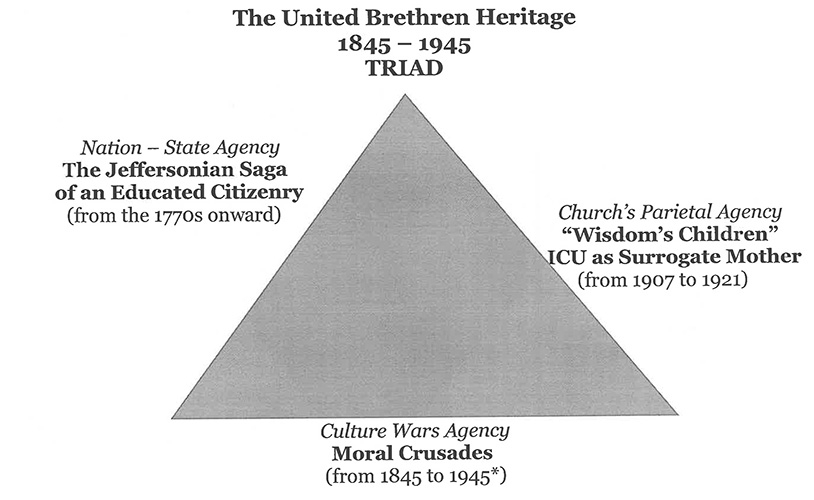
The left side of the diagram reads: Nation-State Agency: The Jeffersonian Saga of an Educated Citizenry (from the 1770s onward).
The right side reads: The Church’s Parietal Agency – ICU as Surrogate Mother (1907-1910) “Wisdom’s Children” (1924f)
The bottom of the triangle reads: “Culture Wars Agency: Moral Crusades from 1845 to 1945*”
*Please Note: Some might argue that the anti-Communism efforts during the tenure of I. Lynd Esch also took the form of a crusade. Esch’s stance as a fiscal conservative advocating independence of higher education from federal government strongly defined of his vision of Christian liberal arts college.
Front page of The Indiana News (Vol. 1, No. 1)
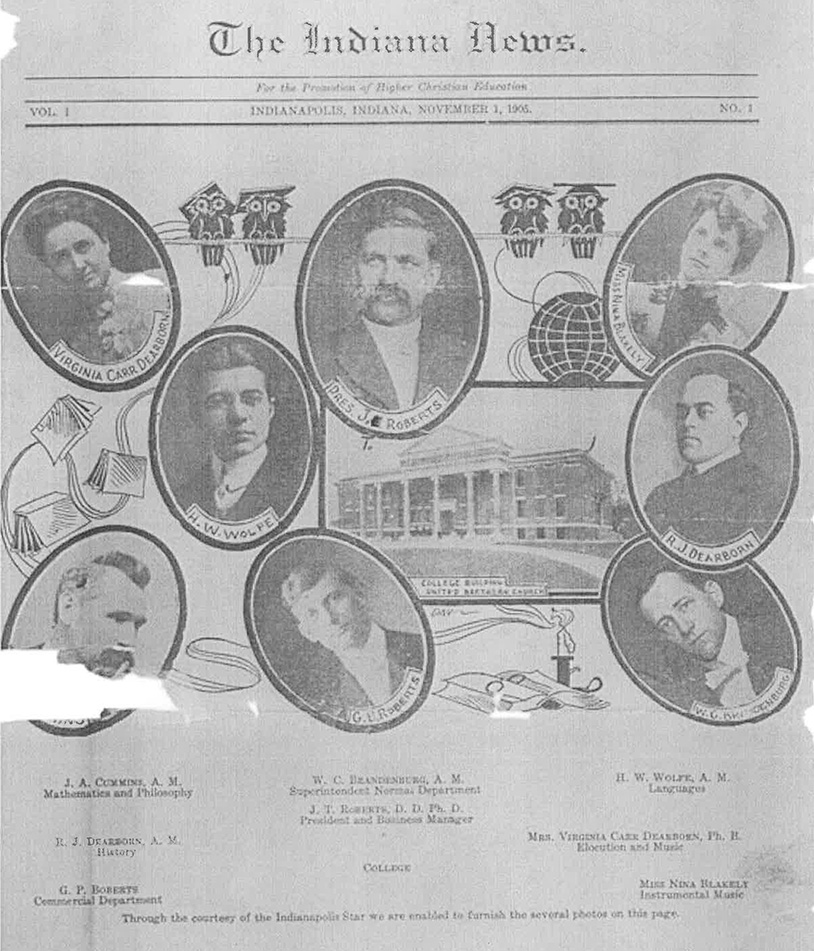
This was the bimonthly communications tool of the college in University Heights, Marion County, Indiana. The artifact is torn but mostly intact. The page displays a set of eight oval-shaped photographs of the first group of faculty of the university within a commercial art design that links various images – a lamp, several books, and four owls perched, arranged around a photograph of the administration building, as it looked in 1905. The initials DAV are incorporated in the design – the initials of the artist? A list of faculty identifications is provided below the design.
Photographs on the page:
- J.A. Cummins, A.M.
Mathematics and Philosophy - W.C. Brandenburg, A.M.
Superintendent of the Normal Department - H. W. Wolfe
Languages - J. T. Roberts, D.D., Ph.D
President and Business Manager - R. J. Dearborn, A.M.
History - Virginia Carr Dearborn, Ph.B
Elocution and Music - Guston P. Roberts
Commercial - Nina Blakely
Instrumental Music
Through the courtesy of the Indianapolis Star we are enabled to furnish the several photos on this page.
The second part of Michael G. Cartwright's talk with Joseph Krall, 2016 UIndy alumnus, about institutional sagas as a transgenerational genre extending across space and time.
Audio Transcript
Announcer’s Introduction: "The UIndy Saga: Looking Back to Move Forward" is a podcast about storytelling. During each episode, our host, Michael G. Cartwright, takes listeners with him as he explores one or more ways the saga of the University of Indianapolis has been performed. As listeners will learn, past narratives often point to the present patterns and future prospects. Indeed, this podcast aspires to cultivate 21st century conversations and storytelling. This podcast is part of a larger set of initiatives designed to encourage the campus community to tell stories about the diverse people of this university. We are partnering with the Office of Inclusive Excellence and Retention Strategy to involve students and faculty from the Shaheen College of Arts & Sciences who are leading the two-year project. Ultimately, we will produce a documentary that demonstrates the 21st century experience in rich detail. By listening carefully to the ways current faculty, staff, students, and alumni tell the story of their UIndy experiences, we hope to catch the tune of the UIndy Saga in the 21st century. We hope you’ll join us each month for another episode of Looking Back to Move Forward.
Introduction: Hello, and welcome to Looking Back to Move Forward, A 21st Century Podcast about the University of Indianapolis, an institution of higher education founded by the United Brethren in Christ Church in 1902 and now thriving well into its second century as a comprehensive university of more than 5,500 students, who are enrolled as undergraduates as well as graduate students in master’s degree and doctoral programs. I am Michael G. Cartwright, Vice President of University Mission and Director of the UIndy Saga in the 21st Century Project. I am joined again by UIndy alumnus Joseph Krall, from the Class of 2016. who in addition to being a wonderful friend is also a person who perhaps more than most alumni his age has pondered the significance of the university’s past in relation to its present and future, and therefore is himself a source of wisdom.
In Episode #6 of this podcast, Joe and I discussed the storylines that were in view in the earliest years of the university at a time when the fledgling Indiana Central University was still influenced by the National story – what some have dubbed the Jeffersonian Saga of Education for an Engaged Citizenry, as well as some of the ways the founders were also haunted by the crusades of the 19th century and attempted but failed to attract the constituency of Hartsville College by imagining itself to be the adoptive parent for an orphaned group of children. Today, we are going to be looking at a second saga triad, the stories that comprise intersecting trajectories for the venture that became much more viable after World War II under the leadership of President I. Lynd Esch, the man who invented “Education for Service.” Welcome back, Joe!
Joe: Good to be with you again, Michael. The first place I set foot on campus was Esch Hall housed the Office of Admissions. Fitting, in many ways, for a president who had long-term impact on the college and the Indianapolis community over a 26-year presidency. That being said, as I thought about this conversation and the conversations we’ve had about this period, what I think of is how Esch, a United Brethren pastor and one-time employee of the Goodyear Tire and Rubber Co., I frankly find him to be an opaque figure, he rather escapes me. You, of course, enjoyed reminding me that I. Lynd Esch’s given name was “Isaiah,” but apparently didn’t want folks to know that or name him as that! Michael, how do you make sense of this pivotal yet opaque president, and this puzzling period in the university’s history?
Michael: Good question, Joseph the alumnus! The second triad of intersecting storylines is more familiar to us and I will not provide the same level of explication as I did with the first trio of institutional narratives from the founding era. In more direct response to your question, I am tempted to say that the second three all result from the post-World War II re-founding of Indiana Central under the leadership of President I. Lynd Esch. Further, we owe it to the late Dr. Frederick D. Hill’s careful work as the first University historian and author of our centennial history that we are able to bring these things into focus for ourselves at all. As you know, Prof. Hill chose a phrase from I. J. Good for the name of his book: ‘Downright Devotion to the Cause.’
It turns out that what was most distinctive during the first forty years of Indiana Central’s history was a strongly held sense of vocation. Under the leadership of President I. J. Good, Indiana Central was a place where students could pursue practical training opportunities and a broad liberal education. Good said over and over again, “We do not apologize for helping our students learn to make a living but we also do not apologize for helping them to make a life.” Good saw the institution as an instrument for the good of the United Brethren in Christ Church. Around the time that Prohibition is repealed, the narrowly white Protestant demographic profile begins to shift and with that change a broader set of religious sensibilities – and the belated growth in the population of African-American students – the prospects for a different institutional profile begin to be revealed. As I argued in Episode #6, agency matters when we are talking about organizational sagas, or “the story behind the story of what really matters” to invoke Eric Childers’ study of Lutheran church related colleges.
I have come to think of this first candidate as a kind of “displaced Saga.” “Downright Devotion to the Cause,” which was the focus of President Good’s constant exhortation was always aimed at the leadership of the church. In some ways, in his centennial history, Dr. Hill succeeded in identifying a legacy for the campus (more about that shortly), but in my judgment his attempt to bridge the gap between the two longest serving presidents in the history of the institution failed for a very simple reason having to do with another shift in agency. Good’s decades-long exhortation for United Brethren leadership to display “downright devotion to the cause” was directed to clergy and laity.
But as time went on the people who actually bore the weight of sacrifice were faculty. Many of the faculty were members of the UB Church, but not all. So at times the church’s agency is being exercised in a dysfunctional way – especially when the instructors and professors who are sacrificing their interests and perhaps the well-being of their families are not actually members of the United Brethren in Christ communion. I think of that poor woman, Miss Gertrude Coldscott, who was not paid for several years in the 1920s, a debt that when unpaid for months after she was no longer employ’ed by the college.
As I have indicated on other occasions, we all pay a price for such stories as these. Martyr-like devotion to a cause requires something different than the collegiality of loyal service that tries to find the balance of working within defined limits.
I imagine that other UIndy colleagues may share my puzzlement about why Prof. Fred. Hill would deploy Good’s exhortation as the title for the centennial history, and therefore in some sense resurrect a storyline that had already proven to be dysfunctional for Indiana Central. I am not sure that I understand all of the reasons why Fred did that, but I can discern a couple. First, Dr. Hill was intent on dispelling several myths about President Good that had been propagated during the thirty years of his career on the faculty. Hill came to ICC in 1958 and spent the thirty years of his career hearing negative stories about President Good.
Second, Dr. Hill was trying to find a way to locate threads of continuity in an institutional tapestry where the discontinuities were all too prominent. And if I wanted to name a third possibility, I think we can say that Fred Hill was operating the in shadow of I. Lynd Esch, whose presidency had shaped Fred’s own life and work at Indiana Central University where he served for 30 years and more. I think Fred Hill found himself in a tough place: Can you tell the story about your institution that run against the grain of what you have lived?
For these and other reasons, I have come to think of “Downright Devotion to the Cause” as a kind of “displaced Saga,” intended for the church and partially enacted, but at many points shouldered by the faculty, which means that the church’s agency is being exercised in a dysfunctional way. What do you think about that Joe?
Joe: In answer to that question, Michael, I am not sure it is easy. But I do think there’s a figure who offered his own perspective on Indiana Central’s continuities and discontinuities that he observed both as a student and a faculty member. You‘ve probably guessed I’m referring to Marvin Henricks, class of 1939, who joined as professor of sociology in ’52 (six years into the Esch presidency) and retired in 1982. I have really appreciated his own version of a “middle distance perspective” he provides about this period – carefully situating himself as both and actor and an observer of the Indiana Central story.
His sui generis memoir, From Parochialism to Community, recounts his experience, alongside philosophy professor Robert McBride, teaching the “Senior Colloquium,” a class for seniors, taught by Henricks and McBride, starting in the mid- to late ‘50s. This, too, would fit with the sort of “displaced” and “dysfunctional” saga that you’ve recounted, wherein faculty service ends up standing in the gap between church and university. But it’s interesting to hear Henricks’s own account (pp. 104-105):
“The colloquium was designed as the capstone of the four-year liberal education. Seniors were supposed to come with the myriad threads of theory that four years in college had spun, and we were to weave for them the whole cloth of truth. We failed in this objective, much to the dismay of President Esch, for we raised more questions than they had been aware of, and provided no answers. I think the students enjoyed most to have the faculty argue among themselves, but I believe, too, that they caught the excitement of intellectual controversy.”
Now, the sight of Bob McBride and Marvin Henricks arguing with one another about ethics. . . is related to service of the university. And he would have understood it as service, but this is something different than both service to the university or service to the church. I think we’ll touch on the “liberal arts” thread of this saga more again later in the conversation – their utility or lack thereof, their relationship to a life a well-lived and even to wisdom. But I point out this anecdote about the senior colloquium because even in this terse and slightly tongue-in-cheek account, we find faculty cultivating students in ways that run somewhat independent of “Education for Service.”
Michael: Thanks, Joe, for that reminder about the senior colloquium. Each time I think about it, I marvel that they pulled off something that was non-compulsory and it was not compensated. They did it above and beyond their teaching load. As I recall, the class was both non-compulsory for the students and non-compensatory for the instructors! Ha! Henricks, McBride et al. certainly brought a strong liberal arts emphasis to the project of engaging students in the 1960s. . . .
Joe: So, clearly, they were enjoying it.
Michael: Exactly! They are doing it for “the love of the game.”
Joe: Yes, they were. . .
Michael: I have described the second part of the triad as The Independent Christian College Saga of “Education for Service” – after World War II, a fully developed project that enlisted both off campus constituencies and much of the campus culture. Perhaps the most definitive statement has been Frederick D. Hill’s centennial history. Hill wrote the last two chapters of the book in response to the pressure of President Israel and other administrators (Provost Lynn Youngblood and Dean EIP Michael Cartwright among others). He aptly stated that Education for Service was a “legacy from the past and a beacon from the future.”
During the 1970s, as Hill frankly stated, the mandate for service-oriented ventures was over-extended, perhaps most famously in the “Humanics” initiative. “Education for Service” was both a means and an end. The creation of various pre-professional degree programs coincided with the service ethic even as it multiple ecologies of service programs developed with their own patterns of professionalization. Some understood service as “pro-bono” and others saw their work as the vehicle for service to society but chose not to do “volunteer work” out of respect for the integrity of their chosen disciplines. In the 1980s, it was possible to see alumni passionately argue about the relationship between the liberal arts and education for service (debate between Jim Brunnemer ‘66, both Ann Cory Bretz and Bob McBride of the class of 1948, and Virginia Valiska Gregory ‘62, who was also the spouse of faculty member Marshall Gregory ‘62”
The stories that have been lifted up during that time and later (1947) and (1977) tend to display Good’s saga of “downright devotion to the cause.”
My lunches with Fred Hill in the late 1990s displayed the unstable mixture of these tendencies. I always came away from these conversations shaking my head. On the one hand, Fred recognized the dangers of employees giving themselves over to the cause without adequate self-protection. When he signed on as a volunteer to organize the archives and write the history, he asked President Lantz to make arrangements for him to have a lunch “on the university’s dime” – as he put it – each day that he worked on campus. So there I would sit with Fred at Streets Grill back in the days when it was located in the basement of the Schwitzer Student Center, while he had a Corn Dog and a Pepsi, or perhaps – if he was feeling really daring – a Hamburger and French Fries. And even so, from a certain perspective Fred’s own brand of frugality displayed the very pattern of “downright devotion to the cause” even while he is trying to discipline the university to take care of its workers.
Joe: Suddenly, I have a strange hankering for a breakfast burrito that Streets Grill produced in my time if you were willing to be a few minutes late to class. . . . I think we see here, Michael, another gap open up in the gap between the anecdotes of private and extraordinary acts of service, passed along informally amongst alumni and staff, and a very “public” project of “Education for Service” as guiding saga for the university as it engages with the community. And in this public project, “service” no longer issues from the church, but rather departs from the university itself, towards a general “public.”
We’re back at the Jeffersonian saga of “educated citizenry,” but without the particularities and peculiarities of the Brethren churches and their moral crusades. (Henricks, for what it’s worth, would remind us of his opinion that the United Brethren Church which nurtured the college drew away first and drew away faster from the college it had nurtured.) And in spite of the movement toward professionalization, the stories of “downright devotion” and the smaller, more “parochial” college where Henricks himself knew some of the people who appeared in the early history that were still within living memory. Hill himself pointed out that Downright Devotion relied on the tapes Henricks made with Esch and faculty who worked during the Good era.
Michael: Yes, Joe, you are exactly right about that. These two candidates for of the UIndy Saga in the 20th century are entangled with one another. Try as we might to tell the story as if “Education for Service” can be separated out from “Downright Devotion to the Cause” we find that they often overlap. After all they are part of the same book! I also suspect that it is these tales of devotion to the university’s mission that contributes to what I have come to think of as “the anti-saga” by which I mean the tendency to gesture at something that is not fully public (as a saga typically is) but which supposedly can be known (if you talk to the right persons).
This third corner of the triad that is a strange and persistent tale at our university. “The Best-Kept Secret of the Southside of Indianapolis” is an oddly diminished pattern of talking about the university that both gestures at the prospect that there ARE good reasons to think that the university is a fine place while also LETTING OTHERS NAME what those reasons are. This has been accompanied by a recurrent and surprisingly persistent counternarrative that may have its origins in the marketing efforts that supported Esch’s vision for “Education for Service.”
Joe, you and I perused a pamphlet once upon a time called “The Essential Difference,” which was the vehicle for President Esch’s successful marketing campaign in the late 1940s – built around the motto of “Education for Service” – quotes the testimony of an unnamed superintendent of schools who bears witness to the fact that the teachers continue to offer “the best service” in the classrooms that he oversees in an unnamed school district in (central?) Indiana. I have noticed that this kind of “testimony” continues to be voiced in conversations of the School of Education – perhaps more so than other professional schools. But I don’t detect any special affinity for the notion “the Best Kept Secret.” So it is possible to trace some patterns of this trajectory back to the origins of “Education for Service” itself.
Now, I do not claim to be able to offer a definitive account of this “anti-Saga” as I refer to the notion of the Best Kept Secret. Indeed, I don’t know that anyone has taken the trouble to gather evidence of the narrative or the traces of its propagation. What impresses me, however, is the number of people I have encountered across the years at UIndy who continue to buy into this narrative. This includes a few people who have been trained in the field of marketing and communications, although I hasten to say that I do not know of anyone associated with the Marketing and Communications staff of the university who espouses this view in the year 2022.
The fact that (to date) none of the branding proposals for the identity of the university have had remarkable success may not be so much a statement about the competence of the university’s marketing efforts as it is a testament to the capacity for growth in the midst of what has been an ill-defined identity. We are no longer a “denominational college” in the strict sense; neither is the university a “secular university.”
Joe: I think Marvin Henricks, here, too, attested to this tension. “Community” can be a bit of a buzzword. Reading From Parochialism to Community (1977). I came to realize that “community” represented for Henricks a movement from a close-knit group of insiders to a looser collection of outsiders. In circles I move in, community can mean a buzz word. You’ve suggested to me, that, in a way, he’s wrestling with the tension between gemeinschaft and gesellschaft – the difference between a fraternal community of intimate relationships and the kind of community that is functional yet still well ordered and collegial.
For him, this movement took concrete form in the change of name from Indiana Central College to Indiana Central University. Towards the book’s end, he comments on “the multiplication of parking spaces and parking lots” that points to the mobility of the campus population. He writes that “the institution is more functional for a much greater clientele, but it is less a homogeneous community, and more a gathering of strangers.”
I think Henricks was a sharp reader and he was well aware of the homogeneous community of which he was an alumnus, , but he also had his opinion that the university could keep a place – perhaps through memory—that “the old college with its personal touch” could have a place.
Michael: I agree, Joe. I think he also understood that the university could not be viewed through a single icon as it was during his yeas under I. Lynd Esch. Over the years, I have had the privilege of introducing many faculty and staff to his essay about “The University: What‘s It all About?” which he wrote in 1980 for the 75th anniversary of the opening of the university in 1905. For many of the participants in the University Seminar, his image of what it means to be a “verger of the trust” is inscribed if not on their souls perhaps in their psyches as university employees as well as on the mugs that they receive at the end of the seminar. It is an image of distributed stewardship, one in which the mission and its coherence is to be discovered and enacted over and over again in daily work.
I think that is at least in part because he succeeded in capturing the conundrum of what missional stewardship is from day to day. It involves everything from the humble task of sweeping the floor in the chemistry lab to crafting the strategic plan and many things in between.
If this were one of my institutional essays (!) seeking to understand the mysteries of your alma mater, I entitle this last part of our conversation something like “Penultimate Perspectives about 20th century UIndy Sagas.” But, I am not a fool. I know that I do not have the capacity to see the whole. As St. Paul put it so well, “here and now, we see in part. . .” At my best, I can see the lay of the land from “the middle distance,” to use that British metaphor for historical perspective that refuses to give in to the grandiose temptation to claim to be able to see beyond the empyrean heights or to shrink from the responsibility to seek the truth by merely claiming to see what is visible from “the parish pump” in the village where one resides.
In that respect, as you have identified on other occasions, Marvin Henricks is something of a Virgil to my Dante. I want to avoid parochialism and I join him in the quest for community. But in the process we have to overcome a lot of binary oppositions, and that is part of the problem we confront within a post-World War II “triad” that has shaped what UIndy has become. It is not clear to me how much these three are still operative. However, to the extent that they can be heard percolating through our conversations, I would argue that we cannot discount them. There are at least some alumni who appeal to the “singularity” of Education for Service – as if it is the actual mission of the university. That was the focus of the conversation with Jim Brunnemer in Podcast #2. As I have argued on several other occasions over the years, I think the university’s motto is a very important tradition, but I don’t think it helps us move forward to work through our muddles to cling to Esch’s pragmatic invention as if it is the final act or as if it is the only act of the play.
My intuition is this tendency to cling to “Education for Service” and/or to attribute to it more than it can bear has something to do with the problems we have inherited from a mission statement that goes back to 1993-94 academic year and with only minor tinkering has continued to be our basis for thinking in the 21st century. The fact that strategical planning at the university has sometimes been conducted in compartmentalized ways is an indicator that we have chosen to ignore, although I am quite sure that this latter opinion is a minority perspective on my part.
Joseph: From my perspective as an alumnus of the class of 2016, I have my own version of the “middle-distance perspective,” namely, that the different smaller communities with which I was involved in my four years offered overlapping and non-exhaustive meanings for “Education for Service.” Working as a resident assistant in Roberts Hall, tutoring in the math lab, and leading worship in McCleary Chapel – and it was all work! Even so all of these practices were, in retrospective, forms of service. . . . That being said, I also was at the university to pursue a course of study, I think in many ways, the paths of study I went on, formal and informal, took me beyond that tradition. And, of course, working alongside you allowed me to reckon beyond the present with the different facets of mission, identity, and institutional ethos at UIndy and Indiana Central before it. I mean, seventy-five “Mission Matters” essays don’t just come out of a singular unproblematic saga! You had a lot of different kinds of stories to work with!
Michael: Yes, Joe. I think the conversations to which you are gesturing among students and with professors is a reminder that there is very much a dialogical matrix within which “Education for Service” exists and is transferred across the generations. Part of the purpose of the UIndy Saga in the 21st Century is to prompt reflection about how we make sense of the experience of faculty, staff and students in the period beyond the marker that was dubbed Y2K. I am very eager to hear what others have to say about these matters. We have several spurts of dramatic growth since 1970, a series of entrepreneurial presidents who have engaged successive cadres of business-minded trustees, and we have had some remarkable fund-raising efforts along with a few ventures that did not succeed at the levels we had hoped they would, such as the ill-fated Mayoral Archives endowment that was launched in 2007-2008.
We have had expansion and contraction of international programs in Athens, and Israel and China. We have transitioned from the end of denominational funding for college chaplaincy and scholarships from the United Methodist Church while raising money from foundations, including but not limited to the Religion, Community and Education divisions of Lilly Endowment, Inc. These are but the most obvious ingredients of the late 20th century stew that comprises the UIndy mission. Others could be mentioned. That is NOT my agenda today.
Joe: Michael, I understand that part of your agenda is to look to others in the UIndy community to identify candidates for the UIndy Saga today. But I wonder, I want to press you, if you think there are any features from the earliest years of the university that might be viable candidates in the 21st Century?
Michael: I do want to conclude by asking about the prospects for one of the three sagas that I discussed during the previous episode. In laying out the story using the triadic framework the way I have in these two podcasts about “Sagas Past and Present,” it is true that I have prescinded from trying to provide a defined pattern for the 21st century. I do not mean to be begging the question and in effect contributing to the problem of “the Best Kept Secret” saga surrogate that I have just discussed. My reticence is deliberate though.
On this occasion I will offer two of the reasons why that is the case. First, this is a matter for another time, and quite possibly for others than me to address. We do have faculty who are better trained in the disciplines of philosophy in our midst. And, of course, this is an intellectual challenge that goes beyond the parameters of any single field of study, however we might construe the subject matters of the faculties and the curricula of the university. I am confident that in due course, there will be colleagues at UIndy who will take up this challenge, and I would like to think that the UIndy Saga in the 21st Century Project is preparing the way for that challenge, which is both a matter of institutional leadership facing the faculty and a conundrum that will require ingenuity on the part of administrators and staff at all levels of this comprehensive university. At the moment, let’s just say that this nest of questions is beyond my paygrade!
Second, I want to continue to do what I have been doing for many years now – to invite colleagues at the university to tell your stories! I am confident that if we do that well, then we will begin to hear the melody of the song that fits what we are about at the University of Indianapolis. And as we do so, we will start to hear ourselves harmonize, like those Mennonite forebears of I. J. Good and other United Brethren in Christ, folks who were well practiced in singing four-part harmony. And we might even begin to take pleasure in the fact that we sound good!
Joe: Come on, now! [as if he is saying, “Amen”]
Michael: But I also fear that we won’t do that if we continue to be so driven by the work we have to do on any given day that we fail to take the time to listen to one another’s stories. That’s what the spiraling venture of the UIndy Saga project is about, collecting oral histories, sitting down with colleagues and recording “story-booth conversations” about our experiences in the 21st century.
Joe: Conversations from colleagues and former students both! For my part, I continue to be fascinated especially by how many conversations there were from alumni who circled back to their alma mater. . . .I would be poorer, for my part, without knowing the stories of Marvin Henricks and Florabelle Wilson.
Michael: In the meantime, I will continue to think in terms of the earliest candidate for the ICU institutional saga, namely “Wisdom’s Children.” As I briefly explained in Episode #6 of the Looking Back to Move Forward podcast, the founders drew upon the loose mixture of wisdom imagery that is the inheritance of that older literary paradigm of higher education.
I do not mean to suggest that students at Indiana Central all saluted one another as they entered Good Hall by acknowledging their common parentage as Wisdom’s progeny. They certainly did not. They were not that self-conscious or that socially awkward. On the other hand, many of them would have been biblically literate enough so that they would have been able to grasp the connections between Proverbs 9 and the poetic hymn to the wisdom of the Torah in Psalm 19. They would have been able to hear the echoes of Lady Wisdom’s invitation to come to the feast, to drink the wine and eat the bread that had been prepared for those who were eager to learn and be shaped alongside those friends who spent their lives engaging students in loco amicis – that is as “wise friends.”
My friend, once upon a time, you studied with Professors Murphy and Evans as a Philosophy major here at your alma mater, and if I remember correctly you also were the recipient of the Socratic Prize and the Herbert W. Cassel Scholarship once or twice. And you have read some things on your own, Joseph Pieper and Ludwig Wittgenstein to mention but a couple of your favorite bedside volumes.
Joe: Oh, boy, here we go. . .
Michael: So, you know a bit about this stuff, don’t you?
Joe: I remain very grateful to have had more than one class and conversation with Profs. Peter Murphy and Jonathan Evans, and lunches with Herb Cassel! All three of whom are concerned with the relationship between the classroom and the life well-lived. . . .As for Pieper and Wittgenstein, both of them have their lessons which I am still learning. But I’m afraid that Wittgenstein serves the purpose of a soporific more than anything else these days! And for the record, I suspect Pieper felt there was a more organic relationship between philosophy, theology, and wisdom than the often-fraught Wittgenstein, who if we take his word for it just wanted to stop doing philosophy! In any case, we did discuss the “hybrid” sensibility in our last conversation, and how Minerva’s owl and Proverbs 9 could be present together in the very architecture of that first building.
Michael: Thanks, Joe. Suffice it to say the cultural inheritance at the turn of the 20th century was more heavily populated with wisdom symbolism in the arts and architecture. As citizens of the 21st century, you and I look back on the era of the founders and we think we are able to see some things that may or may not have been evident at that juncture. . . . There are other influences to be sure. But among these, we should not ignore the widely shared sense that the Greco-Roman heritage was part of the Western civilization. In other words, we are more likely to see the tensions between “pagan” and “Christian” expressions and styles. But the founders’ attention was attracted to the convergences.
The imaginations of students at ICU and ICC had a similar track. I do not mean to claim that such sensibilities were pervasive, only that we find sufficient evidence in the first two decades to see that this mode of expression was frequent and – in some instances – preferred. Moreover, it served the purposes of claiming continuity with the past. All of this is background that helps to make sense of why it was that members of the Roberts Circle would have been able to think of themselves as “Wisdom-seekers” who engaged one another in confidence that the project of education was the kind of formative adventure that was carried out in a residential context mediated by chewy texts and long conversations.
I set aside the Founders’ presumptions about the capacity of this university – or any of its predecessor institutions – being in a position to adopt “orphans” from Hartsville and elsewhere in Indiana. That was an overextended misapplication of the Hebraic metaphor, then and now. And it is even harder to see how you might locate it within those temple traditions of Greco-Roman wisdom-seeking.
But when viewed from the longer vista (medieval predecessors) like Rabbi Moses ben Maimon (aka “Maimonides”) and the wider terrain of indigenous storytellers in Africa, Australia and elsewhere in the world, it does makes sense. Early and late, Maimonides invoked the invitation of Wisdom – in the eighth and ninth chapters of Proverbs – who called upon the children to come to “her house.” The emphasis is on taking the ever-present opportunity to respond to the invitation by seeking wisdom – which entails avoiding “the way of the fool” to use the phrase that we find in Proverbs chapter nine and elsewhere – not merely acquiring mastery. Wisdom is more than techne. It encompasses practical thinking about how to engage the daily challenges of life as well as the quest for speculative discovery about the mysteries of the cosmos.
While we dare not impute to the founders anything like a fully developed philosophy of education, neither should we act as if they had little clue what they were doing. Their appeals for financial support are not so desperate that they set aside aspirations for a real university education. The first catalogue explicitly names their purpose as “liberal education.” That doesn’t mean that they had read John Henry Cardinal Newman’s great essays on The Idea of the University. But they did have coherent thoughts about how to shape students. Fred Hill recounts the conversation that occurred at the 1901 session of the St. Joseph Conference [Indiana] of the United Brethren Church, when the United Brethren leaders assembled “defined education as balanced development of the intellect, the heart, and the physical being and declared that overemphasis on the head . . . overemphasis on the heart produces and fanatic; and overemphasis on the physical produces a pugilist. ‘Only cultivation fothe intellect, heart and physical would produce ‘the well-rounded symmetrical man.’”
So the founders wanted to offer an education for students who are preparing for various professions, but they perceive that goal to be coterminous with the formation of intellects focused on wisdom, persons of faith seeking understanding.
Joe: That does raise a point about pluralism, though, Michael. Earlier, I partially quoted Marvin Henricks’s closing words in From Parochialism to Community (self-published, 1978). Let me quote it in full. “The new school can serve any number of purposes that it feels the changing community needs, but the new concept also says that it is not inconceivable that a part of its efforts will be the strong, vibrant retention of the old college with its personal touch, its intellectual concern for the liberal arts, and its Christian commitment.”
Which begs the question? What about other religious traditions or no religious tradition at all?
Michael: Well, Joe, I am so glad you asked that question! If I didn’t know better, I would think that you and I were reading from a script! The trope of the “House of Wisdom” is not limited to Judeo-Christian sources, of course. Indeed, it exists as a multi-dimensional metaphor in the Islamic tradition, where belief in the unicity of Allah, helps to locate the diverse streams of thought. And these explicit cognates do not exhaust the metaphor.
We don’t have to think about wisdom in monological ways in order to locate prospects for convergence. Indeed, part of what it means to seek wisdom is to look to other communities. Rabbi Moses lived in a culture. He wrote in Arabic and he drew upon the Hebraic wisdom tradition in his famous Guide to the Perplexed, to explain how it was possible to reconcile Aristotelian science with the Augustinian theology. We need to re-think many of the non-dialogical patterns. On other occasions, I have evoked the examples of the Hugh of St. Victor’s The Didascalicon: A Guide to the Arts (late 1130s) and The Introduction to Divine and Human Readings by Cassiodorus (553-555). The point is not to claim that these examples from the past are adequate for our own time, only that they display the range of possibilities for making connections when we decide to seek Wisdom.
Even if we should want to continue to see UIndy as a bounteous parent for first generation college students, we must avoid arrogating to ourselves the status of omniscient guardians. We don’t have the capacity to know what every would-be student needs and we lack the wisdom necessary to be able to pull that off. That is simply wishful thinking to imagine that we will ever have it all together.
Here is my final point: The figure of Wisdom has her own agency. She summons “the children” from the streets and the neighborhoods around her. She arranges for the symposium at which students and faculty engage one another and taste the delights of rich texts and experience the awe of well-developed arguments that lead to the apprehension of truth.
And let us not forget: those who dare to identify themselves as Wisdom’s progeny also have agency. Indeed that is true of all those who are invited to Wisdom’s feast. Those students who study among us for a time, some of which complete the circuit of the “curriculum,” others who do not and still others who become life-long learners alike have agency, however limited and still in the process of being shaped.
So some of those owl-like would-be students resist taking on the identity of apprentices in wisdom. Some linger in the thickets of ambivalence unwilling or unable to engage the challenges of disciplined learning. And still others wander in the wilderness of confusion before they commit to spiral-like quests to learn about ones selves, neighbors and world(s). These are the kinds of perennial possibilities that have always been the case, and I would argue, are likely to continue to be enacted even in the strangely hybrid world of higher education carried out during and after COVID time.
And what about those of us who are faculty and staff of the university?
Whether we are taking the measure of the Roberts Circle – the first members of which are depicted above – or regarding with due admiration the collegial engagements associated with the Faculty Academy led by our colleague Amanda Miller, there must be capacity for action if there is going to be wisdom-seeking in any effective sense of the words. As I have argued repeatedly over the past two decades, we are called upon to exercise a particular kind of agency – that of the wise friend, what Thomas Naylor and William Willimon have aptly called in loco amicis as opposed to the two extremes in loco parentis and the kind of college in which faculty presume that it is possible to occupy no locus in relation to the students they teach.
This is particularly important, I would argue for any institution that wants to claim to be about the tasks of church-related higher education in the liberal arts tradition. Our agency is not so much one of independence as it is a vocation of interdependence. Like our students, we work alongside one another as friends of Wisdom, who have been entrusted to engage students in the grove of academe. Some of us are adept scholars. Some of us are master teachers. Some of us occupy the role of administration, attempting to make it possible for the university to function well. A few people excel in all these ways, but truth be told most of us have a more limited set of gifts to bring to the venture that I like to call Wisdom’s Feast.
Joseph: There is that image again! I do look back at that Wisdom’s Feast gathering in 2017. Michael as you may remember, the reflection I wrote described the interweaving of Marvin Henricks’s life within something very much like a vocation of interdependence that you are describing. He was a student at a denominational college with the lives of his students at a university that more or less kept pace with the increasingly secularizing and pluralistic trends of wider society. On Henricks’s own reading of his locus and limitations, he “found the resources to not only ask the difficult questions of meaning”, but also was sustained by his own ongoing education as he taught and walked “walk with students as they asked those questions as well.” On that occasion, I offered a question to faculty and staff: “how had their experiences as students – their own educations – affected their own vocations as teachers?” I think that was my own way, in retrospect, at gesturing at interdependence. Whether we find the model of in loco amicis to be just as idealized or unhelpful as in loco parentis, the fact that we had teachers at all shapes the kinds of students and teachers we’ve become.
Michael: And let us not forget that the arts of pedagogy are matters of practical wisdom. Phronesis is not less than prudence, but always oriented toward action and therefore it is never adequate to retreat into one’s cell – although some of us may be retiring sorts. Contemplative disciplines – mindfulness, etc. – are enjoying something of a renaissance in the 21st century and you and I have surely benefited from these developments. But they are also deliberative in the sense that sooner or later we must assent to be guided by “best practices” and learn from our mistakes.
Not all of our would-be “Minervas” [fledglings in wisdom] are ready to do the work when they respond to Wisdom’s Call. As one of those who has long advocated reorganizing “the first-year experience” of the University, I applaud the efforts of Interim Provost Prof. Mary Beth Bagg and other faculty and administrators who have worked tirelessly during the 2021-2022 academic year to put together a stronger set of interventions to make it more viable for students to make fruitful transitions. We have learned to pay closer attention to what students experience in their “first year out” – to invoke that plain-speaking phrase the sociologist Tim Clydesdale uses to describe the collection of challenges ranging from the capacity for daily-life maintenance to reading comprehension.
Joseph: Michael, you’ve already talked about the problems of middle-distance – how it’s hard to have perspective on one’s own education much less one’s own formation in wisdom. But I’d like to take your mention of Clydesdale as an opportunity to reflect a bit on the purpose exploration program that the university maintained and grew, the Christian Vocations and Exploration Program, CVOC as we called it. And I had ample opportunity to reflect on that program, which was one of the 88 “purpose exploration” programs that Tim Clydesdale wrote about in The Purposeful Graduate – Thanks to you, I not only went through the program, but I even wrote a review of Clydesdale’s book for one of your Mission Matters essays. Talk about recursive! The “line is long, and not straight!”
Re-reading that review, which, among other things, contains an attempt to narrate and make sense of my own halting growth, I found myself emphatically returning to interdependence-and-relationship as what enabled me to make viable transitions. I had a specific memory of something that happened that first year. I had been invited by you to come to a session of the Lilly Fellows Program National Conference that was meeting on the UIndy campus at the time. I showed up there at 8:00 a.m. on a Saturday morning, a very sleepy undergrad that found myself in a room full of Ph.Ds. I wasn't sure what I was doing there until Sam Wells showed up. He was the plenary speaker that morning, and I just got dynamite. In particular, he spoke about service in a way that forced me to reckon with the singularity of meanings that I had attached to [the idea of] “service” in my own life.
If I may, I want to quote at length from Wells’ talk, which was later published in The Cresset:
I once was asked to do a bit of consultancy work for a college that was seeking to expand its student service programs. I talked to the board of the service initiative. . . . Like many professional people, they liked to use the phrase “give something back.” I tried gently to point out to them that such a phrase assumed the rather problematic premise that they and the student body would inevitably and rightly spend most of their careers taking something away. I suggested that perhaps they would do better to focus on stopping taking away rather than trying to give something back.
Now, that’s a zinger! At the time, I heard that as a personal challenge for “Joe-the-Anxious-First-Year Over-Achiever”: I left that lecture a bit dismayed, and wondering: “Is there a way for me as a student to stop taking – altogether?” Looking back at that moment almost ten years ago. Today, I might elbow that Joe with a grin and tell him “No!” and then remind him that education, like any relationship, involves give and take. And saying that, I think about the time that professors spent in and out of office hours with me, and that staff, chaplains, residence directors spent with me, and counseled with me, the laughter we shared and the ways we pushed and challenged one another, to keep growing, to keep learning in our roles.
I ended that review with the admission that “I, for one, cannot separate what I have learned from those with whom I learned,” and that one way of meeting Wells’ challenge is to learn “to see the relationships we form as a crucial part of educating and being educated.”
I wrote those words six years ago, and I stand by them; in retrospect, I’m amused to realized that I had unintentionally offered a very “personalist” and probably “theological” reading of Wittgenstein who wrote in On Certainty: “Knowledge is in the end based on acknowledgment.”
Michael: Thanks, Joe, for that thoughtful and insightful reflection. For a moment there I thought you might go all the way and begin quoting from the Summa Theologica of Thomas Aquinas, but I can appreciate why you might hold yourself back. Neither you nor I have yet seen the Beatific vision, but we are inspired that Thomas came to the point of registering the penultimate status of even his greatest intellectual achievement.
What we do not know – indeed, can never know in a comprehensive sense -- is how our stories – individual and collective – ultimately turn out. The prospective challenges and opportunities for formation of the university are new for each generation whether we can recognize that at any given time or not. And each generation of faculty and students have the responsibility for telling the university’s story. It is a tricky challenge. We cannot act as if we have the capacity to give a plausible account of what has transpired.
Nor can we act as if we have the kind of omniscience that could presume to see everything that is going on.
Still, we hope to tell “the whole story” in as much as we can discern what is going on. That is the challenge of attempting to make sense of things when we are trying to see things from the perspective of “the middle distance.” Sometimes we come close to realizing our aspirations. Other times we don’t. Sometimes we know how to go forward. And on occasion, we have to seek clarification from Wisdom – and those who dare to call themselves Wisdom’s friends. And so it goes!
Joseph: I’ll see your Vonnegut allusion and raise you a Walker Percy: “To become aware of the possibility of the search is to be onto something.” Michael, it’s been great to have been part of today’s conversation.
Michael: And many thanks to you my friend, Joseph Krall, UIndy alumnus of the class of 2016, for joining me for this second conversation about UIndy Sagas Past and Present. It is always a joy to have the opportunity to collaborate with you. I also want to thank the team that produces this monthly podcast, which is disseminated courtesy of the Marketing & Communications staff of the University of Indianapolis. Mr. Joshua Lane continues to hold the title of The Intrepid Podcast Producer, I am very grateful for the focused attention to details that Josh brings to this endeavor.
In the next episode (#8), Dr. Jonathan Evans and I will be discussing what it means to hear “Wisdom’s Call” in the 21st Century. Evans is Professor of Philosophy and for the past seven years has served as the Chair of the Philosophy & Religion Department. Until then, I encourage you to tell your own UIndy stories along with other faculty, staff, students, and alumni. And as you are able, please do take some time to listen to the stories of those around you who, like you, have dared to respond to the call to “come to the feast” of Wisdom.
World War II Era & Beyond Triad
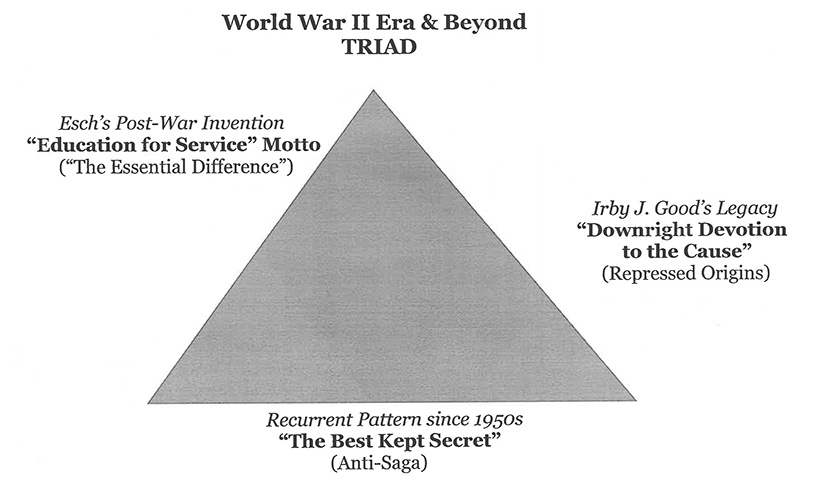
The left side reads: “Esch’s war Invention: ‘Education for Service’ Motto (‘The Essential Difference’)
The right side reads: “Irby J.Good ‘Downright Devotion to the Cause’ Repressed Origins
The bottom of triangle reads: Recurrent since the 1950s “The Best Kept Secret” (Anti-Saga or Wannabe)
Hearing YOU-Indy Voices
We are pleased with the strong response to our call for submissions of colleague story-booth stories and oral history recordings. We are still collating what we have received, but as of December 15, 2022 we have made 15 narratives available. For the next five months, we plan to feature one narrative each month while keeping the archived recordings available for faculty, staff, students, alumni and friends of the university to access at your convenience. Look for narratives to be posted on the third Thursday of each month at 3 p.m.!
Audio Transcript
MUSICAL INTRO: Excerpt from Cul-de-sac composition [Adobe].
NARRATOR – MGC: Listen, as Physical Therapist faculty and UIndy Colleagues Ellen Winchell Miller and Stephanie Piper Kelly Ellen and Stephanie talk about “Back in 1990 when we first met."
ELLEN: Back in 1990, I was a 30-year old masters-prepared physical therapist who got hired by Dean Beth Domholdt as a faculty member in the School of Physical Therapy, the Krannert School of Physical Therapy. And so I was a totally green faculty member. And it was 1990. And a new cohort of students started in what was then a Master's program in Physical Therapy. And one of those students in that in my very first cohort was this really smart, very quiet, young girl named Stephanie Piper. And, I taught that cohort, a bunch of classes. At the time, there was a faculty member who had to go on medical leave. And there were some classes that need to eat it to get picked up, which I volunteered to do. And so it seemed like that cohort had me for most of everything here I taught,
STEPHANIE: Everything!
ELLEN: I taught a bunch of their classes, and so became, I was young, and there wasn't a big age difference between us. And it was it was a really fun group of students. And so I got to know that cohort very well. And that's how I got to know Stephanie as a as a student, in that first cohort that I was a part of, in 1990. So it was it was fun. And she was impressive as a student that you could tell behind that quiet young woman was a lot of potential and just very bright and fun to have as a student in the classroom.
STEPHANIE: I can remember as a student, and not not just me, our whole cohort thought you were just the most fun, coolest teacher, so we had you for a lot of things. But fortunately, for you and us, we love we love having you in class. And, and I think maybe because I also was a grad assistant and worked some in the office. I knew. I knew during that time, you weren't just, you know, you weren't just the faculty member you were also starting on your your doctoral studies. And then you were pregnant with your first child during our first year of PT school. And, and I think I even babysat for Alex, during that time.
ELLEN: Yes, you did! So for me, you were this amazing example of a working professional mom, who was, you know, balancing all all aspects of that. For the most part, well, I mean, I'm not happy, but you also made it seem fun. And you could see the I could see the challenge in it too. So it wasn't like I don't see you made it look completely easy, because it's never completely easy. But I remember thinking, I want to be like Ellen someday. She is just, she is so cool.
ELLEN: It was a, it was a crazy year. So I started in my faculty position and at the time I was hired as a three quarter time faculty member, because the expectation was that I was also starting my doctoral studies because the school of PT needed doctorally prepared faculty and it just so happens that I was also out. So I was pregnant. So that first year I was it was my first year of teaching my first year of my doctoral studies. And I was pregnant with my first child. So it was a, it was a wild year. And so as during that first year, that Stephanie’s cohort watched me go from, you know, normal me to like super pregnant me. And it was a day after their, their last – well -- I had Alex on a Tuesday, I gave my last final on Friday, I took my last final on Monday. And then I went in to the hospital to have Alex on Tuesday to be induced to have my baby. So it was just like this. And to get all these things done, and check off my list. So I could go and have my baby and then kindly, a group of students after just I don't know, it's probably a week after she was born, showed up at my house and wanted to see the new baby. And that was just fun. It was just a great group of students that Stephanie was a part of and you know, over the years as a faculty member, you, you kind of lose track of what students were part of what group. And to this day, that group of students is still just in my mind, cohesively; I can could tell you all of them because they, they kind of stay. It was my, my first and certainly one of my most favorite groups of students. It was a it was a fun time.
MUSICAL OUTRO: Excerpt from Cul-de-sac composition [Adobe]
Audio Transcript
MUSIC INTRO: Excerpt from Cul-de-sac composition [Adobe]
NARRATOR—MGC: UIndy Voices Story #2: Listen as Physical Therapist faculty and UIndy Administrators Ellen Winchell Miller and Stephanie Piper Kelly remember when the Health Pavilion was built in 2014.
ELLEN WINCHELL MILLER: So for a number of years, the Center for Aging and Community was up in Fountain Square. And so my office, my main office was in Fountain Square, but I was back on campus frequently, and the deans of the health programs and, and me, as the executive director for CAC, had the really fun experience, I think it was, it was a one, it's the only time that in my professional career, I got to be part of a team that talked about what a facility, what a building [of] bricks and mortar, what it needed to look like, to to accomplish the purposes of our programs.
And so I don’t know how many dozens and dozens of meetings that we had between the College of Applied Behavioral Sciences, the School of Nursing, Stephanie and College of Health Sciences, and me and CAC, where we got to just sit down and meet with the architects and learn architectural terms and talk about, you know, what the classrooms should look like.
And people probably wonder sometimes why every floor on the Health Pavilion looks so different. And it's because because different people kind of designed those floors. So there's the room numbering and the way that the floors -- each floor, one two and three -- are laid out are so different, because it was it was different people and different ideas and different needs coming together. So I don't know what what you remember most about those years when we were when we were planning that building?
STEPHANIE PIPER KELLY: Yeah, I mean, that I learned so much about architecture during that time. And the things we would I mean, I'm sure we drove the architects crazy, but they were proposing ideas and they were like, “Well, you can't do that, or it doesn't work that way.” Or, you know, there's certain things they could do. You know, we also had the challenge, or I have a challenge with the large department to bring all of them on board with what was happening. And so, you know, we remember we did that lot kind of a lottery thing for picking offices, we were trying to make it fun with drinks and trying to make it a social activity, because the whole office thing was quite stressful for faculty and that balancing of big ideas –"wouldn't be cool if” with “we have to have a space to store equipment” or, you know, like, the boring things about a building
ELLEN: And the realities of what was would be really cool versus what was
affordable. And one of the it's interesting to remember the part about the offices because one of the things that we considered as we were building that building were more kind of open office spaces, which NOW is is much more popular in general in the world kind of be down workspaces and things and at the time, you know, our faculty just didn't -- it was not a popular idea. To have these open office spaces everybody, you know, could only imagine themselves in an office with a door where you could close it and be by yourself or be by with a couple of students and that sort of thing.
So, at the time CAC kind of became the big guinea pig for that open office space. we set up I will try this open office space. And it was an interesting experiment. We, we made it work! But now as things changed, and and during COVID, as classroom needs and things changed now we're, we're back in, in more traditional office space for the Center as well. So but it was the -- I had forgotten all about that lottery day when we were trying to figure out, we wanted faculty to feel like some ownership of where they were going to be physically so.
STEPHANIE: Well, and I just remember this too. We flew out to University of Colorado, to see their kind of interprofessional space. And that's where we got the idea for those garage door rooms!
ELLEN: That’s exactly right.
STEPHANIE: Which have been really popular and a good additions.
ELLEN: Yeah, that was a fun trip we did, we found a couple of places that we felt had really good into professional spaces. And we had the privilege of going out and visiting and talking with the people about their spaces. And yeah, that was the garage door rooms came from that, from that, from that trip. And they've been, I think they've been popular with everybody with faculty.
STEPHANIE: Yeah. Yeah! If you like the garage door rooms thank Ellen and Stephanie!
ELLEN: And the University of Colorado when we first saw them, we were so struck with how cool that was when we when we did that visit. So yeah, we got to know the architects. We even tried to set up one of our colleagues with one of the architects on a date -- didn't work . Our matchmaking didn't work. But it was, it was, it was a fun stage and really learned a ton working and thinking about developing spaces. You don't get the opportunity to do that very often as an academic administrator, and so to do that was really was – it was a fun season, and then to see it take shape. And to actually, you know, walk into the building that you designed, and see, Oh, this is how this looks! And you know, it was it was a lot of fun. It was very fulfilling. We got to put on hard hats and have shovels and you know, do that.
STEPHANIE: That's right.
ELLEN: As academic administrators, that doesn't happen that often. And so it was really a fun, a fun project for a few years that we that we were completely and totally engaged in. Because it was it was important. And we knew it was going to be the Health Sciences building for a long time. And we needed to make sure that it worked for everybody.
STEPHANIE: Yeah!
MUSIC OUTRO: Excerpt from Cul-de-sac composition [Adobe]
Former Academic Dean and Provost Lynn R. Youngblood '63 shares his memories about the creation of graduate programs at the University of Indianapolis beginning with Physical Therapy in the 1980s. UIndy Saga Storybooth Conversation recorded with Anna Moore on May 19, 2022.
Audio Transcript
MUSIC INTRO: Excerpt from Cul-de-sac composition [Adobe]
LYNN YOUNGBLOOD: The other thing that I think I was involved with was the creation of the first Physical Therapy program. I don't know if you're familiar with the PT program or the Occupational Therapy program there, but -- somebody came to my office, it turned out that this person was the head of the Physical Therapy Department at Community Hospital in Indianapolis. And he had, he said, we have a real need in the city that's not being met. He said, there's a Physical Therapy program at IUPUI, actually was the IU School of Medicine there. The only physical therapy program in the state at that time, was the one in Indianapolis as a part of the IU School of Medicine. But they were they were a stepchild, they were treated as a stepchild to the School of Medicine because these guys were there to prepare MDs. And while they were preparing PTs, it was like, second class citizens, if you please.
They so they weren't getting resources, they weren't getting attention. They weren't getting the education that the Louis Greenwalt was his name, Louis felt that they, they weren't getting the education, they needed to be a competent PTs. And there weren't enough of them to serve the hospitals. So he then along with the head of the PT department at St. Francis, in the head of the PT department at Methodist, those three guys comprised the team of local PTs that invited me to come and sit with them. And we did a lot of back and forth over the period of several months. And to the point where finally, I was persuaded that there was a need there, and that we might be able to be in position to fill that void.
So I went to the president at that time, President Sease, and told him what was up. He was interested, he said he thought it would be something that we ought to pursue. BUT Physical Therapy costs a lot of money. I mean, you can't you can't just start a PT department, without having some money to support it, some monies to support it. So he went to the Krannert Charitable Trust. The person in charge of the trust at that time was a gentleman named Don Earnhardt. And Don, by the way, was on our Board of Trustees. And so Gene Sease says to Don, “We'd like to try to start a PT program. We need to get accredited. But we can't do that until we get started. And we can't start it because we don't have extra cash on the site to fund the program.”
So he convinced Don that the that the Krannert Charitable Trust, would give us a million dollars to start the program. And if we got our accreditation, then they would give us another thing was another million and a half [dollars]. Well, we got that first million, brought in faculty [who] got the accreditation to give us the next million and a half. And that's why the Physical Therapy program is now called the Krannert Graduate Physical Therapy programs because of the Charitable Trust that invested in it that initiated the program from a financial standpoint.
So then we had a PT program, with the first graduate program in the state with physical therapy, and then we put Occupational Therapy in and Psychology came along all those programs became a part of a graduate program a full time, or full time graduate students like the one you're on now, the Sociology program was, was a follow up to that.
ANNA MOORE: [Yes]
LYNN YOUNGBLOOD: So it was I think, I know it was the first full time graduate program we ever had at the university was PT and then OT and Psych and Sociology and so on. So those again, are the feelings I have about maybe how I might have made a difference at the university.
MUSIC OUTRO: Excerpt from Cul-de-sac composition [Adobe]
Audio Transcript
MUSIC INTRO: Excerpt from Cul-de-sac composition [Adobe]
NARRATOR: Listen as Former Provost Lynn Youngblood explains to Anna Moore how the university’s international collaboration in Nicosia, Cyprus, began with a conversation he had with an adjunct faculty member named Andreas Polemitis in the 1980s.
LYNN YOUNGBLOOD: The two things where I think I made a difference . . . was one was in the internationalization of the campus. And I can't tell you what year this was, but I know it was probably in the late 80s. One of our adjunct faculty came into my office, this was when I was academic dean. And he came into my office, he taught evening classes. He was a native of the country of Cyprus. And he came into my office and he said, you know, my country values education. In fact, he had the statistics to show the percentage of students who went on to college, but but they don't have they didn't have any universities on the island in the country, they didn't have a single college or university.
He said, "I would like to go back to my home country, Cyprus, and start a university. And I would like to be able to be a branch of the University of Indianapolis." And so we talked about that. And we worked, we worked it out, so that eventually I went to the faculty and, and said, "This is an opportunity that we have. Do we want to get involved with an international campus?" We hadn't had a branch campus internationally at that point. So this was new territory for us. And so the faculty agreed to do that. We eventually got accreditation in Cyprus, the country of Cyprus, for the University of Indianapolis Cyprus branch.
And what I didn't realize at the time was that, I think, the, the number of students that eventually came to that branch, were from a variety of countries, not only were they from Cyprus, they came from all around that area. And they had when one of the conditions was that they were going to get a degree from University of Indianapolis, they could take almost all their courses in Cyprus, but they still had to come back to Indianapolis for a year. So those 12, the first group of students that were 12 of them that came over, and they had a good experience. They proved themselves academically and the effect, the irony was that there were there were 12 students that came to the US who had three years of work at our branch campus in Cyprus. And I ranked those 12 in an academic GPA, I took the GPA from top to bottom. And after they had been here a year, those same 12 students were top to bottom had the same GPA. Their, their performance in Cyprus was identical to what they eventually did on our campus. And when I showed that to the faculty, I think there were a few doubters and naysayers about what we were doing in Cyprus and why we were there. But it showed that, I mean, once they had them in class, and they saw that they could perform, then they sort of took away the questions.
But the more important thing was, they went back then to Cyprus, and they went back to the other countries near there, and spread the word that university, Indianapolis was a welcoming place. We valued international students. And from that point on, the population of international students boomed. I don't know what it is now. But I do know, at one time, we were second only to Purdue in the state of Indiana, as far as the percentage of our student body that was international. Now, you know why you and places like that would have a lot more in numbers, but the actual percentage, and the student body that were that were international was only second, we were second only to Purdue, which -- that may still be the case. I don't know.
But I know those a – When I was an undergrad, I think we had a half a dozen students from “foreign countries,” as we call them then. And then when those soccer kids came, several decades later, we had maybe two dozen, half of whom were from Cyprus. It wasn't long after that, I think we had maybe 150 students from different countries, and I don't, you would know far better than I know, Anna, if that's still the case. But I mean, you probably came into contact with a lot of students in your experience from someplace other than the US.
ANNA MOORE: Yeah. Mm-hmm.
LYNN YOUNGBLOOD: Boy, I think I take pride in that. Because of the role I think I played in that. And again, I don't want to sound like I'm bragging, it's just a need to share comfort, you know, you want me to share my soul in that regard. That's where I'm coming from. And I think what does that mean? It means that not only that we provide an education for students from a variety of countries, the impact that those students had on our own students, particularly first generation students, whose parents probably could never afford to send them overseas for an experience. We brought the overseas flavor or culture to the campus of Indianapolis and I think that, you know, that made a difference in whether they knew it at the time. A kid from Connersville, Indiana comes into contact with somebody from Mozambique. That might have made a difference in terms of how they viewed the global situation. So I think that matters.
MUSIC OUTRO: Excerpt from Cul-de-sac composition [Adobe]
Audio Transcript
MUSIC INTRO: Excerpt from Cul-de-sac composition [Adobe]
Narrator: Listen as Mimi Chase talks with Anna Moore about some of the experiences she has had with International Programs at the University of Indianapolis going back to 1992.
Anna Moore: So when did you initially come to university? And what were your first impressions?
Mimi Chase: So I joined the University in July of 1992. I actually was on my way to live in the American Southwest. I was coming back from living a few years overseas. And I came to UIndy then, well, it was the University of Indianapolis, but they were saying U of I. And I came for an informational interview, I met the person who was this International Student Advisor at the time, Steve Weninger. And then I learned that there was a position coming up. And so I applied for it.
Anna Moore: And what were your first impressions of the university?
Mimi Chase: I kind of had some memories of what was Indiana Central University. But I didn't feel like I knew much about University Indianapolis. My interview was in the Smith boardroom at the president's office, I was amazed at the grandeur, all the woodwork, the big table. I did my homework. And I knew the people who were at the table, and I was impressed with the diversity of the people who were there interviewing me. There were people from several different countries, different cultures. And I thought it would be a wonderful place to work. And I was right.
Anna Moore: So what do you remember about the period before the turn of the century? And what did you experience after 2000?
Mimi Chase: Well, you know, the turn of the century is not a great change. For me, I would say, the big core of the work that I do is immigration advising. And so I'm directly tied in with immigration regulations as they apply to international students, and always have been. My work goes in many other directions as well, but always at the border is that immigration advisement we have to do for international students. So really, a big change came from me in 1993. I came in 1992. But in 1993, was the first World Trade Center bombing. And when that happened, there was a shift in my work, and I could feel the shift. There was a sudden desire to exercise more control over F-1 visa students, all non-immigrants, people coming in on tourist visas, that's all we could talk about was how we could avoid something like that happening again. And then of course, it did happen on September 11. And that was really not the turn of century but September 11, 2001, was the major pivot point in my career in my life. Everything changed immensely, quickly. All sorts of new regulations came about with regard to immigration policies and processes. There was a huge government database that was established, training required for us to be able to be on that database, all sorts of new controls that came in, which now are routine, and it's hard for me to imagine that there was a time before this, but that was a huge, huge change.
Musical Interlude: Excerpt from Cul-de-sac composition [Adobe]
Anna Moore: What's your favorite place that you've gotten with university?
Mimi Chase: Um, you know, I don't know that I could say a favorite. I had lived for a year in Greece before I came to UIndy and I think that's one of the reasons that I got the job was that I speak Greek. I had learned it while I was living in Athens. After I finished my, my undergraduate, college, my undergraduate studies, I lived a year in Athens, I lived two years in Spain, and then went to living here in Athens. So I love Greece, but Cyprus, Cyprus was very, very special. I spent a long time on the island of Cyprus in Nicosia, where the Nicosia University is located. Then it was called Inter-College and I became very good friends with a colleague that works in admissions there. Of course, we have our colleague who worked for you with UIndy he worked for us. Galena Yaneva. And then Georgia, Sophocleos is the person that I worked with closely in Cyprus. And we drove all across the island in her car singing songs in Greek and visiting the villages. I stayed with her family in their family village home and helped to pick olives and had an amazing experience in Cyprus.
But then I wouldn't downplay Belize either. We had a very close relationship with Galen University in Belize. And I spent significant time in Belize as well, when we were first setting up the school there and trying to bring our curriculum and our faculty and, gosh, it's so hard to choose any one thing.
And then I would add, that in Haifa, we had a close relationship with Mar Elias University. Father Chacour, who had written several books and I, I remember one of his phrases, “I was born a baby.” And what he meant by that was that even though he was Palestinian, he was Christian Palestinian. And he had around him many challenges with people who were Muslim, or people who were Jewish. The three religions do conflict quite a bit in Israel. There you know, there are some challenges in Israel we have still today and have had for many, many years, but his point that I was born a baby. He kept saying we were all born babies. And so everything that we're going through all of these conflicts that we're having, these are things that are learned later. We were born babies. And then we learned everything that has now brought us to this place where we're having trouble working together. Father Elias Chacour – wonderful, wonderful experience, Mar Elias University. We partnered with them briefly. Because as a Palestinian institution, it was difficult for them to get a foothold in Israel. But by partnering with a US institution, we wanted to help them get off the ground, so to speak, and they did, and they're doing well. So we fulfilled what we had hoped was our mission to help them succeed. And it was a brief partnership, where they could then stand on their own.
Anna Moore: What are your memories of the students at UIndy, and the interactions with individuals and groups that you have worked with over the years?
Mimi Chase: Oh, students, there are so, so many students, and fortunately, I'm still in touch with many of them because of Facebook. Um, the, they've grown, they're older now. It's been a long time. There was students from Sierra Leone named Shadrach Gonqueh, who I was a new advisor, and I had to deal with a complaint from his roommate, because Shadrach would get up at 3am every day to study at his desk, and would turn on his little overhead light over his desk, and his roommate complained because the light would wake him up. But how do you reprimand someone who gets up at 3am to study. That's how serious he was about his studies. It was amazing. Yeah, it was, it was pretty cool. And he did wonderfully well.
I remember Serge Melki. Serge Melki was a student from Lebanon, one of the few students that I know who went out of his way during Move-In days, and helped American students just went out and helped carry boxes because he was determined to make friends and, and that's a difficult thing in American culture. We're, we're very, we, we take pride in our sense of independence. Anonymity. Let someone be on their own, don't overwhelm them, give them a place to stand, and then let them do what they do on their own. But some international students can find that isolating because they're used to living in a bit of a warmer culture where people don't stand back, but jump in right away, as you probably experienced in Cyprus. And so Serge, was one of the few who actually took that initiative and did it himself.
Many students from Ireland, Northern Ireland, Republic of Ireland who came to us on a program that's now called Study USA. It still exists. One of them dressed up as our Santa Claus during our Christmas our annual Christmas party. Many Christmas parties did we have following our Irish Santa then we had Mohamed Wahbi, from Egypt, who was our Santa Claus. So that was pretty awesome. Getting people from all different religions and different cultures, joining in and doing our Christmas traditional parties.
Anna Moore: So how has your mind changed about UIndy over the years?
Mimi Chase: Well, it's not the small place it was, I think. I guess there was something I really liked about the smallness of who we were. I'm excited for where we're going. I miss Brown County Day, when we used to close all this, the classes and everyone would get in a vehicle and I would try to carpool I would arrange carpooling for international students. And we would all go down to Brown County State Park, and we'd have the tag of Tug-of-War fight. Had you heard about that?
Anna Moore: No
Mimi Chase: Yeah, that every and so classes would tug against each other, we had this long, long rope with knots in it, a very long rope that they used every year since forever, and they would pull against each other, and we would record who won. And Ted Polk would make the food, we would all eat there. And then after we had our picnic, and our historic Tug of War, where the faculty would fight against each other one time, and then there was always students against faculty. Then we would go and just be in the park and have fun. We were free for the rest of the day that became fall break. So it's wonderful that we have a fall break. But I do miss those days. I miss that time.
Anna Moore: Is there anything else that you maybe didn't cover that you'd like to share?
Mimi Chase: I think we've grown tremendously. You asked me before if that growth, if I perceived it as good or bad and, and I kind of left it as I think it's necessary. And I do believe in change and change is usually good. And I would say that is very true for international. I am a little worried about the effects of you know, sometimes our government, our culture seems to pull back and not engage internationally, we become fearful of others from other countries. But there are so many greyhounds now located all around the world, UIndy alumni from so many countries, many of whom I've gotten to know but many before them that I don't know personally, who – we UIndy – we have had an impact on other places in the world. These students have brought us wherever they've gone. And, of course, they've left a part of them of themselves with us too.
So I have seen that sort of engagement, contract and expand, contract and expand over time. And right now I have to say, post COVID and with financial concerns due to COVID, and the changing society in the former administration that we had. We're at a period of contraction. I hope we're at the end of that period. COVID is coming to an end. Everything is opening up again.
I was able to co-lead the first international trip post COVID with Dr. Milind Thakar. Another I want to say key member of the UIndy Foundation, Dr. Thakar has been here many years in history and political science. And his wife, Dr. Jyotika Saksena in international relations, and we went to India, and we were the first trip to travel since COVID. So it's opening up again. So I'm really looking forward to seeing what happens I hope to stay always connected with UIndy And I hope to be able to watch a period of expansion internationally because we have a curiosity and a hunger for being connected internationally, greater than an institution of our size would normally have. So I am proud of that. And I hope to see it come back alive as the world opens up again.
Musical Outro: Excerpt from Cul-de-sac composition [Adobe]
Audio Transcript
MUSIC INTRO: Excerpt from Cul-de-sac composition [Adobe]
Narrator: Listen, as Kevin Corn talks with Anna Moore about his experiences as a scholar, teacher and religious outsider who came to the University of Indianapolis in 1999 and spent two decades working with colleagues to foster a pluralist ethos at this United Methodist Church-affiliated university before recently retiring at the end of August 2022.
Anna Moore: When did you initially come to the university? And what were your first impressions?
Kevin Corn: [Chuckles] I started teaching as an adjunct in 1999. I started with one class. Then I got two classes. Quickly, I moved from teaching one class part-time, to basically full-time within within a few months, a semester or two. And I started in January of 1999. So halfway through the year I was, there were a couple of us who were recruited by Michael Cartwright to teach. It was 1999 and it was a whole different kind of place. And a lot of my experience with this is the dance of an outsider coming into something very different from a lot of what I had been involved in with my life.
I had I had been at IUPUI teaching part-time. I got a Master's Degree in History there. And then I went over to Bloomington and started taking classes toward a Ph.D in religious studies. My master's thesis was a history of Methodism in Indiana, early early 20th century, late 19th century that 1880 to 1930 period. I was doing that work as part of an effort to understand mainstream American culture, that there will be my my thesis my unpopular thesis at that time was that there is there was such a thing as a kind of cultural mainstream, and I was trying to figure out how that was put together. And I was interested in the way religion worked as a component of culture. Not the old-fashioned culture, meaning symphony orchestras and art museums, but the way you know ethnography, ethnology. So I was doing that as a complete outsider to Methodism. I'm Jewish. So that was completely, and it was a lot of fun. A lot of work and I ended up writing a thesis. There was about 300 pages long. Took me a long time to do it, and I sweat blood over it. And my advisor began to talk about it to my advisor was a Methodist who studied Mormons. [chuckles} So she knew this about this sort of insider outsider thing. And she said, Well, you know, if I want to know what the mainstream is, like, I should be looking at the Methodists. And come in to Methodism the way she had come into Mormonism.
Anna Moore: Mm-Hmm.
Kevin Corn: So I, you know, I would think, and she'd been showing them the manuscript around, she'd been talking about it a lot. I started getting invitations to speak at Methodist churches and things. And then I get this funny phone call. I got a phone call from a guy named Michael Cartwright and he said he was the chairman of, of the religion and philosophy department
at University of Indianapolis. And that he had heard about my thesis and he liked to see it. And then he asked as a good Methodist clergyman himself, he asked if I wasn't, you know, a Methodist clergyman, you know, seminary graduate and all that. And I said, “Uh, no. I'm Jewish. And my whole study is really a very secular study of religious phenomena.” He said: “Alright. Really, wow. What can I get a copy?” And I said, “Sure.” And back in those days, we moved paper around. We were absurd. So I drove down. . . See I live up around 86th and Ditch -- where all the Jews live -- and so I I grew up here I know the city pretty well. You know, their pockets the city. I never really spend much time in. And 1400 Hanna Avenue, that was out of my range. So I drove down there. Picked my way through the south side. It’ s pretty hard. You know, the going from the south side to the north side. It's, they make it really hard. It's really hard right now.
Anna Moore: When I-65 shuts down. Yeah..
Kevin Corn: Yeah, it everything's, but it's it's always shut through the summer. These two halves of the city just don't talk to each other as far as I can tell. Anyway, so I drove down there. And at that time, the whole center of the campus where the canal is the so-called canal. The tubular pond? That was a parking lot.
Anna Moore: Mm hmm.
Kevin Corn: That was a big parking lot. And so I pulled in, looked around and it was ugly. This was this. This was a campus that was not just utilitarian-ly ugly, but kind of aggressively ugly. It was like, trying to say, you know, “We're doing God's work here. And if you don't like it, go to hell!” It gave me those kinds of vibes – not friendly. Visually speaking, so that was weird. And I, you know, I walked around I found the right building to Esch Hall and I wandered around until I found his office and he was he was gone, but I I left a little secretary or something. And okay, that's, you know, I thought that was the end of that.
As a kid, I had known that the University of Indianapolis existed. It was “Indiana Central.” It existed but I kind of got the feeling then, talking about in high school that it was, it was a kind of Evangelical redoubt, you know, “A Mighty Fortress” kind of kind of place, down there on the south side, so. And then the surrounding area wasn't very attractive, either. Anyway, I left and figured that would be that. A few months later, I got this call from from Michael saying, “Well, you know, I read your book, and I really like it. Wondered if you'd be interested in teaching. We offer a class in Judaism, and in our guy’s leaving. (Their guy happened to be the assistant rabbi at my synagogue) but anyway, “he's leaving, and we need somebody.” And I said, “Well, I've never really studied it academically very much, you know, it's not. It's not where my attention has been focused on Judaism.” And he says, “Well, you know more about it than we do.” So, I said, Okay. And went down to talk to him. And right about that time, they, they took out the parking lot. And it started looking a little a little nicer. Not entirely! But but I got down there, and the people were pretty nice. And, you know, I interviewed with the Department of Philosophy and Religion. At the time I, I didn't really know what to make of it. I, there was a, I at the time, I was teaching English at the University or at IUPUI. I was an adjunct, among other things, teaching people how to write papers. So I knew another guy there who also taught as an adjunct at UIndy -- or, we didn't call it that then -- but the university. So I said, Okay. I'll talk to him. Well, I'm not gonna use any names, but he was a kind of a snob about intellectual life. And I said, “I'm, I, I'm going to be teaching over the University of Indianapolis, and I know you, you teach over there. I just wondered if you had anything to say about the place.” And he looked at me with a shock look, and he said, “Good God, man, they're all ordained.”
Anna Moore: [Laughs out loud.]
Kevin Corn: . . . this East Coast, upper class drawl guy. I thought, “Aut-Oh.” But by then I figured out I get along with preachers, so, okay. Anyway, I was teaching a class in Judaism, to a bunch of students who didn't know Judaism from the moon. Well, except those who thought they knew something about Judaism, because they'd read part of the Old Testament. [Aside: “They know it was bad.”] Anyway. I had been teaching for English for years and taking various graduate student jobs and whatnot. But this was the first time I like first first time I got to actually teach what I cared about, which was religions, specifically, history of religions. And so I was I, I taught the class it was fun. The students were the most passive group of students I had ever experienced. It quickly became apparent that there was a code that you never offered anything to your instructors in class.
And so it took me a while to figure that out, because if I'd asked questions in class, nobody would move. It was very difficult to talk to students, and was very difficult to get anything out of them. And the other thing I noticed was that they after teaching, writing for all these years, they couldn't write. They couldn't write at all. Occasionally, one or two would come through, they could write, but most of them couldn't write. They had never been taught to write. That was a difference in the they were not. You know, at IUPUI, we had the average intelligence of our students was about the same as as University of Indianapolis. But at IUPUI, it distributed up and down a lot farther. So you always had really bright students, as well as kids who couldn't read. University of Indianapolis students --They could all read. But they had no idea what what to do with what they, what they read, they were at a very undeveloped state in their ability to interpret what they'd read what they were reading. That was a problem, which I decided I would solve somehow -- or at least work on. And but they were much friendlier. Individually, you could talk to students individually. They were much nicer people. Much more innocent, I think about the world. Much more trusting in many ways than students at IUPUI, where we needed campus police to pull people out of classes sometimes. You know, some really strange and dangerous stuff happened there all the time. And that that wasn't going on much at UND at that point. So I thought, okay, I can do this. In this period, when I was teaching part time, I had constant discussion with a few other people who were teaching, but specifically with Michael Cartwright, some with Perry Kea, who was at that time, you know, what he was teaching, history of Christianity, and stuff.
And Michael was really interested in, in providing different perspectives on religion and culture than they were getting in this narrow little place, right. He wanted to bring me in to do that. So he kept offering me more and more stuff to do. So as I said, in a fairly a couple of semesters, I was essentially teaching full time. I was instead of being a teaching four and four, I was teaching three and three, but with some administrative stuff. With that time we had this relationship with a school in Palestine. And it was it was to enable this Mar Elias Educational Institute to start offering college degrees that would be recognized by the Israeli government. If they did that. As part of the Palestinian, they weren't they were located in Israel proper. It was all fraught with, with arcane political things, rules, customs, etc.
Anyway, they wanted me to help. In that respect, I worked for Mary Moore, who was in charge of that at that time. And essentially, I just sort of kept the files and made a lot of phone calls. And eventually, they sent me over there. And I spent some time walking the line between the Palestinians and the Israelis, and that was a kind of transformative experience for me as a Jew.
Anna Moore: Absolutely.
Kevin Corn: It's really interesting to be in a place that's being bombed by your own people -- as you're sitting there. Anyway, that's sort of how I got hooked in. I was I was also take take taking classes in Bloomington through part of this period in religious studies, but yeah, that was that was my early exposure . . . Oh, so you asked me about first impressions. Okay. I don't know whether you know, that the there's this bell tower in front of the building of Esch, in front of the theater.
Anna Moore: The Ransburg Auditorium.
Kevin Corn: Yeah. Ransburg there's a there's a weird kind of aluminum -- or stainless steel -- Bell Tower with bells hanging from it. Well, those bells used to actually play. Now if you hear them they're playing a recording in its be it's, it's, it's coming out of speakers in Schwitzer. But yeah, but then there were real bells. It was a carillon. Right. Usually, if you think of a carillon, it is somebody sitting at a keyboard playing a carillon. This these were they had little cartridges and they would play them. So the through the day, you'd get this carillon music going constantly. And I thought okay, that's kind of cool. And I expected classical music.
Anna Moore: Right.
Kevin Corn: Or maybe, maybe Methodist hymns, right? [Laughs loudly.] No, these were pop songs from the 1950s. You know, this is the carillon version of Frank Sinatra singing “My Way”
Anna Moore: I'm a little disappointed it’s not still like that.
Kevin Corn: [Laughs] Well, the problem, of course was was the the thing didn't work very well. And it was always breaking down and eventually they just gave up on it. They left the bell tower there because it's kind of cross on it. So you know, standing there in class, lecturing about religion. And having Sinatra tunes wafting around the campus provide provided a profoundly dislocating experience for me. It was a kind of middlebrow “funk” that's impossible to fully describe. These people were aggressively middlebrow. The ugly buildings were part of that and so was the strange music. The other thing, when I started teaching. I'm coming down I-65 from the north side. So I'm coming down from 65 and just before you got off there, on what What's the exit?
Anna Moore: Keystone?
Kevin Corn: Yeah, the Keystone exit Woods is Mark University of Indianapolis well, right or there were the sign saying University of Indianapolis, if you look off the road, looked down on a house kind of a crummy neighborhood at that time, it looked down there. And the house that immediately presented itself had a rusted out old red Ford, I think, up on blocks in the backyard and had a great big Confederate Flag in its back window. And then I kept seeing this, it looked like a dog house in the backyard with it. And but this looked real . . . It wasn't a dog house! It was a goat house. [Laughs loud.]
Anna Moore: Oooo-kayyyh.
Kevin Corn: This was a goat house. And this goat ran around in the yard. And I would watch it every day coming in. And it felt like I was going -- back in time. When I was a really little kid in the 1950s on the east side of Indianapolis. It had that same kind of feel. It felt like it was in time warp. The goat was just there to be weird! [Laughs] So I figured out that I was going to have to change the way I thought about the city, I was going to have to get to know the south side. So I did, I spent a lot of time driving around, trying to figure these things out. And trying to figure out my students’ mindsets. And also the mindsets of the faculty, which was NOT like it is today, I can tell you that. It was very close-knit group of people who were not particularly -- most of them weren't particularly -- intellectual. And to tell you the truth, I don't want to push this too far, but there was there was a culture to the place among the students and among some of the faculty that that really was not about excellence.
Anna Moore: Mm-Hmm.
Kevin Corn: It was about being beige, being in the middle, being average,
Anna Moore: Yes
Kevin Corn: Yeah, it was a it was a code of averageness. And part of that had to do with our admissions policies, part of that had to do with the way the instructors understood themselves and the way they were treated by the administration, which was, Oh, we got to get some, we got to get some teachers. They didn't think of professors, they thought of teachers that they had to get in there. Um, it was a very friendly, it was a very nice place. But it wasn't ambitious. And what was clear to me about Michael Cartwright was that he wanted to make the place a generator of excellence. He wanted to it, he wanted for it to be a place that would inspire students to think beyond the boundaries of their own lives. And at that time, most of our students were over 50% were the first generation of their family to go to college.
Anna Moore: Mmm-hmmm.
Kevin Corn: Now, right now that that number is somewhere around 40% I think. It's changed a lot. But so what we're dealing with it was a bunch of students who, who didn't have anybody to tell them what college life was. And they were sort of aimed at college education supposed to sort of project you into the upper middle class, right?
Anna Moore: Mmm-hmmm.
Kevin Corn: And then have that. They were working class kids, lower middle class kids, aiming at -- the middle of the middle class. And I think he really wanted to break that down? He wanted, he wanted an atmosphere in which we were saying the students, hey, you have something about you, that's extraordinary. You can go to graduate school!
Anna Moore: Mm-hmmn.
Kevin Corn: Well, not everyone, there were a, we could, we could pick people out and say, you know, you've got a lot more going on than you think you've got. You can be excellent! You can do something better than most people do it. You can, you know, you can have a job amongst the people, running the city. You can have more, you can be more. And I could really get behind that. I really thought that was an excellent attitude to take. And I think we’re I think we're sort of pulling it off. I think in the twenty-some years that I was at the university, I think we've managed to start doing that. It required that we raise our entrance requirements -- a lot.
Anna Moore: Mm-hmmn.
Kevin Corn: And to do that we had to change, make the campus a lot more attractive, etc. And we did! We did, and I am -- you know -- did I play a huge role in that? No, but I played a little role. Every day. And I really, really, I take a lot of pride in that when I look around and see the way the university -- Not everything about the old university was was bad. There was a lot of really great stuff with loss. But but this was good. This was good. And I Michael wasn't the only person who was pushing it. But see, what he was out there raising money to make that happen. And that helped a lot.
Amber Moore: So would you say that that kind of shift in dynamic was one of the biggest differences that you saw kind of what the turn of the century?
Kevin Corn: In 2000, I was just figuring out what was going on here. I think 2000 is an important year for the university insofar as it institutionally started moving in that direction.
Anna Moore: Yeah.
Kevin Corn: It was clear 1999, even before, somewhere in there, they got rid of that parking lot. Which was a big deal. They committed themselves to an upward trajectory. We didn't have that many students at that time. It wasn't a big school at all. So we increase the number of students we're bringing in, we raised the we raised the admission standards, we made it a nicer place. I think, from Michael's point of view, maybe the commitments to to do that those fell into place around the year 2000. And in from about that point on, we knew we were moving, that the university was not just trying to be what it had always been, or whatever that was, it was it was actively trying to be something bigger, better. And a lot less quirky. I always the terms I always use when people ask me to work on the south side of the University of Indianapolis, what's that like? And I'd say, “It's a quirky little place.” [laughs]
And it stopped being such a quirky little place. It's much more homogenized with universities around the country. I think it's also been financially very well managed. Which allowed us to keep going when we had various financial, you know, when there were downturns in the economy. So, I think I think from about 2000 on, everybody figured out that we weren't going back. And the faculty began to change. A lot of new people started coming in, yeah. I guess one of the big initiation moments for me was 9/11 --2001.
When that happened, I immediately got a call from the chaplain’s office, saying that they were putting together a an Interfaith Peace Service -- which we still have sometimes -- anyway, um, would I come down and participate? I don't think I had to go in until like, three o'clock in the afternoon. So I was. So I jumped in the car and went down there. And we did that. And what that did was, It emphasized that number one, religion was important. It's important for people enough for people to kill, right?
Anna Moore: Yeah
Kevin Corn: . . .to kill Americans and that our specialness as Americans, or specialness, yeah, depended upon our ability to get along with each other. And the well the university was a Christian university, decidedly Christian University at that time, it was going to be a Christian university participating in a pluralist society. And encouraging difference and trying to provide hospitality to those of us who were not part of the Methodist Church or, or even Christians, etc.
We had a lot of people that really didn't fit into the Protestant model. Actually, we had more Catholics than anybody. But it suddenly became part of the mission of the university, to bring together people of all sorts of different religions and cultures, and create some diversity on campus. And that that became part of the educational philosophy of the institution. So partially we were talking about religious pluralism, partially, we were talking about, about a kind of, oh, we also in that period, determined to internationalize -- internationalize the campus, and as to say, we'd start we were going to start bringing in a lot of international students. And we did this saying this is good for our whitebread students as well. All this really revs up 2000 than 2001, the the real explosion happens -- of interest in this -- and I think the movement of the university just kept going from there on and it was really quite, quite remarkable.
I was -- I was kind of excited! Not everybody wanted to go along with it. That's for sure. A lot of people didn't like it. But you know, occasionally, we have racist students who show up and quickly find out that that's not cool around here. Anyway, um, yeah, a lot of things. A lot of things started to happen right about that, that time. And I was involved with that.
I was -- we formed what was called the Ecumenical and Interfaith Council changed the name of the chaplains office, the ecumenical interfaith. Activities. Yeah. Office for interfaith act. Anyway, something like that. Sounds sounds very bureaucratic. But, but what it was a commitment to this pluralist vision, and, Being a Midwestern-middle-class-raised-in-Indianapolis-Jew,” I could play the role of “other” because I'm not that different. [Laughs out loud]
You know, I'm really not. I'm just a kid born in Anderson and grew up on the northeast side of Indianapolis and and currently live on the northwest side of Indianapolis and and I'm, I'm as Hoosier as anybody here. But that Jewishness allowed me to play a role of. of “other.”
Amber Moore: Yeah.
Kevin Corn: So interfaith dialogue became possible. [laughs] You know, when all you got a Methodists and Baptists talking to each other, is that really Methodists? Is that that interfaith dialogue? Well, I understood that the part of my role was, it was a kind of, you can say it was a kind of tokenism. But it was, it was tokenism deployed in a very particular way to encourage people to change. And I was always involved with things going on the chaplain’s office. You know, there was always this. Most students, most of the students who came, didn't care much about religion, it was just, you know, boring, boring stuff at church on Sunday. But we always had this core of, of “born again, evangelical” Christians.
Anna Moore: Yeah.
Kevin Corn: And what we've, I had to figure out that that wasn't a bad thing.
Anna Moore: Right.
Kevin Corn: But the people in the EIP office were trying to work a change in them. And they were trying to get them to loosen up and to look past their sort of holy warrior sensibilities.
Anna Moore: Sure.
Kevin Corn: And they did that because they, if you wanted to major in a religion, you had to start taking classes from me, and figure out how to get along with somebody who wasn't going to immediately say, “You know, nothing counts, but Jesus.”
Anna Moore: So with all keeping everything that you just said in mind, you know, about the changes of the 20th century? And just your experience at the University? How would you say that your mind has changed about UIndy over the years?
Kevin Corn: Well, my mind changed with UIndy. First, I had this, I had to say to myself, “Well, it's a job, right? (Any job.) It's a job doing what I want to do, and it has health insurance benefits, and I don't care about salary,” which has always been a joke. It just happens that I, I didn't really have to worry about too much about money. I went from that “I'm going to try to fit in to this place, at least temporarily,” to “Oh, I think I want to be part of this,” um, to a, to saying, “Oh, this is, you know, my agenda and the agenda, the university are pretty much the same. Not entirely, but pretty much the same.” And to be very, very committed. And to be very impressed by this steps that the administration was taking, and even some of its missteps seem to be, you know, well intentioned, however, disastrous, and and so, I mean, you know, I got old. I'm about to turn 70. I got, I got old and there were things about, there were things about the University I didn't really understand or care about or want, you know. Things started changing faster than I wanted to go, and I got old and crotchety and decided: “Let me see. I don't really have to do anything I don't want to do.” And the way you do that, you retire. So I just put in my papers. I will be retired as of August 31.
Anna Moore: Congratulations!
Kevin Corn: Thank you. Like, anyway, I am not, you know, I know people who get really angry and leave with bitterness and not me. I'm, I, I became enthusiastic about the place. Even as I lost touch with, you know, most of the faculty I used to, I pretty much knew most I knew most of the people on the faculty. And could, you know, I go to lunch in the lunchroom and always sit down with a whole big pile of people. I remember, one of my friends was starting to teach there for the first time said to me, “Kevin, you'll be friends with anyone, won't you?” I said, “Well, that's kind of why I'm here. Right? . . .”
MUSIC OUTRO: Excerpt from Cul-de-sac composition [Adobe]
Audio Transcript
MUSIC INTRO: Excerpt from Cul-de-sac composition [Adobe]
Narrator: Listen as 1976 alumnus David W. Wood talks with Anna Moore about some of the experiences he had as a multi-sport student athlete in the 1970s and later as a faculty member in the School of Business in the 1970s and 1980s.
Anna Moore: When did you initially come to the university? And what were your first impressions?
David Wood: I showed up in the fall of 1972. My, I thought I would like it, it was small. I knew some people who had gone to school there prior, I had actually spent time as a young person in what is now Nichoson Hall. Because I traveled with the high school team for Crispus Attucks High School, and they play several of their home games in that gym when I was eight or nine or 10 years old. And I carry warm-ups and towels for for that school. So I had been in the gym many times.
It's an interesting story, really, as to how I got there. I was, I was a recruited athlete. But in my experience with Crispus Attucks, only two of the guys on the team really talked to me, you know, that was a little fat kid, that coach brought on the bus. They didn't know who I was. But one of them was a guy named David Williams, who, certainly as a nine-year-old was my hero. And when I visited, he had gone away to Vietnam to the service. And I looked down on the floor as they were practicing. And he was on the team. I literally missed by one year of being his teammate. But when I saw that this he was on the team, [I thought], “If this is good enough for him. This is good enough for me.” And that really influenced my choice as far as coming to Indiana Central at that time.
Anna Moore: So what do you remember about the period before the turn of the century?
David Wood: Well, I left there in 1986. So you know, I certainly have seen the growth. Yeah, we were a really, really small school we had when I got there. We had, I think, between seven and 800 students on campus. The grads, the grad school was relatively small. The MBA program, really they just start I was in the second graduating class, the MBA program in 1979. But we were really known as a small Christian school, affiliated with the United Methodist Church. When I got there, we had just moved into the Indiana Collegiate Conference. That was a big step up, we were with a lot of smaller schools, as far as conferences concerned, athletics is concerned, and we moved up, right when I got there. But, you know, what, what most struck me was was how everybody knew everybody on campus, you got to know your teachers. You know, I'd never heard of a TA in all the time that I was there.
David Wood: That was that was that was non-existent in the 1970s. And I in the at least through the mid 1980s When I was there. You know, I was in a class with four students, my senior year, so I better go and you better be ready in class. Though, you know, it was it was a it was a small school atmosphere. And I really really really enjoyed that.
Anna Moore: So which of the schools or offices the university where you most involved in?
David Wood: Okay, um, I spent a great deal of time as a student in Esch Hall because my major was business education with a minor in physical education, so I spent a lot of time at Nicholson Hall also were in class as well. So, you know, we got to, I didn't spend a lot of time in the science buildings. I spent a lot most of my time in Esch Hall, some in Good Hall at the time. And certainly in the gym. The Ruth Lilly center was not there when I was a student. It was there before I left as a teacher. But oh gosh. And I would say this as a in the 80s. After I got my second degree in 1979, and I was I was a full-time professor in the School of Business, taught accounting primarily. Taught 28 hours a year in the School of Business and then certainly spent a lot of time over in athletics because I was also assistant basketball coach and assistant football coach for those seven years as well. So worked with Bill Bless, who's a Hall of Famer there and Billy Keller was the head coach for the last six years that I was there in basketball.
Anna Moore: Are there any memories that you have colleagues with whom you taught in projects you lead during your career?
David Wood: Oh, many, many, many very pleasant memories. Probably a few that aren't as pleasant but but many, many pleasant memories. I played on the last four teams in basketball that Angus Nichoson coach. The gym was named after him. I was on his last four full seasons as coach there and had a lot of respect for Nick, as did everybody on this camp on that campus. I also was on the first four teams, that Bill Bliss coached as the football coach. And so I felt really privileged to play for him. We were awful. My freshman year, his first year, and my senior year, we were the first team in the history of the school to be in the NCAA playoffs by 1975. So in those three in that three year period, we made a lot of progress. And I play baseball also can't do that today. But again another Hall of Famer at UIndy was Bill Bright. The baseball field is named after him. And he was my baseball coach. And I spent three years as his assistant basketball when he was the head basketball coach. So but I have very pleasant memories of those people have very pleasant memories of Terry Wetherald also is also in the Athletic Hall of Fame. He was the wrestling coach and assistant football coach forever and ever it seemed. But he and I he was my position coach in football and we were very very, very close. You know, I look at him and I look at especially him and Bill Bless as my mentors in my time that I spent there . . .
Anna Moore: What memories do you have of the students at UIndy
David Wood: One of my teammates there was Tom Zupancik. I don't know if you've heard “Zupo.” Come on. Well, you ought to call him when the Indianapolis Colts came to town in about 1983. Tom was a football player and a wrestler and I think an All-American wrestler while he was at UND, but he became the strength coach for the Indianapolis Colts when they got to town. Zoop was ultimately probably the third most most powerful person in that organization by the time he was done with that – behind the owner and the general manager. You know, he was he was a very, very well-known guy with the Colts around town. But but, you know, a lot of people didn't know that he was a he was an athlete at UIndy. He was. He was my roommate on the road.
You got to realize that in 1974 and 75 There weren't, there weren't a lot of 300-pound football players playing small college. There are some now but there weren't back then. And he was one he was close. And as my roommate. He was like I say he was crazy. He would. I've told the story before but football players get antsy the night before a contest and, and one time that he was a little antsy and he took he just grabbed me and threw me on the ground and took took the hotel bed and turned it over on me. And he liked me, you know? So but he was he was quite he's, he's quite a character, and He's two years younger than me but he left. he left a lasting impression on me as as as a as a as a teammate and as an athlete. . .
But like I say, I spent 20 I taught 24 or 28 hours a year in the School of Business, so you know what I remember about the the students a lot was that they were pretty normal people, you know they like to have fun most of them understood what what getting educated meant and spend spend enough time with that but you know it's a very unique campus no fraternities and sororities I assume that's still true. . . . .
David Wood: You know, when I got there, there weren't a whole lot of black students. I went to if I'm gonna mention influential people on me and influential people in this university, I have to mention a guy named Paul Washington-Lacey, who I think was -- he might be -- the most important figure in the history of of the school when it comes to bringing the black community in Indianapolis especially, but around the state, into, you know, making them aware of the University of Indianapolis. Paul is also deceased, died at a relatively young age, but his influence, I can see it when I come back to campus, and I see, he started the significant number of black students on campus. He started inviting third graders, fourth graders, fifth graders, to campus and having little programs for them. And that really, really paid off with with trying to diversify our student body and certainly diversify our faculty as well.
You know, the University has a has a long, long history with the black community in Indianapolis, but there was a period in probably when I was there, where that that relationship was lost a little bit. And Paul was the primary is the primary reason why that was rekindled, especially in Indianapolis. And I think that's been really, really good for the school.
Anna Moore: We do have a very diverse population now. Not just you know, blacks and whites, but we have a very large international population that comes to us.
David Wood: Fantastic. That's great. Yeah. And in the 70s, that was not the case. The black population was relatively small. The international population was very small at that point. So it's, that's, that's good to know. Good to hear.
Anna Moore: So during this period of time, while you were at the university, what activities and experiences do you recall with pride and or pleasure?
David Wood: Well, like I told you about the football team going from not very good to the NCAA tournament. I was fortunate and I've been on I was on two teams that have been inducted into the University of Indianapolis, Athletic Hall of Fame and that's very special to me. That's not an individual thing. That's a that's a team of accomplishment 1973 baseball team and the 1975 football team are there, you know, and so certainly a lot of athletic accomplishments stand out for me. We lost in that playoff game we lost to the national champions 17 to 13. And that was their closest game in the entire tournament. Happened to be in the first round, they won 28 to nothing on national television two weeks after that. Yeah, oh, I believe me, I think about what could have been, you know, we were You were we threw an interception late in the game, as I recall, you know, while we were driving, so who knows where that might have ended up?
And the coaches I think, did a great job of, of, of recruiting good people, and good players and proud, you know, I'm gonna pat myself on the back. I was I was, you know, I was a part of that was a big part of that. And, and, you know, along with three or four of those guys, I'm also in the, in the Athletic Hall of Fame. I don't know if I deserve that or not. But it was, that was a very special night when that happened. And “Zoop” [Tom Zupancic] and I went in at the same time, and he started telling stories about me. So I told stories about him, too. So that was, that was fun for us that night, but, you know, it was just a really, really special time. I thought athletically at the school, you know, in my time guys that weren't in my class. Dave Wallman was it was a great athlete became I think he was the head track coach at Stanford for a while. You know, all American zoo, I mentioned Zoop. Dick Nalley was it was on the Olympic team. Kevin Pearson was a young man who is again a Hall of Famer, basketball player from Marion high school who just had a phenomenal career. In his time at UND Steve Cole was a great player. For us in basketball there was you know, there were a lot of Mike Jackson a lot of I got I gotta mention, it's crazy. You You know, I'm thinking about guys and I probably the one guy I've spent a lot of time with getting Jack Emily's is still a friend of mine, who, who I don't think anybody thought much of him as a as a baseball player when he got there. But he was our ace by the time he left. And again, had a great career and, and he was a very good basketball player as well, you know.
A lot of us played more than one sport back then. And that doesn't happen very much anymore in the time now.
Anna Moore: Who has the time now?
And well, you know, we didn't have weight programs, we didn't have off season programs. You know, we play football, you play football. When the last game was over, I went to the basketball court, and I practice basketball. And that was over. I went to the baseball field, and I wasn't missing anything that the football team, you know, the bass or the basketball team is doing. So now you would miss a great deal of work with your teammates, and it's just impossible. But but in the 1970s, that wasn't the case. And we had a lot of dual-sport [and] three-sport athletes that did very really, really well.
Anna Moore: Wow, so much talent, so much talent!
Anna Moore: So one of the things that colleges and universities encourage students to do is to be lifelong learners. So what forms has Lifelong Learning taken for you, and how, if at all, do your own habits and practices connect with your tenure at UIndy.
David Wood: Okay, I spent my career as a teacher and coach, I spent 14 years at the college level nine of those at UIndy. My last day, as a as a member of the faculty and staff at UIndy was the day that the name was adopted. So I never actually worked for the University of Indianapolis but, but I was there the day that happened at the commencement ceremony. And when so I spent the rest of my time at the high school level, as a as primarily as a as a basketball coach. And as a teacher, I taught, I've taught the last 27 years at West Lafayette High School, in West Lafayette, Indiana. And I was the basketball coach, I taught in I taught business. And I taught physical education and health. And I think that, that when you are around young people, you have no choice but to learn. I've learned way more from them than than I think I've taught them. You know, you you stay young, you you learn, you know, you, you learn about them, just as, as my coaches and teachers at the university learn about me, and got to know me, you know, I think I use some of that, to get to know my students and get to know, my players.
Bill Bishop was a was a professor in education that had a profound influence on my life. He was, you know, this was he was a very, very staunch, Caucasian civil rights activists, you know, then that had an impression that made an impression on me. And but, you know, I, you learn every day, don't you you learn every day. You know, I grew up on the, on that campus, I was a kid when I got there and a man when I left there, and that has to do with a lot of the people that influenced me, you know, there as a as a, as a basketball coach, you know, I still use some of the things that I was taught there as a coach in general, you know, like I've mentioned, these two guys, Bill Bless and Terry Wetherald. Were very, very influential on my, on my coaching career about, especially with how they, how they related to young people on our team, and I tried to do a lot of that in my coaching career.
Oh, goodness. You know, I grew up on that campus. So so just, you know, I think it's fair to say that I was that I am still influenced by the time that I spent there and the people that I spent time with there. But, you know, as it's not for everybody, when I say, you know, when I'm talking about sports, but I learned I learned more in the in the arena than I did in the classroom.
And you know about life, and a lot of that on that campus. And I would tell you that if people ask my players and my students . . . over a lot of years, you know what I tried to teach them, I think they would tell you I tried to teach them about life more than I taught them about the game, or more than I taught them about law.
You know, I, I loved my career, because I taught health, which is a life, you know, which is . . . It’s hard for that, for the geometry teacher to say, this is going to affect your life. You know, if it's just, it's hard, it's easy for me in the health classroom to say this is going to affect your life. It's easy for me in physical education to say, you know, you got to learn some some lifelong fitness skills that you know, to take with you, and you leave here. And it was very easy for me to say when I taught law, which is what I mostly taught in high school, that this is going to affect your life, we're going to talk about 10 things in here that are going to directly affect your life, you know. And so I taught life I learned life. On on on that campus on Hanna at Hanna Avenue. . . .
MUSIC OUTRO: Excerpt from Cul-de-sac composition [Adobe]
Transcribed by Otter AI
Audio Transcript
Narrator: Listen as Michael G. Cartwright recalls some of what happened at UIndy before, during, and after September 11, 2001, during a period when he moved from a faculty role in the Arts & Sciences, where he had been serving as Chair of the Department of Philosophy & Religion into the first of the roles in the senior administration that he would serve over the next two decades.
[Musical Intro: Cul-de-sac by Adobe]
Michael G. Cartwright: Several of the people who did oral histories for UIndy Saga in the 21st century Project this spring and summer talked about the significance of what happened before and after the turn of the century. I have heard very few people say they think of Y2K as an actual pivot point, but several of our colleagues on the faculty and staff have made references to the events around 9/11. My own experience reflects much of what others experienced during that intense season. However, in my case, my work as chair of the Philosophy & Religion Department, director of the Lantz Center for Christian Vocations and my later work (after 2002) as Dean of Ecumenical & Interfaith Programs added drama and stress during the period after 9/11.
Kevin Corn's evocative description of how he came to be at UIndy caused me to think about the very different route I have traveled in my journey to campus from points South and east. One way or another, Kevin drove past Washington Street to get to UIndy. Since 1996, I have lived either in Perry Township or -- for the past nine years -- in Brown County. So I don't think of myself as entering a different space or cultural community in the way that our recently retired colleague has done for the past 23 years.
On the other hand, I often do feel the oddity of my position or status in the university. During the 2001-2002 academic year, this became particularly acute. After hearing Kevin's story (Hearing YOU-Indy Voices Episode #6), I thought I would share my own.
As it happens, I am a different kind of “insider-outsider.” I am not a native Hoosier, to be sure. Nor am I Jewish. I was born in California and raised a fundamentalist Christian in Arkansas, where some folks liked to say that “80% of all cats, dogs, and human beings are Southern Baptists.” I also am a United Methodist clergyperson, which actually was an important factor when I was hired in 1996 for the role as chair of the Dept. of Philosophy & Religion. By personality, I prefer being on the outside looking in. When I am at the center of things, I tend to make my way toward the edges. So I always feel self-conscious of my privilege. Then again, it is a privilege to be a “participant-observer.”
Let me explain with a story: When I moved to Indianapolis in June 1996, a friend who was a former student of mine volunteered to help me unload the truck. K---- was in medical school at the time. His fiancé Y--- was concerned about his safety coming to the southside. She asked me to follow him back into town “as as far as Washington Street.” I was more than willing to comply with her request, but the idea that I would actually be much good in protecting him struck me as dubious at best. Ludicrous might be the best way to describe the assumption that I would be able to protect this Navy veteran of the Persian Gulf War from danger. As a newcomer to Indianapolis, though, I was learning that “the southside” had a reputation for being inhospitable to people of color.
Indeed, the same week that I moved, I was shopping for something at one of the bigbox stores in Greenwood when I heard someone ask another person: “What do you call a black person on the Southside of Indianapolis?” The answer: “Lost.” When you think about it, that joke actually is NOT that funny. However, the person who tells it is revealing something and -- by implication -- the culture of the city and community.
Suffice it to say that there are quite a few things about the city of Indianapolis that I find strange. Kevin Corn's narrative features his experience of driving to the southside from a part of the city of Indianapolis where he was surrounded by Jewish neighbors. By contrast, on several occasions over the years I have been asked to serve on committees and advisory groups “representing the Southside” – as if the area south of Washington Street is somehow homogeneous is some sense, when in fact the neighborhoods are disparate and disaggregated, and the population is becoming more diverse. This has happened enough that I started to flag it as a category mistake, an unconscious form of ignorance on the part of folks who regard themselves as cultural leaders of the city of Indianapolis. This seemed to me to have intensified during the period after 9/11.
Part I: What happened before August 31, 2001 [no musical interlude here]
When I arrived at UIndy in the late 1990s, the church affiliation was changing. In fact, one of my charges from President Lantz was to do all I could to strengthen institutional connections with the UMC. It is a tricky world when you are dealing with the disestablishment of a mainline Protestant denomination in American culture, even in the Midwest. My stance has always been that of an “intentionally pluralist,” by which I mean that United Methodists and Christians more generally have an assured voice in ongoing conversations and debates of the university, but we should never act as if we have the only voice.
Prior to coming to UIndy, I had written an article entitled “Looking Both Ways” – about the prospects for a both/and approach to church-related higher education. My call for a latterday “holy experiment” in higher education was a proposal for breadth and depth, for cultivation of religious practice and multicultural engagement. Taking seriously the church-college affiliation and the challenges of a world in which differences – religious and otherwise – were both local and global calls for a robust sense of imagination and a willingness to engage across various lines of faith,k ethnicity, race, and gender, etc.
The folks on the department's search committee were intrigued enough to recommend that the administration hire me. The president and the provost were also intrigued by my aspiration to create a center for theological exploration of vocation and the fact that I was equally interested in finding ways to organize interfaith engagement on campus. I remember telling Ben Lantz that I thought I could obtain grant funding to build such a center from the Lilly Endowment, Inc. Ben asked me how long it would take. I told him that I thought I could do it in three years. (We actually did it in two!).
Once I got to work, I began to take the measure of the culture of the university. I often found myself noticing things about the university that others claimed not have given any thought about. I worked with my senior colleagues – Perry Kea and Terry Kent – as well as people beyond the department to build the department's infrastructure, particularly with respect to curriculum. We revamped the religion curriculum, creating a pair of introductory level courses based on a practices-oriented paradigm that emphasized participant-observation. In contrast to previous editions of the religious studies course offerings that had been created for the general education core curriculum, the courses no longer presumed that students came from Christian backgrounds. Meanwhile, the university began to explore ecumenical partnerships that moved beyond its primary denominational pattern of affiliations. For example, we joined the Lilly Fellows network of church-related colleges.
And much to my surprise, we had the opportunity to explore interfaith engagement in international contexts as well as nearby. In November 1999, Provost Lynn Youngblood and I traveled to Israel and Palestine, where we visited the Mar Elias Educational Institution, and learned of the aspirations of Raed Mualem and his colleagues to create a Christian Arab University that would provide an opportunity for the people of the Galilee from four different religious traditions – Jews, Christians, Muslims and Druze – to receive an education leading to a baccalaureate degree in communications, computer science, and the possibility of certifying to teach as well as training to be tour guides.
Raed Mualem was the person who had been tasked with the responsibility to bring the new venture into existence, but the driving force was the charismatic priest, Fr. Elias Chacour, known to his parishioners in the Melkite Catholic Church in the village of Ibillin, and his followers around the world as “Abuna.” Father Chacour was famous for many things. His book Blood Brothers recounts his efforts to foster reconciliation between Jews, Muslims and Christians in the Galilee region of Israel and beyond. In 1985, he had been awarded the World Methodist Peace Prize. Fr. Chacour was a marvelous speaker, who told memorable stories like Mimi Chase recounted in her own oral history about international adventures she has had over the years. He could also be an cantankerous. Abuna was used to getting his way. And he was wiley as can be when dealing with the Israeli bureaucracy, which was notoriously discriminatory in dealing with Israelis who were Palestinians.
I was familiar with the adage “it is better to ask forgiveness than permission.” But Fr. Chacour had mastered the use of that tactic in both ecclesiastical and governmental contexts. I looked forward to the prospect of working with Abuna. Provost Youngblood and I both regarded it as a privilege to be able to help Mar Elias Educational Institute build a degree-granting college in the Galilee.
The next spring, during spring term 2000, a half dozen of us – including Scott Uecker and Greta Pennell – traveled to Israel where we spent a week working with “the Raeds” (as we fondly called the team of middle-aged faculty with whom we worked) and Abuna among others. I remember one exchange between Fr. Chacour and me: “With all due respect, Abuna, you can't treat the North Central Accrediting Association the same way you treat the Israeli government. When dealing with accreditors, it is NOT better to ask forgiveness than to ask permission.” Chacour wanted to create an 80 credit hour major program for “religious tour guides” that would have had undergraduates doing a mini-seminary curriculum, including courses in sacramental theology and Koine Greek.
As a priest of the Melkite Catholic Church, Abuna Chacour had his own way of negotiating religious difference, but it didn't explore rival interpretations of religious texts. I remember having a conversation with him on the Mount of Transfiguration, where he expressed frustration that I wasn't content with his way of resolving differences solely through the lens of the Melkite Catholic Church, which melded the Latin affiliation with the Greek rite and Arab language. Chacour's notion of “blood brothers” wasn't dialogical in the ways that I thought that Christian approaches to interfaith engagement needed to be. As I reminded him, paying attention to the interpretation of scripture in the Historic Black Church is an important example for those of us in American culture to engage, given the history of racism and slavery.
About that same time, I had begun working with Rabbi Peter Ochs, who was one of the founders of the Society for Scriptural Reasoning, which brought Jews, Muslims, and Christians together to read one another's scriptures together as a peaceable practice. My graduate studies were in the history of biblical interpretation and hermeneutics, so I found this venture to be fascinating. And I was eager to do more work in the arena of interfaith scholarship and dialogue. So my wife Mary and I decided that we were going to take the opportunity to take our family to Jerusalem since it appeared that I would be traveling back and forth to Israel as the person in the religion faculty who was initially assigned to coordinate the program for the department. We began to explore possible ways to finance such at trip. Mary applied for a sabbatical. At that time, I was still on a 9 month contract, supplemented by grant funding for my work in directing the Lantz Center for Christian Vocations.
Meanwhile, Provost Youngblood and Dean Mary Moore had convened a group of faculty to plan a set of spring term courses that would be taught in May 2001.
Bill Ayres in Political Science/International Relations and other faculty in the Arts & Sciences worked together to put together a set of special topics courses. There was a good bit of excitement on campus. Unfortunately, the second uprising (intifidah), which started in the fall of 2000 when General Ariel Sharon led soldiers into the precincts of the Temple Mount where the al-Aqsa Mosque was located, shut down those possibilities.
Even before spring break, it became clear that it would not be viable to take students to Israel and Palestine to carry out the activities that we had planned for that spring. At some point, I remember hearing Provost Youngblood state that we might feel comfortable taking on the risk to take our own children to Israel, we cannot take other people's children into “the situation” (a euphemism that was used by all sides at that time). All of the UIndy spring term courses were cancelled.
So as it turned out, the six members of the Cartwright family were the only people from UIndy that went to Israel that spring. We spent ten weeks there. My wife was on a sabbatical funded by the Louisville Institute, and I spent the summer doing research. We lived at the Tantur Ecumenical Institute, which was located adjacent to the Israel checkpoint on the southside of Jerusalem. If we walked out “the back gate” of Tantur, we could walk into Bethlehem. And when we walked out the front gate, we had access to Jerusalem. And our four children had some incredible opportunities to learn about injustice during that time of eerie calm between the nightclub bombing on May 31 and the pizzeria bombing in mid-August. We volunteered at Hope School in the village of Beit Jala. One afternoon, we were the only people visiting the Church of the Nativity in Bethlehem. At times it seemed like our lives were more valuable than the lives of the Israelis and Palestinians, like the day when we were rushed by taxi through the streets of Bethlehem back to our apartment at Tantur. We returned to the USA in August slightly before school started in Perry Township.
A lot had been going on at UIndy in my absence. The expansion of the Schwitzer Student Center and renovation of campus dining facilities had been completed. In June, the United Methodist Chaplain John Young had concluded 17 years of service to the university. John was much beloved by folks at UIndy. Known for service more than programming, he had operated within the existing paradigm that allocated funding based on a 25% allotment of the student activities fee. That was going away. Student leaders had been advocating for several things. Reorganizing the student activity fee was one of them. Establishing a Fall Break was another. President Israel had asked me to redesign campus ministry. I had recommended that Lang Brownlee serve as interim chaplain, and Lang accepted with the proviso that he be given a two-year contract.
[musical interlude excerpt from Cul-de-sac by Adobe]
Part II: What Happened the first ten days of September 2001
Before I had left for Israel at the end of Spring term, I had been surprised to learn that the Religion Division of Lilly Endowment, Inc. was inviting me to apply for another grant (up to $1.5 million over five years) that would expand the programming in theological exploration of vocations by creating a set of other programmatic linkages that would support the university's campus ministry, career services, and even first-year experience activities. So I didn't have much time to relax. I had to carry out a planning process for submitting an application by November, which entailed working with faculty colleagues, staff collaborators, and line up support from the senior administration.
Sometime the week after Fac-Staff Institute, I began to hear that some people on campus were upset about the cross with the double-flames – the official symbol of the United Methodist Church -- against a silver background that had been put on the outside of the chapel on the south side of the new wing of the Schwitzer Student Center. I had not seen the new “sign” since I was still parking on the west side of Esch Hall. After receiving a phone call from a faculty member who assumed that I had instigated this change in the campus landscape, I decided to go see what the fuss was about.
I remember standing in the Ransburg Circle parking lot looking at the sign, and shaking my head. During Jerry Israel's years at Morningside College in Sioux City, Iowa, he had done something similar. I recall hearing Jerry quip: “that was the best $800 I ever spent as President.” This was a change for which I was given “credit” by disgruntled faculty about which I actually knew nothing! Soon, classes began for the fall semester and we all got very busy. I think it was the week following Labor Day that the center of the new chapel space on the south side of the second-floor atrium was used for the creation of a sand mandala. I remember feeling a bit embarrassed because at that point it still looked like “a glorified conference room.”
I don't recall ever knowing who initiated this venture, but it had already been set up while I was away from campus that summer, and I tried to do everything I could to support it given that classes had already started by that point. I think Fred May, a member of the nursing faculty who practiced Buddhism, had been involved. But it is possible that someone else made that happen. I remember that Pat Jefferson-Bilby was fascinated by the week-long endeavor during which the monks would take turns creating the shapes using colored sand, etc. At that time, Pat was serving as the Dean of the School for Adult Learning.
Although I knew a bit about Tibetan Buddhism, I had not witnessed the sand mandala ritual in person before. So I was learning along with others from campus. I joined the group as they processed across campus to the body of water that in some of my irreverent colleagues had been dubbed “Lantz Lake.” Although I did not resonate with the ritual of pouring the sand into the water, I was struck by the imagery of impermanence as an exercise in detachment. After the event was over, we greeted the monks at a brief reception before they left campus. A small group of evangelical Protestant students protested the action. I remember looking across the retention pond where they lifted up a large cross with some sort of sign in a quiet form of protest against what they regarded as a form of idolatry. So even before 9/11, we were already beginning to foster an ecumenical & interfaith ethos.
The day before 9/11 had been quite busy with other activities. In addition to planning meetings for a grant project that I was writing in response to an RFP from the religion division of Lilly Endowment, Inc., I responded to a lot of unexpected email. On Sept. 10th, Stanley Hauerwas had been named by TIME magazine as “America's Best Theologian.” As one of the co-editors of the Hauerwas Reader, which had been published earlier that spring, I found myself being contacted by old friends who wanted to congratulate me as well as by people who were just learning about Hauerwas's books and essays in Christian theological ethics. I wasn't able to respond to everything that I received that day.
I remember not reading some of my mail that day. I needed to get out a communication to campus about the Lilly Endowment grant project, inviting campus input as we planned the theological exploration of vocations project that became known as the “Crossings Project.” I made sure I got that done before I left the office that day to go home to cook supper and tend to the needs of our four children given that my wife had gone to visit her parents in Arkansas to help care for her father, who was dying.
[musical interlude excerpt from Cul-de-sac by Adobe]
Part III: What I experienced ON 9/11
I had been working at my office for a while that morning, when I noticed the time. I realized I was running late for my 8:45 meeting. So I rushed over to the Schwitzer Center. On my way to the meeting in Streets Corner, I saw that a group had formed at the television set on the first-floor space adjacent to the Atrium of the Schwitzer Center. As I recall, Paul Gabonay and I were meeting to explore ways ways that the Office of Career Services could collaborate with the Lantz Center for Christian Vocations. We were talking about how to create a position that could be paid for out of the grant.
At the end of the meeting, I saw that the crowd watching the TV screen was larger. The first tower was still burning. We watched for a few minutes. Then a plane hit the second tower. Later, I wondered, why did we go ahead with our meeting that morning? An obvious answer, of course, was that we didn't know the terrorists were going to hit the second tower or the Pentagon or that later in the day the fourth plane would crash in a field in Pennsylvania. But as the TV replayed those scenes, it was impossible to unsee it.
After the second plane hit the World Trade Center, I went back to my office on the second floor of Esch Hall where I spent much of the time before noon making phone calls and trading emails with the President, the Provost, and the chaplain with whom I was working to put together an event for the campus. I don't recall that we had a lot of conversation about the matter. It was pretty obvious to all concerned that the people on campus should have an opportunity to come together to grieve, pray, and offer comfort. At that point, we had not had any public events in the Atrium of the Schwitzer Center.
The service that Chaplain Lang Brownlee and a few colleagues put together was simple.
A series of scriptures, prayers, wisdom sayings and readings from the various religious traditions represented on campus – the three Abrahamic traditions – Judaism, Christianity, Islam – and the “Eastern” traditions of religious and philosophical wisdom: Buddhism, Hinduism, and Confucianism. Our initial thought was to have students, faculty, and staff from the various traditions reading the prayers from their traditions. But it was difficult to make that happen on short notice.
So it fell to me – as the outgoing chair of the philosophy & religion department – to read words of peace from the Qu'ran and the Hadiths of Muhammad. I had no hesitation in doing so. I knew that we needed to hear words of peace from the Muslim religious communities that day. I felt a strong sense of conviction to do so both because I am a clergyman and because I am committed to peacemaking and because I believe an institution that is Ecumenical & Interfaith should make that possible. I know of a clergyman at another Protestant institution [not UM-related] who was charged with violating church doctrine for participating in an Interfaith service.
That afternoon as we gathered in the Atrium of the Schwitzer Center, I was especially moved to hear our colleague Kevin Corn read from the Hebrew collection of the Lamentations of Jeremiah. Kevin's passion was understated but his lips quavered and I saw a few tears running down his cheeks as he read those words: I remember thinking how the embodiment of the words fit the content. I knew Kevin was not just reading for effect. He felt the anguish and passion of those words of the prophet Jeremiah. I don't remember much else about what happened at the university that day. I trust that others on campus who were present 21 years ago have their own stories to tell.
Shortly after the interfaith prayer for peace service, I left campus to go home to take care of our children. I remember calling my wife at her parent's home in Arkansas to compare notes on the day. Neither one of us could take it all in any more than our children could make sense of it. Life seemed to be broken up, compartmentalized. We all held our children tight that week and the days thereafter. As did people everywhere.
[musical interlude excerpt from Cul-de-sac by Adobe]
Part IV: What I experienced AFTER 9/11
My memory of what unfolded after 9/11 is not so much sequential as it seems more like a spiral that moves back and forward in ways that seem to suggest possibilities that from day to day could seem very fraught – as if interfaith engagement was being blocked by xenophobia – but at some moments could seem almost luminous with promise. There was a lot of anger being voiced in the media at that time, and I found that distressing.
In particular, Lance Morrow wrote an essay for TIME magazine in which he called for a “purple rage” and expressed the hope that the US government would exact vengeance on the perpetrators (said to be sheltered in Afghanistan, Al-Quaeda). This worried me – as a would-be peacemaker, as a religious leader, and as a member of an institutions the purpose of which is to bring about greater understanding of ourselves and our world. Back in 2001, we had not yet set up restrictive policies for use of campus email. Almost anyone on campus could send out messages using the “fac-staff” designation.
This scenario reminded me of an incident that had taken place in February 1942. Sitting in my office that Friday afternoon, I found myself thinking about some of the historic moments in the past. I pulled out a photocopy of the Feb. 28, 1942 editorial that the student editors of The Reflector newspaper had written decrying the advocates of vengeance in their day. In many respects, the editorial was mild mannered, but in the wake of the attack on Pearl Harbor, it was so controversial that President Good was afraid reactionary forces on the Southside of Indianapolis would have the college shut down, so he had the copies confiscated and ordered an assistant to arrange for a new edition to be printed that substituted an innocuous calendar of activities for Religious Life Emphasis week for the offending editorial by John Knecht, Class of 1942.
At the time, I had been using this for several years as an example of censorship in my Ethics class each semester. I would have students example the two versions of the newspaper and give them historical context. Much of the time, the students tended to agree with the President's action, which surprised me. Only a few students in each case resonated with the anger that the Rev. Dr. John Knecht ‘42 still felt when I interviewed him in the late 1990s at a time when he was almost 80 years old. But it did provide a good example of censorship and I found it productive for helping students begin to develop skills in critical thinking. I decided to reprise the piece for a post 9/11 audience.
Oddly enough, the title of my email that Friday afternoon was “Hearing a Voice from the Past.” I re-told the story about the student editors' attempt to check the xenophobia against Japanese Americans during the early days of World War II, and I explained the social context of the time as well as what we know about the pressures that President Irby J. Good was under at that time. I concluded the message with my own lament about the unrestrained anger being displayed by those who were calling for vengeance. “If we as citizens and educators don't have any better sense than to given into these cries for “purple rage” and unrestrained vengeance, then I pray that God will send as a student like the student journalists in 1942 [meaning John Knecht and Robert Barton] who can help us be more imaginative in our responses to terrorism and violence.
I didn't get a lot of responses to that message. Probably not many more than I get when one of my Mission Matters essays strikes a chord. I do remember two in particular (Indeed, I still have copies of them.) One of my younger faculty colleagues sent me a long e-mail in reaction to my message to the campus community. I still have a copy of that four-and-a-half-page single-spaced message that displayed the patriotic anger and anguished soul of a passionate evangelical who by the end of their text recognized that his anger was disproportionate and asked me to join them in prayer.
Another faculty colleague, closer to my own age, responded with questions, asking me what I proposed that we should do as a campus. This latter email was puzzled – was there something that we actually could do, this colleague wondered. It wasn't obvious. So he invited me to provide further guidance for the university since I had called for action. There may have been other reactions and conversations, but those are the two that I recall from the distance of 21 years. This was one of those occasions when I felt compelled to act even though I was aware that some people would not like hearing what I had to say. I tend to be a “rule follower” by nature. If the current restrictions on the use of email had been in place in September 2001, I would have had to find another way to address the issue, but in the absence of such guidelines, I thought it was important to offer a more peaceable voice to counter what seemed to me to be an increasing chorus of xenophobia that I worried could have a corrosive effect on our campus, particularly because the objects of the anger were not be named in nuanced ways.
Even just a few days after the event, UIndy's international students – many of which at that time were Muslims from Pakistan and elsewhere in the Middle East – were anxious about what they were hearing from Americans on the television. And soon, we would be hearing reports of bottles thrown at “foreign” students from passing vehicles on Hanna Avenue. I also remember a conversation with a new faculty member, Haitham al-Khatib, a Palestinian citizen of Jordan who taught Mathematics, about the anxiety he experienced that fall. Haitham and his wife and five children had just moved to Indianapolis a few weeks before. After 9/11 he was so aware of the potential danger of his wife and children being seen in traditional garb for Muslims that he did all of the shopping so that they could remain inside their apartment where he felt they were more or less safe while he was teaching classes at UIndy. For the next few years, Prof. al-Khatib would be a primary collaborator with the Office of Ecumenical and Interfaith Programs as Muslim students on campus formed an RSO and began praying in the Meditation Room on the second floor of the Schwitzer Student Center.
That fall, I also found myself in conflict with a few of my UIndy colleagues about the Lilly Grant proposal that I was writing on behalf of the university. Turns out that the email message that I had sent out to the campus on the afternoon of September 10th got lost in the midst of everything that unfolded on the next morning. Some faculty wanted to have nothing to do with the venture that we dubbed The Crossings Project. Indeed, I recall one meeting in the Provost's Office that ended rather abruptly after a member of the faculty stated: “Religion is toxic. Michael, you don't seem to understand that our students could be damaged by the kind of programs you are proposing.” This is an example of what I came to think of as “the allergic reaction” to matters religious that I sometimes encountered in the early years of the 21st century.
Somewhere along the way, I learned from Kevin Corn that one of our faculty colleagues had referred to me as “the Osama bin Laden of the university.” At that point, I had to laugh. At least one of my colleagues seemed to ascribe to me disproportionate power.
Meanwhile, the program officer in the Religion Division at the Lilly Endowment, Inc. called me to express concern that the draft of the proposal that he had read didn't seem to him to be “theological” in substance. I remember he said: “Michael, we know that you are a theologian, but it is not clear to our reviewers that your proposal is theological.”
At that point, I began to worry that we might not get the grant, despite the fact that the Lantz Center for Christian Vocations that I had founded at UIndy three years before was the forerunner of the Programs for Theological Exploration of Vocation that the Religion Division was developing on a wider scale. It was a strange and confusing season, to say the least, as we struggled to adjust to an intentionally pluralist approach to the church-college affiliation, one in which the church has an assured voice in conversation, but not the only voice.
Because I am a visual person, art often helps me to “see” what words fail to convey. While our family had been in Israel and Palestine earlier that summer, I had picked up a print of a piece of art entitled “Comment Naissant les Colombes” (the Beginning of the Flight of the Doves) while visiting the church at Emmaus in the village of Abu Ghosh, the site of a French-speaking Benedictine community. The print displayed the religious symbols of the three Abrahamic religions – the Cross, the Crescent, and the Star of David – moving together in flight from separation to acting in concert with one another.
The fact that it came from Emmaus (the site of the gospel account of Jesus's appearance to Cleopas and his unnamed companion in Luke 24) was all the more meaningful to me.
We had the print of that piece of art framed and during the year that followed it became a focus for my prayerful hopes for the world and our campus community. “Could we begin to bring peace to our war-torn world? Lord, have mercy, on us if we cannot.”
Meanwhile, I had family concerns. My wife's father was in poor health and Mary was away a lot that fall taking turns with her sisters to help care for her father in Fort Smith, Arkansas. The four Cartwright children – ages 6 to 15 -- had spent the summer living in Israel and Palestine. And their re-entry to American culture that fall was challenging. Hannah and Erin, Jamie and Bethany had been able to encounter people of different backgrounds while living at Tantur. They understood that not all Palestinians were Muslim. From day to day, they had seen Israeli soldiers ill-treating Palestinian men at the checkpoint, and they had played with Palestinian children and visited in Jewish synagogue. They found themselves standing up for Muslim classmates in Perry Township, and they got into conflict with children who were parroting what they had heard adults say. The summer of 2001 turns out to be a pivotal time for our family.
I remember grieving that international travel would never be the same for them. As it has turned out, they all travelled internationally in college – and not simply for a semester abroad -- and as young adults they continue to go and come, in a world where security remains elusive. They adjusted along with the rest of the world.
I spent second semester of the 2001-2002 year on sabbatical. I was editing a book with Jewish theologian Peter Ochs about the historic Jewish-Christian Schism of the first four centuries of the Common Era and contemporary Jewish Christian engagement. I also did a fair bit of speaking that spring, and I encountered a lot of anger in some places. Mostly, I remember how deeply sad people were in that season. I also found myself invited to speak in various churches and colleges. It was during this season that I grew frustrated with the earnest but in my judgment the often ill-informed question: “What is the future of interfaith relations?” My answer was: “I don't know. . .” When pressed, I would say, “Look, my experience is that the more that I engage people across the faith line, the more I discover questions that I don't know the answer to, which then leads me needing to talk with the people in my own ‘religious household” because over and over again I discover that there are issues that we have to sort out with one another as well as questions that are interfaith in nature.
Later that same year, my colleague Perry Kea and I contacted Rabbi Dennis Sasso and Rabbi Sandy Sasso about hosting a scripture trialogue group that brought together five Muslims, five Jews, and five Christians on five occasions to discuss scripture texts together. We chose to read texts about the biblical figure of Jonah, who is regarded as a prophet in all three religions, but plays a different role in each. The venture was simple in design and modest in outcome, but it seemed like a good place to engage. At the end of the first gathering, we talked about the plans that we had made for the next four sessions. Everyone thought it made sense to meet at a Jewish synagogue (Temple Beth-El Zedek had invited the group to meet there at the next session.) We were also going visit the Masjid-al-Fajjar Center and School on Cold Spring Road in addition to a Christian congregation.
The final session was to be held at UIndy. I thought this made sense since we had taken the initiative in calling the group together, but several of the participants felt rather strongly that the last session should be somewhere more centrally located. And so we made arrangements to gather at Christian Theological Seminary for the last session that spring of 2003. I remember thinking it very odd that given all the differences between the groups, that the priority concern was Northsiders expressing their desire to avoid having to travel all the way to the southside again. But it was also a reminder that in the world after 9/11 not everything changed. The cultural divide north and south of Washington Street persists in the city of Indianapolis.
[musical interlude excerpt from Cul-de-sac by Adobe]
Concluding Comments: I tend to agree with people who caution against focusing too much on 9/11. For that very reason, I am a bit uncomfortable with the framework I have used for these reflections. Before—during—after is by no means original, but it is how I remember my experience during that strange season of my life. At the same time, I know that there are people on this campus whose lives have been changed due in part to the events that took place during that difficult season at this university. It is hard to know what the right emphasis might be to give to that day in our memories.
I do have unanswered questions: Given that we had already been talking about interfaith engagement at UIndy in the context of re-organizing campus ministry, would we have done as much interfaith programming as we began doing during the Israel administration if the events of 9/11 not occurred? I am not a speculative thinker. I do not have a basis for knowing that. What I can say is that I remain grateful for the privilege of serving as Dean of Ecumenical & Interfaith Programs in the years after 9/11. We did some good work together in those years. I think we still do.--MGC
[Musical Outro: excerpt from Cul-de-sac by Adobe]
Audio Transcript
Narrator: Listen as faculty from the Department of History & Political Science discuss the UIndy Saga in the 21st Century during a public conversation at the University on Friday, Sept. 9, 2022. This first UIndy Saga Community Conversation was moderated by Dr. Jim Williams, the Executive Director of the Ron and Laura Strain Honors College. The four participants from Shaheen College of Arts & Sciences were Dr. Lawrence Sondhaus, [the Gerald and Marjorie] Morgan [Endowed] Professor of European History; Dr. Jyotika Saksena, professor of international relations; Emily Miller, instructor of practice in history; and Dr. Ted Frantz, department chair and professor of history and political science.
This recording was made with permission of the participants for distribution solely for the purposes of the UIndy Saga in the 21st Century Project.
Musical Intro: Cul-de-sac by Adobe.
Jim Williams: Hi there, everybody. I want to go ahead and call us together and to welcome everybody. For those who do not know me, I am Jim Williams. I am an associate professor of history here, and I'm also the Executive Director of the Strain Honors College. I'm also a member of the steering committee that is working on the UIndy Saga in the 21st Century.
So, I want to begin by at least giving a brief overview here for the UIndy Saga in the 21st Century. What does that even mean? What it is, is we've received a grant that Michael Cartwright helped craft and put together with some input from the steering committee that he convened and called together. It is a grant that comes from us, to us from NetVUE [The Network for Vocation in Undergraduate Education] that is associated with the Council of Independent Colleges, and also from ultimately the Lilly Endowment, which, of course, seems to basically, funds, I don't know, half of what exists in the city. And maybe more.
And so I want to say “thank you” to those partners who provide the funding to help sort of make this vision possible. What the UIndy Saga in the 21st Century [Project] is about is is hopefully encapsulated in its name. And that is to say, what is the story of UIndy as we try to figure out where it exists in the 21st century. It runs from 2002, originally, [and the] grant was supposed to conclude around 2024, so sort of the first quarter of the 21st century.
And I think that our history and political science panel that we have here is really uniquely positioned to comment on this. Those in our department tend to work on studying, of course, individuals, as well as groups and collectives, tends to try to not only understand what changes have occurred, but the impact of those changes, bringing a lens of both reflection and analysis to the things that have taken place. And so, I think we're going to see, obviously things presented from a lens from their own experiences from the panelists that we have here today. And so, they'll bring that with them. But they're also bringing that tool that they use in their discipline as well. And we're going to try and get as broad a view of the university as possible and not keep it to the narrow corridors of Good Hall, where they mostly reside.
Jim Williams: I think it's also timely for us to, to be talking about this. We are, as a University, in a great state of transition at the moment. And anytime you have a moment of transition like that, I think it's incredibly value to step back and try and reflect about where are we and how have we arrived here. And this panel is going to present us with the opportunity of doing just that. In terms of the outline of what we're discussing, we're going to kind of take a zooming-out approach.
So, we're going to start with students, because the University, of course, wouldn't exist without them. So they'll be talking about students first, and then we'll talk about the faculty role and how that's changed or how that looks in the 21st century. We'll zoom up above that to commentary on administration, and then last looking at sort of community and identity for the University. That's a lot of ground to cover. And there'll be much more that, I'm sure, they want to say or that you may want to ask about what's happening. If you do have questions that are raised by what they're commenting on, there's note cards at your table. And I'd encourage you to write a question or two down on them. And you're welcome, even as we're talking, to shuffle one of those questions over here to Ted Frantz, who is the chair of the Department of History, and also the panel chair here. And he is going to come up at the end of our panel discussion, to provide a summary overview of what we've covered, and also to maybe throw out a couple of those questions that you have raised.
Last, but not least, I'd like to go ahead and turn here to our panelists, so that they may introduce themselves to you and just briefly outline who they are and what their titles are. Emily, let's start with you.
Emily Miller: Hi, I'm Emily Miller, and I'm an instructor of practice and doing World History and content courses for Elementary Ed.
Jyotika Saksena: I'm Jyotika Saksena. I'm the director of the graduate program and International Relations, and I'm also a professor in the department. I mostly concentrate on courses in international politics, international organizations, political economy.
Lawrence Sondhaus: [I’m] Lawrence Sondhaus, former chair of the Department of History and Political Science. I'm the Gerald and Marjorie Morgan Professor of European History, thanks to the large gift of a former alum, class of ’87, I think, and my main specialties, the area if you will, [are] the wars in European history. And I also teach a couple of writing classes. And I see probably half of the students in one of those writing classes. So, thank you for coming.
Jim Williams: Hopefully, they're not here to throw food at you. All right. So, follow-up question here. Just to get a little bit of a background of your story at UIndy. How did you arrive at UIndy, and what were your first impressions, and we're going to take this from oldest to youngest. So let's get started with Larry.
Larry Sondhaus: Well, as you can see, from the scroll there [pointing to the screen], I've been here, this is my 36th year. So I turn 65 shortly here. I was 28 then. Again, so kind of “big brother”-ish age to a lot of my students. And I, I think, the whole [number] that year, there were less than 20 tenure-track jobs in my field in the whole country. So I was applying for jobs literally from Vermont to California. And I just happened to end up getting this job. So I had no friends, family, anybody in Indiana, I just happened to land here, as a result of that. Lucky for me, a few years later, my wife, similar situation, landed here as someone working at Eli Lilly and we got married, and now it's home. But I had no roots whatsoever here. So I would always ask my students where you're from. And that was the way I learned my Indiana geography, because I, other than Indianapolis and Fort Wayne, I really didn't know where anything was in the state.
Jim Williams: And what were your impressions of UIndy when you first arrived, unknown?
Larry Sondhaus: Well, I thought it reminded me some of my — I'm losing my voice — it reminded me some of my undergraduate college. I went to Elon [University] in North Carolina, which at the time was was pretty small. It had about 1,200 full-time undergraduates. And when I got here, we had about 1,200 full time undergraduates, we had a very large, part-time, evening population. But there were only four dorms, and the central quad was paved for the sake of all these commuters. And it was a much smaller place. Below Malcolm Gladwell’s “tipping point” in number of faculty, so 120-130 faculty. We all knew each other. I could name every nursing professor. I could name maybe two or three right now. So it was just a much smaller place. And it reminded me of where I'd been as an undergrad.
Jim Williams: Jyotika, how about you?
Jyotika Saksena: Similar to Larry, I think I applied to 50-plus jobs. And this was just one of the jobs I applied to. And probably wasn't even going to apply to this position, because it called for teaching world geography, which wasn't necessarily my specialization. But one of my professors persuaded me to apply, and [after] my interview, Larry picked me up. And we had a great conversation. But I think one of the things that stuck out to me was next day, we had lunch. And it was — our only other female member wasn't present. It was just an all-male presence at lunch. And you probably don't even know this, Larry, but it was, to me, it was really surprising how comfortable I was. It was just really, that's, that's what I would say. I think UIndy signifeis, to me overall, is really friendly and comfortable. And once I got to campus, to me, it was a big contrast, because I was at University of Georgia. And before that, I was, of course, in India, where I also went to really big schools. So, the first thing that stuck out to me was, I was walking across campus, and I run into Jerry Israel: “How did you get your computer to…?” “Wow, the President knows about my computer situation.” So so really, I think both of those incidents to me, in some ways, signify what UIndy was very friendly, very community-oriented. Everybody knew everybody. It was a little easier, since I was one of the few people of color, for everybody to know me, but still.
Jim Williams: Emily, your entry here is a little different from the others.
Emily Miller: Yes. So I was a student here. Graduated. So for me to then start working here, it was a coming home. So my husband and I, Travis Miller, he was teaching in Pennsylvania at a university, and we always kept in contact with faculty here at UIndy, and they said, there’s a position open in the math department. And we had just bought a house and we’re like, do we actually sell this house and apply, move back to Indy? So we did, and while he's working, the school year had started in the Indiana school systems. So I was late to the game, trying to transition back into teaching high school. So I got a job at a charter school, very quickly realized it wasn't my forever home, and Dr. Angie Ridgeway emailed me and said, “I heard you're back in town, and I'd love you to apply here at UIndy through the School of Adult Learning.”
She gave me the Dean’s name, said, “Call her up. I'd like you to work here.” It was Pat Jefferson-Bilby. And she was the Dean of the School of Adult Learning. And she happened to also be my classroom communications professor when I was a student. So we talked, she hired me, and she said before I left, “I hope you don't mind, I passed your stuff off to Dr. Sondhaus. And hopefully you'll be hearing from him.”
And I did. Shortly, you called me and asked if I could teach a government class. But it didn't fit my schedule. So you said, “Let's, come meet me at Schwitzer. We'll have coffee, we'll talk.” And I started as an adjunct. And then that was in the summer of 2012. Then by fall, I was an associate adjunct. And then by 2018, have been able to get on full-time, so I’ve come back full-circle. In coming to UIndy, it was one of comfort, because I went to a very, very small high school, and so I loved it. The faculty ratio very small, wasn't going to get lost in the crowd like larger, Big-10 schools. So I’ve been happy to continue those relationships that I started all those years ago.
Jim Williams: It's a great baseline for all of us to realize your entry into the institution and those first impressions. Let's some broaden that out a little bit and look at students. What do you think is “the typical UIndy student” that you've encountered? Over the course of your teaching here in the 21st century? Is there a 21st-century kind of UIndy student? Or does that even exist?
Larry Sondhaus: I would almost say it's kind of the absence of that, because you all, and I'm looking around the room here, you're such a kaleidoscope of people in terms of where you're from, in particular, and what your own backgrounds are, and what your own interests are, and what your own strengths are. The one thing that I think is, is it may sound corny to say this, but it's, there's a degree of the way you guys accept each other. And I see this when in my writing seminars, I have everybody get up and do a presentation of their topic at the end of the semester, in the way you guys listen to each other and respect each other. You wouldn't see that in a lot of places, if somebody is in any way different. There would probably be somebody in the room, smirking. Making, you know, just like not respecting the person. So, I've always thought that it was, it was a cool thing that there was that that level of acceptance that people have for each other.
Jim Williams: Emily, how about you ,as you started here as a student?
Emily Miller: So, I think a lot of the kind of donut counties have a lot of influence on our school. When I ask where students are from, we have a lot of that Perry, Southport and Greenwood. And I think since a number of us also are on the south side, we can kind of all relate, and that brings us together, knits us together, to be like, “Oh yeah, we go to that place, too.” Or sometimes, you run into students as you're out shopping or eating, and they will not hesitate to come up and talk to you. They're not hiding behind the, you know, clothing racks at the mall or something. But they'll talk to you, they'll engage with you. And I think that's something that's really special — that you can have these relationships with students and still keep in contact with them all these years later.
Jim Williams: Jyotika, you want to follow?
Jyotika Saksena: So I would have [to] agree with Larry; I don't think there is a type. Maybe it has something to do with the discipline itself. But we have first-generation students, but we also have a lot of students that are international, from other states. And I think what is probably common to all of them is probably what our University provides to them, which is a small classroom that allows students in time to get to know each other, not have a distance, as Larry was saying, but over time being in the similar classes being with similar faculty, it creates a sense of community among the students as well. So there's a lot of, I would say, giving and learning among them. And also, I would say, with faculty.
Jim Williams: Let's build on that for students for a minute and see what you've noticed maybe has changed about students from the time when you first began here to where we are today? What changes have you seen, or even how has that impacted, you know, how you approach the classroom?
Emily Miller: Technology. So just thinking about being a student here, and we had the Strawberry Fields, Mac computers in the lab. And then you. if you wanted to work, like you went to the library. And now we have computers in the classroom and technology. You know, students, we're doing something that's interactive online. And that's been, we can bring so much more to the students because we have such, you know, a wide range of apps and technology to choose from.
Jyotika Saksena: I would say technology, too. The first thing that came to my mind was that the minute there's a break in the class, everybody picks up their phone, which used to be different, I think, some years ago, where students at least made the effort to chat or at least got up and got themselves some water. And now I feel like I have to remind them, get out, walk around a little bit. This is a, this is a break time for you. I also think, particularly in the last five or so years, I think the number of international students [has] started to decline a little bit. I have definitely noticed that in my classroom. And that has, in some ways changed the way the way I teach. And I think the way that students learn.
Jim Williams: What do you attribute that decline to?
Jyotika Saksena: Some of it is competition from other countries, a lot more other places that are doing probably as good a job of attracting international students. But a lot of it has to do with, I would say, the administrative structure of the visas. I just had a student who would have been absolutely wonderful, if he could have come here. But to attend, he had admission for this fall, and he got a visa appointment for next September. So a lot of it is definitely institutional structures.
Jim Williams: Larry, you've got the longest time to note change here. So you know, [won’t you] come in on change for the students?
Larry Sondhaus: I would comment too on just the technology. My, when I say this in classes, people look at me like, “What kind of a fossil are you?” but in 1987, when I was hired here, faculty did not yet have computers on their desks. And in 1988, we got those enormous ones that were like a foot deep. We didn't have email until I guess it was invented in the early 90s. You didn't have to bother to delete your emails, because there weren't any yet. That is blessing. And the first time I taught a class using any kind of technology or trying to was probably in the middle of in 90s. And I had one day a week that was in a computer lab. And I was remarking this in my [History] 275 seminar, just the other day, that — and again, you sound like the old fossil — when you're trying to like coach people on you know, “Don’t give up,” when you're trying to do a search, and the first thing you type in doesn't get you what you want. Because as good as search engines are now, they're still not perfect. And 25 years ago, I mean, search engines are practically worthless, you know, because you would type something in and you get thousands of hits that had nothing to do with what you were looking for. So you were still doing a lot of old-fashioned detective work. But yeah, just the way technology has gotten better. And even in disciplines like ours, that you wouldn't think of as being right off the top of your head, something where technology would be that important. It's really made a huge difference.
Jim Williams: Yes, a big difference in our fields for sure. Let's zoom out a little bit more here to the larger faculty role at the university. How do you think the faculty role has changed over the course of the 21st century? And you can speak to whatever level you want, although I'm thinking in the traditional areas of, you know, teaching research, service, you know, what expectations are now here that maybe weren't there before?
Larry Sondhaus: Isn’t that a kind of an “old person’s” question? So maybe I should start and then we could follow in order. Well, I mentioned before that the faculty was somewhere — with over 300 full time faculty now — so we were less than half the size we are. There were three academic buildings Lilly, Esch, and Good. In our department, History and Political Science, we have 10 full-time people now; we had four then, and the four of us were divided. Two of us were in a little niche with two nursing faculty on the third floor of Lilly Hall. And two of us were in with nurses on the second floor of Lilly. So we were, we were mixed in with the sciences, and nursing, in the same building, I got [inaudible] because we're out of class at the same time. So I'm having lunch and coffee breaks with someone in the Chemistry department. I got to know all these people in Biology, just because back then the faculty, the individual departments were so small, and the way we were mixed in together, you were, you would socialize with each other. Because your own colleagues, you know, if I’m at a class, that means all of my colleagues are in class in that hour. So that’s one thing that’s gotten really different with the faculty; there are so many more of us, our departments are bigger, we tend to only interact with our own tribe, basically. But that's natural, because they're the people around us. But that's really changed the dynamic a lot. And then just getting bigger, just one of the functions getting bigger is we can't all possibly know each other anymore. And then we crossed a big divide around 2004 when we stopped having monthly faculty meetings, because we couldn't really do business in a group that big. And we when we switched to a Senate system. Joe was the president of the Senate the first two years.
Jim Williams: And we're gonna pause you there, Larry, because I'd like to come back. Yes. But let's just stick with the, you know, what's changed maybe about faculty expectations? In your time here at UIndy. Jyotika, you want to go next?
Jyotika Saksena: Yeah, I was trying to remember. In some ways, I feel like we've always been very active in service. Maybe the expectations largely on scholarship are not as dominant. But at our department, they definitely were. So for, from that perspective, it hasn't changed for me as much. But I would say that the general sense was, even that in our committee meetings, it was more relaxed, it was more fun. The general perception of faculty was that we're going to meetings to have, not to have necessarily just fun, but to meet other faculty and the chit chat. And I see a difference now, in the sense that everybody, most of the faculty seem more stressed. They feel like there's a lot more expectations on them. It seems to be less enjoyable. Even going to meetings or doing your own work. That would, I would say, what's the biggest difference that I see.
Jim Williams: Emily?
Emily Miller: I’ll bring in from kind of a student perspective. When I was here, I felt like, as a student, you kind of were brought into professors’ research. If you were within the Honors College, and you kind of got to work alongside your professors. I think that's something that's changed over time, is that faculty are weaving their students’, their interests, into the research that they're doing, allowing and giving them platforms to go beyond our community to do things in other states or international, co-present with them. Those were things that weren't necessarily around in the late 1999.
Jim Williams: In terms of going back to Larry's point that he was beginning to raise about faculty governance, you know, that's arguably one of the biggest changes for the faculty in the 21st century, was the creation of the faculty constitution in 2013. And sort of the codification of the Faculty Senate and its roles and responsibilities. Wondering if you want to talk about either, you know, how that process came about, or what are the ramifications of that change, you think, for the faculty voice on campus?
Larry Sondhaus: That's hard to do in a soundbite. Well, Joe, Joe was the first, did the first two terms of Senate president, then I did a term, then Roger Sweets. So longtime share of biology, two terms. So my joke and American presidential analogies was, I was the John Adams of the group between the Jefferson and the Washington. I was the nervous bald-headed one, one-term guy. But I think, you know, Jerry Israel as President, was very much in favor of faculty governance, and kind of nudged us in the direction of creating a self-governing system. A lot of faculty were not in favor of it at the time. And then, I think, Rob Manuel’s administration as President, he was also generally in favor of faculty self-government, but the administration in between, quite frankly, was not. And we got a lot of push-back. And by the time I was President of Faculty Senate, I felt like the union griever going in to talk to the boss. It was very, we had the… so it was like Labor versus Management. And that was not the way we thought it was going to be at all, when we were starting it. And I think some of that has gotten better, but it's still kind of a work in progress. It really is still a work in progress. We've been at it for 18 years now. And in the history of the institution, going back to 1905, 18 years isn't that long of a period of time. Although, I did pull out my phone and do the math yesterday, when I was thinking about this panel, and, I've actually been here for 30% of the University's history. As a historian, I'm thinking, “oh, my gosh,” but it's still a work in progress. You know, we went 100 years with authoritarian presidencies, which, you know, the, the best kind of absolute monarch is the enlightened despot. And, you know, sometimes the absolute monarch was more enlightened than others. But, you know, I'm one of the only faculty members left who was here, when, when Dr. Sease was President. And I mean, the President back then called the shots and called the shots standing up in front of a faculty meeting. And the same was true in the 90s, with Dr. Lantz. So that's been an improvement from that. It's, it's certainly a huge change.
Jim Williams: Jyotika, [how] about you?
Jyotika Saksena: So I was around as well, when we made that transition, not too many years from full faculty to Senate. I was — I think, in the early years, it was a little exciting. I was part of a new committee that was, that now you all know it as the International Oversight Committee, IOC. It was exciting in the sense that I served on the International Advisory Board. And I was supposed to represent faculty interests on international, and I had no idea what those were. And then I went back to the Senate, and I said, I have no idea what faculty interests are. And I think Joe Parnell was the chair. And he said, Well, now you're the chair of a subcommittee. But I think over the years, I would say it has been a little disappointing. The change in the sense that, as I already said, that it has become more like day-to-day minutia, rather than really making any major substantial changes. And I think, for most faculty, I would say — for myself, I've served on it twice. This is my third term, to illuminate. But it really feels like we're not making the difference that we want to make, or we should be able to make. It seems like we’re just doing daily tasks. In some ways, of little consequence. That’s how I feel.
Jim Williams: [It’s] almost like we've created our own bureaucracy. Yes. And then it's created the barrier to maybe being the effective change that it was originally intended to be, you think?
Larry Sondhaus: And I don't think that it's the Senate. That is the barrier to effective change. I think it's really what, what our responsibility should be, what we viewed our responsibility to be, and how much real influence we have in decision-making. And I think, I think that's where we, if we fault that, we realize that we really don't have as much influence as we think we have. And so, we make a lot of noise. We say the things that we want to. We don't see necessarily them being, making a difference.
Jim Williams: Emily, you've got a newer perspective as a faculty member, yeah?
Emily Miller: So I have grown up in the system. So this, this is all I have known. So kind of thinking of some of the things and connecting to you. And as you're saying day-to-day, like, that's a group that I know of, like if I need procedural things, or I need to talk or, you know, communicate with our senators, like I know how to go about and do those approaches. If I need advice, or you know, they'll brainstorm. Or if I've needed to talk to the Executive Committee, they have helped problem-solve. And I think, as you were saying, you know, you make the voice but haven't had the change. I think it's, a lot of times, the Senate can make recommendations, and that's where it stops, like you make the recommendation, and then somebody else has to be like, yes, that was a great idea that they came up with. So that's what I've picked up on as my years here.
Jim Williams: So it sounds like, you know, shared governance is in some ways still an aspiration, rather than a reality, from your recollection of how things have worked. You know, it's fairly remarkable in that sense, because many decisions are of course made beyond the faculty level, right from the presidents and provosts, deans, and Board of Trustees, whoever sees all of that system. And in that sense, one of the slides back here shows us the presidential administrations of the last, you know, to, I guess, the 21st century, with three presidents — Jerry Israel, Beverly Pitts and Rob Manuel. If I were to ask you to provide three words of description — this is a “Lightning Round” — three words of description for each of these presidents that you may be familiar with, I'd like you to do that. We're going to start with Jerry Israel. [What are] three words you would use to describe Jerry Israel? And it's a kid show. Keep it clean out there. All right, go.
Emily Miller: I had him as a professor. So he taught American Presidents. So I would say educator, compassionate, and timely feedback. I know that was more than Jerry.
Jyotika Saksena: Friendly and accessible. You could say… oh, sorry, umm, friendly and accessible. You would often see him pop into our offices just walking around the corridors and he was always very [friendly and accessible].
Jim Williams: Larry, are you prepared now?
Larry Sondhaus: I, my mind doesn’t work like this. I don’t. I can’t, I can’t. So I think in Jerry Israel’s case “collegial.” Definitely. He came to me when he was getting ready to retire. He came to me and said, “I came into academia teaching U.S. History. Monday, Wednesday, Friday. I want to go out that way, too.” So his last semester as UIndy president, he came into our department and taught U.S. history Monday, Wednesday, Friday — at the expense of Ted Frantz, because I had to take a class away from Ted to give it to Jerry. And it was still one of those things where, you know, he'd come in a few minutes before class, and if he had an overcoat or whatever, he'd hang it up in the department. And we still would have that reaction of “”Oh, crap, the President's here.” But then it's like, “Oh, yeah, Jerry's here,” you know? So there was still that sense of, I mean, I always considered him to be a colleague.
Jim Williams: You all seem to have commented on his approachability. And so that's pretty remarkable. How about Beverly Pitts?
Larry Sondhaus: I'll go. I mean, I had a lot of interaction with her, because at that time, I was Faculty Athletics Representative, which I've done since 2003. She came from a much bigger place; she had a long career at Ball State. And under, on her watch, we developed a much more hierarchical administration. So very few faculty actually had a relationship with her head, ever. I was one of the only faculty members who ever got to talk to her one-on-one, with nobody else present. And when we did that, it was just about athletics. I think it's fitting that she's got a football there, because she was a huge sports fan, and a big promoter of athletics. And she was also very active as a University president in the NCAA at the time. Jyotika?
Jyotika Saksena: I would say efficient. I felt like in her time, we got a lot of stuff done. Yeah, I'd have no other words.
Jim Williams: Emily?
Emily Miller: I was not working here at the time, but I still kept in contact and knew what's happening at UIndy. So my perspective was, she was about business. And as you both are also talking about, like the growth in progress, and I think that background of coming from a larger institution played into that.
Jim Williams: And last, but not least, Pres. Rob?
Larry Sondhaus: I'll just start off and say I think visionary, because in my one of my last, my last conversation with him one-on-one, which started off being about athletics, because I was still faculty athletics rep. Just last April, I made the comment to him, “All of this COVID stuff being in emergency mode, the belt-tightening and the gloom and doom: That's not really your thing.” [He] started laughing. He had that kind of think-big aspect about him, which not all of our previous presidents had. And the challenge there is to have a constellation of people underneath you as President. If you're that kind of President, you have a constellation of people underneath you, you can make things happen. You can translate ideas into reality, or you can vet ideas and come back and say, “We can do this, we can do this, but we probably can't do that.” And I think that's something that that was always a frustration for him.
Emily Miller: I will say, the word approachable. So, from students being able to know him, come up to him, interact with him. You know, we go from President Israel, you had to have class with him to, you know, have real interaction with him from the student-to-President perspective. But I will say, he was all over campus. Students knew him. Was very approachable in that way. And we had some tough things go health-wise with our daughter, and for him to know and be concerned about how our families were doing. So I would definitely say, you know, he was also more about, not just about, you know, what was happening in the workplace, but also, you know, that our well-beings were taking care of, as well.
Jyotika Saksena: I know this should be the easiest one, but I'm having a hard time with coming up with three words for him.
Jim Williams: Maybe that says something in and of itself: Enigma.
Jyotika Saksena: He was definitely friendly, not in the way that Jerry Israel was, that he would be in our offices very often. I agree with Larry, I think he did an excellent job during the COVID times. But I think, broadly, he was less aware of what the larger University wanted, the faculty wanted. He definitely had visions. But he spent time in understanding early on, and even later, what UIndy stood for and what, and what UIndy was. I think, I think that's, that's what I would say.
Jim Williams: Collectively, they obviously had an influence on the development of UIndy in the 21st century. What do you think was the biggest impact that that they had, or the most positive or negative thing you saw coming out of the administration in the 21st century?
Larry Sondhaus: Well, under Jerry Israel, and under Rob Manuel, we had Vice Presidents of Development who raised a lot of money. And, and Jerry and Rob also, obviously helped moved that along. So for a president to have that knack of having the right person as their development person, and then to work with that person to figure out how to get people to dig deep and donate 100-plus million dollars in a capital campaign to UIndy, when there were plenty of other places that could give them money. That's enabled a lot of what we have today. And that's something that we really, we really shouldn't, I mean, looking back on their administrations, I think that's something that we should certainly give them credit for.
Emily Miller: And I would, I would echo the growth of our University, not just on the south side, but expanding our presence through our international travel, our connections overseas and things like that. So [they] made us a staple on the south side, especially expanded our programs, when you talk about like how many buildings we used to be to how many are on campus now. And the outreach that we're doing in the community. I would say that's partly because of the growth that we've seen.
Jyotika Saksena: I think under Beverley, one of the things that she focused on was really transforming our campus in terms of putting more trees, planting more trees, just beautification of the campus broadly. If I'm not wrong, she was the one who came up with the, or in her during her administration, we came up with the term UIndy to define ourselves. Is that right?
Larry Sondhaus: That's true. That was that actually started with a capital campaign was called the campaign for UIndy. And then it was after the capital campaign that we used to call ourselves to “U of I.” And people in Illinois would be confused by that.
Jyotika Saksena: So good, at least I have one thing for Jerry, then. And Rob, definitely expansion of our, both, the buildings, the campus, different programs. Really thinking big is what happened.
Jim Williams: So I'm going to zoom out one more level here. Where do you think UIndy stands in the 21st century as a member of broader communities? And Emily already touched on this a little bit with the South Side. But do you think UIndy has had an impact? And what is that impact on Indianapolis or even the state of Indiana?
Emily Miller: I think you can see, like, look at some of our legacy families, that multiple generations come here to the University of Indianapolis, a number of them still on the south side, sharing that message of, “We loved our time here,” wanting to send grandchildren and things like that. I think as our future, we will need to keep telling our message, telling and explaining what education for service is, what opportunities that we have, that can bring the community here, and also how our students can serve those around us, as well.
Jyotika Saksena: I think in the last four or five years, through our service-learning programs, we've really expanded the work, particularly on the south side, working with the Burmese community, but I think our students really have been other ones that we've sent out into the community that have really expanded our work and our name. So there are many organizations, institutions now in the city. And the one that I'm always the most proud of is our alum, Cole Varga, who’s now running Exodus Refugee[Immigration], but he's not really the only one. So I think our students have been a big part of spreading our name.
Larry Sondhaus: I think, obviously, we have people who have made a big difference locally. And we're very proud of them. I — 30-second version of this story — I made a history conference about 20 years ago now. And a professor from Cal Berkeley comes up to me with a professor from Stanford and says, “This is Larry Sondhaus, who sent me that wonderful graduate student I was telling you about.” And it was somebody who grew up in Vincennes, on the wrong side, in a sense, in a broken home. And who I had encouraged to shoot for the moon. “I know somebody at Berkeley, who would be a good fit for you.” And as it turned out, she was actually house-sitting for her while she was at that conference, but down. And she's a professor at Boston College now. So I've had a couple of history majors go on to get PhDs at big places and become professors at places way bigger than UIndy. Had somebody again about 20 years ago who went off to Yale Law School and was, ended up on the Law Review at Yale. And we've had other people in poli-sci who have gotten positions as staffers for senators or congressmen and had been on Capitol Hill. It's those stories that are really kind of heartwarming, especially if there's anything along the way that you remember where you did or said something to make a difference. I had somebody once come back for an alumni event and say, I was the first one, that they grew up in humble circumstances on the east side. And he said that, in his freshman year, I was the first person who told him that he could go to law school. And he ended up being like one of the Forty Under 40, or whatever featured one year in Indianapolis, is like an up-and-coming local attorney. So things like that, that really kind of keep us going and, and also reinforce just the impact that UIndy has had in the community. And then, And then beyond.
Jim Williams: Thank you all for that. I'm going to do two things here: One, note just the time that it's 12:45. And the other thing I'm going to do is “tap out” here to my colleague, Ted Frantz, and let him step in as chair to help summarize some of the things that we've discussed and bring forward some of your questions. So Dr. Frantz?
Ted Frantz: Thanks, everybody. And thank the students for being here. I think what you've just seen up here is why, immediately, I'm surrounded, I love coming to work. And when Larry talks about being part of your tribe, you know, these are my people. So I think this is also why we feel fortunate to be here. And when he starts talking about the students, and you all put questions in here, that make us think, that's the most critical part of what we do. And when we look at some of you, and you remind us of somebody 15 years ago, or 20 years ago, the thought of becoming — and if I think about one of those themes that I heard, it's this thought of becoming. And that's both for you all, as students. I think that's still for what I heard about faculty in the institution, writ large, I think UIndy is still in that process of becoming, especially in the 21st century. They were talking about it, I think, particularly what I heard from the faculty perspective, was that the faculty are still becoming or still trying to figure out who we want to be, and in what way we want to do that. In the 21st century, obviously, the student part comes first. But what does that mean moving forward? That's certainly something I heard. There's some great questions here. And for those, I'm assuming anybody who stayed, you know, that time commitment isn't as hard and out. So I might just ask, I think, a common theme and some of the questions was thinking about all the changes taking place at the University, either in the context of our own national government, because we're a history and political science department, or about the changes of the United States, and its relationship to the world, and how you might think about our experiences here as perhaps a microcosm for some of those larger things. That seems really heady stuff that was you all, not me. So any of the three of you want to try to tie any of those things together?
Larry Sondhaus: I couldn't do that and like, he knows, I can't say anything coherent in less than five minutes. I have to pass.
Jyotika Saksena: [While] Emily's thinking, I'm just going to reiterate a point that Ted made, which has nothing to do with the question you asked, but just justify that you said, these are my people. And that's really what this University is. And I do want to say, most of you know that my husband [is] also on faculty, but we've often talked about it, that we would go to India, take a 16-hour journey. Overall, it would be 24 hours, get home, take a quick shower and come to campus, only so we could say hello to everybody. Wasn't anything else. But it was just the, they'll be enjoyed and missed, our department and our people. So that would be my answer to whatever question that was.
Ted Frantz: It was about using any of our experiences here perhaps as a microcosm, either for the changes going on nationally, or the changes of the United States vis a vis the rest of the world. Do you see any linkages?
Emily Miller: I think, with what's going on, like I think we bring it into our lessons, as we're teaching about maybe a political science moment, or we were talking about laws today. We were talking about the Queen's death. You know, we bring a lot of this stuff into our class. I was talking to Dr. Wilson as we were heading over, and I said, “I love my 11 a.m. class, but we can't get enough accomplished because we have such great conversation.” And kind of, Friday's been our catch-up day, like to get all the rest of the, you know, content taken care of, but they are so interested in the world and what's going on and how it applies to their education degree, but also to social studies. So I've been really enjoying like having those conversations with students. And as I was leaving, as I was racing over here, a student said, “Do you have time to talk?” And I said, “No, I don't.” She goes, but she said, “I need to talk to you about stuff that's going on in the world.” So when can we talk and so they are interested in it and she wants to get some perspective on things. So we were going to meet up on Monday to have that chat.
Ted Frantz: All right, to keep us on schedule a little bit more. But one last thing that that I was reflecting on too, because, you know, we could have had any of our faculty members from the department get up here. And as you can see, we're not shrinking wallflowers, as many of you know. I was kind of reminded by Gene Sease, who we all have met at times, and I started here. This is my 21st year, so he was already, uh, Jerry Israel was president as well. And one of the questions was if his tie that was in the picture was as ugly in [the year] 2001, or 2000, as it appears to be now. And I think the answer to that was yes, but it was a different time. Styles are different, and we move on, but Gene Sease — I can remember multiple presidents, quoting from him, that he was fond of saying, “There's a reason our windshield is larger than the rearview mirror. Where you're headed is much more important than what you left behind.” It's not a quote I really like. I'm a historian, right? So. But I think for, as a leader of an institution, I can see the allure of that statement. And so, if we go with that metaphor, and notice, I say, if I would say, that in the past is we've been driving, whereas once we did so in a very cautious, conservative, some might even say ponderous or plodding, way. In more recent years, we accelerated and may not have been minding our blind spots, might have been a bit reckless at times, as we drove, some of us might have had some road rage, to be honest.
Ted Frantz: I appreciate that. Reconsidered, the University of Indianapolis can look to its past — I really do think that — to help discover what we want to be for the rest of this century. And I look forward, as I know all of you do, to working with students, with staff. That's one part that I think in our conversation — we always lump faculty and staff together. But I would just as a very quick aside, say one of the great things about this community is that faculty and staff, when it works, work together as one. And the connections you're able to make are genuine, anyway, that as we do so in the weeks and months and years to come, that'll be very fruitful. So those are some of the summary thoughts I had.
Musical Outro: Cul-de-sac by Adobe.
Audio Transcript
NARRATOR: Listen as UIndy’s Vice President for University mission talks about the three foundings of our university.
On Sunday, October 2 2022, Michael Cartwright presented the annual Founders Day address before a live audience. On that occasion, Cartwright stated a thesis or argument about how to read the university's history, instead of talking and acting as if the university has had a straightforward history that started in 1902, and has continued unbroken for 120 years.
On this the 120th anniversary of the university's founding, Michael argues that und faculty, staff, alumni and administrators should follow the advice of Hugh Heclo, the author of On Thinking Institutionally. And to learn to think institutionally Heclo argues, is to “stretch your time horizon backward and forward, so that the shadows from both past and future lengthen into the present.” When we do that Hugh Heclo argues, we are more likely to pay attention to the ways our predecessors looked back at their predecessors. And we are also more likely to take into account the ways in which the successors of our predecessors were engaged in that same dual task of looking back, while moving forward.
Cartwright names three foundings, that occurred over a period of 100 years, beginning in the middle period of the 19th century. 2:02
Michael G. Cartwright: It is my privilege to be able to give the Founders Day Address this year, this is the 10th year that I've been involved in doing this. There have been some years that other people have spoken, and that I've made arrangements; it has been a lovely responsibility to be able to draw attention to those of our predecessors who have made it possible for this venture to work. And we have often, but not always drawn attention to somebody from the earliest years of the university, and 2018, we brought attention to Florabelle Williams Wilson, who was the librarian at the University for many years, and who retired in 1986, but who had a very important role to play in areas of diversity. And so I do want you to know that I think of the word “founder” not in a strict sense of people who all came from a certain era, but there are “foundings” of the university -- and I will draw attention to some of those -- but there are particular ventures where an office or a program is founded. And we we know about talking about that as well. Homecoming 2022 provides an appropriate occasion for thinking about who we are institutionally speaking, after 120 years. There's nothing magic about the year 120. But it's a good about a full amount that we can look at. And the way I tend to think of this as a gathering that we convene, with a focus on the predecessors, “a convocation of the predecessors,” to borrow a line from the Kentucky agrarian poet, novelist, Wendell Berry. In the seminars that I've offered over the years, I've encouraged faculty, staff, and alumni as well as students to think of ourselves as a company that exists in the present moment, oriented toward future prospects. We're that generation that receives an inheritance and inventively approaches the future. So I sometimes say we are “the company of inheritors and inventors.’
This “we” comprises all those who at any given time, catch the vision of what it means to march forward in the processional of the university. So we are gathered here today, and we've been gathering this weekend. Some of us were present for the luncheon yesterday, where we heard some eloquent speakers including the ninth president of the university, Robert L. Manuel or “Prez Rob,” as he was known to students during the decade that he served as president. Some of you may recall that Rob like to use a pair of images to talk about commonalities across time and space at the University at commencement, and occasionally at occasions such as Hong Kong. thing, he would invite us to think about how we are all part of “the UIndy tapestry” -- a lovely image that I think the speaks the whole of which we're a part. But Rob also invited those who are graduating to think about their own contributions to “the UIndy quilt,” as if they each graduate, were adding their own block to a vast set of quilted contributions.
Now, logistically, it's hard to imagine 14,000 of them, which is the number of people cited yesterday who graduated during the ten years, Rob was president. But I like this set of metaphors, the way in which they invite both the individual focus and the collective focus, the tapestry and the quilt. And truth be told, I helped craft those images. So that's part of the reason I like it. But these were ways during the past 10 years that we've framed an evolving sense of tradition at a university that is leaping through change.
Yesterday, another eloquent speaker was Craig Chigadza, who caught my attention with a third image not unrelated to the quilt or the tapestry. If you were there, you will recall that he spoke about how we have all been knit together in a unique fabric. And as he talked about that, with several evocative international images of family and country and engagement, I found myself thinking about, well, what would it be like to be part of this unique fabric that involves all different kinds of threads and materials, right? Not exactly a tapestry. Not exactly a quilt, not exactly a cloth of a standard American framing. I wonder what it might be like for us to imagine going forward, a more multicultural, multicolored kind of tapestry for the future, it is a challenge to the imagination. And that's part of what I want to do today is to challenge our imaginations a bit. And to do that, I'm going to use some visual examples.
This [referring to Power Point frame] is the earliest image from the first publication of the faculty of the university, you'll find it on the digital page of the library. This was the way that President JT Roberts advertised the university to folks. And you'll see that the faculty are arranged around these fledgling figures of apples with little mortarboards sort of players to be named later. This is the earliest way that university advertise itself. This is an iconic photograph that you probably all have seen, right.
I would love to find somebody who saw this photograph before 1970. Because Mark Vopelalk, the former archivist of the university tells me that the university did not have this photograph until somebody at IU in Bloomington, dug it out of the archives there, recognize that it was the University of Annapolis, and sent it here, thinking that we might be able to make use of it. I first started seeing this around the turn of the 21st century. And it appeared in publications like Fred Hill's history, the Profiles in Service booklet that we came out with in 2006, and so on.
If anybody can tell me that they saw it before 1970, I would be glad to hear about that and what the context was, but apparently, it was not part of our own set of images until then. I bring this up to remind you that at any given time, we are inheriting stuff, and kind of incorporating it into our collective memory of the institution and trying to appropriate it.
Another curious thing about this is while we think of this as a photograph of the founders, the faculty and students, actually, if you get down to it and look at them, we don't know who all these people are. I can identify about six of them. But at one point, I gave up trying to identify who all of them are. This apparently occurred immediately following the gathering, which they opened the university and involves some church people and some students and so on. But strangely, this very familiar iconic photograph is something we don't know a whole lot about. And we would have to learn more about to really get a sense of what was going on with it. September 27, 1905?
So what I want to do today is to set up our five panelists who are going to be speaking in this sense of we are the inventors and inheritors. And we today are talking about our predecessors. I do think that there is a way in which the people from the past can pose questions for us in the present and future. I'm not such a severe “presentist” (historically speaking) that I believe that the only questions that matter are the ones that we invent. But I think we do move both ways in this. So what I want to explore are the gaps in our knowledge to engage the founders with a view towards discovering things that they thought of, that might not occur to us and our time.
And this [pointing to the Power Point slide] is our image that the folks in marketing and communications created for this event and for the series of podcasts. And basically, you can see that this is not a very complicated image, we have a set of names that have come down to us from the past, there's been repetition of Indiana Central University as the initial name, and the third name and so on. But we want to pay attention to the different ways in which the university has named itself.
So people who took one of the seminars that I offered about institutional mission or mission stewardship are familiar with this quote that I often used from Hugh hecklers book On Thinking Institutionally. “To think institutionally is to stretch your time horizon backward and forward, so that the shadows from both the past and the future lengthen into the present. That's challenging to the imagination. It's also challenging to any given day, when could you have the shadows from the morning and the evening “lengthen into the present,” but thinking institutionally does involve paying attention both to that which is inherited, and that which is to be invented, and that which has been appropriated.
So there are three distinct seasons of founding. This is my thesis, my argument, and people are welcome to disagree with this, alright. But over time, I have come to believe that if we think only of [the year]1902 as the time of founding, we err, both by not paying attention to those that we would like to think of as the founders but also by airing to think of people who came since the founders. So I'm going to try to illustrate this while also setting up our speakers. This is the oldest document in our long procession of the university. It says: “Resolved, therefore that the White River Annual Conference is now ready and willing to cooperate with the Indiana conference in supporting and retaining said Academy and that measures may soon be taken to connect with the same a manual labor system of education moved by MK rook, and TJ Connor seconded, which after deliberate investigation was passed with three dissenting votes.”
This is 1850. And this is the resolution that made it possible for the first United Brethren College in Indiana to be founded, known as Hartsville college. And that was the institution that JT Robertson company thought of as their predecessor, and they thought of themselves as creating a venture that built on bat. Indeed, JT Roberts addressed the first two graduates in 1908 and said that Irby good and CP Martin, were joining a processional that began in 1859, with the first graduates of Hartsville College. And he actually pointed to the bishop standing with him on the podium on the rostrum and said, “Your brother was one of those first two graduates, right.” So he imaged a processional that existed prior to the venture known as Indiana Central University. And he then proceeded to talk about these two graduates as being the first two in the group of hundreds and 1000s that would string forth from the institution. So he actually looked to the past. And he looked to the future and he positioned the venture in the midst of that.
What might it mean to take this into account in our own thinking about The University? Well, I can tell you nobody here presently is advocating that we offer a manual labor “system” of education. But part of it, I would submit is to understand what they meant by that. And to me, it's fascinating that the word “System” is capitalized, manual labor system capitalized of education. So I'll come back to this and explain more about it as we go.
So the Pioneer effort was Hartsville, college 1947 1855. And this was a venture that the United brethren in Christ sponsored until it closed in 1897. And then mysteriously burned in 1898. So let's call this the initial founding, the initial founding, the creation of Indiana central by three conferences of the United Brethren Church, of the new constitution variety, in the wake of an 1889 split. That venture that was created in collaboration with the real estate developer, William Elder, we might call “a second founding” of the university, a second founding that looked back at the initial founding. And then, after World War II, things were in such desperate circumstances, that there were a good many people, church leaders and not, who thought that it would be best to just shut Indiana Central down. And there was a fairly vigorous interim effort from June 1 1944. And just think about what was happening in June 1944. June 1 1944, was when President good left office, not willingly. He wanted to stay on for 30 of the year and the trustees said no, but from June 1 1944 until late February of 1945, the university was held together by three people, the pastor of University Heights church, Roy Turley; the Treasurer, Evan Keck, a staff person and a professor of biology named William Morgan, who was also an alumnus of the University from 1916.
They made it possible for the venture to go under the leadership of L. L. Huffman, who was the chair of the Board of Trustees at the time. It's really hard to ignore the ways in which the venture had to be put together in a new way. It was fundamentally altered by the leadership of I. Lynd Esch. And under Esch, Indiana Central was able to, for the first time, achieve recognition by the North Central Accrediting Association in 1947. And the college was actually able to function without being in debt. The first 40 years of the institution's history, it was chronically in debt. And it was all that President Good could do to liquidate the debt. But even after President Esch came on board, it wasn't viable for a couple of years. So it was a huge achievement between 1947 and 1955, to put the university in a position to move forward.
So even if you don't buy my thesis -- that there are three foundings -- I think it's possible to show that the founders in that singular sense believed that teaching matters. It's a question of how teaching matters. Nobody today is going to say teaching doesn't matter. Right? It's a question of how -- so here's what the founders thought.
This is a statement made in a church decision making body as they talked about the prospect of creating something that became Indiana center University. This is the St. Joseph's conference in northern Indiana. We're talking about north of Huntington, Indiana, toward Michigan. “Education,” the church leaders said is “the balanced development of the intellect the heart and the physical being. Overemphasis on the intellect at the expense of the other two facets produces a skeptic; overemphasis on the heart produces a fanatic; and overemphasis on the physical produces a pugilist.” I love that line! And then they say, “Only cultivation of the intellect heart and physical would produce ‘the well-rounded symmetrical man.’”
Now, I'm guessing that they took this from somewhere, but even even “googling” the words I cannot find where they took it from. But it's interesting to consider. The fact that this is that this is a meeting that's taking place with people who live in the vicinity of South Bend. And the University of Notre Dame is there. I'm wondering if the kind of classical liberal arts education being offered at Notre Dame, perhaps has provided a vocabulary for this. But “the well-rounded symmetrical man” -- obviously its sexist language -- but the notion of a well- rounded person, is what they're trying to get out here.
And, of course, this photograph from the first issue of the Indiana News [gestures to power point slide of newspaper] was intended to convey that these teachers were trustworthy people. There were biographical summaries on the second page that defined where these people came from, what their background was, and why the parents could trust them.
So part of the way we convey that teaching matters is by exhibiting the qualities of the teachers themselves. And there's a lot about this that bespeaks in loco parentis., right? The notion at the time was that the faculty would be the parent substitutes for the students. That was very explicit in the publications of the university in the earliest years.
So formation matters. These were Christian folks. They were founding an institution for Christians. And so they had a clear sense that formation and faith was important. So here's another statement from the St. Joseph conference of the United Brethren from a resolution also adopted in 1900. “The state [read in Indiana University, Bloomington] can teach mathematics, it can teach languages, sciences and the humanities, but it cannot teach faith in God and loyalty to Christ, without which an education is fatally defective. If a man be immoral, and possessed of a vicious nature, then to educate his head without educating his heart, is to make him all the more dangerous to society.”
Now, you could take the religious language out of this and simply substitute a standard Aristotelian teleological approach to the formation of human beings. And you could find consistent with that. If you educate an incorrigible person, the person will still be Incorrigible, right? You have to educate people in virtues that approach the golden mean between the extremes. So these are Pietist folks. They believe in education of “the head and heart,” but they are putting themselves on record as seeking a particular kind of telos, a particular kind of formation.
Students matter in the sense of “co-education” for the founders. One of the people who wrote about this in a striking way was one of the earliest women who was a student here, Beryl Eastes Bood From the class of 1914. She actually lived into her 90s. And so this is from a piece that was written for the alumni magazine, I believe in 1992. She says, “It appears that around 1901-1902, there was a general awakening among our UB churches, that something definite need to be done along education lines for their young boys and girls, who were undecided where to go to college. And because those who had gone to some colleges were not returning with ideals as high as when they left home.”
Now, I had to scramble to find something say about this. Because there was never a time when the United Brethren didn't have coeducational approach to education. When they started Indiana Central, it was not something they were intending to do that was differentiated from everything that came before. They were part of a tradition in which women and men were being educated together.
So in 1859, when the first people graduated from Hartsville college, it was a girl and a guy, right? And all of the institutions in the United Brethren Church were for men and women. That doesn't mean that they were always egalitarian in all respects, it doesn't mean that they weren't sexist. But that was a feature of the education. So when Beryl Eases Good is reflecting on this. They just thought of it as an institution for boys and girls.
So I've already referred to this document from the long procession of the United brethren founders. It actually is the case that the primary reason for a manual labor system of education was an inclusive purpose -- to make it possible for girls to go to college with guys. And in many instances where it was possible to have an interracial education, the manual labor approach was used at Oneida Institute, at Oberlin College, and other places to make it possible to do this. So there's a kind of a egalitarian Midwestern sensibility that says you can be together and that's the difference. And hands matter, right, “the hands of work,” the free labor, as opposed to enslaved labor, there's a lot that is popping with this.
So this is the same statement [referring to power point slide] without the cursive writing. You see there: “a manual labor System of education.” If you would like to see a copy of the “circular’ [publication] that made its way around the Midwest in the 1830s advertising this approach, this approach is what informed the creation of Knox College in Illinois. But it was a widespread notion that appealed to a certain intuition of common sense that it ought to be possible for students, male and female, to work their way through their education.
And manual labor also was something that was held up to students at Indiana Central, and was part of extracurricular activities from early on, and even into the 50s. So here's a photograph of everybody out in front of Good hall with their rakes and their saws and their tools -- the entire campus -- from 1930. It's really quite striking.
Diversity Matters. This is a place where if we look to the founders in 1902, we don't see the concern. If we look in 1946, and beyond, we start to see it under the leadership of President Esch as part of a re-founded institution. And here's a quotation from Florabelle Wilson, from the class of 49, who would have been part of that re-launched venture. This is from her memoirs: “All the staff for most of the years, I was an assistant librarian were all white. And only for a few years after I became a librarian, was there another black person on the staff. When I became librarian, I made a special effort to have a multiracial staff. One summer we had Africans, Afro Americans, Chinese, Taiwanese, and a fellow from India, as well as white students. Finally, that job became a kind of mission. Because I was the only contact most of those students were going to have with a black person in authority.”
Now, some of you have heard me talk or have read my writings on other occasions. Florabelle Williams was in the play “Deep Are the Roots” in 1947. That was about what it means for African-Americans to have equality, social equality, in the world. [That play] was put on on this campus, and at the time was lauded for the quality of the acting as well as for the courage of the players. And it was an interracial past of students, with five white students and three black students.
All of these things that we're talking about are tricky. Teaching matters. Students matter, in the sense of gender, students matter in the sense of diversity. Formation matters. Leaders have to make careful judgments about these things. And practical wisdom is that old-fashioned sounding term that has to do with making judgments that matter, making judgments that go to the heart of the matter, and that makes it possible for you to actually accomplish something.
Here is one of the statements that you can find in the 1958 Oracle yearbook.Gene Lausch will be speaking to this topic in a few moments. But notice that in the first year that they founded the university they created a literary society for young men. It was a project of a student and a faculty member. And here's the description for the Literary Society, “developing deliberative faculties and practicing a systematic transaction of business.” These societies met every Monday evening. They were opportunities for students to take leadership roles and to practice leadership to practice making decisions to practice living as citizens in the world.
So practical wisdom was a real struggle for an institution that didn't have the means to go forward. President JT Roberts famously said, “If we had known how challenging it would have been to create a college, we wouldn't have had the courage to try. But we didn't know. And so we tried.” There is always that retrospective glance when you realize that you didn't have the wisdom you needed to do what you set out to do. So sometimes practical wisdom is something that we yearn for in its absence. But it is not possible to found a college without practical wisdom. It's not possible to re-found a college without practical wisdom. It's not possible to reorganize a college -- as we're doing today -- without practical wisdom. So it was a challenge for them. It's a challenge for us.
The whole question of why “hands” mattered and a manual labor system of education is something that I fear we forgotten, even though the clues are here in our midst. Have you ever noticed? If you're walking down the street on Otterbein at Russell, Otterbein at Windermere, as it's now called, you can actually see in the sidewalk, the names of the street as it first appeared. You can see there is the word “Russel,” the name Russel was in memory of Bishop John Russel, who was a renowned abolitionist who believed that if you were going to have colleges, you should have them on farms, where young men and young women should be trained in the arts of agrarian life. So they would stay close to the soil; This was a man who ended up being quite wealthy. But as you can see in the photo, he has a severe visage, I would not have wanted to know him, I'm afraid. But to the day he died, Bishop John Russell, shoed his horses and made his own shoes.
He was born at the end of the 18th century, he died after the Civil War. He was quite a character. And he represented one of those early opponents to college education in the United Brethren, who ultimately came over and changed his mind. And so they named one of the streets of the neighborhood for him. And that proceeds to be the one street that was renamed.
Here's the image I was looking for earlier of the ICU students with tools, it appears to have been a gathering in which they deliberately dressed up looking like yokels of some kind. But this is only one segment of a picture that stretches across the entire lawn. Because in 1930, they had more students on campus than ever before.
So these are six of the themes that will be the focus of our conversation this semester, as we continue to engage the convocation of our predecessors, while carrying out tasks as our own contemporary inheritors, and inventors.
We will not have time today to have a fulsome conversation about these issues. But I hope that we have whetted your appetite for the conversations that will come in the podcast, We're going to have a series of 15 or 16 conversations, and they will be on topics that matter to the persons that I've invited to participate in this and the conversations that I've had with people already have read shaped what I thought would be the case, a number of people came back and said, You know, I'd love to participate in this, but you need to alter your categories. And I think that's part of the process. We've already talked today about teaching matters, diversity matters. Formation matters. Poetry matters, right? Practical wisdom matters, gender matters. But in addition to those six, we're going to have conversations about literacies matter, Math matters. Making matters. We have a number of people in the arts, for whom the category of “making” is the most relevant way to talk about the studio arts, for example, business matters, The Bible matters, global matters, land matters, innovation matters, the performing arts matter. And we are going to have a conversation on “how hands matter in the 21st century,” [that is] a very different conversation than a conversation about manual labor.
As inadequately as I broached the topic today, I hope that you get a sense of my own sense of respect for the founders, for whom there was a strong sense in which hallowing, the lives of individuals had something to do with paying attention to what it is that's demanded of their hands and demanded of your engagement with them as people who like you have hands that are scarred and worn.
Conclusion: I am very, very grateful to you for the privilege of having been able to serve as Vice President for University of Michigan for the past ten years. Some of you know I will be retiring at the end of this semester. And so this is a wonderful occasion for me to practice what I've been doing over the years, in encouraging, cajoling, and being a kind of cheerleader for not just the possibility that we can have the conversations. But as my friend Andy Kinsey indicates, we are having the conversations. And we need to value the fact that we're having them and see that as also something that matters. So thank you.
That concludes the 2022 Founders Day address. If you're interested in learning more about Michael Cartwright’s “thought experiment,” listen to episode number 10 in the UIndy Saga series: What were they thinking? Or you may want to listen to one of the six presentations from the Founders Day celebration of UIndy@120.
Audio Transcript
NARRATOR'S INTRO: Listen, as Carolyn France Lausch, a 1960 graduate of Indiana Central College, now known as the University of Indianapolis, talks with Michael Cartwright about how Teaching Matters in the 21st Century. This episode of Hearing YOU-Indy Voices builds on the panel presentation Carolyn Lausch made during the Founders Day celebration on October 2nd. Indeed, Carolyn’s remarks constitute the centerpiece of this podcast. In part one, Michael Cartwright talks about what the founders were thinking about teaching matters. The third and final part of this episode focuses on Lausch’s experiences across a career of more than sixty years as a teacher and educator in both public and private school settings.
MICHAEL CARTWRIGHT: This is the 1st in a series of podcasts during the 2022-2023 academic year in which we are exploring what it means to celebrate the 120th anniversary of the university, which was founded by United Brethren in Christ Church leaders from Indiana in the year 1902. As I have explained in earlier podcasts, there are at least three “moments” in our institutional history when our forebears founded the predecessors of the venture we know as UIndy. Those who acted in 1902 looked back to the period when Hartsville College was created in the early 1850s as an initial founding moment for United Brethren in the state of Indiana. And forty years after the university first opened its doors at the 4001 Otterbein location, church leaders worked together to reorganize the university in the years immediately after World War II. At that point, President I. Lynd Esch and company were seeking to re-engage the city of Indianapolis as well as other sector of church and society in that time and place. So while we rightly celebration UIndy@120 commemorating the 120th anniversary of the founding of Indiana Central University, we also recall a pioneer college that was founded in 1847-1854 and the re-founded ICC in 1945-1955.
We have been asking the question, “What were they thinking?” – with respect to those persons who were acting at one or the other of those founding moments. And we have been offering responses. In upcoming episodes we will be discussing what it says about the founders that “hands mattered,” gender, and practical wisdom matters.”
And today, we are talking with Carolyn Lausch, a master teacher who has taught in a variety of contexts over the past 60 years: Welcome, Carolyn!
MICHAEL: [I. Why Teaching Mattered to the Founders]
I doubt that anyone present on this occasion is surprised that the founders of Indiana Central would have placed a premium on effective teaching. What is interesting, for our purposes in the series UIndy@120, is how they articulated what that meant.
As I pointed out in my Founders Day Address, the first publication of the venture known as Indiana Central University placed photographs of the faculty on the first page and provided descriptions of each on the next page. In each case, the reader would find a statement about competencies for the area of study, but the most salient factor was to convey the trustworthiness of the instructors. No one would miss the in loco parentis rhetoric any more than the United Brethren parents and youth who read the Nov. 1905 issue of the Indiana News would be able to ignore the claims these Christian guides for learning about self and world.
That does not mean that the founders lacked a vision for what they wanted the outcomes of the teaching to be. Far from it. Indeed, in the year 1900, the St. Joseph’s Conference of the United Brethren in Christ Church passed a resolution at its Annual Session declaring that education is the “balanced development of the intellect, the heart, and the physical being. . .” Overemphasis on the intellect at the expense of the other two facets produces a skeptic; overemphasis on the heart produces and fanatic; and overemphasis on the physical produces a pugilist. ‘Only cultivation of the intellect, heart and physical would produce ‘the well-rounded symmetrical man.’”
I strongly suspect that this statement is borrowed from some other source. Given the location of the gathering in question, it is tempting to wonder if it may reflect some of the educational patterns of thought associated with the Congregation of the Holy Cross in South Bend, Indiana, where Roman Catholics had founded their own educational venture for the training of priests as well as liberal arts curricula for young women.
On the other hand, there certainly would have been more than a few candidates among the world of Protestant church-related higher education who would have decried the secularity of land-grant universities. The challenge that would have faced the St. Joseph Conference no less than the founders of Notre Dame University and St. Mary’s College would have been how to shape lives of purpose that displayed that “well-rounded” balanced life. That remains a great challenge for us in the 21st century.
At the turn of the 20th century, the founders were conscious of the ways that public institutions of higher education were not created for the purposes of cultivating spiritual formation. And they were committed to finding ways to do that for the sake of cultivating leadership for the church and the wider society. We know this because by the time Indiana Central was founded, the United Brethren had been talking about these issues.
For example, a quarter of a century before, in his book Christian Co-Operation, a book about the United Brethren Church that was published to commemorate the centennial of the church’s founding, John V. Potts associated teaching with the role of the pastor of a church. And, of course, the universally revered icon of what it meant to be the best teacher-preacher in the UB Church was the Rev. Philip William Otterbein. Otterbein was trained at the German Reformed Seminary in Herborn, Germany. And they were quick to point to the fact that Otterbein's "old Baltimore churchbook" specified that the church should "establish and maintain a German school . . ."
UB leaders pointed to Philip William Otterbein as the model for scholarship that serves the church. In time, they came to think of Otterbein as the icon for what it meant for a United Brethren man or woman to be learned.
At the same time, Otterbein was also viewed as an important model for what it meant to be humble in spirit. So the way UB leaders told the story of Rev. Otterbein's relations with the other founder, Martin Boehm, accentuated the stance of the German Reformed pastor in looking beyond the fact that the Mennonite man's limited literacy. The United Brethren aspired to find ways to stress the importance of learning while also continuing to cultivate the virtues of simplicity and humility.
Accordingly, John V. Potts saw his audience as broad: “I invite the minister and the lawyer, the rustic and the critic, the rich and the poor, the believer and the skeptic, all classes and professions . . .” Or as he also stated in an earlier sentence, “All, all, are invited to come and read, ruminate, resolve, and act – to act as the deeper convictions of the heart may direct.” The United Brethren were a practical folk. They weren't drawn to speculative thinking in theology any more than in metaphysics.
Not surprisingly many United Brethren struggled with the tension surrounding state schools in matters religious. They were suspicious of what Catholics were doing in parochial schools. And they chose not to interpret the subtleties of Roman Catholic traditions of learning associated with monastic practices and priestly training. Indeed, it is hard to ignore the anti-Catholic perspectives that all too often crept into otherwise irenic texts like John Potts’ book Christian Cooperation (1874). A hundred twenty years later, I am pleased to report that the students and faculty at the University of Indianapolis are much more comfortable about sharing space with Catholicism on campus.
That said, the United Brethren founders did recognize that they had much to learn from other peoples. They looked with admiration on the long heritage of learning associated with the Jewish synagogues. (Potts, 186) And they lifted up those models of catechetical learning associated with the great school at Alexandria in Egypt (187). Very few United Brethren were cosmopolitan in the 19th century. Bishop Ezekiel Kephart was an exception, having traveled in Europe, the Middle East, and even participated in the Parliament of the World Religions in Chicago in 1893. The man who gave his life trying to raise money for the fledging college at the corner of Hanna and Otterbein Avenues was confident enough to be able to recognize the ways that Muslim religious practice was more devout that most American Protestants, and at the same time he was humble enough to say with St. Paul that even at our best, this side of eternity, “we know in part.”
John Potts attempted to synthesize these matters in the explanations he offered to his fellow United Brethren. He said: the word education referred to the “world of wisdom and understanding.” (182) “Understanding is right knowledge; wisdom is right action. The one is mental furniture; the other is the adjusting of that furniture to the proper ends in life.” (183) This is not all that the founders thought, to be sure. But I think Potts’ perspective is representative of the consensus that already existed when Indiana Central was founded.
These are some of the important reasons why the founders of Indiana Central would have prized teaching to the highest degree. But this summary would be incomplete if we failed to mention that the founders were the inheritors of the Hartsville College legacy of teaching pedagogy. The students remembered learning to conjugate Latin verbs, but they also recalled that Prof. Shuck taught them physiology, and they remembered rambles in the countryside when they collected specimens for scientific analysis. The classmates who gathered for the reunions told stories about Lucretia Shuck Condo, Samuel Wertz, David Shuck, O. W. Pentzer, and other teachers who not only were highly regarded as exemplary persons but who were remembered as skilled teachers. In time Hartsville College became known as “the parent of the teachers of Bartholomew County,” a phrase that was first used by Samuel Wertz, the renowned mathematics professor who taught at Hartsville College for 15 years before serving as principal of Columbus High School for 36 more years. If the founders of Indiana Central thought teaching mattered, perhaps the most significant reason why was because each of them knew –personally -- the difference that teaching excellence had made in their own lives.
From the beginning, then, J.T. Roberts, Hartsville College Class of 1887, and the other founders of ICU thought teaching was very important. Indeed, there probably never was a time when the clergy and laity of the United Brethren Church had to be convinced that training teachers was very important. So the earliest incarnation of this university included two-year training programs for those who were to qualify for the initial certification as teachers, and in due course they demonstrated that the school was eligible to offer training for teachers at the secondary level of “normal school” certification that today we think of as the teacher training curriculum of the university’s School of Education for those who plan to teach in elementary schools, middle schools or high schools.
In due course, principals and superintendents of schools also came to have great respect for students who certified to teach after studying at Indiana Central University. This was especially true during the years that I. Lynd Esch was president, from 1945 to 1970. Indeed, during that period, the institution that would later became known as UIndy would achieve its own well-deserved reputation for training fine teachers. One of the people who remembers those years is Carolyn Lausch.
Carolyn is a master teacher who has taught in a variety of contexts over the past 60 years. Born in Anderson, Indiana, Carolyn grew up in the home of graduates of Indiana Central. Her father Gordon France was an ICC graduate (’33). Carolyn’s grandfather was a United Brethren clergyman, who once served the congregation of University Heights United Brethren Church. Carolyn earned her bachelors degree from Indiana Central in 1960 In 1974, she earned a Master’s in Arts in English from Butler University.
She served as an English teacher, high school or middle school, 1960-2010, 2014-2015, etc. As an educator, Carolyn France also has served Academic Assist. Principal, Director of Research in Ignatian Pedagogy for the Jesuit Secondary Educators Association, and later served as Director of Middle School, St. Richard’s Episcopal School, where for the past two decades she has continued to teach writing to 8th grade students. Carolyn believes that administrators should be “model teachers.” For that reason, she always taught a course in the English (or Divinity) areas while serving as an administrator. In these and other ways, Carolyn France Lausch is the epitome of life-long learning.
Throughout her career, she has been recognized for her pedagogical excellence. In 1989, Carolyn became the first non-Jesuit to receive the Ignatian Educator Award. Two years later, she was named Semi-Finalist for the Indiana Teacher of the Year award. In 2003, she received Lilly Endowment’s Creative Educator travel study grant.
In addition to her professional pursuits, Carolyn has served on the Alumni Board of Directors for her alma mater and in 1993, she was recognized (along with her husband Gene) with the Gene and Joanne Sease Award.
Welcome, Carolyn! I look forward to hearing what you have to say about “Teaching Matters in the 21st Century.”
[Musical Interlude]
CAROLYN LAUSCH: [II. Why Teaching Matters in 21st Century]
“Send our Roots Rain” from Gerard Manley Hopkins’ poem “Thou Are Indeed Just, O Lord” comes to mind as an apt metaphor for celebrating 120 years of the University. Nurturing rain, the gentle flooding of those roots in 1902 when the university was founded, has produced rich blossoming and growth and continues to do so.
In May 1989, I traveled from Brebeuf Jesuit, where I was teaching, to Washington DC with a Jesuit colleague to the 200th celebration of Jesuit education in the United States. Fr. General Peter Hans Kolvenbach, S.J., had arrived from Rome to speak at Georgetown Prep, the first Jesuit High School in America. His presentation, “Remembrance of the Past for the Future,” has remained with me these past 33 years. I can apply “remembrance” back to 1956-1960 and reflect with gratitude on the education I received so that I could become an English teacher, which I have been for over 60 years now. Indiana Central College permitted me to be an English major and history and journalism minor so I received more of the liberal arts than others who were education majors. Now I look back as those years as being waters of regeneration and renewal. My grandfather Nathan Perry France was a United Brethren Minister who supported my father Gordon France’s education at ICC. He was a graduate in 1933. So, unlike many of my 1st generation classmates, I was a 3rd generation college student.
Michael, in his Mission Matters and podcasts, has shown us that one of the challenges the founders faced was “how to engage the need for excellent teaching,” not just in technique and method, but in additional pedagogical ways of proceeding and in storytelling, so those will be my emphases. For me, pedagogy is the journey a teacher takes with the students. In fact, I am currently working on a book titled: Privileged Moments: A Teacher’s Journey with her Students. In its six chapters, five are dedicated to a paradigm I helped to write in the fall of 1993 near Rome with three women educators from Zimbabwe, the Philippines, and Hong Kong, 27 Jesuits, and three laymen from Jesuit schools around the world. We discussed the need for context, experience, reflection, action, and evaluation as the paradigm and the way of proceeding for a teacher to lead students on a learning journey that encourages “men and women for and with others.”
While I was teaching at Brebeuf Jesuit, 1975-1998, I began to realize in 1993 that the professors I had at ICC from 1956-1960 were very much oriented toward those five steps. They knew many of the students were first generation and saw that as an exciting opportunity. As they prepared preachers, teachers, and those going on to grad schools, they knew their students’ backgrounds, they understood that the affective is as important as the cognitive, that reflection isn’t just repeating steps and memorizing materials but the ‘What’s the new that can come out of what I’ve just learned?” The “action” step is the “Education for Service” motto. And as a professor or teacher evaluates the students’ work, the comments, verbal or written, serve as a template of what results in a job well done. Dr. Alan Kellogg, chair of the English Department, was not only my professor in several English courses but also my advisor, and he and I held rich conversations about my papers, about aspects of teaching, and about how to engage students.
Most of the professors at Indiana Central were story tellers, and I took that aspect into my own teaching, using that process more and more as the years passed. Marvin Henricks in Sociology and Social Movements, Kenneth St Clair and Fred Hill in history, Robert McBride in Logic, Eugene Underwood in Spanish, Leonard Pearson in Journalism, Sybil Weaver, Lois Fouts and Alan Kellogg in English—all used the story-telling process. Marvin and Sylvia Henricks stayed in touch with us for years, and we continued to enjoy evenings in their home. We received hand-painted watercolor Christmas cards of various aspects of their property from Sylvia until the year before she died in her 90s. Those cards opened the door for rich reminiscing between Gene and me to reflect upon what we learned from them as exemplary examples of not only a couple in love but as a couple fully involved with living.
In his book The Courage to Teach, Quaker educator Parker Palmer says that knowing begins in our intrigue about some subject, but that intrigue is the result of the subject’s action upon us. “The things of the world call to us, and we are drawn to them—each of us to different things…Once we have heard the call and responded, the subject calls us out of ourselves and into its own selfhood.”
Parker’s openness to transcendence is what distinguishes the moment of truth “…as a complex and eternal dance of intimacy and distance, of speaking and listening, that makes collaborators and co-conspirators of the knowers and the known.” Today we hear and talk about student-centered classrooms; I prefer instead Palmer’s subject-centered classrooms around which the circle of seekers has always gathered—not the disciplines that study these subjects, not the texts that talk about them, not the theories that explain them, but the things themselves. We must “know the subject’s inner life” Palmer says. Then we might be taken by surprise and called into new observations, interpretations, and namings.
In June of 2000, I led a colloquium for Jesuit high school principals at Regis College in Denver. I had designed the workbook for the week but was struggling with what to say at the opening gathering after dinner. Everyone would be full of good food and wine, so I wanted to be sure that we ended in a way that the educators would look forward to the next day’s sessions. I thought of my favorite book, Rainer Maria Rilke’s Letters to a Young Poet.
Dear Sir, “…be patient to all that is unsolved in your heart and…try to love the questions themselves like locked rooms and like books that are written in a very foreign tongue. Do not now seek the answers…live everything. Live the questions now. Perhaps you will then gradually, without noticing it, live along some distant day into the answers.
I invited them to live the questions with me during the next five days in order to explore ways of proceeding with their faculties using the Ignatian Pedagogical Paradigm. As an aside, I shared with them as I was writing my monthly columns for the JSEA Bulletin beginning in 1999 that the spell check asked me to change Ignatius into ignite, and Ignatian into ignition. I liked that metaphor: Ignatius re-igniting us that whole week to “send our roots rain” by asking the questions.
Indiana Central’s founders 120 years ago surely asked the question, “How do we engage the need for excellent teaching?” The founders, the professors, the “Education for Service” motto, and the family-like community spirit I experienced during 1956-1960 watered my roots, and I am grateful.
[Musical Interlude]
[III. CARTWRIGHT & LAUSCH DISCUSS HOW TEACHING MATTERS]
MICHAEL: Carolyn, do you have a sense about what gave birth to your personal desire to become a teacher? Were there particular circumstances or relationships that played a role in your life that resulted in you becoming a teacher? Or do you know?
CAROLYN: Yes, Michael, definitely there is. And it's very vivid in my memory. I was in fourth grade, and looking forward to getting home from school on an October day, because I knew my grandmother, Carrie Arford France, was going to start teaching me how to work crossword puzzles. Plus, the last time she had come, she had made me some tea -- with lots of honey and milk. So my mom wouldn't care. And I was looking forward to having my second cup of tea.
So I got home, I went in the house. I said, “Hi, mamma.” Ah, she said, “Hi, Carolyn.” And as we sat down to have our tea, and we had our crossword puzzle, she said to me, “You know, there's something I want to share with you. Because I see that you're an avid student. You're always reading. You're always asking questions. So I'm wondering if you'd like to be a teacher?”
And I said, “Well, yes, actually, that's what I want to be.” Of course, you know, back then, girls, pretty much teaching nursing -- maybe a little bit in journalism -- or something was about it. And so I was pretty avid about teaching. She said, “Well, okay, I have a story to tell you. I grew up in Odin, Indiana, she said, and it's down in the southern part. And I decided I wanted to be a teacher. So I went to Westfield College, over in Illinois, and I found a family. My dad helped me find a family. Their name was James Dodd family. And they boarded me. They said, I couldn't live with them. And I started teaching in the fall of 1900. And I got to school every morning, and back on my horse. I called it my horse, even though it was the Dodd's horse. And I named her Nell. She was a big brown, strong horse. So every morning, I wake up, I get dressed. I only had a couple outfits. I went down to the kitchen, had some breakfast, I packed a sandwich and apple and a kerchief, put it on a stick across my shoulder, got on the horse, and set off to school.”
And I said to her, “Oh, my goodness, that’s so exciting. What grade did you teach?” She said, “Well, I taught eighth grades in a one-room schoolhouse. And when I got there, I had to start the fire on a cold day, and I had to make sure the blackboards were washed. Those children all did all their lessons on little slate boards. And they each had a tin cup. And so I had to pump fresh water, get it ready for them and a big tin kettle. And then I would ring the bell, and I'd stand at the door and greet them.”
“Mamma, you taught six-to-14 year olds?” And she said, “Yes, I did. And the neat thing is the 13 and 14 year olds will often help me teach the younger students.” Well, I thought that was just the most exciting thing. And so from then on that day, I decided that I was going to be a teacher.
MICHAEL: Wow. That's wonderful. Wonderful. I'd love to hear more about your experiences of teaching students in public school settings, Carolyn.
CAROLYN: Okay. I believe I did public school teaching for 14 years before I went on to other kinds. And back then you have to keep in mind that in places like Indianapolis and other cities, there were -- they used the term “inner city,” which we sort of don't use now. But my first school interestingly enough was up in Livonia, Michigan, outside of Detroit, at Eight Mile and Grand River and the superintendent had come down from there to interview us who wanted to be high school teachers, and had offered me the teaching job of freshman and sophomore English. And I had accepted. And so I did that for a couple of years. And it was near Ann Arbor, too. And I spent some time in Ann Arbor. And then when my husband and I got married, I taught outside of Ann Arbor at Whitmore Lake and taught English in high school.
And then we moved back to Indianapolis. But once I got to Indianapolis, I applied to teach wherever there was an opening I there weren't that many. And School No. 41 at 30th and Clifton had an opening in fourth grade, and I went there to teach it was all black students and teachers except for two. And then I got three weeks later, the sixth grade teacher left, I got moved there. And then a few weeks after that the eighth grade teacher left, and I got moved there.
But the experience I really want to talk about was over at School No. 51 near 34th and Keystone. I had taken the fall off from teaching in 1974 to be [the character] “Elizabeth Connor” at Conner Prairie and give tours to schoolchildren, and [I] finished my master's [degree.] I did finish my master's degree in English at Butler that summer. And in January, I got a call from a person of authority downtown at the main IPS office saying: “We are desperately in need of a English teacher at School No. 51. Would you help us out? “And I thought, “Well, sure, why not?”
So I went over there. Um, I felt some trepidation. I had heard that some of the students had had a tug-of-war with the American flag. I heard they're playing basketball in the hallways. And I'm thinking, “Okay, I'm supposed to teach English there.”
MICHAEL: [loud laughter]
CAROLYN: But the principal took me to my first period class. And I walked in, and I saw a sea of about 22 all black faces looking at me. And the first thing I heard was “You be ugly,” one of the girls said to me, as we walked by. I thought, “Okay, here I go.” But before I went, I thought, “What can I do to engage them?” And so I took large index cards, and I introduced myself told them a little bit about myself. And I asked him to tell me their story -- their learning story -- on the front and back of these cards, what they like to learn how they learned anything in their lives that I needed to know, and so forth. And a voice came from the back of the room and said, “Well, who cares? No one's ever cared before about our stories.” And I said, “Well, I care.”
So in every class that day, they all got right down to it and filled up their cars. And I think I must have filled up five cards that day, because I wanted to see them I was setting an example. And lo and behold, the next day, some of you read from your cards, and I read from mine, and we were off and running. And I introduced a lot of Black authors to them that they had not had. Well, one day in March, I had to go to a funeral. And I didn't tell them that I was going and that was a big mistake. So I came back the day after the funeral and I'm parked the car. I'm walking up to the school building. I'm looking up to the second floor and I see that two of my classroom windows are broken. And their English texts are down on the ground. And I'm going oh, great. So I go upstairs. I walk in the classroom as the students are coming in. And they said to me, “You’re back, you came back!” And I said, “Yes. I said I had to go to a funeral.”
[They replied: “Well, we didn't think you were coming back. We thought you gave up on us.” So they were very contrite. And I said, “let's go down.” [They said] “We'll clean up our mess and get our books.” I said: “Well, you go get your books. But the principal and the custodian don't want you picking up the shards of glass because you could cut yourselves. And then they said, “Okay.” And then later that day one class came to me and said, we'll do a carwash and pay for the window repair. And the principal didn't want us to do it. And I have to say, I was very disappointed in him, that he didn't go up, though.
So I, you know, I had some great experiences, we grew together. And the very last day of school after the little eighth grade ceremony, this girl came up to me who said, you'd be ugly in January to me and said, “You be beautiful.” And I looked at her and I said, “you be beautiful, too.” And she gave me a hug.
MICHAEL: That's wonderful. I was wondering if you could say more about your experiences among the Jesuits, because in addition to your public school experiences, you did teach in the private school settings at rebuff, and you had the opportunity to serve as a consultant for the Jesuit Education Association. So I'm wondering if there are any particular experiences that stand out for you where you feel like the Jesuit focus on discernment and spiritual imagination intersected with your own sense of things?
CAROLYN: Yes. And you know, I started in 1975. And right away by 76-77, the Jesuits in the national office decided there were ten provinces of schools in the United States and Brebeuf was in the Chicago province. And they decided that one October weekend for three days they were going to hold a retreat for teachers and they called it “Companions in the Ministry of Teaching.” And I thought, “Wow, that's really an excellent title for retreats.” And I, I went to it, and I did some of the creative work of it for the Chicago province and they liked what I did. And so that sort of started me they got to know this Methodist woman way out here in the Midwest at Brebeuf Jesuit who was only that was only 46% Catholic, and we were called “the Black Sheep on the Prairie” because of that.
MICHAEL: [Laughs out loud.]
CAROLYN: And we weren't co-ed yet. We didn't go coed until the next year, but we were the second school in the whole United States out of 46. To go co-ed. Really Interesting. It was when Lady Wood St. Agnes closed. We thought it would be a good idea. But at any rate, I was an English teacher. And then a few years later, I was chair of the department and I kept going to retreats, and then they added colloquia around the country. And they asked me to, to write some of the workbooks and to present and to talk about my experience, because the president, vice president at Jesuit secondary ed, had seen some of the English lessons that I did. And they wanted English teachers to be more creative. Tell stories and, you know, not just lecture and take notes. Ignatius was not about that at all. Ignatius of Loyola, of course, everybody knows he's the founder of the Society of Jesus, or he called it the Companions of Jesus back then.
Even though it was all boys in their school, he wanted students to and I actually read that he had written this “Taste their learning experience.” And he wanted the experience to be effective, as well as cognitive. And that gives the Jesuits in DC an idea when we got up into the early 90s. Well, why don't we write a paradigm for the teachers in the 46 Jesuit high schools and maybe all around the world and high schools that are Jesuit, and suggest to teachers how important it is for students to teach their experience. And then they thought well, and we need to have a reflective component and an action component now.
So they did they had a villa outside of Rome, and some of us got to go there to help write the paradigm. And the first thing we started out with was we talked about cura personalis, and that is personal care for each and every student. So a Jesuit from India said you know what, before we do experience, reflection and action. And we need to consider context. What baggage do our students bring to us? What is their background? What do they know? What do they not know? And so forth. So we thought, good, we'll add this step of context.
And then another Jesuit. And he was from somewhere in Africa said, Well, we haven't talked anything about how we assess or evaluate their work. And so that should be a part of the paradigm too. And it's very, very Ignatian. If you think about his Spiritual Exercises, which I did was a Jesuit Father, Paul Allen at Brebeuf. Ignatius once said that, after he did the Spiritual Exercises that he said, “I wanted the retreat directors to keep driving these people on and to keeping them busy. And they're all is for the greater glory of God.” “We need women and men -- Well, he didn't use the word “women” then but men -- or and with God in all that we do. And so we worked on those five steps.
And I think the thing I want to emphasize though, is the reflection part. That has been big in my teaching. And when I look back at my years at Indiana Central 1956-60. Particularly Marvin Henricks in the Sociology department, Robert McBride, and logic and religion and of Alan Kellogg, certainly in English, he was my mentor. They, in a way they had us do reflective kinds of learning. You know, we discussed the subject matter, and got the know it. But then it wasn't just like spitting things back on papers and tests. We did some of that, but you know, what new can come out of it. So I started looking at what Ignatius said about reflection. And he says, “You have to think about and include for the students memory, understanding, imagination, and feeling. And if you put those qualities in your teaching, then you'll help your students to be formative and deliberative.” And from there on, there will be some action coming from it.
And I asked the Jesuits once about the “action.” I said, You mean, like we have our students do volunteer service is that the action? And they said, certainly, that can be but you said, they said it can also be that a light bulb comes on and they in there and what they're learning in the classroom, and it helps them to understand or discern better what they're learning can be when they're in their 30-35 years of age that, well, I haven't done anything to give back to my community. And the Jesuits emphasize that we need to, to do that. And so the action component, though, is really important. And it can't just be the writing papers and taking tests. It has to be how do you spread? The good news? And how do you form men and women for and with God? And then they also would use the term a lot. “Deeds are more important than words.”
MICHAEL: I'm curious what you think of my way of reading the tradition of this university as an institution where teaching excellence has been prized in all three of the foundings first at Pioneer Hartsville College in Bartholomew County, in the second half of the 19th century, and then in the early years, when the United Brethren re-founded their church college that they were building in University Heights neighborhood. And finally, during that period after World War II, when President Esch and the faculty who taught you were establishing a reputation for your alma mater as a training ground for fine teachers, Does, does that make sense to you?
CAROLYN: Yes, it makes a lot of sense. Of course, I didn't know it all at the time, but now I mean, it's been what How long have been 62 years since I graduated? And I realize now? Well, first of all, we start with Hartsville College. I've enjoyed reading what you've written about it. Because before you, I didn't even know it existed. And I'm impressed with the faculty. And I remember reading about one of the professors on some papers that you sent me, his name was Professor Shuck. And he thought physiology, and I love the expression there that he took the students out. And they did “ramblings in the countryside” to learn about things. And very quickly, I will say that, for a couple of years at Brebeuff, I had a when I was just with the boys, American landscape class, and I took them out to walk into fields by the creeks behind the school, and we would look for things and if we had to survive back there, how would we do it? Sometimes we would go out and hug trees during the poetry unit. So I liked how Hartsville wanted to look at the heart and the head and the physical body, not just from what I read about it wasn't just the intellectual that, you know, how did that all work together?
I got to know I. Lynd Esch fairly well, because he was a guest and friend and my dad's and he was in our home and Anderson several times. And I admired him so much, it seemed to me that he was starting to put Indiana Central on the city and state and Midwestern map, he was savvy that way. And he knew and felt at the school was good at helping to mentor and form preachers and teachers, because I remember, at least the last couple of years there, how he and it was I. Lynd Esch who did it, because these people who came in to interview would say that he went out and sought them, and that he would go out and, and as superintendent of schools, or principals to come in and talk to teachers who, you know, people who went on to teach and he felt so strongly that the college had done a good job of preparing preachers and teachers. And, and I agree with that a lot. And I found him to be quite a reflective person and a storyteller.
Then the other one was the founders. Yeah, they they ask the question, you know, what does it mean to be a teacher and and what kind of young people do we want to graduate to be? Teachers? And, you know, I felt like that they were prizing that as a career but more than just a career almost like a ministry. I saw that they were asking some questions. And you know, I've already explained to you in the past how important it is as educators to ask questions. Because you don't have to always just learn for answers, because questions help you to discuss and to discern how you want to proceed.
MICHAEL: Well, thank you. Thanks, Carolyn Lausch for taking the time to talk with me today about how and why you think teaching matters that you end in the 21st century. I'm also grateful for you to you for joining me to record the first of our podcast in this und at one 120 years. Celebration. Neither you nor I Carolyn can know what difference this conversation will make in the future. But it does occur to me to think that someday in the future folks associated with university Annapolis may look back at this period at some of the things we have said and done at UIndy in 2022. And they may say, “What were they thinking?”
CAROLYN: But I think they'll say it sort of friendly tongue-in-cheek. I think they'll realize that they were on the right track.
MICHAEL: Thanks, Carolyn Lausch, for taking the time to talk with me today about how and why you think teaching matters at UIndy in the 21st century. I am so grateful to you for joining me to record the first of our podcasts for the UIndy@120.
Neither you nor I can know what difference this conversation will make, but who knows, “Someday in the future, people at this university will look back at this period, at some of the things we have said and done at ‘UIndy’ in 2022 and say: “What. Were. They. Thinking?”
[Outro: MUSIC]
Audio Transcript
[Musical Intro: Cul-de-sac composition]
NARRATOR'S INTRO: Listen, as Michael Cartwright talks with Kendall Nichols about how and why poetry matters at UIndy in the 21st century. This conversation is structured in three parts. Tirst, listeners will hear Kendall Nichols present the poem that he read at the Founders Day event on October 2. Second, Cartwright explains what the founders thought about poetry matters. In the third part of the podcast, Cartwright and Nichols talk about several challenging questions about the importance of poetry in the year 2022.
MICHAEL CARTWRIGHT: This is the second in a series of podcast during the 2020 to 2023 academic year, in which we are exploring what it means to celebrate the 120th anniversary of the university, which was founded in 1902 by United Brethren in Christ Church leaders from Indiana. As I've explained in earlier podcast, there are at least three moments in our institutional history when our forebears founded the predecessors of the venture we know as UIndy those who acted in 1902 looked back to the period when Hartsville College was created in the early 1850s as an initial founding moment for the United Brethren in the state of Indiana. And 40 years after the university first opened its doors at the 4001 Otterbein location. Church leaders worked together to reorganize the university in the years immediately after World War Two. At that point, President I. Lynd Esch and company were seeking to re-engage the city of Indianapolis as well as other sectors of Church and Society in that time and place. So, while we rightly celebrate UINDY@120, commemorating the 120th anniversary, we also recall a pioneer college that was founded in 1847 to 1854 and the refounded Indiana Central College in 1945 to 1955. We have been asking the question, what were they thinking with respect to those persons who were acting at one or the other of those founding moments? And we have been offering responses. In previous episodes we have discussed why teaching matters, and today we're talking with Kendall Nichols, a member of the Class of 2023 about poetry matters. In reply to my request for information, Kendall said that he has six siblings, and was born and raised in Chicago at 22 years old. Kindle has already published one collection of poetry, a book entitled modern constellations. He is currently working on his second novel, in addition to being a poet. Kendall currently serves as the head coach for Beech groves High School men's soccer program. He has a double major at the University, secondary education and history. His minor is in mild intervention.
Welcome, Kendall. Let's begin by listening to the poem that you presented on Founders Day, October 2 2022.
KENDALL NICHOLS:
Back to the future
a blast from the past
120 years of happy moments
120 years of firsts
120 years of history
No one's Mcfly
There's no delorean
No crazy doctor
It's a blast from the past
But the past is a foreign country; they do things differently there
We can't change the past or even go back a millisecond
But we can distill and learn what some founders hoped to instill
Who would've thought people wouldn't worry about splitting wood
As much as we splinter words, become wordsmiths, socially deconstruct,
Make verbs and words run amuck, ran into danger when most would just duck
No allusion or allegory to the bigger vision, ideals, it's real, and nothing to fear
Something some people started back then and now it's still here
Breathing, living, thriving
This institution is Standing, and never writhing
I can't imagine who decided to branch out years ago
But from that branch a tree has bloomed and has grown
It's enormous, almost as big as the ideas we hope to create
We became the pioneers of our future
When they engineered an education which to some seemed incredible
But to us, those who went through and going through
Our experience is/was endlessly engaging, euphoric, and effortlessly makes/made us effervescent
The past doesn't define us,
The past doesn't speak for us
The past didn't always face the problems we face today
However, the past does help
Our collective beginnings has showed us countless new paths forward
And greener pastures that may not have been seen
I mean,
Who would have thought
A poet would perform and preach to people from a podium propped up like a porter polishing a pedestal
I mean it's crazy, almost think it's magical
No rabbit in a hat, but I kinda think it's practical
Have a poet be a bridge from the past to the future
Link the connection like a railcar headed for a crowded station
What mattered back then still matters today
What they fought for back then, we still fight for today
There is no stone unturned
And no bridge we do not dare not cross
So let us not forget that when walking forward, there is no shame in seeing the distance we traveled
120 years down the drain
120 years not up in flames
120 years and now everyone knows the name
[Musical Interlude: Cul-de-sac]
MICHAEL: As you may recall, Kendall on Founders Day my address included my thesis. I argue that the University of Indianapolis has been founded three times. And I'm pleased to be able to say that it's very easy to find poetry present in all of these incarnations of our University's history. The initial founding of Hartsville college from 1851 1897 that pioneer College in Bartholomew County was a small affair, but we know that they read poems on social occasions, and perhaps composed them as well. The man who served as vice president of Hartsville college during its final years, was a remarkable fellow named O. W. Pentzer. He was a bit of a renaissance man, a classics teacher, who studied at the Art Institute of Chicago, was a painter and a poet in addition to establishing a business as a printer. Editions of The Hartsville Index quarterly newspaper, displayed articles about the poetry of Robert Browning and John Keats, as well as poetry by students and faculty.
Were the Pioneer Generation. Poetry was one of the fine arts to be enjoyed and served as a reminder of the quote, ornaments and quote of a well educated person, men and women alike who were capable of expressing themselves in public by declaiming the poems of others or by offering their own expressions of creativity. But it was also a craft of sorts that people like Pentzer practiced, even if their poetry was derivative. and not original.
The second founding from 1902 to 1915 was a fascinating era when there were plenty of examples of free expression, including a bit of doggerel by Beryl Eastes Good Gemmerfrom the class of 14, called “Ode to My Old Blue Chevy,” which was published in the alumni magazine in 1983, as part of a memoir by the class of 1914, who enjoyed expressing herself throughout her long life, which lasted into her 10th decade. I think I won't read that piece on this occasion, but simply register that students like Beryl and her classmate, Virgie, Mendenhall wrote poems and even wrote early versions of an alma mater song. In those earliest days of Indiana Central University. They may or may not have known at that juncture that what they were doing was part of an already existing tradition, stretching back more than 50 years.
The refounded Indiana Central University (or college) in 1945 to 1955 is also fascinating when we think about poetry. I've read enough of the writings of alumni who were students after World War Two to be able to say with confidence that students and faculty had an active interest in the subject. It took almost a decade before the number of students and faculty was back to the level that it had achieved prior to World War Two and the depression. But as the capacity increased, the community of Indiana Central moved beyond the notion of poetry as ornamentation to recognize that this was indeed a craft to be practiced in an art to be performed. And students like Dan Motto of the class of 1962 pressed administrators to create additional opportunities for literary expression. He was especially proud of having founded Tussitalia in the 1960s. His classmate Marshall, Gregory was a master teacher who spent his career teaching faculty to teach “Concepts of the Liberal Arts” and challenging students to embrace the particular arts of places by making things with words and displaying due care and the wise use of words.
And historian Charlie Guthrie built several of his courses around poetic texts such as TS Eliot's Four Quartets. In time, the university hired actual poets and residents such as Alice Breiman, and the 1970s through the 1980s and 90s. And Elizabeth Webber, from the 1990s through the 2000 10s. And newer publications like etchings were created as outlets for student writers.
So we can say that poetry mattered in all three of the founding moments of the university as well as before and after. But I think it's also true that it mattered in different ways, and has only been in the last 50 years that students have had the kinds of opportunities to display the kind of agency that we heard on October 2, when you presented your own Founders Day poem, as one of the first things that you wrote in your office is you indies Student Poet Laureate for 2020 to 2023.
I'm eager to hear what you have to say now. And I'm thinking that may be a good place to start is to ask you to talk about what your experience of applying for and writing poems for the inaugural und Poet Laureate has been like.
KENDALL: Well, good afternoon. Thank you for having me. Honestly, my entire application experience and even getting the courage to do it was was terrifying, because, you know, as a poet, you have to become very what's the what's around trademark for it to be open, had to be open to receiving criticism and vulnerable to other people, to let them experience what you're trying to show them. And so, when you normally do poems, poets we, we do it because we love it, or we want to share something because we feel it's important. And so to do it in a, in a competition aspect, it's definitely a little bit scarier. Because like, oh, is my experience worth that much more? Do they value what I value, they see what I'm trying to represent? And I had to talk to a lot of people like, Hey, I don't know if I should do this, just give me a reason not to do this. And they said, do it. And I ultimately did it. And thankfully, I was chosen for the position. And I've loved every minute of it. And it is definitely challenging. It's inspirational. But it's, it's fun. Normally, as a poet you write because like I said, you want to, because you feel that you need to share this. But for the Laureate position, when you have a set subject that you're writing for, you always want to make sure the subject stands out that the tone is representative of the atmosphere you hope to create. So you can always try to take things a different way. But the other thing about, you're not just writing it for you and you want you're writing it for an audience. And so it's been it's been fun. I will definitely say that. And I encourage everyone to definitely apply for it and get rid of those jitters.
MICHAEL: Thank you. Now, I know that you published a book of poetry. Prior to becoming the UND Student Poet Laureate. I'm wondering how you approach that work of selection and curation of your own work? I presume that you initially wrote these separate pieces, and then collected them in the more active sense, as you assembled the volume? Is that right?
KENDALL: That more or less, that'd be correct. So I originally wrote the book, when COVID first happened, you know, so everyone's got sent home, you wherever you are, go back to where your base of operations is, there was that time period. And so I just began writing. And then it was weird. Everything that I was writing kind of was connected to one another. And it was preparing me for like, it was just giving myself little life lessons or, or anecdotes that I could apply. And so I connected it all. And it made a lot of sense. And so the title of the book is called Modern Constellations. And the reason I stopped with that, is because back in the olden days, so if you think Greeks, Romans, Latins, Mesopotamians, Egyptians, ancient cultures, right. They look to the mystics, they look to the priests, they look to the stars for answers. I mean, we currently still do [look] for heaven in our beliefs, but it was more or less of a shooting star happened, you know, it meant something. So it's titled “Modern Constellations,” because we're just looking for answers in a modern way. And realizing that everything connected to itself in our in our current social climate, and that the the constellations have changed. So if a shooting star falls, it doesn't mean it's destined happened, it could mean that we are now orbiting the sun a little too close to like something scientific, but there is a look at things in a in a different manner. And so with the book, it was just trying to showcase how we see the world and how it's changed. Thank you.
MICHAEL: I would like to invite you to talk a bit about the poem that you wrote and read on October 2nd. It, of course, is something that our listeners will have heard in this podcast already. And so the poem is available, both in that written sense, and in the performative sense. But while I have some questions, I'll ask you about a particular image that you and I have already talked about. I'm just curious about how you experience the writing, and the performing of that particular poem.
KENDALL: So it sends back to that first question of what is, what's the Laureate experience been like? And so it's writing that subject about Founders Day. So initially, I didn't have too much context on it. So I had to do some research, a little bit digging. And then oh, how much do you want to add? How much do I need to say? What am I trying to go for? Who's going to be here? And it just was a, it was definitely a lot to consider.
And know that you don't have a lot of time. This isn't an essay. This isn't a five page paper. It's a very short succinct piece where you're trying to leave a message and leave an image and that's hopefully what I did. And so when I was writing it, it was just – okay, what are some ways that we – You can connect the past to the present? You know, Founders Day, 120 years. So I started off with the classic movie that everyone has to love. Back to the Future. If you don't like it, I feel like we need to have a time we need to. Because Back to the Future is an oxymoron in and of itself, how can go back while going forward. And so I thought that was very nice.
So I tried to tie that in with the crazy doctor and saying, fantasy happens, fiction happens. But this is current. There were problems back there that they had to face. When founding the university, there's problems today that we face going on with the university in the sense that the current social climate, you know, and so it's just, oh, things are changing, once again, and just how do we connect that, and I just wanted to make emphasis on that. And that 120 years, everything has changed. But this university has still been at the forefront of getting students an opportunity, giving the community a chance to be heard, and to show itself. And it's just been there, you know, it's been like this, this rock.
MICHAEL: So when I think about this particular institution of higher education, and poetry, one of the things that struck me in hearing your poem and reading it, subsequently, is this arresting image of the Porter and the Pedestal, I say it's arresting, because it's a reminder of the kind of heavy lift that sometimes required for individuals to make their specific contributions to an institution. And at the same time, it's a very vivid image that suggests the prospects for renewal in that institutional sense of mission stewardship.
I might add that last week, I was in Tennessee, and visited an old railroad station in Cookeville, Tennessee, where they had a porter's cap, but they also had a display case about the Pullman Porters Union. And the social conflict around that role, which was almost entirely African Americans, and so occupied a very visible space for African Americans in society, albeit one in which they were obviously, the victims of discrimination.
But seeing that display made your image of the Porter and the Pedestal even more vivid to me. So I want to congratulate you on having achieved something quite well with that particular image. But it does strike me as it has a particular power as an image for us in the 21st century, as something that that looks back. But something that the very action of putting something on a pedestal is a present and future or is a gesture that has present and future importance. So say more about the porter in the pedestal.
KENDALL: I think you started off by hitting it on the nail, you talked about the conditions. And those conditions weren't the best, but when you can say about that they were hard working, you know. And so, with this idea of founders they, and 120 years is nothing short of that. It is hard work to stay in any industry for over a week. And so to do it for 120 years, and understanding that the porters had a very big impact in the 1900s. It was a no brainer for me. So the entire line was a I love. I absolutely love alliteration.
I used to have a speech problem as a child. I used to stutter. And so whenever I can use alliteration to make a point and I can say it right, it's like, oh, five year old me would be so proud right now. And so writing this piece of like, okay, I can use alliteration, boom, I can create an image, boom, I can tie in the past and connect to the future. Boom, homerun Grand Slam. And so I went for it and I'm glad that it got received this way.
But back to your main question. The porters they are. They are hard-working. We just got started. So to stay in the industry for 120 years is hard work and to be placed on a pedestal is just understanding that this university does not shy away from leading at the forefront of anything and to be chosen to speak about this topic is to be given the pedestal and that I hoped I would use in the right platform, which I was given. Because I to get here, and so did everyone else. And so I just wanted to hopefully, reflect on that and just emphasize because, you know, a lot of things did happen in those 120 years, you know, railroads definitely improved, the porters unionized conditions got better.
And it was just an ode to the old ways, and how we went forward. And that is what I believe the university tries to do. And every student or every faculty member, you come here, year one, but by year five, you are transformed into something more that you didn't think was possible. And I can, I can attest to that personally, and I know many people, and possibly even yourself to attest that you didn't. Where you aren't now is not where you saw yourself, maybe when you first started or where you thought you would be like you're retiring this year, you've impacted so many more people who will never forget you. And I am just one of those people. And I'm glad to have crossed paths.
MICHAEL: Well, thank you. So, as you know, I do not write poetry, but I am aware of the ways that poetry is becoming much more available in the 21st century. You know, one no longer has to pull down a volume off the shelf and read poems from anthologies, or, you know, I've often had the experience of going to a library and checking out a copy of poems by Robert Penn Warren or poems by Allen Tate or poems by one of the great women poets.
Today, there are poetry podcasts, such as the one by Padraig O'Tuama whose work has stimulated my imagination in recent years, you may be aware of his own being podcast, and there are materials that are available from day to day by the Poetry Foundation, you can even subscribe to a daily poetry reading that comes from the Poetry Foundation that's funded by the Ruth Lilly Foundation. And of course, there are new forms of poetic composition and performance that are emerging – Spoken Word, et cetera. So I'm curious about where you encounter poetry? And where do you find yourself inspired, in the course of reading it or hearing it?
KENDALL: So honestly, I'm a teacher, I'm student teaching, that's my track. And so, for me, I didn't start off with poetry until eighth grade. And I really got into it. And so I, I'm a history teacher. Right? So it's not about areas to sprinkle that in, but I tried to. So I encountered poetry and some of the teaching methods that I do. It is the short snippets will have, like, Oh, this is a there's a poem from 18th century 16th century fifth BC or something like that, you know, written in a completely different format, and the rhyme schemes, something unheard of. And it's just I tried to incorporate it slightly.
I have a I have a lesson on Tuesday, about Rudyard Kipling, and how he connects to history. And I was like, oh, poetry in history, I love to do it. So I tried to encounter it and what I teach, well, outside of that, it's a lot of people who you work with or talk to, they start to find themselves more intuitive. Or they'll say, like, one or two lines from a very famous, famous poem. And you're like, oh, from the classics, I see. And so I tried to encounter it a lot of different places, and it's everywhere. It's just you have to look for it.
MICHAEL: So are there particular influences that you are aware of that have influenced your poetry?
KENDALL: Yes. So I got my start in spoken word, thanks to a poetry festival, entitled Louder Than a Bomb, which is now revamped into Roots and Radicalized in Chicago. And so Spoken Word, I'm sure you're aware of, is a very expressive form of poetry. It's a lot more emotion as you can see it on some space. It is telling you exactly what it is. It's not jumping around the lines are. . . It goes straight to the point. And it wants you to hear the impact that it has on someone or something. And I love that. I love just being open and honest with myself and with other people not to know what I went through. And, you know, being vulnerable, as I said, is scary. But being afraid of the unknown is something that we have to venture into sometimes. And so with the spoken word concept, I try to do that in my pieces, especially in my book. And my other pieces that I do write for magazines and articles. Expresses, it allows me to express myself so with that alliteration, it comes in, in with the the long pauses, or you say, a very powerful line, and then you stop, stare at one person or two people, you know, you try to have that in a written format. It's a little harder, but I think I do the job better than I would have imagined.
MICHAEL: So I have one more question for you that I want to pose as we wrap up this conversation about how and why poetry matters in the 21st century. I've mentioned Padriag O' Tuama, who recently celebrated his birthday. And on that occasion, he published an article where he posed a question for himself and his readers. The question was, “why do we turn to poetry?” His answer was “because poems turn to us.” And he then proceeded to explain his response this way, he says: “a poem is not trying to solve the world. It's simply saying that in some other place, a poor person with a pen, and paper, as wrote, wrote and has written something to make a bit of sense of their world to open it up a little. And then opening up, they've made space for us to”
What do you make of this declaration by O'Tuama. I realized that may be a bit unfair to ask you to comment. After all, you cannot represent all poets, even. So I'm curious how you would respond to that explanation. Or if you prefer, you can offer a different metaphor, one that you judge to be more apt for your way of thinking about being a poet and a member of the UIndy community in the year 2022.
KENDALL: I think O'Tuama hit on the head. And with that being said, we do turn to poems, as poems do turn to us. And I feel like it's very important to that because we like to say we have to be vulnerable. So we have to write down what it is we're expressing what we're feeling. Okay, so my house has got burned down. Why did this happen? You know, examples like that. And you just want to find a way to make some sense of the situation. You know, poetry is, is a form of journaling, in a sense, it explains your situation and allow someone else to see what you're thinking. You know, we're not all visual artists, so we can't paint what we see. But we can express it, we can make it creative, we can move the words around, move the sounds around to make you understand our struggle, our emotions are our physical and emotional mental battles that we go through every day. So I love that line. “Poems turn to us.” Because not everyone has a song that they can relate to, that everyone has a book, or even a podcast, but they might have a poem that just at that moment, or whatever point in time, just elaborate more than they could, you know, I have a couple pieces from various artists, when I'm going through certain situations. It just hits the spot, and it's just like, okay, they get it, this person, they get it.
And so poems turned to us, they find us when we're not looking. And even in my book, I can like, Oh, I could, I could write this a little bit better. I can do this better. There's still there's, there's poems, I'm like, I understand what I'm going through partly the previous media and people who who've had the book, some people have reached out and said, Hey, this, this poem means a lot to me, thank you for expressing in this way. And I think that's, that's incredible. So we turned to poems as much as poems turned on us. They are personal pieces, and they speak for themselves.
MICHAEL: Thanks, Kendall Nichols for taking the time to talk with me today about how and why you think poetry matters at UIndy in the 21st century. I'm so grateful to you for joining me to record this second podcast and the UIndy@120 series.
I realize neither you nor I can say what differences conversation will make but I with a sense of puckish delight, wonder myself if someday in the future, people at this university will look back at this period at some of the things we have said and done at UND and 2022 and say to themselves, what were they thinking?
[Musical Outro: Cul-de-sac composition]
Audio Transcript
[Musical Intro – Cul-de-sac composition]
NARRATOR'S INTRO: Listen, as Michael Cartwright talked with Andy Kinsey, about how and why Christian formation matters at the University of Indianapolis, the conversation is structured in three parts. First, Cartwright explains what the founders thought about the question of Christian formation. Secondly, letter listeners will hear Reverend Dr. Kinsey talk about how and why Christian formation matters in the 21st century. In the third part of the podcast, Cartwright and Kinsey talked about several challenging questions surrounding the importance of Christian formation in the year 2022.
MICHAEL CARTWRIGHT: This is the third in a series of podcasts during the 2020 to 2023 academic year, in which we are exploring what it means to celebrate the 120th anniversary of the university, which was founded by United brethren in Christ Church leaders from Indiana in the year 1902.
As I've explained in earlier podcasts, there were at least three moments in our institutional history when our forebears founded the predecessors of the venture we now know as und those who acted in 1902 looked back to the period when Hartsville college was created in the early 1850s. As an initial founding moment, where the United Brethren and the state of Indiana and 40 years after the university first opened its doors at 4001 Otterbein location. Church leaders work together to reorganize the university and the years immediately after World War Two. At that point, President I. Lynd Esch and company were seeking to reengage the city of Indianapolis, as well as other sectors of Church and Society in that time and place. So while we rightly celebrate UIndy@120, commemorating the 120th anniversary of the founding of Indiana Central University, we also recall a pioneer college that was founded in 1847 to 1854 and the re-founded Indiana Central College in 1945 to 1955.
We have been asking the question: “What were they thinking?” with respect to those persons who were acting at one or the other of these founding moments, and we have been offering responses. In previous episodes we have discussed what it says about the founders that teaching matters, diversity matters, etc. When it comes to the question of Christian formation, there is little mystery about what the convocation of our predecessors thought.
Listen to what the St. Joseph Conference of the United Brethren in Christ Church in Indiana had to say in the resolution adopted in the year 1900.
“The state can teach mathematics, it can teach languages, sciences and the humanities. But it cannot teach faith in God and loyalty to Christ, without which an education is fatally defective. If a man be immoral, and possessed of a vicious nature, then to educate his head without educating his heart, is to make him all the more dangerous to society.”
Here the United Brethren -- clergy and laity -- appear to have had in mind the concern that Aristotle and other Greek philosophers struggled about. What do you do with someone whose formation is misaligned? By virtue of having been developed in a one-sided way? It is striking that they never claimed that all students at Indiana central were Christians, but they also made it clear that the faculty were the founders of Indiana central did not think that faith formation can be taught without the conversion of the soul. But neither did they think that faith could be fruitfully cultivated without a well-furnished mind. And they had a sense for how to achieve that goal.
John D. Potts lays out the provisions in his book Christian Co-Operation, which I am using in some of the other podcasts in the series. Lay persons in the United Brethren Church were encouraged to learn -- learn about the Bible -- in opportunities for Christian education offered on Sunday mornings and at other times. In the earliest decades, those who were assigned to teach religion courses focused on questions of practical theology and the context of carrying out the church's mandate for “young people's work” in local churches of Indiana as well as in camps and conferences.
Reverend Simon Ervin and Reverend Samuel Long were two of the people who were assigned pastoral responsibilities during the period when the congregation of University Heights United Brethren Church met in the College Building from 1906 to 1931. Under President I. J. Good, it became clear that the college's needs for intellectual formation of persons of faith required separate staffing from the congregation.
Although there remained an overlapping relationship, David Harvey Gilliat graduated from Indiana central around the end of World War One before enrolling at Bonebrake Theological Seminary, and even completing a PhD. He was probably the first person to have a PhD in the field of religion from Indiana Central University, although he played the role of a generalist when he returned to teach at his alma mater. From what I've gathered, though he had a scholarly bent, as well as a pastor's heart. D. H. Gilliatt left Indiana Central in 1939, after 15 years of teaching, to take a position on the faculty of Bonebrake [Theological Seminary] in Dayton, Ohio, where he would teach homiletics and practical theology.
His successor, James Weber played a similar role at Indiana central indeed. except for the time that he invested in graduate study at the University of Chicago, Weber would spend the rest of his life at Indiana Central. It wasn't until the mid 1950s that other faculty at Indiana central would complete terminal degrees in theology or religious studies. Robert McBride’s graduate focus was on philosophy religion, but he taught courses in religion too. For our time in the 1960s, students had three different options for how they could meet their religious studies requirements. Professor James Weber taught courses in Biblical studies, including addressing basic questions of higher criticism of the New Testament and Hebrew Bible. And Professor Fred Hill taught courses in history of Christianity, in addition to his regular teaching load in world history and history of Indiana.
During the Esch years, all faculty were expected to be available to students for purposes of spiritual counsel. Indeed, the president famously proclaimed in many occasions that as long as he was president, there would be no chaplain. In practice, many students looked at Island ash as a pastoral figure. And he seems to have cultivated that perspective during the quarter over a century that he served as president from 1945 to 1970.
During that same period, in hiring, there was a clear preference for Protestant clergy. Roughly one in four faculty turned out to be an ordained Protestant minister. Several of these men taught religion courses. Because students with Henry angry intellects tended to gravitate toward Professor McBride. And students who taught Dr. Hill’s classes often were viewed as an intermediate option. That was emphasized how Christianity had developed in the course of Western history, and met their pragmatic concerns for teacher education requirements. Also striking is that students who indicated an interest in pre-theology in the Esch years were steered toward the liberal arts. Indeed, in the late 1950s, the pre- theology curriculum was arguably the most well-developed curricula from from the perspective of the breadth of higher education, leaving the most in- depth study of Christianity, for seminary.
Although I'm not sure how many people thought of it this way at the time, there was an underlying assumption that operated during this era, namely, virtually all students were treated as if they were already Christian believers, or that they would be more or less likely to be so after graduation.
By the mid 1990s, it became clear that there was no longer the case for most students. This is the period when the Lantz Center for Christian Vocations curriculum was created for those students, lay and clergy alike, who were exploring their callings as persons of faith. And the religion requirement was refocused within the working assumption for all practical knowledge students brought no working knowledge of Christianity.
In sum; Christian formation begins with the working assumption that the students lack basic biblical literacy and cultural knowledge of Christian history. The responsibility for Christian formation remains that a church with the university can play an important role in assisting the church in the shared project of Christian spiritual formation of students.
Accordingly, when we commissioned Christian students for Christian service throughout the Lantz Center, we invited families and members of the congregations from which students come to the university to join the chaplains, as well as selected faculty, staff and students in laying on hands of blessing. As such, students affirmed their sense of call and were sent forth to serve in Christ's name.
When it comes to Christian faith formation, I think it is possible to see clear lines of continuity and change in both the University and the United Methodist Church, which in turn means that the ongoing conversation between church and Academy is sometimes takes a different focus than it did for our predecessors.
That is part of the reason why today we are talking with Reverend Dr. Andrew Kinsey, a United Methodist pastor of Grace United Methodist Church and Franklin and adjunct instructor in the Lantz Center for Christian vocations. And as it happens, a parent of UIndy students, and he grew up as a professor’s kid. His father taught mathematics at the University of Southern Indiana, and his family has deep roots in the United Brethren tradition, and he began preaching when he was 18 years old.
He has served as a United Methodist pastor for 33 years in the south Indiana and Indiana conferences including appointments in Terre Haute and Brownsburg. His two most recent pastorates have been at Community United Methodist Church in Vincennes, Indiana, and Grace United Methodist Church in Franklin, where he has served since 2008. Along the way, Reverend Kinsey has served the United Methodist Church in a variety of leadership capacities, including as Wesleyan theologian for the Indiana conference, and has been a frequent collaborator with faculty and staff at the University of Indianapolis since 2000.
Dr. Kinsey has collaborated with faculty and staff in creating the Christian vocations program offered through the Lantz Center. Reverend Dr. Kinsey is currently a doctoral candidate at the University of Durham in the United Kingdom. The focus of his doctoral research is on the formation of local pastors in the United Methodist Church’s Course of Study [School], and he is doing ethnographic research and exploring the ways the Holy Spirit is vital in the shaping of those who are serving congregations with the event of Pentecost as key to the way we learn from others in the church.
Andy and his wife Peggy, who teaches in Franklin, are the parents of three young adult children. The two youngest, Hannah and Grace are UIndy graduates. As pastor and parent, lifelong learner as well as theologian and teacher, Pastor Andy Kinsey is well suited to talk with folks at UIndy about the formation of students, Christianly understood.
Welcome, Pastor Andrew Kinsey, to this podcast conversation about our Christian formation matters, then and now.
[Musical Interlude: Cul-de-sac composition]
II. Christian Formation Matters: Keeping the Conversation Going
ANDREW KINSEY: It is a privilege to speak here at the Founders’ Day Celebration. As the introductory material indicates, Michael and I have had the opportunity to collaborate over the years on a variety of projects and events as part of the church and university relationship.
As a graduate of the University of Evansville, a United Methodist affiliated school, and as a pastor in The United Methodist Church who has had a deep interest in the church’s role in cultivating a life of heart and mind – I have always been glad to take part in the “ongoing conversation” about the mission of schools like the University of Indianapolis.
I share this idea of “ongoing conversation” to state what I would like to communicate today, by drawing on a quote from the philosopher Alasdair MacIntyre in his influential book After Virtue, where he speaks of the importance of tradition, noting that: “When a tradition is in good order it is always partially constituted by an argument about the goods the pursuit of which gives to that tradition its particular point and purpose . . . Traditions, when vital, embody continuities of conflict. Indeed, when a tradition becomes Burkean, it is always dying or dead.”
To be sure, this is quite a bit to digest. Yet, I believe I can sum up this quote by pointing out how, at least in terms of my participation over the years at the University of Indianapolis, when involved in various projects and programs – that I have been a part of vital tradition here, of a tradition open to keeping the dialogue going about the relationship between the church and the university.
I mention this as a representative of the church who has taught students in the Lantz Center of Christian Vocations, and as someone who helped create the Mentor program for students here, and as a partner with Michael Cartwright in offering pastors coming into the ministry in Indiana, theological instruction in the Wesleyan Connexion Project, and also not to mention as an instructor in the Course of Study that meets at UIndy, to name a few.
The goal of all these forms of participation and cooperation has been to find ways of embodying the good or of how the church and the university can work together toward fostering the good of what we as Methodists call “knowledge and vital piety.”
To embody such a good, though, means that we need to understand how we are part of what is a “living tradition,” which is always going to include “continuities in conflict,” but is not dying or dead; that the traditions of which UIndy is part, the United Brethren and the Methodist traditions, have a long history of seeking ways to instill the importance of bringing together the “two so long disjoined, knowledge and vital piety,” as we sing in Charles Wesley’s hymn “Come, Father, Son, and Holy Ghost.”
Therefore, what I appreciate about the University of Indianapolis, in addition to how it has educated two of our own children, is how it shares this “good” by bringing the pursuit of knowledge and vital piety together in constant conversation.
As someone who comes out of the United Brethren and Methodist churches, I applaud this. Indeed, I don’t think this is merely an “academic exercise,” but has a personal connection.
Indeed, I can remember very well, before I went to the University of Evansville, to study pre-theology, how my grandmother, a devout Evangelical United Brethren laywoman with a missionary heart, warned me of how too much education could hurt the life of piety and devotion. She wanted to make sure that I didn’t lose my faith at the hands of academic experts. To be sure, this was not a hostile warning, or an anti-intellectual muse, as much as a statement that wanted to protect the piety that she believed was critical to the Christian life. All the education in the world could not make up for the life of service to others.
What I would come to realize later, however, was the other side of the family equation: the importance of education for the life of faith. Here, the emphasis from the paternal side, or the Methodist Episcopal side, of the ledger was about joining piety with knowledge.
In the words, this is not an “either-or” posture: rather, there is this conjunctive nature to the Methodist/EUB traditions, which realizes that in our ongoing deliberations about the church and university relationship, we bring these two together: it is about both vital piety and knowledge – a definite good.
Such a task to keep these two ends of the conjunction together in our day and age, as we know, is continual. Yet, the current challenges in higher education, along with the present struggles of The United Methodist Church, necessitates that the conversation take place even more!
As Alasdair MacIntyre’s quote suggests, we do not want to withdraw into entrenched positions as part of our respective traditions, which signals death and dying, but rather, we want to engage in the kind of dialogue that realizes the importance of what has gone on before us, as part of a tradition, from those whose vision sought to express what was good, which points to life.
I mention this as someone who has sought himself to live a life of the good, of vital piety and knowledge, and as a father whose children were formed here for service (and are now flourishing). I don’t believe we can underestimate how formation takes place at UIndy on so many different levels.
It is why, then, I cannot think of a more challenging mission than to keep the conversation going, between the university and the church, realizing that its “good” is always present, if you will, and that if the conversation comes to an end, we might be in the process of losing a treasure of immeasurable price.
[Musical Interlude: Cul-de-sac composition]
MICHAEL: Thanks, Andy, for that wonderful set of reflections about what Christian formation entails. Indeed, keeping the conversation going is both a wonderful opportunity for church and university and at times a challenge that is fraught, given the struggles that congregations like Grace United Methodist Church and Franklin and the University of Indianapolis are facing in the 21st century. As you and I both have explored in person and in print. On several other occasions, this quest to cultivate head and heart in a balanced way continues to be quite challenging. 120 years after UIndy was founded, by pastors from the United Brethren Church in Indiana, to use a slightly different language the challenge of finding the best ways to coordinate intellectual formation, spiritual formation and moral formation probes to the heart of the proper purpose or ultimate ends of education. Alas, in American culture, the efforts of the followers of John and Charles Wesley have often resulted in a bifurcated tradition. Even so, however, broken the middle, may be between the extremes. The vision to embody the fullness of the statue of Christ, as Paul had it in Ephesians 4:13, remains important both with respect to the church's responsibility for catechesis and for the university and assisting the church in carrying out its mission by offering opportunities for students for faith formation. We are so fortunate that in the year 2022, the University of Indianapolis still offers both curricular and co-curricular programs, through the Lantz Center for Christian Vocations, as well as through the office of ecumenical and interfaith programs. And I am grateful that you are here today, to reflect on this topic with me as a veteran pastor, theological educator, and parent of recent und graduate you are well positioned to help us think about this aspect of higher education, which the founders so highly prized.
So for our first question, I wonder if you could describe what you have learned through the experience of mentoring students who have been mentored and congregation's while also continuing their education at the University of Indianapolis before going on to seminary, and then coming back and serving churches. Although I haven't had the direct experience of working with someone like Jason, I have known him going back to the days when he was in college and have fond memories of his struggles. When you think about Christian faith formation of someone like Jason, what do you think are the most important things for the Church and the Academy to work together to help make possible?
ANDY: Well, thanks, Michael, I appreciate being on the podcast and to talk about these matters with you. Jason, with him, we've been able to shape and form over the years, he has called into the ministry here at Grace United Methodist Church, and we've been able to shape that accordingly and in partnership with the University of Indianapolis, and it's been wonderful for me as a pastor to see how the institution of a college university like the University of Indianapolis, and a congregation, like Grace United Methodist Church can come together, and to help in the process of shaping a person for ministry in this particular case. And I think having that awareness of how institutions work, how a university works. How a congregation can relate to a university as a part of a bigger whole is something that I take very seriously as a part of the overall approach to formation and how the work between these two entities can come together.
And I think, in the case of Jason, it's been a beautiful thing to see how it can work, to see how practices that we share can flourish and helping a person to develop. With respect to the Lantz Center for Christian vocations, again, for me as a pastor to be a part of that even has been such a joy because I kind of feel like I've struggled two worlds, one in the academy and one in the local church. And those are two worlds that often don't meet very well. And for me to live in both, and to work in both, I think, is something I value. But it really gets back to your point and the point we were making before about how vital piety and learning go hand in hand, and at least in the EUB tradition, and the Wesleyan tradition, you know, that's been a mantra of ours. And I just feel that to create spaces where collaboration and cooperation can take places, is a beautiful thing. And in fact, I would say it's a work of the Spirit, where we can come together, and allow people to learn and understand who they are, and then go forward in this world, which is you talked about just a moment ago, you know, the 21st century poses all kinds of challenges for us. Not that we didn't have challenges before. But they're certainly unique to us at this moment.
MICHAEL: And it's been wonderful to see how you have carried out these kinds of collaborations with other institutions. So I know it's not just und that you've been able to work with but United Theological Seminary, where you have had a seminary and that your congregations work with as well.
ANDY: Exactly. I think that's a good point that began when you see the resources that we do have, at least in the United Methodist Church, there, they're United Theological Seminary, has a wonderful history, as well. In addition to the University of Indianapolis, Otterbein Community here in Franklin, again, we have resources, and to be able to bring them together to work on behalf of a seminarian from the Congo, I think illustrates what can happen when we pool our resources, and find ways of keeping formation at the center. And to realize that we're talking about people whose lives are going to make a difference in the life of the church, but also in the life of society.
MICHAEL: I would like for you to talk about the project that you're in the process of carrying out as part of your doctoral research at the University of Durham, where you're exploring alternative forms of theological education. What do you see as the most salient issues that you're working through? And what do you anticipate could be some of the most significant learnings that are pertinent to questions of Christian formation of clergy?
ANDY: That's right, I'm working on a project with the course of study in the United Methodist Church. This is the community, if you will, that forms and educates local pastors for ministry in the United Methodist Church. I've had the opportunity of teaching in the Course of Study for about 15 years, 16 or more. And I've really, myself have gained a great deal through the process. But what I think I have discovered over the course of conducting several focus groups, interviewing local pastors from California, to Florida to Maine, to Wisconsin, is there is a hunger for learning. I misread that. I thought that many local pastors didn't really want to go through the course of study that there was this resistance to it, I've been pleased to say, No, the vast majority of local pastors are hungry for learning, and for understanding what the faith is about. So that's been a surprise for me. I was not expecting that. And I think we need to pay attention to it.
In addition, another part of what I've discovered is, it's not just a dry academic exercise. There is that and there's been a part of that in my research that I've discovered that some teachers and classes do not connect to the life of ministry. But for the vast majority of the local pastors in the course of study. There has been what I would call just a vitality or an impression of the Spirit in their lives. learning that I do take very seriously. And I think we need to pay attention to it because it is odd that as Methodists, we tend to just become so functional, that we lose sight of the theological, or in this case, what I'm trying to understand is, what is the role of the Holy Spirit in our teaching and learning. And that I think can ground us moving forward, if we're, if we're understanding of what the life of the mind is really about?
And what the life of the heart is about if it's about holiness of heart and mind and well, that holiness is of God, then how does how do these elements come together, when we teach when we learn, and so to hear the lived experience of people in the course of study, has been rewarding so far. And I think it's something we need to listen to moving forward, I think the [UMC] Course of Study is going to become more important. It's one track of theological education in the church. But I think with the growth of local pastors, and bi-vocational ministry, it will take on a more important role in addition to or in complementary form of the seminary. And so when we think of ordained ministry, we need to think simultaneously of local pastor ministry to and that's has to be a part of a much wider conversation. But that's just something that I've been pleased to hear when I've been doing this research.
MICHAEL: And I've been pleased to hear you talk about this kind of formation as a “workshop of the Holy Spirit,” or what I've sometimes called “the workshop of witnesses,” where we're not presuming that these things can be done in a cookie cutter fashion or mass production, but creating witnesses, one at a time, mentoring. And then in doing so attending to the needs of each person that's very expensive, in terms of time, requires a huge investment on the part of the faculty members. But I think it's fundamentally realistic, but also profoundly humbling to realize that it entails exactly that kind of attentiveness, to what's needed to learn and attentiveness both to the human beings involved. And we hope and pray also to the guidance of the Holy Spirit in that I want to ask you to reflect with me about this book that has both troubled me in the best sense and also inspired me in other senses, the book by Willie James Jennings called, After Whiteness: An Education in Belonging.
As you know, Jennings offers a sharp critique for those of us who have been influenced by Alistair McIntyre. I thought it might be useful for you and me to take this into account since Jennings also has his eyes squarely on the question of academic formation, and in particular, the troublesome concern of how to engage in the theological formation of clergy. The quotation that I paused over and then you and I've probed a bit is this: “It is a pedagogical and theological mistake to imagine tradition prior to the fragment.” Jennings goes on to explain that the use of tradition in theological education has most often been to promote white, self-sufficient masculinity, in search of coherence that would make us safe from seeing our fragment work and conceal what the fragment aims toward which is communion, the working and weaving together of fragments, and the forming of life together.”
Willie James Jennings tells the story of a pair of seminarians, Bobby and Mark, two white male seminarians. Mark is from Indiana raised on a farm. Bobby, who is Southern Baptist, was from Washington DC. And as Willie James Jennings explains, “They were both wonderful guys. Each young white man was serious about this Christianity and serious about as they both told me, racial reconciliation both were tired of tired Christianity, one that lacked clear commitment to the tradition to the church and so they sawed a tradition that made sense, because their churches of origin no longer held hope for them.” Willie James Jennings goes on to say, “I watched as they explored several denominations present on the Divinity School menu. Mark finally settled on Episcopalian and Bobby on Eastern Orthodox. They both came to me as academic dean, to rework their programs to fit their new formation and collaboration with their new denominational requirements.” Jennings goes on to provide a brief but quite vivid, and for me believably familiar description of the development of these two young men across the period of their seminary studies. “They both still wanted to engage in the work of reconciliation. But now they understood that the liberalism infecting the church had to be dealt with before any substantial reconciliation work could be done in quote, he goes on to explain they were now tradition demand. Now they look to many of their student colleagues as nice people who lacked a clear sense of being in a tradition. And now they also listened to their divinity school colleagues differently through a filter. Did their colleagues speak from within an ecclesial tradition or from within the broader Christian tradition? Or did they speak from the chaos of liberalism, and its damaging lack of tradition? Did they understand who they were as bearers of a tradition or were they afloat in a sea of emotivism and fragmented ideas.”
Of course, Willie James Jennings there is using loaded language because Alastair McIntyre takes aim at the kind of emotive ism that is empty of content, but so prevalent in our culture wars around us, Andy, you and I have both cited McIntyre in our discussions of formation [in this series]. And I take it that you have also known people like Bobby and Mark, including people from Indiana who have found themselves migrating from one ecclesial tradition to another. The United Methodist Church in Indiana is populated with folks who formerly were Pentecostals and we know people who were formerly United Methodist who became Episcopalians. It's not as common for somebody to become a Southern Baptists to began as United Methodists but but certainly not unheard of.
I wonder if you have a response to this critique by Willie James Jennings, to the notion that the problem of formation can be addressed by finding the best fit, as if to invoke his analogy, “seminarians are trying to put on jeans in the Old Navy store.”
Both of us have reservations about the commodification of tradition. But we also know that long before the United Methodist Church faced its contemporary crisis around questions of doctrinal vitality. The Piatt test in Germany, France and England confronted this problem in the 17th and 18th centuries, in the wake of the 30 years war that ended with the Treaty of Westphalia. What I find most striking about Willie James Jennings critique is that he displays it at the intersection of theological formation and racial deformation.
So how have you made sense of this troubling set of concerns, as problems? As parents, you and I both have children who have expressed disappointment, significant disappointment with the United Methodist Church's failures to address the deformation of racism? And so we're familiar with the intergenerational brokenness of families, congregations, and conferences of The United Methodist Church. Is this one of the places where you have found Paul Murray's approach to “receptive ecumenism” to be a productive way to engage seminarians and college students?
ANDY: That's a lot Michael! Yeah, yeah, we're where do we want to start? You know, to first address Jennings’ work. I mean, he's obviously calling the church to task and to face its own brokenness, woundedness, dysfunction, its own history of racism, both in the church and in the academy. And for me, that has to be taken just incredibly seriously. To engage in that conversation, moving forward, both as a theological educator and as a pastor.
But yes, obviously, as a parent, my kids have been disappointed with the Church and its witness on matters of race and human sexuality.
It's easy then to want to be like Bobby, and the other young man to want to go and fit on a new pair of jeans. And to go out and see, well, what else is out there? Let me try on Eastern Orthodoxy. Let me try on the Episcopal Church. And I think what I hear Jennings saying is, you have to deal with the fragments in your own tradition, you need to come to grips with the way in which modernity, the enlightenment, so forth, since the Reformation, give going back further, of course, but the idea then of critically engaging what those fragments are, how did we become so fragmented? What does that mean moving forward, he talks about moving toward communion, and we, we need to do that.
And so at that point, we would want to engage Jennings and saying, well help us get there, you know, he'll help us understand what that means, in spite of the fact that we are broken and dysfunctional, to pick up on Murray's piece.
And for folks who may not know about receptive ecumenism, it really deals with the question of what we can receive from others in other traditions, to address our own brokenness and fragmentary and fragmented pneus in our own tradition. And so I need the Eastern Orthodox, not to tell me what I need to hear, per se, but to help me address what's broken in my own family, my own heritage. And the same with them, I can help them address their brokenness, as well. And so it's in that receptivity. Rather than just engaging in trying on a gene here, and a new set of pants here. But you have to look within yourself and within your own tradition to see what's broken, and how you go about mending.
And until you have the humility to do that. I don't think there can be the kind of healing moving forward that we need to have not to mention reconciliation and forgiveness. So that's where I would start as taking Jennings work, and building upon it and say, “Okay, we're receiving this from you in terms of our own brokenness. Now, let's see what that looks like, with receiving and exchanging gifts from each other, in light of what's been wounded in our past.”
MICHAEL: Thank you, you know, you and I both struggle with the brokenness of The United Methodist tradition. But I think that there are fragments, pieces of the tradition that we haven't dealt with in the past that perhaps in the spirit of Paul Murray's notion of receptive ecumenism, we could come together in thinking if we were willing to pay more attention to parts of that heritage that we haven't reflected on before.
I recently read that Freeborn Garretson, who was raised in a culture of slavery in the American South, in the 18th century, and became a Methodist circuit writer. He repented of his participation in slavery, and he and Harry Hosier, a former slave preached together on the American frontier, including in Indiana. So one of the candidates for the meaningfulness of the term “Hoosier” is that Hoosiers were people who followed Harry Hosier around on the revival meeting trail of the first Great Awakening.
And perhaps we need to imagine ourselves as in that space of brokenness, but also a space guided by the Holy Spirit where Freeborn Garretson and Harry Hosier could offer a testimony to God's Salvation into the possibility of human reconciliation made possible by Jesus Christ. In the midst of their different circumstances, it could not have been easy for a black man like Harry Hosier and a white man like Freeborn Garretson, to speak together. In the fraught circumstances of the American frontier, there wouldn't have been much protection for either of them to get it wrong. And yet, they, they were committed to carrying out the work of the gospel.
And so it's examples like that. And the example that you and I've talked about about Bishop John Russel, preaching a abolitionist sermon on the occasion of the first gathering of the White River Conference of the United brethren in Christ in 1847. That gives me hope that we might yet gather more from the fragments of the past than we've gathered to this point.
ANDY: Michael, that leads me to say that there's no mass production in this, right that that, you know, the relationship of Freeborn Garrison, and Harry Hosier, there's a, an apprentice model, there a mentoring. And that has to be recaptured, I think in some capacity. And that those are fragments, you know your story. They're all fragments, but they point they can point us to a deeper communion if we listen.
MICHAEL: Well, I want to thank you for your time today to talk with me about how and why you think Christian formation matters. In the 21st century. I'm so grateful to you for joining me to record this particular podcast for the UIndy@120 series and for your presentation on the day of the Founders Day celebration. Neither you nor I, Andy can know what difference this conversation will make in the near term. But someday in the future people at that university may look back at this period, at some of the things we have said and done at UIndy in 2022. And they may say, what were they thinking? And I'd like to think that they will find that we are struggling with same some of the same problems that they are struggling with in their time in place.
Audio Transcript
NARRATOR'S INTRO: Listen, as Michael Cartwright talks with Laura Merrifield Wilson, about how and why Gender Matters at UIndy. This is a three-part conversation. First, Cartwright explains what the founders' perspectives about gender questions were. Second, listeners will hear Professor Merrifield Wilson talks about how and why gender matters in the 21st century. And the third part of the podcast, Michael and Laura will talk about several challenging questions pertaining to the importance of gender at the University of Indianapolis in the year 2023.
MICHAEL CARTWRIGHT: This is the fourth in a series of podcasts during the 2020 to 2023 academic year in which we're exploring what it means to celebrate the 100 and 20th anniversary of the university. As I've explained on earlier podcast, this, there are at least three moments in our institutional history. When our forebears founded the predecessors of the venture we know as und those who acted in 1902 looked back to the period when Hartsville College was created in the early 1850s as an initial founding moment for the United Brethren in the state of Indiana. And 40 years after the university first opened its doors at the 4001 Otterbein location. Church leaders work together to be organized the university in the years immediately after World War Two. At that point, President I. Lynd Esch and company were seeking to re- engage the city of Indianapolis, as well as other sectors of church and society at that time and place. So while we rightly celebrate UINDY@120, we also recall [that] a pioneer College was founded in 1847 to 1854 and the re-founded Indiana Central College in 1945 to 1955, we have been asking the question, what were they thinking with respect to those persons who were acting at one or the other of these three founding moments? And we've had and we have been offering responses.
In previous episodes, we've discussed what it says about the founders, that hands mattered and teaching mattered. And today we're talking with Associate Professor of Political Science Laura Merrifield Wilson, about the senses in which gender matters.
Dr. Laura Merrifield Wilson is an associate professor of political science at the University of Indianapolis, where she also serves as the Pre-Law advisor, and the Co-Director of the Gender Center. Her research focuses on gender, politics, state government campaigns and elections. Wilson earned her Bachelor's in Theater and Master's in Political Science from Ohio University, and her Master's in Women's Studies, Master of Public Administration, and PhD in American Politics from the University of Alabama. Dr. Merrifield Wilson teaches a variety of courses in American politics, including American national government, state and local government campaigns and elections, public policy, American political behavior, gender, politics, and popular culture and politics. She also contributes to other programs on campus, including serving as an assistant director for fellowships for the strain Honors College, and as Co-Director of the Gender Center, in recognition of her excellence in teaching. Laura Merrifield Wilson received the UIndy Teacher of the Year award in 2021.
Dr. Merrifield Wilson is an active scholar. In 2020, she published her first book Lurleen Burns Wallace: The Power of the First Lady Governor. She currently is working on another book to be titled Secretaries (of State): 35 years of Women's Leadership in Alabama.
Dr. Merrifield Wilson is a resident of the south side of Indianapolis and the proud wife and mother of three beautiful and spirited children. Still, Laura Merrifield Wilson manages to find time to engage the public through her media appearances on several metropolitan television stations, and she is the host and production producer of power, Positively Politics, a weekly political analysis show on WICR At 88.7, as well as a regular guest on Inside Indiana Business, among other weekly news shows.
Welcome Dr. Wilson!
While the first pair of founders' concerns might feel straightforward to those of us who are citizens of the world of 2022. I'm all too conscious of the ways that gender matters are rather complicated for us. That begins with the fact that the founders would have talked about such concerns under the heading of co-education, or the kind of schooling in which students of both sexes studied in the same precincts.
If you go looking for language in the early ICC catalogs about this, you will certainly find explicit statements to indicate that the education provided at Indiana Central University was to be for both sexes. But the founders did not talk about this matter as if it was an innovation because it wasn't Indeed, as I've stated on various other occasions, all of the colleges founded by the United Brethren in Christ, were intended to be co-educational and most actually functioned that way.
However, it is also quite possible that there was a renewed sense of purpose in the earliest years of the 20th century. One early alumna seems to have thought so. Beryl Eastes Good Gemmer, a member of the Class of 1914, recalled an occasion when President J.T. Roberts visited her family's home in Greenfield, Indiana to talk about the vision of the university he was in the process of founding. She talks in great detail about her college experience, making it abundantly clear how she and other young women actively engaged the opportunities of that time and place. “It appears that around 1901 to 1902, there was a general awakening among the United Brethren churches, that something definite needed to be done along education lines for their young boys and girls, who were undecided to go to where to where to go to college. And because those who had gone to some colleges were not returning with ideals as high as when they had left home.” That's Beryl Eastes Good Gemmer remembering ICU's early years. Notice the language she used assumed inclusion of women students. The concern is already part of the tradition.
But most people at UIndy in the 21st century do not know much about the origins and as a result, we haven't paid sufficient attention to the shifts that have taken place over time. Nor have we paid attention, I fear, to the variety of women's experiences in the earliest decades. Beryl herself displays the capacity for creativity that exceeded the boundaries of sexual stereotypes in her time. She enjoyed car repair, and she wrote poetry and she liked to fish. We also know that her husband was not enthused about the prospect that she might teach in the public schools, desiring instead that she worked with him in the family farm. Beryl Eastes Good also enjoyed motherhood. Her daughter, Roberta, or “Bertie”-- as the family nicknamed her -- was also a thespian and was part of the interracial drama Deep are the Roots performed at Indiana Central College in 1947.
In other words, conversations about how gender matters are multigenerational, but we haven't engaged them as such. Bertie Good was a second-generation college student, albeit one who had the benefit of the guidance of her grandmother as well. Given that her mother's mother had been an employee of the college for a little more than a year, preparing the meals for students who participated in the dining club that Flossie Marchand Class of 1911 had organized during her own student years. All of this is a reminder that there is a generational history that is still might be possible to recover, if we found ways to commission students to work with faculty to carry out such a project.
I don't know if either of these women would have ever identified as feminist, but we know that they were known for their spirited independence and outgoing dispositions. Beryl was an outdoorsy person, who in her younger years, plowed and carried out other tasks associated with farming. She prided herself on her capacity for hard work and capacity for manual labor. Beryl's daughter Roberta wrote plays and directed Student Theatre for the public schools in the communities Mount Comfort and Greenfield, Indiana. These two women from successive generations lived in the same communities where their forebears had lived. And yet they live lives that were different from the expectations in which they had been raised.
We don't know all the ways that the college education of Beryl Eastes Good and Roberta Good Cheney shaped their lives. But we know that they both relished the opportunities that they discovered during their educations at Indiana Central College in 1910 to 1914 and 1944 to 1948. If we had access to their letters from across the decades, I can imagine some striking contrasts that might be drawn between their experiences as young women who were students respectively in the teens and late 1940s.
These are striking developments when we compare them with the initial venture, founded in Bartholomew county in the mid 19th century, the initial founding of Hartsville College, as I explained at greater length in the podcast about the founders thinking regarding manual labor, the leaders of the United Brethren Church were grappling with the fact that women were experiencing a call to witness to the good news of the gospel of Jesus Christ.
Women's names like Charity O'Ferral from 1845 appear in early records to indicate the congregations of the White River Conference of the United Brethren knew that if women were called to serve as ministers, in whatever sense that was to be, whether ordained or layperson, they needed to be equipped for service and that meant some form of training. So in the 1850s women enrolled in college in Indiana for the first time, and in the 1860s Hartsville College was the site of a Theological Institute. By the 1870s, the Bonebrake Theological Seminary, was founded in Dayton, Ohio.
In the first extant Academic Catalog of Hartsville College, which was published at the end of the 1854 academic year, we find a description of the kind of education that United Brethren women could expect: “The female course is destined to include such branches of science as tend most to qualify woman for the sphere she is to occupy in the future, and the duty she will be called upon to perform in life. Those branches which are practical and useful, have been preferred to the ornamental.”
The “female course,” as it was called, spanned three years and was partly preparatory in nature, although it also had features of the college course taken by men. The principal difference that someone would notice in doing a side-by-side comparison would be the absence of Greek and Latin. Men and women both took mathematics and scientific courses as well as rhetoric, and both sexes were required to take the courses on moral philosophy and political economy, which functioned as a capstone in the curriculum. Young women were also required to complete exercises in composition and declamation weekly during their third year.
During the first decade, hundreds of students took courses in the preparatory school and scores were in, were enrolled in the scientific course or classical course of studies, but only two people actually graduated with degrees. Significantly, one of those females -- Celia Riley Gibbs --graduated in 1859 alongside William Matthews. We are not sure in what measures their experiences of particular courses differed or were roughly the same. But we know that Celia stayed on for several years to teach in the preparatory school at Hartsville College as a member of the faculty after graduation, while her fellow classmate William Matthews returned to Cincinnati where he became a lawyer.
As time went on, and as the United Brethren gained more experience with administering co-education in the Pioneer context of Indiana. There was a noticeable shift in the way women were educated at Hartsville College. The female course of study, which was a hybrid of preparatory academic coursework in the baccalaureate program, was superseded by a curriculum in which men and women took the same courses throughout.
Consider the language used in 1873-1874 when Hartsville college advertised its co-educational purpose to the constituency of the United Brethren in Christ Church with the following statement: “Both sexes have equal advantages and equal honors.”
Let me read that again. “Both sexes have equal advantages, and equal honors.” This is a statement that is difficult to contextualize from the distance of 150 years. For example, equality between the sexes does not mean that the courses are the same in all respects. But it is a shift away from the previous framework of the woman's sphere. And that may signal but the wider society was beginning to recognize that women had a wider range of experience and ability. For example, we know that Alba Button Roberts was trained to be a printer and Greenup, Illinois, which was the site of Westfield College, before she became “the First Lady Circuit Rider” to be ordained in the United Brethren in Christ Church.
What is striking about these two examples, however, is that subsequent generations have forgotten this history. As with the broader society after World War Two, “Rosie the Riveter” returned home, this was when the University Heights neighborhood became fully inhabited by traditional families. The faculty of the university were almost all male, and those who weren't were single women. Some of these like Agnes Cunningham, and Virginia Cravens became “dorm mothers” as it was called.
[A] January 26 1940 [ICC student Reflector] article reports on the creation of a new group that was to be the Christian Ministerial Association. Sherman Cravens was the president, Roy Davis was the faculty sponsor, and the members were all male. The speakers were all male. There is no listing of members as such in that article, but this could be the answer to the puzzle. Because about the same time there was an organization of a Home Economics Club. And what we had in 1940 was the re-segregation by gender.
There are complexities in this history that we need to explore in order to better understand how it is that UIndy has both a heritage of egalitarian engagement and a heritage of segregation by gender. I'm grateful that our colleague Laura Merrifield Wilson is joining us for today's conversation, so we can explore how gender matters in the 21st century.
[Musical Interlude: Cul-de-sac]
II: Founders Day Presentation by Laura Merrifield Wilson
“Gender at UIndy & ICC: Invisible, Collaborative, and Critical”
For Indiana Central College, ICC, gender has always mattered. Although much like the acronym ICC, one could say it has been sometimes largely invisible. It's often collaborative. And it has always been critical.
When I interviewed for a position here, a faculty position in 2014, I had interviewed the week before at an all-female school in Pennsylvania. And then I had a week after interviewing at a school, which had a largely male population in West Virginia.
And there were a lot of different factors that I considered when looking at offers. It wasn't just what was the gender dynamics of the student body. But one thing I remember when I talked to my mother about this, because I was very interested in gender politics, that's a large part about what I do as a political scientist, was she said, “Well, don't just look at the students and the faculty. Look at the leadership, and look at the history.”
And I remember thinking, I don't have that kind of time, I've got like, 48 hours to make a decision. And it felt like the most unhelpful maternal advice, but I actually think it was deeply valuable. And now as a parent, I realized just how it always does turn out to be like that. But I looked and I saw a history of female leadership. Even at the time I took the position, we had a female Dean, we had a female Provost we had had before my sister graduated here in 2012. So it's familiar, we'd had a female president, a lot of these first institutions that you still hear about, we'd have those. Those had happened, we were on our second and third, and it tells you a lot about how gender operated at the ICC, even though it wasn't always visible.
In the picture [Sept. 27, 1905 photograph on the steps of Good Hall] that Michael shared with us earlier, you see the women front and center, right, and then men beside and I think, sometimes when we think about gender, we feel like it has to be right up front, when we founded the Gender Center, and I say “we” because it was a genuine effort of collaboration, right. And faculty and leadership got together and said, you know, this is something we need on our campus. Interestingly enough, it was something that we didn't have, and many other institutions did when I came. I finished my graduate work at the University of Alabama. And there was a Gender Center, there was a Women's Studies program, and a large part created because of a need and invisibility, that perhaps our culture had dealt with differently in a unique way.
In preparing for this, Michael had shared with me information about the history of women's involvement [see the booklet “A Neglected Chapter in the Saga of Education for Service.”] A lot of times we do think of invisibility, or ignored, or often forgotten, and yet, I emphasize ICC: there's the collaborative piece, there's the critical piece, the way in which women have been involved in the conversations to and not just involved in them, but lead them, incited them, responded to them, taking them up on their mantle.
When I think about the Gender Center, and gender matters on campus, we look back 120 years ago, of course, it wasn't an existence, it came about in 2019. I remember having meetings with Mary Moore, who graciously supported us with Amanda Miller and sociology, a number of people on campus, including Marianna Foulkrod. And so many . . .
Once you start naming them, you worry that you're going to forget a name there, but so many people who were immediately supportive and recognize the need for such a center, as I mentioned, other institutions founded these much earlier in their time, likely because they had a need for them. Maybe in a way that we didn't know when we founded the Gender Center in 2019. I think well, we're three years away from that, where have we come? Where would we go? 120 years?
I think of our students now. And then I think of my children who are a bit younger than our students now. What are the needs of students? What is their interest in gender? How does gender matter to them? And I think of it as how even in my time at the University in eight years has changed so much with the conversations and gender, the expectations of the students to have the conversations regarding gender. When I was a student, things that we wouldn't feel comfortable talking about with professors, my students openly come to me. So in a way that feels like an incredible privilege and I would add a heavy responsibility, right?
We operate in a space we provide this space for our students to have these kinds of conversations and not just on gender, and not just on sexuality, and on race, on any issues in society, this is the place to have those earnest conversations. And it's not just about inciting the dialogue. It's getting them excited to engage. It's giving them empowerment in terms of knowledge. And embolden, I think with that kind of confidence you need not just to understand, and to look at all the sides, but to act to make a difference.
I had the opportunity to speak at Franklin College on Friday [Sept. 30], and I was talking about women and politics, which is kind of my shtick. That's a lot of my research. And I was talking about how encouraging my parents were, to me was part of the reason why I was interested in women in politics. My parents always said that I could be anything. And I think they meant it, and I took it to heart. And there are a lot of people that aren't necessarily socialized [in] that [way]. And historically, when we look at those women in the picture, I'm not sure that their parents told them, they could be anything. And I'm not sure that they had every single opportunity that the male students maybe necessarily had. I don't think we can can whitewash it in that way. But I was talking about how important that is that kind of openness, that encouragement, that confidence.
We know in political socialization, it really does matter. Because if you're taught early on, you can run for political office, you see yourself in that position, you really believe in both the symbolic but the substantive representation.
After I talked to Franklin College, I did a couple other things. And eventually, it was bedtime for my children. And I put my daughter -- I have three children, but my daughter is four years old, and we call her “Birdie.” And I put Birdie to bed. I thought about it on my drive up from Franklin, but I'm not sure how often I've told her she can be anything. So that was the convenient time.
So I said, “you know, “Bird,” you can be anything in the world do you want to be? Yeah, you can do whatever you want. You can be anything.”
And she said: “Mama?” And I said, “Yes.” And she said, What's a boa constrictor? And I thought of how for her at least at four-years-old gender is largely invisible in that I'm probably not going to be a boa constrictor. I answered, It was a type of snake. But I'm not that kind of scientist. So I think that was an accurate enough answer for the age.
When I think of gender matters and 120 years from now, for the University of Indianapolis, we'll be having the kind of conversations that I can't anticipate right now that our students will come to and bring to us. And that we won't have easy answers for that won't be the kind of questions I asked when I was in school nor the kind of questions that I answered initially as a faculty member, but the questions that they are curious about, and if we do a good job answering those questions, the ones with the unexpected answers that take you back and make you think, but make you respond thoughtfully. If we do a good job with that, then it proves that in our mission, gender has always mattered and it will continue to do so.
[Musical Interlude: Cul-de-sac]
III: Conversation
MICHAEL: Laura, thank you for the wonderful set of reflections that you presented as part of the Founders Day panel discussion. Your comments are strikingly personal. But they also have an institutional resonance, especially with respect to cultivating mission stewardship. And so I'm eager to talk with you today. I wonder if you might spend a few minutes laying out the current vision of how the Gender Center is to operate. I realized that you're the Co-Director. And so, I know that yours is not the only vision for the operating agenda. But I think that folks who are listening to this podcast will be eager to know what the current vista is, for this venture that was founded, as I recall, in 2019. Even if we all know that there are more chapters in this venture still to come.
LAURA MERRIFIELD WILSON: I appreciate that you mentioned the Co-Directorship. Because this is truly a group project in many ways. And it was founded in 2019. Essentially, I went to Amanda Miller and was talking about things for women's history month in March, I do a lot of gender politics work. And I came from institutions where there'd be an entire calendar full of things, we'd really celebrate Women's History. But it seemed that there were individual events here and there. And I knew Amanda Miller was deeply involved in gender and sociology. And she's a great leader on campus. And she said, Oh, yeah, you know, we don't have anything that connects this, there's no, there's a lot of collaborative tissue, right. But there's no central organization. And she connected me with another great leader on campus, Mary Moore, and the three of us talked about what we would need to make something like this happen. But we knew individual outlets were doing things, we knew different departments and programs, people were doing things. But just at a small, individualized level, and we thought, well, we should be able to broadcast this more, we should have something more broadly. And we reflected on what institutions did, what other peers and aspirational peers were doing and recognize that many of them had evolved some sort of women's center. And usually that's what they called, it was a Women's Center around the 1960s. And for whatever reason, und didn't have that demand, perhaps, maybe they didn't have the need in the same way, but had never happened here. And what's kind of neat is we were able to skip that chapter since we never had one, many women's centers have since evolved into something like gender center, but that was what we were able to establish. And it truly was a large coalition. I also have to mention Marianna full grad. And of course, my co director, Stephanie Weidman, from Department of Communication, it but a lot of people that got together and said, You're right, this is something we need, we need to have a space a place, I like to say, to cultivate conversations to encourage engagement. But a lot of this stuff is the stuff that's important to students, but they don't necessarily know what to think or how to feel about it. We don't tell them what to think or feel, by the way, but we do give them information and, and try to challenge them with what they currently believe. And give them things to question, give them things to consider. So through that a large group of people came together faculty administration staff, and we created a committee. Of course, we had our debut in February of 2020, which at the time was very exciting. And we brought community partners, people to campus, we had this big party. And of course, it truly a few weeks later, everything changed with the COVID 19 pandemic. And so our first few years have been different. I think that in many ways we would have necessarily thought we'd see. But the goal of the Gender Center is always to help cultivate conversations and insight engagement, to bring community partners to campus with goals of dealing with issues of gender, sex and sexual orientation. This is not your mother's Gender Center. This is this is not a women's center, right? We're being really strategic and specific in the language we use, because we know that that's going to help capture the conversations we want to have. Then we also want to bring our students off campus right Students that have these interests, sharing them with community partners, being able to be more connected in that tissue of the larger community. If we do a good job, I think we are driven by student and community interest. And we as the CO directors, that's Dr. Wideman, myself and the large committee we have that supports us, we're able to respond to student and community needs, and ideally serve as that connective tissue that helps network and bring them both together. And these are issues of gender, sex and sexual orientation, recognizing there's a lot of larger questions and issues and we want to be able to be a centralized place that helps make those conversations and that engagement happen.
MICHAEL: And we're so grateful that you are doing that in 2022. And that, despite the interruptions of COVID, that this venture has been able to move forward. Your presentation on Founders Day reminded me that there are chapters from the past that have sort of gotten lost at UIndy. And I was reminded in particular about the lives of two persons, one United Brethren in Christ lay person from the early 20th century and the other, a United Brethren in Christ clergy woman. And both of them lived long lives, before dying in the past 25 years. And I found myself wondering how we should think about the lives of these two remarkable women in relation to the work of the Gender Center.
So bear with me as I try to tell their stories and engage you with these lives lived in view, in the first case, that of Beryl Eastes Good Gemmer, there's a striking independence of mind that yet displays continuity with the past. As I described briefly at the beginning of this podcast, here's a quote from barrel goods life that she recalled. Toward the end of her life, she talks about living on the farm:
“I plowed with three horses, combined, combined, plowed in Harrowed, disk and everything. We had a big farm old tractor that I drove, I'd done everything on the farm. And I think that's why I'm living now. Because in those days, I had to do hard work. And when I was a kid, I had to walk through a pig field, through the woods and through the field on the other side of the woods to get the cows. I always took my Latin book along to learn my vocabularies. I was fortunate to be able to go to college at that time, living on a farm, we'd get up at 4am Each morning, and the work was never done.”
Laura, here we have a particular instance of a young woman whose life has been shaped by the tradition of manual labor, not at all in the sense of a college requirement, but rather in the broader sense of an ethos out of which her life arose in the state of Indiana. I'm quite sure that Beryl Eastes Good Gemmer's life experience was exceptional. Certainly not every female student from the United brotherhood background at Indiana Central was shaped by using a plow and other kinds of hard work on the farm. But we need to be able to see this life experience in the context of a wider spectrum of work roles at the beginning of the 20th century. Do you agree Laura?
LAURA: I do. I liked the part where she said the work is “never done”. And in that even if not physical labor, certainly the intellectual labor that you and I know so well, is never complete. You've never answered the question, you've just helped address one aspect. Well, probably raising a number of subsequent follow up questions. I also think that her life, in many ways, still feels like a reflection of many of our own UIndy students, quite frankly, many of them not only tasked with full time, college schedules, but also balancing some work life obligations. Many of them are central to their family. Some of them reside still at home to be able to complete those domestic tasks before and after their course schedule. And of course, many of them have other jobs as well. In some ways, it's the challenge of pursuing an undergraduate career while doing other things. But I think that's also what makes them stronger, quite frankly. And as she said, she felt that she attributed her life and her longevity to having that kind of work. I hope I live that long without having done such manual labor. But I guess we'll find out someday.
MICHAEL: Well, what I find striking in this case is that it actually remains possible to recover this kind of story. Indeed, I first heard about Beryl Eastes Good Gemmer when my colleague Kevin Corn contacted me to tell me about a conversation he had with a student in his religion class in the fall of 2021. Vivian Hoeppner is a member of the Class of 2025. She's from Greenfield, Indiana. Her family owns the blue house where Beryl Eastes grew up on a farm outside Greenfield and the Hoeppner family now farms the land and continues to tell some of the stories about Beryl and her family. Indeed, Vivian Hoeppner's room is where Beryl Eastes once slept, which I find delightful.
LAURA: Yes. What a fascinating coincidence, serendipitous?
MICHAEL: Yes, yes. The second case, oddly enough, displays amnesia, about the ways that gender mattered in the past. In this latter case, the issue of invisibility and that negative or obscuring sense of the word is most salient to me. Reverend Wilma Horner Allen is one of the persons who was featured in the booklet that you referenced in your presentation on Founders Day. At that time, I had gathered materials in 2003. I knew that there was a neglected chapter in our institutional saga associated with the motto of “Education for Service.”
But once I found out about [the] women's story, I found that description to be even more haunting. So we held a luncheon to recognize women in ministry. And we invited several honored guests including the graduates from Our Lady of Grace monastery from the 1960s and 70s. And the Right Reverend Kate way, Nick, the bishop of the Indianapolis, Archdiocese of the Episcopal Church, and we had a guest speaker from the class of 1980, Reverend DeDe Funkhouser Roberts, who is now a pastor in my own home state of Arkansas. But the person we chose to honor was Reverend Wilma Harner Allen, a graduate of the class of 1945, who had a long-standing association with the congregation of University Heights Methodist Church, where she served as a minister of visitation and pastoral care long into her retirement and with the university itself due to the fact that her husband Bertel, who in the 1950s was the campus maintenance worker, back in the era when that was a one-person job. Wilma died during COVID and her memorial service took place earlier in 2022 in Franklin. But when she arrived on campus in 1941, she had an encounter with Dean Stoneburner, who asked her what she was planning to do with her life.
This was as an entre to talking about what she wanted to make the focus of our studies. Wilma explained that during high school, she had served as a pastor of small churches in the community of Plainville near Washington, Indiana. In fact, Wilma had been ordained as a deaconess in 1936, under the old provisions of the United brotherhood church, and for reasons that no one quite understands Dean Stoneburner told Wilma that she should try another focus of study because it would not be viable for her to become an ordained minister in the [United] Brethren Church. Although she was disappointed in what he said, that did not deter her from her object. Subsequently, she graduated in 1945, and a few years later began serving as a pastor in the merged Evangelical United Brethren Church. She never went to seminary, but she did become a clergywoman. For the next four decades, she served as a pastor before retiring in 1986. Most of her appointments were to small congregations such as Honey Creek United Methodist Church. She did not itinerate because her husband worked as the maintenance man of Indiana Central University. So there we have a life witness but one that's been forgotten.
LAURA: Yeah, and, you know, it's the lived and forgotten piece. And in one way, you being able to share this information as being able to recite and discuss it makes certainly less forgotten. And being able to restore the memory. I like to think that anything even forgotten, much like things lost doesn't mean lost forever. It just means temporarily misplaced until it's been located. And then it was only, of course, temporarily misplaced.
But I think in her particular story, too, it certainly reflects a lot of the common themes of women of that generation. And so I'm careful when I talk about the Gender Center. And I mentioned that we didn't have a uniform organized Women's Center of the 1960s. We could joke and say, “Well, was it was there no need? Was there no demand? We could say, oh, it just wasn't, it didn't have to happen here. We didn't have those kinds of questions or issues or whatever it might be. But also being sensitive to probably some of the institutional challenges and barriers and the cultural differences of our students in our institution relative to to perhaps others that did create something like this.
For her. She had incredible talent was discouraged from using it in one way, she found another outlet, and I hope, was able to live a meaningful and fulfilled life, that there are so many women from that generation, and certainly in generations before, where that talent wasn't nurtured or recognized that their dreams weren't necessarily realized. They were certainly limited to a small handful of vocations being a mother and a housewife among the most prominent, and those were their options, as those were the limited opportunities that they were given.
For me, I think, is a woman in her 30s As a mother and a wife, but also as a professor and someone who gets to find fulfillment, in a variety of ways, is probably the greatest tragedy of all for the women that didn't have those opportunities and minimally if, if we're able to provide those for students now, I like to think that for our ancestors and for women of the previous generations, so they may not have had them themselves, they look down on us and they smile, knowing that we're able to change that and be a part of making a difference there for the women of the future.
MICHAEL: Well, you may be interested to know Laura, that when I initially met with Wilma Harner Ellen to talk about the event at which we plan to recognize her, she was a bit uncomfortable with the idea. She said, “Michael, you shouldn't try to honor me, I never really amounted to anything.” And I said: “Wilma, with all due respect, this is about the way you served.” I talked about the tributes I had read from such persons as Scott Fogo, another graduate of the University, who had served as an intern under her mentoring in the 1980s. She had embodied the university's model of education for service I said, “So this is not about whether you are prominent, Wilma.”
I told her that we would love to have her speak on the occasion of the luncheon. But she indicated that she would not be able to do that because her husband Bertel was dying, and she felt that she would be deep in grief. So the day came for the luncheon with her daughter's and other members of her extended family attended her brother Dale was present a prominent retired pastor from the Indiana Conference of the United Brethren of The United Methodist Church. And they all testified to the fact that she was regarded as such a good preacher, that members of the churches he served, teased him that when his that his sister was a better preacher than he was. It was a great occasion. And when it came time to conclude, I was in the midst of thanking everyone for coming when Wilma interrupted to ask if my offer for her to speak was still good. I said, “By all means, please do.” At that point, she told the story of her encounter with being Stoneburner in 1941, which she had never told before. Her family did not know the story. Then she said, “When I get to heaven, I'm going to go to Dean Stoneburner and show him the Lantz Medallion and tell him, “I did too make it.”
Now, I've told that story many times over the past almost 20 years and each time I tell it, I'm struck by the fact that Wilma Horner Alan's life and work was not lived in the context of remembered past in the ways that it might have been. Those of us who know the stories about Alva Button Roberts, who was identified as the First Lady circuit writer in the 1890s, in the United Brethren Church, she was a forerunner, and she was also the spouse of the first president of our university. But that is not the institutional memory. That is not how the institutional memory operated during and after World War Two.
Indeed, the photograph of the 1960 ministerial Association, in The Oracle yearbook of Indiana Central College, proudly proclaimed that women had been admitted to their association, as if that was a first-time occurrence. There was no institutional memory of the prominence of women clergy in the earliest years of the university's history. This is not the occasion to speculate about what happened at the college and in the church, such that there was such a gap between the memories of women in ministry, such as Alva Button Roberts, in the 1940s. But there is no question that this is one of the dislocations that has occurred in our university's history. I invite you to offer any comments you may want to make about this example, Laura. At this point, we do not know whether this was an isolated example, or was part of a much wider pattern of dislocation of memory in the institutional culture of Indiana Central University in the 1960s.
LAURA: We knew it would map onto a lot of national changes that we saw and, and not just specifically, in terms of women's involvement in religious matters, I'm a political scientist by trade. And a lot of the research that I have done focuses on women and politics. And oftentimes those forgotten stories, especially the “Forgotten First” [generation] in the 1960s, and 1970s, I would add that and let's just cover both decades here. But those are important moments in American politics, because that was when you saw the second generation of women really running for elected office.
And I mentioned the second generation, they, they weren't among the first, although sometimes they're among the first remembered or the first noted, but there were women that ran for election, even if you think back to Jeanette Rankin, the first woman elected to Congress for Montana, before women actually had the right to vote nationally, or there were women that were elected or served when either their fathers or husbands died. And so they would take over those seats.
And we have a lot of examples of that pre 1960s and ‘70s. And in fact, I've done a lot of research on those women, because I think it's fascinating that usually, and I say usually a little bit with an emphasis here, there are a lot of times we don't count them, they don't qualify in the same way as women that ran in the 60s and 70s. Because this first generation of women before the 1960s, they were fulfilling seats, right. So if a husband or father passed away, or could no longer serve there lot of great examples of when women would step in and fill out that term for office, even sometimes running as their own self, of course, understood that they were the wife or daughter of stones. So they had the same surname, they would presumably carry on the same policies and focus on the same issues in that way.
But what we see politically in the 1960s and 70s, I think is a lot of what we might be seeing here. And that was the first time that you had women on their own accord in their own right, seeking and running for public office. And even though those numbers were small, then and they've grown significantly today, we can still point to the fact that women are underrepresented in nearly every branch and nearly every level of government. But that is a critical mass change that we've seen over the last several decades that began with that second generation of women in the 1960s and 1970s.
And I think about how much courage one had to have, at that point, a lot of the dynamics in our social sphere that were changing, and the country a lot of the different expectations that were being challenged, and the kinds of circumstances that led to that sort of shift and change. And not just for women in public office, but in women across the board. Women's involvement in the social life and the public life beyond just what they had previously been relegated to in so many ways, which is just the domestic and the private. I think you see some of that here. And if I may elaborate in some of the research I've done specifically in Indiana and Indianapolis focusing on women who have been forgotten but made a tremendous impact on their community.
I worked with one of my former students who's now a graduate student pursuing her doctorate in political science, Carly Taylor. And when she was still an undergraduate student here at the University Minneapolis, we got a grant from Indiana humanities. And we were able to sponsor an Indiana historical marker. It's downtown on Capitol Street. And this was commemorating the life and legacy of Harriet Bailey Conn. And people may not know her, but we've we learned about her Warren harder, say history, he felt like they ought to. And she was the first woman and the first African American to serve a state public defender in 1970. She was the first Republican woman to be elected to the state legislature.
She was the first in a number of different ways. But it wasn't just her identity and being the first person to do something. It was what she did in those roles. And, in particular, state public defender, a really important office, oftentimes underfunded. She was able to increase the number of workers, she had increased the number of attorneys, they were able to be more efficient and effective in the work that they do, which is really important for the judicial process. And she held that role for just over a decade, and really transformed it into what we see as that current position. Now, and that was because of this woman, Harriet Bailey Conn, that might otherwise not be known, I think little things, little moments of recognition.
And as you mentioned this earlier, it would talk about Reverend Wilma Harner Allen, these little recognitions are invaluable. I think a historical marker in and of itself is nice. It is not necessarily commensurate with the work that Harriet Bailey Conn did. But at least it's a recognition. And what I always hope and Carly and I talked about is when people walk downtown and outside the Indianapolis repertory theater that IRT so if you make that stroll towards capital, and you see that sign, you catch the name, and you read it for all of a few minutes, and you've learned something new. Her legacy goes on her name lives on. And it's one more way in which we can recognize women's contributions. But I think the 1960s -- that's the beginning of this change. And we certainly see that in women in politics, I imagine we see that in women all across the country in various facets.
MICHAEL: As the project moves forward into this third decade, in the 21st century, I'm curious about whether you imagine the Gender Center taking on additional historical dimensions. In your own case, you describe the transgenerational conversation in which you located yourself. And you talked about that in a very hopeful way as the middle generation between your mother and your daughter. But as you noticed, I described the connections that existed between the three generations of the Eastes Good family, where Beryl Eastes Good Gemmer and her mother and daughter, Roberta, who was nicknamed Bertie. These folks are also engaging the challenges of a changing society. albeit within the narrower precincts of the small town of Greenfield in Hendricks County, and the suburban neighborhood of University Heights in Marion County. What we don't know until we do research is whether these kinds of connections can help us to make more sense of the existing gaps in our knowledge of the past. Do you have comments about that? Laura?
LAURA: Yeah, I, this is what I talked about this a lot. My classes, I just say we live in a great time. And it is a “middle generation” we're talking about. Do these kinds of connections help us make more sense? I absolutely believe they do. And let me elaborate here for us in the Gender Center, when we look in terms of what we are, hopefully -- hopefully -- moving towards is responding to the new generation, that I am a millennial, we are out.
We're really working with students who are Gen Z. And they ask different questions. They have different priorities, they have different concerns. And so part of it is being able to use the history, the living memory that we have, but also the connections that folks like you, Michael make. For us being able to say let's look at my mother's generation, let's look at my grandmother's generation, right, let's look at these women and what they did beforehand, giving credence and recognizing both their contributions and the limitations in which they created them. Because I think it's, it's easy to think well, that's not that that's not that difficult, right? We can we can simplify things because we think of it from a lens of 2022 and not from the world and the context in which they lived, but serving as a connector.
And I think in many ways, in my generation, as an educator, that's what I do. I connect with my students knowing this is what they're interested in. But I want them to have a reverence and an experience and not just respect but an application of of what we can learn from the past and connect it to what's going on right now how they can use that to further advantage, what they're interested in, that it's serving as a connector to provide them with the history and the context, to give them a thirst for the conversation and question if they don't have it, to direct them to places where they can get questions addressed for potentially find answers, to do that, and I and I also think that's part of being that middle generation as you discuss, when I think about my daughter, and she's only four. So we're early in her lifetime, but I could see even with Generation Z, and my students being older than her, but younger than me, they, they have changed in terms of what they think is important. They are a part of the “me too” generation. So even the world which they live is quite different than the world in which I was a college student. Their questions are going to be different.
And the Gender Center has to be able to evolve to that all institutions do, right. But if we're good, we're agile. We respond, we hear what their questions are, and we bring them the institutional history, the individual memories, the knowledge, the scholarship, the research, we help, give them that information, to address it, address their questions, quite frankly, and serves their interests.
I feel like if we do a good job, we've served as that connector and I think even within the Gender Center, all the generations the the legacy of leadership, everyone from Mary Moore, who was absolutely essential in our creation, she was an ardent supporter and advocate, Amanda Miller, who has been on the faculty a few years before me, someone I greatly look up to as well. Marianna Foulkrod as a staff member integral in supporting us, and you go all the way down, and even Dr. Wideman, Stephanie, has been here a few years less than I have. So perhaps in some way, she might look at me. And we'll have so many more,
At some point, I'm going to be the, the old one that says, “Well, back in the day, this is what we did, and what I hope, but I hope is that people respond and say, You're right now let's use that, okay. This is what we're doing now. It should never be “the end all” conversation to rely on. But to be able to serve as a connector, to be agile in response. I think there's a value in all of that. And that's the thing I like most is the Gender Center is comprised of people who share that value system. We have a lot of different ideas, a lot of different perspectives, but we're able to harness that energy and excitement. And I think really provide valuable programming and ideas for students in response to what it is they're interested in. If we keep doing a good job. That is what we are doing.
MICHAEL: Well, that's all we have time for today. Thanks, Laura Merrifield Wilson, for taking the time to talk with me and about why you think “Gender Matters” that UIndy in the 21st century. I'm so grateful to you for joining me to record this particular podcast in the UIndy@120 series. Neither you nor I can know what difference this conversation will make in the near term but someday in the future people at that university may look back at this period at some of the things we have said and done at UND and 2022 and say “What were they thinking?”
Audio Transcript
[Musical Intro: Cul-de-sac]
NARRATOR'S INTRO: Listen, as Michael Cartwright talks with Gene Lausch about why Practical Wisdom Matters at UIndy. This conversation is structured in three parts. First, Cartwright explains what the founders in all three moments were thinking about regarding practical wisdom. Second, listeners will hear Gene Lausch’s remarks from the Founders Day panel presentation he made on October 2nd. In the third part, Cartwright and Lausch talk about several challenging questions that they are facing in the year 2022.
MICHAEL CARTWRIGHT: This is the fifth in a series of podcasts during the 2022-2023 academic year, in which we are exploring what it means to celebrate the 120th anniversary of the university. As I have explained in earlier podcasts, there are at least three moments in our institutional history when our forebears founded predecessors the venture we know as UIndy. Those who acted in 1902 looked back to the period when Hartsville college was created in the early 1850s as an initial founding moment for United Brethren in the state of Indiana. And 40 years after the university first opened its doors at the 4001 Otterbein location. Church leaders worked together to reorganize the university in the years immediately after World War Two. At that point, President I. Lynd Esch and company were seeking to reengage the city of Indianapolis, as well as other sectors of Church and Society in that time and place. So while we rightly celebrate UIndy@120, we can also recall the Pioneer college that was founded in 1847 to 1854 and the refounded Indiana Central College in 1945 to 1955.
Throughout these conversations, we've been asking the question, “What were they thinking?” with respect to those persons who were acting at one or other of these founding moments? And we've been offering responses. In other episodes, we were discussing what it says about the founders that teaching matters and gender matters. But today we're talking with Gene Lausch, a member of the Class of 1960s, a practicing lawyer until 2016, and longtime public servant for the city of Indianapolis. Gene was born in Indianapolis. His family lived in the University Heights neighborhood for most of his childhood, but he also lived on a farm near Kokomo. Both of his parents graduated from Indiana Central College, Catherine Kurtz and Ralph Lausch. His mother was a musician and public school teacher during college Jean was active in a variety of ways on campus through cross country, the debate team, Philolethea literary society. He majored in sociology but he also took courses widely in the liberal arts with a view toward attending law school. He received a Bachelor of Arts degree from Indiana Central University in 1960. After graduation, Gene enrolled at the law school at the University of Michigan from which he graduated in 1964. In their article Letting Life Unfold, Jim Fuller and Rebecca Blair described the beginning of Lausch’s career this way.
“After earning his law degree, he returned to Indiana where he clerked for an Indiana Supreme Court Justice, work for private law form and volunteered in Richard Lugar’s campaign for the Office of Mayor of Indianapolis. Lugar won the election and thereafter his administration began working toward consolidation of the city and county governance and administration structures, and the agenda that would have implication for Lausch’s career in public service. In 1968, while he accepted a position working for the Metropolitan Planning Department, a county wide agency Planning and Zoning agency that had been established a decade before. With the adoption of the Uni-Gov legislation. The Metropolitan Planning Development became part of the newly created Department of Metropolitan Development. Later, Lausch would serve as Deputy Director and subsequently he managed Regulatory Affairs for the city. In 1998, Mayor Steven Goldsmith appointed Lausch to be director of development, a position he held until the opposition party won the mayor's office and as an appointed official he was replaced in the year 2000. Since that time, Gene Lausch has served as a consultant to state and local governments in the arena of Metropolitan development.”
Longtime service in a particular arena does not guarantee practical wisdom will be on display. However, when a practitioner is an astute observer and effective administrator, there are good prospects that it might be exercise. When interviewed for the 2006 publication profiles and service by Jim Fuller and Rebecca Blair. Bausch commented, “Life isn't a straight line from who you are 22. Life is an unfolding. let your life unfold, and maybe its work will be revealed in different ways.”
Gene has been very engaged in alumni activities across the past six decades, including service as a member of the Alumni Board, and later as Alumni Association President 1972 and alumni representative on the University Board of Trustees. In 1993. He received with Carolyn the Gene and Joanne Sease Award. Universities rely on alumni to offer effective counsel in directing programs and initiatives. Gene Lausch co-chaired the committee that organized the 2002 centennial celebration of the university from 1999 to 2002.
Welcome, Gene!
I. “What Were They Thinking?”
MICHAEL: Going back to the philosopher Aristotle. The conundrum has famously lingered. Namely, is it possible to form persons for leadership in civic communities where they live and work? Aristotle's term for this was for analysis or practical wisdom, as opposed to wishful thinking.
By definition, you have to be in a position to act in order to exercise action or so, Aristotle argued. When we are not in a position to act, we may fret about circumstances. We may wish we could do something, but often we cannot and when that is the state of affairs, foolish folks fail to muster wisdom in practice. On the other hand, to shirk our responsibility when we are in a position to do so is to act carelessly, and where we do not act at all, we may be cowardly. It requires discernment to be able to distinguish the two circumstances in the midst of the messiness of daily life. And this has been so throughout human history.
The ancient Greeks gestured at a type of wisdom or form of intelligence, relevant to practical wisdom, practical action, but even Aristotle knew that without storied examples, the notion would remain unhelpfully abstract. In his book, the Nicomachean Ethics, Aristotle provided a curriculum of action reflection, that was intended to cultivate practical wisdom. But he recognized that not everybody was ready to engage in this kind of moral formation. He mused to himself about whether educators could even begin to do this with students until they were past 30 years of age. And yet, Aristotle insisted that it wasn't viable to wait until it was demonstrable that students were ready to engage.
Then as now, advocates of practical wisdom have wondered what the best approach is, given that in some cases, informal master-apprentice relationships and/or mentoring supplements are hard to come by. If we look at the actions of the founders and all three cases of founding, we see plenty of evidence that they struggled with practical wisdom.
[The year] 1902 is a case in point the three annual conferences that ultimately agreed to sponsor Indiana center University certainly did not arrive at the decision at the same time. And even when they did decide it was hardly unanimous. That struggle would continue. As chair of the committee assigned to identify leadership for the college to be built in University Heights, JT Roberts was painfully aware of his limitations. plans to have Bishop cap heart raisin endowment were dashed by the bishop’s death in January 1906, just days after arriving to begin the fundraising campaign. That did not stop them, but as Roberts ruefully acknowledged at several points, they didn't know what they didn't know. That was a particularly painful acknowledgement given that JT Roberts and Bishop Kephart had been resolved not to make the mistakes of their United Brethren forebears, who so often had failed in their efforts to found institutions of higher education by not making adequate financial provisions.
On page 13 of the 1905-1906 Academic Catalog for Indiana Central University, there is a curious statement on the topic of government, which appears to do with personal conduct. Here is the statement: “Personal culture is the true purpose of the student in college. Manliness and womanliness are primarily essential to the highest and best development for a student to violate the rights of other students are the rules of good conduct will subject him to private or public reproof and if necessary to suspension or expulsion as the faculty may decide, the faculty also reserves the right to require the withdrawal of any student whose conduct or whose work is not satisfactory. Good Conduct will always be rewarded”.
The course in Ethics at Indiana central provided students with “a critical and constructive view of the various theories. And their practical ethics is considered the application of the principles to social problems and the Christian civilization.” This was required of all seniors.
We know enough about the practices of the time to know that this course was closely associated with the notion of “moral science” typically taught by an ordained minister. In this case, Professor John A. Cummins would have been the instructor.
I noticed with great interest that there was also a course on the topic of “Political Economy” listed in that first catalog. And students who completed that course could go on and take courses in public finance, and municipal problems. Keeping in mind Professor Fred Hill's warning not to assume that all courses listed in the catalog were actually offered at Indiana Central. It may be that someone like Irby J. Good could have learned more by helping his mentor John A. Cummins, with the task of making arrangements to have sidewalks built on Otterbein Avenue and Bowman during those early years, when University Heights was actually a separate community. On the other hand, I think that Professor Cummins was scholarly enough that he could probably have used whatever examples and opportunities existed to teach his young protégé that first major in philosophy at this university.
In 1850, Hartsville college displays several notable instances of the problem and possibility of practical wisdom. The fact that they were able to forge an agreement by relying on the dubious plan to found Hartsville college using :the manual labor System of education” is both a gesture at the need to appear to be exercising practical wisdom, and an indication sadly, of their struggles to actually do so. In sum: even when they were able to name the essential means that must be in place in order to meet the requirements practical wisdom, the founders were not able to succeed in putting such provisions in place. And therefore, they failed to avoid the very problems that defeated their forebears.
Even so, I find it striking that as early as 1905-1906, the students at Indiana central worked with faculty leadership to found literary societies on campus that also became contexts for practicing the skills that are necessary for effective leadership in church and society. The Philomusea Literary Society is an organization of men interested in improving literary ability, developing deliberative faculties and practicing a systematic transaction of business in a quote, that is actually a caption from the 1958 Oracle year book. But it also describes what the first men's Literary Society was doing when it was founded in 1906 by a student, namely Irby J. Good, and a faculty member, John A Cummins. The following year, a women's Literary Society was organized at Indiana Central University. And so the process of practical wisdom formation unfolded.
Just as the origins of coeducation did not surface for the first time in 1902. Neither did the tradition of student led literary societies begin in the 20th century. In fact, the Jeffersonian society for men was founded by 1855. And the Germania society for women existed at Hartsville. College by 1871. Oh W. Pentzer tells the story about how in the in the 1880s, the students decided to merge the men's and women's groups to form a single group that adopted the name “Davisonian” to commemorate the leadership of Lewis Davis, the man who was renowned among the United Brethren Church leaders as champion of higher education, he served as president of Otterbein University In Westerville, Ohio, and later the Union biblical Seminary in Dayton, Ohio.
We probably know more about the activities of the literary societies than we know about any other feature of student life at Hartsville College after the end of the Civil War. I think we would have greater understanding of the role of literary societies at Indiana Central University if we bothered to explore the continuities and discontinuities in practice of these leadership development groups, they existed for nine or 10 decades altogether, and the literary societies may have flourished most during the tenure of I Lynd Esch. That's my hunch anyway.
I have made my point. I believe that the role of literary societies in fostering student leadership is another neglected feature of our institutional tradition. That does not mean of course, that what we might learn about the role of the literary societies is going to show that these leadership development activities always played a constitutive role in the form of formation of students. We know, for example, that in the latter years of the Kiracofe administration at Hartsville College, the campus became so consumed with disputation around the question of whether there were exceptions to the rule against United Brethren Church members being members of secret societies, that this topic of concern dominated the conversation to the literary societies. As a former member of the Jeffersonian society at Hartsville. College who would have argued those cases, JT Roberts did not make the mistake of inserting that issue in the process of founding Indiana central in the early 1900s.
Here, I think the danger is twofold. Number One: we might, at the University of Indianapolis continue to take for granted the purpose of such student-led ventures, and fail to recognize some of the ways that these were actually constitutive activities for the cultivation of practical wisdom among students. Or Number Two: we might fail to take the measure of the value of the older literary paradigm of undergraduate education that actually served the two generations that followed, as illustrated in the memoirs of Marvin Henrichs, Class of 39, and the students of the late 1950s.
In either case, we are talking about important sources of institutional continuity, in the midst of the very real disruptions that occurred in the 1890s and again, after World War Two. For both of these reasons, I am grateful that we have a pair of alumni present on Founders day, both of which were members of literary societies. Gene Lausch, class of 1960 was a member of the Philomusea Literary society. And Carolyn Lausch, Class of 1960, joining the Philathea Literary Society, which was founded in 1907 by Flossie Marchand Beghtel, class of ‘11 and Alta Hindbaugh, class of ‘12.
These ventures were founded with the active assumption that literary societies should be open to all students who wish to pursue the kinds of endeavors that were consonant with practical wisdom. From what I gather, no one thought that all students would do so. So the literary societies were provisions that founders made that made it more likely that those students who wanted to practice the skills that were conducive to practical wisdom would do so. But I think no one then are now believed that achieving the goal could be guaranteed. Even so they hoped that would be the case. In many cases, the participants came to enjoy the aspiration and to love their alma mater, where they had the opportunity to practice acting with wisdom and insight.
And that leads me to one final comment about what may be the deepest of paradoxes associated with Christian understandings of practical wisdom. When the principal founder of Indiana Central looked back on what he had done from the vantage point of 1923, he readily conceded that if they had fully understood how difficult it would be, to found a university, the founders of Indiana central might never have had the courage to try. But for good or ill, they didn't know what they didn't know. And so they dared to imagine something that they could have chosen to believe was not possible.
But then they didn't believe that what they were trying to do was entirely up to them. They placed their hope in the One who has the capacity to accomplish much more than we can ask our imagine. The writer of the Letter to the Ephesians offered the poetic prayer of praise, “that you may have strength to comprehend with all the saints, what is the breadth, and length and height and depth, and to know the love of Christ that surpasses knowledge that you may be filled with all the fullness of God. And now to Him who is able to do far more abundantly than all we can ask or think according to the power at work within us, to Him be glory in the church and in Christ Jesus throughout all generations, forever and ever. Amen.” That's from Ephesians chapter three, verses 18 to 19.
Now, I hope I succeeded in perplexing you. On the one hand, the founders were not always well prepared to exercise practical wisdom in making the kind of resourceful judgments that they needed to make. On the other hand, they looked to God and hope they acted in faith, they trusted that God would act where their judgments and efforts might fail. I now propose to resolve that perplexity in at least one sense. As I've said, I don't think we can make sense of this institution's history without recognizing that there really have been three foundings that occurred over a 100 year period. And these have been moments of grace, opportunities for the exercise of wisdom. wise persons understand that it is never all about what they can do. There are always other factors at play. Aristotle was frank about this. He talked about the role that good fortune or just plain good luck plays. The founders in all three of these moments were Christians who were quite humble. They knew that their lives had been graced in ways that they could never deserve.
I'm looking forward to the opportunity to engage in conversation with my friend Gene Lausch, who is well known for the ways that he thoughtfully engages tasks as a lawyer and a public servant, as well as in his present as well as in his personal life.
II. Founders Day Presentation: “Practical Wisdom Matters”
GENE LAUSCH: The nature of practical wisdom seems reasonably clear: to act prudently in pursuit of worthy goals or values. Practical wisdom is prized as a trait but not evenly distributed among us: some persons have a lot, some have little, and others demonstrate it at various levels in between.
Practical wisdom has an elusive aspect. How is it secured? It would seem that this capacity is gained, over time, through the knocks and scrapes of lived experience; it is resistant to being gained merely through reading, or listening, or classroom learning.
Each of us follows a unique path to attaining some level of practical wisdom. Let me reflect on the UIndy experiences that might have contributed to my ability, not always successful, to demonstrate this trait.
Of course, classroom experiences were important. The course in Social Movements increased my knowledge of the complex workings of the world. Marvin Henricks, pensive and articulate, with a quick smile and a deep laugh, taught the course.
As a 20-year old who spent his adolescent years on a Howard County farm immersed in a rural culture, rich in its own way, but homogenous in nature, I had much to learn about the multifarious wider world. A major paper was required for the Social Movements course; I wrote mine on Senator Joseph McCarthy. I focused on the forces that allowed, even in the placid Eisenhower years, McCarthy’s disruptive ideas to gain considerable public support. I was a distance runner in college but now take long walks; sometimes on those walks I think about what Professor Henricks might make of—how he would analyze—apparent parallels in our current civic life.
In philosophy courses, taught by Robert McBride, I learned how to dig under the surface of things and to think rigorously. McBride was a tall, wide shouldered man who had been an outstanding football lineman at Indiana Central. Dr. McBride taught with passion—there was no doubt that he thought his subject was important—and with intensity. A clunky answer in class would elicit a withering stare. But McBride was gentle with those who struggled to understand.
The insistence on precise thinking that I learned in Philosophy was a good background for law school. In Ann Arbor I encountered professors who skillfully challenged class members with artfully conjured fact variations of the case being studied. Our minds were stretched as we moved back and forth between abstract legal theory and actual or assumed facts.
The last class I want to mention is a UIndy Communiversity course that I completed just 10 months ago. It was a one hour, on-line literature class taught by Dr. Jen Camden. Now I do not come to literature naturally. Throughout my life I have been enamored of quantitative thinking; in a book store I will pick out a fact book in preference to a novel. I was an out-and-out slacker in the World Literature class that I took as a sophomore. In the 2021 on-line course we read the 19th century novel Moby Dick. I was blown away by this unruly, droll, wind-in-your face, entrails-on-the-deck book with its vivid characters, obsession with ancient knowledge, minute descriptions of whale killing processes, philosophical excursions, and aching beautiful language. I began to see that the study of literature requires the reader to consider the situation and point of view of each individual character in order to understand their actions. Such study develops a respect for nuance and an understanding of the messiness and complexity of life.
Outside UIndy class rooms I found experiences that greatly enriched me. Philosophy Club met on Monday night in the basement of Dr. McBride’s home. Sprawled on the floor in the company of other serious students, my mind was expanded by wide ranging, speculative thinking. On the debate team I learned that to be effective the debater must thoroughly understand the opposing side and that there is no impregnable case. As a residence hall advisor in the freshman dorm, I saw first-hand Dean of Men Robert McBride thoughtfully grapple with disciplinary issues. He seemed to know when to stand firm and when to cut some slack. In the Philomusea Literary Society, I basked in the pleasures of fraternal learning and absorbed lessons in organizational self-governance. On the Student Court I learned how it is intimidatingly difficult to judge the conduct of others and decide on consequences of that conduct.
Moral values guide the exercise of practical wisdom. UIndy adheres to the traditional group of worthy moral values such as respect for truth and honesty, but also holds dear two moral values that are derived from its institutional origins:
First, educational opportunity should be broadly available. It is part of the myth of this institution—and the reality of this place—that students have been able to come here—and now can come here—with few resources and gain a college degree and be successful in life. There are countless stories, many quite moving, illustrating this theme; our family story is that my father came here from a large, not-well-off northern Illinois family. His grandmother was able to scrape together $50 for college; with that sole family support he worked his way through Indiana Central. At UIndy, a large number of students have been and are first generation, striving to improve their place in life.
Second, lives should serve others. A major original purpose of the school is reputed to be to train teachers and preachers. The College motto is “Education for Service.” Now UIndy offers many degrees leading to careers in service professions: teaching, ministry, medicine, nursing, physical therapy, and others.
Based on what I have seen over many years, I think that these two values give a distinctive nuance, a special flavor, to practical decision making for UIndy graduates. They influence choices to “give everyone a chance,” and to “look out for others.” These values prompt many graduates to go into service professions, or, like myself, select careers that have a potential for bettering society. The values also, I think, influence many UIndy graduates to give back by volunteering in their communities, leading scout troops, raising money for worthy causes, serving on school boards, and engaging in other worthy endeavors.
[Musical Interlude: Cul-de-sac]
III.The Conversation: Michael Cartwright & Gene Lausch
MICHAEL: Gene, please talk about practical wisdom in the context of your profession as a public servant, who was trained as a lawyer.
GENE: Practicing law does, I think, prepare one to exercise practical wisdom. Of course, there are other occupations that also prepare a person to do this but practicing law teaches about people and how they interact. Brian Dirk, author of a book published in 2007, Lincoln the Lawyer contends that Abraham Lincoln's law career was important in shaping him as a person and political leader. The author points out that Lincoln learned, “in ways quiet yet profound – about how people interact with one another in a community, about the realities of their conflicts and abrasions, and about what he should and should not expect from the bumptious sea of humanity that crossed his path.”
From my experience, practicing law teaches how to objectively size up the strengths and weaknesses of a situation. It teaches you that it is critical to perceptively consider the points of view of all the involved persons, and it teaches the importance of squeezing out emotional considerations in making decisions. And a lawyer learns the importance of building trust with others deals with. Because I worked for local government for most of my career, I didn't practice law in the traditional way. One activity in which I engaged that involved both law and public policy was the preparation of local and state regulatory legislation. I enjoyed the intellectual challenge of drafting an ordinance or statute with many connected moving parts. In some ways, it reminded me of what I learned from Dr. McBride in logic when I was in college. At the city, we typically made preparation of regulatory statutes and ordinances a collegial process; meaningful consultation with persons affected by legislation was part of the process. This was important for two reasons. First, by listening to affected persons crucial information and insights are gained. An effective piece of legislation is never written in a vacuum. No one person is smart enough to do that. messiness was engendered by this inclusiveness, but give and take was healthy, although sometimes exasperating. Quite often compromises are part of that effort. The second reason for inclusion is persons affected are powerful advocates for an agreed upon piece of legislation, and their opposition might well be fatal to it. Practical wisdom is needed at several points in this collegial process.
MICHAEL: Gene, as we have talked about it several different times, one of the challenges of teaching and learning about practical wisdom in the college context is that it's the kind of virtue or practice that can quickly become vague. It needs to be illustrated, even Aristotle needed to provide examples of leadership to the citizens of Athens. So he talked about Pericles, the warrior. Can you talk about exemplars, both positive and negative of practical wisdom that you've encountered across the years that have made a difference in your thinking about this?
GENE: Yes, I can talk about four different individuals. And these are people who weren't simply adept at solving problems, but had a higher order ability needed to resolve complex situations that reflected a tension between aspirational ideals and messy discordant facts. A person with practical wisdom will see a principled solution that reaches toward the ideal but accommodates the realities. Let me talk about four different people and I'll discuss them in alphabetical order.
The first is Rozelle Boyd, who died this summer. He was a Crispus Attucks, graduate and history teacher, and later an academic administrator at IU. He served on the Indianapolis legislative body from 1965 to 2007, and was elected as the first black president of the Indianapolis city county council. I first got to know Rozelle when I worked in the executive branch of local government. Let me simply say that he and I were of opposite political parties. And so there was some tension as we dealt with each other -- a healthy kind of tension -- not a psychological tension of difference of views and background. Rozelle was known for his impressive debate and speaking skills. He had been a debater at Butler University. But there were other dimensions. Roselle was unassuming and always optimistic. He showed empathy for the underdog. He did careful research and asked good questions. He was flexible. Rozelle was willing to make reasonable compromises that did not harm the interests of his constituents when it promoted the greater good. We think about political leaders having one of two styles: being a trusted insider or being an activist, pushing for change. Rozelle accomplished each. His thoughtful, measured personal style resulted in his in his becoming a trusted adviser to both Democrat and Republican city leaders. But he also pushed for changes that were controversial. He supported the establishment of a Martin Luther King Day in Indianapolis, before it became a national holiday proposed the creation of a citizens police complaint board in 1989, and pushed for LGBTQ protections in the early 2000s.
A second person was I. Lynd Esch. He was a name familiar to individuals associated with UIndy. He was a business executive, became a pastor and then was served as president of und from 1945 to 1970. He was president when I was at UIndy or Indiana Central. Dr. Esch exuded sagacity. It was hard to think about him in another kind of way. He acted with steady and disciplined intelligence and showed superb judgment. But there were other dimensions. While always dignified, he was a man of great charm, and gentle humor. He was broadly knowledgeable with an earned Ph.D, he could talk about the philosopher Alfred North Whitehead, or as a former successful corporate executive, he could discuss best business practices. While comfortable with traditional ways of doing things, he was curious and eager to embrace the new. [A memory comes to mind.] As a small boy, I lived in University Heights. And so in the 1940s, walking by the president's house, I was captivated. I was excited to see a new ultra streamlined Studebaker parked in front of his Otterbein Street home. It was the first car like that in the neighborhood. And I thought a welcome replacement for the dowdy cars of the 1930s that had not been replaced during the Second World War. When I was a student between 1956 and 1960, Dr. Esch was a poised and courteous, slightly reserved presence on campus. I had positive encounters. He asked probing questions when the Student Court idea was presented. He came to Philosophy Club on occasion. In meetings about disciplinary issues and the freshman men's dorm which I attended as a residence hall advisor, his approach was practical and he made during my half hour senior interview, Dr. Esch knowing my interest in law school were recommended Michigan the school that I ended up attending. At the start of his presidency in 1945. Dr. Esch impressively drew the university back from the brink of failure. And much later, as he was retiring, he did something selfless and wise. During an interim period after Dr. Sease was named as the new president, but before Dr. Sease took office, Esch and Sease worked out an arrangement to share responsibility for decisions. Esch would make current decisions. Sease would make decisions that [would] apply to the future.
The third person I want to talk about would be my two parents, Ralph and Catheryn Lausch. When you asked me some time ago to start thinking about practical wisdom, I immediately thought of my parents [who] graduated from Indiana central in the mid 1930s. When I was young, I remember thinking that my parents were wise. And the years have only confirmed that impression. My parents lived day-to-day values, not what they said but what they did, was an aspect of practical wisdom: [it] was to act with balance and moderation and making choices.
From them, I've learned that there are two sides to every issue. Sometimes problems are complicated and tangled. It's important to listen and understand before you act. My parents were not well-known people outside their local community. My mother was a classroom teacher, homemaker, and taught violin and piano into her 90s. My father was a Sears executive, farmer, and served as local school board president. They were like many public spirited UIndy graduates, persons who were leavening agents in their communities, persons who are consulted for their practical wisdom, quiet forces for good.
The last person I'd like to mention is Charles Whistler. He came from a modest family, excelled in law school, and became one of the leading labor lawyers in Indianapolis. In the 1960s and 70s, he was a confidant and advisor to Mayor Richard Lugar, and along with Lewis Bose, led the group of lawyers who drafted the Uni-Gov legislation. But he was more than a high-powered partner in one of the three large Indianapolis law firms, he was unpretentious and public spirited.
One example. He was the active leader of a Boy Scout troop. He was revered by the boys. To earn the respect and affection of adolescent boys. That’s a stern test. I knew Whistler primarily as president of the Metropolitan Development Commission, the city board that made planning and redevelopment policy decisions and heard and decided zoning cases, I was able to watch Whistler lead. He was a quick study and analytical in his thinking. He was adept at finding practical steps that furthered city goals. He was a wonderfully skilled at leading meetings, [with] persons of various views and backgrounds. He had a superior ability to discern the perspectives of others, and was adept in suggesting common ground for decisions that might meet the needs and concerns of all. He was willing to take risks to achieve a good result.
When some developers were engaging in a practice of making insincere promises, to appease neighbors in order to secure a positive zoning board vote before the Metropolitan Development Commission promises the developers well knew were unenforceable. Whistler shepherded through a rule change that made the developers legally responsible for these promises.
Thinking about these persons causes me to consider traits of character and abilities that seemed to support the exercise of practical wisdom. These include analytical ability, balance and moderation, curiosity, empathy, insight into the perspectives of others, modesty and objectivity.
MICHAEL: Thank you, Gene. It's intriguing to me to consider the kind of development of your perspective about practical wisdom. Given these kinds of examples that you've encountered throughout your lifetime, you and I have had occasion to talk about your experience as a student when you were a member of the Student Court that was created during your last two years at Indiana Central. I believe that was from 1958 to 1960. Would you would you talk about your experience of the student corps?
GENE: Yes. A friend of mine [Ron Howard] was running for student council and I ended up being his campaign manager. But then another even better friend decided at the last minute to run for student council president. This is the end of our junior year. And Bob Frey, my debate partner and good friend proposed that we should have a student court. It was entirely Bob's idea. Bob was not elected, but Ron, for whom I was campaign manager, was elected. And one must give him great credit to Ron Howard for deciding to take Bob's idea and try to implement it. And so I was involved behind the scenes in pushing that idea forward.
I remember that Bob and I met with and talked with Dr. Esch, which was a strategically wise move on our part, as a student, I wasn't always wise. But that was a good idea because Dr. Esch was really the dominant decision maker on campus. And I think Bob and I realized that the idea would not have any kind of chance unless Dr. Esch was supportive. And so we went to him hat in hand and asked advice, and [his] thoughts. And he provided ideas. We went ahead and fleshed out the idea. And then the idea was presented to the faculty. And I think that may have been [a critical point]. I wasn't in that meeting, Bob Frey did that. And Bob later became a got a PhD at Minnesota and became an academic administrator, a dean. And I think maybe Bob was, even at that point in time as a junior, was showing some of the kinds of skills and abilities that he showed later on as an academic administrator, because he was able to skillfully present that [idea] to the faculty.
As I think about it, it was tough for a student to do that. But Bob did it well. And the faculty did not object. And so the idea went forward, and it was implemented. And Ron Howard, the student council president, named Bob Frey, as Chief Justice, and asked me to be on the court as well. And there were three other members of the court. And I will say that all of the students, all of the members of the court were regarded as very able students and persons with solid good judgment. I was really proud to be part of that court. And I think all of us, were pleased that we got a lot of positive feedback about that from other students, and even and from the faculty. And I know Fred Hill has [written] about this in his book. [Bob enjoyed coming up with the court idea and I enjoyed working with him to implement it.] And we felt a bit like the idea asked the college to give up some governance authority, [although clearly] a limited amount.
We felt like we were fledgling birds allowed to advance to the edge of the nest. We were tantalized by doing what adults do. And it was, a good experience. I know that we took it all very, very seriously. [The court had] well thought out procedures it was it was considered very serious business. Interestingly, [our decisions] in all the cases were pretty conservative. If any of the faculty or staff thought that we would be a group of students going easy on other students, they would have been mistaken. We were pretty tough in our decisions.
GENE: So, let me inject a personal note. It was when I was on the student court that I made the decision to go to law school. And after my [student court] experience, I decided that I didn't really ever want to be a judge. [As] I sat there I was frustrated that I kept thinking about, well, this advocate should be making this argument and they weren't doing that. Here's something they ought to be saying. And I began to realize while the role of a judge is crucial in our society and in our legal system. They have a really very, very narrow role. You can vote yes. Or you can vote no. You have [little] ability to move to maneuver or to fashion solutions that I enjoyed having when I worked in the executive branch of local government. So I think that realization that the judge has a crucial role, but it's a yes-no role was a confined role was something that made me think that that's not something I would ever want to do. And I went [to law school; I became a lawyer.
MICHAEL: So you've described yourself Gene as a law-and-order kind of person. But you found yourself voting for outcomes that might be a little different than you what you initially thought would be the case. Your comments remind me of my daughter, who is an attorney. She served as clerk in the immigration court in Philadelphia, before founding a nonprofit and becoming an advocate. I've often mused on the fact that she has been a very, very effective advisor to judges, and is regarded, as an effective attorney, but she would never want to be a judge for perhaps a different reason than the ones that you've enunciated.
It is fascinating to see how these experiences of particular roles help to shape the judgment of the individuals such as yourself or my daughter, as you take on the different roles and recognize things about yourself, and how you fit and how you don't fit in in the process. In your case, I appreciate the fact that you understand the provisional nature of your role in the process of governance, and at the same time, are committed to playing that role. for the greater good. I'm wondering if you have any final thoughts about these matters before we adjourn this conversation?
GENE: I learned a lot at UIndy that was really helpful to me as I went to law school. And as I began practicing law, [I realized that] a lot of my values and attitudes were really shaped [at UIndy]. And as I went forward in [my career situations were presented providing ample opportunities to grapple with issues and work to make choices reflecting practical wisdom. And now I can think about persons especially like I. Lynd Esch and Charles Whistler. They were not -- in a formal sense -- mentors, but [had a great influence on me]. I was smart enough to [observe] them and learn from them. And there have been other people in my life as well who I've learned from in that way.
Thank you, Gene Lausch for taking the time to talk with me today about how and why you think practical wisdom matters in the 21st century. On behalf of your alma mater, I'm so grateful to you for joining me to record this particular podcast and the UIndy@120 series.
Neither you nor I can know, Gene, what difference this conversation will make in the near term. But someday in the future, I have to wonder if people at this university may look back at this period at some of the things we have said and done at UIndy in 2022 and say [to themselves], “What were they thinking?” And I hope that they will say that with a sense of wondering appreciation for all concerned
[Musical Outro: Cul-de-sac]
Audio Transcript
Musical Intro: [Cul-de-sac composition]
NARRATOR'S INTRO: Listen, as Michael Cartwright talks with Molly Martin about how and why literacies matter at UIndy. The conversation is structured in four parts. First, Cartwright invites listeners to consider the role reading plays in our family histories. Second, Michael explains what the founders thought about the question of education for literacy. Third, listeners will hear Professor Martin talk about how and why literacies matter in the 21st century. In the fourth part of the podcast, Cartwright and Martin talk about several challenging questions about the importance of education for literacy at UIndy in the year 2022.
MICHAEL CARTWRIGHT: This is the sixth in a series of podcasts during the 2020 to 2023. academic year, in which we're exploring what it means to celebrate the 120th anniversary of the university. And today we're talking with Molly Martin. Dr. Martin is Professor and Chair of English at the University of Indianapolis. She earned a PhD in Middle English Literature and Language at Purdue University, and served on the faculty at McNeese State University in Lake Charles, Louisiana, before coming to UIndy in 2015. She teaches our theory and literature, medieval and other British literature, linguistics and composition, among other things. She is an Associate Editor of the journal Arthuriana and serves on the executive board of the International Arthurian society. North American branch, Molly's primary area of study is authority and literature. She has published two books in the discipline, Vision and Gender in Mallory's Morte d’Arthur and Castles in Space in Mallory's Morte d’Arthur. She also has articles and essays published and forthcoming and on the Arthurian legend, as well as on Chaucer on an old English version of the Genesis story, and on teaching. Current projects look at ghosts in the Arthurian legend, and that late medieval England imagined Rome. Welcome, Professor Martin.
MICHAEL: You can't talk about the university. without coming to terms with reading as a foundational practice. Literacy is one of those funny words we use. But too often we don't pay attention to the way we use it. To be able to read is a gift and task that in many ways, it entails quite a bit of effort, before it begins to feel effortless. Unknown Speaker 3:46 Literacy is a necessary means for higher education.
Without it, you cannot make a living these days but with it, you may be able to make a better life. So we assume that is likely to be the case. The three R's are much less than the trivium and the quadrivium as the medieval scholars thought of it. You cannot get to rhetoric and astronomy without them. The word literacy has both specific and general uses, rooted in the medieval vision of the Southern liberal arts. It wasn't really viable for someone to engage in study of certain subjects. If you cannot read it is difficult to practice the art of rhetoric. Inevitably it plays a role in setting standards and setting up divisions in the curriculum of study. And we are so used to the terms “elementary” and “secondary” education that we fail to realize that we're talking about divisions that were invented by Thomas Jefferson to name functional distinctions between the kinds of study that ordinary citizens need in the United States. Those areas of study that civic leaders require in order to serve social goods, both those that are personal and the wider, common good.
This is also a useful way for us to talk about the evolving expectations of the university for its graduates, as it shifts across time. But it's also a reminder that the shifts in the university's culture of literacy is reflected in the lives of those faculty, staff, students and alumni who embody those changes, which is another way of saying that literacy is a storied endeavor for individuals as well as groups. In a more mobile society, we have trouble passing along these transgenerational narratives of learning to read and learn and to make a life. But it is still possible to recover at least parts of the story.
I want to illustrate what I mean by telling a few stories from my own extended family in which the quest for literacy is prominently featured. And then I will talk about the three institutional moments of founding in which literacy matters are clearly on display.
I don't know about other people's families, but I fear that this is something that many people are far enough away from that it is difficult to register personally. And in that case, I probably am a bit of an outlier. outlier.
I've lived outside the state of Arkansas since 1979. But whenever I return to the area in western Arkansas to visit where my ancestors homesteaded in Scott County, located immediately adjacent to the state line of Oklahoma, I try to take some time to visit the graves of my ancestors.
One of those people is a man with the remarkable name of Hepzikiah Carbuncus Stares, who was the 16th child born to parents who had made the journey across Tennessee to Western Arkansas in the latter years of the 19th century. There actually were two progeny in his generation of Scots-Irish Americans who were given his first name. The first one died and so the parents bestowed it upon the child who was youngest.
We know a fair bit more about this man because Hezekiah Hepzikiah her car bronchus stairs was known in the mountain communities, the Watchtower range for being literate. People who were illiterate came to Hepzikiah to have him sign his name on their documents, particularly contracts of a legal nature such as property, deeds, and homestead claims. Throughout Scott County, Arkansas he was known as “Write Stares,” W-r-i-t-e right stairs.
My own surname, Cartwright, deploys the image of persons of manual labor, who wield muscles to make wagons and carts. But my children think of “Cartwriting” as something of a contemporary legacy since all four of our progeny have long ago determined that writing is part of the way they live their lives, albeit in different respects. Our youngest has actually trademarked the name “Cartwriting” for a business venture that she started years ago.
We know that another one of my relatives, this one from the extended Cartwright clan of Scots Irish immigrants, was responsible for building the school in the little mountain community of Cartwright, Tennessee, located ten miles north of the Cumberland River.
You can still go to that unincorporated community located in Smith County, but today the schoolhouse Wesley Cartwright built is used as a storage facility for old agricultural implements. I've seen photos from the early years of the 20th century that display 80-plus children and youth grouped outside that 24 ft. by 80 ft. whitewashed wood frame building. I imagine them working their way through McGuffey Teaders with the more advanced students struggling to conjugate Latin verbs.
Not all members of my family have been literate, however. Indeed my grandfather Jesse Cartwright, who was born in 1903, and died shortly after my own birth in 1957. Jesse was an unlettered man to use that older phrasing, who actually had the humbling experience as a middle aged person of going to sit with the third graders at the Abbot school, a three- room schoolhouse, for a while to learn to read well enough to interpret the Bible since he had felt that he had been called to preach at the Cedar Grove Baptist Church. Eventually, Jesse learned enough to be able to use a one volume Bible Commentary. He was competent to read and interpret Scripture, albeit with a humility about his limited knowledge base. This is but one of the examples of what Vicki Toller Burton has called “spiritual literacy.” That is the development of the competency to read the Bible in order to be able to participate freely in religious endeavors.
In the preface to Derek K, Olsen's book, The Honey of Souls: Cassiodorus and the Interpretation of the Psalms, the author describes the remarkable story of Radigund, the Thuringian princess who lived in the sixth century, whose family was murdered by the sons, the Frankish King Clovis, prior to her forced marriage and 540. Radignd had learned to read, and she aspired to use her literacy for the religious purpose of praying the Psalms in the Daily Office of monastic prayer, rather than sought protection by appealing to the abbess Ceasarea III of Arles to help her escaped the abuse of her husband Clothar, while divesting herself of all worldly wealth. Radigund displayed uncommon shrewdness in her adept use of religious mandates to free herself from the oppression of her husband, so that she could live freely as a monastic alone.
Now, I hasten to say this is a complicated situation, involving religious and secular authority as well as the power over husbands over wives in sixth century Europe. But amidst such complexities, what is abundantly clear is that being able to read scripture for the purposes of prayer also has implications for self-agency Radigund founded a monastic community where women could learn to read in order to fully grasp the meaning of the words that they would chant in the songs. The two letters she wrote to Ceasarea II of Arles display a rare example of women's writing from that period.
The story only makes sense of course, when you understand that in the monastic context, reading was integral to the work of praying The Daily Office, indeed in that world to be “psalterus” –to know the Psalms – was to be literate in a religious sense.
Cassiodorus the Roman author of an introduction to “divine & human readings,” wanted to make sure that the monk who was praying the Psalms understood what the words meant when he chanted in Latin, “Search me, O God. . .” [Psalm 139] or “Create in me a clean heart, O God. . .” [Psalm 51] Radagund’s story makes it clear that such provisions were important for women, as well as men, albeit within oppression.
As the title of Cassiodorus’s treatise on “The institutes of Divine and Decular reading” indicates, literacy pertains to ways of reading within and beyond the religious sphere.
Our colleague, Nathan Johnson, who teaches courses about the New Testament and Hebrew Bible has recorded a separate podcast about ways that the Bible matters in the 21st century. So we will leave that fascinating questions [of] spiritual literacy for the time. The primary context for literacy training in USA, of course, has been academic, whether located in a one room school, or multi-campus university.
With that extended introduction, we turn now briefly to the university's institutional heritage with respect to literacy in the more secular sense.
We have been asking the question, “what were they thinking?” with respect to those persons who were acting at one or the other of those three founding moments pertaining to our institutional history? And we have been offering responses in the mode of “what are we thinking?
In previous episodes, we discussed what it says about the founders that teaching mattered, gender mattered, and poetry mattered. As I have explained an earlier podcast, or at least three moments in the history of the predecessor institutions, when leaders founded the predecessors of the venture we know as UIndy, those who acted in 1902 looked back to the period when Hartsville College was created in the early 1850s as the initial founding moment for United Brethren in the state of Indiana. And 40 years after the university first opened its doors at the 4001 Otterbein location. Church leaders worked together to reorganize the university in the years immediately after World War Two. At that point, President I. Lynd Esch and company we're seeking to reengage the city of Indianapolis, as well as other sectors of church and society in that time in place. So while we rightly celebrate UIndy@120, we can also think in terms of a venture that was initially founded in 1847 to 1854. And the project that was re-founded a century later by the EU B church in 1945-1955.
So the initial founding, the cause of universal literacy in 1847 to 1855 was central to the institutional purpose of the pioneer college in Bartholomew County, known as Hartsville College, which was the result of a collaboration between the leaders of the two annual conferences of the United Brethren Church in Indiana and the little town of Hartsville. These entities took responsibility to make something happen, that the state of Indiana still was not doing despite the pious phrasing of the Northwest Ordinance of 1787, and the lofty language of the Indiana State Constitution of 1816, each of which made it sound as if literacy would be a hallmark of Hoosier citizenry.
Although it was called, the university for its first 20 years, and a college for its last two decades, its initial description was that of an academy. The preparatory school of Hartsville college was almost always a large part of the endeavor. And a minority of students were actually enrolled in either to “the classical course” or “the scientific course.” Both college curricula open to women and men. So co-education was a way of talking about kind of moral crusade that understood that without equality, freedom was empty and literacy was a critical determinant in the struggle for equality. This was a highly participatory venture, as witness to the fact that when the classmates gathered for the reunions, they gathered around tables that celebrated when they began their educational journey, whether in the preparatory school or in the colleges. These classmate reunions occurred regularly from 1907 to 1958, before they disbanded when they were still five people alive in the classmate Association.
I have to think that part of what worked about this venture is that it would have been virtually impossible for older students to forget what it was like for someone to begin the journey of learning to read, learning to count -- in short, learning their three R's -- in close proximity to one another.
Hartsville college was remembered locally as the parent of the teachers of Bartholomew County and to some extent of teachers and adjacent counties as well. Notice the way that familiar language slips into the emerging narrative about the cultivation of literacy in the pioneer-era Hoosier communities.
These aspects of the “family history” we're learning about Hartsville college are reminders of our humble beginnings as an institution of higher education at UIndy. It's also possible to connect the dots with respect to the generation that was born around the time that Indiana Central University was started. So we talk now about the second founding from 1902 to 1915. The founders clearly enunciated a commitment to liberal education and education for free people. And they never debated whether that education was to be for women, as well as men. It was mixed. It was accepted by all that it would be. For the first 40 years the college was a hybrid with parts of the older literary paradigm, plus the emergent power pattern of majors in pre professional studies. The Literary societies continue to operate well into the 1960s. So it was possible to find notions of learning the ornamental features of education alongside the more pragmatic and scientific approaches to higher education.
Meanwhile, there was a growing sense that the limited facilities for scientific instruction made it difficult for students to achieve the kind of scientific literacy for participation in the modern society. And now we talk about the re-founded Indiana Central in 1945, and after. As our institution has grown and matured, tensions between the liberal arts culture of literacy and more applied corporate curricula have surfaced. After the college finally received accreditation in 1947, faculty began to create a curriculum that had more pathways for specialization in nursing, for example, that President Esch liked to talk about as “liberal arts for specialists,” which developed alongside the motto of “Education for Service,” but faculty in the arts and sciences have pushed back.
Most notably, Professor Marshall Gregory from the class of 1962 stressed the importance of educating students about “the concepts of the liberal arts.” In his 1978 Self-study Report for re-accreditation by North Central accreditation, Marshall Gregory was arguing for a particular kind of cultural literacy. It was not sufficient, Gregory argued, for students to be able to talk intelligently at cocktail parties. The Concepts of the Liberal Arts course from 1979 to 83, which was principally taught by faculty in humanities division, ultimately did not survive as a permanent feature of the general education curriculum of Indian Central. But it remains a landmark in the struggle to define the extent of the faculty mandate to set standards of cultural literacy.
And now we proceed with the third part of this podcast. Dr. Molly Martin talking about why literacies matter in the 21st century.
MOLLY MARTIN: Well, I want to start by just saying thank you, Dr. Cartwright for inviting me to have this conversation. I think it's an important one. And one that I'm I'm excited to be a part of, I really can't overstate enough how much literacy does really matter, right, there's so many why's to this to literacy mattering. And I'll just barely be scratching the surface here. And I want to start also with a proviso that I'm not a literacy expert, right. I'm not a historian of literacy. I'm not a an expert on sort of literacy in the K-12, classroom or anything right now. But I do have a really up-close personal view of an awful lot of readers, an awful lot of reading, and a lot of teachers of the same at the college level in particular. And also, of course, a lot of seem to be high school teachers that come through our program. So it's something I'm thinking a lot about, even if it's not my discipline, per se. And so, I want to start with some definitions, mostly current, but a little bit of looking backwards.
My own education and teaching and research means that I know a bit about reading, reading history in the Middle Ages, particularly in Western Europe, and more, particularly, in medieval England, which is my personal specialty. And you know, and I know, bits and pieces along the way between then and now and a little bit before then, as as well. And then I teach the linguistics class in our department. So I have a who's reading and how are they reading as sort of part of the history of the language units in that class as well. And then I know a bit about literacy today in the American college classroom. But I want to make sure, of course, everyone's thinking about literacy as a global phenomenon. There are with a global history, there are leaders everywhere, of course, and my view is decidedly narrow because of my own experiences and day to day interaction.
So at its at its most basic literacy is the ability to read and write. This, I think, is also much more complex than, than it sounds on the surface. You know, what is reading? what is writing? these could all be 800-page dissertations to really get into into those conversations. And the meaning of reading and writing and what it means to be literate has changed over time, too, right. So in medieval England, being book-learned, generally meant that one knew Latin. And that was really reserved for an extremely select group, because of limited access to education or any sort of education of any sort. for it, because of a regular relative scarcity of texts.
You didn't just go to a corner store and pick up one of 45 copies of something in that time. And in fact, the word “literate” itself doesn't enter the English language until the 15th century, which is toward the end of the Middle Ages. Earlier in England, in the Old English time period, they use a term stæfwis or stæflæred,” which meant for learned, or wise in letters, the word “staff” coming from a stave, or a stick on which, like letters, characters would be written. And then sort of extrapolated out from there. So even the idea of literacy, you know, and what it means has changed significantly over time.
And today, it's still changing UNESCO, the United Nations Educational, Scientific and Cultural Organization has a much more expansive and, and just a bigger, literally bigger definition than just knowledge or ability to read and write. And so they say, “Beyond its conventional concept as a set a reading, writing and counting skills, literacy is now understood as a means of identification, understanding, interpretation, creation, and communication in an increasingly digital text-mediated, information-rich and fast changing world.”
I'm going to start by saying I'm leaving “counting” out of my conversation at all because that is not that is not my expertise. It's certainly important, but it's not the literacy I'm personally going to talk about. I'm going to be focusing on pretty much all the other parts because all the other parts can very much focus on on reading and writing abilities. And I want to think through, right, the idea that it's about understanding. And it's about interpreting, right? Or creating, right, it's not just the very bare bones, technical ability to see letters formed into a word, make sense of that word, and then move on to the next word at a, at a pace that is deemed sort of, you know, appropriate, age appropriate or whatever. Right? It's much more about sort of that second level of understanding and interpreting and be able to be able to work with, with the information on the page, or the screen or what have you. Right, and then on the back end of that definition, right, there's also a lot of important information, right? The fact that we're in a very digital world, we're in a world where we're just saturated with text, that there's information coming at us all the time, and that the world is fast changing. Although I would argue that the, the fast changing is something that is ever the same has always been been that way, I think we just feel it differently than maybe people didn't in other times. But being able to analyze and interpret in a world when there's so much being thrown at you is so important.
But I'm getting ahead of myself, I'll be talking about that shortly. I want to slow down a little bit. And and think about something else they actually add UNESCO adds to their definition. “This focus on literacy as a tool for meaningful engagement with society makes sense. As our population expands, and technology breaks down evermore barriers between us. The ability to communicate and interact with those around us becomes even more important.”
In our consideration of literacy, however, it is impossible to ignore the myriad ways that imperialist and colonialist system shaped gender and regional disparities access. So I'm not going to spend a lot of time on that that second half, but I think it's so important to keep in mind that who gets to be literate, who gets to have this access is, is so mediated by things that are out of an individual's hands so much that is part of where do whom and under what circumstances one might be born. But that meaningful engagement part, right, that's, that's so important. And a huge part of why literacy matters.
Like literacy, reading can mean a range of things, and has been has meant a range of things, across time, continues to mean multiple things. But if I harken back to the Middle Ages, as I am wont to do, people were much, much more likely to experience the text as a listener, than as someone with the page in front of them. Even people who are literate are likely to have experienced much of their texts as a member of the audience, right. And it's not that there wasn't individual reading, we have many of small prayer books in particular that clearly are used for individual engagement with the text.
But so many manuscripts, especially the manuscripts that I work with, in my discipline, that are literature, stories tend to be like, quite frankly, enormous, right? And they're just not something that you're cuddling up with on the couch. It's like, uncomfortable, if nothing else, right. So I mean, they're meant to be put on a lectern, read by someone to a crowd. And we do know that much reading, or much enjoyment of texts was one person reading to an audience a as a social engagement, right as a form of entertainment.
And even when people were reading individually, there's a fair amount of evidence that indicates that it might not have been silent, that people tended to be reading out loud because of this connection between reading and an oral presentation or reading, perhaps. And then for centuries, reading kind of moves to a more private, individual activity, at least after childhood, sort of individual pursuit of a person with a paper text in hand.
MOLLY MARTIN: But that, of course, has changed again in the last couple of decades, right as now we have e-books and we have various digital media and read it on our computer screens in our phones. And I know in my classroom, I'll have students who have been they'll have their computer up and that might be like where their textbook is like, or the the reading for the day is available via you know, via our online system. And then I'll say look at this and then they'll pull out their phone to look something up to so they're using all these different types of screens, and some will even have their have a hard copy of the textbook open and then they're finding it on their screen and then they're also finding something else. from their phones that we're reading, just from, from what medium we're reading from it's so variable these days, and I continue to be shocked at how many students actually default to their phones when they're so small. You're just gonna have so few words on the page. And I mean, that sort of throws into relief, how I want them to read when they can only say a couple words at a time, but I'm getting ahead of myself yet again.
But we've also returned to an era of orality. Hearing, right, so many people experienced texts through audio audiobooks, these days, and there are often debates about whether that is,“reading” or not. And I would say, Absolutely, yes. I mean, is it a different process? Sure.
But when I'm talking about reading, and I'm talking about literacy, I'm always looking for that second level, which is the analysis, the interpretation, the understanding, which is a step beyond just like a see the words on the page, and I know what they are anyway. And I had, that reading is so ubiquitous today. I have I'm regularly not percentage wise, not a lot.
But I encounter a lot of students who will say things like, I don't like to read, I don't ever read. And, and I think that's, I mean, they're just they're actually wrong, right? Because they are constantly they'll say this while their phone is up in front of their face. And they're reading, for example, and I'm like, oh, no, we like to read and you're probably really good at it. You just don't realize it. And that I mean, that's part of my job, of course, is to make them realize it and make them or make them strong, but encourage them to pursue reading a little bit more more broadly. So I'm going to want to talk a little bit about why reading and literacy matter. Today, and then especially how, here at UIndy.
In the English department, we are trying to produce, “literate students.” Right, so hearken back briefly to UNESCO's definition, right? That we are in this text-mediated world, we're just so full of words, things to read all around us all the time. And successful engagement with the world around us depends on the ability to read, to read well, and to read critically. And that's I think that's the key point: reading critically. I can't, I don't think it's possible for me to emphasize that quite enough. But we also, because of the nature of a very tech-centric world, because of how quickly and how often things are thrown at us. We also really need to be able to read well, read critically quickly, right?
There's, there's so much on social media, right? People are scrolling through and if you're not, particularly reading while you're doing that, you're you're not going to be really making sense interpreting and figuring out how you really feel about what you're reading. Right? So we need to, hopefully, know how to assess some online posts or some advertisement, or a tweet or something. Quickly and well.
But we also need to be able to read well, slowly, right? I mean, I think, I think that's just as important to take in layers of meaning that can kind of emerge in a text if we literally sit with it, and let it kind of wash over us again and again. And I know most people aren't nearly as invested as I am and like re-reading everything, one to 17 times to really know it well. But But how much better? Do we understand things when we do that? Right?
Whether it's a Supreme Court ruling, for example, or a news article, or a fresh poll that comes out or the latest word from our favorite fiction writer or whatever genre to read, right each. Each slow reading will tell us so much to the written word has so much to offer. And we'll miss out on that without strong literacy skills without the interpretive skills without the ability to analyze and to think through things. And so these are the things that I want our students to walk away with.
I want our students to come through classes in the English department, and walk away knowing how to read. And again, I'm not talking about, you know, phonetic training or something like that. I'm talking about knowing how to read critically and well. And some of my students really are taken aback when I tell them -- and I do this in all levels -- that we're learning how to read it. That's what we're doing. I mean, I want you to walk away from my British literature class with an understanding of British literature and some key highlights and the genres and important writers and historical context. But I also know the general education class. And what's just as if not more important is that my students come out really good readers and able to take those skills to the rest of their lives, I hope they also take some of that cultural enrichment with them too. I mean, there's some darn good stories for reading in those classes, is that there's a lot to take away from them. But I also know that they can, they can take those reading skills to another class to a job to reading the newspaper or a tweet, or whatever they read, on your Twitter might be done by the end of the week. So maybe I maybe I've overdone it with my record.
And so, I'm going to talk a little bit about how, how in the classroom, classrooms, not just mine, but as chair of the department, I get to know a lot about how other people that are teaching things to, I'm going to talk about how I teach students how to read how to differentiate between surface and deep reading. And a little bit about how how they can sort of adapt these to other other types of written or other reading arenas. That's something that I'm really, really insistent upon when I'm teaching critical reading. It's both extremely specific to the types of things we're doing in class, but also very adaptable broadly.
So I literally have a slide, a PowerPoint slide that says, here's what reading is, here's what Surface Reading is, here's what Critical Reading is like, I want you to be very, very much thinking through, okay, I've come to class, and I've done my surface reading. I know the plot, maybe, I mean, sometimes there are even some questions about that. But I know more or less what happened. I read the words on the page. And once we get the class, we're doing that critical reading. So we're working through like, what are some gut reaction? What things were repeated and emphasize? What are some objectives and conflicts that come up in the reading? What some historical or cultural contexts that we can place this reading?
And what's the textual context? Right? If I'm looking at a passage, line, 14 have a poem like what happens in line 12? What happens in line 16? How can I how can I place this sentence in a paragraph next to the other sentences with this paragraph next to the other paragraph, I like to think about the the impact of the words on the page the effect, I want students to think intertextual as much as possible. Now in a given class, we can only really read intertextuality, based on our shared experiences, the things were read previously on the syllabus. I don't it because of the specific stuff that I teach really old literature. Most students do not come with a wide breadth of, oh, I read these 100 texts from that century, or centuries. That's just not usually the situation. So our intertextual -- our reading, between and among the various texts -- is often limited to the to the syllabus itself and what we’ve read. But I can also practice syllabus that makes that make sense. So that we're, we're seeing connections in texts across time. And then in the class, when I teach this, I usually do this. And in a any general education class, I do this about week three. So we've already been doing it, we've already been, like kind of working on these skills, but I haven't been overt about it. And then we'll pick up the rest of the class period, looking at a small passage, and taking it through each of these steps really, really slowly. And this is one specific version of it, this is what I do.
Other instructors do different versions of teaching critical, critical reading, it's so important to what we do in our composition classes, or one on ones in our Gen Ed literature classes and our upper-level literature classes. We're still teaching deeper and deeper and better and better and stronger and stronger literacy skills. But we teach reading and think about literacy in lots of other ways. A lot of our English 101, which is our first-year composition or college writing class. A lot of those classes have an assignment that's called a “Literacy Narrative,” which is a personal narrative or personal essay, where the writer thinks about a time in their life when they learn something about reading or writing, writing, engaging with the language in some way. And so it says really overtly, “Hey, how does reading work in my life, how has writing entered my life?”
So with literacy narratives like It's really amazing to see the students like realizing that they actually have something to say about it. Because they'll often be like, “Well, I don't have anything to say you want me to remember, like, when I learned how to read, and you know, kindergarten or first grade, or whatever it was.” I'm like, “Well, it can be bad. But it can also be like, an encounter with a book that made you realize something about reading or a time you had a, you did some writing, right?”
It's this really broad topic. It's not like I learned how to read this day, but I became a better reader or a better writer, right understood reading or writing more because of this moment, or this interaction with this person. We also English department really, really value reading peers work, reading our own work, rewriting, we're thinking about the material that our our classmates are writing, thinking about the material that we're writing in the classroom. So we're training students how to do that, how do you read each other's work? How do you help each other become more literate citizens, quite frankly.
I have one colleague, who has very literally, the day before they do peer review. He's like, here's how we read. We're going to learn how to read today. And the tears like, wow, we know how to read and the intellect. Yes, of course, you know how to read, but you need to know how to read for this purpose, right? You're you're reading in order to improve other people's writing. And it's, it's a really different process, how we think about it. And then the final, and this is still just such a small class.
But the final thing specific to the department is Dr. Camden's Communiversity course, which is a, as advertised a slow read, right where it's one, one book, one novel, over the course of a semester. And that's a class that's open to open to the community broadly, it's a class, it's open to students, it's going to alums, it's really meant to bring readers together. And to read really slowly over time. And I think it's just a, a wonderful alignment with our, our department’s goals and mission, which is really focused on creating good readers and writers. I mean, that's, that's what that's what we do. That's what we want to do. And, and not just good, but we want to cultivate an interest in that as well. And that can university courses is certainly a good example of that. But that's just one more public one.
I mean, what everyone, all of our faculty from our, you know, are full professors down to our adjuncts are day-in and day-out, like doing the hard work of producing good, literate student-citizens. And, and it's, it's pretty remarkable. I watch, observe all of our faculty teach and, and each time I learn something else about how we're teaching, reading and writing, and how I can do it better as well, which is something I'm really lucky to be a part of. Yeah, so thank you for letting me share, share some of these thoughts.
MICHAEL CARTWRIGHT: Thank you, Molly. It's a pleasure to be in a conversation with one who is a scholar of English literature. And at at several points in your remarks, you actually used words that some would say are archaic, you, you, you You referred twice to hearken back, which I find to be a lovely that anymore.
I'm going to invite us to talk about what some people call “bookishness” that readerly habit of mine that marks us in different ways. At the end of his wonderful book, The Pleasures of Reading in an Age of Distraction, Alan Jacobs, quotes from Richard de Bury, a figure who wrote at the end of the 14th century, and de Bury said:
“In books I find the dead as if they were alive. In books I foresee things to come and books were like things are set forth from books come forth, the laws of peace. All things are corrupted and decay in time. Saturn ceases not to devour the children that he generates. All the glory of the world would be buried in Oblivion, unless God had provided mortals with the remedy of books.”
I realized that this testimony to the existence of what Alan Jacobs calls a “readerly community” should not be thought of as inclusive in the fullest of senses. Richard de Bury was a monk, a librarian, a book collector. And before the end of life, he became a Catholic bishop. But he gestures to the experience that people have, who love books. Whether an amateur reader or professional scholar, we enjoy using our acquired learning skills to taste pleasures that we might not be able to access otherwise. And so what I'm trying to get at here is, you know, the, these are the kinds of encomia that we offer when we love the game of reading, right. And I'm just aware, as you already have gestured to in your remarks about university, that the Department of English literature that you are the chair of is a group of lovers of books. And so could you talk about the practice of literacy that you share in that quaint notion of bookishness?
MOLLY MARTIN: Yeah. So yeah, we're it's a real hotbed of bookishness. We are all bookish people, most of us have have lifetimes of bullishness, right to, to one degree or another to the exclusion of other things, right? That we are we are people who, who love books. And as I, as I mentioned, in my main top part of our departmental mission is to support a campus culture that fosters love of literature, and language. And we hope that it's happening. And it's also something that we, I mean, we foster in our in our classrooms, of course, but we also try to foster in other ways, right, so we have, for example, Communiversity, which is both a class but also has, has public events, right we we have regular writers that we invite to campus to talk about their books and, and we raffle off books to give to students so they can they can have have a literal book we give, we are routinely cleaning out our own shelves, some of us more more readily than others.
Of course, some of us are much more likely to hold on to every book we own but but others of us are, are always sort of spreading our books out in the world. And we'll just put them on the table and tell our students come and get some books Share, share the books, and we've recently started a a departmental library in in a very open sense of the word library that it's just these are books, they have little sticker that says return when you're done. But there's no like checkout system. It's just we want you to read and want to cultivate enjoyment of books, we want to introduce you to good books, because even even across our classes, yeah, we're reading lots of good books, but we still only get to scratch the surface, right?
I mean, there's, there's so much more out there that students will just never learn. And that's often if it's not presented to them that like I think many students don't know where to go to find “the good books,” or it's hard to find that in the good book, I don't I don't believe there's a thing that is a good book, I think that's very different. But when you get to learn what, what a student might be interested in, one of our faculty members is like, like, oh, I also like that genre. Or, I also love books about that topic, and I can share my bookishness with you. And so, I mean, we're fortunate to have students who are willing to go on the bookish adventure with us. But it's something even outside of our major we're trying to trying to cultivate. So I really want to like shout out to my my faculty for spreading the good word of bookish.
MICHAEL CARTWRIGHT: And one last question, I think, given the limits of our time here. Part of what it means to be a member of a faculty in the department or in a college or in the university is to set requirements for reading. And of course, there are requirements for learning a language that are about exposure, and there are requirements that pertain to mastery and so on. And, of course, faculty are not omnsicent, however much we might prefer to be dictators of the universe, or masters & mistresses of the universe. In fact, we are only one set of agents in a world that's increasingly pressurized with a different combinations of agency. But the university's faculty is in the midst of that once in a generation endeavor of setting the standards for a general education curriculum. Literacy is only one means to that end But as you indicated in your conversation about UNESCO standards and so on, it is a rather expensive, expansive and multitudinous kind of thing when you're talking about the different species of literacy.
So I wonder what do you make of this shift in status in which the university's faculty is being asked to respond to a circumstance in which the public is asking for us to have fewer requirements for our general education, core curriculum, or at least the administration has construed the public's demands, in that sense. And so now the faculty is really in historically, it's a very unusual circumstance to be put in the sense of needing to set standards with an already predetermined qualification.
MOLLY MARTIN: That's a big one. And such an important one. I'll be more brief than my thoughts. Certainly. Fair enough. But I have a lot of thoughts on this. I want to it is an interesting, interesting approach, right? That the, the charge seems to be make it smaller, right, which which can be seen in lots of ways it can be seen as we need to fit this into an overall idea of what und is at the university.
It could also mean, our students don't need to learn all the things we thought they needed to learn whether that's right or wrong, but it could be something that really about what do our students need to learn? And that's what that's what I want to hope. And what I'm trying to impress upon the people who were in the, in the room having the early conversations about this, my hope is that regardless of the the impetus, or the conditions under which this evaluation is happening, and I strongly believe evaluation of the agenda core, just like the evaluation of any major anything, every class should be a regular, ongoing process. And I think, you know, it's been over a decade, and I think it absolutely makes sense to look at the look at the gen ed code and think about it. But But my hope is that it's beginning with the consideration of what knowledge is, what skills what literacies are students need? What do we want the students who graduate with a und degree? What do we want them to be able to do? What what what do we hope they're showing of themselves in the world? And my hope is that we thinking of, of literacies really extensively, but also thinking of content and expansively like, my hope is that whatever it comes to this conversation, are conversations that are ongoing at a pretty, pretty quick clip. My hope is that the that that isn't lost, that the thoughts about what students need to know need to be able to do is hopefully always on the minds of everybody making the decision and every step of the way. And that hasn't always been clearly communicated. But that doesn't mean it's not in in the mind. And I'm just hopeful and continuing to push for that to be an important part of the conversation.
MICHAEL CARTWRIGHT: Thank you. Thanks, Professor Molly Martin, for taking the time to talk with me today about how and why you think literacies matter at UND. In the 21st century. Neither you nor I can know the difference this conversation will make but who knows, someday in the future. People at this university may look back at this period at some of the things we have said and done at UND and 2022 and say, what were they thinking? We'd like to think that they will smile and think to themselves well, they were a lot like we are after all they still cared about reading. I hope so.
Audio Transcript
[Musical intro: Cul-de-sac]
NARRATOR'S INTRODUCTION: Listen, as Michael Cartwright talks with Jim Viewegh and Katherine Fries, about Making Matters. There are three parts to this episode. In part one, Michael Cartwright explains what the founders were thinking about why art matters. In the centerpiece. Katherine and Jim describe how they think about making matters in the 21st century in the art and design department. And in the third and final part, Michael talks with these colleagues about several questions that flow from their presentation on behalf of the faculty in the Department of Art and Design.
This is the seventh in a series of podcasts during the 2020 to 2023 academic year, in which we are exploring what it means to celebrate the 100 and 20th anniversary of the university. As I've described in an earlier podcast. When leaders founded the venture that we know is and those who acted in 1902 looked back to the period when Hartsville college was created in the early 1850s as an initial founding moment for United Brethren in the state of Indiana, and 40 years after the university first opened its doors at 4001 Otterbein church leaders in the United Brethren Church work together to reorganize the university after World War Two. At that point, President I Lynd Esch and company, were seeking to reengage the city of Indianapolis as well as other sectors of church and society. So arguably, there are three foundings of our institution.
We've been asking the question, what were they thinking with respect to these persons who were acting at one or another of these three founding moments? And we've been offering responses about what we are thinking in the 21st century. In previous episodes we've discussed why hands matter, teaching matters, and diversity matters. And today we're talking with Katherine Fries and Jim Viewegh, faculty from the Art and Design Department.
Professor James Viewegh is Chair of the Department of Art and Design and curator of the permanent art collection at the University of Indianapolis, where he has been teaching undergraduate and graduate courses in drawing and painting for 23 years. For 35 years he has been a practicing professional artist, and as exhibited this works nationally realistic figure drawing and oil painting are his specialty. He has won numerous awards for his drawings and paintings and as work in private corporate and museum collections. Mr. Viewegh received his Bachelor of Fine Arts degree in drawing from Ball State University in 1990, his Master of arts and drawing from Ball State University in 1992, and his Master of Fine Arts in painting from Indiana State University in 1998. Katherine Fries is a two- time UIndy alumna and is currently serving her ninth year at UIndy as an Associate Professor of Art and Design teaching 2-D foundations, printmaking and letterpress courses.
In 2016, Katherine created Hullabaloo Press, UIndy’s printmaking program and studio by re-establishing printmaking within the department and introducing letterpress to the UIndy curriculum. Katherine created a new avenue for students to develop their own artistic vision, engage the community and participate in research and preservation. As a studio artist, Katherine explores storytelling and preservation to the understanding and use of objects and images as biography. She actively shares her scholarly pursuits in a variety of ways, including but not limited to presenting at international and national conferences, exhibiting her artwork locally, regionally, and nationally, as well as collaborating with community organizations and students. She is a co-founder of LEAD --lead like metal -- that is Letterpress Educators of Art and Design -- and is actively organizing programming with and for LEAD members across the globe. This includes print futures, the collaboration with partners and print, which supports new voices and letterpress by building bridges between emerging letterpress printers doing great work in educational institutions, community centers and professional shops. Katherine is a passionate advocate for utilizing the power of the press for artistic and educational purposes.
Welcome, Jim and Katherine!
So in this first part of our conversation today, I want to talk about what the founders thought about making matters in the sense of Art and Design. The initial founding from 1847 to 1855 at Hartsville college was a highly regarded institution just before the Civil War. But it is the case that students were not required to complete courses in art and design at Hartsville College. Professor Joseph Riley taught the art of penmanship as both a feature of the commercial courts of study and the correspondence scores. And he did so in a way that this player displayed a flair for design that would have gone beyond the pragmatic requirements of those particular programs of study. We have several examples of the “hands” or styles of writing that Professor Reilly taught. So there are some visual artifacts from the early decades of the Pioneer College in Bartholomew County, that show attention to what the founders of those initial institutions would have described as the ornaments of higher education. A decade or so later, we find a listing for a teacher named Temple A. Dunn, whose assignment was courses in Plain and Ornamental Penmanship.
These sorts of distinctions are rather tricky to parse when we look back from the distance of 150 to 175 years. We are used to thinking in terms of curriculum of studies and the set of co-curricular activities. The founders clearly thought that it was important to display the effects of education. So students were required to read an original essay or “declaim” before the school once every two weeks. These demonstrations of learning would have been integral to the educational process.
At that time, when it was time for the faculty to judge whether a student's work merit to the awarding of a degree, they would have made a collective judgment based upon a body of work not so much a grade point average as it would have been a kind of portfolio. So a student who had poor penmanship would have had to demonstrate improvement along the spectrum that would extend from legibility to being able to execute a particular hand or style of writing, about which it might be said that it was decorous or, perhaps, distinctive.
There is no separate section of the catalog devoted to courses offered by the School of Art, as there were four other programs of study. Nor are there even other references for art, I might say. One of the otter footnotes to the history of the founders, however, is the listing of Mr. Joseph E. Engel. As one of the faculty who was to teach art during the year, immediately poor prior to the college building opening in the fall of 1905. I have seen no information that would clarify this puzzle, but besides Mr. Engel’s name credential list him as having studied at Cincinnati Art School. So we know that they have somebody lined up to teach art. But we have no courses in art for Mr. Engel to speak to teach. It's almost as if the person who was putting together the catalog left out a section, except that there were no courses for majors and students are not required to have demonstrated any proficiency in art when presenting their high school coursework for admission to the college. And there is no requirement that students hoping to graduate with a BA or BS degree would study art history, much less to learn to draw paint sculpt ex cetera.
Perhaps this was one of the features of the university that the founders located under the category of “Special Students,” that would be like the arrangements that were made for students enrolled in theological department at Hartsfield college in the early 1870s. The voice and instrumental music programs provide for fees for students who are training in those areas. But again, there are no specifics. Another possibility is that art was to be offered for students in the academy, the preparatory school for students who were hoping to be admitted to college, and the catalog that is notably sketchy on details. This particular aspiration lacks all definition.
Perhaps we could say that the founders displayed more wishful thinking when they dreamed of having a school of art than they did in other areas. This does not mean that students failed to use artistic ability in inventive ways. The earliest Oracle yearbooks, Volume One in 1909 and Volume Two in 1916, both display the artistry of student editors, typically from the junior class. Will Morgan from the class of night teen 17 later became a member of the faculty. He was a cartoonist and later advised the student editors about layout and design in due course, and the Art department was established in the early 1920s. Thereby realizing the hope that there would be a curriculum as well as co-curricular endeavors like the newspaper which began in 1923, and the yearbook.
After World War Two, the Department of Art begins to take on the familiar framework that we associate with majors and minors, organized for the purposes of regional education. And the college itself begins to provide categories so the programs of study that clarify the relationship among the pieces, President Esch liked to talk about “Liberal Arts for Specialists.” I have not researched when these were developed for faculty and students who were learning to draw and paint or sculpt. But I know that these developments follow a trajectory that at least partially fulfilled the aspirations of the founders of ICU.
As with other departments in the Shaheen College of Arts and Sciences, we have a few gaps in the historical record that we are working to plug. So I'm not going to pretend to be in a position to tell the rest of the story about how making matters for the art department. However, I am looking forward to learn to learning more when the department celebrates its centennial later next year. In the meantime, I'm eager to hear what our colleagues Katherine and Jim have to say.
[Musical interlude: Cul-de-sac]
Part II
KATHERINE FRIES: I think it's important. First that we start with why, when approached with this podcast, we decided to talk about why MAKING MATTERS, versus “art matters” or “craft matters” or any other iteration of that kind. And I think when we talked about it, Jim, we talked about the fact that it's kind of a distinction of inclusivity, because we have lots of different majors that are making for different means for different purposes.
JIM VIEWEGH: Exactly. I mean, it all starts with making anyway, whether it's craft or whatever: you have to make first.
KATHERINE: Right. And and it's not always the product that you're making. It's partly process.
JIM: Oh, yeah, definitely.
KATHERINE: When we engage our different majors, you know, it might be that they're trying to create a specific drawing, or painting or print, but they're also creating communities and experiences, there's some of our other courses.
JIM: Yeah, I mean, no matter what they do with that, making starts with being creative. And so if you, if you have to, first of all, create the idea, come up with something and then, you know, then you can make it and so it doesn't matter what your medium is, like you said, it could be anywhere from graphic design, to printmaking, to drawing, it all starts with a creative idea that then we make something out of that.
KATHERINE: Absolutely. For different purposes, right, a studio artist in the studio making something to fulfill their artistic vision is very different than in our educator preparing for a lesson plan, or an art therapist creating a technique that can help their client or a designer who's trying to meet their needs of their client. We can't hold them to the same yardstick. And so, making matters is the thing that kind of unifies us all together.
JIM: Right. And I think, you know, we we take it even beyond that, there's people who just, you know, in their house or taking whatever they have at hand and making things and because I think, you know, making for all of us is innate. Yeah, that we want to do that we have to do, just by the nature of our being and the nature of, of, you know, existence. When you look back at our history, you do right to the beginning with the cave paintings, people had to make stuff, Oh, here they are in a cave, you know, fighting for life and food, and they're making, I mean, I think that tells us something about the nature of our being and the nature of, you know, how we deal with existence that we, you know, we're always making something?
KATHERINE: Well, I think that that kind of comes down to value that you and I share, and that we truly believe that all all humans are makers innately. And you know, as artists, we we bridge the gap between necessity, you know, you talked about certain things, you know, that are pre-history. And I'm sure some of that making was part of survival, right? We're making now is very different than it was 100,000 10,000 years ago.
JIM: Yeah, we don't worry about being eaten. No. We can make in safety.
KATHERINE: But, but there's still a combination of purpose, right? You can use something for a purpose. And those purposes are different, I think.
JIM: Yeah. Yeah, I think too with you, as you say that you think about it, that, you know, it. Sometimes making is for our purpose for something that we utilize, you know, in life. Other times we have the luxury of making just for pure aesthetics just for the joy of it, and has no tangible purpose other than enriching the life of others.
KATHERINE: I would argue that is a purpose, Jim.
JIM: It has a purpose, too.
KATHERINE: But it's not one maybe a survival. Although I think there are artists, we think that if they don't make, they won't survive, or they won't thrive, I think, you know, artists who are. Yeah, you're raising your hand. I would I would be in this category. I think, you know, we think about our human needs of water, air food shelter. For me, making is essential too. I think that I wouldn't be me and I wouldn't get to express myself or find meaning in my world in the same way if I weren't making.
JIM: Right, exactly. And we can make in so many ways, just from you know, a scrap piece of paper and a pencil to you know, much more elaborate extensive tools and materials.
KATHERINE: Yeah, I think when you say that I think about how in our our Print One Class, one of the things that I'm constantly trying to, you know, impress upon them (pun intended) is that you can do things in a low-tech way or high-tech way. And a low-tech way is really accessible. Anyone can engage it. It might simply be, you know, rudimentary tools, but it's that act of making and those main ideas that are carried through all the way up to getting to use all of our big presses and all of our fun toys and tools in the print shop. But at the core of that is process and engagement and the facilitation of something that you're making something that you're creating, and sometimes it's just for fun, and to have the experience and other times is to create a specific end goal that can be shared.
JIM: Yeah. And let's face it, making can just be relaxing. I mean, how many? I mean, how many people do you see sitting, you know, on a couch, crocheting or knitting or, you know, doing cross-stitch or, you know, taking a little watercolor set out someplace and just doing a little painting, because they just need to create is also just a sense of spiritual relaxation?
KATHERINE: Yeah, absolutely. I think one of the things that I've seen our students use, and that I've even heard some of our faculty talk about is that, you know, there's the end goal in mind. But one of the things that we're constantly talking about, regardless of class is the process, right and enjoying the process and being part of the process. And there are different pressures, you know, sometimes it's self imposed, sometimes it's faculty imposed. But there are different means and ways. And so one of the things I even talk to our students about when they're struggling is finding a coping making mechanism, right? So if you are struggling over here, and you're finding that the parameters of a project are really stressful, what are you making on the side? Are you doodling in your notebook to relieve that tension and help you work through it with the knowledge that we have the experience and knowing it all feeds the same thing and all helps helps that creation of whatever it is you're trying to make? Do you Jim, do you have things that you work on, that are low, low-risk, to help feed your high-risk scenarios?
JIM: I mean, you name it, I mean, for us, if it's not drawing, it's watercolor. If it's not watercolor, it's oil paint, if it's not oil paint, it's a woodshop. I mean, it never, it never ends, it's just one thing after another, and sometimes, you know, I've even spent the last, you know, part of the weekend, just, you know, tweaking my studio so I can make better, so I'm making to make. So, you know, I'm putting in, you know, some little storage pieces, a little shelf here, a new rack for this or that and, and so here I'm in my woodshop, making things for my studio, so then my making space is even more usable. So we're . . . [it] never ends.
KATHERINE: Well, and I think making what you're talking about making is making for problem solving. Right? Like some of the early examples that we were referencing, were solving problems, whether that be to share a story or to create a tool, I think that we're constantly tinkering and are making spaces, trying to get them, you know, this idea of perfection, but as soon as we get something figured out, there's another thing to figure out its ending cycle.
JIM: Yeah, because it’s, as you mentioned, already, it's not necessarily about the product is so much about the process. Because, you know, if it were about the product, you know, we'd create one piece and then say, oh, my gosh, that's wonderful, lovely, I mean, hanging on the wall and stare at it. And that's the end of our making. But it's not, it's about the process, because as soon as we get done with the bests, you know, it's like, okay, well, you know, on to the next one, because that's, that's what we really, truly love is the process. Well, and
KATHERINE: I think it's also that dance of, you know, completing a piece and immediately thinking about what you're going to do next time and what you're going to improve on or change or what you didn't get accomplished in this piece. And I think sometimes one of the things I try to impress upon our students additionally is that, you know, you can celebrate the moment of accomplishing it like you did it. You don't have to get everything you have to say, as a maker into one piece. You have a lifetime, hopefully, of pieces that will say all the things you want to say and so that alleviates that pressure of that one piece. But you have to think about it in terms of all the things you're gonna make. There's there's a flexibility in that. So I think you have to celebrate the piece but then as soon as you're done, you're just like, let's do the next thing.
JIM: Yes, yes, that, you know, some of the celebrations may last 30 seconds, some maybe, you know, a few more minutes than that. But still it's, it's a quick and booboo.
KATHERINE: Or even delayed. Right I think sometimes, you know, either personally or with our students, you're just you have a sense of relief. It's done and you might not celebrate until later and you're like, Oh, I really learned this from this piece or, Oh, I started to do this in that piece. And I didn't realize it until six pieces later that that was starting place. And so sometimes I think it's also a delayed engagement or celebration.
JIM: Yeah, because I didn't. You know, some of those pieces sometimes when that you create become those, oh, I call sort of those, you know, “signposts” in your journey is that, you know, you have this piece that was like, Ah, this was an aha moment. And then you move on from there. Because, you know, in the sense of making for, you know, so much is about, you know, it's moving moving, you don't feel like there's much forward momentum, much evolution in that all sudden, boom, and all hits, and you're like, ah, that's it. And then you you look back, and you realize that you have come a long way, and didn't even realize it.
KATHERINE: Sometimes I think for me, those are some of my favorite pieces. I had a friend who was also [a] maker come visit my home, and was kind of surprised by some of the pieces, my personal pieces that were hanging in our home. And I realized upon reflection that a lot of those were those signposts pieces. Important journey or lesson or thing that happened. So they might not be my best pieces, or the most noteworthy pieces, but they were significant to that idea of the artist journey that it got me somewhere important.
JIM: Right. Exactly, exactly. So I think that's why it's good to, you know, not dwell on our past pieces, but sometimes reflect on those last pieces. Yeah.
KATHERINE: That reflection can be important, but you're right, we can't be stagnant.
JIM: Now, too, I think that's so much makes the difference between those who are makers that can seriously can continue on versus those who are sort of, oh, you know, not traveling as far on that pathway. And so, you know, it's those who really delve into the loving that process, love that idea of making, and in, you know, in, as we talked about earlier, feeling kind of so innately in their being that they have to constantly be doing that. Otherwise, you know, they feel like you know, they're not breathing.
KATHERINE: Right? Well, I think it's also a commitment right to yourself, that sometimes I don't think young artists necessarily realize they either are doing it without realizing it. Or they come to a point where it gets difficult, and they don't know why it's difficult. And it's that reminder that this is a commitment. It's a lifelong commitment. And it's the easiest thing in the world to stop making. It can be the hardest thing in the world, but the most fulfilling thing in the world, to continue making and to push through those hard times. Or there's tough times when you're not quite sure of yourself, you're not sure why it's ending up this way, meaning in the result of a piece, but just kind of push through those what I call the messy middle moments. Yeah, yeah, yeah, the other side, and you figure out how to move forward. I think, you know, making is a commitment. It's a way for us to frame why we do what we do is important, but it takes continual practice, it's perpetual.
JIM: It does. And we have to understand that, you know, creating making is not the same as that you see in a Hollywood movie, or you see, you know, this movie about this famous artist who, you know, in in the span of the movie and five minutes grace this masterpiece, because they went from you know, this struggle to the like, all sudden, bam, they have it, it's done. And like you said, the messy middle, it gets left out. And our for our students, they have to understand that making is a is this is a process, but sometimes it can be an arduous process. And there are mistakes in that making it times. It's Oh, yeah, and sometimes those are, you know, biggest lessons that we learned. And so if you don't have that struggle, that that work through that, you know, that Hollywood romanticized version of what making is, then you really aren't learning that process. And so, you know, for students, it's, it's understanding that, oh, you have to sit in that studio for all those hours and make it is about the process. It is about the messy middle, and that you will eventually work through that and have that at the other side. But if you don't have that all-encompassing determination to do these things, then you know, it won't turn into anything more than just something you do every so often just because.
KATHERINE: And I think that, you know, that again, goes back to the idea of purpose. Why are you a maker? Why are you trying to do things? What are your goals? And being reflective of those so that you can be active and an intentional in your, in your practice in your making? One of the other things I think it does is it bonds us together -- makers understand makers -- because we understand what it means to have those successes, but also kind of struggle with different parts of the process and figuring out how to cope with those things. Yeah. I think every person has a moment when they question, What am I doing? What am I making? Why does this matter? Right? Usually, it's talking to other makers that help you come out of that, that funk or that moment, and gets you to the other side?
JIM: Yeah, like you said, there, it's almost like a being an athlete who has to train and train and train for something, you know, artists are people who practice, practice, practice that process. And so, you know, talking to the other artists, other makers, especially helps you understand that, you know, we do this for a reason that we, it's part of our being.
KATHERINE: Yeah, I think the other thing is that it's, it's the acknowledgement and appreciation that it's work, you know, I have a print on my wall, it says: “Art is work, being creative is work.” And I think that's true. There are these pure moments of joy, where everything falls into place, and it's magical, and the sky parts and the angels sing, but nine times out of 10. It's the, you know, the long hours in front of your press, or easel or whatever you are working on, to make it happen. And I think the best thing you can do is make peace and then embrace that element.
JIM: Yep, exactly.
KATHERINE: Yeah. So one of the things we're talking about is not just why Making matters, but why Making matters in the 21st century. And I think, you know, we've actually surveyed our students, and one of the things that they are most excited by, interested in, or feel is important is the idea of expression in their work, that they want to use art or making as a tool to express themselves to kind of figure out or explore who they are and find meaning and the things that they care about. And we've had some crazy things happen in the last few years, where I think our students have leaned on the making, in ways that they might not have before.
JIM: Yeah, yeah, I mean, you know, I think we've kind of hit on that before. Earlier on to is that, you know, making is not only expression, it's also therapy. Yeah, it's a coping mechanism. Yeah. And sometimes, you know, you know, making can be purely just for the aesthetic of it just for the product. Sometimes making is self-expression, self-reflection, it's something about leaving a mark of who we, who we were, to those who come after us. And so, I think, you know, with the whole pandemic thing, and, you know, there being both isolation and the connection across digital media, people have found that we want to also make with our hands and want to express ourselves through that, through that medium of, of, you know, leaving a mark behind that actually, is the reflection of our, of our hand of our physical being and not just a digital imprint.
KATHERINE: Yeah, there's a physicality to it, a permanent in putting paint-ink-pencil to canvas-paper-what-have-you, that I think is specific, and you know, while we're all makers, and we have different tools for making, I think one of the things that you and I really value is the handmade and the hand processes. And I think that's the other side of the expression coin. It’s why you have expression which is an important part of understanding who you are and coming up with your artistic vision. The other half of that is finding a medium that you feel is that voice. Can can be the translator for what's in your Your mind to what you share with the world. And for us, it's the handmade, but we know that there are lots of different people that have different ways of doing that.
JIM: Right. And it's really amazing to if you think about it as, as individual makers, how people create a relationship with, with a medium, in which they, they feel so connected to that that's their, their thing to work at, you know, you know, like, we talked about it, whether it's making through fiber art, you know, people feel connected to that, whether it's through clay, whether it's through, you know, materials through sculpture, woodworking, you know, people get their hands on something, and they feel like that is their is their thing, that's their, their connection to a sense of there being well.
KATHERINE: And I also think it connects us to community, right, there's a built-in lineage there. Nine times out of 10. And this is a hasty generalization, perhaps. But if you're a “maker,” you were taught by a “maker.” So some of my earliest making experiences were with my parents and grandparents, who were makers of various kinds. Before it became a formalized thing through education, and then a chosen thing through education, but you have people who teach you and then for us, we ended up teaching others who then teaching others. And so it's also a connection point, it's a way for us to not just share the process, but also talk about how that process can connect us. And, you know, it goes back in when why we look at our history is defined, where we kind of situate ourselves within the scope of Art and Design and the world.
JIM: Yeah. In you know, to your point is, you know, the dichotomy between you and I is that, you know, you're you're very much up with a community of that, getting together where I'm very much of the, you know, the isolated studio and just going in and in closing the door and working away, because, you connect sometimes with making through others, while I'll connect through making in a in a solitary way. So there's all kinds of ways we can do that.
KATHERINE: Yeah, I think for me, definitely joining the print and letterpress community has opened up what making means because, as you inferred, I started as a painter, which we painters live isolated in our studios, and some of us thrive in that environment. And I can certainly say that I've thrived in that environment to some extent. But one of my favorite parts about being in the print community is, is that the community that we are literally sharing space, because it's inherent in how we have to make that we have to share the presses and the space and the time and utilize our resources together. So there's a kind of a collaborative or negotiation that has to happen, right? That can be really interesting. But I would say even for those who are solitary in their studio, as students, you usually have an easel next to somebody else. And so even just like eyeballing what somebody is doing next to you can be really interesting.
JIM: Oh, yeah. Everybody has to kind of find their, their, their way of making, you know, it's either, you know, what is most comfortable with them and what works. And so, you know, it's sometimes it's that community, sometimes it's, you know, again, that sense of isolation in the studio, where, you know, you get so engrossed in what you're making that time, in essence, disappears.
KATHERINE: Yeah, you're like, wait, it was six hours, I should probably eat at some.
JIM: What is eating? So noise between, you know, work between...
KATHERINE: Times in the studio? Yeah, exactly. Yeah, I think there's that time that stands still. And I think that's kind of the magical part of making is that you get lost in it. And that kind of time pauses and you're like, it's dark outside what happened? The studio for so long.
JIM: But I mean, either way you look at it, it sort of goes back to you know, we keep circling back to the same thing. It is you have to love that process, you have to enjoy that process.
KATHERINE: It's important to kind of be self-aware and self-reflective. It took me a long time to know what worked best for me. It was like trying on different people's attitudes or processes or habits and figuring out what made the most sense for for me, and I think that's part of the process too is saying, Oh, I'm going to try this working-alone thing or working-at-night thing or with music or with me sick, and no noticing when you're being successful and trying to replicate that to the best of your abilities. I think that self-awareness comes with time. But I also think one of the things we talked about in some of our mid-to-end level classes is: “Okay, how are you making? And why are you making? And what environment are you making in?” so that when you do leave, you can recreate that. And so, for me, you know, finding peers was important having a studio, where I had collaborators was important. And so that's one of the reasons why I went with some of our loans to create an outside studio space. So I think finding out what makes sense for you is an important part of that.
JIM: Oh yeah. Yeah. And, you know, I think that you can take that, to the materials you work with figuring out what, you know, what materials, you work with what mediums work best for you. You know, it's all about finding out what is what is yours, and what, you know, makes that making. I don't want to say easier, but more fluid, I guess I should say. And so and how you create just flows through what you do, because you become you in the medium become, you know, so closely related to each other you, you understand what it needs to do and how it works.
KATHERINE: Yeah, I think in that, I would argue that making is optimistic or hopeful. One of my favorite quotes is by a maker and educator Corita Kent. And the quote comes from one of her books she wrote, and it was: “Doing and making are acts of hope.” Because when you're making you hope to improve upon your work, you hope to find that you hope that your work finds its way into the world, that it's recognized, it's understood, you hope for it in a lot of ways. And so, I think, even when we have hard times or rough times, when you get yourself into the studio, that commitment manifests in this idea of hope, or and manifests in this idea of optimism, because you're creating for something for some purpose, and it might just be yourself. But it's just some end.
JIM: Yeah. It I agree with you completely. I think it is, it has a sense of optimism to that we are in we're also you know, in that sense, creating to leave a part of us behind too, is that as we move through life, and beyond that, you know, here is a record of who we were, for others to know something about ourselves. So...
KATHERINE: Or wait for me to preserve what has already been and to carry it forward. Right. Yeah. I think a lot of times, and not exclusively, but certainly there are notes of hope and how someone or why someone makes what they're hoping for can drastically different. But I think there's that kind of optimism that you're making towards a purpose.
JIM: Yeah, I mean, how many things we all have in our houses that are, you know, made by a grandmother or grandfather or great grandfather, great grandmother, that go back and back and back. And in you, you have those items that have been made by somebody else's hands, and you treasure those because it's a link between you and that person?
KATHERINE: Well, and I would argue that in that vein, all objects are the true time travelers, right. Art is a “time traveler.” It comes from a previous time, it lives here while someplace else. And if someone has the care to to save it and pass it on, it continues in time, and a way that makes that makes it feel that there's a permanence.
JIM: Yeah. So making is, is something that can live on and on and on. Yeah. Just like the cave paintings are still, you know, we're still keeping.
KATHERINE: That's right. Well, and actually, I think it speaks to one of our shared more recent projects with the University Saga project. You know, we're both looking backwards and looking forwards. But the true encapsulation of that work is to capture what's happening right now. So that when someone does look back, there is a record of some kind. Yeah, and I know that our two projects are engaging that idea specifically.
JIM: Right. I mean, the project my students did with, you know, was looking back at individuals in the past and then interpreting them in today's context and then moving that idea forward.
KATHERINE: So for us, the printmakers are trying to capture kind of the essence of place and people by interviewing and doing observations, and then creating prints where it encapsulates that information, almost like you said, like a record saying, Hey, we were here. We matter. We identify in this way. We think these things are important. We want you to know that if you reflect back on this...
JIM: Right, exactly, exactly. And so what was, can be, and then we'll be as we move forward? Oh, yeah.
KATHERINE: I think one of the things that allows us to in gauge our students and to be hopeful and to be optimistic, and to create a record, is the idea that we know making is so important. And so I think sometimes we also have to be advocates for that. And I think you specifically have been a very specific and important and diligent advocate on our behalf as the department we're about to be 100 years old, as a department. And that longevity, is something that is a testament to the value of understanding, making and valuing, making, and seeing those who make and engaging with those who make,
JIM: Right, yeah, and so it's a way that we can perpetuate the idea of makers who create to share that with others. And so, you know, our our campuses is, throughout our campus, we have artwork from the permanent collection, for example, that is the record of makers who have made artwork that others can share, and just even through them strolling through the halls of their daily life, they connect to those pieces, whether they think about it or not, you know, sometimes I hopefully they stop and see those pieces and engage in them. Maybe they, you know, see them in passing, but it has some mark on them at some point. But you know, they are surrounded by the record of those who made,
KATHERINE: right, I think, at the end of the day, if we think about why does making matter, especially in the 21st century, and especially when there are quick and easy ways of making at times, and some of us are choosing to go the hard route, using handmade things, it all goes back to those kind of beginning ideas, we talked about that we as humans are inherently makers, we're surrounded by things that are made every day, whether they be pieces of art, or communities or experiences, or faculty or crafting, curriculum, these are all things that are being brought to life, from a place of hope, a place of desire, a place of value, and purpose. But at the end of the day, we're all makers and recognize that only helps us see and value those acts.
JIM: Yeah, that does. And I think, you know, I don't think people understand to the degree that they are individual makers that they think they discount some of the things they do is not really being a maker, but really they are in a way that they don't necessarily define as such, but really, you know, that's who they are as, as makers, and they're contributing to, you know, more of those objects that will carry on in the world.
KATHERINE: What do you miss demystifying of the artist, right? I think sometimes people think that we are blessed on the head with a magic wand, and we can just do it. But creativity and problem solving,are things that can be learned and can be practice and some obviously, get to that place quicker than others and hear me understand it better than others. But it's something that anybody and everybody can do. It's just some of us choose to commit our whole lives and, and spend vast amounts of time doing.
JIM: Yeah, and some of us feel like it's just, you know, so much of our being that we have to do it otherwise, you know.
KATHERINE: There's no choice.
JIM: Do you want to breathe? Yes. Then you got to make it you want to, you know, live then yes, you have to make
KATHERINE: You want to have a filled life a life that feels purposeful, then yes, you have to.
JIM: Yes. And if you're not then you know If we feel like there's something missing who we are?
KATHERINE: Yeah, I think there's a place where I call it “art hangry” where you know, something's off and you're being, you're not feeling your best, you're not feeling great. And it's because you haven't made something recently.
JIM: Yeah. But again, it's amazing how easy it is just to have something at hand that you can just, you know, draw or some, you know, again, whatever that may be that somebody is doing that they can just be making just, you know, sitting on a couch sitting in a chair someplace, you know, and you're just constantly doing well,
KATHERINE: How many of the world's great ideas probably started on a napkin? or something, right? Yes. Ever available to you?
JIM: Yeah. Yep. Doesn't take much scrap of paper marketing tool. Got it? You're good to go. You're good to go. So whoever knows, maybe it's just taking that piece of paper and folding up into some shape that becomes interesting.
KATHERINE: Yeah, we are two very “two-dimensional makers.” I'm sure our “three-dimensional” colleagues would, would agree with that and have much more to say on the topic.
JIM: Yes.
KATHERINE: And I think it's important to recognize that these are our views that we come to them from our lived experiences and what we know and have found to be true in our own practice in helping and teaching our students. But they're, like I said, the point of making is that it can be inclusive and meaning that others are going to make it different ways for different purposes and have different opinions on it. Yeah,
JIM: Exactly. Yeah. But it's just, you know, amazing how a common thread making is to everyone. Whether they realize it or not. It's like the tie that binds us.
MICHAEL: I've been fascinated by the conversation y'all been having, and what I would call the elegant simplicity of language. You know, there is a kind of plain speaking that goes with what you're talking about, and unadorned language. The man that whose name has become synonymous with the original space where artwork was done in Good Hall would say: that “We do not apologize for helping our students learn to make a living, nor apologize for them learning to make a life.” I. J. Good. And I think it's lovely that it can be said that that simply -- and yet, profoundly -- with respect to how “making matters” intersects with higher education and the curricula of the liberal arts.
One of the things that fascinates me about the UIndy Saga Project, and about the work that the two of you do is the way in which there is a kind of spiral-like arch traveling in directions that previous generations have traveled. So in Wendell Berry's recent book The Need to be Whole, which may be his magnum opus. He quotes Eric Gill in the longest chapter on the topic of “Work,” where he is talking about the importance of making and this is, this is a quotation that the two of you could have said words like this today, “wondering when art is not the making of a particular kind of thing. But is the making of any kind of thing at all, when that making is conducted with full humanity”?
Part of what is at stake for Wendell Berry is defending against the kind of industrialization of making against the commodification of everyday life.
But what's striking to me is the ways in which y'all individually and collectively continue to reinvent “Art & Design,” along with your colleagues, in the midst of generations that have come and gone at the university. We've referenced the fact that you are going to be celebrating the centennial of your department. We've in previous conversations talked about the fact that you co-inhabit a multi-generational pattern of life in your department.
You know, not everyone wants to “own” relationships across time and department, but at least you two would “own” the relationship with Dee Schaad and so forth. But, Katherine, you I think, are, are it's quite striking how clear you are about the ways in which you have brought back -- or I think you use the word “re-established” -- printmaking for the department. But you've done that in the context of Letterpress, which itself is a non-industrialized form of something that was a craft industry of the past.
KATHERINE: Right, right.
MICHAEL: Jim, you reference, the ways in which you make things with wood, as well as the ways in which you make things with paint and so on. Do you think that your Department of Art and Design is is strikingly different than other departments? Or do you think in some sense, other departments of Art and Design around the country and around the world? Or do you think this is the way it happens? A lot of the time?
JIM: Oh, I think we're different. I think we, you know, I think within depart-ments of Art and Design, you can look at them in in simplistic way of, of those who embrace “the art of making” versus “the art of conception.” And so, you know, there are some places where the, you know, the conceptual idea takes precedent over the materials and the materials and the techniques and the processes of making will follow that. And there are other places like us who feel like understanding materials and techniques is, is important to that conceptual process. And that if you understand your materials and techniques, then anything you conceive of you have the structure already at hand to make it. And so and within that we can focus more on the craft of how things are created, and less on, it's “the idea” that matters and whether the work is well crafted whether the artists really understood their materials or not, doesn't really matter, because it was that idea that really mattered the most. Ours has been of that philosophy that the process and the craft mean a lot.
KATHERINE: Well, I think it's about value systems, right? there are different schools of thought and different value systems. And this is how, at least as far as we know, especially looking back and looking forward, we exist, I like that your quote, reference, Eric Gill, he was a printmaker, and a sculptor and a type designer, and he was versatile. And one of the things we want our students to be is to be versatile, to have a breadth of experience, that really allows them to try lots of different things. Sure, they're going to have the ones that they gravitate towards, and have a more in-depth relationship. But they also are having all these other skill sets to draw upon. And both Jim and I have a practice where we do lots of different things. And while they're connected by ideas and concepts, we can do them because we've had those experiences related to the processes that we teach and share and love and perpetuate in our department.
JIM: And I think, as far as moving, the idea of making further down the road, by by having students who understand their materials and techniques, just like Katherine [and] I do, you can, you can pass those on to the next thing, or the not the next thing, the next person. And so, if you look at the history of making, it's so much about passing on those abilities of technique and understanding of materials and craft. And, you know, in the past, that was that Apprentice system, where you worked with a Master who understood all those things, that master taught you those skills, you took those skills and did with them, what you felt was your, your destiny with him. And then you pass those on to the next person, and so on and so forth. And so even if you look at something like painting, in the history of time, the art of making has been really very consistent through time, the materials have evolved in that sort of thing. But that that process of making is has a lot of consistency to it. But what the artists have done with that process of making has changed a great deal.
KATHERINE: And I think if you bring it back to education, and us as a department, our students are changing. They're not the same students that happened 10-15- 20-30-100 years ago. And it's about taking the core values, and saying what makes sense here and now for the students we have here now so that it can live into the future. And so just like Jim was talking about with painting, the same is true of printmaking and of Letterpress. You know, Letterpress is a defunct industry, it was for a great purpose to get the printed word out and survive for over 500 years, but now has been thoroughly adopted, especially by “higher ed” as a means to create. That's an alternative to the digital processes, so that it's combining our digital interests, technology, and need with the history, the passion legacy of its past and finding new manifestations. So you know, Letterpress printers of today, their work looks and feels and it is for a very different purpose than letterpress printers 50-100 years ago. And in fact, when you get those two different generations or three or four different generations together, they might argue about why you're making this and what it looks like but they're not going to argue about the value systems of the process of making. They all are in love with it and that's what combines and kind of the celebrated in the community is that all of us love this thing, this process but what we're making is very different.
MICHAEL: Well, I think that is a good place to stop, even though I know that we could talk for a long, long time. Thanks Katherine and Jim for taking the time to talk with me today about how and why you think making matters at UIndy in the 21st century. I'm so grateful to you for joining me to record this 10th podcast in the UIndy@120 series. Neither you nor I can know the difference this conversation is made but who knows, some days someday in the future. People at this university may look back at this point. At this time in the past at some of the things we have said and done at UIndy in 2022 and say: “What were they thinking?” And my guess is that someone present for that conversation is likely to say at that point. “I don't know what was in their heads, but they certainly did make some beautiful things with their hands. Did you notice their art?”
Audio Transcript
[musical intro: cul-de-sac composition]
NARRATOR'S INTRODUCTION: Listen, as Michael Cartwright talks with Karl Knapp, about how and why business matters at UIndy. This conversation is structured in three parts. First, Cartwright explains what the founders thought about business matters. Second, listeners will hear Karl Knapp talk about how and why business matters in the 21st century. In the third part of the podcast, Cartwright and Knapp talk about several challenging questions regarding the importance of Business at UIndy in the year 2022.
MICHAEL: This is the eighth in a series of podcasts during the 2022-2023 academic year, in which we're exploring what it means to celebrate the 120th anniversary of the university founded by United brethren in Christ in the year 1902. As I've explained in earlier podcast, there are at least three moments in the history of the predecessor institutions. Those who acted in 1902 looked back to the period when Hartsville college was created in the early 1850s as an initial founding moment for the United Brethren in the state of Indiana. And 40 years after the university first opened its doors at the 4001 Otterbein location, church leaders worked together to reorganize the university in the years immediately after World War II. At that point, President I. Lynd Esch and company were seeking to reengage the city of Indianapolis, as well as other sectors of church and society in that time and place.
So while we rightly celebrate UIndy@120, we can also recall a venture that was founded in 1847-1854, and the project that was re-founded in 1945 to 1955. We have been asking the question, “What were they thinking?” with respect to those persons who were acting at one or the other of these three founding moments and we've been offering responses. In previous episodes, we've discussed why teaching matters, and today we're talking with Karl Knapp about how and why “Business matters.”
Welcome, Karl!
As you may recall, Karl, on Founders Day my address included a thesis. I argued that the University of Indianapolis has been founded three times. And I'm pleased to say that it's very easy to find how business matters in all three of these incarnations of our institutional history. The pioneer college at Hartsville, in Bartholomew County, was a place where business mattered. Indeed, one of the people who attended classes at the Pioneer college there was a man named David Stobo, who attended in the 1850s.
David Stobo attended Hartsville college in the 1850s, where he learned the art of penmanship, and the skill of bookkeeping. He later became the person who wrote abstracts for property and was heavily involved in real estate in the city of Columbus in the latter part of the 19th century.
After the Civil War, Lewis Mobley took on the assignment to teach students the basic skills associated with bookkeeping and penmanship. This probably was a feature of the preparatory curriculum, but we can't be sure.
Indeed, by the mid-1880s, there was a separate business college that shared space with the Hartsville College faculty who taught the classical course of study and the scientific worse. By 1886 Bryant's Business College had taken over the chores of teaching students penmanship, and bookkeeping. The integration of business endeavor with the college appears to have taken yet another step as witness the fact that the 1888 Catalog contains four full pages of advertisements from Bartholomew county businesses.
The second founding from 1902 to roughly 1915 is also important for our consideration. One of the features of our university's irregular history that often put a reaction in the university seminars that I offered for faculty and staff over the past 20 years, was the fact that it's impossible to disentangle the university's creation from a business deal. Indeed, as Marvin Henricks aptly stated, “The negotiations between the realtor and the church were sincere and resulted in a refreshingly honest arrangement, apparently free from hidden selfish intrigue. The church helped to sell the locks and Mr. Elder built a building.” That's from Marvin Henricks’ book From Parochialism to Community, page 13.
It's simply not adequate to say that the interest in business was unnecessary and not therefore integral to the institutional purpose. On the contrary, in his 1923 Indiana Central College Commencement Address, J.T. Roberts recalls that one of the reasons the founders felt that they needed to call the venture a “university” was because they planned to offer courses in business. That does not mean that the School of Commerce was ever fully realized. But there was enough work to keep Gustin P. Roberts busy teaching young people from United Brethren families for a few years.
Already in the 19th century, families were beginning to make decisions about whether to send their children to state universities based on whether they thought was the likelihood that the cost without play weigh the benefits. So United Brethren leaders of Indiana Central had to engage that challenge just as their predecessors had done at Hartsville college in the 1890s. The re-founded Indiana Central College 1945 to 1955 is a third case of founding where business ventures are prominent.
It is certainly true that the School of Business begins during President Sease’s tenure in the 1980s. But I think it's even more to the point that from the beginning of the administration, there was an overt effort to engage the business community of Indianapolis that is highly visible in the luncheons that President Esch hosted after leaders accepted bus rides to the south side. And it was a feature of the business-oriented curriculum for people who took courses in the evening division. “Education for Service” has always been more than a way of appealing to the leaders of the city of Indianapolis, as well as to the leader of church. But it was never less than that.
[musical interlude: cul-de-sac composition]
KARL KNAPP: Thank you for having me, Michael, this will be an interesting discussion. I did find one statement fascinating about the first founding and in your presentation. The initial direct support for Indiana higher education by the United Brethren Church, in the 1850s emphasized something I found curious. It was described as “a manual labor system of education.”
In the 1850s, just to kind of think about that time, the railroads were just being completed in the US. This period predated the industrial revolution in our country by about 20 years. At the time, the US was almost entirely an agrarian economy. Our exports were almost all natural resource products. At that same time, there were a variety of people pondering what the purpose of higher education was.
And one of the books that has influenced my thinking was by Cardinal John Henry Newman. He wrote a book that was actually a series of lectures, put together in two volumes, called The Idea of a University. To boil his arguments down: he defended a liberal education, that “prizes the development of individual intellect, over institutional measurement and narrowly defined skill development.” The focus was on the development of individual intellect.
Taken on its face the “manual labor system of education” can be misunderstood. As you noted, I think, in your discussion on Founders Day, the meaning behind that phrase, did not have really labor as its focus. The meaning that I gleaned was that students needed to emphasize both work ethic and most importantly, to put into practice the knowledge that they were gaining. The idea was to apply personally and individually the knowledge that you're gaining throughout an education. The thing that heartened me with this, is that this exact concept, the application of knowledge, is really the foundation for the School of Business here at UIndy to this day.
One of the articles when I was joining higher education that had a big impression on me was published by the Harvard Business Review in 2005. It was titled “How Business Schools Lost Their Way.” And in this article Warren Bennis and James O’Toole review how business schools of the first half of the 20th century were basically just trade schools.
Many just used local business managers as the faculty. And in 1959, the Carnegie Foundation published a report that called business schools out on that. They denounced the state of the schools as just trade schools. And as a result, almost all business schools very quickly pivoted toward theory. They became focused on empirical research and theories of business. They very badly wanted to fit in with the rest of academia. I've heard this called “physics envy”. In the theories that fit in. And you know, this is a social science, it's not quite that clean.
But the issue is that the move toward theoretical scientific method-based curricula, over time since 1959, caused business academics to be more and more separated from, and to this day to right now, little relevant to business practitioners. And this is the major problem Bennis and O'Toole. I agree with their statement that business schools should mirror their medical school and law school peers. You have to have a close alignment of practice with theory, research and scholarly activity. And these have to be aligned with and helping leading practice. In business schools, right now, there's a giant gap between practitioners, the things that are published in academic journals and business. Academic journals, at least very rarely have relevance to practitioners.
So this is the issue that in 2013, the School of Business attempted to address in our strategic plan. We voted formally as a faculty that all majors in the school of business must have at least one “off-site applied experience,” where the students use what they're learning in the classroom. And they're using it at a local business in an applied project. They're actually applying what they're learning as they're learning it.
The other gap that I see is that the vast majority of business school faculty, you know, they don't have any experience in business. That most when you look around Indiana, most of the tenure track faculty have zero actual experience in the field in which their teaching. This is something else that we wanted to address. When you look at the UIndy School of Business -- tenure track, and basically all of our faculty -- we all have significant experience as practitioners, because we're trying to actively intertwine theory and practice fixing what Bennis and O'Toole had highlighted in their article. Literally, there's no other school in Indiana, or very few in the country, that have actually done what we've done.
On its face, this makes little sense. Why would business schools often look down on professors who have significant experience in the field? This is one of the issues in higher education. I'm fairly new with 16 years in higher education. I spent 17 years in the field myself before joining UIndy. In higher education, it's what we can call a class system: where you went to school, and the prestige of that institution in academic publications matters more than your work experience.
We all talk about impact factor. This is a commonly used metric to judge quality of academic scholarship. And this is basically rating how many times articles have been cited in other academic publications. But in my view, this is an almost useless metric. In business, almost useless. And the reason is because the gap between academic research and practitioners in business is so vast that there's little if any relevance of their research to actual practice. And this is the gap that we're trying to close the UIndy School of Business.
We're trying to actively link students, and importantly, professors with the business community throughout the learning process. We're making the learning relevant to the students, but also keeping our professors focused on the things that are relevant to the practitioners that we're working with.
In summary, the founding sentiment of the 1850s by the United Brethren Church to create a manual labor system of education, in our time, this means an applied education where students learn the value of their knowledge in practice; and the importance of hard work; that our students and our professors are actively engage with local practitioners as they apply our education to solve real world problems. This also nicely aligns with our motto “Education for Service” because most of the time those projects are done as a service to other firms.
MICHAEL: Thank you, Karl. I appreciate your close tracking with the commitments that your colleagues in the School of Business have made to have a particular kind of orientation to the education of students in the field of business and the education of students. were generally at the university and I appreciate the connections you are drawing between the classical statements of liberal education, as famously articulated by John Henry Cardinal Newman and the University of Indianapolis’s own patterns of thinking about liberal education, you obviously are part of a faculty cadre where the mat motto of “Education for Service” is something that people love and act upon.
You are also aware that there are tensions in our institution surrounding business and what the heart of higher education is understood to be. We're certainly living through a difficult time right now as we try to find a business model that is more apt for the circumstances of the year 2022.
I'm recalling a period of time when you and I were both on the academic affairs leadership team. I think it was after Mitch Shapiro left and perhaps after a Sheila Yadav serving, but there was a lot of tension in that time. And there were conversations about whether the university was too customer service oriented. There was that famous conversation that took place in the 80s when Robert McCauley famously said that “niceness does not a university make” and cautioned the university and its faculty about becoming too consumeristic.
I'm wondering, do you think that the University finds the balance in these matters, there's always going to be debate of one kind or another, between faculty regardless of what school you come out of. But across time, do you think the University finds the balance in these matters? Or is there some sense in which we tend to be like a pendulum that swings too far back and forth? What do you think?
KARL KNAPP: Well, you know, my, my comments are going to be guided by the area of my doctoral studies, which was management but also more specifically, organizational culture. You know, when I hear a term like “niceness does not a university make,” that strikes me as an approach to management.
I'm a big fan of something called “servant leadership.” This is an approach to leadership that ascribes to the theory that the primary focus of a leader, in addition to facilitating a shared vision, is to serve and serving those who follow or work for that leader. And leaders provide a variety of things in service: tools, training, guidance, advice, coaching, they also remove barriers to those they lead. But that said, being a leader also requires communicating the truth of various situations, especially if there are challenges. To me nice encompasses how an organization treats its members. This is a way to express an attribute of organizational culture.
So an organizational culture described by something like “nice,” I think about respect for others. I think about honesty, and straightforward leadership. Universities are a collection of people who are drawn together in common cause by a mission, usually to educate students and enhance the community. And this collection of people, they're very smart, and they deserve to be treated with the respect of leaders who are open and transparent.
Now, in my experience, many organizations led by weak leaders can become paternalistic, have a closed communications climate. This may come from a source of good intentions, thinking that as a leader you should protect your organization's members from bad news or from becoming alarmed by various data points. That shows there's a real problem. But this is backward thinking, perhaps represents the opposite pendulum in your question. The best leaders treat everyone around them with respect that especially in openly communicating challenges, then a group can come together in common cause and find solutions to those problems.
I'll never forget the advice that my mentor Karla Vest gave me years ago. She told me that as a leader whenever possible, you should “give people choices.” People need agency over their choices. Now these choices might be constrained by realities of a situation, you may even be limited to several of only a few choices, none of which are wonderful. But as a collection of smart adults, we can discern the truth of a situation when it's clearly communicated and described. We can understand the realities of a situation when it's explained. We can make choices individually or collectively that advance the mission of the organization in a positive way. So in the end, you know, when I hear the question “nice”, to me, means creating a culture of open, honest communication embodied by leaders who understand practice, and especially servant leadership.
MICHAEL: Thank you, thank you for that clear and candid response. One of the fascinating refrains that you can find echoing across generations at our university, is the idea that each president comes in promising to engage the business community more effectively than his or her predecessors. And almost every time this comes up, it's also said that the problem is not that the university has a bad reputation. It's rather that the university has made no impression on the public, the cat seems to chase its tail, even though at any given time, it's possible to say that X or Y leader has done a great job of deploying particular initiatives.
I'm wondering if you have insight to offer on this? I'm not asking you to assess the history of the university. I'm just drawing attention to a pattern that I think you and I both recognize, whether it's Gene Sease, trying to engage the business community of Indianapolis more than his predecessor I. Lynd Esch had done, or more recently, Rob Manuel, engaging the business community more than his predecessors, Jerry Israel, and Beverly Pitts did. Do you have a thought about that?
KARL KNAPP: Yeah. You know, business in using this context, you know, I think we should define specifically, it's a very broad term. Most people when they hear the term business, they think about publicly-traded companies like Eli Lilly. But there are other types of business entities. So there are privately held companies, these are owned by an individual or a small group of individuals not publicly traded.
There's a new form of corporation called a social benefit corporation. These corporations exist for the purpose of advancing a social cause, in addition to profit or other motives. And then lastly, the other type of business are nonprofits. These organizational types are most certainly businesses too. So in thinking about your question, I was thinking about each of those types.
So an organization, they have to be true to their mission. So any organization is obviously subject to the reality that revenue has to exceed or match expenses in the long run. But the hope is that the mission of an organization is relevant to the local market, and that its mission is supported by individuals and customers who choose to support that mission and either benefit individually or societally by that organization's existence.
So the key to engaging the local business community in that context is to understand the motivations, goals, missions of these various types of organizations. If our mission and our goals are in alignment with these local organizations, then they're much more likely to engage with us in common cause.
So let's talk about each type because it varies how we might engage each type of, quote, business or organization. For-profit publicly traded companies, the ones that's kind of most commonly thought of here -- you know -- what do they want? Well, they want to engage with other organizations that help them become better, help them grow their revenue, enhance their workforce, reduce their expenses. The bottom line with for-profit publicly traded companies is that it's all about growing profits. If we as a university have technologies or training that help them do this either directly by educating their employees - that's how we should think about engagement.
The second category, private for-profit companies. This is highly dependent on the mission of the owners. They don't have the pressure of shareholders. So their missions may be more altruistic or widely vary. So if they're public about that mission, then we can see how we as a university can engage and help them achieve their goals through the assets that we can bring to bear. We have a variety of ways that we can help in this category, though, and engagement likely means outreach, because their missions may not be public, at least written or easily discoverable.
Take Beverly Pitts, for example. I joined UIndy because she was speaking to the Kiwanis Club of which I was a member. And it was her presentation to that group of business leaders of a variety of different organizations that drove me to become interested in, and ultimately joined the faculty. So the President and other representatives, they have to be constantly interacting with and presenting our capabilities and what our mission is. We may discover that there are local partners, who can either benefit from what we have, or whose mission aligns with ours, driving engagement.
Last, lastly, nonprofit organizations. Their motivations are more easily discoverable. They're usually public and in written form. To engage with those organizations, we should find organizations whose missions in alignment with ours, or who can directly benefit from our educational products or services, and what we provide to the community.
So, you know, overall, UIndy has to be a cornerstone for all local organizations. In the end, we cultivate and create the talent that enables their organizations to thrive. So making sure that our educational offerings and services that are in alignment with their needs is the best way I can see to engage with local businesses.
MICHAEL: Thank you, Karl. Do you have anything else that you want to address, Carl, or any questions you'd like to pose?
KARL KNAPP: In facing challenges, our university, the thing that heartens me is that we seem to have gotten over the point of either management not communicating clearly the magnitude of the challenge, or more specifically, the elements of those challenges that we face. I think that's the first step. And to me, it's always a shock when you're faced with maybe even an existential challenge or very least a difficult challenge.
The first step, though, is to face up to it clearly and honestly. And I think that, that we're doing that. And once we have clearly communicated the current situation, the current challenge, then, you know, that is really enabling the next step in discussions about what exactly we need to do to face that challenge. So, to me, the thing that makes me glad is that it's very clear what the challenge is. We have leadership now who's engaged and clearly articulating and not, you know, worrying about, how we might feel about that challenge.
And to me that, it may lead to difficult discussions that I think most universities are going to have. Especially with a demographic drop coming in 18-year-olds. But, you know, as a friend of mine pointed out recently, there are plenty of other people who are in need of our services. And it may change our orientation to a very large market, which is non-traditional students, where you have people that have had a year of college and never finished? And they would like to. I mean, so I think it may provide opportunities that we may not otherwise have examined, because we haven't really needed to. And usually, problems like this are the mother of invention.
MICHAEL CARTWRIGHT: Well, thank you, Karl, I think it's a difficult season for us, I concur with you that there's a there's something to be proud of in that the the issues have been identified. And that gives us a place to engage. That doesn't mean that it's it's comfortable doesn't mean that it doesn't mean we're going to like what finally come out of it. But we aren't ignoring the problem. I was notified earlier this morning about another institution that has informed its faculty and staff that they will need to start enrolling in Obamacare for health insurance. And that, that probably is a harbinger of even worse circumstances, but for that institution, that's a drastic step.
KARL KNAPP: It's a drastic step. It's a step that has consequences to it. And the fact that it came out of the blue is itself an indicator of a profound ethical lapse. So in that respect, I think we're in a very different situation.
MICHAEL CARTWRIGHT: Thanks, Professor Karl Knapp, for taking time to talk with me today about how and why you think business matters at UIndy in the 21st century.
Neither you nor I can know what difference this conversation will make. But who knows, someday in the future people at this university may look back at this period at some of the things we've said and done at UIndy in 2022, and say: What were they thinking?
Those people who are paying attention to the history of the university at that point, might just say, well, they were still engaged in the business of higher education.
[musical outro: cul-de-sac composition]
Audio Transcript
[musical intro: cul-de-sac composition]
NARRATOR'S INTRO: Listen, as Michael Cartwright talks with Krista Latham, about how and why science matters at UIndy. This conversation is structured in three parts. First, Cartwright explained what the founders were thinking about questions pertaining to science, particularly with respect to laboratory science and experimentation. Second, listeners will hear Krista Latham talk about her sense of the matter. As a scientist who teaches and does research in the 21st century. In the third part of the podcast, Cartwright and Latham will talk about several challenging questions about what it means to do science at UIndy in the year 2022.
MICHAEL: This is the ninth in a series of podcasts during the 2022-2023 academic year, in which we are exploring what it means to celebrate the 120th anniversary of the university. We have been asking the question – “What were they thinking?” -- with respect to those persons who were acting at one or the other of the founding moments, and we've been offering responses. In previous episodes, we have discussed what it says about the founders that teaching matters, gender matters, and literacy matters.
As I've explained in an earlier podcast, there were actually several moments in the history of the predecessor institutions. When leaders founded the venture that we know as UIndy those who acted in 1902 looked back to the period when Hartsville college was created in the early 1850s as an initial founding moment for United Brethren in the state of Indiana. And 40 years after the university opened its doors at the 4001 Otterbein location, church leaders worked together to reorganize the university in the years immediately after World War II. At that point, President I. Lynd Esch and company were seeking to re-engage the city of Indianapolis as well as other sectors of Church and Society in that time and place.
Let's look at how science mattered in each of these founding moments. The initial founding from 1847 to 1855. The United Brethren’s pioneer college in Bartholomew County, founded in 1852, was highly regarded in the period just before and during the Civil War, for its emphasis on science education. According to one source, students at Hartsville college were required to complete 100 hours of laboratory experiments. We're not sure what that means.
There were a couple of things that distinguished the “scientific course” from the “classical course.” First, that meant that you did not have to take as much coursework in languages. Students who did not want to take a full course in Latin and Greek could get a bachelor science degree. But there were important positive features to a scientific degree at Hartsville College.
We know that students enjoyed going up to the cupola of the college building where they could see the constellations, and there was even a microscope. No one should make the mistake of thinking that the pioneer college was adequately equipped to do basic science in the middle-to-latter years of the 19th century. On the other hand, neither should we ignore the purposive efforts to introduce students to basic skills and disciplines of scientific inquiry.
We also know that the classmates of Hartsville college we're very proud of the fact that Professor Shuck had trained to be a doctor at the Medical College in Louisville, Kentucky. Many of them believe that one of the distinctives of their alma mater was that undergraduates studied physiology. This is not quite accurate. But we do know that the textbook that was used written by Calvin Cutter was one of the standard resources used at the time for the study of anatomy and physiology.
The second founding in University Heights took place in the first five years of the 20th century. One of the things that I think we have to say about the effort to found the college in University Heights, is that whatever inheritance may have existed in Hartsville, had been almost completely lost. The microscope, the telescope, and the apparatus and geological specimens had disappeared. Some of those items made their way to Central College in Huntington and other items may have been destroyed in the January 1898 fire. Suffice it to say that whatever the founders may have hoped to be able to transfer from Bartholomew County to University Heights was not available. They simply had to start over.
The situation was so pathetic that the 1906 faculty consensus to turn the college building into a science facility named after Bishop Kephart was set aside as impractical. They were not even able to raise enough money to furnish the chapel with Memorial gifts to the fallen Bishop.
Here is a list of the requirements for entry into college at the time that Indiana Central was created in 1905.
First, “a year’s experimental work each in two of the following sciences, botany, zoology, geology, chemistry, physics. In addition to the textbooks in use, the school should have several other texts and laboratory manuals on hand, and they refer to them constantly.” Second, “fifteen hours of science or this work, the student may elect from botany, zoology, chemistry, physics and geology. But less than one years work in some one of these will not be accepted as fulfilling the requirements.”
Now this is relevant for two reasons. One is that it helps to explain how the faculty at Indiana Central University drew the line between “the ready” and “not ready.” Secondly, it helps to name what the outcomes were the faculty who taught courses in the academy were trying to meet. During that year. There were more students in the academy, the preparatory school at Indiana central initially than there were at the college.
The listing of courses to be taught at the fledgling University and University Heights may have been more or less aspirational. The courses in physical science included in the general inorganic course, metals and nonmetals received an elite and equal allotment of time. The work was conducted by means of lectures, recitations, and laboratory work. Students were required to keep a record of all laboratory work. The qualitative analysis course was largely laboratory with one lecture and eight hours in the lab per week. Geology was to be studied under the general heads of dynamical structural and historical geology. Physics was intended to be a thorough introduction to mechanics and heat, vibration and waves, sound and light, magnetism and electrostatics. For the course and botany, students were expected to collect and preserve 50 plants. And then there were also courses and zoology.
The re-founding of Indiana central in the period from 1945 to 1955. is a period after World War II when science became more viable, in the sense of developing the kind of capacity for laboratory equipment to make it possible for students to develop skills until the mid-1960s. The standard by which scientific aptitude can be judged was Professor Warren Morgan. The oral tradition was that if you could get Professor Morgan to write a letter of recommendation for you to medical school, then you would likely to get in. But that is what it would take if you were coming from Indiana Central University.
When Lilly Science Hall opened in 1964, the students formed a line and paraded the books and materials from what we now call Good Hall, to the building that was named Lilly Science Hall. Given that the first two incarnations of the United Brethren College had failed to make adequate provision for doing science, despite an evident desire to do so, we can hardly ignore the importance of the building that today we call Lilly Science Hall, which is actually the first building to house the necessary laboratories for teaching basic science.
[musical interlude: cul-de-sac composition]
MICHAEL: Today, we're talking with Dr. Krista Latham. Krista is a professor of biology and anthropology at the University of Indianapolis where she's taught since 2007. She is also the director of the University of Indianapolis Human Identification Center. The human identification Center provides high quality forensic anthropology, and forensic DNA services to the state of Indiana under the university's umbrella of “Education for Service.” She received her BS in biology and chemistry from the University of North Texas in 2000. Her MS in human biology from the University of Indianapolis in 2003, and her MA and PhD in anthropology from Temple University in 2006 and 2008 Dr. Latham is a board-certified forensic anthropologist and fellow of the American Academy of Forensic Sciences. Her research investigates different aspects of skeletal biology, population genetics and transfer DNA. Dr. Latham has co-edited several books, focusing on forensic anthropology and has produced numerous scientific publications. She currently serves as a consulting forensic anthropologist for police, coroners and pathologists in the Midwestern United States and has delivered numerous lectures for state and local agencies around the country. She also serves as DNA expert in the US court system.
MICHAEL: Welcome Krista, please tell us how and why you think science matters in the 21st century.
KRISTA LATHAM: Thank you, Michael for inviting me to be a part of this series. It's so important because it aims to record our thoughts and goals as we members of the UIndy community teach and mentor our students on topics that are important to us, and that we think matter. Thank you also for introduction, that allows us a glimpse into the thoughts of our founders as they explored why science matters to them.
From those humble scientific origins evolved a thriving biology department on the campus of the University of Indianapolis. We continue the tradition of botany and the study of animals at UND. We're also known for our specialty in the human body, which is called the field of human biology. Because that's my specialty. I think I can speak more strongly from a place of why science matters.
When we're talking about science of the human body, an obvious application is the field of medicine. UIndy is known for its strong clinical programs like nursing, PT, and OT [Occupational Therapy and Physical Therapy]. These are based on understanding the human body. We offer human anatomy and physiology courses at the 100 [7] 300 in graduate levels here on campus. This allows our students to become familiar with structure and function of the human body.
As the field of medicine has moved into the genomic age, the application of human genetics to medicine has become increasingly important. We offer multiple genetics courses that aim to familiarize our students with the molecular instructions inside our bodies. So science of the human body matters at UIndy to produce the next generation of doctors, clinicians and nurses, using our Education for Service to provide health care and health related resources is an important identity of the UND community.
But we have an equally important, in my opinion, yet less well known community service formed on the foundation of our human biology experts here on campus. And that is our forensic science laboratories. I'm a forensic and molecular anthropologist, which means I study human skeletons and human DNA. I then use my expertise in these topics to address legal questions. This allows me to be the director of the Human Identification Center here at UIndy. My lab provides forensic anthropology and forensic DNA services to the state of Indiana and beyond. Since it's an academically based laboratory, it means UIndy students get hands on training in the forensic sciences and leave you UIndy with real case-work experience. This is a really unique opportunity not offered by many other universities in the United States. And it provides our students an advantage when applying for jobs, or for additional graduate school studies.
The existence of the Human Identification Center means science matters to UIndy for multiple reasons. This includes the forensic science services we provide to law enforcement agencies in coroner's offices. The training we provide our students, the volunteer services of the Beyond Borders, humanitarian forensic science team, our rigorous research program, and our community outreach initiatives.
I'll start with talking about our casework. Science matters because it forms the foundation for the forensic sciences. Our lab provides forensic anthropology and forensic DNA services. The forensic anthropologist is an expert in the human skeleton. Forensic anthropologists assist in the identification of people from their bones, and analyze the bones for any trauma that might have happened around the time of death.
My lab works closely with different law enforcement agencies in coroner's offices in Indiana. We assist in the field of the death scene by recovering the remains and associated evidence and personal effects. We also do lab work and analyze the skeletal remains here at the human identification center. Much of our work is aimed at identifying who that person was in life. positive identification not only provides closure to the families, but also has legal consequences in terms of documents like death certificates, wills and insurance. Trauma analysis will assist the pathologist in determining the cause and manner of death and assist in the death investigation process.
In addition to the new cases that come in each year, which typically ranges from about 75 to 100 cases per year, I also started the “Identify Indiana Initiative.” When I took over as director of the Human Identification Center, I noticed we had a lot of unidentified cases that were quite old. Some were recovered when forensic DNA was just in its infancy. The Identify Indiana Initiative is aimed at re-analyzing “cold human remains cases” with new and novel technologies. The group now consists not only of individuals from my lab, but also coroners, detectives, and DNA analysts from the Indiana State Police.
The Human Identification Center also provides forensic DNA services. Right now, our biggest forensic DNA contribution surrounds rapid DNA analysis in the state of Indiana. We provide the DNA interpretations for the profiles generated from crime scene and reference samples. After interpretation, the samples can be held or passed into a database for comparison purposes. Our partners in this work are the Fisher's Police Department, and the Indiana State Police. Our UIndy students get to participate in every aspect of forensic casework.
That leads me into the next reason why science matters at UIndy. And that's training the next generation of forensic scientists. UIndy students get to participate in every aspect of casework in the field. And in the labs. They need proper training, from coursework and extracurricular activities to prepare them for participating in the various aspects of forensic casework that comes through the human identification Center. Our students are working with coroners and law enforcement in the field. They're not only gaining valuable content experience in processing a crime scene, but they're also experiencing interactions with law enforcement and coroner's that they would never experience from reading and learning about this in a book.
They're learning to make informed decisions because of the unpredictability of crime scene work and learning to work as members of a team. They are practicing their communication skills and learning how to navigate a system that is based on chain of custody and professionalism. In the lab, they are learning the content of skeletal analysis. They get to experience firsthand the high amount of human variation that makes applications directly from a book based on perfect examples challenging the ability to experience a wide range of casework observations will prepare them for a career in forensic science and way that just workbook learning cannot.
In the forensic DNA lab the students are evaluating DNA profiles and getting a unique experience not offered at other universities. Their training has real world applications, and they are learning directly from professionals and experts in their fields. The human identification center is fully transparent with the medical legal community. When it comes to student participation, our partners know in advance that instead of staff, our lab consists of students who have prerequisite training in the tasks they are completing. We've had nothing but support in our mission to train students in the field and lab and allow them the hands-on experiences that will make them better practitioners. Creating a system that embeds our students in forensic casework demonstrates how much science matters at UIndy.
A unique aspect of the Human Identification Center is the Beyond Borders Humanitarian Forensic Science Team. This is a volunteer team that is available to deploy to areas experiencing a short term or long-term mass disaster. A mass disaster is any event that overwhelms local resources. For the past decade, we've been traveling to South Texas to assist counties overwhelmed by long-term extended mass disasters. Specifically, the movement of migrants across the southern border following dangerous and clandestine pathways. Local agencies don't have all the resources necessary for search, recovery and identification efforts and rely on a large group of volunteers to provide the services.
Our early trips involved large scale excavation of migrants buried in paupers’ areas of county cemeteries awaiting the resources for identification. Our more recent trips involve working with the Brooks County Sheriff's Department Search and Recovery Team on large scale search and recovery efforts. We conduct systematic searches of clandestine yet active migrant pathways to search for anyone in distress, or who perish in route.
These trips allow us to practice “Education for Service” by providing our specialty forensic science training to agencies in need of assistance. It also allows us to provide training to local authorities so they have the skills to do forensic archaeology, and sort human from non-human bones on their own. The training is important since these individuals are on the ground doing this work year-round. These trips also provide valuable learning opportunities for our students. They are immersed in a politically charged and physically and emotionally stressful environment. It provides an opportunity to experience empathy and global citizenship, which they will carry with them as they graduate from und, and move on to be a positive impact on their communities.
Science matters at UIndy, because it provides an opportunity for our students to realize their privilege, and use that platform as a way to advocate for change. These are just a few examples of what we are thinking today, and why science matters at UIndy.
MICHAEL: Thanks, Krista, for these reflections. I'm struck by your strong sense of purpose. Indeed, it's not too much to say that you are on a mission and the work that you and your colleagues do with students. It's clear that you are driven by strong ethical commitments, and that your students are indeed learning by doing education for service. Please say a bit more about how you see student research fitting into this in the first part of this podcast.
You know, I described how the founders of that initial pioneer institution in Bartholomew County were committed to introducing students to science in the sense of going beyond book learning to actually “do” experiments. But what you're talking about is at a much different scale of participation in scientific endeavor. Indeed, some folks might describe the UND approach to doing science as an immersion.
KRISTA: Yes, the ability to participate in research is a requirement of obtaining a science degree at most academic institutions these days. Many universities allow their students to participate in research that often revolves around projects already being conducted by their faculty mentors. At the University of Indianapolis, we have what's called a student-centered research program. Our student-centered research allows students to focus on topics that interest them. We work with our students to propose their own research questions and hypotheses, and to construct a rigorous research design. This approach provides them with the confidence and critical thinking to make them strong scientists. They're not just going through the motions or following a list of research related activities. They're actively involved in the research process themselves. The student-centered approach is more work for faculty, because we're committed to a variety of projects, and often pushed out of our own research comfort zones. But it demonstrates just how important science is to us. We want our students to have book knowledge. But we also continue the tradition of going beyond the books as our founders envisioned.
MICHAEL: Krista, I have read with great interest about the impact of your identification of human remains project has had on your students. I'm wondering how do you think about this from the vantage point of education for scientific literacy of a broader population of students?
KRISTA: So to me, scientific literacy involves the use of scientific knowledge to make decisions about the world around us. I do feel very strongly that all students from UIndy should graduate with some basic scientific literacy that will help them make informed decisions about things like their health. I give a lot of guest lectures and other universities and for the general public on our work at the border. But I use it more as a way to teach about our ethical and scientific responsibilities than about content-based science.
As scientists with a very specific set of skills, I believe it's our responsibility to share those skills with people in need, or better teach the populations in need. So they have the skill set that is needed for their own communities. This is one of the things that attracted me to UIndy, its motto of “Education for Service.” The knowledge we acquire is a privilege, the emphasis on sharing that knowledge to better benefit our community is a powerful notion. It makes you into unique and it's focused on not only bettering our students, but bettering them in a way that prepares them to make positive contributions to their community.
After listening to your introduction, and having this experience, I did have a few questions. And the first is, I wonder if our founders envisioned how wide reaching the sciences at UIndy would be in the impact our graduates have on the people and world around them?
MICHAEL: You know, the founders at Hartsville college were hopeful that their institution would have a major impact in the world. Of course, they deliberately created that venture away from the city in a place where the impact would be limited to those who came to that space. So in 1854, they had 175 students, which was not that many less than the number of students at Indiana University in Bloomington at the time. But when they moved to Indiana Central, the scale of the operation was a much smaller scale to begin with. They were not able to draw upon the previous iteration of the institution. And so I think their dreams became much more basic.
Although it is fascinating to me that in 1907, there was a proposal to locate a medical college on this campus for the state of Indiana. The real estate developer, William Elder effectively quashed that for reasons that no one seems to have recorded at the time. But it's quite striking. There was a live proposal to have a medical college on this campus and all of the United Brethren founders were eager to see it happen. But for whatever reason, William Elder who still owned the title to the property, vetoed it. And now, despite what plans came to fruition and what didn't, we can still say that our UIndy graduates have gone out to make a global impact.
KRISTA: Another question I had is, I wonder if our founders would agree in how we define scientific practice today at UND. We've expanded it from just a practical or observation-based approach to more holistic practice. And I wonder how they'd feel about that?
MICHAEL: You know, I don't think they would have been competent to make the kind of technical judgments that we wrestle with in our time. Certainly, they weren't dealing with notions of DNA and molecular analysis. And all that sense. They, they were basically compatibilist, they were biblicist folks who thought that science and the Bible we're compatible, and that that approach, as our colleague Nathan Johnson and I are going to be talking a little later today ub a podcast about the Bible matters. That approach is, is simply not easy to sustain in the present, given all of the various quandaries and struggles that we have with with science and with the Bible. Which is not to say that the interpretation of Scripture and the engagement of science is impossible to do. It's just the founders would not have had the categories to process, the kinds of issues that are involved with scientific practice today.
The founders would no doubt be daunted by the kinds of things that are happening here. And yet, you know, they they wanted to claim that Hartsville college was a institution where people dared to do science. And in that sense, they would have to be proud.
So, Thanks, Krista, for taking the time to talk with me today about how and why you think science matters that you end in the 21st century. I'm so grateful to you for joining me to record this podcast for the UIndy@ 120 series. Neither you nor I can know what difference this conversation will make but who knows someday in the future people at this university may look back at this period at some of the things we have said and done that you end in the year 2022 And they may say what were they thinking?
[musical outro: Cul-de-sac composition]
Audio Transcript
[Musial Intro: Cul-de-sac composition]
NARRATOR'S INTRO: Listen, as Michael Cartwright talks with Nathan Johnson about how and why the Bible matters at UIndy. The conversation is structured in three parts. First, Cartwright explains what the founders were thinking about questions pertaining to the Bible, particularly with respect to the interpretation of the Bible. Second, listeners will hear Nathan Johnson talk about his understanding as a Bible scholar who teaches and does research in the 21st century. In the third part of the podcast, Cartwright and Johnson will talk about several challenging questions about what it means to study the Bible at UIndy in the year 2022.
MICHAEL CARTWRIGHT: As I explained in the September podcast, there are actually several moments in the history of the predecessor institutions. When leaders founded the University of Indianapolis or its predecessor institutions. Those who acted in 1902 looked back to the period when Hartsville college was created in the early 1850s as the initial founding moment for the United Brethren in the state of Indiana and 40 years after the university first opened its doors at the 4001 Otterbein location and University Heights. Church leaders work together to reorganize the university in the years immediately after World War II.
At that point, President I. Lynd Esch and company were seeking to reengage the city of Indianapolis, as well as other sectors of Church and Society in that time and place. We've been asking the question: “What were they thinking?” with respect to those persons who were acting at one or the other of these three founding moments.
And we've been offering responses and previous episodes we've discussed what it means that the founders said that teaching matters or practical wisdom matters, or Christian formation matters. The United Brethren churches original confession of faith specified: “We believe that the Holy Bible, Old and New Testament is the Word of God which contains all things necessary to salvation.”
The goal here was to emphasize the sufficiency of Scripture, which is different from fundamentalist notions of “inerrancy” or ‘infallibility.” I've chosen to use a resource published in 1874 as a point of reference, given that it was published in the wake of the creation of Union Biblical Seminary, at a time when the United Brethren were self-consciously trying to create “a system” for their church. The Bible was central to that effort of of Christian education.
John V. Potts wrote the book Christian Co-Operation in Actual Life or “United Brethren in Christ” -- A Review for the centennial celebration in 1874. As such, it's a representative source for talking about how these matters were discussed in that time. The United Brethren Church began to create resources to help lay people deal with commonly asked questions and interpretation of the Bible. For example, the the use of the “Scripture Compend” a volume published on the authority of General Conference was a catechetical resource consisting of 141 questions. It was 46 pages long, and it was intended to be used by parents and Sunday school teachers for religious instruction purposes.
Potts dedicated his celebratory volume “to all Those who love the Holy Bible of Pure and Liberal Christianity in a Humble Church, with Christian Union and Cooperation, this book is respectfully dedicated.” The assumption that clergy should be educated within a Bible-centric pattern also informed the Course of Study school developed during this period. Persons who were studying under the supervision of one of the conferences would have given sustained attention for a period of three years, the list of topics began and ended with the Bible. And the list of required books did as well.
Indeed, the Courses of Study that were prescribed for clergy, like the emerging literature for laity to study were education in the church. And so far as Indiana Central University was intended to be an institution of the United Brethren Church, the founders were carrying out that mandate.
As John V. Potts made clear: “the word education refers to the world of wisdom and understanding” and “understanding,” he said is “right knowledge, wisdom is right action. The one is mental furniture, the other is the adjusting of that furniture to the proper ends of life.” No book is so well calculated to teach this fear of the Lord is God's own word. We cannot separate education and the Bible,” Mr. Potts said.
In his Centennial volume, Potts wrote, “Men are not born scholars; sages come by toil. Education is not a free gift, it is an acquisition. Industry, activity, energy and perseverance must be used in the pursuit of wisdom and understanding, get and find, imply action.” he wrote. Potts appealed to the work ethic of the largely agrarian movement of evangelical pietists whose theological instincts were shaped by a strong preference for “practical divinity,” as John Wesley called it.
The founders were confident about the compatibility of scriptural truths, and the broader quest of knowledge. The initial provisions for courses to be offered in Indiana central like the pioneer college at Hartsville College, provided for instruction in the Bible. Indeed, the founders claimed to be starting an Institute for the study of the Bible. There was a daily chapel service that was required of students, but the school that the founders imagined did not materialize.
Even so, just as the United Brethren emphasized the charism of Christian unity, the founders of Indiana Central always regarded the Bible as the center of their “system,” not simply an ideal, but -- as Potts claimed – “in actual life.” After the 1889 schism between those who thought that the Constitution and Confession of Faith of the Brethren Church could be revised and those who bitterly fought that set of changes, it became more difficult to lift up the charism of Christian unity, without being aware of the deep divide that existed between the so-called “Radicals” and the so-called “Liberals.”
In retrospect those who had taken their stand on the side of making an exception to rule against [secret societies] were really moderates more than they were people who wanted to get rid of the rule together. Even so, I suspect that every time folks in the United Brethren ran across the words of Psalm 133, they felt a special affinity for the notion of “the word that unites” even if it probably also stirred in them wistful longing for a time that was less conflict written.
Biblical studies, as a scholarly discipline, developed during the 20th century, in tandem with the professionalization of the faculty at Indiana Central College, we know that David Harvey Gilliatt – “D. H.” for short – was a graduate of the class of 1917. He went on to complete a Bachelor of Divinity degree at Bonebrake Theological Seminary in 1923, before returning to his alma mater to teach.
Somewhere along the way he received a PhD, but quite honestly, I've been unable to verify that it was an earned doctorate. Like other faculty in that period, the D. H. Gilliatt seems to have been a generalist, who was known more for his ability to work with the United Brethren young people than he was for his disciplinary expertise. During the first year of World War II, Gilliatt took a position teaching practical theology and homiletics at the seminary in Dayton, Ohio.
His successor, Professor James Weber, had similar leadership strengths and profile. He was a churchman more than a scholar. He was an alumnus of Indiana Central from the class of 1929. Although he did do the coursework for a doctorate at the University of Chicago, he did not write the dissertation. It appears that he did not get along with the faculty at the University of Chicago. He is remembered to have said, “I will not bow to the worship the gods of Swift Hall.” As I understand it, Weber was probably not the first, and definitely not the last graduate student at the University of Chicago to display that conflict.
Be that as it may, Weber spent his career teaching Biblical Studies courses, but did not have a scholarly agenda. As such, the fusion of the roles of teacher and scholar came gradually as faculty began to be hired, who had already completed doctorates in their respective fields of study. One of the first persons to have an earned doctorate in Biblical studies that I know of was Adolf Hansen. The other was David Noble, who taught writing in English composition at a couple of different points after the 1970s.
Adolf was an ordained United Methodist, the son of Norwegian immigrants. He grew up in New York and graduated from New York Theological Seminary, before coming to the Midwest to serve as a pastor. He initially taught courses in the English department, Indiana Central University. After Weber retired, Hanson moved to the Philosophy and Religion department, where he served until 1983, when he took a position as administrator at Garrett Evangelical Theological Seminary.
The courses in the curriculum in the 1950s were introductory-level courses, and focused on cultivating biblical literacy rather than developing the capacity of students to engage “Problems in the Interpretation of the Bible” –to borrow the title of the course for religion majors taught by Perry Kea from 1983 to 2018. Dr. Kea’s approach to the study of the Bible was as a historian. He was also the first layperson to teach Biblical Studies at our university. That said Dr. Kea also displayed a pastoral manner in dealing with students. As such, he combined a tough-minded intellectual disposition, with humane concern for the struggles that many students have, who are first generation students who work parttime or even fulltime jobs in order to pay the bills. Dr. Kea’s longtime collaboration with members of the Jesus Seminar beginning in the 1990s, sometimes set him at odds with administrators. Interestingly enough, President G. Benjamin Lantz was also trained in Biblical Studies and taught at United Methodist related colleges before taking the helm at our university.
MICHAEL: Lantz and Kea often found themselves in conflict over questions of the role of faculty in the governance of the university. Neither one assented to traditional orthodox Christian doctrine. During that same period, Perry Kea was actively involved in North United Methodist Church in Indianapolis, which should serve as a reminder: there is no single pattern of engagement between church and Academy when it comes to the field of Biblical Studies.
As with other disciplines at the university, individual scholars profess in different ways and often occupy roles that place them in scholars in situations of institutional conflict. To invoke a phrase from pop culture. Bible scholars must “code switch” between conversations of the church and the Academy. And today we are talking with Dr. Nathan Johnson about some of the ways that the Bible matters in the 21st century.
Dr. Johnson has been a member of the faculty of the sheen College in Arts and Sciences at UIndy since 2019. He completed his Bachelor’s degree at Hope College in Holland, Michigan, and his master divinity degree at Western Theological Seminary. In 2019, he completed a PhD in New Testament studies at Princeton Theological Seminary.
Nathan Johnson teaches introductory level courses in New Testament, Old Testament or Hebrew Bible and courses about Jesus and the interpretation of Scripture. Dr. Johnson has been shaped by the Reformed theological tradition and like his forebears in the faith. He has a high regard for the scriptures of the Hebrew Bible in the New Testament. He's also a fine scholar, as the author of a forthcoming book, due to be published by Cambridge University Press, entitled The Suffering Son of David in Matthew's Passion Narrative.
Beyond his specialized focused in the study of the New Testament gospel, Dr. Johnson also is interested in questions about how laity and clergy of the church make sense of the Bible. His recent article, “Living Active Elusive: Toward a Theology of Textual Criticism” in The Journal of Reformed Theology (2018) explores the theology of Scripture, which is a topic of concern that has attracted the interest of many scholars in Reformed and Pietist traditions alike, as well as many who are associated with the United Methodist Church.
[Musial interlude: Cul-de-sac composition]
MICHAEL: Welcome, Dr. Johnson, hearty congratulations on the forthcoming book!
NATHAN JOHNSON: Thank you, Michael. And thanks for having me. So on the question of Why the Bible Matters in the 21st century? I think this is an incredibly important question. But before explaining why the Bible might matter, I think it's helpful to make the case that like it or not, the Bible does matter. So we can think about what ways in which the Bible matters. But, first of all, we have to establish the fact that the Bible does indeed matter in our world and in our context. So first, I want to argue it matters for more than just Christians. The Bible's a powerful book. And of course, it's been claimed as scripture by numerous religious communities.
So in my teaching, I work with the Hebrew Bible, the Old Testament and the New Testament. And I have to remind students that the first roughly seven-eighths of the Christian Bible is scripture within Judaism. So this is again, sometimes called the Hebrew Bible, or the Old Testament, but also, numerous stories and figures from the Hebrew Bible, are shared with Islam. So notably Abraham, Ishmael and a number of others.
So the latter part of the Bible, this is where my specialty really lies is in the New Testament. It's actually also receiving more and more attention by some Jewish scholars seeking to reclaim the importance of Jesus for Judaism, and set the record straight, for instance, on the vexed question of who killed him and the importance of really bringing Rome back into perspective as we, as we make sense of Jesus death. And then I remind students, Jesus in plays, plays an incredibly important role in Islam also is one of the most highly revered prophets. So the Bible does matter. And it matters, even outside of Christianity.
A second [perspective] on the question of does the Bible matter? And in wanting to answer that affirmatively, I would point to the fact that the Western world has been shaped by the Bible in profound ways. And you know, not all of them are good, not all of them are bad. So the Bible has always been a touch point in Europe and the Americas, and it's been used as a touch point, to justify different positions. For example, in the 19th century, both abolitionists and enslavers appeal to the Bible support their positions. So for example, enslavers argued that Paul and others did not abolish the institution of slavery. And then they would atomize and proof-text lines from those Epistles of Paul, such as “Slaves, obey your master,” to attempt to give divine justification to acts of owning people as property.
On the other hand, Abolitionists found deeper meaning in stories like the Exodus of the Israelites from slavery in Egypt, God was the God of liberation, or the cries of the oppressed, resisted human exploitation. So these abolitionists focus on bigger themes in the Bible, like the greatest commandment of Jesus -- to love God and to love neighbor as self, arguing that owning a person's property could never be loving under any conditions. So both of these sides appeal to the Bible. But the important thing right to note is how they're doing this. Is it atomistic proof-texting or noticing bigger themes in the Bible? And also the fact that the Bible was their shared reference point. And so the hope would be that concern over rightly interpreting the Bible could overcome some of the economic greed that was going on in the period.
Even some, famous abolitionists, like Frederick Douglass argued that it's tempting to reject the Bible outright, as the scriptures of the enslaver. But for just that reason, he argued that people should know it even better, and hold it even closer, if they were going to be able to understand the true meaning of it, and argue against those enslavers and find more liberatory meanings. So in the 19th century, at least, the Bible has this cultural and political cachet.
We could of course, discuss the Bible in the 20th century, we could discuss the Bible, you know, many different periods. But question we have before us today is, why does the Bible matter?
In the 21st century, so setting up a little bit of here of the history of at least the importance of the Bible, and American context, Western context and other centuries, we can now look to the 21st century. So the importance of the Bible, in our own time, would argue, goes beyond trivialities, people just needing to know, some, some factoids about the Bible.
This actually recently came up, I was at a conference in Denver, just this weekend. And this was a conference with the Society for biblical literature. So it's a group of about 5000 scholars dedicated to researching the Bible and its impact on history and theology. Unknown Speaker 7:04 It's a really fascinating group of scholars. So you have people from all different backgrounds coming from not just all over the country, but actually all over the world, descending on Denver, to study this book and this collection of material. So we have Christian scholars, Jewish scholars, scholars from other faiths and scholars who have no faith, atheists and agnostics, and everything in between.
And part of the discussion, as I mentioned, you know, the importance of the Bible goes beyond just trivia. This past week, their Final Jeopardy question, actually. And so the Bible pops up in popular culture quite often, and even on you know, a quiz show, like Jeopardy. And the question was, Paul's letters to this community has the most quotations of the Old Testament of any of Paul's letters. And as it turns out, the answer that they gave for Final Jeopardy was Hebrews. And there's basically no scholar who thinks that the book of Hebrews was written by Paul, I mean, there's barely a scholar today that thinks that. And so, you know, we were all kind of joking about this, at the conference that you know, they didn't consult any of us about this, none of us would have said that. But of course, the importance of the Bible goes far beyond trivialities like that.
So there's, you know, knowing Bible trivia matter, not necessarily, since even apparently, our most famous trivia show can get it wrong. Instead, I argued that the Bible matters in the 21st century, because of the sway that it holds in this kind of larger, cultural shared resource that it represents. So one of the ways of thinking about this for the importance of the Bible is the ways as I mentioned earlier, with Abolitionists and Enslavers, the ways in which it's quoted and used.
One exercise I've been doing in my classes, to introduce students to how to interpret, interpret the Bible. Think through its importance, and also in a way to think through the claims that we find a lot in popular culture around the Bible. The Bible “says X” or the Bible “says Y” are the Bible opposes this, or the Bible supports that, or this person, you know, we should vote for so and so because the Bible “says” we should or we should vote against that person because the Bible “says” we should.
One of the ways I try to get students into some of these questions is to think through, you know, does the Bible say things. Does it have this kind of clear unequivocal meaning on different issues, and therefore can be used as a very straightforward authority in the ways in which we often see us, especially on social media, right? People will post a Bible verse supporting a position and that means that You know, the Bible supports this, this is right. Or this is what God intends for the community that recognizes this as scripture.
So as I was at this conference in Denver, I was actually talking with a colleague who teaches Bible in Montreal, and he introduced me to a really interesting exercise. He says he takes students to the Library at the University of Montreal. And once they're all in the library, he says, Okay, I want you all to break up into groups. And in your group, I want you to tell me what the library says about and then I'll give them an ethical issue like, you know, genetic engineering for for humans, right? Should humans be genetically genetically engineered to have certain physical characteristics or something like that? So “what does the library say” about genetic engineering?
And then he breaks them up into these groups and sends them off? And they report back about a half hour later says, Okay, what is the library, say? And one group will say, Oh, yep, there's this research that says, yeah, it's there's actually a lot of possibility here. And ethically, it would, you know, have these benefits. And then another group will say, well, actually, we read this, and it says that this would be very problematic, and is ethically and morally very dubious. And some groups say, well, actually found some resources that are in the middle. And it's a, it's a bit of an undecided question. The point is: the library doesn't “say” anything about genetic engineering. It says many things about it, correct.
And so with this exercise, my colleague is trying to make the point with his students that it's not as though the Bible just has one thing on different issues. It is a collection of books. And so we need to be able to interpret it in a more sophisticated way than just here's a proof-text that somebody can quote on social media to support their own points, we need to deal with it in a much more complicated and nuanced way than just that.
So I think it's a good reminder that the Bible doesn't just “say” things automatically. Also, another thing that I like to point out to students, when we introduce how the Bible was formed, as you know, of course, it didn't just fall like an asteroid from heaven or something like that, with all 66 books in the Protestant version in King James English or something like that. There's a long formation process of the Bible. And we won't get into all that right now. But the important thing to know is that originally, the early church recognized the Bible, not as the book, we think of the Bible as “The Good Book.”
And so Bible just means book, but actually, as “the books,” so they would refer to it as ta biblia (in Greek), which means not singular, book, the book, but actually ta biblia “the books.” And so again, even the early church was recognizing that this is a compilation of books. And they are unified in many different ways, especially in reference to the God of the people. So the God of Israel, and the God of those who are following Jesus in the early church. But some of these books have tensions between them. And so we have to have a sophisticated approach, I think, a nuanced approach to reading them, rather than just saying, “the Bible says.” So that's one example of how does the Bible matter in the 21st century, obviously, how it's being used today, to support positions and the kind of cultural cachet, it still has.
Another thing to think about, as, you know, one, approaches the Bible and tries to work through interpretation, how do we interpret this book? Does the Bible just say, and then given an unequivocal answer on things, another thing to consider is do we have guiding principles when we read the Bible, so can we just prove text, pull something out and quote that to support a position or to denounce a position? And as I explored some students think about the Bible as a library and as a collection of books, rather than simply a book.
We have to have some guardrails to [use] on interpretation. I think that's another important point, especially in 21st century context to appreciate is the church has long tried to have in place some guardrails on interpretation, some norms on interpretation. Because otherwise, it's really easy to twist the meaning of Scripture.
One church father that I like to introduce is Augustine and his rule of reading his “rule of faith.” And I think this is very helpful because he's saying, Well, what if we get a reading that, you know, tells us it's just to choose an example, maybe somebody's reading the binding story of Isaac and that's about Abraham being commanded to bind his son and to offer him as a sacrifice and the like, oh, well, the Bible, you know, supports child sacrifice, it seems like or something like that right? Just choose a very, very extreme example. Yeah. Again, very extreme.
But Augustine would say, you know, “How do you evaluate whether or not this is a valid reading scripture?” Well, you know, Abraham had to do this. And what if somebody had a dream, they thought God was telling them to do something like that. And so Augustine comes down on the side of saying, well, actually, the fundamental guideline to reading scripture is given by Jesus of Nazareth. And here Jesus is actually drawing on two command-ments from the Old Testament from the Hebrew Bible itself. So it unites the Testaments. And that is that a reading of Scripture should always lead to love of God and love of neighbor. And if it fails on either or both of those criteria, then it's an insufficient reading of Scripture.
So if it doesn't lead to this love of God, and love of people, humanity creation as well, then it's an insufficient reading of Scripture. And so it's a good reminder to say the Bible isn't just about, you know, atomizing these tacks, these quotes to support ideological positions and score points. It really is this, this greater kind of holistic reading that involves the love of God and love of people. So some good reminders for us, I think, in the 21st century, where we're much more prone to [use] very short bite size quotes of biblical texts in order to kind of bolster what we already think or believe. A good reminder that we need some guardrails as well.
MICHAEL: Thank you, Nathan. You talk about the importance for norms or guardrails as you as you put it, there are also other kinds of lenses through which people read the Bible. The founders of our university, as I indicated in the first part of the podcast, liked to focus on unity. It's one of the sad little jokes of our time that for much of our culture, as well as for the university and the United Methodist Church these days, the most operative word is not unity, but the lack of unity, not “united,” but rather “untied” Methodist Church.
The 19th century writer John Potts, as well as various founders associated with Indiana Central University were quite emphatic about stressing the importance of Christian unity, as both an experiential dimension of Christian faith as well as a precondition for knowledge of God. In their experience, the United Brethren efforts to publish books and prayers were expressions of what Potts called “the actual life” of a communion in which unity of purpose was driven by the experience of reading a shared set of scriptures, singing hymns, many of which were anchored in Scripture also reinforced this sensibility. In that respect, I think, United Brethren thought that they're very peoplehood as a church was an embodiment of one of the virtues associated with the Bible.
Unfortunately, the Schism of 1889 made it less viable, the founders could claim to be united in the ways that John pot took for granted just 15 years before when he wrote his book. It seems to me that we don't have that kind of iconic self image as an Ecclesia -- a church -- either denominationally or is Protestants more generally, in our time in place, but I would be interested in your sense of the matter, either from the perspective of your discipline of study as a Bible scholar or as a member of the faculty of UIndy in the 21st century on that matter.
NATHAN: Thank you, I think that's a really important question to bring up because, on the one hand, there are these aspirations towards unity. And on the other hand, especially in the American context, the history of the church is one of fracturing and factions, so it continues to divide and splinter into smaller and smaller groups. Um, in terms of the Bible's role in that, obviously, the Bible is a book that does have the potential to unite. It's a shared book. Throughout its own history, however, there have been times where people have argued against each other, not just on the basis of the Bible, but actually, over the Bible itself, of course.
So we don't just have one canon in existence right now. We have many canons. So we have the difference between the Protestant canon of 66 books. And we have the longer canon with the Apocrypha [or] Deuterocanonical books like Maccabees and Tobit. That's received by Catholic Church and Orthodox churches, we even have the, you know, much longer canon of the Ethiopic Orthodox Church, which includes a book like Enoch, and goes up to 88, in some estimates, is actually a more fluid cannon. So there have been long standing debates, even over the Bible.
So it can be a book that unites. It can be a book that divides as well. And sometimes we can't even agree on what should go in the book. And that's before we even get to translations, correct. There's lots of people who, who argue over which translation should be authoritative, in these different communities. I do want to say that, I think the Bible is a book that does have the potential to unite people around a shared common text, it's a touch point for them, it's a source of authority for them. That that has the potential to norm. There are differences.
Sometimes I do think this can be done in a way that's perhaps even unhealthy or we see some nefarious examples of this, I'm going to give a fictional example here of how the Bible is sometimes pictured as a book that unites but for unhealthy purposes. So if folks have seen the 2010 movie, The Book of Eli, it's a really interesting film, that is set in post- apocalyptic America. And in this book, the Bible is represented as sort of the, the ultimate weapon in post-apocalyptic world. So if one has the Bible, they have the potential to unite people. And that can b
e again, done in a healthy way, or it can be done in a very dangerous way. So the film's bad guy, it's played by Gary Oldman. He wants to get the last remaining Bible and he says, you know, the Bible is a weapon. We want to rule over more than one small town, you have to have it. He says, people will come all over, they will do exactly what I tell them if their words are from the book, it's happened before. So in this movie is imagining, yes, the Bible has the potential to unite people. But in this case, it's the bad guy in the movie, who wants the last remaining copy of the Bible so that he can control people.
So the Bible can be a way to unite people, but it can do that in a way that is used as a weapon and culture wars against groups. And so that unity can can be around a common enemy. So the the double edged sword of Scripture. Oftentimes, only one of those razor-sharp edges is used, that's against others, and this edge pointing towards people have a kind of mirrored edge of Scripture is rarely used within groups used against other groups, right. So I think we see this as I mentioned before, and in a way in which you know, passages are, are atomized in groups form around that their common identity in these ways. However, the Bible I think, can be a book that unites people around the common purpose of, of love for others, and for themselves.
So again, this central theme in scripture of Jesus quote from the Hebrew Bible itself, the command to love God is central to the Shema, which is, you know, the one of the oldest prayers in the Bible: Hear, O Israel, the LORD your God, the Lord is One,and you shall love the Lord your God with all your heart, all your soul, with all your mind.” So Jesus taking that as the first commandment, the strongest command, but then as part of this greatest commandment is also “You shall love your neighbor as yourself,” which is from Leviticus.
So I think that's a really central place, obviously, where the Bible can bring together this sort of unity around people coming together, having this common text, and I think, you know, we do live in a time where it's hard to have common experiences with people and shared touchpoints we live in a pretty isolated time where people all kind of have their own and canons in a way their own interests, their own hobbies, their own things that they're enthusiastic about. And each of those communities has its own sort of lingo and way of speaking. But for throughout history, the Bible has been this. This shared point, this shared text that unites us, not only with people now but also with people in history and really across the world.
So yes, it can be that that book of unity, even though it's often used as a book to divide thank you for that very illuminating answer to a question, I think is it's been a stumbling block for many in earnest student. You can imagine somebody who wants to believe that unity is possible, but who find themselves dealing with a world of conflict as we're finding today.
MICHAEL: The other thing that I'd like to hear your comment on is the perspective put forward by biblical scholar Karen Kean, and her recent book, The Word of a Humble God, which was published by Eerdman's Publishing Company in 2022. As you may know, Karen Keen visited our campus in 2019, as part of a series of conversations that I was attempting to lead to build bridges between LGBTQIA folks and the United Methodist Church. And I don't imagine having extensive engagement with her position in the book. But I was struck by a prayer that she offers for humility, in which she says: “Humble God, over all there is, you kneel down, holding feet soiled by who knows what, no matter who . . .”
I wonder, would this be a direction that you would find congenial for conversation in the study of Bible and the appropriation of Christian tradition? Or do you have your own ways as a biblical scholar of encouraging students to think about these matters other than talking about humility, as Karen Keen does?
NATHAN: It's a great question and a really important book. I think, so much of the scholarship on doctrine of Scripture is about authority, right? So if we can establish the Bible as the ultimate authority, in all matters, then we have this reference point, but it can also be used in a dominating way correct. So if we have the Bible as authority, and then if we have positions of authority, and clergy, and we put these two things together, and we don't have humility, there is a clear and present danger, of domination and oppression. And the Bible being used in ways that are not life giving, but again, oppressive.
So I think humility is an incredibly important virtue to have when handling the Bible. And Keen goes so far as to say, yes, we need to have humility, when reading the Bible, but also this is the word of a humble God, right? This is a God who humbled God Self, and took on flesh took on the form of a slave as Paul has it in the Christ hymn. And so this, this is a book that reflects that humility. And so it's only fitting that we would approach it with humility. I think as an academic virtue, that's also important to have humility. So maybe that's part of, you know, knowing what we don't know, we should always have that sense, if we're going to gain wisdom. And then maybe that also matches this biblical idea that the fear of God is the beginning of wisdom to acknowledge the limits of human knowledge before trying to learn more, and knowing those limits.
So I think humility is an incredibly important academic study the Bible. Part of and this is obviously a theme for me as I'm seeing how the Bible is bandied about a lot on social media, but this weaponization of the Bible, I think it's, in part, driven by a desire for certainty.
So in my own church circles, this came to a head last summer. Some of these Reformed denominations were debating on inclusion or exclusion for members of the LGBTQIA community. One of these denominations -- not the one that I'm a part of, but just watching these debates from afar -- one of them decided that within the clergy that were represented at this meeting, they couldn't live with this uncertainty anymore, they wanted to be certain on the issue. And, therefore, they voted in an exclusionary way, because of a desire for certainty, rather than living with tension, and ambiguity.
So I think it's important to have humility, because if not, then we're so desirous of certainty, I think that can be problematic in a way that, for me, doesn't show love of neighbor. And, you know, as you noted above, there are, of course, matters in the Bible that are presented as certain, it's not to say that everything's ambiguous, and that we can't know anything.
The Bible, as a document has been recognized by people throughout the history of the Church, as giving certainty on matters of life with God. So, in order to be in a relationship to be in connection with God, the [Protestant] Reformers in particular said, that's the Bible is actually inerrant on matters of salvation. So in our time, a lot of in our times, often people will say, the Bible is inerrant in all ways, in all matters. But for the Reformers at least. And then also, there's kind of a broadly Catholic idea, really kind of “small c” catholic idea. The inerrancy of the Bible is around matters of salvation, not historical details, or, you know, whether there were 500,000, Ammonites killed in that battle, or, you know, 499,000, or something like that, right?
It's not making those kinds of historical claims. Rather, the inerrancy of the Bible is actually around, being sure [to] have a life with God. So I think that's one way to approach that in a way that's more humble. But there's, there's much we don't know. The Bible itself here, is a document that needs to be approached with humility, and then there's also certainty in these larger matters.
Another thought on approaching the Bible, with humility. And often humility, is in tandem with this reality of, of reading the Bible is doubt. Right? So on the other side of certainty, and that desire for certainty, kind of a mastery of the text in a way that we're absolutely certain certain of all positions, all actions in life. On the other side of that is doubt. When we're uncertain, we doubt what if we're not correct about this, what if we're not treating people the way we should?
And I think the Bible actually gives us a lot of fascinating windows into doubt. I think, our our sense might be that the Bible condemns doubt constantly. And that this is really a vise that you shouldn't have doubt. But there's all these examples in the biblical witness of people living with profound out. And that not being discouraged, but actually being seen as healthy and as necessary, as a kind of guardrail against too much certainty in a way that's not humble.
So just two examples of of doubt, along with humility in Scripture.
[1] The book of Job, the very famous book of Job ends with God appearing to Job and his friends in a whirlwind. And then, after that experience, God asked Job to intercede for his friends, because they've done something wrong. And what is that thing that they've done wrong? Well, in Job, God says to him, they have not answered and asked questions, the way that my servant Job has. So Job is actually commended by God for CHALLENGING GOD, for asking questions and for wondering, at the end of the book, let's it's a really, I think, wonderful portrait of the friends being to certain Job, you must have done something wrong. And that's why this happened to you. And here's all of our theories about that. But there must be something wrong here. We don't we don't believe you. We don't trust your experience. They're condemned in a way for that certainty. Whereas Job and all of his wrestling with God and is really fierce, fierce anger with God is commended for that at the end of the book.
[2] The second example I think of is at the end of the Gospel of Matthew, which I always joke with my students is, is the best gospel because I wrote a book on it, but everybody has their favorite, right. And so at the end of the book of Matthew, Jesus is finally represented as risen in the Gospel of Mark, at least in earliest manuscripts, we actually don't see a reason Jesus, and the women flee from the tomb and fear and terror, and they say nothing to anyone. And then the gospel ends in our earliest manuscripts quite abruptly. In Matthew, you actually do get an appearance of the risen Jesus. And so you think, Okay, this is great. In Mark, we had this doubt, and terror that was characterizing the women. So now we're going to have belief because seeing is believing.
And when the eleven apostles because Judas is gone at this point, when the eleven apostles gather on the mountain and galley see the risen Jesus, the translation says, and it really differs depending on the translation. But it says, And they worshipped Him. And this is where the translation matters, some [manuscripts] say, “and some doubted.” But I think a more accurate translation is “they worshipped him and doubted.”
In other words, at the end of Matthew, even the eleven apostles who'd gone through everything with Jesus and heard him predict his death and resurrection, three times, even before the risen Jesus on the mountain, Matthew represents them as shouting as they worship. And so, I think it's a beautiful picture really of doubt and worship going together. Right, they're not working against each other, necessarily. Doubt is a really crucial part, to worship as Matthew presents it, to not be too certain of itself, to not become so certain that becomes domineering. There has to be a healthy amount of doubt, because doubt is part of humility.
MICHAEL: Last question. I'm also intrigued by Karen Keen’s concluding invocation of the Holy Spirit, and that prayer, to guide and are in power those like ourselves, who seek to live out the truth of the Scripture or witness that strikes me is the kind of prayer that's convergent with the broader reformed tradition of confessional understanding of Scripture as well as John Calvin's, well known affirmation of the role of the Spirit in making it possible to read Scripture. Well, do you resonate with that kind of? I don't know. Should we call it an “epiclesis”?
NATHAN: I do teach Greek. So it's nice to hear a good, good Greek term in our conversation, like “epiclesis” as well. So good to hear some Greek along the way here. Yeah. I think this is a great point that the role this Spirit has long been seen as as important in a right reading of Scripture. Especially in a in a theological context. So I think in a way, this gets back to the role of humility. So I have done some work on Scripture and theology. And I think that the role of the spirit was called Pneumatology. Here, we've got another Greek term here, right with “pneuma.” It's a great way to maintain humility, all while dealing with some of the messiness in Scripture.
So one of my areas of interest and an expertise is on manuscripts of the Bible. So as I like to tell students, we possess not a single original copy of any of the books of the New Testament, in Greek, we don't even have a copy of a copy of a copy. In most cases, we probably have a copy of a copy of a copy of a copy about eight times over until we get our first texts. And that's completely typical of any ancient document. We don't really have original documents of hardly anything from the ancient world, except for, you know, a few, one-off letters that we found in, you know, trash heaps in Egypt.
And so that's not unusual. But that reality does create quite a bit of messiness. So we have about 5,000 Greek manuscripts of the New Testament, so not of the entire New Testament, but portions of the New Testament, about 5,000 manuscripts. And no two of them are exactly alike. That is just a feature of handwritten manuscripts, mistakes are made, things are added very slight alterations, these aren't huge changes, but no two are alike. So when you look at these 5,000 manuscripts we have, and you calculate how many differences, there are between all these manuscripts.
So how many differences do we have? The current estimate, and this is, from an article in New Testament Studies, which is a journal that is done by Cambridge University Press, the current estimate of differences between these 5000 manuscripts is half a million, so 500,000. So not only do we not have, you know, original copies of the New Testament, we have lots of manuscripts, and we actually have lots and lots of differences. So if someone's doing this right, that the Bible is the Word of God, you have to ask, which Bible? which copy? which translation? which languages? which edition? And it gets very messy, right?
I think a simpler – and again, humility playing a role here -- a humbler solution is to affirm the ongoing work of the Spirit in the production, the transmission and the reading of Scripture. So in church history, and I've noticed this in my own research with we'll come back to Augustine but also with Origin, who are slightly different ends of the ideological spectrum in the ancient world. Origin was was deemed a heretic hundreds of years after his death, even though he was orthodox when he was alive. So you know, someday in the resurrection, he'll say: What happened when I died? Why did they start burning my books a few 100 years later?
You know Augustine never had that sort of phase where people question his orthodoxy. So these are two figures, now in very different ends of the ideological spectrum, the church of a both of them insisted on the importance of the Spirit, not only in what we call illumination, which is illuminating the text, in right reading, but also, even in figuring out what manuscripts are using, or what languages are using, that the Spirit is going to continue to guide the church was their argument.
In this process, we're not on our own. In other words, we're never on our own in Christian theology, and so they would affirm that there is this really important advisory role. That yeah, we're not left to our own devices in any way. And so that messiness, again, I think it brings us back to humility, but it also shows a healthy reliance on the spirit, right?
There's the old hymn, “I Need Thee Every Hour.” And I think that's, in some ways, summing up what's been the position of many in the church for a long time, once again, that has a kind of countervailing effect on our desire to have certainty as a way to dominate others.
So I will say on on this as well, as we're thinking about humility, we're thinking about the role of the Spirit and reading, I do have to confess that in my own teaching at the University of Indianapolis, I don't always adopt this sort of confessional attitude in the classroom.
So it's, it's nice to be able to, to think through Christian theology. And I have kind of a longstanding background in that. But part of this call the humility as well, I think, trickles down to the classroom, and how do we introduce people, from a wide variety of backgrounds, to the Bible, and calling the Bible scripture is already making a claim for a community or from within a community that this is a recognized and authoritative text, that's the claim of a community. And one can't make that claim for others.
So at least in the classroom, kind of speaking about humility here. I try to maintain a fairly neutral attitude towards scripture. So we get into history, we get into manuscripts, we ask big questions and important questions. We try to arrive at answers. And hopefully in a way to show that people don't have to be afraid of asking questions, if they have some of this humility. And again, maybe a little bit of doubt, even if they're coming in with faith, or if they're coming in with none, that they can explore these questions and and I think, a healthy environment.
Again, no religious background, non- Christian religious backgrounds. All are welcome to ask questions in this context. So at the end of the day, I think many of the students who walk into a Bible class thinking they might already know all the answers are the ones that at first, at least, can be the hardest to teach. Right? That getting back to the trivia and reference to Jeopardy here, right? The Bible is not just about trivia, but it's actually about asking questions. And for those of faith, developing this, this life with God, that's like any relationship going to grow, have questions and kind of have moving contours to it.
So I really enjoy teaching context at UIndy precisely because it brings up these questions of humility, of how to approach the text in a neutral space in a pluralistic, intentionally pluralistic space. And I think, for people from all backgrounds to come to this common touch point, this common shared text is really helpful.
MICHAEL: Well, thank you, Dr. Nathan Johnson, for taking the time to talk with me today about how and why you think the Bible matters that you end in the 21st century. someday in the future, we hope and trust people at this university may look back at this period. That's some of the things we have said and done at UIndy in the year 2022. And they may say: What were they thinking?” And I trust that the founders in all three periods of the past would be glad to know that and the third decade of the 21st century, folks could still be heard talking about how and why the Bible matters.
Audio Transcript
[Musical Intro: Cul-de-sac composition]
NARRATOR'S INTRO: Listen, as Michael Cartwright talks with Steve Spicklemire and Ken Reid about how and why science and engineering matters at UIndy. This conversation is structured in three parts. First, Cartwright explained what the founders thought. Second, listeners will hear Ken and Steve talk about how and why science and engineering matters in the 21st century, in the third part of the podcast Cartwright and Spicklemire and Reid will talk about several challenging questions in the year 2022.
MICHAEL CARTWRIGHT: This is the 11th in a series of podcasts during the 2022-2023 academic year, in which we are exploring what it means to celebrate the 120th anniversary of the university, which was founded by the United Brethren in Christ Church. As I explained in earlier podcast, there are at least three moments in the history of the predecessor institutions. Those who acted in 1902 looked back to the period when Hartsville college was created in the early 1850s as the initial founding moment for United Brethren in the state of Indiana. And 40 years after the university first opened its doors at the 4001 Otterbein location, church leaders worked together to reorganize the university in the years immediately after World War II. At that point, President I. Lynd Esch and company were seeking to re-engage the city of Indianapolis, as well as other sectors of church and society in that time and place. So while we are rightly celebrating UIndy@120, we can also recall a venture that was founded in 1847 1855 and the project that was re-founded in 1945 to 1955.
We have been asking the question, “what were they thinking?” with respect to those who were acting at one or the other of these founding moments? And we've also been offering responses in previous episodes we've discussed why teaching matters, and today we're talking about what we're thinking with respect to science and engineering at UND in 2022.
With me today are Ken Reid and Steve Spicklemire. Ken Reid is the Associate Dean and Director of the R.B. Annis School of Engineering. Prior to joining the University of Indianapolis he was assistant department head for undergraduate programs at Virginia Tech, and First-year Director and Director of Engineering Education at Ohio Northern University. He and his co-authors were awarded the Wickenden Award for best paper in the Journal of Engineering Education, and the best paper award from the American Society for Engineering Education in 2014. And then, he earned a USA Professional Achievement Award in 2013, for designing a BS degree in Engineering Education. Ken earned his bachelor's degree in Electrical and Computer Engineering from Purdue in 1988, and master's degree in electrical engineering from Rose-Hulman in 1994. He worked for the Navy in Electronics Engineering prior to joining academia. He earned his PhD in engineering education from Purdue. He was the seventh person in the United States to earn the degree.
Steve Spicklemire is an Associate Professor jointly appointed to the Department of Physics and Earth Space Science and the R.B. Annis School of Engineering. Steve has been teaching undergraduate courses in physics, Astronomy and Engineering at UIndy for over 33 years. Steve developed the plan to begin engineering programs at UIndy in 2014. He helped to recruit the faculty and staff that now comprise the R.B. Annis School of Engineering, established in 2017 and now includes 18 faculty and staff members and over 180 full time students.
Steve received a bachelor's degree in physics from Rose Hulman Institute of Technology in 1983. He worked as an electrical and engineer for the Naval Avionics Center in Indianapolis, before leaving for a Ph. D program in Physics at the California Institute of Technology in 1984. Steve began teaching at UIndy in January of 1988 when he was ABD and finished his Ph.D shortly thereafter. Welcome, Steve again.
As you may know, on Founders Day, my address included a thesis. I argued that the University of Indianapolis has been founded three times. And I am pleased to be able to say that it is very easy to find indications that interest in science and technology, even engineering, were present in all three incarnations of our institutional history. But I hasten to add say that it was not until fairly late in the game, that sufficient provision was made to train students in the ways that were judged by the faculty to be adequate. So whatever we are able to say about the founders, we have to underline the simple facts of inadequacy, the capacity to do things is critical.
When I speak to the entering class of students at the ANA School of Engineering Each fall, I tease them a bit about their capacity to imagine the original campus. And I invite them to think about what the founders were doing. I asked them to estimate the amount of usable space at the time the university was built, and then I educate them about the reconstruction in 2018, etc. Even if we concede the inadequacy of financial provisions, I think it is still impressive that the book that the building we call Good Hall, was built in about six months. I really don't know how they did it, except that we William J. Karsteddt was an experienced contractor, who had built several churches in Canada and Indiana, not to mention a few homes in the University Heights neighborhood and elsewhere.
The initial founding, which took place from 1851 through 1897, was of Hartsville College. As we know scale matters when you're doing things making things etc. We happen to know that Hartsville college was erected over a six-year period. Harrison Harrell began building it in 1859 and finished it shortly before the end of the Civil War. We have receipts from his construction costs. One of them specifies that he made 475,000 bricks for the three story 80 foot by 60 foot building. I'm guessing that once you factor in quality control, apparently those bricks were made on site that must have include included a lot of inferior bricks. Indeed, this was one of two bills that he submitted for bricklaying and brick making. The other one was for another 275,000 bricks.
One of the reasons why leaders of colleges use bricks of course was to prevent buildings from burning. In this case, it appears that arson through the use of kerosene insured that the building was ultimately destroyed. Of course, these are facts of the matter that are not scientific as such, but may be subject to scientific scrutiny. As Steve may recall, I have a molten hunk of melted glass, that is one of the few extant relics of the fire in 1898. It's fascinating to speculate about the fact that we may have bubbles encased in glass from the fire, and some enterprising students perhaps could analyze them. But I am not suggesting that we try to do that today.
I do think however, that we should take seriously the aspirations of the founders of the Pioneer College in Hartsville Bartholomew County. At the top of that building that was completed in 1865, there was a cupola that was used for the purpose of astronomy. The 1871 [Academic] Catalog provides a detailed description of the recently acquired telescope and “a chromatic refracting telescope of the following dimensions and power has been secured. It's clear diameter is four and a half inches focal length six feet with five celestial and one terrestrial eyepiece for sunshades have different degrees of intensity. So the sun may be viewed at any hour of the day or any season of the year. Of its power, it is only necessary to say it will exhibit the companion of the polar star in the presence of the full moon.”
On that same page of the 1871 Catalog, the college proudly boasts that there is an apparatus that is being assembled as a result of recent purchases by the college, for instruction in chemical science and surveying among other subjects. I don't know about you fellows, but I have to wonder what it was that the faculty in Hartsville college were trying to do. According to extant records, students were required to complete 100 hours of laboratory experiments. Not exactly parallel to “Design Spine,” I grant you. But again, I think it is striking when we think of it as an index to aspiration.
The college building was located adjacent to a mineral spring, which reflects the 19th century notion that students benefited for being out in nature, where there was fresh air and in a wholesome environment. At that time, the United Brethren Church leadership was suspicious about what it would mean to locate a college in an urban environment. As I'm discussing with our colleague, Krista Latham, in one of the other podcasts, the founders of Hartsville college were serious about teaching students to pay attention to physiology, in order to understand how bodies work. Over time, the teachers of science acquired additional items for the cabinet and apparatus, including anatomical tools for students to use for their studies of the human body.
By 1886, this catalog listing informs readers that the college owned a mounted human skeleton, and mineralogical and geological specimens, especially of the locality of Bartholomew County, which is rich in fossils from the Upper Silurian period. We cannot claim that the founders of Hartsville college were advanced in scientific pursuits. They were not. But they clearly aspired to be doing things even in those days.
The second founding occurred in 1902 to 1915. And as Krista Latham and I discussed in podcast number nine, among the most grievous losses of the 1898 fire and the dissolution of Hartsville college, was that the liberal faction of the United Brethren that carried out the heritage of Hartsville College had almost no wherewithal to furnish the college building that was created in University Heights in 1904. The building looked impressive, but during that first years, they were operating with a bare minimum of everything. They dreamed of having a science building, but they struggled to locate enough books and supplies for students. The efforts of Loren Noblitt and Q. G. Noblitt were responsible for the construction of the Noblitt Observatory, built in 1928, which would stand for many years as a promissory note toward the furnishing of the scientific facilities. In retrospect, I'm not sure where to draw the line between the kind of ingenuity that is operative with someone who, for whom making things as a hobby, and the practices of science and engineering in the late 1920s and 1930s. As a teacher of physics, Loren Noblitt was successful and transmitting his enthusiasm for how things work in the physical world. He was a doer. But I think those who are looking for things that approximate the scientific method would want to focus most on the work of the biologist William Morgan, who earned a PhD and was renowned for his academic rigor.
The re-founded Indiana central of 1945 to 1955 is when we start to see the connection between aspiration and doing the stories of how the humanities and social sciences and natural science disciplines of the university were re-founded after World War II are different in several ways. But I think that most people would agree that it was not until the mid-60s that the faculty who taught science believed that they had the most basic science facilities. That was true, especially of laboratory science, and was also true of the more applied sciences.
This is the period when it became viable for faculty to challenge students to actually carry out scientific projects and to do the kind of work that we think of when we talk about the practices of scientific technology and engineering. I don't know if there were if there are many alumni left, who remember the day when the students carried the all the science hardware and books from the third-floor of Good Hall to the newly constructed like science hall. But as much as any other social event I can think of that day long campus activity probably represents the “coming of age” of science. Tom Anthony, from the class of 1964, says that he was assigned the responsibility to lead the effort, and he can still tell the story of the parade across Hanna Avenue, and around Esch Hall across the parking lot up the steps to Lilly Science Hall and into the laboratory with great pride and good humor. That event took place 58 years ago, and no one should be surprised that there are no faculty [remaining] who were part of that occasion. But I do think there are overlapping memories.
Dr. Gommel was one of the bridge persons between the third founding and the present. And I know the stories of him taking students up into the observatory, like Professor Vondrak and Dr. Brooker. Gommel was the military man. The 24/7 Internet Accessible Weather Stem Weather Station installed on the roof of the Switzer Student Center is another one of the technological matters that commemorates Dr. Gommel’s life and work at UIndy. It was made possible by a grant from one of Dr. Gommel's students Bob Green from the class of 1970 and the observatory that sits atop Lilly Science Hall still uses the hand ground telescope lens that was made by Gommel's predecessor, Loren Noblitt, who taught in the 1920s and 1930s at a time when faculty didn't have to have a terminal degree to teach at the university.
MICHAEL: I think the more striking example of the kind of contemporary work that is going on at UIndy that displays the fulfillment of the aspirations of those three founding cohorts is the design spine curriculum that Steve Spicklemire and colleagues have put in place over the past decade. Steve and Ken, Can y'all talk about the origins of Design Spine and the first years of the Annis School of Engineering?
STEVE SPICKLEMIRE: Sure, so the design spine is a four-year curriculum that involves students in authentic hands-on interdisciplinary team based design experiences throughout their program. And the focus is on doing, as you say, and the notion that only through actually designing, prototyping and testing engineering solutions, can students meaningfully sort of “close the loop” on the engineering process. Also, it's only in the actual design experience that students can directly confront the consequences of their design decisions on things like public health and welfare, the environment, the economy, and so on.
So classroom instruction focuses on a relatively narrow, sort of technical problems associated with the engineering process, but the Design Spine requires students to consider a much broader array of concerns. The basic concept of the Design Spine curriculum was developed in the 2014 to 2015 timeframe. It was at that time that we were trying to figure out how we were going to implement engineering programs at UIndy, and we recognize that there were some serious challenges.
We have a much larger general education curriculum than our competitors. And while this does give our students greater depth and breadth, in the liberal arts, it also makes it very difficult to offer a rich set of elective courses in engineering. The other issue we noticed was that most engineering programs have no authentic design experience for students until the senior capstone. The design spine helps with both of these problems. By engaging students in real world design projects throughout their undergraduate program, while also giving them opportunities to apply that sort of theoretical classroom knowledge in different contexts beyond their core engineering coursework. The design spine became the central unifying curriculum for the School of Engineering.
At first, the engineering programs were housed in the Department of Physics and Earth-Space Science. But before we even finished our first year, the R.B. Annis Foundation provided a gift of $5 million. But in return, they expected that there would be a named unit of some kind. So we created the R.B. Annis School of Engineering. At that time, we only had three programs: Industrial and Systems Engineering, Software Engineering, and Mechanical Engineering.
Our first Associate Dean Jose Sanchez suggested that we include computer science under the R.B. Annis umbrella to facilitate accreditation of our software engineering program since so much of the software engineering curriculum was actually offered by computer science. Luckily, and happily, the computer science faculty seemed okay with that. So we implemented the transfer of computer science from the mathematics department to the R.B. Annis School of Engineering in the following year. Two years later, we added electrical, computer and general engineering to fill out the disciplines we felt that were not only in demand but were also needed to supplement our existing programs for a strong Design Spine curriculum.
KEN REID: You know, I came to the R.B. Annis school in 2020 in the midst of the pandemic. When I arrived, we had transitioned to online courses as everyone else had to do. In fact, I had just transitioned the first-year course at my prior institution, so I understood the difficulty of moving hands-on courses to an online mode. One thing I found that really impressed me was a device that was created by Dr. Rashedul Sarker, who was teaching statics. He designed a low-cost device that was easy to ship. And then he had them shipped to his online students so they could avoid missing out on the lab component of the course. He designed this device for no other reason than to help students continue to learn. And it just serves as an example of the strong student-centered focus of our engineering faculty.
When you consider engineering programs nationwide, with 100-year anniversaries, and so forth, we're a very young program. Our history as engineering really consists of about two years before the pandemic, two years during the COVID, and then two years since COVID. Basically, in fact, our first graduating class graduated in the spring of a COVID year. So in many ways, that's really disrupted our history. But it's also allowed us to grow to where we are now about 180 students and about 18 faculty and directors. And from here, we expect to continue to grow in all aspects of our program from students to hopefully faculty and facilities. And we're also making an effort to branch out to local schools to serve as a resource for local K-12 teachers to help with technological literacy within K-12.
MICHAEL: Thank you, Steve and Ken for helping our listeners to get a better sense of how the engineering program has developed in the past decade at UIndy. Although these developments are comparatively recent, I have the sense that in a variety of ways, ranging from curricula to organizational infrastructure, that faculty in science and engineering have brought design expertise to the work we do here at UIndy. But I'm not sure that everyone is in a position to see some of the everyday examples of this.
For example, I'm intrigued about the origin of the UIndy moniker for the university email, a decision that as I understand that took place back in the day when there was a question about how to name that “-edu” email. But no one had in mind at that moment that we were going to one day adopt und as the name of the university. Steve, can you tell that story?
STEVE: Yeah, sure. So back in the early 1990s, like 91, I think maybe, Beth Kiggins and I put together a National Science Foundation grant to get the funds we needed in order to connect the campus to the internet. At that time, you know, there was no World Wide Web. There was there was something called Gopher, you had gopher servers, and people would get on the internet, and and try to find stuff using this thing called gopher.
But one of the things we had to do in order to connect to the internet is we needed a domain name. And so since we had never been connected to the internet, we had no no such thing. And so the question was, how do we decide what the domain name of the University of Indianapolis ought to be? And we decided “Well, we just go around and ask people for suggestions. And then we'd collect all the suggestions together, and then we sort of vote.” And there were a bunch of different ideas.
People had the “Uindianapolis.edu” or some abbreviation “Uindpls.edu” or whatever. But, but my suggestion was, why don't we just call it “Uindy.edu”? Because we had, we had, you know, the the Indy-500, I think the Art Museum maybe had an Indy thing that they had a, you know, they had the LOVE statue, which I'm sure you remember, but I think they also had an Indy thing. So Indy seemed like a short version of, of Indianapolis and, so I thought “uindy” made sense. And it turned out, that's what everybody else decided, as well. So we became “uindy.edu.” And, of course, we had no idea at that moment. That ultimately, UIndy would become sort of the the, I don't know, it's it's practically a trademark at this point of the University of Indianapolis. So anyway, interesting little things that happen along the way.
MICHAEL: Yes. And I'm sure that in a certain sense, this is not something you would think of as a scientific endeavor, Steve, but on the other hand, I know a few institutions that got saddled with domain names that are not nearly as practical this is. And I can also remember the occasions in which people were sitting in the room talking about whether you “UIndy.edu” was indeed suggestive for how we would name ourselves back, I guess that decision was around 2006 2007 or so [when we] shifted over to you UIndy.
So, Ken, I'm wondering whether you've seen examples of this kind of, I don't know, collaboration, doing things that make a difference, no matter how small they might seem, from some perspectives, from your vantage point, as Associate Dean of the School of Engineering. Do you see examples of this kind of design collaboration.
KEN: You have seen some examples, although not really examples of hands-on project-based Industry Focus curricula that were ingrained throughout the plan of study. So for instance, every engineering and every engineering technology program is required to have a capstone experience. So an experience where students are expected to use all the skills they've learned throughout their studies and do an original design. That's in the senior year, in almost all cases, that the first-time students experience a completely open-ended problem. And it's often the first-time students formally present their results to an audience in some fashion. Sort of the opposite of the capstone course, there's been a recent influx of design projects in the first-year engineering courses. It's relatively new. Well, in the past decade or so.
In a lot of cases, the designs are really somewhat contrived. So for example, I've been a part of a course where we've designed a device to improve safety in a sport. So you might imagine, students resulted in doing a series of helmet designs or shin-guard designs, things like that. So their hands-on there weren't really original, they weren't really that effective, [and] they were open ended. And with that, there have been a lot of these nine experiences in the senior year and then the first year, but adding open ended design experiences throughout the curriculum is something that almost every program discusses. But it's really difficult to add such an experience to a mature plan of study.
So one example I was involved in was the was called the VIP or Vertically Integrated Project at Virginia Tech, was a government-funded effort to get design into the second and third years. Those projects spanned multiple years. But the projects were largely research-based. So they were projects that contributed to research the university was already engaged in, not really with an outside company. It was considered a success. But really, in the end, it only allowed about 20 or 30 students to participate each year out of about 2000 students per year. So it was very small scale. In our case, though, Design Spine allows all of our engineering students to participate every year. And every year, there's a new design for a new client and a new interdisciplinary team.
MICHAEL: And that's truly impressive, to make it so integral to your curriculum, along with the involvement of faculty and other members of the team. Steve, did you have something you wanted to add?
STEVE: I just I something just occurred to me. And that was that one of the benefits of designing an engineering program like this from scratch, especially something like the design spine is that all the faculty that we're hiring -- our brand new faculty -- were bringing in, into our culture that we get to invent. If you tried to do something like Design Spine” in an existing mature program, it means people who've already figured out how things work and how they want to operate and how they think things ought to be, are going to have to make drastic changes to their perception and to their perspective about how things are going to go. But we brought people in we told them about the Design Spine from day one, and we hired people who are excited about that prospect and so it was baked into the culture from the beginning in a way that would be difficult to adjust. You know, it would be very difficult to take an existing established engineering program with departments and silos and so on and try to turn it into an interdisciplinary Design Spine program like we have it at UIndy. So I think we're, we're really beneficiaries of starting something from scratch and having this vision of, of what it was, what the framework was going to look like from the beginning.
MICHAEL: And it is a very striking signature that you've created for the program, the the many different kinds of contributions that are being made. It also occurs to me that the faculty you've created are creating an ethos of collaboration, in the midst of what are strikingly different kinds of personality and roles. I think of my limited opportunities to work with David Olawale and George Rico. I can see how these two colleagues engaged the first-year students. George with his relentless engagement with the students -- a bit like a drill sergeant maybe -- and David kind, but firm. They're very different fellows. But apparently, they're very effective together. And I'm sure I don't see it all.
So I'm wondering if you could say a bit more about the faculty and staff contributions within and beyond the school, in the sense of how you all make it work. It's one thing for us to cite the statistics of growth, the number of students, the number of faculty, but I get the sense that there are other ways that you've achieved something like critical mass in a very short period of time. Is that true? And if so, how are you going to maintain it?
KEN: Personally, I've been at a lot of different institutions, I have friends at a lot of different institutions. But I've never been part of a school that has such a cooperative and cohesive team of engineering faculty and staff, when it's truly a team in every aspect of the word, and they're absolutely student focused. Honestly, I've never known a team in academia like this. For example, every faculty member is involved in Design Spine as a member of Faculty Teaching Committee or an FTC. So it's like a small, dedicated group of consultants on each project, the dedication to seeing the students succeed, both academically and succeed.
Regarding the project itself, it's really an incredible thing to see. Faculty within their program meet routinely for continuous improvement, which is the way you would expect it to be in academia, but it's really rare. And they don't do it because they have to, but because they're genuinely interested in improving for the sake of their students. Our staff is amazing too. Our lab manager, James Emery is a he's an integral part of every Design Spine project, and he does countless projects in the school. So he makes a huge difference for every one of the students.
I think, a perfect example of this dedication. So when idea came up last year, it was pitched. Why don't we stay late one night, open the labs in the shops up to students will do some fun projects will offer some space for homework and team collaboration. And from there, “Thursday Nights” was born. We probably could have come up with a better name. But it is on Thursday night. . . anyway. Almost every Thursday night, we have a big group of students in Annis Hall. They're working on different fun projects, or they're working on their team, with their team and coursework, working on homework. We have tutoring available, we grill out, we do a lot of things during that time just to build community. So it's a an idea that was created by our faculty and staff. And that's really an amazing thing to see.
MICHAEL: Steve, do you have anything to add?
STEVE: Yeah, I will say that one of the advantages of a curriculum like the Design Spine, where we have faculty from all different disciplines working with these teams to try to design projects that have all kinds of different needs, is that the faculty are constantly engaged in projects with one another from different disciplines, cross disciplinary boundaries, and and it really has developed a fantastic community feeling in the School of Engineering. We don't have departments now we don't have a Department of Electrical Engineering and Department of Mechanical Engineering, and we never plan to, because we're just having too much fun. And I think the students also appreciate that that we're all working together, we're solving problems and attacking issues that would be very difficult if it weren't for that kind of culture.
MICHAEL: Thanks, Professors Ken Reid and Steve's Spicklemire for taking the time to talk with me today about how and why you think science and engineering matters at UIndy in the 21st century. I'm so grateful you for joining me in this podcast in the UIndy@120 series. None of the three of us can know what difference this conversation will make. But I'm thinking that someday in the future people at this university may look back at this period, at some of the things we have said and done at UND and 2022. And they might say, what were they thinking? And no doubt someone will say, Well, back in those days, they were actually doing things...like Design Spine.
[Musical Outro: Cul-de-sac composition]
Audio Transcript
[Musical Intro – Cul-de-sac composition]
NARRATOR'S INTRO: Listen as Michael Cartwright talks about in what senses we might say that “Hands Matter” at UIndy in the 21st Century given that we know that the founders of Hartsville College and Indiana Central University believed that to be the case – albeit for different. In this episode, Cartwright revisits the particular case study that inspired the “thought experiment” that became the basis for the UINDY@120 series, which has resulted in a baker’s dozen conversations with various UIndy colleagues. There are three parts. Cartwright begins by recounting the background of the 19th century Midwestern beliefs about the manual labor system of education and the 20th century evolution of the notions of manual training and “hands-on learning.” The middle part of the podcast provides a reconstruction of how this approach was and was not deployed in the Midwest, in communities like Hartsville, Indiana. In part three, Michael engages three contemporary writers who offer insights about what it might mean to pay attention to the importance of hands in the 21st century, particularly with regard to higher education. This is not an adequate account of this fascinating topic. Michael’s goal in is to stimulate UIndy colleagues to continue the conversation about how hands matter.
Part One: Origins & Development: Manual System of Education
MICHAEL CARTWRIGHT: Greetings! I have been looking forward to doing this podcast almost as much as I looked forward to the beginning of retirement. The fact that I am recording this podcast during my first weeks of retirement from the University of Indianapolis is an indicator of my longstanding interest in the topic. There are several different streams of tradition associated with the proper use of hands. These have largely been forgotten, so before I plunge into discussion of the ways this topic intersects with the three foundings associated with our own university, I want to reintroduce two versions of the conversation about how hands matter.
One is specifically American and agrarian from the 19th century, and the other is Christian and medieval. It is a tossup which of these is stands in an odder relation to UIndy at present. However, I suspecdt the fictional world of Wendell Berry’s Port William “membership” located just south of the Ohio River not far from Southern Indiana may be as a bit more entertaining than the lore of the monastic scriptorium in the Middle Ages in Europe.
In “Where Did They Go,” a story (Ch. 13) in That Distant Land, a collection of stories about Port William, Berry describes what it was like for Andy Catlett and his brother Henry to grow up (on a farm) in the fictional town of Port William, Kentucky ca. 1947. “Where Did They Go” is a delightful vignette, including glimpses of adolescence during the season of tobacco planting, when young people start to grow into their own bodies
Andy Catlett looks back on that period with the awareness that his father had sent him out to do the work for a local tenant farmer [quote] “not as the bearer of his authority but as the heir of his imagined joy. That this was to be part of my education I also understood. My father’s strongest held theory of education was that if Henry and I could learn the use of our hands then whatever might happen to us as a result of the use or misuse of our heads, we at least need not starve. . . .but when he put me under the tutelage of Jake Branch, my father in effect abandoned me to a vast and chancy curriculum in which nobody was in charge.” [end quate] Looking back, Andy Catlett concludes from this: “I did learn the use of my hands.”
Berry’s description shows the network of localized relationships within which someone learns about things like raking hay and plowing and even romantic relationships. Berry’s wry use of the word “curriculum” to describe the journey to young adulthood should not be interpreted without regard for the humor of the story. Berry is describing what he calls the “practical imagination” of Andy Catlett’s father, a character who imagines the world around him with great relish for all the opportunities for good work that can be found in a community where there are old homesteads that need to be restored, etc.
Written from the vantage point of 40 years later, the narratives “Where Did They Go” can be paired with Berry’s more recent story on “The Art of Hay Raking.” In this latter piece, an older Andy Catlett indicts institutions of higher education for focusing on so-called “fine arts” to the exclusion of those practiced by ordinary people.
Berry’s works to keep supple these metaphors of educational progression in the various seasons of agrarian life and work, but we should also avoid another kind of failure of reading practice, which happens when we neglect to see the ways in which practical wisdom develops within particular communities where practices are traditioned, and exemplars can be imitated, and stories convey a way of life for children, youth and adults.
I think Wendell Berry’s placement of the notion of the proper use of hands in the story “Where Did They Go” may also be helpful for the purpose of taking a journey to a far more distant space and time, the medieval monastic communities where scribal activities are the focus. Randall Rosenfeld is one of the scholars who has clarified the social power and imaginative force of the pervasive use of “the image of the writing man” for a period of almost a thousand years beginning in the sixth century.
Monastery scribes imagined God using the hands of the prophets and the evangelists to write the Word, the letters of the Holy Bible. These scribes imagined themselves as missionaries who made it possible for the Word of God to be spread throughout the world without ever leaving the confines of the monastic scriptorium. According to Rosenfeld, the iconography of the imago hominis scribendi was ubiquitous in European precincts from the sixth through the 15th centuries.
In time, monastic communities developed intricate ways of understanding the importance of manual labor in the context of the scribal arts. First, Cassiodorus, the Christian scholar who created the Vivarium library, and later the author of the Catena Aurea, Jacobus Voraigne, spread the lore that identified the name Matthew as a compound of two separate words meaning “the hands of God.” Both drew upon the Jewish memory of Ezra the Scribe to imagine God’s active engagement with humankind through writing in the post-exilic period. And we are very fortunate that the Codex Amiatinus – a complete manuscript of the Old and New Testaments dating to 700 C. E. – survives with this iconography of this scribal figure whose hands are identified as the instruments of divine purpose.
From what we know, the monastic image of the man writing was not a tradition that shaped the imagination of the founders of Hartsville College and Indiana Central University or the re-founding of the Greater Indiana Central College. Indeed, based on the existing documentary archive, there appears to be almost no overlap between the monastic era and the pioneer period in Indiana when the United Brethren founded their college in Bartholomew County -- unless we consider the fact that there were courses on penmanship offered by Prof. Joseph Riley. Another exception: during the last decade the remarkable artistry of O. W. Pentzer, a man who spent his life immersed in words – poetry, letterpress printing, painting, and the “word-pictures” that he created based on his memories of the people associated with pioneer college in Bartholomew County.
As I briefly mentioned in Episode #10, the earliest institutional records we have indicate that the United Brethren in Christ founders of Hartsville College went on record in 1850 as planning to create an academy “on the manual labor System of education.” While clearly enunciated for the purposes of stating the resolve of the gathering of clergy from the White River Conference of the United Brethren Church, it is by no means obvious what that entailed, especially since there is no written explication or follow-up documents. We know, however, that this was not an isolated idea on their part and it by mid-century, the notion of manual labor education had existed for almost five decades albeit in different forms.
Some were articulated by European advocates of universal literacy and holistic pedagogy such as Pestalozzi and de Fellenberg. Others were offered as commonsensical appeals to ordinary people who were not well-educated. And still others were couched in appeals to universal education that imagined that education would extend beyond the privileged position of white male Americans. I do not presume to know the exact configuration that existed in the minds of the proponents of those progenitors who gathered in 1850 in part for the purpose of founding a college for the United Brethren in Indiana in the village of Hartsville. But we know that the belief that hands mattered was both prominent and widespread.
Before we can tackle the tangle of ideas surrounding manual labor, however, we must pause to consider what prompted the initial founders to describe their project as a “system.” The industrial revolution is a likely source of this notion, or at least it fueled the imagination of Americans in the years of the early Republic. And there were abundant examples of machines and mechanized forms such as factories that prompted the American fascination about systems.
From the perspectives of the industrial revolution and the Enlightenment, questions arose abouthow “systems” might be used either for centralize purposes (by the federal government) or on smaller scales. In the wake of the War of 1812, the Kentucky statesman Henry Clay famously proposed an “American System of Economics.” As Robert McNamara explained, Clay argued that “the federal government should implement protective tariffs and internal improvements and a national bank should help develop the nation's economy. . . by protecting American manufacturers from foreign competition, ever-increasing internal markets would spur American industries to grow.” Or so they thought. Henry Clay also was a proponent of a National Bank, which worried folks in Indiana as well as his political rivals to the South and West. The canvas for Henry Clay’s proposals for an American System of macro-economics was national in scope, imagining an eco-system within which different regions of the country could engage in the kind of inventive competition that could build an independent nation.
Along with such “can do” optimists, there were American critics representing Western states who worried about growing power of East-coast business interests. Recall that in Jacksonian America, populism also had widespread appeal. Some folks wondered about how Systems might work on a smaller scale.
The connections are not direct, to be sure, but we dare not forget that the socio-economic evolution of institutions had much to do with the struggle to create an educational infrastructure in the United States. At the turn of the 19th century, Thomas Jefferson’s earlier hopes for a National University had been dashed, which led him to create a university for the people of Virginia in the early 1820s. That venture had access to several kinds of wealth, including financial provisions from the Old Dominion state, and we dare not forget, was built on the backs of slave labor.
By contrast, the educator George Washington Gale and other abolitionists were thinking about growing an educational infrastructure via the kind of smaller scale economies that would be likely to succeed in the Midwestern USA, particularly on the expanding frontier of the Old Northwest, where land was available for sale in measured townships of 6 miles square, etc. The “burned over” district of Western New York served as a laboratory for experimentation, particularly in the town of Whiteville, New York, where at the Oneida Manual Labor Institute operated from 1827-1834.
Proponents of this approach touted that such education was natural, stimulated the mind, shaped good morals, trained young men and women to be industrious and independent, encouraged manliness in character, providing opportunities for developing knowledge of human nature. In addition to these idealistic claims, there were several practical appeals associated with the practice of manual labor in newly founded colleges, including reduced costs of operation, built wealth for the country, and helped to thwart class-based distinctions in American society.
George Washington Gale drew upon these experiences in drafting the plan that he circulated in 1833 as he was trying to launch Knox College along with Presbyterians in Illinois. By that time, of course, one or another version of this idea of the manual labor college had been circulating at least for a quarter of a century. For example, in their 1798 commentary on the discipline of the Methodist Episcopal Church, Bishops Coke and Asbury advocated the use of manual labor and physical exercise in their “plan” for Methodist colleges such as Cokesbury. They imagined students at places like the short-lived Cokesbury College and later Wesleyan University spending time when not studying in healthful activities like chopping wood.
This is where G. W. Gale deployed a religious argument. Like many religious reformers in the 1830s, Gale believed that human history was moving toward a telos. Christ would be coming to set up the millennial reign. In the meantime, Christians should build institutions that addressed human iniquity as well as inequities. Like other social reformers, Gale believed that this approach would make it possible to use educational institutions to combat social evils such as slavery. Indeed, both Oneida Institute in western New York and Knox College in Galesburg, Illinois, followed such mandates.
George Washington Gale was not an original thinker and innovator so much as he was gathering the emerging practical wisdom for what was most viable for operating under frontier conditions. People who read his circular likely grabbed hold of those features of the proposal that seemed most viable to them. And while some idealistic souls were attracted to the moral and pedagogical features associated with formation, others would have had more pragmatic reasons.
As the historian Paul Goodman has shown, it is difficult to disentangle the movement for manual labor education from abolitionism. See Journal of the Early Republic, Vol. 13, No. 3 (Autumn 1993), pp. 265-388. Both were shaped by the notion that God could save persons with immediate effect, and when that happened new options for social reform emerged as possible to think and do. This notion of “instantaneous sanctification” fueled the activism of people who practices a form of perfectionistic politics in the first half of the 19th century.
This was particularly true of Theodore Weld, who served as a field agent for The Society for Promoting Manual Labor in Literary Institutions for a year (1832) during which he travelled more than 4,500 miles throughout the Midwest and South lecturing on behalf of a manual labor system that would bring together manual labor on farms and in workshops with an academic regimen. He spoke on 236 occasions, almost half of which were on the topic of manual labor. His other lectures were on the topic of temperance and other topics of “general education.” Weld was an evangelist in the crusade against ignorance. We have a pretty good sense of the content of that message. He carried with him an extensive set of quotations from various authorities from which he could choose to engage different audiences.
A typical lecture would center around Weld’s claim: [quote] “The prevailing neglect of the body in the present system of education is a defect for which no excellence can atone. This is not a recent discovery.” [end quote] (14) Theodore would proceed to quote whatever enlightened authorities -- John Milton, John Locke or Jean Jacques Rousseau -- he thought most useful to his purpose for a particular audience. He often cited the renowned American physician-educator, Benjamin Rush, who plainly stated that the best kind of “useful” education would be an academy where “the student should work with his hands in the intervals of study.” (15)
Weld’s use of declarative statements invited his audience to contend with his bold arguments. “THE PRESENT SYSTEM OF EDUCATION MAKES FEARFUL HAVOC OF HEALTH AND LIFE.” (17) This concern about promoting health was not as scientific as its proponents wanted to believe that it was, but then the science of physiognomy was just coming into being. Even so, these social-reform minded advocates found it intuitive to think that “mind and the body operate together” and dared to imagine a sensory based ways of knowing within which the mind and the body interacted in ways that were “mutual” in effects even if it was not possible to explain all of the connections. Before all was said and done, Weld became a vegetarian, moved “back to nature” as they say and spent most of the rest of his life teaching students at an experimental school in New Jersey.
Weld’s evangelical zeal for the topic of manual labor in education is conveyed in his report to the Executive Committee of the Society in January 1833, which he gave as he resigned his responsibilities in order to put into practice what he had been preaching. He thought that he might do that in Cincinnati at a recently founded school sponsored by the Presbyterians. Student protests on behalf of educating black children and youth did not succeed at Lane University, but it contributed to the subsequent effort to create a college and academy at Oberlin, Ohio.
We know that the founders of the first United Brethren College, named after Philip William Otterbein, in Westerville, Ohio also specified this plan for a college that was built around the assumption that hands matter. In this case, there was an explicit effort to make manual labor central to what we might call the business model for the college. Despite repeated efforts, the folks in Westerville were unable to make it work. They repeated the experience of a decade before at Oberlin College despite the fact that the venture did not work at Oberlin.
According to the Oberlin College historian, Geoffrey Blodgett, “Little was heard from manual labor as an educational reform at Oberlin after the early 1840s.” Yet this idea was so appealing to the naïve sensibilities of Pietist and evangelical Protestant settlers in the Midwest – then known as the Old Northwest – that the idea continued to be propagated long after it had already been disproven by those committed to what approximated “evidence-based decision making” at that time.
I cannot improve on Blodgett’s distillation: [quote] “In the first years, the experiment thrived mainly because there was so much sheer physical work to do. . . . Students were attracted to the scheme because it helped them work their way through college. But the system fell apart sooner than anyone anticipated or desired. It proved unworkable in both economic and educational terms. Student labor was simply too expensive and inefficient. It cost more to raise crops on the college manual labor farm than it did to buy produce form local farmers. Furthermore, however beautiful in theory the idea of integrating learning and labor, in practice the two did not reinforce each other, but rather competed, to their mutual disadvantage. At the worst, they were incompatible; at best irrelevant.” [end quote] That is from Blodgett’s collection of Oberlin History: Essays and Impressions.
If the manual labor proposition had only been about an finding a viable business model for higher education, we could end with Blodgett’s testimony. But it wasn’t ever that simple. Manual labor was intricately bound up with the “crusade against ignorance” – an oft-quoted phrase of Thomas Jefferson -- which took many forms over the decades, few of which were carried out with greater fervency than the effort to extend educational opportunity to people of color in the Midwest. In a world where many people were scandalized about the extension of literacy training to women and people of color, incorporating manual labor was both a matter of practical necessity (it was thought) for financial stability as well as a kind of social solidarity with those for whom manual labor had never been a choice.
This is why we misunderstand the implications of proposals for manual labor if we fail to see the intricate ways it was deployed by advocates of social reform.
By the end of the first decade of the Oberlin experiment, the efforts to extend the crusade against ignorance had spread beyond the Ohio River. For example, consider the following statistics. “By 1840, thirty-nine former Oberlin students, half of whom were women, were teaching colored schools in the West. Twenty students had by that time served as agents of the American Antislavery Society in Ohio, Michigan, Indiana, and parts of western Pennsylvania and western New York. Six had gone as missionaries to the Indians.” Just seven years before Hartsville College was proposed, central Indiana would have been on the western edge of the frontier of anti-slavery advocacy.
Whereas Theodore Weld’s message eight years before had been to carry the good news of the possibility of universal literacy by means of a manual labor system of education, which made it more viable to education women as well as people of color, these ambassadors, were focused on doing the work of universal education.
The Anti-Slavery Crusade took many forms, some of which were more activist than others. The stance of most of the Oberlin students was to call for immediate emancipation (as opposed to gradual) of slaves, which meant that provisions for literacy training and education for job training were critical. Where such plans were afoot, the already existing social order (which was often pro-slavery by default) was threatened. Riots greeting the formation of the Anti-Slavery Society in Boston in 1833 and brick-bats greeted Frederick Douglass when he spoke at Pendleton, Indiana a decade later. Many people in Indiana in 2023 still have difficulty recognizing the ways the crusade against slavery was a direct threat to the status quo.
One of the activists who was part of the 1843 anti-slavery campaign wrote a report for the National Anti-Slavery Standard in which he described the situation that these heralds of the abolition of slavery faced. After returning from his trip to Indiana, Sydney Gay described the situation in these words: "It is a harder thing to be an abolitionist in Southern Pennsylvania than in New England or New York, and harder still in Southern Ohio and Indiana. . . . The pro-slavery laws, both in Ohio and Indiana, but most especially in Indiana, are exceedingly severe, and no opportunity is suffered to escape, where public sentiment will permit their infliction, of putting them in force against the abolitionists." (The Liberator, Jan. 26, 1844) The fact that Indiana is described as being the most recalcitrant state of the Old Northwest in resisting the evangelical abolitionist gospel may surprise some people in the 21st century, but it is important to keep in view as we consider what transpired at Hartsville College.
At this point, we are not yet able to document specific connections between those itinerant agents who were sent out by the American Antislavery Society in the 1830s and 1840s and the abolitionist activities of students at Hartsville College. Then again, that was not the only way that moral crusade against slavery would have influenced the United Brethren who gathered in 1847 to talk about the prospect of starting a church college on a day when most of the actions taken were in advocacy of emancipation and opposing those Christians who supported slavery as an institution.
The various reasons offered in support of “the manual labor System of education” did not have persuade everyone. Indeed, that may be what was most advantageous to the manual labor proposition. It could be used for different visions of higher education, some of which were more or less focused in terms of social reform and others which may have been quite conservative. Those United Brethren who advocated building the pioneer college in Bartholomew County did not agree with one another on all points. They only had to agree to begin. The founders of Hartsville College had already passed that threshold in by August 1850.
Part Two: What Were They Thinking? Hands Matters for Founders
All of this provides context for taking the measure of what transpired at Hartsville College. As I have reminded my colleagues, it may be that one of the most powerful reasons for stipulating that Hartsville College would follow “the manual labor System of education” was to outflank folks like Bishop John Russel (1799-1871) in the United Brethren Church, who were committed to the notion that manual labor should be required of all students at the church colleges of the United Brethren.
In the mid-1840s, Russel vigorously opposed ventures like Otterbein College unless they incorporated provisions for manual labor. For this United Brethren agrarian, manual labor was not some kind of ideal. He was a trained blacksmith and was also known to make his own shoes when necessary. In the case of John Russel, we are talking about the kind of agrarian sensibility that is deeply committed to self-sufficiency, and whose anti-slavery stance was integral to his strong egalitarian commitment to the promotion of “life, liberty, and the pursuit of righteousness” for all people.
Near the end of his life, Russel would later establish a $10,000 endowment for a Bible Chair, but in that instance, he did not give it to a particular college but rather made it available to one of the church’s annual conferences in Pennsylvania. He had in mind something like an apprentice-based system where students would train with a veteran preacher like himself. We do not have to attribute greater coherence to such notions than is warranted to simply acknowledge that United Brethren leaders such as Bishop John Russel were determined to hold manual labor together with the church’s institutions of higher education.
We don’t know specific intentions about what the founders of Hartsville College hoped to do with the “manual labor System of education.” But the terminology that they used in this brief statement is an important indicator that Martin Rook, John Conners et al. saw their initiative as part of the broader set of Midwestern Protestant efforts to create and sustain educational opportunity for Hoosiers at a time when the state of Indiana did not have much of an infrastructure of any kind for education.
We know more about what was happening elsewhere. In the state of Indiana, the Baptists of Johnson County founded Franklin College in the 1830s on these principles. And about the same time that the United Brethren first began talking about founding a college in Indiana, a group of Quakers in Randolph County collaborated with black families from three communities to create the Union Literary Institute located less than ten miles from the Ohio State line, which runs through the community of present-day Union City. Neither of these ventures lasted long.
What did work in Bartholomew County was that many of the students at Hartsville College worked their way through college while teaching in one of the many one-room schools scatter around the northeastern part of the county as well as nearby Shelby, Decatur and Johnson Counties. At one time there were 100 such schools, and many of those teachers received what education they had from Hartsville College’s scientific course of study, its classical curriculum in the arts or the normal school. There was also a school for commercial endeavors. Hands mattered for business.
David Stobo was one person attended Hartsville for parts of six years in the mid-to-late 1850s, without ever graduating. During much of that time, he taught in rural schools in the north and eastern sections of the county to earn a living. In the 1870s he founded a business in Columbus, recording abstracts. I imagine him copying deeds and creating real estate papers, having taken courses in penmanship from Joseph Riley. In time, he became the secretary of the Savings and Loan and a central player in the growth and development of the city of Columbus.
Hands Mattered for the 2nd Founding by the United Brethren: President J.T. Roberts and Bishop Kephart were certainly aware of the fact that in order to succeed Indiana Central University would need to raise much more money if they were going to avoid the fate of most of the colleges founded in the 19th century, including the pioneer venture at Hartsville, which burned 125 years ago on January 30, 1898. And yet, as President J. T. Roberts frankly acknowledge in his retrospective address in 1923, if they had known how difficult it would be they wouldn’t have had the courage to begin the college. This is but one of the ways that the venture that was to be Indiana Central University replicated past mistakes.
But there was still a default reliance on the notion that hands mattered. Several of the early catalogues had provisions for “manual training,” which appeared to skate along the edge of the old mechanical training institutes. And, of course, there were the legends about the students who inherited to job of stoking the furnace with coal, that originated with none other than Irby J. Good. The image of the future president shoveling coal in the basement of the building that has borne his name for the past five decades is a memorable feature the lore of Indiana Central that employees enjoy as they take the measure of their own work from day to day.
Hands Matters at the Re-founded Greater Indiana Central: By the time President Esch came along, the rational for racial integration had shifted. But at that point, the tension between the localist approach to financing higher education and the more nationalist framework was quite sharp. Esch was a fierce advocate of the independence of higher education who drew on his conservative economic philosophy in combination with a more cosmopolitan approach to questions of race. In the wake of the restructuring of American society after World War II, the vision of the manual labor college was forgotten. But as Virginia Cravens sometimes reminded folks at the college, Indiana Central was “born in a cow field” and in the 1950s there were still students who worked parttime at the Rosedale Hills Guernsey Dairy Farm located just east of State Street.
Part Three: Some Ways Hands Should Matter in the 21st Century
When I first conceived of the UINDY@120 Series of reflections, the phrase “how hands matter – then & now” served the purpose of a thought experiment that worked in a couple of different ways. First as a way to talk about the role of the arts in liberal education once upon a time, and second as a way of taking the measure of where we are in the 21st century. So manual labor served as a marker of sorts, a real oddity, this notion that manual labor might be the defining feature of an education at the point of origins for the United Brethren leaders who founded Hartsville College. The shimmering query of how and why hands matter, with the awareness that once upon a time manual labor was a singular kind of provision that abolitionists and other social reform radicals advanced as the means for coeducation and interracial education.
Behind the questions of why and how lies the notion of propriety and an ethic of stewardship that is closely related to the premoderrn mores associated with moral views of usury. Usufruct, that old-fashioned word that comes out of the medieval world of agriculture, refers to the restrained use of the fruits of a field or a crop. It presumes patterns of stewardship in which care of the land may entail restoration in order to be as fruitful as possible. This is closely related to the moral language of virtues. There are “uses” that fit the parties involved and there are uses that are abusive either by virtue of excess or deficiency. Involuntary servitude for purposes of manual labor (aka the practice of enslaving human beings) displays the abuse by excess. The failure to use appropriately is also a form of abuse.
In his more recent work, Wendell Berry illustrates “the need to be whole,” the network of relationships within which an appropriate use of hands can draw people together within a local economy and foster the kind of relationships mediated by the practices of “usufruct” that defines the goods held in common by members and grounds notions of propriety regarding the proper use of resources.
As we have already seen, the conversations around making are particularly provocative in this regard. When I initially broached the question of why and how “hands matter” at the Founders Day celebration in October 2022, I was already aware that this was a rich vein for exploration and further study. At the time, I imagined that I would engage listeners with an extended discussion of literature about craftsmanship, perhaps Peter Korn’s discussion of the key difference about quality that floats through the literature that has emerged about craftsmanship over the past fifty years. In his wonderful book Why We Make Things and Why it Matters, Korn focuses on “the role we assign to creativity.”
Some weeks later, I discovered that the political scientist Jennifer Greiman has written a fascinating study of Herman Melville’s visual use of hands as a device for inviting Americans to think of themselves as part of the kind of social democratic experiment that brought 19th century Americans together for social reform. It is striking how “experimental aesthetics” – as Greiman describes it -- remains suggestive even now in a social world constructed with digital technologies, many of which obscure the metaphors of the ten fingers of a pair of hands. I also have thought about the fact that there are institutions of higher education that did fully incorporate manual labor and in some measure continue to do so. At Blackburn College, Berea College, and Warren College, it is not unusual for faculty and students to talk about the ways in which hands matter for how “head and heart” are educated.
These are but three trajectories for further inquiry. As it turned out, Katherine Fries and Jim Viewegh needed no prompting or outside resources to carry out a very fruitful conversation about how “making matters” in Episode #8 of this podcast. And I have been very pleased to see that the conversation extended in several other ways. Much to my surprise, I have discovered that colleagues elsewhere in the university also talk about why “hands matter.”
In the end, I decided to conclude this episode with a discussion of one novel and a pair of witnesses. Wendell Berry and Temple Grandin are two seminal thinkers whose work I have found to be particularly evocative over and over again in the seminars and reading groups I have led at UIndy. I also am intrigued by a fictional narrative exploration of the ways “hands matter” that is set in the same period in which the initial founding of Hartsville College took place – ca. 1850-1859. That strikes me as a good place to dig in as we try to think about life in 2022.
A. On the Proper Use of Hands: Wendell Berry’s Witness
Berry’s most recent book The Need to Be Whole includes an extended reflection on the nature of manual labor. In the chapter on “Work,” Berry writes: “If you willingly degrade necessary work by assuming that you are too good to do it, and if your ‘superiority’ determines that the work so degraded will be the hard work that is done by hand, then you have opened an economic vacancy most conveniently and appropriately fillable by slaves.” (297)
One of Berry’s more arresting discussions pertains to a conversation with Senator John C. Calhoun reported by John Quincy Adams in his diary (March 3, 1820). Calhoun disagreed with Adams about the status of manual labor. Explaining the folkways of South Carolina, Calhoun said:
Domestic labor was confined to the blacks; and such was the prejudice, that if he who was the most popular man in his district, were to keep a white servant in his house, his character and reputation would be irreversibly ruined. [Adams] said that this confounding of the ideas of servitude and labor, was one of the bad effects of Slavery – but he thought it attended with many excellent consequences – It did not apply to all kinds of labor – not for example to farming – He himself had often held the plough – So had his father – Manufacturing and mechanical labor was not degrading – It was only manual labor [that was] the proper work of slaves – No white person could descend to that – And [slavery] was the best guarantee to equality among the whites. . . . I told Calhoun I could not see things in the same light – It is in truth all perverted sentiment – mistaking labor for slavery, and dominion for Freedom.” (298)
Berry is as tenacious in spelling out the specious social implications of “the significant distinction between work that is not degrading, and therefore suitable for white people, and degrading work fit only for slaves.” (298). To make this work, Calhoun would have had to make tendentious distinctions between “mechanical labor,” and manufacturing and farming and “manual labor” – Berry engages the conversation for the purpose of laying out the specious nature of the claims for equality between whites, which is not only illogical but fails to pay attention to the fact that “most southern white people could not afford to have their degrading manual work done for them by slaves. . . . By assigning specifically to slaves the manual work considered degrading, the slave-owning aristocrats degraded that work for everybody, black or white, who did it.” (299). “And inevitably – provided that the workers consented to the aristocratic values and attitudes – it degraded the land on which the work was done.” (300)
Berry regards this remarkable conversation between John Quincy Adams and John C. Calhoun as “essential” to the sense of his book. (300) Berry also thinks that we are still muddled about the nature of “work” and as a result that we continue to fail in our efforts to exercise stewardship of the land. Mr. Berry’s argument is about the systemic implications for the land as well as for people when manual labor is defined within hierarchies of value. To make degrading judgments in this way is to devalue people on the basis of class and race.
Hands matter, Berry helps us to see, because they are encoded with our values about what it means to work. These dislocations in turn contribute to class-based hierarchies. Higher education contributes to these patterns of dislocation. In the last edition of the University Seminar that I led, we spent a semester talking about Berry’s critiques of institutions of higher education. More than ever before, it was evident to me that Berry’s work strikes a chord for UINDY faculty and staff but more importantly he provides ideas for the recovery of moral purpose and spiritual heritage.
In this podcast, I cannot spell out all the ways this pertains to the origins of our university, but the discussion between John Quincy Adams and John Calhoun provides the kind of background distinction that is very helpful for explicating the moral purpose of pioneer institutions such as Hartsville College and shows an even closer connection between Bishop John Russel for whom the use of hands intersected with the antislavery crusade.
B. The Witness of the Historical Novelist Geraldine Brooks
American historians have a growing recognition of the dangers of telling the story of slavery, racism, and Jim Crow segregation in ways that flatten out the stories of particular “lives lived.” Where this happens – where specific stories are ignored or overwritten by broader patterns – much can be lost. Indeed, arguably this is exactly what has happened with respect to our university’s initial founding and second founding. Fortunately, there are resources that are helping to remind us to pay attention to the contours of actual history.
As well as anyone else I know, Geraldine Brooks may have captured this sensibility – especially with respect to the anti-slavery crusade and the 21st century struggles against racism -- in her remarkable fictional narrative Horse: A Novel. Two-thirds the way through this remarkable tale set in 19th century horseracing, a conversation takes place between a journalist named Thomas Scott and an enslaved young man named Jarret who is beginning to experience the transition from slavery to freedom in the context of his role as the groom of the great thoroughbred racing horse, Lexington.
The scene takes place in 1854. Thomas Scott asked Jarret what it was that he found most interesting about the brief time he spent living in New York while conditioning he thoroughbred Lexington for the man who had purchase him along with the horse from its previous owner. .
“He looked thoughtful. He said he was oppressed by the noise. . .He had roomed at a black boarding house among free laborers and tradesman, sharing a cot with a boy who made howsers at the docks. . . . I could tell he was still haunted by the experience.
“I asked him . . . what on earth he had found not to dislike in that smelly, noisy, disease-ridden city.
“He looked at me with a frank appraising look, as if to assess how far he could trust me with his true opinions. He said it was the folk he came to know in the boarding house, every one of them with a powerful drive to work at some kind of trade, even if the task was hard, dirty or thankless.
“You know why that was Mr. Scott?” he asked me. . . .He stretched his hands out in front of him, his two palms facing up. And this, verbatim, is what he said. “Their hands is their own. And that dollar that get put in their hands. That’s their own dollar.”
Brooks’ use of “ownership” of one’s hands as a profound symbol of human dignity is but one example of the ways that the she portrays Jarret’s achievement of humanity amid the degrading circumstances of slavery.
By the end of the novel, Jarret has become a “freeman” and there is even a scene in which he purchases one of the two portraits of Lexington (and himself) that had been painted by Thomas Scott. Through scenes such as this Brooks goes reveals Jarret’s human subjectivity.
I briefly used this example in my 2022 Founders Day presentation, where I commented on the way it illustrates how “hands mattered” in particular circumstances at the time when Hartsville College was populated by at least some abolitionist, and where at least one formerly enslaved person lived.
We believe this person’s name was Mary Latimoor. She was born in Virginia before Crispus Attucks died in 1770 in the first armed conflict of the American Revolution, and she was still alive after the end of the Civil War in July 1865. She lived as a slave in Louisiana before coming to Indiana in 1852. At the time, slavery was illegal but “Negrophobia” was extensive & vicious. We do not know much about Mary Latimoor. She would have been 82 to 95 years old when she lived with President Shuck’s family in the community of Hartsville. We are not in a position to know in what ways students of Hartsville College may have learned through their encounters with Mary Latimoor. We do know, based on testimonial evidence from that time-period, that students were hungry to learn about the conditions of involuntary servitude. After 1852, Harriet Beecher Stowe’s novel Uncle Tom’s Cabin circulated between readers who were eager to know more about the actual social conditions of enslaved persons of color.
Altogether, Horse, by Geraldine Brooks, offers a powerful portrait not only of the 19th century but also of our present moment (or 2019) as well as the New York City of mid-20th century. I also find it striking that her depiction avoids the kind of reductionistic pattern of thought that makes it seem as if learning to read is what is transformative. For the character of Jarret, learning occurs with respect to relationships and practices within which that skill is exercised not simply for his own interests but also for the betterment of those people with whom his life is intertwined.
The three time periods of Brooks’ novel happen to coincide with three of the four periods of that are the focus of the UIndy Saga in the 21st Century. But I also think the novel illustrates some of the ways that higher education itself has been transformed through the interaction of the characters of Theo and Jess, two highly educated cosmopolitan English-speakers. Within the intricately woven fabric of Brooks’ fictional narrative, there is no escape from the historically inscribed patterns of racial prejudice. The invocations of the ways “hands matter” to characters who are finding their way out of slavery do not suggest that there is any necessary transformation of heads and hearts by those white people who learn to see hands for what they are.
C. Why Hands Matter for Learning: Temple Grandin’s Witness
One thing that has changed across the past centuries is that thanks to better understanding of neurology, we are becoming more aware of the different patterns by which people learn. And this has led to a greater appreciation for the biological relationship between hands and the use of our heads.
Temple Grandin’s recent essay “Society Is Failing Visual Thinkers, and That Hurts Us All” published in the January 9, 2023 issue of The New York Times offers an exemplary lament and a very important intervention in the broader conversation about what it means to provide the kind of education that is most beneficial for children, youth and adults. Grandin, who describes herself as “neurodiverse (on the autistic spectrum),” writes:
“Today, we want our students to be well-rounded; we should think about making sure that the education we provide is as well. At the same time, I wager that the people who will fix America’s infra-structure have spent hours and hours on one thing, whether it be Legos, violin or chess — hyper-focus is a classic sign of neurodiver-gent thinking and it’s critical for innovation and invention.”
[She goes on to say]
“I often get asked what I would do to improve both elementary and high school. The first step would be to put more of an emphasis on hands-on classes such as art, music, sewing, woodworking, cooking, theater, auto mechanics and welding. I would have hated school if the hands-on classes had been removed, as so many have been today.
“These classes also expose students — especially neurodivergent students — to skills that could become a career. Exposure is key. Too many students are growing up who have never used a tool. They are completely removed from the world of the practical.”
Notice: Temple Grandin’s protest about the loss of hands-on opportunities for learning is multi-disciplinary. This is not someone whose critique of education is narrow in focus. Indeed, “global” are holistic are probably the best words to use for the scope of problems she is describing with respect to elementary and secondary education, and that is also a familiar critique of higher education institutions. I am particularly intrigued by the trajectory of her discussion of “hands-on” learning – a phrase that I have found rather troublesome. (Often, it means too many things to too many people.)
But there is precision in Temple Grandin’s usage due to the focus on learning processes in which hands and brains connect via neurons. She has something fairly specific in mind here – “the hyper-focus” that studies have shown to be a feature of neurodivergent thinking, but also happens to accompany successful innovations and/or exemplary inventors. I do not pretend to know how to integrate these insights, but I do think it is possible that they can be brought together along with the equally fascinating fictional example about how hands matter in the novel by Gertrude Brooks.
While writing this essay, I happened to read a perceptive essay by Schmuel Klatzkin in The American Spectator about the intersections between the work of Berry and Temple Grandin. Klatzkin writes:
“Her concentration on the practical and her profound awareness of it that comes from her visual-centered mind, has led her to realize two very large things — so much of America is falling apart; and American education has been getting rid of education that develops concrete intelligence and its skills and has taken on a dangerously unbalanced tilt towards abstractions.
What Klatzkin brings to this conversation is the penetrating observation that this unbalanced tilt toward abstractions is doing deadly work in both higher education and American communities. Hands matter, it turns out, for learning to be neighbors with whom we share common needs as well as for learning to make things at schools and colleges. He goes on to draw together insights from both Wendell Berry and Temple Grandin.
Grandin is not proposing that concrete thinking should displace abstract thinking. Her point, rather, was that the two modes of thought are incomplete in themselves and must complement each other, both in our individual lives, in education, and in the social value we assign to them. [Wendell] Berry, too, in the end, is proposing a rebalancing...His criticisms are based on his firm assertion that the love we say we want is based not on abstractions but on the way we harness ourselves to relate to the very concrete things we love. Love is of the particular...but with the devotion, passion, and focus that mere abstractions cannot by nature provide.
American culture has a long history of preferring to love humanity in the abstract often while adamantly refusing to love particular “neighbors” – indigenous populations, imported enslaved peoples, immigrant groups, etc. Some say that the Midwest has its own peculiar history in this regard. I dunno. That may be. Regardless, we have a fascinating history and we have the opportunity to explore the intersection of hands with heads and hearts in three locations: the initially founded Hartsville College, the second founding in University Heights, and the post-World War II re-founding of the Greater Indiana Central College.
Concluding Reflections: I do not pretend that my comments about Temple Grandin and Wendell Berry offer an adequate account of why and how hands matter in the 21st century any more than lifting up a few scenes from Geraldine Brooks’ latest novel clarify matters that remain difficult and quite fraught. Indeed, some listeners might argue that all I have succeeded in doing is to demonstrate that this is an unresolved set of concerns that has been with us now for a couple of centuries. I readily agree with the first part of that statement. But I do take away a different implication from the observation that the concern about why hands matter is not new. Indeed, the story of what transpired in the origins of the pioneer college of Bartholomew County displays the intersection of egalitarian aspirations associated with the “crusade against ignorance” with financial pragmatism.
What I think we see in the 1850 resolution of the White River Conference of the United Brethren in Christ in Indiana is a locally grounded recognition about how hands might matter in the context of a serious quest to carry out a socially transformative project of higher education. The fact that the notion of a “manual labor System of education” extended across the Midwest in the context of carrying out the crusade against ignorance is impressive however much it proved to be flawed. The conversation between Calhoun (the iconic Southern slaveholder) and John Quincy Adams (the famous son of the Adams family of Massachusetts) displays the fulcrum of debate and division between two well-educated Americans.
One final observation. We don’t have to attribute more insight to the United Brethren founders than they deserve. The Initial Founders, as I have dubbed them, likely were claiming a readily available means that would make it possible to begin learning. They did not comprehend the problem in great depth any more than the cadre of Second Founders, who I have named the Roberts Circle. And at the risk of underestimating the leaders of Indiana Central College that succeeded in Re-founding the venture for a Greater Indiana Central, what Esch’s programmatic agenda of Liberal Arts for Specialists did was to provide adequate breadth and depth for an institution that had not previously been able to find its balance.
This was never a recipe for resolving the conundrums surrounding the question of why hands matter so much as it made it possible for faculty and students to begin to wrestle with the depths of the problem. Hands are symbols of human dignity, and as such they register the depth of egalitarian sensibilities. Where manual labor is valued for instrumental purposes only and assigned to be performed within a racialized hierarchy, it is difficulty to sustain the value of the work of one’s hands.
On the other hand, as Wendell Berry reminds us in his stories and essays, it is also quite possible for work to be the source of pleasure and satisfaction – especially in the context of the shared goods of a community. And as Temple Grandin observes, the failure to create opportunities for working with one’s hands can deprive individuals as well as the larger community, and in the process illustrate a loss of social imagination.
This problem – how and why hands matter – is properly a concern for higher education, and therefore should be on the agenda for faculty and administrators at the University of Indianapolis. But as I have already shown, however new this notion may be invested with significance due to the growing awareness of the needs of neurodivergent students, we should also pay attention to the fact the founders thought that hands mattered for the purposes of education. Accordingly, this is a topic that properly speaking, is part of our institutional heritage.
Even so, this is one place where, I believe, it might be fruitful to dig in – to probe those occasions when the problem “pops up” in various arenas over the past fifty years. There are some obvious places to explore – Pat Cook and Nancy O’Dell in the School of Education, for example. I don’t know that we have really taken the time to talk about the role that the BUILD Center has played in our institutional development. Yet this is the principal locus for conversations about neurodivergent learners. And I know that our colleagues in the Allied Health Sciences -- Occupational Therapy, Physical Therapy – and other fields have contributions to offer.
Hands matter for interfaith engagement too. Or so we have found over the past two decades. Have you noticed the image of “open hands” we use for the Jerry Israel Interfaith Service award? As the person who was the primary inventor of that recognition, I know that was not a UIndy invention. Indeed, it comes from the writings of Henri Nouwen, who juxtaposed the clinched fists (hostility) and the open hands of hospitality. The challenges of interfaith engagement in our time and place are not the same as the challenges that faced the European immigrant communities in the late 18th century when Martin Boehm greeted Philip William Otterbein at Long’s Barn in Lancaster, Pennsylvania with the words: “Wir Sind Brueder.” But we should not be surprised that the visual symbol of the clasped hands was used as the primary illustration for reconciliation in the midst of social differences between an illiterate Mennonite lay preacher and a university-trained German Reform pastor.
I have attempted to stimulate the imaginations of my listeners in the confidence that there are many more ideas in the company of listeners. But I also think that these ideas will not bear fruit unless we find ways to cross-pollinate. We need the tools of social scientists such as Richard Sennett, whose trilogy of books explores the evolution of craftsmanship and the power of gestures for social engagement. Sennett provides some powerful illustrations of what happens when our reliance on (high) technology leads people to act as if hands do not matter. See for example, his fascinating chapter on the overuse of CAD (Computer Assisted Drawing) in the training of architects in the last quarter of the 20th century.
Given the fragmented history of higher education that has more often set aside manual labor and/or hands-on learning from the mainstream of liberal education than found ways to integrate the proper use of hands, it will take concentrated effort to overcome the decades-long segregation of “head and hearts” from hands, which has resulted in the kinds of problems that Wendell Berry and Temple Grandin have so eloquently described in their essays written from the agrarian and neurodiverse perspectives.
Having recently retired, I cannot presume to offer directives about what should happen at UIndy in the future. But I can imagine courses of action that could take place as part of a campus-wide conversation about why hands matter in 2023 and beyond. So here are things to discuss. I invite folks who are still employed at UIndy to consider taking on this challenge.
- Imagine what it might be like for the campus to have a “campus wide” reading project that would explore the importance of “hands” for what it means for students to learn. Students in first year seminars might read Geraldine Brooks’ fascinating novel, Horse, and think about the intersections between liberal education and human dignity. As a point of contrast, they might read Johannes Trithemius’s In Praise of Scribes, a late medieval text that displays the shaping effects of the scribal iconography of “imago hominis scribendi” that was pervasive in Europe from 575 to 1575. And in order to keep this from being too abstract, students would be introduced to the art of the Codex Amiatinus, (Ca. 700 C.E.) the painting of Ezra the Scribe who became identified with Matthew the Evangelist, whose name in the Middle Ages was believed to be a compound of “hands” with “God.”
- If there is one thing that I have encountered over and over again as we have gathered the stories of UIndy@120 it is that “hands matter” in different ways in various disciplines. Folks like Rebecca Gilliland, Steve Spicklemeier, Ken Reid, Karl Knapp, Nathan Foley, Katherine Fries, and Jim Viewegh have well-articulated ideas about this complex of ideas and practices, and I am confident that there are many others at UIndy beyond these seven who might contribute.
- We know there is overlap between the paradigms of manual labor, “hands-on learning,” and “applied learning” that have emerged over the past 175 years in various context of liberal education. There are also very real differences that should not be overlooked. One way to explore this rick topic would be to take a spring term trip to one of the 7-8 manual labor colleges (Blackburn in Illinois, Berea in Kentucky) that still exist in the Midwest. This would make it possible to draw contrasts between what UIndy undergraduates experience and colleges that have built a place for “hands” alongside heart and head.
Concluding Comment: There is surely more to the conversation about how and why hands matter, but this is all we can say about the topic today. Please join me for the next podcast on the related topic of Social Reform Matters. Until then, just imagine. Someday people at UIndy may look back at us and wonder, What were they thinking? And if they should listen to this podcast, they will know that we were talking about what it means that hands matter for student learning.
[Insert Musical Outro – Cul-de-sac composition]
Audio Transcript
NARRATOR'S INTRO: Listen as Michael Cartwright talks about in what senses we might say that Social Justice Matters at UIndy. Unlike most of the other conversations in this series, Cartwright is the only speaker, but as listeners will discover, he is giving voice to questions that he has been asked over the past 25 years. And in so doing, Cartwright is inviting further conversation about matters that have felt rather elusive to him. In the final part of the podcast, Cartwright talks about how placing these questions in conversation with one another could make a difference in the way we tell better stories about UIndy – the institution and its people – in the year 2023. As you listen to this podcast, you may want to consider what are some of the questions with which you have been wrestling during your own sojourn as a UIndy employee.
Michael Cartwright: This past year, we have been talking about us – stories that are yours, mine, and ours –in the UIndy Saga in the 21st Century Project. Part of the challenge of such a project is to get our heads around the fact that no one is in the position to adjudicate ALL of the queries that are generated by such a project. The archive we have created is by its very nature open to various queries. As stories are told and/or gathered in, they in turn generate questions, and inevitably, those of us who are interested find ourselves grappling with the implications of those queries. As newcomers join the university, they will have questions about what they discover. As these “outsiders” become oriented to the wider community, they join various groups and in time they are integrated into the community. At some point, they may even discover that they are part of this greater “we” call the university. Even so, if they are well-disciplined, they will continue to be receptive to the questions that newcomers bring to the community, and recognize that these queries can be real gifts. Where that is the case, there will be a dynamism in the interplay between inner and outer identities as we interpret the university to newer colleagues.
Let me illustrate. I still remember how I felt during my first year in 1996-1997 when there was so much institutional knowledge that I didn’t have yet. It seemed like I was constantly reeling from dealing with unanticipated requests that everyone else seemed to know that would be happening. That happened to be a year when we were revising the catalog while also writing a decennial self study for the North Central Accrediting Association. It would be some time before I was able to get perspective on all that was happening to me and to the university during that season, but there were some things that happened that helped me feel welcomed.
Early on that first year, David Wantz was asked to speak to the New Faculty Orientation Group. Stephanie Piper Kelly and I were two of 20+ faculty in this group of newcomers that David addressed. At that time, David had not yet become a member of the President’s Cabinet. He was serving in a role that bridged the work of Student Affairs and the Counseling Center. In response to the question posed by one of the other newcomers, David said, “You know, we are a friendly lot. It may seem as if we are going to be easy to get to know. But we are also a bit diffident. We don’t want to get into your business. So if you test our friendliness, you may discover that we can be a little aloof at times.”
I have often thought of that observation. I think there is a measure of truth in it, but I also think is more or less true depending on what someone brings to the situation. I suspect that Stephanie Kelly’s experience has been quite different than mine. As an alumna who earned both her undergraduate degree and her master’s degree at this university, she may never have felt quite as much of an outsider as a faculty person during the 1996-97 academic year. On the other hand, she was new to her role, and so it may have felt like she had joined a different community even if she knew the physical topography of the campus like the back of her hand.
Not everyone who comes in from the outside dares to attempt to offer perceptions of the institutional culture within their first year, but I did – as a person who had been told that I needed to help strengthen the university’s church affiliation. In this case, I was a newcomer, but I was also an authorized person – department chair, ordained clergy, John Wesley Fellow, and sometime commentator on the importance of church-related higher education, particularly in the United Methodist tradition.
When I gave my presentation to the Faculty Forum (a monthly gathering that was invented by faculty in Arts & Sciences) back in the spring of 1997 on the role of religion at Indiana Central and the University of Indianapolis, that was an example of someone who was an outsider who was trying to make sense of the institutional saga. I fondly recall how our colleague John McIlvried engaged me afterward: “Michael, I didn’t know that you already had tenure. . . And you gave that presentation? . . . .Interesting.” John’s mischievous teasing was hardly the rebuff of an insider who is refusing the question of an outsider. I had already gotten to know him in the context of department chair meetings and enjoyed his wry sense of humor. Indeed, I probably could not have made that presentation if it had not been for the ways in which Perry Kea and John McIlvried and Mary Moore had welcomed me into this community of learning.
Over the years I have tried to do my part to help newcomers to get a better sense of how longtime members think. Indeed, it is not too much to say that – for better or worse -- this is the form that my own adoption into “the UIndy family” took. Not all of my questions have been well-received, but one of the effects of my conversation with the campus has been to make space for other questions that newer arrivals posed to the campus. In other settings, I have challenged faculty and staff to be disciplined about “making space” by imagining ourselves inviting these newcomers to join us at “The Welcome Table.” I have sometimes used a short story by that very name as a discussion starter to help UIndy employees think about the obstacles newcomers encounter and what we can do about those challenges. Alice Walker depicts exclusion and the persistence of the one excluded (an elderly black woman) who imagines a more inclusive community (the heavenly banquet hosted by Jesus).
As you may already know, ‘The Welcome Table” is also the name of an African-American Spiritual, the lyrics of which are quite powerful in naming forms of social exclusion and the refusal to accept the social equality of blacks and people of color. So this figure is not limited to the eucharistic table of Christian fellowship. Such metaphors tap into the deeper themes and conflicts of American culture. We dare not ignore the fact that you and I live in a land where it is an article of faith to seek “a more perfect union,” and that aspiration has spawned many social reform movements. But the journey from 1776 to 2022 has been quite messy, and telling the story of social reform in relation to the saga of this university is quite challenging as we discovered during the year that we carried out the UIndy Saga in the 21st Century Project.
[Musical Interlude – Cul-de-sac composition]
What ARE WE Thinking in the 21st century? Questions about us.
The conversation between “me, myself and I” about the role social reform has played at this university has been going on now for some time. In view of my recent retirement, it occurs to me that it might be useful to let the rest of the university community in on this interior trialogue. I suspect others also have something they might wish to say about this set of concerns. And it may be that they will be more inclined to speak up if I share what has been said in the exchanges between “me, myself and I.” I hasten to add, that the conversation has been mediated by other voices. Indeed, I have thought quite a bit about several questions that have been posed to me across the years by my UIndy colleagues.
On this occasion, I have chosen to address five of these interlocutors who have posed questions that have pushed me to think deeply about matters of social reform with respect to the university’s institutional history. The voices of former Vice President Sean Huddleston (2018), retired administrator Paul Gabonay (ca. 2009), my late faculty colleague Terry Kent and the late Fr. Boniface Hardin OSB (both in 1998). In addition, I will discuss my conversations with my daughter and ongoing conversation partner, Ms. Hannah Cartwright (2022) about social justice. Along the way, I will bring in other voices as useful to do so to sharpen the focus.
FIRST. Sean Huddleston’s Question: “Are we committed to the struggle for social justice?” Almost five years ago, during a meeting of the University Planning Council, President Rob Manual challenged that gathering of faculty, staff, and administrators to think with one another about the issues that were most critical for the university as we looked into the future. As I recall, the broader context of conversation for that particular gathering of the UPC in 2018 was the recognition that we were going to be dealing with “the demographic cliff” – expected around 2025 – which would likely mean that the university would find itself in increasing competition for few students in the Midwestern USA. But we were also trying to look at the university in a self-critical way.
On that occasion, I recall Sean Huddleston saying something that brought us up short. Sean was leading the newly formed office for diversity, equity, and inclusion, which we had named the Office of Inclusion and Equity. As the first person to serve as Vice President of Inclusion and Equity, he taught the community the rhetoric and practices associated with “inclusive excellence” and along the way Sean became a colleague that many of us enjoyed. (Memories of seeking Sean in action at UIndy Football games come to mind, but also presentations to the campus and his participation in meetings of the Board of Trustees.) Indeed, when he left to take the helm of Martin University, I think many people mourned his loss like an elder brother with whom we had shared some memorable experiences. In the three years he served as the founding director of the Office of Equity and Inclusion, Sean became part of what many people like to think of as “the UIndy family.” Perhaps that has something to do with the fact that I remember his question so vividly. Sean spoke that winter morning in 2019 with conviction about the importance of “making social justice central” to our institutional purpose, and he reminded us of the struggle of students of color, many of whom do not feel secure in a world of police violence, etc. “Are we committed to the struggle for social justice?” Sean asked.
He did so as a trusted colleague who stood in our midst asking whether we had the capacity to see those who felt unseen and were willing to engage the voices of those who had not felt heard. He gave voice to the concerns of students, faculty, and staff who had been inspired by the Black Lives Matter movement. Like Derrick Bell, the author of Faces at the Bottom of the Well, Sean Huddleston spoke as a Jeremiah; his words of prophecy were laments.
I remember that there were people present for that gathering of 50 campus leaders who nodded their heads as Sean spoke. There were others who displayed puzzled countenances. The conversation sputtered a bit at that point. Folks weren’t sure what to say. We were a bit ill-at-ease, I think. I didn’t see any angry visages who were opposed to the idea of social justice, but Sean had spoken about making social justice a defining characteristic for the present and future. And we weren’t certain what to say about such a future given that we were unsure how to talk about our institutional past.
Seeking clarification, President Manual astutely asked the group: “Is social justice one of the traditions of the university? Is this one of our strengths?”
By that point, there were a lot of furrowed brows, and more than a few people looked to me (as a person who has made it his business to collect stories about the university) wanting to know what I had say about the matter. My initial response was off the top of my head. As I recall, spoke quickly without much explanation, knowing that this was a complicated matter that deserved collective thought: “Social justice has been strongly voiced tradition in the broader heritage of the United Methodist Church, where it definitely exists, albeit as a conflicted heritage. . . Based on what I know about the history of Indiana Central, the concern for social justice hasn’t played a strong role in the 117-year history of the University.”
I also remember thinking to myself: “This is a difficult matter to be clear about given that there are several religious traditions of social justice not to mention a sprawling set of secular conversations that have evolved across the decades in American culture as well as in global networks. . . .The Catholic social justice tradition is not monolithic, and there is also a very well-articulated Jewish tradition of social justice that encompasses religious and secular groupings.”
And I remember thinking about the one occasion I knew about – back in the mid-1980s -- when students from this university protested against the decision to tear down Dailey Hall in the wake of the completion of the Schwitzer Student Center. This was the kind of exception that proves the rule. An action that looked like a political protest against injustice was really a display of earnest disappointment. In sum: social justice concerns have been more episodic than continuous in our institutional history.
On the other hand, the mission statement of the Methodist Episcopal Church, in the late 18th century was “to spread scriptural holiness across the continent, and to reform the land beginning with the church.” I knew enough about the history of these matters to know that there wasn’t a monolithic storyline that was unvarying. 19th century Methodists had struggled over the issue of slavery, but the United Brethren in Christ were much more consistent about their anti-slavery stance. Indeed, as I explained in Mission Matters #79, we find a clear expression of this at the earliest gathering at which the prospect of the creation of a United Brethren College in Indiana was discussed.
I also knew that Sean Huddleston was someone who had been partially shaped by social justice as a former member of a prominent United Methodist congregation in the Detroit Metropolitan area. Hope UMC is known for its strong leadership. Sean once told me that he had been encouraged to go into the United Methodist ministry but did not discern that to be his calling. In these respects he was an Insider-Outsider. All of which is to say that when Sean Huddleston asked his UIndy colleagues the question about social justice, he was not oblivious to the layers of tradition.
I do not recall having a conversation with Sean about this specific incident, but during those years the two of us had an ongoing conversation about how to shape an institutional feature that reflected a campus that would reflect the patterns of “inclusive excellence.” In particular, we talked about the need to develop “on boarding” activities that would shape the culture in ways that reflected the dynamics of tradition and innovation. For example, we collaborated with Erin Farrell in hosting a series of events built around reading an Alice Walker short story called “The Welcome Table.”
Looking back on it, I don’t know what people thought about my statement at the University Planning Council meeting that day in the winter of 2019. At the time, the relationship between the university and the United Methodist Church was rather tense due to the emerging schism over the questions of same-sex marriage and the ordination of persons who identify as LGBTQIA. I walked away from that event scratching my head, because there was at least one significant exception that I thought was relevant to that conversation, but the UPC meeting was not the right time to sort it out.
I kept this in mind while I continued to do research for the Hartsville College Archive Project, a venture that I had launched just a few months before with the involvement of a handful of volunteers in Bartholomew County, associated with the Yellow Trail Museum in the town of Hope and the Bartholomew County Historical Society in Columbus. About the same time, I began to think that the narrative framework that most people use to talk about the history of the university was misguided, which leads me to another question that I encountered during the time that I served UIndy.
SECOND. Paul Gabonay’s Question: About fifteen years ago, my colleague Paul Gabonay asked a strikingly different question: “Michael, do you think the time will come when it will be best if we leave behind the stories of the United Brethren in Christ?” As a leader in the Crossings Project and later a member of the sustainability grant for the Christians Vocations Initiative that I also directed, Paul a pair of resources was aware of the fact that I had spent quite a bit of time putting together resources to help UIndy employees “make connections” with the United Brethren founders as well as the 20th century history of the Evangelical United Brethren and the United Methodist Churches. I thought then and still think that calling attention to“echoes from the past in conversations of the present” is important for all concerned. But I was also aware that mine was a minority perspective when it came to registering the relevance.
I don’t recall what I actually said to Paul in response to his comment, but I was eager to learn what prompted him to ask. That Paul Gabonay would be the person to ask the question was striking to me – given that he was a person who had been strongly shaped by the Benedictine tradition of higher education. Paul had trained for the priesthood but ultimately decided not to seek ordination. Instead, he spent his life working in higher education, where he served UIndy as director of career services.
Paul was another kind of Insider-Outsider. He knew a bit about these United Brethren. He also had heard me speak about the problems associated with the saga of “downright devotion to the cause.” This was the phrase that President Good had used to exhort the United Brethren of Indiana to support Indiana Central College but which might best be understood as a characteristic that the first generations of faculty displayed before World War II when salaries sometimes went unpaid.
Having served the university more than two decades by that point, Paul also had a sense of the limited ways in which university leaders (apart from me) had drawn upon the history of the United Brethren for the purposes of fostering a mission driven institutional culture. I had no reason to think that Paul had an active skepticism about the United Methodist heritage, but even if he had read Marvin Henricks book From Parochialism to Community, Paul would not have had a reason to think that there was anything that was generative from that heritage.
I had met Paul Gabonay at a point in his career when he was eager to participate in a venture like the Lantz Center for Christian Vocations. He is not a skeptic by nature, but Paul is also not willing to hide from questions where the greater good is not being served. As a member of the Roman Catholic Church, Paul has had plenty of experience with traditions. By virtue of the fact that he studied theology at the University of Louvain after graduating from St. Meinrad College, Paul was well equipped to make astute judgments about such matters. And as a long-time administrator who had been hired near the end of the Sease administration, he had become an insider of sorts, but I think Paul probably always felt like an outsider during his 27 years at the university by virtue of being a Catholic layperson at a predominantly Protestant institution often led by clergy. Answering Paul’s question well entails being clear about agency – both in the personal sense as well as in the more collective aspect of leadership.
I had long since come to recognize that the leaders of the University could no longer look to the United Methodist Church for definitive guidance in these matters. So if the centurylong “saga” of the United Brethren founders is to be told well in the 21st century, it is by university personnel that it will likely occur. In my case, I happen to be an ordained clergyperson, but going forward I knew that was unlikely to be the case. So I was trying to help with what I understood to be a transition in the institution’s development in which the agents of traditioning had already occurred given that I (as another kind of insider-outsider) was one of the principal leaders in the stewardship of the institutional mission. Perhaps I should stop for just a minute to clarify the difference between tradition and traditionalism.
Traditionalism is the effort to carry something forward that is no longer formative in the positive sense of goods internal to the practice. But as Jaroslav Pelikan once observed, it is also possible for a tradition to be alive. “The dead faith of the living” – he quipped – is quite a different thing from “the living faith of the dead.” Accordingly, it is possible to pass on a heritage without getting stuck in a counterproductive rut. In the year 2022, it is hard for many people to see beyond the rigid traditionalism that is so much a part of the American culture wars and the still developing traditions that are animated by healthy features of institutional maturation. To be sure, we have struggled with these things at UIndy over the years.
I also think these two questions – Paul’s worry about traditionalism and Sean’s passionate concern for social justice -- have something to do with one another. Indeed, I have become persuaded that one of the best ways to tell the story of social justice is to talk about what happened in the United Brethren Church in the 19th and 20th centuries. That is not because to do so will resolve either of these two questions. Indeed, I know for a fact that to put the questions in dialogue with one another will entail asking other questions, such as the important difference between advocating social reform versus the calls for more revolutionary forms of change in a social order that has been shaped by incarceration and institutionalized racism.
In the meantime, there is a third question that very early on in my tenure at the University of Indianapolis I was asked by my departmental colleagues that has also caused me to think about institutional leaders than I was initially disposed to think when I was fairly new playing the role of an “outsider” advocating change. I had not yet become the pragmatic institutional leader that I would become over the next two decades.
THIRD. Terry Kent’s Query: “Where are you in the picture?”
One day in the summer of 1998, I was showing my colleague Terry Kent a pair of photographs that I had brought to the office earlier that day. One picture was of my father standing in the pulpit in September 1964, which was taken from the congregation’s perspectives. The second picture provided the reciprocal perspective -- the congregation as that gathering of 60 or 70 people appeared from the vantage point of the pulpit.
Terry listened thoughtfully as I explained a bit of my family history. Then he simply asked, “So where are you in the picture, Michael?” gesturing to the photograph of the small congregation at First Baptist Church in Viola, Arkansas. I am quite sure that I was in the early stages of grief in the wake of my father’s death at the age of 62 years due to complications of emphysema due to a five-decade long habit of smoking cigarettes.
Initially, I didn’t say anything. I wasn’t expecting his query. I looked at Terry in puzzlement because it really wasn’t a question that I had considered to that point. Terry repeated the question. I looked at him and I suddenly realized that it had not occurred to me that I might be in the picture. Together, we looked down the rows of the smalltown church and there I was on the back row sitting on my mother’s lap.
These were photographs from what I think of a “the time before” in my family’s life: before my parents’ divorce, before we came to realize that my father’s outbursts of anger and occasionally violence were in part because of a psychotic mental illness, and before a ten-year period of frequent moves and seemingly continual disruption in my own life and schooling. (I graduated high school after attending a total of 13 schools.)
I was seven years old in Sept. 1964 when the pair of photos had been taken with an old Brownie camera in the small church in Viola, Arkansas. I have a few vivid memories from that period, including where I was the day JFK was shot ten months before the photo was taken, but I did not have a memory of that specific occasion. I am not sure why I had not looked for myself before then. Certainly, I had peered at the picture quite often, particularly during the months after my father died in February 1998. Perhaps I assumed that I was not in the photo because my mother was not immediately visible. Turns out thought that Mama was on the back row. (I think my sister must have been laying down beside us. Because my brother had been born four months before, it is also possible that she was trying to take care of the three of us and chose to sit at the back.) So I was there!
Once you see yourself in a photograph from the past, like this, you can’t unsee it. Or, so I have discovered that I can’t. It makes it all the more difficult to disentangle yourself from the relationships with other people in the photograph. And in this particular photograph, there were some highly fraught relationships. Women and children who had been abused (verbally, physically, sexually) and men and women who were the agents of these forms of abuse. There were busybodies and role models. There were persons, like my father, who played outsized roles in my life and persons who I know only by name but with whom I had little or no relationships.
That Terry Kent would be the person asking me the question is pertinent in ways that I still find to be quite haunting – particularly when it comes to wrestling down the question of social justice. Terry and I shared a deep commitment to the traditions of pacifism associated with the historic peace church traditions. Terry had been shaped by his experiences of imprisonment during the War in Vietnam as a conscientious objector. He was the clerk of the North Meadow Circle of Friends during the period we worked together. (I taught a course, as a member of the “founding faculty” on Issues of Urban Peace & Justice for the Indianapolis Peace House in 2003. The off-campus collaboration between Goshen, Earlham, and Manchester known as the Ploughshares Initiative did not work out, as well as ventures that each institution created for their own campuses.)
Unlike me, Terry was very sympathetic to the anarchist tradition of social justice. (That is not to say that he was an anarchist himself.) He once gave me a copy of A. J. Muste’s small book on Holy Disobedience, which in a certain sense he regarded as an inspired text. I was deeply touched by the gesture and I continue to cherish that slim volume for all that it represents. Terry and I both taught the course on Ethics for the Master of Business Administration class, and we shared duties for the undergraduate course in Ethics along with several adjunct instructors. We were both eager to see the department offer a course on Social and Political Philosophy. I was strongly formed by the tradition of Virtue Ethics. Terry was very much indebted to the analytic tradition, but would have admitted to having refused to buy into the doctrinal separation between the continental and Anglo-American focus on the analytic tradition. After coming to UIndy, he did a masters in the history and philosophy of science.
I have known very few people who were more committed to the quest for truth, through philosophy, than Terry Kent. In sum: Terry was one of the strongest voices for Social Justice who I knew at UIndy during my first few years at the university. And although we were not talking about social justice that day when he asked me the question, I think of it as the kind of question that Terry would ask of himself and others. To “do philosophy,” in Terry’s way of thinking, was to pose critical questions to oneself and others in the ongoing quest for truth. It mattered, he believed, if a philosopher’s theory of justice can be used to account for their personal life and work.
When Terry Kent stood up at a faculty meeting and advocated that the university should divest from stocks in companies doing business with South Africa, he was bearing witness to the importance of social justice. And when Terry took time away from teaching and writing to meet with colleagues on the faculty to work on governance issues (at a time when the university did not have structures for shared governance) without payment, he was taking on stewardship of the institution’s mission and purpose.
I am not sure that I can convey the complexity of the situation during that season when the Lantz administration displayed such a strong pattern of authoritarianism. Terry displayed the Quaker tradition of the dissenter, who was going to continue to bear witness even if he would always lose. When Terry died more than a year ago, I was contacted by more than a few people who were deeply puzzled by the obituary that named the truths of his life and work with unflinching candor. With respect to the things that matter, Terry Otis Kent was uncompromising. He expected that of others.
So Terry’s question – “Michael, where are you in this picture?” – was part of a longer set of conversations that he and I had been having over the previous two years, which included sharing some of our own reflections about our lives and work. I hasten to add: I did not feel that Terry was scrutinizing me that day in 1998. It was simply an invitation to think with him – as a philosopher -- about what is the case, what is and is not true, what is conducive to the common good for members of the university, etc. I was surprised by the query, but more intrigued than anything else.
And I remember Terry chuckled. He was surprised that I really had not seen myself before. I have since come to think that this is the way that many people at UIndy feel. They may not think they know what is going on. They may or may not feel that others do. But they don’t see themselves as social actors in the drama of institutional change for the greater good.
Initially, as I looked at the photo, I did not have a sense of agency. Or so I thought. I have since come to question that assumption -- even for the seven-year-old Michael G. Cartwright. What it means to own a sense of responsibility for one’s life involves being able to see oneself in context. That was true in 1998 when Terry invited me to place myself in relation to the circumstances of my life almost 35 years before – as a member of the household of Billy and Mary Cartwright, and it is true today a quarter of a century later in 2023 as a newly retired member of the university.
And as I take the measure of Terry’s question a quarter of a century later, I am even more aware that this is the case with respect to questions of social justice on and off campus. On the one hand, I am a knowledgeable person who should be in a position to offer information and perceptions about the matter. On the other hand, I am also sure that there are other persons on campus who would have knowledge and/or perceptions to offer. And, my own embodiment of ethics from day to day may be more or less fallible. In that respect, I readily agree with those who would remind me that I am not necessarily the best person to judge where I stand in the picture with respect to whether UIndy has a tradition of social justice.
That fact of the matter definitely stood out for me on December 20, 2022 when our UIndy colleague Jeffrey Barnes introduced me as a “warrior for social justice” at the retirement celebration the university held in my honor. To tell the truth, I felt a bit embarrassed. For much of my career, I have tended to eschew the rhetoric of social justice. While I can be outspoken about questions of social ethics, the horizon of such pronouncements tends to be theological, focused on the church’s witness to what God is doing, calling Christuans to embody their social ethics. For many years, there was a poster in my office: “Let the Christians of the world agree not to kill other Christians.” And I have been an advocate for a robust and focused mission for the United Methodist Church, as heir to the early 19th century apostolate to “spread scriptural holiness across the land and to reform the continent beginning with the church.” I was co-author of the 1996 revision of the mission statement of the United Methodist Church making clear that our purpose was “to make disciples of Jesus Christ.” So I am not shy about making my views public. But I tend to think of myself as a person who has strong convictions that are deeply rooted in the Christian tradition.
All of which is to say that I don’t typically think of myself as a progressive.
I hasten to add I am by no means offended that our colleague Jeffrey Barnes would see me as having served as an advocate for him and other LGBTQIA folks across the years. I think I played a minor role on a few occasions, but I would never claim to have led the way for gay and lesbian concerns. However, if the question is raised about the quest for social reform on campus then I think it is possible to say things with greater assurance. For example, when the faculty and administrators were discussing the petition of the students of P.R.I.D.E. to become a registered student organization back in 1997, I explained the stance of the United Methodist Church as it applied to the church and the wider societyThe UMC also was on record as stating that gay and lesbians should enjoy human rights and civil rights.
In those days, I also had students in my Christian Ethics classes practice doing moral argument analysis by analyzing the United Methodist Church’s “social principles” document. I might not be able to resolve United Methodism’s struggles, but I could help students understand the social consequences of the patterns of “two kingdoms ethics” – one set of standard for the church and another for the world – and “two level ethics” – one set of standards for ordinary people and a higher standard for clergy.
These divisions reflect the ambivalences and inconsistencies of Christians who are struggling with a range of issues including hypocrisy.
“Placing” oneself in a picture from a particular moment in time like September 1964 is easier than it is to locate oneself with respect to a tradition that has a multitude of voices some of which dissent from one another in relation to cherished standards and exemplars. That said, I do think it sometimes helps to be able to locate oneself generationally, as a member of a procession of people who share a common membership, whether we are talking about a family or a church or university. In the case of the 1964 photograph, my father and mother are both in the pictures and my grandmother who happened to be visiting us. And oddly enough, this was a very small community (in North Central Arkansas) where I would live again in the early 1970s. So there is a sequence of memories upon which I can draw, including some fairly fraught relationships. When I take the measure of my involvement at UIndy, there is a longer duration – more than a quarter of a century – and several different leadership positions. And as a result, there are more questions of self-agency.
Too much self-questioning can be paralyzing, of course. But still I don’t regard Terry’s question as intrusive or threatening so much as it is a form of encouragement that can be clarifying. Such a query invites me (encourages us I want to say) to locate ourselves provisionally within the framework of what is going on, and ultimately I was able to do that with respect to the photograph from 1964. And that proved to be true for at least most of my time at UIndy – notwithstanding the difficulties I experienced at the end.
What neither Terry Kent nor I could ever do, I feel confident in saying, is to claim that we were “on the right side of history.” I remain leery of those who claim to possess that kind of narrative omniscience. To invoke a British metaphor I learned from Nicholas Lash’s writings, I do think we are able to see things “beyond the village pump,” but in my experience, many people are not very happy with the kind of “middle-distance” perspectives that I am able to offer in the midst of the messy social conflicts.
I also know that my answer to the question of “where are you in the picture?” began to shift after I had been at UIndy for about a decade. I realized that I had never lived that long in one place in my lifetime. That may not be particularly impressive to some folks, but by the time I arrived at UIndy – when I was almost 40 years old, I had lived an average of one year at each place. As it turned out, I would spend almost 27 years working here. The people who have worked with me across the past three decades are ultimately the ones who will have to tell that story, but the collective challenge for us all is to try to tell the whole story about our efforts to achieve “a more perfect union” on campus as well as in the wider society.
We cannot do that unless we are candid about our own participation in the institution where we engage students in projects of teaching and learning.
And that brings me to a primary focus of this podcast: in what senses do we think social reform matters in the 21st century: Do we have a tradition of social justice at UIndy? Raised by Sean Huddleston, the question was pressed by President Manuel. It is not impossible for the university to develop a tradition that we haven’t fully discerned in the past, but to do so also entails that we develop patterns of institutional thinking. Traditions are matters (to be) construed. They are subject to interpretation. As Alasdair MacIntyre has taught us, traditions also are embodied by exemplars, who live out practices, and who help to sustain institutions, They exist in the context of socially embodied arguments. So it matters whether I am able to see myself in the picture of faculty and staff actors in the play called the University of Indianapolis, and it also matters how people at UIndy picture me as part of this endeavor. When I think of the struggle for social justice, I remember the late Terry Kent. I try to keep the memory of his life and work alive, and in doing so, I think the struggle for social justice may become more viable. One of the ways that is true, I know, is that I continue to hear Terry’s questions that probe for the truth about what is the case with us, individually and as a university.
FOURTH. Hannah Cartwright’s question, which she posed after we had an hour long conversation about the New Abolitionism: “Why are you so intrigued with the Abolitionists, some of whom you obviously admire, like the 19th century founders of Hartsville College, but you are so critical of the New Abolitionists in our own time?”
As I readily admitted, when Hananh asked that sharply worded question that day in October 2022, it is a fair question for my daughter to ask her father. The short answer has to do with my penchant for “institutional thinking” – which I have learned from Hugh Heclo among others -- and my readings in the history of social reform in American history. Sooner or later, long-term efforts of social reform must come to terms with institutional structures. As Heclo aptly states, institutional thinking is always going to be “an uphill climb,” but we dare not give up on that particular form of struggle. Those who are attracted to revolutionary causes are tempted to give up sooner than necessary, but then as the Rev. Dr. Martin Luther King, Jr. famously reminded the moderate clergy of Birmingham in his 1963 Letter from the Birmingham Jail, those who temporize should not be surprised when their repeated assurances lose credibility over time. And as MLK, Jr. is also remembered for saying, “the arc of the moral universe is long, but it bends toward justice.”
The longer answer to the question of Hannah Cartwright has to do with what I have learned about the moral crusades that have marked the history of this institution and its predecessors.
But just as I have done with my UIndy colleagues Sean Huddleston, Paul Gabonay and Terry Kent – I need to say something about the identity of Hannah C. Cartwright, who is an attorney who has been barred in Maryland and Indiana and who regularly argues cases in the immigration court. She is a passionate advocate for social justice whose “social location” is not exhausted by the fact that she is an advocate for detained immigrants seeking asylum and (hope for) US citizenship, She is the co-founder with Romelia Solano of Mariposa Legal (I interviewed the two of them for the podcast on Juneteenth Conversations) and the Midwestern Bond Fund, both 501c3 non-profits the purpose of which is to seek justice in ways that challenge governments in local communities like Brazil, Indiana, state capitals (Indianapolis) as well as contesting the Immigration system of the federal government.
And for the past 37 years she has been my daughter, the first-born among a quartet of Cartwright progeny. I cannot pretend that the relationship does not matter. I will have more to say about that aspect in just a bit. First, I should provide some context.
The question she posed came after a day when we had discussed an essay by Andrew Delbanco on “The Abolitionist Imagination.” HCC is correct. I do admire the 19th century Abolitionists, particularly those original members of the American Anti-Slavery Society who dared to name the incompleteness of the Revolutionary Declaration of Independence. I admire their insightful critique about the ways that the Fugitive Slave Laws -- that comprised the law of the land from the 1790s through the 1850s -- and the related political compromises had undermined the very institutions that were supposed to insure both liberty and equality of citizens. And I deeply admire the life and work of Theodore Weld and Angelina Grimke, two people who were activists for the greater part of a decade during the years when evangelical Protestants contributed a great deal to the abolitionist cause. They each “spoke truth to power,” to be sure, and they both dealt with people in the struggle to abolish slavery with whom they disagreed about tactics and strategy. But this was during one segment of the long lives they lived. We are not limited to the synchronic moment. We do not have to be driven by the tyranny of the urgent as is so often the case in the midst of the struggle for social justice.
Weld and Grimke spent the majority of their adult lives working as educators in an experimental school outside of Philadelphia (in New Jersey) where they lived in ways that had not been possible during their participation in the struggle for abolition of slavery. Their lives are not models of social reform so much as they display the costs that activists sometimes must pay in order to lead social justice struggles. And not to put too fine a point on the matter, we know more about this pair. Biographies have been written. Collections of their letters have been published. Psychobiographies exist. Some of which are better than others.
But at the risk of being found guilty of the charge of “changing the subject,” I also think that the New Abolitionists are too impatient to want to take the time to build institutions and/or they are too undisciplined in their use of revolutionary rhetoric to be able to develop the kind of coalition with folks who are do not wear progressivist brands or use the rhetoric of “the struggle for justice” as if there is only one form that takes. In a time when fascism does seem to be on the rise, I think it is dangerous for folks on the left to use provocative rhetoric in reckless ways without giving due consideration to prospects of building coalitions with folks who “lean right” or claim to be moderates who are more disposed to build institutions.
Hannah C. Cartwright has persuaded me that there are at least some New Abolitionists who may approach coalition building with a different kind of orientation than some progressives of the past. Derecka Purnell is a very interesting figure and possibly a relevant exception. She represents the desire to engage different perspectives in the midst of the ongoing quest for justice. I wonder: Will Derecka Purnell find herself becoming more pragmatic (as others have done?) as she moves through her lifetime? Or will she elect to remain on “the outside” of the institutional frameworks?
I do not pretend that there is some sort of recipe for social reform that works in all instances. I simply recognize that given the splits in our society both sides need “the middle.” And as “an independent who leans to the center” and is disposed to engage substantive arguments by folks on “the right”, I am looking for constructive reform in the midst of unconstructive extremists, some of whom seem to be ideologically committed to seeking “dissensus” and almost constitutionally allergic to substantive definitions of the common good. This is also where I think there are reasonable conservatives who can and should be engaged.
A case in point is Yuval Levin’s 2020 book that called for Americans “from family and community to Congress and the campus,” to recommit to give focused attention to the practical tasks of building institutions that will sustain the pursuit of the common good. I had hoped to bring together a group of faculty and staff – from the left and the right – to discuss this book but due to COVID and emerging struggles with fiscal challenges at the University I was not able to convene such a conversation before I retired.
I do not find Yuval Levin’s book A Time to Build to be very satisfying when it comes to offering a historical perspective about higher education and social justice, but I suspect that most people recognize that the story he tells of higher education is largely true. Most faculty and administrators find themselves dealing with higher education institutions in which there are advocates of liberal education (liberal arts, etc.), advocates of professional training programs, and activists of various kinds, some of which are social reformers and others of which might be new abolitionists.
The problem is that in the case of institutions like our own UIndy – founded by social reformers who struggled to find a middle-position – social reform cannot be disentangled from the study of the liberal arts, for very good reasons including the fact that questions about the use of hands and/or the system of manual labor in education (see the discussion of Wendell Berry’s The Need to be Whole and Podcast #12). Nor can we ignore the fact that our institution’s own history in matters of social reform (see Podcast #13) has not been consistent so much as it has displayed abrupt shifts without attempting to narrate continuity in the midst of change.
In my judgment, Yuval Levin’s typology is a little too neat and/or compartmentalize. It works best to explain large-scale institutions like state universities in the public sector and elite private universities where there are concentrations of wealth that foster semi-independence. It works less well for institutions that have their origins in evangelical social reform, which as I have argued is the case for our own university.
And for that very reason, I think it is misleading to suggest that social reform can be sectioned off from professional and liberal education. And to the extent that institutions such as the University of Indianapolis are dependent on the federal government to finance student enrollment (need based grants, etc.), it is difficult to act as if activism can be disentangled from the ongoing struggle for “a more perfect union” in these not so United States of America. While I do have criticisms of A Time to Build, actually I do welcome the institution-building pleas of Yuval Levin and other conservative pundits and thought leaders, the kind of folks who are admirers of Edmund Burke notwithstanding the criticisms of Alasdair MacIntyre. There is more I could say about that of course.
But in order to address the question of Hannah C. Cartwright, I must deal with the New Abolitionist critique of social reform. There clearly is a heritage of social reform, but from what I can see it has not been described as such. Which probably should be stated in a slightly different way.
Following Charles Taylor’s astute observation that “in-articulation” is the curse of the modern age. In other words we often lack the capacity to say what is the case with us. I obviously do not think that is always true or else I would not take such pains to try to nurture the capacity for my colleagues and I to narrate the saga of the university in the 21st century, but I do think it is “an uphill climb,” and that is especially true for institutions in the 21st century, not simply because most of us prefer to “bowl alone” rather than to participate in intermediate institutions, but also because of the regnant cynicism that undermines the efforts of our strongest leaders to build a civil society. That is an insight I owe to Hugh Heclo.
From a different direction, I am haunted by “the myth of the one story.” I am one of the thousands of people – perhaps millions? – who have listened to the podcast about “the dangers of a single story” and read the essays or novels of the Nigerian writer Chimamanda Ngozi Adiche. We know that there are stories that have done deadly work. They are monological even when they are not maniacal. And many people are oppressed by them.
But it is also the case that there are storylines that have shaped the imaginations of social struggle in constructive ways. Being good stewards entails paying attention to the effects – some salutary, others damaging -- and disentangling patterns (as necessary) as we pass on the heritage. It also means listening very carefully to questions and stories of the outsiders we engage throughout our history. Thus, my reflections in response to Terry Kent, Hannah Cartwright et al.
Making discerning choices about which stories we tell – and when and where and how – is part of what it means to be an institutional thinker whether the context is a medium sized comprehensive university or a non-profit immigration law practice. That last comment is likely to be flagged for being overly didactic, which is a cardinal sin for an academic who is the father of the person who has posed a question that is very astute. In my defense, I would point out that New Abolitionists cannot have it both ways. There isn’t a single story. We have to take responsibility for the choices we make in the stories we tell in the contested quest for truth.
This is also where, I believe, it is especially important to pay attention to Frederick Douglass’s witness about the integral nature of struggle to real learning about social change. Father Boniface Hardin loved to quote Douglass in his one-man portrayal of the 19th century abolitionist: “If there is no struggle there is no progress. Those who profess to favor freedom and yet deprecate agitation are men who want crops without plowing up the ground; they want rain without thunder and lightning. They want the ocean without the awful roar of its many waters.” Stirring words, those are. I am grateful to be able to hear the echoes of Boniface Hardin’s performances as well as the ways he embodied that struggle in the city of Indianapolis.
Douglass was one of the most persuasive spokespersons for the view that at the end of the day all the various quests for reform are about the same thing, and he was one of the people who tended to think that demon rum was at the heart of the problem. Many people associated with the Temperance movement thought that Douglass had it right. I think we have seen enough to know that was NOT the case. This led to several kinds of betrayals; the setting aside of women’s rights and the betrayals of the quest for social equality for BIPOC, etc. These problems are part of the history of Hartsville, Indiana Central, and that later act in the academic play: UIndy.
To name these failures is another way to name the need for social justice at our time, and at any time. But that is not the same as to be able to trace the saga of a community’s quest. UIndy is an institution with a history, not simply a movement. It is an institution of higher education in the city of Indianapolis. And one way to clarify this matter is to compare the UIndy mission to that of an institution that is more explicitly committed to social justice at the heart of its mission. In my judgment, Martin University is the best candidate for that purpose.
FIFTH: Fr. Boniface’s Question: Fr. Boniface Hardin was a Benedictine monk of St. Meinrad Archabbey and a civil rights activist as well as the founder of the venture that today proudly bears the name of Martin University. Fr. Boniface was a singular person. His life and witness is difficult to map without redrawing the boundaries and offering a new typology of leadership. He defied categories that threatened to confine him. On the other hand, he arguably illustrates the point that his confrere
Fr. Matthias Neumann made in his article about the creative charism of Benedictine monasticism, which I discussed with my Dr. Jim Williams in an earlier podcast for the UIndy Saga in the 21st Century Project.
Some people raise their eyebrows at whether Fr. Boniface really lived a vow of stability given that he lived for so many years away from the monastic enclosure on the hill at St. Meinrad. But then there are those of a more progressive bent who were scandalized by this commitment to interreligious engagement and intercultural dialogue, both of which make a lot of sense when located within the Benedictine tradition.
Fr. Boniface and I were introduced in the spring of 1998 at an event held at Christian Theological Seminary, when the Rev. Dr. Ed Wheeler was inaugurated as the president of that institution. I was startled by the first words that Fr. Boniface spoke to me after I had been introduced to him: “Dr. Cartwright, can you tell me why your institution’s leaders seemed to be so embarrassed about their collaboration with Martin University?”
Now, before I say anything else, listeners should know that Fr. Boniface was in many ways a gentle soul. He could be exceedingly kind, but like my colleague Terry Kent, this Benedictine monk also could be brutally honest. In particular, Fr. Boniface did not suffer fools gladly when he thought that folks in higher education were trading on white privilege. And he didn’t like condescending attitudes, regardless of skin color. I suspect that he may have anticipated seeing the president of UIndy on this occasion instead of a newcomer chair of the philosophy and religion department who had been delegated to represent the university, but the event in question took place in the midst of the transition between the Lantz and Israel administrations.
At that time, I did not know a lot about the collaboration with Martin University, which primarily had to do with certification to teach in the curricula of public schools. The department that I chaired at that point was not involved in any of the teacher training programs offered by the School of Education. What I did know by that time was that Martin University was the only predominantly minority serving institution in a state that has never had (HBCUs) historically black colleges or universities.
I also knew that our university was involved in conversations about a possible grant from Lilly Endowment, Inc. A few years later, during the presidency of Jerry Israel, the university created a pair of “centers” of excellence, one of which was named CELL, the Center for Excellence in the Leadership of Learning. This venture later attracted funds from the Bill and Melinda Gates Foundation, the interests of which were not framed by the struggle for social justice as such. The quest for quality or “excellence” stretched UIndy faculty and administrators to think about “education for service” in ways that went beyond the institution’s existing traditions. To quote an unnamed faculty member from the 1970s, UIndy was a place that “never tried to set the pace, but always met the pace set by others.” So the timing of my conversation with Fr. Boniface Hardin is interesting to say the least.
I don’t think my response to Fr. Boniface was as smooth & diplomatic as my superiors might have preferred, but I think they probably gave me points for trying in this instance. My reply consisted of two statements. First, I told the president of Martin University that I thought there might be a misunderstanding that had to do with differing judgments for purposes of assessment of the quality of academic programs. Second, I said that I had heard that students from Martin who took courses at our university were experiencing disappointment as they worked to achieve their goals, which led my colleagues at the University to question how well these students were prepared for our university’s teacher-training courses.
Fr. Boniface looked at me and nodded his head. “I see. Thank you for telling me something that no one has been honest enough to say before.” Having gotten an answer that he judged to be honest if admittedly incomplete, Fr. Boniface pivoted to other topics. Indeed, as I recall he was very interested in my work in theological ethics, etc.
The following week, I asked for clarification from the university’s provost, who gave me some background information. The transfer arrangements for student work that had been created for this collaboration had not worked out very well. More students from Martin University were not ready to do the advanced work than UIndy administrators and faculty had anticipated. This led to disappointment on the part of the students, some of which had to do additional coursework in order to achieve their goals.
When Sean Huddleston took the position as president of Martin University, in the spring of 2019, he and I recalled this conversation from more than 20 years before. If UIndy should develop a tradition of social justice, my guess is that we would need to partner more with institutions such as Martin University. This will need to be faculty-led, but even during a time that is likely to be defined by financial constraints for years to come, I think it is possible to create targeted forms of collaboration. The fact that Dr. Sean Huddleston knows UIndy makes it more likely that realistic ventures can be formed that have lasting benefit for all parties involved.
I am pleased to report that a few years before Fr. Boniface died, we hosted an event in UIndy’s McCleary Chapel at which he was honored as one of the “sages” whose life and work in the Sankofa Circle of Spiritual Sages. With Fr. Boniface’s active participation, I arranged for him to perform his one-man show about Frederick Douglass in the University’s chapel where it could be recorded by a film crew. Filmed by the cinematographer, Daniel Scott class of ‘2010, during his senior year at UIndy, this digital recording included Fr. Boniface’s own address about the ways that the struggle for social justice was anchored in spirituality. Copies were made available to employees at Martin University and a limited number were distributed to people who were interested. Fr. Boniface’s performance was not as crisp as he would have liked on that occasion, but I think everyone present could discern the integrity of Boniface’s embodiment of the words of the great abolitionist.
In the 21st century, faculty and staff at the University of Indianapolis need to take the measure of the examples of Boniface Hardin and the institution he founded alongside I-70 on the near north east side of Indianapolis.
Picking Cotton on the Way to Church is the title of Nancy Van Note Chism’s fascinating book about the life and work of Fr. Boniface Hardin, OSB. Published in 2019 by the Indiana Historical Society, it is worth reading for many reasons, not the least of which is that it tells the story of the origins of Martin Center, which was originally named for St. Martin of Tours and Martin Luther King, Jr., and has grown into Martin University.
I have had the opportunity to listen to some recordings of the early 1970s radio shows that Fr. Boniface recorded with his longtime colleague Sr. Jane Schilling. He was quite deliberate about making it possible for the African-American community (and others) to discover its history in Indiana and beyond, and he pursued the dream of bringing people together at the fledgling university. No one should underestimate Boniface’s determination to do the work where it needs to be done in order to enable members of the black community of Indianapolis to move forward in a social world in which redlining, etc. was very real and difficult to combat.
Fr. Boniface was not by nature an institutionalist, in the negative sense of that word as used by folks in the New Abolitionist movement, but I think it would be quite wrong to say that Fr. Boniface Harden preferred to be in the streets involved in protest than in the Gathertorium of Martin University where he participated in the mysteries of transformational learning.. He did the former, when it was important to do so, but he also worked very hard to create the kind of institutional infrastructure that would sustain social reform for racial reconciliation and social uplift. What should also be said is that there are individuals associated with our university who supported Fr. Boniface across the years. That list begins with Gene Sease, who served as president from 1970 to 1988. And it included former provost Lynn Youngblood and several faculty who might be named.
It remains to be seen how historians will narrate the role of the struggle for social justice in the 21st century at UIndy. Much will depend, I think, on how well the university engages the challenge of lifting up the stories of people of campus. This is part of what I have described as the challenge of PHASE IV historiography about this university.
In the meantime, I think the Juneteenth Agenda (June 19, 2020) is the place where we have the opportunity to do good work at the University. This work clearly is prompted by the desire to engage in social reform, and it is conversant with those voices in the culture that are calling for social justice – including those demands associated with the New Abolitionism.”
In the preamble, the President’s cabinet and Provost’s Council stated their commitment as individuals and groups “to make our community more welcoming and open. As an institution, we are committed to accomplishing these [six] goals:”
- Create a dedicated process to increase representation of Black professionals (Faculty, Staff, and Administration) on campus.
- Create dedicated programming to recruit, retain, and develop Black students through a connected web of scholarships, events, and living-learning communities. . . .
- Create greater transparency and increase institutional accountability through data transparency. . . as it pertains to retention rates, and academic achievement for our Black students.
- Empower faculty and staff with specific interventions to help increase student success throughout the academic experience.
- Create dedicated space for Black students, faculty, and staff on campus. Establish a brave space where bias issues can be reviewed. . . and action can be taken to create a more inclusive, equitable atmosphere.
- Assess our University’s cultural competencies and create educational programming that is tied to the development of our community.
I think the concluding statement of the Juneteenth Agenda is also worth pausing to consider: “The University of Indianapolis is committed to building and maintaining an open and inclusive environment, but we must do more. We must intentionally confront structural racism, as individuals and as a collective. We must be honest with ourselves about our own implicit bias and the ways that can impact the people and the world around us. We must start where we are, and challenge ourselves to grow. We all have a role to play.”
At the time it was written, I thought this statement was both aspirational and realistic. We named goals for ourselves that were clearly beyond what we had previously achieved. And yet, there was a recognition that we must dig in and work from where we are and reach beyond the status quo.
During the last two years of my career at UIndy, I tried to lift up the challenges associated with the sixth of these goals: “Assess our University’s cultural competencies and create educational programming that is tied to the development of our community.” This strikes me as an appropriate agenda for any university, but especially one which has the kind of social reform heritage that UIndy has, which began with evangelical abolitionists who were trying “to reform the continent beginning with the church.”
I do not presume that everyone who would pursue this kind of agenda would be a Christian, but I am not ashamed to say that like the United Brethren, my support for the Juneteenth Agenda is animated by my commitment to Christian peacemaking, and by my witness to Christ’s kingdom, which does in significant ways qualify the ways that I can uphold the social order of the United States. Indeed, in the year 2023 I find myself confronting the rise of (white) Christian nationalism as a potent movement of people who think of themselves as the rightful “insiders” of American identity and blacks and people of color (and most immigrants) as permanent outsiders. Where such attitudes persist, we need not be surprised that the result will (continue to) be “faces at the bottom of the well” to use the chilling phrase of Derrick Bell, Jr. that is the title of his book about the seeming permanence of American racism.
Social reform deals with questions of the status of those people around us --our neighbors – and how we understand ourselves in relation to these “others” as would-be participants in the institutions of civil society.
Both Martin University and UIndy are institutions that are known for fostering social mobility of students in the city of Indianapolis. Both can be said to have advocated for social reform. But that doesn’t translate into a commitment to justice. The Juneteenth Agenda (as I have called it) is a current testimony to an institutional commitment to seeking social justice, but I do not dare claim that it constitutes a firm basis for institutional transformation.
Joshua Lane reminds me, what we do have, however, are exhibits like the one about Florabelle Wilson ‘49 and the archive of memories contributed by Stanley Warren ‘59. And we have the set of 13 podcasts in response to the Founders Day address exploring “UIndy@120.” I readily admit that it is a limited analogy, but I do want to invite folks at UIndy to ask themselves the question –as Terry Kent once asked me – "Where are you in this picture?" And if they search, they'll find me somewhere and they might find themselves too. Since there is no such thing as a view from nowhere - even within the wide and often de-personalized perspective of an archive.
Where more people are invited to join the company gathered around “The Welcome Table,” there will be a need to develop a greater capacity for forbearance since this is the social virtue that is about “bearing with” one another instead of gauging when we are ready to accept one another. Our former colleague Kory Vitangeli and I used to have conversations about the possibilities and limits of acceptance at the university. I readily agree with her that the language of “hospitality” can be very slippery if it is not anchored in practices. Where students don’t feel engaged – indeed, where they feel that they do not belong! – we do not have a sufficient basis for carrying out projects of “liberal education” much less education for transformation, etc.
Where these factors are at play we are always dealing with matters of history, whether we choose to face the facts or not. When we are dealing with questions of diversity and matters of race, I think it is particularly problematic to start with 1902. However, that is also an important moment in our history given that it is when the prevailing influence of Jim Crow began to exercise a determinative influence on the venture that was being built at the corner of Hanna and Otterbein. And in the year 2023, we have more than a few precedents that display in various ways how it is that we are still seeking a more perfect union. After 175 years of institutional history, we are still wrestling with the question of how to tell better stories of what has happened – the story of how we became what we are at UIndy.
[Insert musical interlude]
Outro Script: This is the final podcast in the series. I am so grateful to those members of the UIndy community who have listened to this podcast for the UIndy Saga in the 21st Century Project. On this occasion, I have stepped back to consider questions I have been asked. As such, this podcast is a kind of companion piece to my final Mission Matters essay #79, where I laid out some specific features of the struggle for social justice and social reform, as well as a kind of bookend to Podcast #10, based on the 2022 Founders Day Address.
This is hardly the last word that I or anyone else must have to say about the UIndy Saga in the 21st century. Indeed, our colleague Jim Williams has recorded a conversation wit Pat Van Fleet – Dean of th Shaheen College of Arts & Sciences on “Why the University matters.” Please do check it out!
Finally, I want to take this opportunity to thank Joshua Lane for his good work in producing these podcasts over the past year. Josh is a careful reader of texts, and shares my love of reading and writing. On several occasions, including this last podcast in the series, he has provided the kind of critical feedback that called forth my best responses, and for that I am most grateful. I am also very thankful that I could turn over the tasks of curation to him at the point at which I had to retire from UIndy earlier than expected for the purposes of the UIndy Saga in the 21st Century Project.
Audio Transcript
[Intro music – Cul-de-sac]
NARRATOR'S INTRO: Hello, and welcome to Hearing UIndy Voices a 21st century podcast about the University of Indianapolis, an institution of higher education, founded by the United brethren in Christ Church in 1902. And now thriving well into its second century as a compre-hensive university with 1000s of undergraduate students, Master's students and doctoral students.
James Williams: If you have listened to the prior podcasts, you'll likely be surprised to hear my voice. My name is Dr. James Williams, and I'm the Executive Director of the Ron and Laura Strain Honors College here at the University of Indianapolis, as well as an Associate Professor of History. I'm serving as the host of this final podcast in our series in place of my colleague and friend, Dr. Michael Cartwright, whose voice is the one you've likely grown accustomed to from the prior podcasts. You may be wondering why I'm here instead of him. The short answer is that Michael asked me to conduct this interview, and final airing of this series. And who am I to refuse the request of a friend? Moreover, I was deeply intrigued by the question we are tackling today and found myself emerging with a number of good questions that I wanted to share with a broader audience.
The longer answer to the question of why I'm here and my you're hearing my voice, is that Michael retired from the university this December. And so I find myself in just a small way trying to finish fulfilling the vision he launched when we started this project as part of the net view grant our institution received. This grant has been intended to allow us to reflect on the place of our university in the 21st century, as a juxtaposition between past and present. Myself, Dr. Jonathan Evans and Professor Katherine Fries have served on the steering committee for this projects. And behind the scenes, these individuals have been among the essential ingredients to the endeavors of the grant. But the grant and the podcast ultimately are the products of Michael Cartwright’s tireless vision and relentless efforts to lead us in conversation, the better understand our mission, and our purpose. He's been the proverbial captain of this ship. And so I want to dedicate this final podcast to my friend and now emeritus professor of the University of Indianapolis, Dr. Michael Cartwright. And to thank him for all he has done to make a real community here on our campus, and for challenging us all to reflect on why we are at the university.
That leads me into today's podcast topic: Why the university matters. It's a topic that can be taken in a plethora of directions, but we've decided on three main pathways for our conversation today. First, we're going to take the question, why the university matters, in the context of why higher education matters, because that's a sentiment that is directly under assault in today's world. Second, we're going to take the question, why the university matters, and probe the significance of a more comprehensive university as opposed to a college dedicated solely to an undergraduate education. Finally, we're going to take the question, why the university matters and change up that Article of the into this. That is to say, why does this university, the University of Indianapolis matter? So get ready to toss out that proverbial graduation cap as we dive into these questions together.
My intrepid partner in today's discussion is a special guest, Dr. Pat Van Fleet dean of the Shaheen College of Arts and Sciences here at UND. I couldn't be more excited to have him offer up his wisdom for those who don't know you, Dean VanFleet. Can you give us a brief overview of how the university shaped your own education?
Pat Van Fleet: Hi, Jim. Thanks for having me. Yeah, it's, it's a pleasure to be here. I'm glad to supporting something Michael Cartwright’s worked on he's, he's I didn't know him long in his role here, but I definitely enjoyed our conversation. I'm gonna come at this a little differently, I think. I grew up in a town in central Illinois, population 2,400. And that was up from 2,100. It was a significant growth at the time. Two thirds of the town was first-to-third generation Slavs and Italians. So I remember Sunday morning tennis was good, it [was] Agnolotti, Bigliatzi and Van Fleet.Yeah, everybody in town pretty much worked at Caterpillar in Peoria, which is about 25 miles away in the strip mines, which were prominent, then we're on a farm.
So the concept “The University” was mostly what people there didn't do. But it was interesting. These are hardworking, intelligent people want nothing more than their children have a better life. And they did. So in their minds, that meant go to college and learn to do something that was other than what they did. So the university to me was simultaneously a path to a life different than what everyone around me did an adventure or, and also a very intimidating, unknown. But I do remember, I guess, in high school having kind of a watershed moment.
There was a couple in married couple in town. She was the local doctor and kind of give you an idea. Her front porch was her waiting room, and she had a clothesline across the front porch where she would, you know, clothes-pin your prescription up there if you need to go pick it up. And he was a math teacher, but he had a Master's Degree from University of Illinois, which is not common, I guess in those days. They were well respected in town, but they were obviously viewed as eccentrics. And one day in senior math class, near the end of the year, when everybody was dozing off, you know, waiting for the semester or the year to be over, he went off course and gave an impromptu lecture on multi-dimensional spaces.
I was pretty good at math, or what I thought math was, you know how to do computations or you know, really quick at adding and subtracting but for some reason the abstractness of his talk really resonated with me. And I decided that's what “university” is, I want to see more. So I had basically no idea what was in store. But my curiosity was piqued and that's what university was then to me was this, this, this place where Mr. Henderson found out about multi-dimensional spaces, and where we were all supposed to go to stay out of the mines and Caterpillar and on a farm. So there's my answer.
James Williams: What sounds like then that, you know, certainly growing up, it's not like you saw folks regularly, certainly pursuing a career in higher education. So that must have been an even bigger leap from where you were coming from in your own background, right? To not only go to university, but then to decide to, to go further and stay within a university setting. So, you know, I guess, I guess you must have had more curiosities once you got to school. Is that right?
Pat Van Fleet: Well, yes. And no, I didn't really have a plan. You know, I, I went to college, because that's what my parents thought I should do. And, you know, the town was full of wonderful people. I mean, they weren't college educated, but they were they were smart. They were analytic, you know, they, they, they understood the value of, of all kinds of different occupations, and how one might have to get ahead to get there, you know, so, and, you know, I think that's, that's something I got out of that and, you know, their goal for me, you know, as a group was to see me go off and earn a higher degree and do something. We didn't know what that something was, but here I am today. I'm sure that I would have guessed this, but yeah, so it was it was not the normal starting spot for most of the kids today.
James Williams: Yeah, so when did you decide to go on and get your doctorate then?
Pat Van Fleet: I decided I want to be an architect and University of Illinois was the place to go. It's still one of the best architecture schools in the country. And at the time, it was no different, maybe even more elevated status. But to give you an idea about my high school, I couldn't go to Illinois because I lacked the language. I'd been advised to take woodshop and typing instead. And then past that, you know, I'm first generation [college student]. My parents were had no clue what what to do about me in college. They didn't like the sticker [price] of Illinois. So there was a community college nearby that had an architecture program that actually transferred students in as juniors if they were able to complete it. So that's where I went. And I end up playing tennis there. And about the time my two-year career ended, I realized I wasn't very good at architecture. I didn't want to do it. But I liked playing tennis.
So my coach got me a tryout at Western Illinois University, which is a division one school so I went there mostly to play tennis and basically picked math, kind of as an afterthought. They had told me how to have a major and it turned out I want more out of them. athlete a history of psychology. So Jim, I could have been your colleague, if I just had one way or history, you know. So I thought I didn't teach in high school, maybe in coaching somewhere. And then near my end at Western, I had a professor suggest I take some grad schools in the spring because it was semester behind. And I did that. And she said, Well, I want you to apply to grad school. So I said, where do you go? And she told me and I said, Where did the author of this book go? And she told me, so I applied to those two and got in at Southern Illinois, figuring I get a master's degree and maybe coach somewhere. And then a professor kind of got me hooked on the Oregon Math that was kind of a mix of theory and real world application.
Next thing, you know, I'm finishing up a Ph.D. And, you know, this is interesting, historically, I think that when I started, everybody said, Well, this era you're in, you're gonna have your pick of jobs. Well, the Soviet Union collapsed, the Cultural Revolution [in China] ended, and all of a sudden, we have an influx of incredible mathematicians coming United States, not only mathematicians, but scholars of all all kinds. So in 1991, job seeking was impossible. I think I sent out 120 applications and got 119 rejections, so there are 119 Smart schools out there, I guess. You want to stop by the office, you can you can look through all my rejection letters I keep to keep me grounded. Right. So but I was lucky.
James Williams: I haven't I have a humble file as well. Or the “they say you can't do it” file. Yes. Yes.
Pat Van Fleet: You have. Yeah, I have 116. I have 120 for the next year. So I've you know, my batting average is not good. But I got lucky. There was a prominent mathematician at Vanderbilt, he had a one- year postdoc, and I landed it and ended up you know, there and I didn't know I was gonna go on in academia, but it was Vanderbilt. And how can you say no, it was only for one year, and that was 32 years ago. So I kind of got in and never got out.
James Williams: Yeah, interesting. Well, on that journey, then how is it that you ended up here at the University of Indianapolis? And how did you arrive as our dean, can you tell us about that part of your professional journey?
Pat Van Fleet: Sure. Yeah, it's a meandering -- I think we should use the word meandering rather than journey -- because there has been nothing scripted here. At all, like I said, I'm at this point, five years removed from detasseling corn, and, you know, thinking about what I'm gonna do with my life. So at Vanderbilt, of course, naturally, the guy went to work with I didn't work with and ended up with two guys from Georgia Tech, who were looking at emerging field called “wavelet theory,” which is answer some questions that we have time, frequency and time together that had been bugging scientists for centuries. So right out of the gate, wisely, I changed research areas, and as soon as you know, but nobody should ever do that. And I got really lucky. And it was one of those topics at kind of come along about every 100 years in science or math. And I got it on the ground floor, which was incredibly lucky. Took a tenure track job at Sam Houston State in East Texas, and did a lot of wavelet research there, ended up in a leadership role with the Department of Defense Initiative, whose funding was procured by our local Congressman Charlie Wilson from movie fame.
So early in my career, I'm getting a taste of a math topic that's very multidisciplinary, I'm learning the hard way about politicians, let's say in government work. And getting well-schooled in liberal arts, I guess, at least in some areas of it. And learning I had a real love for undergraduate research. And I got lucky again, when St. Thomas and St. Paul has endowed center of Applied Math, directorship open, and I took it and we moved to Minnesota in ‘98. And we built basically a really vibrant undergrad research program that you know, this, despite my mathematician colleagues, objections, extended in about anything you can think of, if you could use math, I would find a way to support you and your students. So we had, you know, history, we didn't have history, we had art history, we had art history, we had psychology, sociology, econ, all the STEM areas all got supported with this. And it was a really nice taste for me to see how people thought about things in different settings. So I got involved in a lot of grant work. And I then went on the exercise of distilling my own research and an undergraduate setting, [and] wrote three books to do that. And then in [the year] 2000, became chair of the department -- kicking and screaming, I might add – and that that was enlightening, because I'm now working with chairs of 24 other academic departments in the arts and sciences setting, which was really cool. You know, you really learn how people think about things and why aren't you thinking about this way they are, because they're really coming out of the right way and different points of view.
So I had an Associate Dean say you should think about becoming a dean somewhere and you know, my meandering way, that's not a bad idea. So it wasn't gonna be St. Thomas, the dean, there was really good. I mean, there was no way anybody should displace him. But I thrive in the private school setting. I'd never been educated one but I'd worked at Vanderbilt and worked at St. Thomas and I love the liberal arts-y, feel to it. So when I started looking, I just checked a lot of those boxes, you know, it's a, it's a college with 16 departments and a school of engineering, you know, diversity runs rampant in our college, you know, with with disciplines all over the map. And even inside those departments, there's several different different disciplines, sub disciplines, if you will. So I, you know, I applied and I got the job. So here I am.
James Williams: [chuckles] Well, and we're fortunate to have you and I gotta say, it sounds like we're fortunate that we've had so many people who have nudged you along the way to help you find your, your pathway here, right, because it, as you said, “It was not scripted. It's not planned.” But it sounds like at the right moments in your, in your development, you had people to just give you that encouragement to think on the next horizon. Right.
Pat Van Fleet: I think so. And it's, it's a life lesson, right? We think, you know, as instructors, we do that for our students, but it happens to us all the time, doesn't it?
[insert interlude music – Cul-de-sac]
Part I. Why the University Matters
James Williams: Dean VanFleet, I'm so glad you've got this diverse experience in higher education. Because that's the first direction I want to take our conversation on today's topic. If our topical question is Why the university matters, I want to jump right into the controversial nature of that statement. I think it's easy for those of us who choose to live and work in a university to understand why it matters. But that's no longer the public perception. New America runs a very detailed and well-regarded survey of public sentiment about education and educational policy. They've registered a dramatic decline in confidence. In 2020 69% of Americans believed colleges and universities had a positive effect on the way things are going in this country. In 2022, that number had fallen 14 percentage points to just around 55%, or almost half. In the same survey, they asked this question of respondents. “How much do you agree or disagree that the following institutions of higher education are worth the cost?” When they ask that about private, not-for-profit colleges and universities, only 41% of the respondents strongly or somewhat agreed with that statement. For those who aren't aware UIndy is a private, not for profit University. So that means that only 41% of the national population out there thinks our degrees worth the coop is worth the cost. That's a very underwhelming minority. So as Dean of the College of Arts and Sciences, what do you think when you hear information like that?
Pat Van Fleet: Oh, well, I'm glad we jumped to such a happy happy topic there, Jim.
Jim Williams: You're welcome!
Pat van Fleet: Oh, my mind races when I when I when I hear that. And I see those numbers and it's going on several fronts. And I guess sad is the first word that comes to mind saddened on multiple fronts. I mean, I'm I'm a parent of Well, now I have one that's finished his PhD and he's out amongst the professors. But I have another one still in college. So I am intimately aware of the heavy price that comes to sending students to a private not for profit institution. And I'll also say that was our choice to enter Our children's choice, you know, so we understood that, you know, probably that academics, my wife is also an academic, more so than a lot of families. And I guess I'm saddened to sometimes when I see these articles out there because it's incomplete, right? I mean, you'll see these all the time, they'll listed tuition, but they don't mention, you know, for strong or good students, the scholarships that these universities offer, that'll knock down that price quite a bit, too. So, you know, between that and a Pell Grants, which I agree is still a loan, the numbers don't look terribly awful compared to a private school’s, our public school institution’s tuition, right. So I'm a little sad that you know, it's not accurate is I'd like it to be I get completely as a parent that it is expensive. You know, so I'm a little frustrated there.
I can also tell you, you know, when people say, “Well, why is it cost so much?” I can tell you, and you can probably affirm back, they're not getting rich in this profession. My wife. So we're not reaping the benefits of all this, and you probably aren't, either. And when we were both members of faculty, you know, she's a little more into administration. Now, we did live comfortably to be sure, but it's, it's picked up in my 32 years of academia, the workload and stressors, per faculty have increased dramatically in the last five-to-eight years. I mean, it seems like it was always going up. But the last five-to-eight years, it seems like it's taken off in an exponential exponential rate. So it's, you know, it's stressful for faculty, you know, to work under this pressure. And it's a testament to their dedication to the profession, that, that they do such a great job for the students. So, you know, when I, when I see this, this data, you know, I'm like I said, I'm mostly saddened. And I'm saddened, because it costs a lot. I'm saddened, because I don't think reporting is as wholesome as I'd like it to be. I'm saddened because, you know, faculty are working incredibly hard and not getting maybe as well compensated as it should be. And I'm saddened that we can't figure out how to solve the problem, you know, that, you know, we're even in this position, we're asking these questions. So I guess that's, that's, that's the first thing that strikes me.
James Williams: Yeah. And and I think that's, I think we can all relate to that, in that sense, a feeling of frustration like that, that small number of people who see that it's worth the costs, were not able to demonstrate to the majority in that case, or we're not able to demonstrate strongly enough to that majority, that the complications of how financing works for universities or those other matters. Really, change could change the perception, right? Like, whether it is worth the cost. I mean, it's just, uh, yeah, it is, it is. You know, that's just one way to, of course, measure value in that sense in terms of cost. But, you know, the, the media headlines in especially 2023 have really been following the same kind of thought.
So, for one example of Fortune [magazine], which is especially prominent on social media these days, Fortune ran an article in January 2023, entitled, “College Degrees Could Become Obsolete.”
And they weren't the only one publishing that kind of material can easily find dozens of clickbait, like articles out there from many times reputable media companies that really decry the value of a higher education degree, or, you know, they essentially set out to make the case that higher education no longer matters. So given that the winds are shifting for public sentiment, in this sense, sort of away from the value of higher education. You know, what do you offer as a response for that? How can we articulate that the university matters that the college education is worth it today?
Pat Van Fleet: Yeah, it's in I think, my my overriding thought about this is, it's a family choice, right? Or it's a student choice about the worst I mean, now, there might not be the means there, but it's, you know, and we're living in a society now where, we can we can cherry pick facts sometimes and make arguments. So the example the article that you cite the Fortune article, it starts out by talking about how universities have dropped the LSAT and the ACT for use in college admittance and then they go on to use this as an argument for why the university the degree isn't worth it, or it's gonna become obsolete. And it's frustrating to me as you will know that universities have dropped these exams because it's well known that they're, they're biased against people of color and people of lower class. So, you know, it has really nothing to do with their whole point it no matter fact, it was done to remove barriers, right? Make make college more more accessible to people that might otherwise not have a chance to be admitted. So, it again, it bothers me that the reporting sometimes is, is not accurate.
That said, you know, I guess we've got to figure out how to respond, and maybe it's on us to do a better job of explaining the worth of the college education. I mean, for my wife, and my children, and I, it was a resounding yes. Both our children went [to] private schools. It was not cheap, it still remains not cheap for the ones still there. But based on what they wanted to do, and what they needed to get there, this was the right choice, and it might not be the right choice for everyone. And we all have to recognize that, you know, you know, people, I think in my my nephew in Switzerland, you know, he's, he's a computer ease into computer tech, and he didn't need a four-year degree for that. But it was his passion. And he went to a special school to do that. And it's thriving, you know, both, both in his in his in his in his work and his his family life.
So everybody has their idea of what worth is. And I think to dismiss something as not worthy -- because it doesn't fit your parameters -- it's short sighted. I think we have to be willing to accept that for some it is worth it. And like I said, for my wife, and I it was. We understand the cost then and how to deal with that. You know, it's on us. And I think the universities are going to have to figure out how to respond to these critiques and present a compelling case of the worth of the degree we try. And we offer this work to the same, same terms, you know, we've always used, you know, teaching critical thinking and skills of that nature, which I think are crucially important, but we're gonna have to up the ante, I think, as far as why we believe the worth is there.
I'm more resolute in that, that opinion, after serving as dean, you know, I had a corner of the world that was was math nerdy, and I could see the worth there. And then it got expanded a little more, I can see the worth of some STEM programs. And now I'm sitting in a spot where I can see what's going on in History, I can see what's going on in Art and Design, and I can see what's going on in Communication. And for a student that wants to do the things that we prepare you for. I can't think of anything would be of more worth. So it I think at all, it just depends on who you are right. And what you see is a way to get to your goal.
Jim Williams: Very well stated, very well stated. I want to take the sort of last line of questioning on this this one area of our topic here, specifically to the liberal arts. And you get to answer that one, because you are the Dean of the College of Arts and Sciences. And so I think that's why that's why we're headed in this particular direction. So, you know, this questioning about the value of a university degree today, has, has already been launched in many ways against the liberal arts, over a decade ago at least, and it's been more persistent, questioning the value of a liberal arts degree more than others. And I'll give you an example from one of the loudest opinion voices in America today, that of Tucker Carlson, who has the highest rated cable news show in America.
In 2021, he did an interview with OutKick and during that interview, he he talked in this way about college, he stated: “There is this idea that college improves your worth. Where's the evidence of that? I'm sure that hard sciences do. If you're an engineer, or you are in medical school, you would learn discrete information, actual facts that you can use, and that you need to know in order to join the profession that you want to join. But for kids like me who go in for liberal arts education, I believe it diminishes you.”
In the same interview, he reportedly claims to have told his four children not to attend college because it's worthless, even though apparently they did. (And of course, I would.)
The easiest counter argument to him, of course, is to say, “Well, clearly, your liberal arts degree got you to the top-rated cable news show so it's not worthless.” But I think this sentiment, which he's echoed, and which he's harped on is one that is just one example of this argument that has been made right, in several circles. So and I think it's, it's an argument that that I'm sure you could see coming even from your own discipline of mathematics, right. In many ways you started out on the practical professional path because you pat you are going to be an architect, right. You are going to get a degree that led directly to that profession. And instead, you went from that into mathematics, a more abstract and generalized degree instead of one that led directly to profession. So as a leader of the Liberal Arts, what do you make of this sentiment that's out there that unless it leads to profession, it, the degree doesn't have the same value?
Pat Van Fleet: Well, my first thought Jim is I don't think I would like having classes with you! Because when you ask these questions, my mind races to about 14 different answers all at once.
Jim Williams: I want to keep you on your, on your toes!
Pat Van Fleet: Which is, you know, I think the definition of a very skilled professor, actually, so I think that's great. Yeah, my mind runs all over the map, you know, I hark back to who had actuarial science at St. Thomas, when I was there. We grew that program quite quite, to be quite a prominent one. And we have actuarial science here too. It's it's an in-demand program, often housed in Arts and Sciences. But it's about as professional looking as you can get, you know, a lot of the classes they take prepare them for professional exams, which will lead directly to pay raises when they go out work for a company as an actuary. But the reason we grew at St. Thomas, and we had [the University of] Minnesota, three miles up the river, was our employers kept coming back and saying to us, we want the students that have the minor in Sociology, or Women's Studies, or Gender Studies, or Catholic studies or a language, you know, we want somebody more well- rounded, that can respond and adapt quickly when when situations change. And it's not as formulaic as just having to, you know, pound three mortality tables or something.
So, so I wonder about the short-sightedness of that statement, you know, when he talks about medicine, you know, what's he think of a Medical Ethics class that, you know, Jonathan Evans teaches so, so well here and how that figures in to the success of a doctor. So, I'm saddened, I think, again, because for the direction we're going with, it seems to be increasingly difficult for people to get outside their own points of view and give credence, the points and values of others. And it's even more frustrating. Instead of trying, when you meet, we immediately dismiss or even berate opposing views. And I really struggle with this. You know, I try to spend a lot of my time – if somebody disagrees with me – figuring out how they got to their point. And a lot of times, it's like I can, I can see that it makes sense to me, instead of immediately just dismissing it, which it seems to be where we are today. And I think that embodies what liberal arts is trying to teach us, right? That's right.
Jim Williams: Yes. So to see alternative viewpoints, right, that's a very liberal arts way of thinking.
Pat Van Fleet: And it's, it's healthy, and you might still arrive at the same point where you, you land on something, but at least you've given it the college try.
Jim Williams: Right? So well stated? Well, yeah.
Pat Van Fleet: I mean, your reference to math is interesting, too. So I would, as chair, the department, I advise all the Applied Math majors in my last position, there were 20 or 30 of them, and I love doing it, it was great. But I would see a lot of students are in scholarship days, you know, who would bring their, their child in? And they're like, you know, our daughter wants to major in math, but other than teaching or going on to do some advanced degree work what my child with a math degree? And here's my honest answer. I said, I'm going to tell you right now, this is probably the same for your field, you're not going to find at somebody's office at a job, a title or the door says “Mathematician” or probably “Historian” for that matter, either, right? You're just not gonna see it. Nor is that highly likely in their occupation, your child's going to prove a theorem, or do some computation integration by parts of that they've done their classes.
So what's the point? You know, if we're not going to, we're making them prove theorems through four years of college and making these crazy computations? And they're never going to do it are very unlikely to do it in many settings. What's the point of this degree? Why not just given the basic facts, as Tucker [Carlson] says, and they're going to excel to chess? And the answer is really simple. And I have all the data in the world to back me up. Because there's many jobs out there where employer surveys we've done were salivating to find candidates, you can think critically and analytically and independently. And on top of that, mathematicians, we train our students to problem solve, to read and follow literal instructions, and sometimes complete, you know, literal, incomplete, complex directions, you know, that you don't have to go ask for help, they can try to fight their way through it. And companies want candidates who can be presented with an extremely difficult and foreign concept and learn how to unpack and using their work.
And this is exactly what we do in our curriculum. You know, we throw this topic of a “partial differential equation” at a student and say here, you've never seen this before. And you know, in the span of a couple of weeks, they're they're working with it, and they're figuring out what they can do with it. And they've gone through this mental exercise of unpacking something very, very, very new and foreign to them and are comfortable using it and they develop the competence to do so.
So I say for all the caveats of my answer I can tell you also my job placement for our graduates about 100% of all my students are landing in jobs (collected via alumni survey). (Now I've got this one who wants to go off and work in a bicycle shop in Napa Valley, and I really can't stop that.) But by and large, you know, you got forecasters, you got data analysts, we've got folks that will go work for a medical company. And they'll all come back and tell me how cool it is. And they'll say just what I said, they didn't solve a differential equation at any time in their year there, but they really use their mathematical reasoning skills on overdrive.
So what is it exactly? Mr. Carlson wants them? You know, if it's not, if it's not, you know, if he's wanting folks to be trained to go out and work, you know, I'm presenting a field to these parents, where their students can have a whole different slew of job opportunities, none of which have a real name, and I can give him but but it's successful.
And I'm, I'm just curious to understand why he and others can't look at these issues a little more holistically, I think. And I think I want to stress college isn't the only answer, right? My best friend in high school growing up, his father is one of the smartest men I've ever met. As far as people I've ever met in my life, he had a sixth-grade education. But he worked in the mines, but he had logical and analytic skills that would, would make you you know, looking back at it now, he was thinking like a mathematician, you know, just very, very matter of fact, and he'd work things through things and look at things from different points of view. And I'm wondering where that all went, I guess and, and that's what I guess I my first response is when I see these kind of, you know, assails on on liberal arts, because it's something you cannot put your finger on. But at the same time, these skills are invaluable and employers and professional disciplines will tell you that, you know, so.
Jim Williams: Yeah, I would agree. I mean, as you noted, with your job placements, right. Great careers for those students. Many, many places for them, right. Yeah, it's not just one.
Pat Van Fleet: When I was growing up, all these these these parents, you know, the the Bigliazzis, the Gitaudis. And the Starslavitch’s around the corner -- the Slavs that were there – All they could talk about was, “Get yourself to college, get yourself they can't take that away from you. You can do whatever you want worlds worlds wide open to you.” Yeah, and their children and grandchildren, our saying, you know, look at, you know, I don't need to be, you know, a college educated idiot, I'm a, I'm a, you know, I can be a truck driver and go out and make this money. I'm like, you know, you're right. You can and you're thriving your career, and I'm proud of you and happy for you. But at the same time, it's not everybody's answer, just like colleges, and everybody's answered, but we've lost that ability to discern haven’t. Yeah. And can we get back there. It really it really does bother me. Sometimes we're debating issues where we can't just seem to stop and take a breath and say, Okay, what's this person who disagrees with me really trying what's what's, what's important to them?
Jim Williams: Right? What's their? What's their, what's motivating this? Are they right? Are they fearful of something? Are they? Are they angry about something? Are they frustrated? Are they you know,
Pat Van Fleet: Yeah. Or what am I missing? Absolutely. What am I missing? What am I not hearing from them? Right?
Part II. Why the University Matters
Jim Williams: We're going to pivot now to our second interpretation of the question, why the university matters, to move us away from what has exclusively been a conversation about the value of an undergraduate degree. Because that's not all that the university is. Indeed, a university by its very definition is distinguished from a college by the fact that it offers graduate degrees, meaning master's degrees or doctoral degrees. So let me start by asking you this question. Dean Van Fleet. Why does it matter that we have institutions like UIndy offering graduate degrees?
Pat Van Fleet: Yeah, that's, that is a good it's a good it's a good pivot, and it's a worthwhile one. I'm going to speak mostly about Shaheen college, because I'm not, you know, my newness here. I'm not that familiar yet with Health Sciences and PsyD and all that. So let me just stick there if I can.
I think the best answer I can give you Jim is most of our degrees are there to fill a niche. If you talk to Larry Sondhaus, he'll tell you that the students that are attracted to our MS in history program or our track, because we're one of the few in person options they have, and there's still a demand for that. So they value that, that, you know, social interaction with the professor and that we were here to offer it.
Our Anatomical and Human Biology programs are two of the few in the state provide training for people want to do careers, more advanced careers in forensic sciences. And matter of fact, I'm really excited, we're pushing that out even further with some work that Krista Latham is doing. Our four-plus-one [year program] in Sociology is it gives you a more continuous path, a lot of these kids, students will come here, they're not sociology majors, but they take that social 100 class and they get excited about it, and they end up in it and that that enthusiasm keeps climbing, it seems like so the four plus one provides one more year where they can increase their options tenfold, for careers in social sciences past what that undergraduate degree might give them. And then our Anthropology program has an excellent reputation for preparing preparing students for PhD work.
You know, we're in a, we're in an era now my son was not graduate school ready, when he went off to grad school, he couldn't use, developmental year. And a lot of students aren't PhD ready when they leave their undergraduate degree. And that's the case in anthropology as well as anywhere else. And we have established a niche of bringing in students in in a very inclusive, welcoming environment in, you know, working in through a master's degree, and they can leave very well prepared for PhD work, which is an incredible service. And at the same time, you know, our anthropology group is very outward facing and does a lot of work around the state for for government organizations, and they've got students that can get their hands immediately involved in that. And it provides research for our faculty.
So I think the big thing I see in my two years here is we we we do an excellent job of serving need. We don't offer a master's degree in every possible area that we serve at the undergraduate level. But what we do offer has immediate applications, I think.
Jim Williams: I would agree. And and it's it's a pleasure to see the impact that those graduate programs have made. I'm curious, though, because it seems to me that there's this this fixation that we talked about in the previous iteration of this question of why the university matters. That's the fixation is on the worth of a college degree for an undergraduate.
I don't see those same claims being made about graduate degrees. I don't see folks going out there saying I sure wish my physician had less education. I sure wish my dentist didn't go to dental school, right. Do you think graduate programs have been insulated from this same questioning of their value? And if they have, why is that? Or if not? Why not?
Pat Van Fleet: The reporting you mentioned earlier is all about undergraduates. So that's that's where, you know, people's, frustrations have been fixated. So there might be an immediate answer. It's cost associated, right? I mean, if you're gonna go on and do a PhD somewhere, that's usually you know, was for me, and probably you covered by a TA [teaching assistant] or RA [resident assistant] work, right. So there's no cost other than being a poor graduate student for six years.
For the Master of Science we offer in the Shaheen College, the benefits tend to be immediate, you know, it's 32, credit hours-ish, right. And the cost for that is substantially less than 120 [credit hours] at an undergraduate level. And I think there's perception it's more specialized that it is somehow professional in its in its nature, even though it might not be you know, it's not a professional program in history. A History M.S. [degree] is not a professional program, but it's, it's viewed as a more specialized thing. And then people I guess, can can understand somehow or distinguished that's different than a degree like a Math Masters versus the Math Bachelor's degree aren't the same kind of thing. So I would guess it's, it's perception. And I also think it's cost associated. I'm glad it's been insulated, though. I think, our graduate programs and all graduate programs are immensely worthwhile. So I'm happy they're, they're not seeing this barrage of the undergrad programs we're seeing.
Jim Williams: Yeah, me as well. As a as a historian myself, I do think it's fascinating to look at the development of the University of Indianapolis into an actual university and not just a college. You know, our founders and leaders of the past clearly wrestled with the notion of whether you UIndy should be just a college or instead become a university. Folks may not realize this, but from the very beginning, our institution sought to define itself as a university. University of Indianapolis began as Indiana, Indiana Central and the trustees of the United Brethren Church that founded it sought to establish it as a university, and indeed styled it Indiana Central University at the beginning of the 20th century.
Unfortunately, in 1921, they were forced by the state of Indiana to change their name to Indiana Central College. At the time, President Roberts argued against the name change because the institution was in the planning phase for a School of Commerce, but in many ways he was battling against the currents of the time. With the 1930s, Indiana Central hit difficult economic times. And it was not until the economic boom for higher education, especially after World War Two, that Indiana Central achieved your financial footing.
Capturing that economic success success meant moving in the opposite direction of what the Founders intended. Indiana Central began offering a lot more Associate's degrees or two-year degrees, and in addition to bachelor's degrees, or four year degrees. Nevertheless, the seeds of a university began to be cultivated by President Esch in the 1950s, as he reorganized the university with an emphasis on “Liberal Arts for Specialists,” which began adding new courses and requirements for majors. These ventures eventually paved the way for professional degree programs that evolved in separately organized schools within the College. By 1975, Indiana Central had officially become a university and could resume the name of Indiana Central University. But then, of course, in 1986, we have the famously opportunistic acquisition of the name University of Indianapolis under President Gene Sease.
So looking back at this somewhat convoluted history, it's still clear that there was a persistent desire for UIndy to be a university, but also a struggle to achieve that vision. And I know from our conversations, Dean Van Fleet that you you do enjoy reading history in your spare time. So when you hear this, this story about the history of the University of Indianapolis and the desire of its members to make it into university, you know, what strikes you about that?
Pat Van Fleet: That's yeah, that's, that's really intriguing. I mean, the first thing that strikes me is I want to I want to go sit down with each of these folks and get inside their heads and see how they strategized. Right. I mean, it's, it's it's obviously a central theme, it's ran consistently throughout the history of the school. And it's finally, you know, it's finally realized, several years back that we are at the University of Indianapolis now a comprehensive university. And, you know, how are those trials and tribulations dealt with? And how do we, you know, there's got to be a feeling of Okay, as you mentioned, with, you know, President Roberts, I mean, he realized that it was probably not the right time. Right. And I guess, backed off.
And then there's economic struggles that kind of forbade, forbade the administration from moving forward with that, that that goal, so to me, it's intriguing. I think it speaks to the resilience of the and the continuity of administration, that's to realize that though, the ultimate end goal and ultimately they got us there, right. So I guess my first response is, I'd like to know what their thoughts processes were just so I could learn how they strategized and maybe steal a little from them. When I needed to think about things like that, too, you know, as we try to plan for things we're working on in the university.
Jim Williams: Yeah. You know, one of the things that I often tell my students is, is that we are a product of our histories, right? That is to say, the structures, the systems that we operate in are those that have been created before our entry into them, right. They are a product of the past and in that way, the University of Indianapolis is a product of its past. As we're sitting here now, in the present as a product of this vision from the past, do you find yourself agreeing with that vision? Does it does it matter to you that you and us a university, and not just a college?
Pat Van Fleet: Wholeheartedly agree, I think I'm happy. I love a liberal arts, you know, I the liberal arts setting in the in the, you know, there were schools near us and St. St. Paul, you know, we had I think five liberal arts universities within a three mile radius of our school and some of them were didn't have graduate programs College of St. Catherine. And now its changed. That comes to mind. But I am I am on board with this vision and I'm glad it was it was it was realized I've only been here for you know, roughly two years. But that allows me as an outsider to get a more broader look at how things everything connects and And you know, maybe from that, that external view and the wonderful options available students like so I think a college can be very effective. But I don't think you can achieve things like how do you integrate an Honors College with with what's going on, you know, like you're doing so well and student faculty collaborations I learned about and Shaheen College and Nursing or the Health Sciences, you know, how does how does that happen? If we aren't thinking about or even then, you know, hearing about faculty that are they're thinking, thinking very hard about, you know, how do I distill things I'm doing at the graduate level back to the undergraduate level. And, you know, everybody wins when you do that, right. It's a very difficult endeavor. And I'm, you know, but I've heard of happening in a couple areas, and I think our students are going to, are going to be huge beneficiaries because of this work. So, and I don't know how that gets done in a college. I think college has its place, but I am much, much more happy as a university here. And we have these opportunities.
Jim Williams: Yeah, absolutely. You know, and, and it also diversifies who we are right. So that we're not, you know, in that sense, just dependent on undergrads for our identity, because we have this grad component as well. And we have folks who come through not as undergraduates but solely as graduate students, and have their existence here as part of that.
Pat Van Fleet: Yeah, I think so. I think it's I think it's very important.
[insert interlude music – Cul-de-sac]
Part III: Why This University Matters?
Jim Williams: For the last part of our conversation, I want to pull the two threads together that we've had. So far, we talked about the current crisis that calls into question, the value of higher education. And we've talked about what it means to be a university versus a college, we've also been very attentive to the state of the president. We've also been very attentive to the state of the present, and the state of the past, but not so much the future, I want to wrap up our conversation by taking the question of why the university matters in a final iteration here by being very specific to us. Why does this university matter? The University of Indianapolis, Dean VanFleet, how would you answer that question?
Pat Van Fleet: My immediate response, Jim would be to say, just consider our place and their physical location in Indianapolis. Without und there would be no university on the South side of town, this would create a substantial barrier college, I think, for a lot of the media we serve, we have a long and well-deserved strong reputation for service. You know, our motto is “Education for Service,” and it matters greatly the surrounding vicinity that we produce students can become valuable by community leaders. And I think we do that really, really well. So on the broad scale, I think we serve a definite need in this community. And without that, it would be a, it'd be a very difficult void to fill.
Jim Williams: Why do you think a family should choose to send their child here for their education? So, you know, if you've got a friend who walks in the door, and he's got a kid who's about to go to school, you know, why does it matter that they choose UIndy, versus another institution of higher education?
Pat Van Fleet: The same reason I did? The immediate answer is the faculty. I can I'm gonna speak you know, I'm sure the faculty are phenomenal in all the other colleges, but I'm biased towards the Shaheen faculty. So I'll get that out there right now. Every institution you know, we we've gone on college visits with our children, and they'll tell you that their faculty have genuine concern for their child's academic wellbeing development or prepared preparation for a full life. And I have no reason to doubt that. Everybody, everybody does do that. But I was sitting here, we were getting ready for this conversation thinking and counting grad and undergrad school schools and my stops.
This is my seventh stop in academia. So I've got a bit of a sample size. It's not the 30 that the statisticians will tell you. But it's better than two right, which the engineers will tell you it's just fine. So gonna get me in trouble. And I can resolutely tell you though, and state that the level of commitment of the faculty is college as a whole is a degree higher than in where I've been anywhere else. So I don't know how he wrote that. And I have no data to back that up other than my, my own experiences. But if I were, you know, looking to give somebody an answer, that's, that's the answer I would give.
There's others, we have wonderful programs, too, I mean, but the first thing is the faculty, we can have wonderful programs, so you don't have the people in place that, you know, will, will “run through a wall” like our faculty will for their students, and to make sure they have every chance of success, and it doesn't matter, the strength of the program, right. So our programs are strong, because our faculty are strong. So that's, that's, that's for me. That's, that's number one for why you want to come here.
Jim Williams: What about for those faculty members or for a prospective employee, you know, why should they choose to make you into their home? Why does UIndy matter to its faculty and to its staff?
Pat Van Fleet: Yeah, so that one, it's, it's, it's interesting. I mean, I've been, like I said, if you throw out the my longtime as a student, where I didn't really, you know, I wasn't a faculty member. It's a very close-knit group here. And again, I'm speaking of Shaheen, because that's the one I'm most most most knowledgeable about. And I you know, I've only been here two years. It's a very close-knit group there’s “spats,” you know, we've had topics that that, you know, we disagree on things, but it's my perception, as I've gotten to know, folks, they generally care for each other. And what's more important than that, even as they support each other's successes, I mean, people celebrate when somebody has something great happen, or they, you know, they, they, they they see some new pedagogical innovation in the classroom, and they're excited about it, they want to learn about it, and they want to implement it themselves.
So it's a real inclusive group here. And that's, I've not always been in that situation at my other stops, you know, there, there's different levels of that.
There's a sense of adventure here, too. I think that I proceed. I hope it's the case. But it seems to me that faculty are not only free, but encouraged to try new things, you know, can I try something new in the classroom and more broadly, can I think about and develop new and innovative programs. So you see some programs here that faculty I think, have a little more free rein to go ahead and run with and even earlier in their careers, and they might another university where that might not happen until after tenure, even promotion? Right? Which is unfortunate, because, you know, a lot of our new faculty have the freshest ideas. So, you know, for a fact number that's very late, the freshest energy and the freshest energy. They're not old and tired like me. Right. So. But yeah, I think for scholars, any scholar that's got to do a liberating and inviting scenario, right?
Jim Williams: Absolutely. Absolutely. And it heartens me to hear that. Well, first of all, it shocks me to hear that not all faculty agree on all matters. But second of all, it does hearten me that even when folks disagree, right, that they that they still come together to share each other's accomplishments. Right. And that is, I think, a credit to who, who we are and the culture we try to build here.
Pat Van Fleet: Yeah, I saw that we had an Admissions event on Saturday. And we had to put it together in a in a short order. And to watch our faculty come together, and they basically took the idea of an oil spill and said, you know, how would different disciplines Look at this? How would a philosopher looking at oil spill in their classroom? How would a biologist obviously different different viewpoints, but to listen to him discuss it, and then how they listen to each other talk about it was really, I wish everybody could have been sitting in that room with me, because, you know, like I said, I didn't do anything, I just, I just listened and watched this all kind of come together as a as a, you know, figured out what they wanted to do. And there were some disagreements along the line. But they, once they got on it, it was a train that wasn't going to stop, you know, it was really fun to watch.
So that's another reason that Liberal Arts are so cool. You know that, you know, we brought in 11 departments or 11 Different Yeah, 10 or 11 departments to talk about this. Anthropology was in there, Physics, Math, Art & Design, you know, so we were all over on this oil spill, and that it doesn't have to be an oil spill, it could have been any topic we could think of and bring in 16 departments in a school to give different ideas about how to think about that is, you know, it's a cool place to be and it's fun to see the faculty celebrate each other.
Jim Williams: Yeah, that is wonderful. Well, looking into the future, you know, you've been here a couple of years now. So you've gotten a chance to get, I think, a good understanding of who we are as an institution and to embrace and become part of that culture. You know, what are your hopes and dreams about where the University of Indianapolis can or should be moving forward?
Pat Van Fleet: Yeah, I think, um, I would like to see us, you know, figure out a better way to communicate all the wonderful things we're doing. And I think if we can figure that out, then the sky's the limit. Because, you know, the faculty, the people we have in place here, are adventuresome, and they are tireless in their, in their, in their desire to, you know, provide better opportunities for students. So it's, I think it's a matter of keeps the keep celebrating that to keep supporting that to keep empowering that that kind of vision, and at same time, empower our students to join the faculty members for that ride, and then get the word out, we need to let we need to stand up on the top of the building and let everybody know what we're doing. And we, you know, we've got to figure that part out yet, I think. So that's my biggest hope is that we, we do figure out how to keep this wrapped up secret, a little less secret, you know, let more people know about it.
Because I think when they they do take a deeper look, they'll they'll find some really cool stuff here. And, you know, you see that with the student visits, you know, when the students come here and have a chance to visit. It's very impactful to them. So, so we just need to do more of that. And then I think, you know, once we do, I don't know where this group is going to take us, but it's going to be somewhere good. You know, it'll it'll be fun to see, interesting to see where we are in 10 years based on what the faculty have in mind and are able to do.
Jim Williams: Outstanding, Dean VanFleet. This has been a great and fascinating conversation. There's surely much more that we could explore here. But our time is drawing to an end. And so I want to close by saying a profound thanks to you for joining me on today's podcast. Thank you so much.
Pat Van Fleet: Well, thank you, Jim. This was a lot of fun.
Jim Williams: It was it was. I know you are supremely busy managing the affairs within the College of Arts and Sciences. And I appreciate your willingness to set aside time to engage in these larger questions write about who we are, why we're here.
I also want to wrap things up by taking a moment to thank the folks who've worked behind the scenes to make this conversation possible. Again, Katherine freeze, Jonathan Evans and Michael Cartwright have all provided leadership and guidance on the grant that is underwritten this endeavor. And Mr. Joshua Lane has done marvelous work producing and editing podcasts. And our marketing and communication staff have provided ongoing assistance in disseminating our work and maintaining an archive. Although this podcast does mark an end to the current podcast venture, I hope that it is only a respite, because I firmly believe that people of this institution need to be encouraged to continue sharing their voices, for they are most worthy of being heard.
[insert Outro music – Cul-de-sac]
Telling Your Story
These 6-10 minute conversations are intended to give colleagues the opportunity to tell stories of the UIndy experience that may not be well-known outside a small circle of co-workers. Sitting down to talk with one another for a “story booth” conversation is an informal way we can leverage the now very familiar practice of Zoom calls that we used during the COVID pandemic. The process is simple: A pair of colleagues schedule a Zoom Conversation with one another, and take turns talking about their experiences. After the conversation concludes, they simply transfer it from their computer to the “UIndy Saga” Google docs folder created for this purpose.
Directions for Recording and Submitting a Conversation:
- Decide what you want to discuss. It should be limited in focus. For example, you might want to recall a particular occasion or something that the two of you experienced in common. Think about the past twenty years and the UIndy colleagues with whom you have worked. What experiences stand out to your mind that help to convey the special character of UIndy as a university community? Perhaps there are particular “moments” that you would like to capture, e.g. where were you and your colleague(s) on “9/11”and what were you doing on? How did COVID-19 change the way you do your work in your unit?
- Identify three or four questions that you want to ask one another. Or at least know how you want to pitch the ball of conversation back and forth during the limited time you are going to talk.
- We encourage you to agree in advance who is going to begin the conversation. Ideally, the conversation you will record will be 12-15 minutes. (In some instances, there may be good reasons to do a longer recording, but if you see that this is likely to be the case, ask yourself if you have more than one idea competing for attention. You could always record separate conversations and submit both of them.)
- Consider recording in several “blocks”. The advantage of doing this is that if you decide you don’t like what you recorded in one or more of the segments, you can easily go back and do a second take of that block. You may have to practice a bit, but the technology is simple enough that even Michael G. Cartwright can do it! (In fact, this is also the way we record the The UIndy Saga podcasts.) Helpful Hint: Be sure to turn on the “recording” function before you begin your conversation. If you use Zoom, you will have the option to record on the cloud or on your computer, and can easily convert the MP4/M4A files into a an MP3/WAV audio file.
- When you have finished recording, be sure to “save” the recording either to your computer or to the cloud. You can do either.
- Afterward, please send the recording Michael G. Cartwright, Project Director. If you are using Zoom, please also include the guest “password” needed to access the recording. Cartwright will take care of having it edited for inclusion in the 21st Century Archive.
Archive of Oral History Transcripts
Editor’s Comments: As it stands, this material could be curated if a person had sufficient time to work through the audio files or could edit the texts of the transcripts. Those persons who desire to have access to the unedited audio transcripts should contact Marisa Albrecht (albrechtm@uindy.edu), director of the Krannert Memorial Library. By keeping the set together, it would also be more viable to assemble an index for referencing purposes. For example, Lynn Youngblood’s name also appears in Marianna Foulkrod’s oral history and Ms. Foulkrod’s name can be found in the conversation between Dawn Hershberger and Richard Marshall.
Summary for Indexing with Notes: This oral history interview was partially curated for podcast in the series of Hearing You Indy Voices #3 & #4. Lynn Youngblood served as Vice President and Provost during the administrations of G. Benjamin Lantz, Jr. and Jerry M. Israel before retiring in 2001. At the time of his retirement, Youngblood was one of three cabinet level administrators each of whom had more than 35 years of service to the university. His academic appointment was in the Dept. of Mathematics. Initially hired to serve as Director of Admissions, Youngblood later served as Director of Annual Giving/Development and in several roles in academic affairs during the administration of Gene Sease.
Additional Connections: Youngblood was a son of a United Brethren in Christ clergyman and was deeply involved as a layperson in the United Methodist Church. In the late 1990s, Youngblood led the way in developing a collaboration with Fr. Elias Chacour, the founder of Mar Elias college in Ibillin, Israel. He comments on the presidency of Gene Sease (1970-1988).
Notes: The portion of the interview dealing with the creation of the Physical Therapy Program has been curated as Podcast #3. The portion of the interview dealing with the creation of the international partnership in Cyprus has been curated as Podcast #4.
Anna Moore 0:40
So when did you initially come to the university? As staff? And what were your first impressions?
Lynn R. Youngblood 0:49
Yeah, I had been an undergraduate there and got my degree in ‘63. But I came back in ‘66, as a director of admissions in 1966. And so I don't know that my impressions were a whole lot different than what they were three years prior, when I left as a student. So the, I knew a lot about the place, I guess, I should say, because of my previous work as a student, or that I had worked with the admissions office in some ways, I was part of a, of a men's quartet and the admissions office would send us out on the road to churches, schools, and as a way of helping recruit students. So So I was a little did involved as an undergrad, even with admissions and then came back in ‘66, as the Director of Admissions, I think I was the I think at the time I was the youngest director of admissions in the state, I was only 25 years old. And I was probably in over my head had not been for a couple of the administrative assistants who just these two women already they had been there, they knew the ropes. And they took this young guy under their wing and helped me understand and learn the processes. So I'll be forever indebted to those two people. That so I, I had a desire when I, when I came back. I don't know how much of this will all just be published. Can I get a go off the record on any of this?
Anna Moore 2:19
Yeah, if there's anything that you don't want to be published, if you want to keep it confidential, then just let Michael Cartwright know. (As per LRY’s request, the statements from 2:27-3:59 are not recorded)
Anna Moore 3:59
So were you just in the admissions office, or did you work anywhere else?
Lynn Youngblood 4:05
How many years was I there? 30 to 35 years. I was. I was there for 35 years. The first four were innovations. And after that, then I moved on to a different variety of positions I became in 1969. We had a new president come in. And so and he was actually in 69. He was the assistant to the President that was president in waiting. His name is Jean Cece, he took Island ashes place in 1970. So he became president in 1970. And he needed an assistant and he asked me to take that position. So I was beginning in 1970. I was assistant to the President and Director development that was a combined position. So we're sort of involved in fundraising and but also doing whatever needed to be done out of the president's office as the assistant to the president. So that began in 1970. As an interesting, what I think is an interesting aside was that a couple of things, the tuition if you can believe this when I first went into the admissions office, and pardon me for backing up, but when I went to the admissions office, the tuition there was $600 a year. You know, while that compares to you, so, and then the next year went up to $700. And then the next year went up to eight, my fourth year, it went to $1,000. I mean, we had that kind of an increase. Doesn't sound like a lot of money these days. But on a percentage basis, it was quite a hike. So that was that we survived that we were still I think, because we worked hard and admissions, we help you get the numbers in and in the large increase in tuition didn't scare too many people away, plus, it added to the tuition increase added to the financial aid budget, so people needed more as well, they were able to get more. The other thing when I started in 1970 is director of development as well as assistance, the president. We ran a campaign to raise money. It was called Epic epi C was an acronym for endowment program, Indiana Central. And you knew we were in data center, right? I mean, that's old history to you. We were so endowment programming in a central The goal was to reach we had an Adela at that time was $600,000. The goal was to reach a million. And we did reach a million dollar endowment which at that time, it seemed like a significant thing to say we have a million dollar endowment. Well, in fact, now what is it 100 And universities and dominance well over 100 million, I don't know the number, you know that probably we could find them. But wouldn't that hits. That was when I think about those numbers. Now, it seems rather amazing that we were the tuition was 1000. And we were concerned about that being too high. And then dominant was less than a million. They put that into today's context and see how things really, really changed. So I mean, I've gotten us off the subject there. But that's that's recollections that I thought might be interesting to share.
Anna Moore 7:17
What do you remember about the period before the turn of the century? So around the 2000? Mark,
Lynn Youngblood 7:33
I'd like to think that by that time, we were really on the map in Indianapolis when that when the name change came about, from Indiana central to university in Annapolis, and it was people said, Well, what does that mean? What does that imply? So I think we, I think we took advantage of that name change to try to prove that we really were a University of Indianapolis and for Indianapolis. And President Gene Sease was a terrific ambassador for the university. And he was there and was responsible for getting the name change. And that's a whole nother story. And he took the administrative council and into his confidence. About, he asked us what we thought about changing the name. Should we be universally in Annapolis? Or should we be in Annapolis University, for example, which of those two would be better? And he said, he says, We can't shoot you can do, they're not telling us anybody, we had to keep it a secret for a year, we couldn't even tell our spouses that we were going to try to get the name changed. And the reason being, he wanted to protect that name University in Annapolis from somebody else getting it, namely IUPUI was fine, they would be a natural. And there were people who thought that they would be a natural University in Annapolis. But he had gone to the State House and registered that name with the Secretary of State a year ahead of when it was announced. So he had the name on the books. And when the time came to, he was approved by the Board of Trustees, and it was already there and IUPUI and or anyone else Good, good to complain about it. So that again, I think, sort of taking us backwards before before the beginning of the century. But that was a major step on getting us in front of the public. And then we you know, we got we got a large gift from Crystal to Hong she gave us once he ended up giving us for the de Haan center. I forget how many millions it was. But it helped get us in front of the public. And I know Michael said to mean recently in a conversation with him that he he had heard somebody said we're the best kept secret on the south side of Indianapolis. I found that surprising because by the time I left there, I thought we were far more than I thought we were more visible than that. Secret on the south side I, when I was there as a student, and when I first came back there as an administrator, I would admit that there weren't many people north of 38th Street who, who knew about us knew anything about us. But that that changed over time. And so I think we're No, I don't think we're a secret anymore. But maybe we need to be less than one. But I think we did some pretty good PR work, and getting things in front of the public so.
Anna Moore 10:42
What kind of memories do you have of the colleagues with whom you taught and projects you lead during your career?
Lynn Youngblood 11:01
Well, I really have always felt that. We had wonderful colleagues, I had wonderful colleagues at university, the administration and the faculty. I think we, we did a pretty good job of attracting faculty and staff who were convinced or, and who were dedicated to the concept of Education for Service. We've always been a service institution, and we haven't apologize for that. That was, the matter goes back long before my time. But I think we've done our best to live up to that motto, and I think we were, you know, we were not an Ivy League school. We weren't trying to be an Ivy League school. We were at that time. And I don't know, if we still are, you would be able to know this better than I but most of the time I was there. We the majority of our students were first generation students. I don't know if you were first generation from your family, but it wasn't the majority of students were first generation and I, I always contended that it was those universities and colleges that had a majority of students who were first generation that might make a difference in our society, rather than those who simply recycled. You know, if your parents were college graduates, and you were a college graduate, that's logical, and that's fine. But if you want to make a difference, you got to get those maybe who weren't coming out of the college background as far as their family is concerned and hope the debt makes a contribution to our society. So I, again, I think I'm off the subject, but but I do remember. And it was not too long before I retired. That the the metrics, the demographics of the university, we finally brought in a freshman class that was not first generation majority. They were, they were second generation. And, you know, when I first I think when I first came back as an administrator, I felt apologetic about the fact that so many of our students are first generation, I came to love the place for the fact that we were first generation I really thought we were making a difference in, in bigger in many ways. And I think, research has shown not just with university in Annapolis, but other institutions like ours, that were predominantly catering to first generation students. I think it shows that that the differences those skills make in cultural attainment, if you want to call it that, that's probably not the best phrase. But those those schools are making, in some ways a bigger difference than the Harvard's and the Yale's and Ivy League's so. So I'm proud of the fact that the university still I'm sure has a large portion of the student body that are first generation.
Anna Moore 13:52
So are there any particular stories that you'd like to share of your interactions with the individuals and groups during the years that you served in your roles?
Lynn Youngblood 14:01
When you get as old as I am, you think back on, you know, What, did I make a contribution? Or where did I make a contribution or what? And while I'd like to think that I was a person on the administration and faculty, who students felt, appreciated them one on one, I always thought that was my job was to make students feel that they were significant. So I hope I hope that it would override almost anything else I did, but the two things that I think made a difference was one was in the internationalization of the campus. And I can't tell you what year this was, but I know it was probably probably in the late 80s. Whenever adjunct faculty came into my office, this was when I was academic dean. And he came into my office, he taught evening classes He was a native of the country of Cyprus. And he came into my office and he said, you know, my country, values education. In fact, he had the statistic to show the percentage of students who went on to college, but but they don't have they didn't have any universities on now, in the on the island in the country, they didn't have a single college or university. He said, I would like to go back to my home country, Cyprus, and start a university. And I would like to be able to be a branch of the University of Indianapolis. And so we talked about that. And we worked, we worked it out, so that eventually I went to the faculty and, and said, This is an opportunity that we have do we want to get involved with an international campus, we hadn't had a branch campus internationally at that point. So this was new territory for us. And so the faculty agreed to do that. We eventually got accreditation in Cyprus, the country of Cyprus, for the University of Annapolis Cyprus branch. And what I didn't realize at the time was that I think the, the number of students that eventually came to that branch, were from a variety of countries, not only were they from Cyprus, they came from all around that area. And they had when one of the conditions was that they were going to get a degree from University in Annapolis, they could take almost all their courses in Cyprus, but they still had to come back in Annapolis for a year. So those 12, the first group of students that were 12 of them that came over, and they had a good experience. They proved themselves academically and the effect, the irony was that there were there were 12 students that came to the US who had three years of work at our branch campus in Cyprus. And I ranked those 12 in an academic GPA, I took the GPA from top to bottom. And after they had been here a year, those same 12 students were top to bottom had the same GPA, their, their performance in Cyprus was identical to what they eventually did on our campus. And when I showed that to the faculty, I think there were a few doubters and naysayers about what we were doing in Cyprus and why we were there. But it showed that, I mean, once they had my class, and they saw that they could perform, then they sort of took away the questions. But the more important thing was, they went back then to Cyprus, and they went back to the other countries near there, and spread the word that university, Indianapolis was a welcoming place. We valued international students. And from that point on, the population of international students boomed. I don't know what it is now. But I do know, at one time, we were second only to Purdue in the state of Indiana, as far as the percentage of our student body that was International. Now, you know why you and places like that would have a lot more in numbers, but the actual percentage, and the student body that were that were international was only second, we were second only to Purdue, which that may still be the case. I don't know. But I know what goes. When I was an undergrad, I think we had a half a dozen students from foreign countries, as we call them then. And then when those soccer kids came, several decades later, we had maybe two dozen, half of whom were from Cyprus. It wasn't long after that, I think we had maybe 150 students from different countries, and I don't, you would know far better than I know. And that's still the case. But I mean, you probably came into contact with a lot of students in your experience from someplace other than the US. Boy, I think I take pride in that. Because of the role. I think I played in that. And again, I don't want to sound like I'm bragging, it's just a need to share comfort, you know, you want me to share my soul in that regard. That's, that's where I'm coming from. And I think what does that mean? It means that not only that we provide an education for students from a variety of countries, the impact that those students had on our own students, particularly first generation students, whose parents probably could never afford to send them overseas for an experience. We brought the overseas flavor or culture to the campus of Indianapolis and and I think that, you know, that made a difference in whether whether they knew it at the time. A kid from Connersville, Indiana come into contact with somebody from Mozambique, Mike, you know, that might have made a difference in terms of how they viewed the global situation. So I think that matters. The second thing, somewhat unrelated to that, but the other thing that I think I was involved with was the creation of the first physical therapy program. I don't know if you're familiar with the PT program or the occupational therapy program there, but this should have been. Again, I'd have to guess when it was maybe in the early 90s. I was if somebody came to my office, it turned out that this person was the head of the physical therapy department at Community Hospital in Indianapolis. And he had, he said, we have a real need in the city that's not being met. He said, There's a physical therapy program at IUPUI actually was the IU School of Medicine there. The only physical therapy program in the state at that time, was the one in Indianapolis as a part of the IU School of Medicine. But they were they were a stepchild, they were treated as a stepchild as doula medicine because these guys were there to prepare MDS. And while they were preparing PTS, he was like, second class citizens, if you please. The so they weren't getting resources, they weren't getting attention. They weren't getting the education that the Louis Greenwalt was his name, Louis felt that they, they weren't getting the education, they needed to be a competent pts. And there weren't enough of them to serve the hospitals. So he then along with the head of the PT department at St. Francis, in the head of the PT department at Methodist, those three guys comprise the team of local PTS that invited me to come and sit with them. And we did a lot of back and forth over the period of several months. And to the point where finally, I was persuaded that there was a need there, and that we might be able to be in position to fill that void. So I went to the president at that time presidencies and told him what was up. He was interested, he said he thought it would be something that we ought to pursue. But physical therapy costs a lot of money. I mean, you can't you can't just start a PT department, without having some money to support it, some monies to support it. So he went to the credit Charitable Trust. The person in charge of the trust at that time was a gentleman named Don Earnhardt. And Don, by the way was on our board of trustees. And so Jean sees that the dawn, we'd like to try to start a PT program, we need to get accredited. But we can't do that until we started. And we can't start it because we don't have extra cash on the site to fund the program. So he convinced Don to that the that the Charitable Trust, the credit, Charitable Trust, would give us a million dollars to start the program. And if we got our accreditation, then they would give us another thing was another million and a half. Well, we we got that first million, brought in faculty got the accreditation to give us the next million and a half. And that's why the the physical therapy program is now called the graduate the Krannert graduate physical therapy programs because of the Charitable Trust that invested in it that initiated the program from a financial standpoint. So then we had a PT program, with the first graduate program in the state with physical therapy, and then we put occupational therapy in and psychology came along all those programs became a part of a graduate program a full time, or full time graduate students like the one you're on now, the sociology program was, was a follow up to that. So we it was I think, I know it was the first full time graduate program we ever had at the university was BT and then OT and Psych and social and so far. So those again, are the feelings I have about maybe how I might have made a difference at the university.
Anna Moore 23:47
That's really powerful.
Lynn Youngblood 23:49
Thank you that is, when you get to my age, maybe you'll say what did I do back when I was a person that made a difference? But those are the two things I like to think I was involved in a lot of other things. But those are the two things that sort of stood out that I that I wanted to this day had I not been there and not been convicted about internationalization of the campus or about PT committed to gamers had not been the case. Would it have ever happened? I can't say that it wouldn't have been I just know I sort of invested myself in it. And fortunately had the support of other people once we brought it to fruition. Yeah, yeah.
Anna Moore 24:31
So I think you completely already answered the next question, which was what do you recall with pride or pleasure? I think that definitely covers it. That was so much more than I was expecting. And it was wonderful. Thank you for sharing that. The next question is, is there anything that you knew about und before you came to the university or that people told you about und and how has your mind changed over the yours.
Lynn R. Youngblood 25:02
Well, I came, I came there as a student, because my parents had gone there. My parents both had degrees from Indiana Central. My father was a pastor. So it is it was and still is a church related institution. And so when I came there, it had a reputation of being a preacher, teacher school, almost everybody who graduated from Indiana central back in the 40s, and 50s. Were either teachers or preachers. And then, of course, things started to change in that regard. So we became much more multi disciplined, I guess, you might say, the, the liberal arts college, which we were truly, I think a liberal arts college is a good place for preachers and teachers, so to speak. But we branched off from that. And do think, again, I think I'm pretty sure about this, there was a time and this is when I was an undergrad. There was a time when 70% of our graduates were teacher education majors. So we were putting out students that were going into the high schools and elementary schools all across the state and elsewhere. So it changed, you know, it gradually evolved from that. It's not that we diminish the number of Teacher Education candidates, it's just as the university grew into more programs, you know, like the School of Business. And so for that, we just naturally expanded our offerings, and became more of a diverse institution in terms of the offerings that remained. So I guess that's how I saw it one way as a teacher preacher school when I first came there, and then watched it evolve over time, and being far more than that, although I was one of those teacher candidates. I mean, I came out with, you know, I was one of the 70% that came out with a teacher education degree. So six think that would be the maybe the best answer I can come up with there. And there probably are other answers. But that's just you have another question that will leave me that way, maybe where I want to drop it.
Anna Moore 27:19
The last question is, what forms of lifelong learning have you taken? And how if at all, do your own habits and practices of learning connect with your tenure at UND?
Lynn Youngblood 27:38
No, again, I think you can't help but be on a campus as long as I was 35 years, you can't help but be there and be impacted by all that goes on, about you and your interactions with, with faculty who are scholars, and who come from a variety of disciplines. I came to appreciate all the different disciplines. But I think I again, I come back to the internationalization piece. I was able to travel abroad. I think I have lost count, but I think I went to Cyprus, maybe Cyprus and or Greece, I think I was there 12 times during my career in one capacity or another. I got to go to Israel, then. Near the end of my that's another story I guess. I haven't told but we haven't we had a branch campus in Israel. In fact, that was what that was a phone call I was on was why I was late with you just now because I was being quiet about what some historic questions about we had done there. Because there's, there's somebody doing a documentary on that. But we we went to Israel and started to branch campus there. That because there's a wouldn't let the country of Israel would not allow any one of their universities to affiliate with this. What was called Mar Elias Institute, it was in a small Palestinian village. These students were all Muslims or Christians, but not Jews. And they were fearful that the Jewish State of Israel was fearful of what might happen if they a non Jewish institution was created, where they become, you know, terrorists, and so forth. I mean, they had those biases. Though, in addition to all the trips I made to Cyprus and Greece, then I went to Israel, again, probably seven or eight times. And I was able to observe there. What education in that life was like for these second class citizens, these these Arabs, these Palestinians, these Muslims, these Christians, and that has to change a person's life. When you're exposed to those sorts of experiences. You just see the world in a different light It's fine. I'd like to think I have a far more global view than I would have had otherwise had it not been for all those opportunities. So I'm grateful that the university had me in a position where I could experience those things and open the door to other faculty and students do also get involved in that regard.
Transcribed by Michael G. Cartwright using Otter AI
Initial editing by Michael G. Cartwright for clarity and coherence. Not curated. used for use in Hearing YOU-Indy Voices Series of podcasts due to changes that led to the cancellation of the second year of the UIndy Saga in the 21st Century Project grant.
Summary with Index Information – Dawn’s perspective has been shaped both by the length of her involvement with the university (going back to the late 1980s when she first enrolled as an undergraduate) and the many different roles she has played ranging from working in food service and the Follett Bookstore during the 1980s and 1990s when she was an undergraduate and then a graduate student to part-time work in the library and teaching in the English Department. She is one of several persons who were interviewed by Anna Moore in the summer of 2022 who were employed in hybrid roles – faculty and staff, etc. – with contracts that ranged from parttime to fulltime over a long period of time.
For the greater part of the three decades (1992-2022), she has worked under the supervision of Dr. Richard Marshall first as an adjunct and later as Associate Director of the Writing Center. This interview displays both Dawn Hershberger’s pride in her work with Dr. Marshall and a few of the innovations that she has created (Conversation Circles, etc.) through the Writing Center that serves the needs of student from both domestic and international backgrounds. At the time that the interview took place in May 2022, Dawn Hershberger had just learned that the decision had been made by administrators to make her position with the Writing Center fulltime.
Additional connections: English major, participation in the Theater program. For additional perspectives, see also the oral history interview with Richard Marshall and the “colleague conversation” between Dawn and Rick.
Anna Moore 0:05
Could you tell me when you initially came to the university? And what were your first impressions?
Dawn Hershberger 0:29
I initially came here as a student as an undergrad, in 1988, I guess it was. And I liked it, I was accepted at a bunch of different schools and initially, und wasn't, it was you have I then wasn't even on my radar. But they kept sending me stuff and kept sending me stuff. And I got to the point where, because I was looking at originally at schools close schools far away. And I just kind of got to the point where I was like, you know, Indianapolis is a good distance. I'm from Louisville originally, I like it's far enough away that I'm away. But it's close enough that if I need to get back, I can get back. And so I went and checked out the campus. And I just was really impressed with just kind of the homey feeling I had gone to smaller private schools, for the first programs in education. So I like kind of that feel of the school. And, you know, the campus was nice enough at the time. It's actually prettier now than it used to be. But it was nice, but mainly it was the people that I met, were all very friendly.
In fact, I was deciding on whether I was going to stick with my original image or pick up a theater major as part of my major. And I called and the Secretary and theatre department at the time, who I still actually am friends with now she's long since retired. But she had like a really just long, nice conversation with me on the phone to answer questions and just was really enthusiastic about the department. And one of the things that it just really made me want to come. So I did that. So I did that worked as a student worker in both the library and then starting sophomore year in the writing lab while I was there. And then originally, I was going away for grad school. And it's a very long story, but I ended up instead deciding to come back to Uiney to get an education degree. So I came back to UIndy after I graduated ‘92. I came back for a couple of years did all of my Ed work except student teaching. But while I was there, then decided to go ahead and get my graduate degree as I originally was going to MIT went ahead and got it here. So I got my graduate degree in English, my MA in English from und as well. So basically, I kind of came here in 1988 and never really left.
So I've been here for a long time I started working as an adjunct faculty member in the writing lab starting in 1992. I then started I had a I worked for Follett bookstore, also starting right around then, and did that for a while and also worked part time position, part time circulation position at the credit library. At the same time, I was doing like three different jobs while I was in grad school. I was doing that. And then after I got out of grad school in 1998, when I was still working for Follett's, the library called Ask if I want it to be their periodicals coordinator. So I ended up doing that and leaving my job at Follet to come work for the University. Unfortunately, after I'd already finished, you know, my grad study, so it wasn't a tuition.
Dawn Hershberger 4:19
But, um, so I ended up doing that and work there and kept working as an adjunct faculty member in the writing lab that whole time. Also taught in the English department as an adjunct faculty member did that as well. And then around
2005 Dr. Marshall, who was the writer or director at the time, approached me and asked me if I wanted to be the associate director, which was like basically a half time faculty position.
And I'm like, Well, I would like to but I can't survive on the halftime position. So for awhile, I was actually halftime staff at the library and halftime faculty [Writing Lab?]. Yeah. Until about 2012, when the HR finally figured out, oh, that we ah, the IRS doesn't really want us to do that. It was one of those is an exempt position and what is not exempt? So then they're like, Okay, well, starting in January, you're going to be a full time English department person. So you'll keep working in the writing lab, but you're going to teach two classes this semester to you. And I was like, Yeah, okay. So I did that for a while. There was a lot of other stuff going on. But it really just wasn't my thing. I had three family members who died within six months of each other, my mom, a brother and a sister. And it just wasn't the best time to be taking on a new position. And it just was a bit too stressful. So I had gone in and asked at the time, if I couldrelinquish the teaching duties and just go back to being part time as the writing lab director since that's what I was really hired for. And that's where my passion was. So I did that for a while. And
Unknown Speaker 6:37
I've been doing that. I've kind of essentially they raised me up because they decided it was too too much for halftime. So they raised me up to a 75%. But now my position is going to stay the same. But I'm supposed to supposed to be I've been told it officially [but] I haven't gotten the letter.
My position is going to now convert to a full time professional staff position. But I'll be doing the same job. But I'll be actually full time finally because I've been actually working essentially full time. But yeah, but they because I'm not teaching I couldn't be faculty. So. So that's why I said it was slightly complicated when you ask. It's been here because I've been here in tons of different capacities. And for you know, what, like, 30 some odd years now. So it's, it's been kind of a lot. And I also worked like I worked for I guess it was six years, seven years [for] Follett and worked for PFS for a summer as well. So I kind of have worked on the little ancillary campus areas, everywhere. So I've kind of seen a bunch of everything from a bunch of different viewpoints.
Anna Moore 8:00
So what do you remember about the period before the turn of the century? And kind of the experiences after 2000? Yeah, I guess I've ever really much broken down that way in my head.
Dawn Hershberger 8:15
Because I guess while you're on campus, things change. But you don't really notice how much they change it. So you kind of go back and think like, because I can't remember like when exactly like small was putting because it used to just be a giant parking lot, though, so it was kind of like, oh, no, it was pretty. And then they you know, Schwitzer’s, you know, got a whole another level on it too. The only thing I would say that's kind of different is a good thing and a bad thing.
The campus became prettier, and more, I guess, professional, you know, more kind of what you would draw students in with, but it lost a little bit of that kind of everybody knows everybody, everybody's gonna reveal that hometown feel. Yeah. Because like, there's now sometimes I'll hear about, like a department on campus, I'll be like, what is that? I've never heard that before, which I used to know, basically, everybody, you know, because I've been here and just everybody kind of knew everybody and did everything. And now it's a lot more kind of delineated and structured, which isn't necessarily a bad thing, but it's a different thing. So I would say that's kind of what I noticed kind of going into the 1am. And then just, I think, around 9/11Because I know like that had I was teaching at the time and that had a huge impact on my students, while me as well, but all my students and you know, we come to class, nobody wants to talk about us. They all want to talk about you know what happened I had when I was working at the library then in addition to teaching and I'm several the students who work for me were Islamic, and we're dealing with things, sorted them and, you know, trying to kind of help shepherd them. Through that, you know, the the best on everybody that that's some close-minded people that are lashing out because they have nowhere else to put their anger. So we talked through a lot of that, and I think I'm starting relearn things became a little more polite political and campus, but more awareness, I guess, which overall, I think is a very good thing. So I'm all for that of, of social issues of, you know, needing to nurture, relationships with people we fill as others on campus. And I'd say that that's changed a lot. I remember one thing that's kind of changed when I was working at Follett [campus bookstore]. And it was June and it was PRIDE month, I made a Gay Pride book display with a big, you know, pink triangle and other stuff. And at the time, the provost asked us to take it down, because they were showing new students around and didn't want them to get the wrong idea. I was very angry. But my boss was like, “Let it go.” And he and he was gay. My boss at the time: “Let it go.” Yes, don't.
Dawn Hershberger 11:39
And now, you know, there's the whole Lavender Graduation. And, you know, drag shows. And it's fantastic. You know, and I think of how much of a leap that is, and just basically, a 10-to-20 year period. So that kind of thing makes me very happy about how we've changed the turnout.
Anna Moore 12:01
Most definitely. And I, in my experience at the University as well, you know, we have a PRIDE club, and we do, is it Yeah, I was the first meeting of that. But yeah.
Anna Moore 12:16
Um, so what kind of memories do you have of colleagues with whom you tie in projects you lead during your career?
Dawn Hershberger 12:31
Obviously, I have huge memories with Rick Marshall. Because I've spent, you know, I was in class with him as a student. He was my supervisor when I was a peer tutor, you know, so I've been very close to him. And just, he and his wife [Laura Day] and I have all gotten to know each other really well. And yeah, I know, there are things of him like he's kind of the host and everything like he loves to have, like the tutors over for Lasagna Party for the start of the second semester, and he would have a brunch at his house to recognize all the graduating tutors, and that was lovely and whenever the English department is having new faculty members came in, he was always the person whose house was the hosting house for there's the Dinner faculty, so, so I got to go to a lot of that. So I got to that recollection of him. And he's probably the person that I worked with most closely. But like I said, even with like the theater department secretary who like has long since retired, I'm still in touch with her. You know, I'm still in touch with Bob Burchfield, who retired several people because of that kind of hometown feel, and the people that they've known me since I was 18 years or so. Actually.
Dawn Hershberger 14:01
Remember that Paul Washington-Lacey was a huge a bright spot on campus and he always from the time I was a student to author there would say hey, you know, you're one of the reasons I like ... tell me He was really sweet, nice. And he also helped me I had I remember a story when I was taking the GRE and I'd always done really well on standardized tests. I got kind of cocky and went out of friends the night before, and only had a couple hours of sleep and went to take it and did not do well overall did still really strangely well in the analytical section, but did not do too great and the other two sections, and so I had to take it again because scores were not going to fit with grad school. I need to retake it. But I was a poor college student who didn't have the emergency funds necessary to take the last minute sign up version. You And Paul's like, well, we can make you a loan. And I'm like, What are you talking about? It's like, oh, we have an emergency fund here. And I'm happy to. “Yeah, we'll just make you a loan.” And I'm like, “ Seriously?” He's like, “Yeah,” and
So really, he's the reason I got into grad school because he, you know, reached out with thing I didn't know, you know, you just got to sought me out and said, Yeah, I know, you're having this issue. And let's help. You know, and that was the kind of thing that people did, and a bit, especially him, because he always was super great about that kind of thing. And I, you know, always remember that. And so I've always been, you know, every time I make a donation to the university, and basically earmark it for the Paul Washington, like see emerging leaders foundation because of that. So yeah, he was great. I mean, there's just so many, Linda Corn who just left recently was always incredibly kind and incredibly sweet to me, from the time I was a student to when I was a faculty member, knew she always would forward on emails from the university for, you know, when they kind of went, when they kind of took away the ability to just forward on things to fact staff was yourself, she would always kind of go through and send them to the College of Arts and Sciences for me and always kind of check in with me and just see how things were. And she's somebody I still keep in contact with too, even though she's left the university. So, I mean, there's just so many people, Bruce Gentry, who was a faculty member, when I was here was my thesis advisor, and just was also instrumental in getting me in the classroom teaching, because he asked me to sub her class for him when he had to go back to Arkansas for a family emergency. And that was really kind of the first time I talked to him a guest lecturer at a couple classes on my thesis topic and, and things and he was really tough. But it was one of the things when you did well, in his class, you knew that you really earned it. And it was, it was a big deal.
As far as projects I've led, there's been several, but probably the one that sticks most in my mind right now is the conversation circles program at the University. And also getting the running lab automated for our scheduling system. I had wanted to get automated, I'll start with that one. I had wanted to get automated, for scheduling system for years. And so again, when the money or things were putting in kind of getting put off, but then we started having this thing we used to have, the way people signed up for appointments was when we were up on the second floor of the library, originally, there were bulletin boards with sheets and people's to sign their name. Well, it got to the point where some of the features were requiring appointments, that people were scratching out other people's names, and writing their names in. Oh, and then two people show up for the appointment. And they've got to be a big problem. And I'm like, Yeah, this is a problem. And we don't have desk staff. So we need to automate. So I went through research different systems, and finally got us cut off and running. And I'm still basically the webmaster of our automated system. I'm the one that handles all the inputting of everything and the changes and stuff. So that was kind of a big deal and made it possible for not only for people to schedule, but it also luckily made it possible for us to easily transition when the pandemic hit because the scheduling system has an online tutoring module built into it. So when we had to go online, we already had the groundwork laid in for that. And I already know how to use it. So I was able to train people pretty efficiently so that we could get up and running without losing any time and being able to help people services. So that's one thing that I did that I was proud of. And I think when we started kind of doing strategic planning for university, I was involved with the Disney tutoring program. That's a big deal. He was more in seat to that. But at the same meeting when we did that, I mentioned that I wanted to do conversation circles and although it hasn't caught on as well as implied, but first semester because we have a lot of the main both students who participate it's usually that but it's it's a nice way
of having the international students be able to feel a little more a part of campus, they're able to come share about their culture learn about US culture and UIndy culture, practice English, so they don't feel as self conscious when they need to speak extemporaneously in class. But I, you know, I wanted to make a point. And I make a point for my leaders, this isn't about assimilation. This is about cultural exchange, you know, this is about them being able to tell us about what makes them unique, and what makes their cultures unique. And not us just trying to press all of our stuff in them, but but in the same way, trying to make them feel at home and comfortable here as we can. So
Dawn Hershberger 20:48
it's a project that's been going on for a while, probably about seven or eight years now, I guess. And so that's been something that and we started getting. One of the things I like, too is it started to kind of get some more community members involved, too. We had opened it up to our neighbors Excel Learning Center and internet service. So and also to Oba chi and I can't remember exactly what that means, what that stands for, but it's they work with Burmese refugees in the city of Indianapolis. It's Burmese something something in the United States. But again, we're the ANC stands for, but we've opened it up, but we've done some conversation circles with them. We've had people who've just kind of heard from us, about us from relatives and kind of came in. So we had like somebody who has a relative who goes here, but she lives in Mexico, and wanted to practically live. So she says online, you know, you're zoomed in from Mexico, we practice we got people that have zoomed in from Belize, we've had people from India. So we've had, you know, it's not a giant program, but I'm happy, you know, I feel like anybody that we're reaching and helping is, is a plus. So I've been happy with that. So just outreach in general is something that when I became associate director of the lab, I wanted to really expand our outreach. And we have we started doing more conference presentations, we've started, we do three regular SOS workshops. Now. We've done other workshops, we've done one occasionally with HR we've done, we're doing a personal statement workshop with incoordination with Pro Edge. We do a lot of these things now. And that was something that was really important to me, was trying to, you know, get ourselves kind of out of the building into the campus community and hopefully eventually into larger community
Anna Moore 23:05
We actually at my organization, we work with B.A.C.I. too. Okay. Yeah, we're, I also can't remember for the life of me and want to.
Dawn Hershberger 23:17
But that's a partner community partner that we have. So I'm familiar with them. Yeah. So yeah, they've been they've been great to kind of work with, we used to do they have doing it now. But we used to do also a day when there was a dual credit course with the Christel DeHaan Academy. And we used to bring their students into the writing lab to be tutored by the tutors. And then I would also show them how they can make an online appointment so that if they wanted to say we're going to ever taking a und course, you know, through through their high school, but I don't know if that class is offered, I know the person who teaches it doesn't work toward it, then the coordinated all that doesn't work anymore. So I don't know, whatever happened that it has kind of fizzled away, and nobody asked us to do it anymore. So but those are all those outreach things are things that are, you know, very important demand, and the negative tutors a big part of that. But again, I'll let Rick talk to you about that, because he was more on the ground floor on that one, then I handle all the scheduling aspects and stuff of that. Well, Liz white acre handles the scheduling as far as getting the courses set up. But I handled the getting all the kids who are in those courses into the computer itself so that they can use the system and working with the professors on on that kind of end of things and training, the tutors that are in that program, how to set up the schedule, but as far as the actual impetus of the program that was a record label and bread meal, I think who basically started so I look forward to hearing more about it.
Anna Moore 25:16
So what are your memories of the students, you know, in the writing lab or in the English department whenever you
Dawn Hershberger
I just have just wonderful memories of a lot of students. Not as many as far as the English department where I taught because a lot of those were just people taking I mainly taught English one on one and 102. So although I did meet some lovely students there, but nobody that I've really kind of kept in touch with, because that's kind of my only time that I saw them. I didn't have them again for later courses. But
I've had several students that would come into the writing lab, when I was a student tutor, they're kind of regularly to see me like, What is the grad tutor there and, and made a lot of friends with those. And then a lot of the writing lab tutors, I mean, the writing, oh, the writing lab tutors just in general. They're the top tier level students anyway. And they're just kind of extraordinary. And a lot of them are just such generous, lovely people.And I've remained friends with several of them, some just on a LinkedIn Facebook way, but some that are still we just had dinner a couple nights ago with two people that work for me both the writing lab and is student employees at the library, because I used to fill what I need to employ to the library. My writing lab theater is going what more hours to read the library. So I had several people that took me up on that but I have two that still one of whom lived in my house for like a year she was here she rented a room in our house is this she actually did Rick letter room for a little while back and forth from that but but just chooses a block away for now, but really there and then one of the tutors, was a nursing major who which afara. Nikki is her name now. She was much far more oil. But she has a similar job we keep in touch. And she's She invited me to her wedding. And that was sweet. And she now has two kids and we send gifts for the kids. And she has zoom parties for the kids. And we zoom in and you know sing happy birthday to the kids. And so that's been lovely. And one of the one of my tutors that was one of my favorite tutors, too, was a non nursing professor. Und she was Sarah hawk. She Sarah Holmes, and she was our assistant to the directors. And when she was working for us, I nominated her for Student Employee of the Year and she won. And not only did she win that, but she won student State student employee in the state of Indiana for that nomination too. So because she was very service oriented, as was I and she and I, mainly her but I helped with advising and getting it together.
Dawn Hershberger 28:32
We did a project where she took tutors. And also she because we couldn't fund the whole thing. So she reached out to Circle K and the Student Nurses Association as well and found people there in addition to tutors, but they went into a nursing home and did life reviews with people. So basically, it was getting the patients there to kind of tell them like their biographical story. And then they would record it on things and then make disk and things so that their families can have it and to share. And so that was a huge service project that she did that was lovely. And she's been great in both sending her students now to the lab. And then she and I prior to the pandemic, whenever that kind of fell apart or working with the writing lab in school of nursing to make writing groups for student nurses, because she was wanting to kind of help improve the writing skills. So we would send some tutors and then she would also be their supervisor and people would just bring whatever nursing writing project they were working on and we would have regular scripts for the student nurses and we did that for about a year and a half before the pandemic closed it down. It never quite picked back up after that, but so she's another lovely person that we kept in touch with and it was just great to retire last year, and I reached out to every tutor I could find kind of on Facebook and LinkedIn and whatever. And
and I was very happy with the kind of the number who did respond, to ask them to write up like memories and stuff for him. And so it was just really nice seeing how many still had fond memories of him and of the working at the lab, and just that we're willing to kind of take time to, you know, jot something down. And I made a memory book out of it for him, but it was kind of nice that it's just the, the all the kids that have worked in the lab, there's been very few, I would say there's been no bad apples, but there have been very few that I've tend to like, yeah, okay, but most of them are just really, really lovely people. That I'm glad that even if it's just through LinkedIn, or whatever, that I'm glad to kind of keep in touch with.
Anna Moore 31:06
So over this period of your life and work. Were you involved in other aspects of the university? And do you have any experiences you recall with pride or pleasure.
Dawn Hershberger 31:18
Um, I mean, I try to get involved with a lot of different things. I know that I've worked with, in addition to, you know, the outreach things we've done, I've tried often to do a lot of the kind of things I've been involved with.
Beth Kiggan's kind of started, and I kind of and I helped her out with it, especially when she had COVID, one year with the Department of Child Services, Christmas gift drive each year, so we've done that where we've she's solicited people on campus, to donate presents for children foster care, and I've always kind of just faded with that with that. And I also when when she had COVID, and couldn't kind of come in inventory, the gifts and make sure everything was there. I came in and kind of helped her out with that. And, yeah, don't enjoy Gleaners, food drives and things on campus, I always try to do that as well. UIndy, all of those things. I also had been a part of a couple theatrical thing, things not much since graduation, but I've have come to support you in the theater. And like when Jim retired, I donated and did part of a reading of a scene from Midsummer Night's Dream that was involved with that. And so try to get a get involved with with those things on campus. As well as I've been on several committees, teacher, the HR committee, and also university awards committees. I like to have the committees and other committees where we're giving people prizes that they can people. There's still a lot of work, but at least you know, it's kind of more fun. So I've done that served on HR committee.
Dawn Hershberger 33:27
One thing I love doing, and I'm going to be kind of sad, because technically I don't qualify for it anymore. Now my position has come to staff. But I love doing the faculty book clubs. They've just been a lot of fun. I like to read anyway, and just, it's always just fun getting to kind of talk in depth about a topic with, you know, kind of a small group of, of people and hear different things in it's a good way to meet people across campus to especially now that basically I'm in the library for my entire day for the most part, since that's where the writing lab is, but so I've been I've been very happy about that as well. I was involved with Michael Cartwright for the Oh, I just forgot what that's called Wisdom’s Feast.
I lead one of the book clubs for that. And I was posed to plan the program and things but then pandemic. So that got all got scrapped. We were working up until the pandemic hit and planning the whole program we were going to do and I was supposed to design the program and I was kind of the Secretary of the committee and things and then pandemics that's not happened either. So um, but yeah, I tried to get to get involved. You know, there's, there's a lot to do on campus, actually, both service wise and just arts was, I don't get to do as much as they'd like because I also do support community theater and other things too, and go to New York once a year and do all kinds of things out there. So. So I could do more, I guess, on campus, but there's a lot of things on campus that I, I like I'm mainly interested in kind of the service oriented type things on campus. Yeah.
Anna Moore 35:34
So before you came to the university, do you remember any stories that people used to tell you about und, or how has your mind changed about UIndy over the years?
Dawn Hershberger 35:47
To be quite honest, no one had heard about UIndy, for the most part, when I was coming. In fact, I only met one person. And it was funny because it was something I didn't even know about it. But I do now, obviously, when I was at Lazarus once in Louisville, I have Lazarus as anymore. When I was in Lhasa, it's in Louisville. And I was buying clothes for college. And the guy said, Oh, where are you going? And I said, you listen to the apples. He goes, Okay, I've got a great physical therapy school there. And I'm like, maybe
I was a humanities person. So I'd like possibly sure why. And he was right, we do have a great physical [therapy program]. Um, but that's really, my main thing was trying to convince people we weren't I. U.
That it? Yeah, that still happens occasionally. That happened. When I work in the bookstore, people would call and try to order IU paraphernalia for people for Christmas. And I'm like, Yeah, you're not calling the right place at all. Yeah, admissions office, I was there as a student worker full time for a little while. And all the time calls came in. Yeah. Right. So um, so I really hadn't heard much about it. So all of it was basically just based on my impression when I came here. And it's actually, in a way, a little bit of a funny story, but it's saying, I was divided, fighting between Bradley University and University of Indianapolis. And at the time, I was going to be an English Ed major, and I wanted to pick up another kind of side gig to kind of make myself more employable. And I'd done a school newspaper and yearbook and stuff in high school. So I was looking for journalism education, and Bradley had journalism, but not journalism, education and und at the time had journalism education. So that ended up kind of being the main deciding factor on why I came here. A week after I was here I dropped the journalism Ed portion still, I picked up my theater major instead because that was really kind of where my interests were lying at the time so I was English in theater double major instead of journalism and so it's kind of bizarre that was what the deciding factor was but between the two but yeah, that's how life works but it worked out all right, because I've met several of my former classmates I mean, I met with friends in my life in college, my husband once a year in the two but he I didn't meet him when we were there.
We met after that. And several my friends work at UND as well I guess we all can't leave. It's just kind of an all lot of ways you know feels like home and a lot of ways even if we occasionally just like you do about your own home gripe and girls a bit at times but but you know, it kind of feels like my best friend is is the works in Event Services. Two of my really good friends work at the library. You know, all people I went to school with so Jeffrey Barnes who's in there that services on school them too. And so all these people that kind of come back to work and there's a reason for that it is still you know, I really think what makes you into und tends to be the people there for the most part and and justyou know how dedicated the faculty is dedicated staff is and you know, faculty complained about getting no money the staff really funny the administrative assistants, especially like, I was one for many years so I can testify to that but but they still all Always we're so incredibly devoted, and so, you know, diligent on their work and on really being ambassadors for, for the campus. And just so a lot of that is what really kind of makes it what it is, I think and what the main draw is for people when they come.
Anna Moore
Yeah. So what forms of lifelong learning would you say you've taken? And how would you say that that connects with your work in your time at UIndy?
Dawn Hershberger 40:39
Well, I think a lot of ways it can directly connect, because I really, I was starting to get interested in theater before I came, but of course, getting my theater degree. UIndy really, you know, made me much more knowledgeable about theater and about things and I've taken that love as I've left,
I still see theater regularly read plays, just pick up plays, and read them, you know, regularly, have kind of directed a couple of things here and there. You know, but just that whole love, I've definitely picked up through, you know, being und and, and studying and analyzing it. I can't like see, I when I see a show. I think my husband sometimes enjoys it, but I think sometimes maybe, I don't know, does it annoy you when I analyze everything. But I can see it, I see it both because I had the English and theatre degree. So like when we go to see theater, I see it from a production standpoint with theater degree, but and acting and how how it was approached that way. But I also see it from the script. And from the English standpoint, I start kind of analyzing what happens with that. So so that kind of lifelong learning goes on to being in the faculty book clubs and the other book clubs on campus. And just in general, just the love you've read, I always love to read, I always read a lot. But really getting to kind of dissect the text, I'd started liking some biographies, but taking like some nonfictional prose classes, and really kind of delving into biographies and stuff, it's still one of my favorite things to read. Now, even as I leave, I read probably over 100 books a year. So yeah, I've just read my 65th books so far this year, I just finished that. So and that directly relates to, you know, kind of enjoying the reading and get and also having to read so much as an English major, maybe be able to read faster, so I can read more books. And so all of that kind of goes in with the lifelong learning and just kind of the whole I wouldn't say like kind of the dedication to service and stuff started it, you and me because really, it kind of started in my high school to Catholic High School, but you and he certainly reinforced some of that as well. So you know, trying to give regularly to charities trying to, you know, take care of things for like the Christmas drive during the Joy’s House Christmas drive as well. Those kinds of things, trying to, you know, help out when I can, and when there's a need. Service-wise, is something that kind of, and that technically counts as lifelong learning, but certainly something that UIndy helped foster and inspire so yeah, definitely.
Anna Moore 45:00
I just love talking to people, and I love our university. So just hearing all of the history behind it, and all of you know, the experience of the people who have gone as a student and stayed through, because I've only done two interviews so far, including ours, but that's what I've seen.
Dawn Hershberger 45:28
And it really is just a community. And so hearing, hearing all of these stories of how people just showed up and couldn't leave.
Anna Moore 45:37
Right, right, is what I really love about it.
Dawn Hershberger 46:39
Well, good luck with your continuing your studies. And you know, good luck with the work that you do. It's very important work. The work as an advocate is incredibly important. Takes a lot of fortitude, and make sure you look out for your own mental health while you're dealing with that as well. Because I know that it can be draining to do that.
Transcribed by Michael G. Cartwright using Otter AI
Initial editing by Michael G. Cartwright for clarity and coherence. Not curated. Ultimately not used for Hearing YOU-Indy Voices Series of podcasts.
Summary for Indexing: Dr. Marshall’s perspective has been shaped by his experience as a long-time member of the faculty who has had a hybrid role in Academic Affairs. From the time he was hired in 1985 to the time he retired in 2022, Richard Miller served in a dual role – split between teaching courses in American Literature as a (non-tenure track) member of the English Department of the Shaheen College of Arts & Sciences and service as director of the Writing Center.
See also his Colleague Conversation interview with his longtime colleague, Ms. Dawn Hershberger with whom he worked for three decades before his retirement in 2022.
Richard Marshall 0:43
I was basically hired in 1983, But to found the writing lab,
Richard Marshall 1:14
The writing lab began, week one Fall of ‘83. But we, you know, cuz I had to hire tutors. And so we opened it at at midterm after midterm grades were in. And, you know, just to give a little history of why it was started, you know, which I didn't know, because I wasn't there. But I was told afterwards that, the faculty really wanted help with writing, you know, because if you teach writing in their course, you're going to have a lot more out of class work time, you know, you're gonna have grading to do and, and so, they wanted help. And which kind of leads to one of the things I want to point out, I think, the faculty that were pushing for it, not so much the English department faculty, but and by the way, I wasn't the should be told.
The Writing Lab wasn't really part of the English Department. It's, it's supposed to be a university wide facility. And, you know, which lots of people didn't know. But anyhow, some English faculty, and even and most of the non-English faculty thought that we're going to, you know, help people spell things correctly, that this is way before the days of spellcheck and, and, and little red lines, underlining things that weren't spelled correctly, and maybe, you know, Subject-Verb Agreement and all that sort of thing. And, you know, I just talked recently to one of the earlier tutors, just two days ago, and she's, she kind of had the impression that we were doing that kind of surface correcting sort of things, but really, as the writing lab grew, and they're, they're often called writing centers and other other places, other universities.
You know, I found out and by just observing who came in, and also hearing about it in a national kind of context, that writing labs and writing centers are really designed just to be sounding boards for riders. And I would say, certainly, after three or four years, we had all sorts of different kinds of riders come in.
And probably in this, this kind of contradicts what probably, the faculty was thinking when they're hiring me and they were thinking, Oh, they're gonna correct all the grammar and everything will be kind of students will learn grammar. And it was really more like, “Hey, did the paper fulfill what it was supposed to do?” Meaning the faculty's expectation expectations of what the writing assign was supposed to do, as well, as you know, the thesis statement, what was the main point that the writer herself or himself was trying to make? Did it accomplish those facts? And that's probably what we focused on more than anything else. But that kind of misunderstanding of what the writing lab did, probably persisted all the way through my head. I can't remember 38 years, something like that.
I retired last year in June. And actually a little interesting anecdote, President's hiring then was president Sease. He was a product of his time. So I'm not really criticizing him so much. But when when I was interviewed by the President, when, you know, I came to campus to interview for the job. He sort of kind of said, “Well, you know, I'm not sure. Because I was also hired to kind of walk us into the computer age.”
At that time, in ‘83, there weren't personal computers, like, which I'm sure, sure you're using right now. And I am too there. In fact, at Purdue, I typed my dissertation on on a mainframe computer with these big giant, discs?
Richard Marshall 6:24
About the size of a, you know, a plate and a half a dinner plate and a half these big reels going around on the wall. And, and, you know, they were these computer geeks at Purdue, we're translating all of all of these humanities, people in English and history. And sociology is really kind of in between sciences and, and, and humanities, translating what we typed into Word processing. And and, you know, there were weird things like you couldn't revise just a word. You had, if you wanted to change a word, you had to retype the whole line, the number line. And if you wanted to a capital letter, you had to put an asterisk in front of it, and all all of these sorts of weird things, and underlining had some other sort of code. And then you get these big giant reels printed out, like these scrolls. And you had to cut the paper into eight and a half by 11. So, you know, I went into all that my interview and one part of the the committee that was hiring me, wanted to move us into the computer age, how, you know, what are the Computer Applications for Education in the early 80s 1980s. And so I played that app. And that was one reason I got hired. And so back to presidency's saying, well, he knew this. And he said, Well, you know, I, when I go to a bank, I like to talk to a person. But I know there are people that like to go to the ATM and just stick their card and not talk to people. So I guess I guess we're ready for this now, you know, and I just kind of said, well, good, I'm glad you are and smiled and went on and you know, and so that's kind of the first story of of see some my hiring. So we opened in the fall of mid mid semester, fall of 83 had seven tutors. And now I don't know if Don brought this up. But you know, Don and Jessica ban and Dr. Ban and now are running it and you know, I think they're 35 tutors. So you know, that's kind of the scope. And, you know, so so it, it certainly has, that's probably the the biggest project that I remember. And one kind of final story to that, that includes presidencies and then we can kind of go back and get your your questions. Um, was that? About five or six years after the writing landstar? I think it was in that ad at six or not wait, no, it'd be 88 or 89. The chair of the department said to me, Well, why don't you go up for promotion? Because after after six years, you know, when you get to the seventh year, you're you're close to being on tenure track if you're on tenure track. Well, they claim that they hired me on non tenure track and I really wasn't thinking about that as a young faculty member. So she said, Well, why don't you go up for promotion and also asked to be put made make the position tenure track making it a little bit more of an educational versus of like just a service organization or service facility. Make it more or something that has to do with academics, not just, you know, like, oh, you know, working in it, you're, you maybe are gonna be working with, you know, upgrades on on machines, we're working with upgrades on people and students and making them better students. So it's an academic as opposed to kind of a service facility. So she said, Why don't you get it put on tenure track. So I made, you know, I did all the applications and got all the folders together and everything. And then I
Richard Marshall 10:39
And then I submitted my application to the promotion and tenure committee, and they, they promoted me to associate professor. And, and they said, unanimously, I think there were nine or 11 faculty members, we unanimously think that this is an academic facility, not a service facility, it should be a tenure track position. Okay. And so how I have that sign sheet somewhere, Michael wants to see it. And I also have the letter that President C's responded to, and this is where I met, he was kind of part of the times, you know, it wasn't him individually, though, he probably shouldn't have sent me the letter that said, we find that it's probably necessary to have a Writing Lab, because students are coming out of high school, not prepared for college, and it's kind of an embarrassment to have a writing lab, you shouldn't send that to the person that directs it. But you know, at the same time, you know, presidents of that era were, you know, trying to keep money down and more tenured positions you had, the harder it was to get rid of somebody if if the writing lab disappeared, as he thought it would disappear. Once, you know, once students got up to the right ability, if they were trained, right in high school, which goes against the whole idea that, you know, we're not doing that we're, we're serving as, as, as coaches as guides for, for, for we're not instructing them to a certain level, but we're, we're, we're helping them fulfill their own desire in every individual paper, what they wanted to do. And so, you know, but he, and that, that's kind of an interesting historical point, which I'm sure Michael be interested in. And maybe you will, after hearing lots of other people's interviews, that the idea of that sort of the disconnect between the upper administration and the kind of the faculty committees that were supposed to, you know, approve tenure, and he just kind of overturn that, you know, which was a sign of the times I'm not blaming him personally. But so the final irony and then we'll go to your, your, your kind of list and branch off from there, as I'm sure other people have done. Is that I think in the the first decade of the 2000s his granddaughter ended up becoming a Writing Lab tutor. I can't remember her first name, but I can't remember but her last name was Cece. And so she became a Writing Lab tutor. I never told her that story about her grandfather. Okay. My wife really enjoyed that.
Anna Moore 14:00
So as you were getting hired before you did get hired, what would you say your first impressions were at the university?
Richard Marshall 14:14
Right? Well, you know, when I first came as an interviewee I don't think I thought much about it. You know, I'm, I'm not sure I, I, I'm kind of the person that you know, okay, this is what I'm supposed to do. I didn't sit back and reflect until I probably was here about a year and a half. And then I started realizing kind of differences between first of all, I went as an undergraduate to a small college 1000 students and I love the small, you know, where faculty and students knew knew each other outside of class, which I'm sure you you encountered as their undergraduate and so, you know, you end up if time was, you know, probably only had, you know, under 1500, maybe under 2000, just to be conservative. And so I think, you know, I had another job offer at the University of Akron, which, you know, wasn't gigantic, but it's probably like Ball State, you know, 10,000, something like that. And I, you know, definitely, I'm coming, I'm going to at that time, it was Indiana Central, by the way. And, and so I'm going to Indiana Central, I'm not going to, you know, the larger place. And then I started realizing that about a year, year and a half in that some of my students, I was teaching remedial English at Purdue, and also remedial English here, which to use ceases turned, those were people that really were not qualified to write at the first 101 level in college. So they took English 100. And I started realizing that I had students at Indiana Central, a small liberal arts school, that were less kind of sure of themselves and a little bit lost, not just in an academic sense, but in a general sense, than the ones I had at Purdue. Because the ones I had at Purdue, they were just poor writers, but they, they were going to be engineers, or they're going to be ag students. And so they they, they felt confident about themselves. But and this is one kind of aspect of urban university, urban college at that time, I think, well, no, Indiana Central University, it was yeah, it was a university them, but Mike will be able to tell us how many years earlier than that it was college, it was small, and I thought, Oh, well, these people are going to be kind of more sure of themselves, but they weren't. And I think it was the urban, you know, they, they kind of decided last minute, well, I'll go to college, or somebody said you got to go to college, get in there and do it. You know, and and they want to assure themselves in something that's kind of akin to that was, I don't know if you've heard about this yet. And the the main parking lot was right where the canal is, yeah, Don brought that up. And it made
Richard Marshall 17:29
it kind of, and there were lockers that commuters used. Which I think is probably, you know, I have ambivalent feelings towards it was great for the commuters because they didn't have to carry their books around. But then it also kind of encouraged them not to take them home, too. So that's the ambivalence. And then it kind of almost extended to high school, they seem to like hadn't made the big jump from high school, you know, because they're parking right next to the school. I mean, most well, where I went, we walked to classes, nobody drove to classes. So, you know, and that sort of thing. So, so to answer the question, my my first impressions, when I finally got to having impressions, and comparing them was, there was a little bit more of the this is a continuation of high school instead of a jump to kind of college level and so kind of fit the idea, but they weren't coming to the writing lab. Ironically, we had better. We had writers that you know, like to write, I had a feeling like they were going to say something. And they, you know, they were coming to the writing lab to just make themselves even better writers. Of course, we had some of the remedial, but my encounter with the remedial ones, the ones that weren't quite ready for, for college level writing was, I was half halftime in the English Department. Yeah. So that's where I encountered those. And I had fewer of them come to the Writing Lab, which is kind of ironic, considering what many of the faculty felt I would be hired for. Yeah. So that's my kind of my first impression, and I'll just stop there. So we go on to something.I think that's fair. And I think that's a lot of the impressions that I had even coming later on, honestly.
Richard Marshall 19:33
When did you started in 2017 16? Since you're a graduate, let's say you don't remember. Doesn't matter. So, four or five years ago, okay, but But you at least didn't have the parking lot right in the middle and you had to keep your eyes open after you park because people were Looking for parking spots and which still happens now? So you have that kind of impression that Where did you come from? Where were you coming from out of town or just Connersville? Indiana. Connersville? Oh, I know. My friend of mine taught taught high school there. Oh, really? Yeah, way back. Probably before you were born.
Anna Moore 20:21
I'm always surprised when people know where Kernersville is to be on.
Richard Marshall 20:25
Yeah, we had a friend that did PT in, in terror or in Richmond. So and she was a traveling physical therapist. So she went out even even Connersville because it's one only about 20 miles away, or,
Anna Moore 20:40
So what were your what were your experiences after 2000? What do you remember? About the turn of the century? And what was your experience after 2000?
Richard Marshall 21:03
Well, I don't know if I know you just had to pick a date. And you didn't even do it. I probably, but, you know, 2000 doesn't. I mean, there was no other than y2k, which you probably heard about where, you know, everybody was worried that the computers were all going to shut down because because they didn't have four digits, they just had, you know, 94. So is that going to be 2094, or
Anna Moore 21:35
just the 21st century in general,
Richard Marshall 21:38
I'm going to take it from when I first got here, to the end, and, and a positive. Because when I first got here, who and I didn't even think about it until I was three or four years in. But um, that, you know, we had an urban campus with a fair amount of racial diversity. We didn't have many international students. And those are the two things that I want to kind of mention, in not not 2000 being the turning point. But over the 38 years that I was there. One, I'll start with the less less kind of weighted and sort of hot button issue. And that's, that's international students. I can't remember, I think it might have been president Lance that really pushed that. But after, probably into the night, into the 90s, the 1990s, we started seeing many, many more international students. And in fact, by the time I really became aware that, that we were different, I actually looked up the numbers. And I think we were the, in the top one, two, or three in the, in the state, for international students, not by numbers, but by percentage of international students to total student body. And, you know, Purdue a try. I mean, I had, and maybe that I'm kind of, in retrospect, surprised. I didn't notice it before because of Purdue. Especially working in the writing lab at Purdue. I had encounters with people from Poland, from India, from Taiwan, not Mainland China. At that time, that was too early. But all over the world, they were coming for ag and engineering, especially AG. And so I should have noticed the absence of him when I got to Indiana Central, but I didn't. But then, you know, somewhere in the in the 2000s, maybe around 2005, or six or seven or eight. I looked up Wow. We have a large percentage of international students. And we are starting to see them in the writing lab, of course. And we actually eventually ended up not until probably about three or four years before you arrived on campus. Did we end up hiring international students as tutors, and some of the first ones that we hired as tutors were Indian, not Native American but Southeast Asian Indians. Because Intel Trump arrived. There was a big program of forever. I think it began. Gosh, I you Michael, I have to fill in the dates on this. I think it was probably even in the 90s. Maybe in the early 2000s. Every year a contingent of, of Indian students would come for graduate work in physical therapy, and there were 20 or 30 of them. And and many of them would come to the Writing Lab for for help, not so much, once again, with surface grammatical and that sort of thing. But like, what were the expectations of an American reading audience for a paper what you know, colloquialisms have I kind of missed? Did I use some British expressions, because they grew up going to school as as English speakers and English writers, but they weren't acclimated to an American academic setting. So that was what we were helping with them more than anything. And also dif different expectations of this is something we did all decades that I was here. Americans, in Western Europeans have more of an idea of individual intellectual ownership. If you came up with the idea, and you published it somewhere, nobody else can say that without giving you credit. And many places in the world don't have that kind of sense. That that's what you should do. And so we were helping them with that, but because they were such good English speakers and writers, we ended up hiring some, I think, as early as in the in the early 2000s. Now, of course, September 11 2001, kind of made it harder for for immigrants to get in. But nothing compared to what Trump when when Trump guy in that whole program completely fell apart. But we ended up then moving to in the early 2000s.
Richard Marshall 27:23
In addition to the Indian graduate students, we started getting undergraduates from from China, I'm sure you had some in your in your classes. And we actually ended up eventually hiring two or three native Chinese speakers and writers. I wish we could have hired more. Yeah, but it would have been a tough sell. I mean, some some of the complaints we got from from clients, about the Indian tutors were hardcore, hard to imagine they spoke better English than I did grammatically. And other than their English accent. In some cases, some of them had American accents, depending on where they were educated in India, yes. And who their teachers were. But they, they spoke perfect English, but because it sounded a little different. And so if you translate that problem to the Chinese, who the ones we hired were hurt, but their accent, sometimes would would throw people, especially on a one to one basis. I did you have any international faculty members that you when you were an undergraduate?
Anna Moore 28:46
Um, I had Marianna Foulkrod or Belgrade, sorry, I always say that run from Cyprus, and I actually had her just this past semester for grant writing as well in the graduate program, right. So I've had some experience with that, I would say I definitely had more student peers, as opposed to Sir, and faculty and staff, that sort of thing. But I definitely have noticed our large international population.
Richard Marshall 29:12
That was kind of the reason I asked because that's kind of my final point. But a little side note, too, is, I don't know if you had that experience, but if you have a faculty member that even has kind of a noticeable accent, after a week of hearing them, you know, a week of classes, you understand, but when it's a tutor in a one, you know, one shot deal, then they had trouble but some of our Chinese some of our Chinese students, tutors had regular American English speaking clients that once they got used to them, they'd come back and talk to them all the time, because they liked them. And so you get used to the accent, you know, okay, so you're noticing you You know, the international influence all around you, faculty members, as well as more more prevalent, and fellow students is kind of my big, you know, from 1983 to 2021. The other one is that I noticed, probably not in 83 or 8485, but 86 on, I noticed that there was de facto segregation between blacks and whites, meaning nobody was enforcing it, it was just it just happened. The blacks sat with themselves, the whites, you know, didn't you know, and, you know, that I grew up in the era of, of mandated desegregation of high schools. And it was funny in Missouri, which are, you know, originally was a slave state. As much as I hate to think of that growing up there, never saw a black and white fountain. But we went through the desegregation thing in the 60s, and then I got to Indiana, and they were just instituting busing in the early 80s. And I thought what happened here? They had a little trouble getting caught up with the thing. And so I'm gonna
Anna Moore 31:25
Does whatever, as Indiana does, always.
Richard Marshall 31:29
Yeah, I thought, okay, so, so probably wasn't surprising that, you know, there was de facto nobody enforcing it, but de facto segregation. And it struck me probably, I'm thinking of a class I had, that made me start thinking of it. Class, I had probably about 2010. And it was a, it was a freshman class. Which is important, because I had two, two students sitting right next to each other. And this is before cell phone days where you'd walk out of class and you'd talk to somebody 100 miles away on your cell phone, instead of talking to somebody you're walking outside the room with. And, they, they were great friends, and they're black and white. And I thought this is this is great. I'm so excited. I probably just didn't observe that, you know, because I go to the cafeteria every once in a while, but, you know, then I started seeing it, because I was cognizant of it. You know, among, especially among these two had nothing to do with sports, but I saw good good friends that I knew were basketball, or football players, black and white, you know, hanging out together. And that's, that is a very heartwarming change that I've seen, you know, it hasn't gone far enough, I'm sure there's still, you know, kind of areas where, you know, you don't want to break break the, the the color line, or whatever you want to call it, but it's, it's immensely better than when I first got out there in the 80s
Anna Moore 33:25
So were there other aspects of the university that you were involved in? And what kind of, you know, experiences do you recall from those with special pride?
Richard Marshall 33:35
Well, Dawn, kind of I have to give Dawn credit for reminding me of that, she she gave me a wonderful she got all of the students that were current Writing Lab tutors, and then she she's, she's better at social media than I am she does Facebook and and all you know, I don't think she she's on Twitter much but um, Instagram may be and she contacted however, she could former tutors and put together a little, you know, booklet that said, this is what I remember about the writing lab. And so, this is this is leads to what I feel best about in the whole und experience and that is that you know, that whole personal sort of contact, which was easier in the writing lab because you know, I got to see tutors when they weren't tutoring you know, we just chat about whatever and I'd never realized that I had so much impact you know, because they which is a problem with with teachers and you'll probably encounter to Anna as a As a social worker, I hope you get positive feedback from success stories where, you know, somebody comes back and says, you know, 18 months ago, I was like this, and you pushed me in the right direction. But you know, it doesn't happen. But remember that you probably did push them in the right direction. And that, you know, that little booklet that that that DOM put together reminded me of that, because I have, you know, as I've told other teachers, you kind of have to take those every two or three year, delayed feedbacks that you get. And just imagine that there are others out there that you've never heard about. It's kind of frightening sometimes, because sometimes you get feedback. You said, guys, they remember I just sort of said that offhandedly. And and they took it and ran with it. I hope I didn't say some other really negative things. went the other direction. But yeah, to be more positive, I do remember one one Writing Lab tutor, we're just chatting. And he, he was a baseball player and a football and I love baseball. And so we were talking about baseball and stuff, and, and traveling and just just chatting like to people you know, as opposed to faculty member and tutor or student, because I mean, we were kind of faculty members for the tutors that I'm saying, Don, and the other Associate Directors, I mean, we just chatted with people, but we were teaching them things too, at the same time. And so I wasn't trying to teach him anything, but I were talking about travel and I. And I said I described something where how I got interested in a place. And it was a piece of writing. I mean, I said, he said, Yeah, well, where was that? And I don't even remember where it was. So you know, somebody has to write all those things. That's, that's another thing. For you know, everybody says, Well, what are you going to do if you're an English major you're going to teach? I said, No, no, there's all sorts of things you can do. You can write pamphlets. He ended up taking that he told me about eight years later, when he was working for the government, as some sort of writer for for tax codes are so I, to me, it sounded terrifically boring, but he was glad he was doing it. And he was making lots of money. And he said, You got me on this one, you know, just saying that one day, casually. And I said, well, thank you for giving me that positive feedback. I'm glad it happened. And so so that that's one of the things that Don helped me realize that you know, you had influence even though you don't realize it, you can't chalk it out, you know, big influence there, you know, put it on a hash mark on the chalkboard. The other thing that I really enjoyed was we had a congenial English department faculty. And this is different than, than what I encountered at Purdue, you know, I went to an undergraduate, where I think they probably were pretty congenial among themselves, but I never got to see them interacting.
Richard Marshall 38:28
And then I, I went to a fairly large University in Pittsburgh for my MA, and then I went to Purdue for, and I, I actually, as a grad student got put on a faculty committee, I don't know if I had a vote, but I, they wanted graduate students in there, it was called the undergraduate curriculum committee and somebody that would propose a course I don't know if you know, all this background, try and make it somewhat simple line, because I'm not just talking to you. And I think other people know what this is, you know, a new course is proposed, and they send it to committee and the people sit around talk about it. So I'm gonna try to clean up the language on this. I'm sitting in my first committee meeting, as as the grad student, non voting representative, they wanted to hear my ideas or any other grad student that was in that position. And, you know, I don't know how many faculty members in the English department there were at Purdue, but you know, over 40 And so I'm sitting there and there, there was going to be, you know, we're in a small conference room. And there's, and this has a lot to do with you. And so, bear with me, it's just the contrast. I'm sitting there, and it's about five minutes before the committee start and there are four or five people already there. And, and then, you know, about three minutes Before the meeting, supposed to start, this guy walks in, he looks across the table. And he says, Oh, you're here, F you, and storms
Richard Marshall 40:22
that's a good introduction to this committee. You know, and I ended up telling that story to the English department faculty, probably three or four times in the last 20 or 30 years, because we're all laughing together and having a good time. And I said, this is so different than let me tell you about this Purdue experience that I had. And so that's the other, you know, really positive thing I remember. And I hope it's still the case. In fact, you know, the larger some place gets, the more likely that's going to happen, where there's turf wars and that sort of thing. But, but I remember, Don, Don told me this, too, she said, I think you should, should tell Anna and Michael, that, that I ended up being kind of the ambassador to new faculty members when they'd come in, and I would, one in an academic sense. So they, they would understand what the writing lab does, mostly English faculty realized it was more than correcting the grammar, that we were an educational, academic facility that helps students, you know, see the larger picture what they're doing. And just make sure that they realized the tutors knew that too, I invited new faculty members, not maybe not the first, maybe it was the first month they were there, if they were teaching a writing course, a one to one, or 100 course to bring over. No, I think I did it the second year, after they'd been there a year. Bring over a student paper, you know, that you've had permission from or, you know, we'll remove all the names and change a few things, so nobody can recognize that. And, and we'll have the tutors, you know, do hypothetical conferences on this paper. And so I had them come in and do that. And then they got to know what the writing lab was like. But then that turned into, like, social. And so I said, Well, why don't we have like a social get together to have faculty members that are new. And we did do that, you know, months after the weeks after they got there, you know, just having it at somebody's house. And so, so, that leads to my other kind of feeling of what I enjoyed about, you know, what I prominent memory of of UND, and that is that faculty associated with each other outside of, of the workplace. And students did too, with faculty. And I went trips. Did you ever come on, on spring term or any any sort of trip domestically or internationally?
Anna Moore 43:34
Um, not previously, and mostly with COVID? And all right, I am going to Cyprus in a couple of weeks with the university.
Richard Marshall 43:43
There you go. That sort of thing? Is is terrific. I mean, you, you know, Education for Service, it's, I'm trying to think there's a, there might be a catchphrase. It's sort of everyday learning. I mean, you're learning outside of the classroom. And I, I was able to do that quite a lot. I invited students to my house, especially when when I lived a couple blocks away. But even when I live 25 minute drive away, I got students to come to my house, not just writing lab tutors, but other students for like, a class just one time during the semester, so that we could all kind of break the barrier of, you know, there's a certain level of what you can talk about and what you can't talk about in a classroom. And you sometimes you want to go beneath that and say, Hey, let's get down to just talking about this. Like, like two people that know each other would talk about it as opposed to teacher, student, you know, that sort of thing. And, you know, obviously, you want to have some sort of degree of this. You don't have the F bomb at your first meeting.
Richard Marshall 45:04
But you know, at the same time, it really helps educationally to break that barrier. And so I had classes in faculty members houses, small little liberal arts school where I went, which is out in the hills. And so I tried to, you know, get that to happen. And, and some of the tutors actually were so cohesive, they they liked each other so much that they initiated they say, let's have a Christmas party. Okay, we'll have a Christmas party, where are we going to have it? You know, we can have it on campus might have it at somebody's house, you know, that live nearby? Okay, whatever. And so I tried to do that.
In years when they weren't quite as cohesive it because it just fluctuates. It depends on who's working there and how social they are, are not antisocial. But a socialist put it that way. And, and so my wife finally suggested something, well, “Why don't you combine the two? Why don't you have a Winter Writing Lab meeting?” Well, we, I don't know if Dawn explained, we have a kind of a complete meeting of the whole staff. Because with 30. Or even with 15 tutors, it was impossible to find a weekly meeting time. So we'd have kind of a workshop before a big one before the fall semester and a smaller one before the winter semester. My wife said, “Well, why don't you combine that winter meeting of an hour and a half and follow it up with I like to make lasagna and it's easy to freeze ahead of time. So I don't have to do it all the day.”
So it was winter meeting, then the lasagna party and some of them people would come go to the meeting stay for 10 minutes into the lasagna party. And other times, I couldn't get rid of them. I think it's time to go home. It's 10 o'clock, to go to bed. But no, I was happy that they were staying that long. And so that both as an English department faculty member and as a writing lab director, and as an English colleague, you know, I enjoyed the, the both out of class, I don't want to call it socializing, because it really both socializing and professional advancement because, hey, get a bunch of faculty members together, and they're going to end up talking about courses and books and all that. And, you know, if they get too involved and say, Hey, lighten up, have another glass of wine, you know, come on, come down.
But you know, at the same time, it's the same thing with students. You know, it's, you know, it's mostly social, but it's certainly, it's probably what I brought up the idea that, you know, there's ways to make money writing, you know, that was in the writing lab when I said that.
Anna Moore 48:07
The last question is about lifelong learning, and what forms has it taken for you, as well as how does it connect to your time at UIndy?
Richard Marshall 48:18
Yeah, well, some of the Lifelong Learning I've just described, because I hope that when, you know, the students come to a social/ semi-academic event, outside, that they're realizing that you're not just learning when you're opening your textbook, or walking into a classroom, you know, that you can gobble up information in all sorts of context. And so, you know, and I even, I even encourage that, in classes that I've taught by, you know, in the last 10 years, they weren't that, that current of films. Hey, hell, I'll try them out on you.
Have you ever seen The Truman Show? [I have. Yeah.] Okay, that one's that one's pause. That one, that one's probably likely. But how about Pleasantville? Have you ever seen now that's it's about 12 years old. Now. It's a it's a dystopia. But let's see. What else. Have you ever seen Galaxy Quest? [I haven't heard of that one.] Yeah, yeah. So those are all but anyhow.
The lifelong learning I'm not talking so much about my own, but trying to encourage people that, you know, there's a funny story about English majors want one of my friends said that I know I think it was an actually it was an English major from a decade or two ago that said to me, do you ever get from a friend, when you go to a movie? And you start, maybe quietly? Well, no afterwards, so let's get the idea of you shouldn't talk during the movie. Afterwards, you start analyzing things. And they said, why don't you just sit back and enjoy the film and not quit analyzing it? You know, it's not, it's not, it's just fine. You eat popcorn And drink, drink something and, and lay back, you know, and so, to counter, you know, to counter that idea that it's just entertainment.
I mean, you can still enjoy it, but you can, you can see how it taps in. So I tried to show those films in context of things we're reading to and make them see that popular culture is is not just pop culture, sometimes it goes beyond you know. . . Well Truman Show’s an easy one because I have philosophy professors actually. Yeah, so that I don't know. When did you just see it on your own? Or?
Anna Moore 51:15
Yeah, um, I don't know if you if you're familiar with Black Mirror at all? [No.] So it's kind of I want to say it's kind of more modern Truman Show the same kind of every episode has, has a different idea behind it. Different plotline and different you know, just everything is, is its own episode, you know, they don't, it's not one plot throughout the show, that kind of idea. And so I watched Black Mirror and I'm big fan of that one. So I was looking into and I saw that Truman Show was something kind of similar, just similar. Okay,
Richard Marshall 51:49
So in Black Mirror, is it a person that doesn't realize he or she is on on a story?
Anna Moore 51:58
It depends on the episode. It's different for each episode. So each one is a different situation, where there's different characters every episode, there's, you know, just complete different kind of ideas of how the world could be like,
Richard Marshall 52:14
Oh, the hypothetical world. Which is Pleasantville to it because it's a, it's a world where it's Gosh, who's who's the first Spider Man? Tobey Maguire. He and Reese Witherspoon are brother and sister and they get sucked back in to Leave It to Beaver [and] Father Knows Best, which are sitcoms from you know, the ‘50s were supposedly the world's perfect, you know, and all this. And so it's another world kind of maybe like Black Mirrors? [Yeah.] But yeah. So so that, that lifelong learning, though, what about myself?
Well, I, about 15-20 years ago, I realized that I could actually be in a book club, you know, for about 15 years, while I was a professor, I thought I don't have time to read other than what I'm going to be teaching. But you know, I guess maybe I wasn't very good at time
management. But also, you know, even if you try to update your your syllabi, and you know, teach something sort of there, you're at least teaching a third of what you've taught before. So, you know, well, I started doing as I started listening to something that I've read three or four times, because I remember everything well enough. By just listening to it, I don't have to actually put my eyes to page.
So I guess I had enough time to join a book club. I mean, my wife was already in it. And I thought, oh, and that's been really interesting. So because occasionally, I've you know, we have read some bestsellers, and but some classics, and some not bestsellers, but just something that somebody's read and they said, Hey, this is great. And I go back to campus, after having read it, and I go, and somebody's talking about I said, Wow, I'm up to date, where I would have been totally ignorant.
My main focus is early American literature, you know? I don't I don't have too many yachts up until the Civil War, you know, so I, I sort of ignored the 20th and the 21st century for a long time or you know, so that that's part of the lifelong learning.
One of the best things about being the writing lab director, in fact, one of the English department faculty maybe thought because it wasn't tenure track that I'd want to become just English department and forget the writing lab.
But I said, I know I liked the Writing Lab, because,
we were hiring the best students on campus. And it was so so I felt like I had touch with. And they weren't all English majors, we just we just took whoever applied and who had the highest recommendations about their writing abilities. And if they were, we actually had hired Chemistry majors. You know, they don't write that much. But they had to take courses with writing. And then they did well, great. And so we were hiring people from all sorts of different disciplines. In fact, I used to make a chart, you know, a colored graphic chart, and of all the tutors, and also all the clients that came to the writing lab. And usually it was in the 40s [percentage], where the tutor will where the clients were coming from English classes, which meant 40 or 55, to maybe as much as 58% of the clients were coming from non-English classes, and they had to write. I hope that continues.
Richard Marshall 57:04
But the percentage of English majors that were writing lab tutors is even smaller, probably, I'm guessing this is not scientifically I haven't gone back and looked over the last 30 years, but I would say, probably any given year, at most, we had a third that were writing lab to or that were English major Writing Lab tutors. And probably the average was probably about a quarter of them being English majors. So that that was wonderful, because I felt interdisciplinary, you know, every day. And I could, I could go back to the English department and give them kind of a sense of what's going on in the rest of the university. And I had, you know, not a comprehensive, but a little little thread of connection to so many different disciplines on campus as well as you know, you know, writing lab tutors that were basketball players. Most of the time, sorry, sorry, guys, most time they were the women's basketball players. And, you know, I enjoyed going and seeing them play, and, and also contributing money on how many, how many free throws out of 100, they could make, you know, something like 25 cents for every made one. And I enjoyed losing $40, you know, whatever caused that they were doing it for. And also because the writing lab was not part of the English department, as you can see with the clients and the tutors. It was university-wide.
One of the things I remember doing very early, probably the first or second year, I would say, or maybe the third was getting together a group of faculty from across the campus. And we talked about how to give better writing assignments, but mostly better research paper writing assignments. And that was really, I think we call it “Research Paper Symposium” or “Faculty Symposium” or something like that. So that was one thing that I wanted to mention, and I think that might take care of my
Anna Moore 59:26
Yeah, and that's all the questions that I have, but I am happy that you added that in and that is really fascinating. And it's it's interesting that there's, you know, such a population that is not directly English majors, but they're still, you know, looking to tutoring. I think that's really, really cool.
Richard Marshall 59:43
Yeah. And, you know, my wife just mentioned yesterday was saying, Well, you know, what, what are the things I should mention? She said, Well, you know, at the beginning you had to go out and look for tutors. And now they have to turn them over we you know, Had I actually turned away one person had a 4.0 average about four years ago, which I guess is kind of like med school sort of things. Because she, she didn't have as strong of faculty recommendations for her writing, you know, I mean, they were good. But these others were, wow, this person really can, can drive home a point, you know, all of this. And, and so the writing lab grew in stature because of, of, of, you know, hey, this is good place to work.
And they're not doing it for the money. Like I said, you're a social worker. So, I mean, we got campus wage, you know, and they only work two or three hours a week. Whereas other other University Writing labs and writing centers, they might work eight or nine hours, because we're getting the best students on campus, what they're doing, Don, and I just get blown away by how do they do all this? How do they sleep ever? And you know, did they ever like what I asked you do? They socialize every day. They go to work 40 hours a week, and then come home and, and do interviews with people? On the weekends. Yeah.
And so Dawn really helped. Well, even before Dawn came on, I mean, she told you when it was, she became Associate Writing Lab Director was 10-15 years ago, 10 years ago, I don't remember. But she really helped me keep that ball going. I mean, people were were wanting to get into the writing lab, even before she got there. But she made it even more visible by signing us up for SOS workshops. Every year, every semester, we did some and so people got to see tutors presenting at them. That's a good resume. I am I can I can do that. Have you had have you had to do any presentations? Are you all individual talking? When in their job? Do you have to do any?
Anna Moore 1:02:11
My job, but whenever I'm going to Cyprus this summer, I'm presenting some research.
Richard Marshall 1:02:16
Oh, yeah. And so that, you know, people saw that and, and they saw we she started conversation circles, which the international students wanted, you know, wanted to improve their oral speaking. And some of the tutors were just, they loved having international students and talking with them outside. And this was a way to do it regularly every week, you know, they talk and so Don was really great at getting those sort of more visible things, which made people even want to more readily applied to work in the writing labs. And I have to give her credit for that.
Anna Moore
And she did talk a lot about it. And so I think it's really awesome having the two of you and kind of getting twos, two perspectives of the same field and the same, a lot of the same things that you guys did.
Richard Marshall 1:03:13
And I actually talked to her not not to, so that we could say the same things, but so we can avoid, cause she's sure to talk about the history, which I was going to do anyhow, because I think that's what Michael wants, you know, especially somebody like me that was there in the ‘80s. Dawn was there in the ‘80s maybe as a student, but which, you know, obviously, she's gonna have a different perspective. So yeah.
Anna Moore 1:03:41
Well, if there is any other questions, or just anything else that you can think of afterwards that you may have forgotten, then definitely bring it up.
Richard Marshall 1:04:14
I do have one one other thing to say. Another program that Dawn told me I should get credit for, but it really came from above but it's great. It's Designated Tutors, where we have hired students that have an interest in a course or even a major in a discipline. And we we get them hooked up with a faculty member. And so the faculty member learns. And I'm not saying this derogatorily because I you know, lifelong learning, you know, they learn better ways to develop a writing assignment from a tutor who has seen poorly designed and very well designed writing assignments. And so they're able to, you know, it's kind of a tutor-faculty partnership. And, and I got it started but the Dean of Arts and Sciences, the Shaheen College, it was just Arts and Sciences and pushed me towards it. So I forgot that Dawnn wanted me to talk about that.
Transcribed by Otter AI
Initial editing by Michael G. Cartwright for clarity and coherence. Not curated. Ultimately not used for Hearing YOU-Indy Voices Series of podcasts due to the unexpected decision to eliminate the Office of University Mission.
Summary with Indexing: This conversation expands on some of the topics discussed in the individual oral history interviews that Anna Moore did with Dawn Hershberger ’92, ’98 and Richardl Marshall. The majority of the focus is on the work they shared as directors of the Writing Center from the early 1990s to 2022 when Dr. Marshall retired. In addition, Marshall offers perspectives about the different aspirations that administrators had for the Writing Center. Prof. Marshall brought experience in using academic computing from his graduate work at Purdue University.
Richard Marshall 0:08
Good morning. Dawn Hershberger, the associate writing lab director and, and myself, [Rick Marshall] the past retired director, [are] going to talk a little bit about the writing lab and some of the ventures that we've we've done on our own and, and also some that the university asked us to do. And actually, in my hiring, the university or the faculty that wanted to have a writing lab was, was asking for help with writing in different classes, they wanted to continue to have composition assignments and history classes, biology classes, what have you, but they wanted, you know, some assistance.
You know, maybe in kind of the the model that universities have, where, where you have teaching assistants, you know, work work with individual students. And so when I was hired, though, part of part of what the new venture, in addition to what I just mentioned, was technology, word processing, was just barely starting. And, and one of the, the committee members on the hiring committee that hired me wanted to make sure that the writing lab had this newfangled word processing going on. And so
Dawn Hershberger 1:40
I tell was that right, when you guys started that you had?
Rick Marshall 1:44
And that's a good question, Dawn, because I think we might not have had them when the Writing Lab opened in the middle of the fall semester, after, after midterms in the fall semester of 1983. And I can't remember if we had the computers, and we probably, even if we had them, we weren't advertising common, you know, typed or paper on word processing. We were, we're just saying, “Come and get help with your writing.” And, but I'm sure by the beginning of the winter semester, and ‘84, we had them and we I think we had to to start with and you know, there weren't “laptops,” they were right, they were “desktops,” and people came in, ironically, when the word got out that my gosh, you could revise, you know, your five page paper and change substantially material on page four and not have to retype pages one through three. The word got out and they said, let's go over to the writing and they pay ironically didn't want any help on their writing. Well, okay, that's fine. But I don't know, Dawn, do you even remember? Those days? I know you were here in the ‘80s. But
Dawn Hershberger 3:05
Late ‘80s Yeah, I was here in the late ‘80s. No, I had my own like little I came to school with my own little personal word processor. It was just a building unit. That was all it did was about it was probably bigger than a desktop computer. But it and and you could word-process, that was the only thing you could do on it. And people used to come visit me in my dorm a lot. Can I write a paper on it? You have the same thing that the writing lab Yeah, basically, you're you're welcome to use our computer, but but we do think that you'll really benefit from and since you can revise so easily, will give you some suggestions.
Richard Marshall
And so we kind of had to make a rule that you had to kind of get a little bit of consulting from one of the tutors. And you know, and, and that sounds negative, but everybody really did appreciate it once right. Got some suggestions. So that was kind of the first venture that was both, you know, something that I was interested in because I was one of the first at Purdue to . . . I think that's probably why I was hired because I was one of the the first maybe in a two-or-three-year period to type my my dissertation on word processor. And I won't go into details in there.
And so over the over the years and these a combination of kind of what the faculty would suggest to me and ideas that I came up with my on my own, we would have little workshops and one of the most successful ones I remember was a symposium where I invited faculty members from across the university in all sorts of different disciplines, including some sciences and humanities, sociology, history, I hope some business was there, I'm not sure if the business faculty were included. But we got together and and we just talked about ideas for, you know, improving the process of assigning research papers or assigning, assigning other shorter, shorter compositions and some really good ideas can that I still use even? I don't know, if I came up with I think somebody said,
Well, you know, sources are important and, and, you know, I always want to check to see how people use the sources. It wasn't for plagiarism, which is a benefit or our paranoia if you want to get into it and, and paranoia that the 21st century is really run into with, you know. And I know how easy it is to catch it even without Turnitin.com [and] Google, and you find it.
But one thing that I still have students do is it has given me a printout or if it's a paper copy of book, or, or actual physical journal of photocopy of the of the paragraphs, or the page there paraphrasing or quoting. And that was one thing that came out in the workshop.
And then we did other workshops that are kind of like the SOS workshops, how to write a research paper how to get started on on a composition, you know, and right. And then that, that, you know, I'm skipping over general or not generation, well, actually, decades, and two decades, I guess, make a generation almost. And so in the in the early 2000s, the Dean of Arts and Sciences who was ostensibly over well are assigned to supervise the writing lab, even though the writing lab as you can get from what I've already said was a is a university system place function. It serves the whole university. It's not
like on the organizational chart, at least when I was first hired, even though I was technically hired by Dan Brier, who was the Dean at the College of Arts and Sciences, we were supposedly a direct report to the provost. But we do that really?
Richard Marshall 7:40
Well. It's because one of the Provosts decided, well, this would be better if it was given to the Dean of Arts and Sciences. And, you know, to be honest, because the Arts and Sciences include Biology and Sociology at that time, even Psychology. You know, I would think about 70 to 80% of our, you know, our, our business [students coming to the Writing Center] came from from those disciplines. You know, since that time, you know, business has increased, the number of students that come to the Writing,
Dawn Hershberger 8:17
And health sciences are now because we have hired a lot of health sciences, sir.
Richard Marshall 8:25
But, but at that time, you know, the provost thought, well, the Dean of Arts and Sciences would be a good supervisor of the writing lab. And that that Dean, I'll mention her name Jen Drake, I had mentioned to her, you know, just offhandedly, in talking about the Writing Lab, how some writing labs or Writing Centers as [they] are offering often called in other universities, would would actually get one tutor hooked up with one professor and serve kind of like that student assistant or teaching assistant earlier, to be a designated tutor or a fellow is sometimes called in other places. And the, the, the tutor and the faculty member would sit and talk about, you know, how to make a better, you know, writing assignment and as the semester went along, what was going wrong? And how can we fiddle with it? How can we tweak it? And, you know, what, what should we ask the students to do and, and so it was a combination of, of, uh, you know, and I'll brag and Don, can you add to this to brag on the tutors? Boy, do they give us ideas? I mean, you know, we were the directors, but I should use the past tense. I was the Director, but I mean, so many good ideas came and I would say most of the designated Designated Tutors gave to to faculty that had a designated tutor. Lots of good good ideas over over the wood. We've been doing it about six years now or, or seven, eight,
Dawn Hershberger 10:07
It's probably Yeah, probably going on.
Richard Marshall 10:13
And so, you know, the tutor is, you know, as is down can convention, we hire them, you know, based basically on their, their writing ability, maybe number one and their general academic excellence number two. And so they they have all sorts of good ideas. And I they really welcomed that adventure as they welcome the last venture that we're going to at least focus on and we'll branch out from there as as need be, needs be. And that's conversation circles.
Dawn Hershberger 10:57
The conversation circles was something that I kind of heard about at a conference, I believe, and I was really kind of gung ho on it, I thought it sounded like a splendid idea. And then it would be something that would be very beneficial to us. Part of it was because I had noticed when I taught and then kind of got back to teach. And originally when I taught a lot of the international students were much more willing to kind of speak in class and things. But then kind of, it was kind of a weird thing. Actually, as we got more groups of international students, and they kind of were able to stay kind of with their own culture, they kind of got more insular, and also fell more others, which is kind of weird, and seem to not want to talk as well as writing things.
Their writing was capable, but but their speech was what the writing was way, a lot higher andmore advanced in their speech, because I could sit and study the writing, but they didn't feel real comfortably, especially speaking extemporaneously in class. So that was one of the things but the other thing was I kind of wanted to help combat that feeling of being an other by showing them some welcome. So the idea of conversation circles kind of twofold. One was to improve, you know, their spontaneous English in a very kind of casual, non-risk setting, where they could just talk about various things. And the other thing was to show them, that they mattered to the university that there are cultures that we were as excited to learn about their cultures and what they bring to the table as we were to kind of share with them the American experience. So I wanted that to be kind of a cultural exchange idea,
Dawn Hershberger 13:00
In the conversation circles. Actually, to me, showed what had already existed for, you know, a decade and a half at the university. In fact, I saw one time numbers that said, I think that we were ‘the number one university in Indiana,’ for a percentage of international students. Once again, I'm not sure if that was true, and what year it was. But you know, I mean, obviously, Purdue has thousands of students coming in, because they're internationally famous in in [the fields of] Engineering and Agriculture, but the image of, you know, total students, we were higher and, and so we weren't, we're a multicultural campus. But, you know, how could you show that and conversations was a way to show that because any individual conversation group had, you know, maybe four or five different if it had a, you know, because sometimes they were smaller, but if they had eight students, there might be four different countries represented.
But one of the things that originally when we kind of were setting them up, we were hoping to have like, kind of regular groups. So in other words, people would sign up to come to a pretty good time, and they would come to that time every week and be in that same group. And the reason for that was one because then you know, the leader and the group members could get to know each other a lot better and more consistently, but also then they were able to kind of do some activities and stuff, which was a little more fun.
So that was part of the things that was nice about kind of earlier, iteration to conversation circles when people were coming to Santa Cruz. Like I know, some of the groups went to like, restaurants together and shared like they will. This is “My culture is Food” and then they want it. I remember Marianna [Foulkrod] was one of our “conversation circle” leaders, and they wanted her to show them American food. So they went to like some place that serve like burgers and steaks. And yeah, so they did that kind of thing.
Richard Marshall 15:15
Cook, cook, one of the members cooked actually, yeah, and one of the members from China invited the conversation circle people to her dorm room, and they all made dumplings together, which was fun. And then one of the Indian members around Diwali, they all like paint it, little dishes and the Diwali colors and, and did these things. And those things were lovely. Unfortunately, the sword I want real realities of school life, made it difficult for people to go out. Scheduling scheduling, so we ended up scheduling and stuff. So we ended up having to kind of do, let it be dropped in and let people just kind of come if they want it to, and they could cop around to groups and other things. Because it just wasn't being sustainable the other way. But I do kind of miss the beginning.
Some of that still happens, because I know like hiney, who was our adjunct faculty member, her group only had basically two people that came most often, but they were both grad students. So they weren't really too far away from her age. And they didn't really know anybody else in the country, other than the people are meeting in the program. And so they all kind of talked to them, they ended up just deciding, oh, well, let's have a pitch in and gonna, you know, go ahead and dinner together and, and so they ended up doing some social things outside of the circle together. So there are, you know, just that kind of concept of being able to make friends and see another friendly face on campus. Ya know, a lot of people talked about people or “circles,” finding them else, you know, otherwise, after they come to circles anymore, what would see him on campus and talk and stuff.
Richard Marshall 17:04
I have a example that my, my wife, Laura Day, was an adjunct member in the writing lab, and in her her conversation circle group, she did it for three or four semesters five. And she had the same people showing up and they got to know each other, and some started bringing, you know, you know, things that they could find and purchase from their own culture, they'd bring, you know, some sort of little snack for everybody to share and stuff. So, so that that kind of, yes, this is a group I know, and I can talk to, and they know, my background, and a couple of them were, it was almost, you know, I mean, this, this is maybe an outlier, not not a typical, but there was even kind of a therapy aspect because a couple people were from, from Venezuela, and it was when Venezuela's society was just starting to fall apart. And they were starting to, you know, kind of share their, their dilemma, their their problems with the group. So, but yeah,found today, as addition to conversation, some of the things that kind of drew people out, and it just kind of depended on the group to where a lot of them liked to play games that were kinda like, “language games,” like, and, and things. And so they would, we bought several kind of more language-based games, like, games inspired conversation, like apples to apples and those kinds of things. And so, a lot of the leaders that kind of use those as icebreakers initially, or whatever, and they kind of had fun. I know that when we had to move online with the pandemic, and we're still kind of online with them, that one of our groups did “Two Truths and a Lie” with their conversation circle, which is awesome. Is an awesome conversation starter, and they said that the group really, really seemed to enjoy that a lot. So, yeah, they were able to kind of bring that online as well.
Richard Marshall 19:14
Those Those sorts of things suggest, you know, where you mentioned that, you know, the international student can bring a lot to the, to our culture, they're not well, one thing that also Laura found out was that you know, people would would, you know, maybe with that conversation starter, two truths and a lie or some other game. They would, they would find commonality between Asia and and southern Europe and, you know, and Africa and they will pop out in these days you know, with with with the internet they would they would bring up a song, you know?
Dawn Hershberger 20:05
Like, I know that a lot of leaders would start bringing their laptop or an iPad or something and be like, Okay, well, let's talk about music today or whatever, and what are some groups you like, and then they were able to actually know pull that group up book as of the wonders of the internet. And, you know, be able to play little snippets of you know, that cultural music or that cultures group, and then kind of talk about all of that similar to this group that I like, and you know, and that kind of thing. So they would, there was a lot of that kind of use of technology and things to that kind of ate it rather than, you know, people hiding behind tech and not talking, you kind of ate it the conversation as well. Yeah. So that was really good. But a lot of it's just really, people seem to really get out of it.
A lot of our attendance now comes from the international students mainly from Ningbo, who are, they've been kind of required to come for the last couple of years in the fall semester, as part of their class, but they seem to really enjoy it, even though like we let them fill out an anonymous survey afterwards. And it's all been very, very positive. And you think that maybe because it was something they were required to do that they wouldn't, you know, they can do it grudgingly or not get a whole lot out of most of them really seem to kind of walk them out and welcome the chance to talk about their cultures and working the chance to learn about, you know, other cultures, and we'd let the first time we kind of did the Ningbo things, they were kind of, together with their own classes, it was kind of isolated, but this last time with some other people teaching and they didn't mind if the people circle hopped, because we got it. And so they were able to actually meet people because we had like some very students who kind of were coming in regularly, and some students from Belize and some Mexican students and stuff.
So they were able to kind of hop around and get to meet other people, too, which was nice, since they were already kind of having to take the classes at a distance, it was nice that they still were able to kind of meet people outside of just their own core cohort. So I think that was a lot of why they kind of enjoyed it too. So few, there's that aspect of it, but it's, you know, we don't get the attendance number they wish we get but but I still really liked the program and find it beneficial. We have a lot of people, we've actually kind of been able, strangely, although maybe not strangely, since we've had to move it online. For the last, you know, several semesters can the pandemic, we've actually found some people that are outside the universe. And we've always kind of opened it up to like, Excel, InterNexus and “Back-End,” which is the Burmese group in Indianapolis, to allow them to kind of come but we found some people that maybe had a relative that went to UIndy and kind of heard about it and like, can I come? And we're like, Sure. So because of that we had people like zooming in from like I said, Belize, or zooming in from Mexico, or what are coming by, you know, when when it was physical, coming by car from, you know, from Southport, you know, and so it serves kind of as a community outreach. function, it's sort of, yeah, which is something that eventually I think Jessica and I just got the current writing on director for people who don't know Jessica is that might be listening. To try to, yeah, Jessica Bannon may want to kind of eventually spin it even a little more as a community outreach to because it's kind of a weird catch 22 conversation circles too, because one of the main things I'd heard like the people that came when people weren't required to come was that they didn't like to come when there weren't other people there, like you're gonna miss them in the later but then if you don't come there won't ever be other people.
So so it's kind of nice to bring that get these other groups involved that came maybe want to, you'd be more invested in really kind of showing up. Then maybe even our own students are sometimes and then that kind of encourages our students like, Oh, I get to meet other people. Okay, cool that I'll show. Yeah.
Richard Marshall 24:43
Well, and one thing to consider it's sort of like the LP you know, people do not like lecture performance requirements, but but I've heard so many students that say, “Well, I'm glad I was required to go to that because I really liked it, you know, on the circle.” This is the sort of same sort of thing. So, you know, maybe maybe the university should consider, you know, some some way to, to, you know, to make high and L/P [Lecture Performance] performances have have succeeded sometimes because, you know, a lot of the people there in the audience that add a vibe, you know, were required to come, but right there, they, they loved it. And so, you know, required required requirements are sometimes beneficial for that with the writing lab too, and that's kind of like the designated tutor thing to, you know, that's right, or fired. Or other classes to the class. And, you know, it used to be kind of considered a bad thing. But now, it seems like a lot of people, even though they're kind of required, a lot of people come in and, you know, not knowing what we are or what it is we do, and then kind of say, oh, yeah, right. Yeah, we should point that out to that, that, you know, a bottom-line statement that we always end up telling people about is that, you know, we're we're not a writing, composition producing place, we're a place where you, you bounce ideas off, where, where we help you develop your own thoughts about your own writing. And fix it sharp, it's not an editing service.
Dawn Hershberger 26:40
It's not, it's something that is a educational, as opposed to an editing. Right. And, and, and so I'm sure all writing lab writing center directors, as well, as you know, the two that you're looking at right now, you know, think, oh, required visits, oh, no, some faculty members requiring all 60 students in her or his classes to come. And, you know, it is kind of a logistic problem, but, but we've started thinking, hey, you know, out of those 60 requirements, I would say, just a conservative estimate is that 40 of them, say, Well, that wasn't so bad, or maybe, you know, maybe even 50 It's not so bad, and 40 of them end up coming back.
Richard Marshall 27:34
Right. And it's, it's good to, because I think, you know, a lot of people have certain misconception of what we are a lot of people think that it's remedial, or a lot of people think that it's, you know, like [I] said addicts, or people that maybe already had issues or have been told they were bad writers or whatever, get kind of paranoid sometimes about coming in, say feel like it's gonna be something else this is gonna judgmental. Yeah. Yeah, be judgmental, and that's not what the writing lab does at all, you know, it's, it really is a place to try to, you know, we're not doing it for them, we're not making evaluations about their work, we're just trying to help them within the confines of the assignment, produce the best paper they can produce by generating their own ideas, and by, you know, pushing things through with them, essentially, to giving them you know, take the word revision and put up space in between giving them a re vision of their paper, just like you can, you know, if you when you hear yourself recorded, and you say, that can't be me, it's the same thing that happens with the paper, you know, you can't see your own essay the way other people see it. So we basically give them another vision or a revision paper, so they can see it the way other people see it, and then they can make improvements on it. Come in and have that done.
Dawn Hershberger 29:13
Right, I'm gonna give them that kind of we talked about to how we give them combat distance, because, you know, it's all well and good to tell people when you should start your assignment early, and you should put it away for a little while and then look at it again, to get both procrastinators. So you don't really don't really get that but we kind of can provide an artificial vision and a way of that, because we are able to kind of look at it, you know, with fresh eyes that hadn't seen it before and can tell them, Oh, wait, I'm not able to follow this, or this makes sense. Or this, you know, they really are explanations. They restate in other words, what we were, you know, kind of unclear about and it's like, well, that's a great, you know, that's a great way to say it. Let's write that down before we forget it.
Rick Marshall 29:58
Yeah, exactly. So It kind of works out better that way. And so I think a lot of times, just kind of the misconception of what it is. And what we do kind of gets dispelled once people show up and actually use the service. So that's been kind of has been kind of nice to to have people come in and go, Oh, this isn't what I thought it was gonna be. But this is great.
Rick Marshall 30:26
To give a brief history,
can think of this as kind of a conclusion. I mean, I think in in in ‘83-‘84, when the Writing Lab first opened, we were talking about oh, man, we had, we had 120 People come in this summer, you know, 120 visits, not individual people, but we visits this year. And you know, now, I don't know if Don's recently crunched the numbers. But, you know, for relatively small university, when we say this at conferences, what's the number maybe of how many visits we had?
Dawn Hershberger 31:05
Well, it's falling off, it's been falling off a bit since the pandemic, I'm hoping back, but pre-pandemic we were doing, probably between 15 and 1800 visits in the fall semester, between 1013 100 visits. And so in the 3000 visits, yeah.
Richard Marshall 31:25
Which are more visits than certain schools, like I remember when I talked to, like, I might have been Ball State at a conference, they were surprised because that was more visits than they were getting to there. And you know, they're easily twice or three times the size that we are. So yeah, so that's, that's kind of nice. And so. But yeah, doing that, we also the marketing, kind of along the lines of trying to kind of keep that revision thing. I'll mention this briefly, because it's kind of a weird, quirky thing. But we started kind of using some of the ideas of. And to the right kind of spot sparked a little bit by an article around but but we've brought in to practitioners, people might think, well, that doesn't really seem like a thing that really relates to writing love, but it is because you know, we have no idea as tutors who's going to come in the door, and what discipline They're going to be from, or what stage writer they are, or what anything, so you really are kind of having to think on your feet and improv a bit. As far as you know, you're trained, you have training, and you have a good academic writing background.
But as far as what situation you're going to be kind of put into, you know, no, so having to learn active listening techniques and other things like that are helpful. And even just, you know, we tend to ask a lot of questions as writing lead people to get solicit. So just having the tutors kind of reframe their questions a little bit, so, or reframe the way they do something. So instead of saying something like, this paragraph doesn't seem to fit here, having him say, Hey, can you tell me how your papers organized? And and you know, why, why your this paragraph is here, like, even though it's just a subtle technique that really makes people feel less judged and shut, doesn't shut down the conversation with them going, Oh, I have to write. Because sometimes, you know, the, the paragraph really isn't, and shouldn't be in there, it's out of place or something. But a lot of times when you ask that open ended question, instead of the kind of judgmental question you're gaining, as the example, then then the, the writer comes back and says, Well, what I was trying to explain is, you know, and then then the tutor can say, Oh, now I see how it fits. And then the tutor can explain, you know, maybe adding a transition that shows that, you know, this is, what the writer was, you know, what you were trying to get, again, because all of our students are busy and like to procrastinate, as we all do, is that a lot of times people are still not realizing that writing is discovery.
So they'll forget that they're kind of in that they're really kind of in a prewriting stage, even though they think they're not. They're not going to do multiple revisions of their paper. So they kind of think, well, this is what I have. And then they don't realize that they actually were learning things about their topic as they were writing. And then they're kind of we're not fully developed yet. Like the ideas are still kind of a nascent stages. So have you like say that they're like, and then they say, oh, yeah, well, what I was really trying to explain was this, oh, well, cool, but you need to add this and this to kind of help explain it.
Richard Marshall 34:59
So we've kind of given a thumbnail sketch of how how the learning process goes on. It's a give and take, it's a conversation about a piece of writing as opposed to pronouncements, you know, obviously, you know, tutors do give out direct answers. You know, this is what what a topic sentence is. And this is how the topic sentence connects this paragraph to the whole paper. And, you know, and they do give out information, but it's more conversational. And in that the writer learns, as Dawn just mentioned, you know, writing is a discovery process, learning process for them. Anything else we should cover? I'm glad we got in, I hope, I hope, the idea that the Writing Lab is one of campus facility, and a learning facility is kind of emphasized and got across to everybody. I think, you know, I hope future faculty members will will actually look at some of these historical things and say, hey, oh, that's what's going on.
Transcribed by Otter AI
Initial editing by Michael G. Cartwright for clarity and coherence. Not curated. Ultimately not used for Hearing YOU-Indy Voices Series of podcasts due to the unexpected decision to eliminate the Office of University Mission.
Indexing Summary with Notes: Ms. Foulkrod’s oral history interview displays the experience of an international student (from Cyprus). Marianna has a strong commitment to service, not only by virtue of her role as the Director for Community Engagement but also as the result of his experience as a student and longtime university employee. This interview describes some of her interactions with other employees (Mimi Chase) but it is perhaps most noteworthy for the way it illustrates the student-centered focus of a staff person who is closely associated with academic programs (Urban Sociology, Social Work, etc.)
See also interview with Dawn Hershberger ’92, ’98 for additional discussion of Marianna Foulkrod’s participation and leadership in the Conversation Circles activity of the Writing Center. She also describes her interaction with fellow alumnus and longtime administrator, former Provost Lynn R. Youngblood ’63.
Anna Moore 0:00
When did you initially come to the university? And what were your first impressions.
Marianna Foulkrod 0:20
I first came to the university, August of 1998, as an international student from Cyprus to study music. And then within the first year, I had plans to actually transfer to another state. But I ended up liking U. Indianapolis so much that I stayed at the University of Indianapolis and Indianapolis, and I changed my major to be able to stay here. The first impression that I have, and I will always remember this, one of the administrators of the University, Dr. Youngblood at the time, and he actually picked me up from the airport, I had no idea who he was, I was very comfortable, I just thought he was a volunteer. I mean, he introduced himself with his first name. I was so comfortable with him. And of course, I was so tired after a long trip. And he was with another international student at the time. And they picked me up from the airport, and on the way to the university. He showed me this large billboard, that was promoting you in the University of Indianapolis. And it said, this is where you write your story. And he kind of pointed it out. And he said, to me, “This is where you're gonna write your story.” And that moment, just meant so much to me, I remember it now. 20-some years later, because I feel like I have been writing a story here at the university. But the first sense of belonging was in that moment. Because I was like, “Okay, he's telling me, this is where I need to be.” And this is where it's gonna be awesome. But the next few years I had no idea at the time, that I would still be here working professionally, years later. So I do remember, arriving on campus, I will say, Warren Hall had no idea about dorms, but everybody was just so welcoming. And when I met the team, from what at the time was called an international division, Mimi chase, was leaving that office, I remember how much I felt like I was home away from home. They just like had all the resources they needed, they had scheduled activities for us to get familiar with the campus with the city, with all the legal stuff that we needed to do as international students, it just all felt so solid here. So I do remember that sense of belonging and being home away from home.
Anytime I needed anything that I never felt like I was by myself, or that I was here, without access to resources of support, so I'm always gonna remember that about UIndy. It felt like they were my selected family at the time. And it did make me feel safe, being away from my family and what I have known, growing up back home [in Cyprus] safe. So that's kind of that's definitely a very warm feeling that I will always always come up with. That's beautiful.
Anna Moore 3:59
So I know that the first time you were here was, you know, only 1998. But what kinds of experiences or what kinds of things would you say have changed since the turn of the century since 2000?
Marianna Foulkrod 4:12
Oh, my goodness. Uh, well, everything has changed, right? UIndy has transitioned in many ways into a very strong and, and community-oriented University. And I want to believe that, you know, the institution will continue to maintain its traditional values and, and commitment to its motto “Education for Service.” You know, I feel like the university has grown in size since I've been here as a student. I received my bachelor's and my master's degree here and then I left for a couple of years and I came back to work professionally in the U.S. as coordinator of service learning and now director of, of the Service Learning Community Engagement, and I've seen the university transition several times. And in those transitions, there is always the question of what is our identity?
And you know, I’ve seen the university goes through new administration, and people come people go, but ultimately what remains untouched. It's the values of this institution, and the way that they have carried through in the work of its people, whether it's the faculty, the staff, the students, throughout the years, or has been consistent is the value of true ‘Education for Service,” and how our university engages with its community, whether it's locally, nationally or globally. And in that way, in the meantime, we are enhancing the teaching experiences for our faculty and the learning experiences for our students, that that, that remain consistent, that what changed, it's really the people and the buildings and the infrastructure, and, you know, the capital, and yeah, all that stuff changed around us, there's been growth that way, there's been additional dorms and facilities and administration changes throughout the year, that changes the culture of the University for a little bit. But again, ultimately, you know, when it comes to true institutional identity, it takes us back to the original values of our institution, which is “Education for Service” and, and the mission to engage our students in ways that are truly enriched and experiential in their learning. So it's, it's interesting, you know, we, the university values, things like global collaborations and partnerships, service learning, curricula, community engagement. And it's good to see that the university continues to value those types of engagements for our students and opportunities for our students and our staff and our faculty. But again, I know I'm answering what is staying the same more than what is changing, but I think that really nothing has changed in regards to the true mission of our mission and the values.
Marianna Foulkrod 7:48
Yeah, and that's important. I mean, as you grow, to stay true to what you designed the whole institution to do. And so I think that's, you know, even if all of these things have stayed the same, that's not necessarily a bad thing. [Anna affirms: “Absolutely.’] And it doesn't matter. You see, like, yeah, we're trying to get more students here. Yes, we're trying to build more, more dorms and more facilities. But at the end of the day, students will come here because they want the family feeling the home away from home, that small faculty student ratios in the classrooms. At the end, we always go back to those elements and those elements are critical to our identity and and continuing with what it truly is. [Anna affirms: Definitely.]
Anna Moore 8:40
So what schools colleges and or offices of the university are you most involved in? What memories do you have with colleagues of whom you've shared your time?
Marianna Foulkrod 8:52
Well, you know, I am where I am today, because of colleagues that I've spent my time with over the years. I've got some amazing colleagues who became friends and mentors throughout the years, professionally, personally, and I'm so thankful thankful for those opportunities. I think my academic unit in the Department of Sociology has definitely been my extended family here throughout the years. Many of our faculty that I studied and research with are not here anymore, but I'm always thankful for their advice and leadership and support and love. The faculty now that are there are like my extended family too. I continue to teach for the Department of Sociology and I always find guidance and support in what I need. But I want to feel and I want to believe that the feelings are mutual that they can find, support me when they needed to. So definitely the Department of Sociology has a very close place in my heart. I have done a lot of work with the Office of Accreditation throughout the years, Dr. Mary Moore more specifically, Dr. Moore, may be one of the reasons that I'm still like you in the you know, she has helped me stay focused and remember the importance of our work. And always has guided me to think about our work in broader and and “larger than us” ways.
It's not just a job for me, this is kind of a way of living, you know, I love my students, I love my faculty. The partners that we work with, the job could not be done, if it wasn't for the passion and the time and the energy that everybody who is involved commits to, to move forward through service and service learning initiatives. So it does take a village and the relationships are so important. And Mary Moore has always helped me stay focused and see the big picture in the impact that we have. So I'm absolutely thankful for her collegiality and friendship and support throughout the years.
And then obviously, my heart has always been with the international students. So what is called now the Center for Global Engagement has also been a department that I have committed a lot of time and energy to, and they are the they are home away from home for many of our international students. And I do believe that this, the more solid the transition is for our international students, the better we will retain them and the better, the more enhanced sense of belonging we all provide for them. So the work that they do to welcome our international students and make them help them belong here is so important.
So Mimi Chase, has actually been the one that recruited me back in the day. And she's still like UIndy, I do find her work to be fascinating. I don't know how she she's always going to be close to my heart as well. Of course, throughout the year. Throughout the years, I met and worked with some amazing colleagues or und are not a und anymore, they moved forward to other things. And I wish UIndy would reconsider their policies around retention for faculty and staff, we have had opportunities to keep some amazing faculty and staff who truly loved their work at UIndy and our purpose and mission. And I just hope that UIndy continues to work towards strengthening retention for its staff and faculty, not just for its students. But throughout the years, there's been some amazing people like UIndy. And UIndy has been good for them too. So yeah, I'm thankful for all. Yes.
Anna Moore 13:15
What are your memories of the students at UIndy? And are there any particular stories you'd like to share with your interactions with them?
Marianna Foulkrod 13:22
Oh, my goodness, Anna.
You know, it's it's beautiful to be put in a position to reflect back on our students. You know, our students are the reason that we do what we do. And then there's two types of people, right? Are you into various ones that treat us like another job, and there is ones that live and breathe and love what they do, because we see the potential and growth in our students when we give ourselves to our jobs truly. Because I do that, you know, it's hard, it's not easy, but I do open the door, the doors for my students to come to me as humans to not just as students.
So I do experience the students growth professionally, personally. And it's been absolutely breathtaking to watch students come here and not know who they are, what they like what they want to do. And yes, we talk to them about how to get the better jobs and what to look for and how to do interviews and but we provide spaces for them where especially through service learning and the work that I do, where they explore themselves in ways where if they, if they don't do something well, or they fail at something they're really not failing at anything they're just learning about but they're not as good as or they don't, what they don't enjoy as much or maybe they're learning new skill sets new interest that they never had an opportunity to explore before so how would you know if you don't explore right?
And service learning does that exact thing, but I mean, there's been so many students that throughout the years that I've seen them grow and succeed in that way. And for me, success is not necessarily, you just find that great job when you graduate. That's not what it is about. For me, it's about the personal development, if if my students graduate here, and they say, they've seen worlds that they haven't seen before they travel abroad, they served with communities here that were different than themselves, they participated in something where they felt a sense of belonging and purpose. And that, because when you do that, throughout the four years that you've in your, that's your legacy that you're leaving behind, you're helping sustain services and programs and build experiences for those that you're serving. And that's your legacy that you leave behind as a UIndy Greyhound, you know. So, those are the success stories. And if you want me to name names, oh, my goodness, I'm gonna start with you.
You know, I've got June [the service learning conference in Cyprus at which Anna Moore participated] so and you know, when when we think about this, it's stories of students like you, you know, you're just sitting in a class and you're trying to figure out what you want to do. But next thing you know, you're across the world presenting globally about service learning and your experiences, are UIndy, the hope there is that you're going to take that information and help other classmates understand the importance of traveling abroad and seeing new words and see that the work that you do, because of your experiences at the University of Indianapolis, again, that's the legacy that Anna Moore is gonna leave behind. When she graduates you indeed, and hopefully other students can follow in your steps. But I mean, some of the greatest stories for me as well to come from international students who came here and soaked up every possibility, every opportunity that they got to serve, and engage with American communities, as they, they crossed every element of comfort, you know, that they went out of their comfort zones to engage.
And it wasn't always easy to have Arabic women in the community serving at Fountain Square, and teachers going, “Oh, my gosh, who is this person?” Then? Do we need to talk about safety or, you know, it's not always as easy for international students to come in and engage with local communities here, when the local communities are unaware and uneducated about who they are and where they come from? And what that they are there to purely learn and grow as humans. So
Marianna Foulkrod 18:14
there is a couple of students like me, you know, Mohammed has, right, I mean, there's quite a few students throughout the year, before throughout the years that graduated, taking this experiences with them. And those are so valuable, you know, and of course, yeah, we have the students that move on and succeed professionally and awesome. No, but I mean, throughout throughout my professional years, at UIndy -- 16 years -- I watch many students truly come here and and soak up every single opportunity they had to learn and grow through their education for service experiences. And, and some some students who are from here to have led some of some amazing RSO’s like Circle K and College Mentors for Kids throughout the year for the years like initiatives that have an impact like an impact larger than you and me and our little campus and you know, and they were able to come in like charities work has done that and Lindsey Johnson because that I mean, that can remember names and names and names of people that came and throughout the years to pay leadership roles on a volunteer basis to leave and breathe and grow through Education for Service so you indeed definitely produces some amazing creatures and humans are amazing humans and and they make us proud. Once they leave UIndy and carry on that that identity with them.
Anna Moore 20:00
See? What kinds of activities and experiences during your work at UIndy do you recall with special pride or pleasure?
Marianna Foulkrod 20:12
You know, what I have taught me that everything that I do here I do with pride and pleasure, but it's because I love what I do. Right. As a student, I once was the president of the International Student Association, how could I not be proud of that, and, you know, bringing the family together to help and the consequences of belonging and, and learning about United States and, and in the here in Indianapolis, I mean, I was also a president for the Sociological Association. You know, it was, it was a beautiful experience of bringing sociologists together to help our movement move forward, you know, and then in my work, you know, just seeing community partners come together to be innovative and reciprocal with our partners, with our faculty to say, okay, what are we trying to teach here at UIndy, what do we need in the community? And how do we bring the two together and, and make it work? You know, it's, it's so fulfilling to what? Is it difficult? Sometimes, absolutely. Most of the times, it's difficult to get people on the same page, right? But when it happens, and it happens the right way, and your students are learning and they're being challenged, and they're serving, and they're helping build up the community and change policy and two things that are very sustainable, if needed, the same time while your faculty are teaching, and they're doing scholarship and research, and they're bringing in the grants at the same time your community partners are becoming that extension of your campus and engage with you in the Learning and Teaching and, and, and continue to serve those that they serve and engage with. I mean, how could you not do that with pride and pleasure, and emotion, a lot of emotion, it's, it's every year when programs need to wrap up, because our students are graduating or living life. You know, we need to find it to sustain the programs. But then we have initiatives like the International Symposium of Service Learning, which the University of Indianapolis, Dr. Phylis Lan Lin and Dr. Antoinette Smith Tolken from Stellenbosch University. They are the main creators of the International Symposium movement. And their vision has always been to take service learning to countries where it's not as developed or it doesn't exist. And now, we we got to wait, they pass that torch on to me and to some other leaders. And it's since the pandemic and COVID and everything going on. And it's been so challenging to continue to maintain this kind of traditions and important work. So to recently we hosted in Cyprus, and to just see the institutions represented there globally. How do you not do that with pride and pleasure, you know, so we're excited to bring the next one home to Indianapolis and then maybe go to France for the one after, but there's just so many experiences, and we have community partner days where our agencies come to our campus to recruit students, and they come to accomplish because they want to recruit students for service learning projects. And they know they're gonna go into that experience knowing that they're gonna recruit good students that they're gonna want to hire. Because those events with pride, you know, so it's, it's everything we do a UIndy Day, it's for our students, most importantly, that for our faculty, for our community, for our community here on campus, off campus globally. And when we have the resources and support to do it the right way. It's the it's beautiful, that the outcome is absolutely want to be proud of. So I hope that answers your question.
Anna Moore 24:41
Absolutely. Absolutely. So as someone who came to the university as a student and has since, you know, been working there professionally, how has your mind changed about UIndy over the years?
Marianna Foulkrod 24:57
It's not a trick question.
Anna Moore 24:59
It's not It's not a trick question you can choose not to answer.
Marianna Foulkrod 25:03
See, we're comfortable. Now. I think it has been very difficult at times to watch the institution that you have historically no need to be for what it was go through some transitions. Okay. So internally, it's even more difficult because you're living and breathing those transitions, right. But again, I want to believe that the institution is a community and as a whole, maintain its values. On You know, that the education that we want to provide for our students, the professional development, we want to provide for faculty and staff, the value of community engagement and engaging with the community that is around our University and beyond, whether it's nationally or globally, I want to say that throughout the years, those values have remained alive and what, what really has been driving our work. So I'm excited to see where your input will be going in the future.
Because of those bytes? So has it been hard at times? Absolutely. Do I feel like we lost track at times? Yes. But again, it doesn't matter how many people come that are used to UIndy, and they are here for six months, or a year or two. And they ask, “Who are we as an institution? What is our identity?” What do our students mean, when they say “I'm a UIndy Greyhound?” It always goes back to those values and our motto “Education for Service.” And as long as that remains consistent, then we will do some amazing things with our institution.
Anna Moore 27:26
Good answer,
good way to dance around the question. Oh, that was good. That was really good. This is my last question for you. So one of the things that colleges and universities encourage students to do is to be lifelong learners. So what forms has Lifelong Learning taken for you? And how have those habits and practices connect with your time at UIndy?
Marianna Foulkrod 27:53
Well, I am going to start with saying that I do agree with that statement. One of the things that we have explored here at the at the at the Center that I worked in, when we talk about impact of service, right, we are always wanting to know how our students continue to engage after they graduate, when they are in surveys, whether it is through board membership, volunteer opportunities, serving their time, somewhere, given their time, self skill set one way or another, you know, it's always good to know so. But through those experience, what happens is that our our students continue to actually learn and grow, whether it's through their giving through an additional degree through, you know, for me, it's always been about connecting the dots, right. And I'm always looking at ways to continue to learn things that are current. So if if the community needed us to play a certain role at an institution 10 years ago, it doesn't mean that the need is still current, right? So the way I engage with the community is different throughout the years because I do want to make sure that I'm staying current in a way, the way I engage with the students, our student population is very different than what it was when I was a student here. So I need to do my part of learning. And my part of research and my part of keeping up with the new generations so that makes me a learner in that sense to me personally, myself, I do want to be you know, the best human and the best professional I can be for UIndy. I'm pursuing my PhD in Global Leadership now. And I continue to always ask the questions, how do we globalize the work that we do? And when I say globalize, I don't just mean, take it to another country, I really truly mean: How do we make our impact, larger, bigger, stronger, more sustainable, throughout the years for all generations to come?
So personally, doing this has given me that space and time and support, to continue to learn throughout the years, right, through my work, through my service, through my educational advancement, professional advancement. I do wish I had more opportunities to challenge myself here professionally. But I hope that UIndy will provide that space eventually, you know, but you know, I have when it comes to my work, and what I do, and my personnel learning, I certainly am thankful for you indeed for providing me the space to, to continue to grow in that sense. So it's exciting times.
Transcribed by Otter AI
Initial editing by Michael G. Cartwright for clarity and coherence. Not curated. Ultimately not used for Hearing YOU-Indy Voices Series of podcasts due to the unexpected decision to eliminate the Office of University Mission.
Indexing Summary with Notes: Experience of being a graduate student in the Dept. of Biology in the early 1990s and serving as the coordinator of the biology laboratory and instructor during the first two decades of the 21st century. To use her own words, Mary Fudge Gobbett’s experience has been one of working in an “in-between” role, assisting long-time faculty [John Beaty, Ken Borden, and Robert Brooker]. Initially, she was hired to work and designated as a graduate student. She teaches courses for students who are training to teach, so she serves the purposes of the Education Dept. Eventually she was promoted to Assistant Professor based on her research. Mary Gobbett’s perspective reflects her unique role...“I interact with all the faculty and all the students and so my job is very different.”
Anna Moore 0:00
When did you initially come to to the university and what were your first impressions of it?
Mary Gobbett 0:19
Um, how far back do you want me to go?
Anna Moore 0:21
As far back as you want to go?
Mary Gobbett 0:23
Okay, well, I probably came in the 1970s. My brother came here. I think he came in 1970. So I was a very young kid. I remember coming to Indiana Central College, think it was still college at those days.
Anna Moore 0:41
So, did you come here as a student? Or?...Were you ever a student there or did you just come hired on?
Mary Fudge Gobbett 0:56
No,
I graduated from there. I got my masters there. Okay. Okay. So my brother went there. My sisters went there. I came as a graduate student, I got my masters there. I had a B.A, and I've been there thirty-some years. Just never left. Yeah, I've threatened it. I don't I don't know. I mean, I love the place. Like you said, it's very unusual to have one job. Yeah, pretty much your entire life. But um, yeah, I was a high school. I had a high school teaching license. So I didn't really know what to know what I graduated from Earlham College. Okay. Yeah. Greg was from Earlham.
Anna Moore 1:40
I know. Earlham. That's in that's Richmond, right?
Mary Fudge Gobbett
So I went to Earlham. And then I worked in Richmond. For years, I worked at IU East as a [biology] lab coordinator.
And I taught microbiology classes. I taught the lab for IU East. And then I did substitute teaching, but I just didn't really know what I wanted to do. So I came to Indianapolis. And like I said, I knew about the university in the ‘70s. I said, my sister and brother both graduated from there, and my other sister came in the ‘80s. But , she actually transferred to Earlham. So then, I was working at a lab in Indianapolis. And the owner of the lab, one of the co-owners went to University of Indianapolis. So he was like, “I think they're looking for people to teach as an adjunct.” [I was] still living in Richmond. And so they actually hired me to be a grad student. They're like, we can't pay you. You're don't have your master's. I was like, “Well, I've been here a month. That would have been nice to know.
And the department was very messy. The biology department. There's only probably four or five professors. I came in ‘91. And the place was just a mess. And I love to organize. So they were like, Hey, let's hire this crazy woman. They hired me as a graduate assistant. They told me I had to go to school, I kind of want to go to school. They're like, well pay for it. Okay. So at that time, they had a biology master's program. Yeah, we've since gotten rid of it. I was about the last [student]. I actually did a thesis. And I wrote a lot of the labs. So they gave me a GA [graduated assistant] to run the prep room. Okay. I took classes from these professors. And I also taught with them because I taught the labs. So it was a very crazy time of different hats. You know, I don't know if you've ever heard of them [Professors] Beaty, Borden, [and] Brooker. They were the key people in Lilly Science Hall. So I was kind of their, their young protege that, you know, worked under them. And then since then, I'm on my sixth chair of the department. I'm still the laboratory coordinator. Since gotten I never got a PhD. But I have with my research made it to be a assistant professor. I did my dossier. And I do a lot of education. I teach non-majors classes. And I run the prep room.
Anna Moore 4:27
So what did you do your research?
Mary Fudge Gobbett 4:31
My research was actually in the history of biology labs. So I researched even back in the ‘80s, even before that the ‘60s is how to teach lab at the college level. So I did a lot of research on the background of how to teach labs, and then I actually designed a lot of the labs. It was a more of the ‘80s were very much “cookbook” -- that's what they called it. The 70s were a little bit more investigative, open-ended. And the 90s -- when I was doing this --was still trying to figure out what do we do? Right? You know, so it was do you make a cookbook? Do you make an investigative-- that was the other buzzword. So my graduate [study] was half biology and half education. I took a lot of the courses actually, I was the only there's only two of us in the program, so I took a lot of the courses with the PT-OTs. So I took Gross Anatomy and all these other ones. But then I also took a lot of the M. Ed. classes, which I don't know if we had M.Ed. but the master's level from the Education Department, right?
Mary Fudge Gobbett 5:49
Like you said, I've always loved the outdoors. And like you said, Earlham did a great job of I was a bio major, but I also did my education so that I went to iOS four [?]. After I graduated, I went to IU East and got my teaching license. So what I liked it, but I don't know, the career I wanted to teach. But the system, I don't know, just didn't seem like I could teach enough biology. The university really allowed me to clean up the department. You know, I could do a lot of the labs, I could assist the professors so it's been a really fun opportunity. You know, it's like, I've been there 30-some years and I'm, I just taught a summer course, it's like, you know, I'm kind of “in-between, “I'm a 10-month professor. But you know, it's like, fall is all brand new again. It's like I'm starting my first job. You know, because it's just everything's different, or the pandemic or different chair, a different professor, I mean, different president. You just never know.
Sometimes people when I tell them, I'm in the same job. They don't quite understand. Like, it's a very diverse job. Yeah.
Anna Moore 7:05
Something different every day.
Mary Fudge Gobbett 7:07
Exactly. So I mean, the academics is just real fun. And I love the University. Like I said, My daughter just graduated. She actually got a job there. Right out of college. So, you know, we're very much attached to the university. Family family. Oh,
Anna Moore 7:23
So what do you remember about the period before the turn of the century? And what did you experience after 2000?
Mary Fudge Gobbett 7:32
Oh, well, the ‘90s Like I said, I remember the ‘70s You know, it when it was Indiana Central , my sister was there. And it was a teacher. She was a teacher. Her roommates were nurses, [it was] you know, very “teacher-preacher.” But a very, small, private university. So I really enjoyed that part. Like you said, you knew all kinds of people. My brother went there because my neighbor went there. You know, just kind of that small, I'm, well, I'm from small town. And everyone was like that for me too. So it was that small town, kind of feel of the college, I understand. And then the 90s were still like that biology department was small. We were mainly catering to PT-OTs. So before that, it just felt more like a small small family. You knew everybody on campus, you You knew everything was going on. After 2000 We got a little bigger. And I would say once we got bigger, I think a little that went away. It didn't seem like we knew people as much. Everybody seemed very busy. Like we used to go and play basketball together. Like I used to go to pick up basketball at lunch with the criminal justice [faculty]. What was his name? Dennis ______. You know, with a lot of they're probably all retired now, but just a bunch of people we had time. Yeah. You know, you hung out with people. You went to Streets Corner and met everybody. So the ‘90s seemed a lot more relaxed. Be social to get, you know, we knew your students a lot more. It seemed like, then I would say in the 2000s it was sort of like that, but then by the time you got to hire, you know, you think about the [Vision] 2030 teams. Just seemed like we had so many students. We were so busy. The field kind of went away. We never left our building. We never did anything together except FacStaff Institute, like our department, I think has 16 [faculty] people now. Okay, I used to be in Lilly science Hall with all of nursing. Yeah, you know, all of those people. [Faculty from] History. All of the people [who] were in Sociology I think was in there. [The faculty from] Psychology was in there. You know, you knew other people from other departments? Yeah. You know, and then finally [the faculty from] nursing left, but now, really, Science Hall is just Chemistry and Biology faculty. So you don't really see anyone else.
Anna Moore 10:18
Yeah, say I will say that's a cool thing about this is I'm not just meeting people who have, you know, watched the university grow. But through these interviews, I'm meeting people from all different departments.
Mary Fudge Gobbett 10:27
I mean, that's what the fun part was. Yeah, like, you know, we would fight with nursing at the, at the coffee machine [in Lilly Science Hall]. You know, it was you would make fun of the History professors. And you know, I mean, it was just a different we had coffee cakes every morning. We did the jumble [?], you know, just, it was just different different times.
Anna Moore 10:48
I know that you've said, you've been most involved with Lily Hall and you know, that group. But what are some memories that you have of colleagues with whom you taught and projects you led during your career at UIndy.
Mary Fudge Gobbett 11:11
Um, you mean without outside of Lily Hall? Or any any of it? There's just a set when you've been there. 30 years, there's a lot going on? Yeah. You know it's been fun. Over the years. You said a lot of it was in the office. Yeah, we used to have an administrative assistant, Vivian Mauser, who was up there for years, but it was on the first floor. That's where the coffee machine was. It was like the Hangout at the watercooler. You know, so a lot of our activities, we had kitchens, we had Christmas parties. You know, it was that kind of the atmosphere of a community. You know, you cried to him, yeah. yelled at, um, you, you know, we're a bunch of science people. So we don't take anything personally. You know, they were all like your brothers and sisters. And, you know, you're very close knit group. So I think just over the years getting to know, but you said you kind of miss you miss when [the] Math[ematics faculty] moved to third floor. And Martin, you've never seen any math people. Yeah, so that's what and then since then, during our renovation [of Lilly Science Hall and Martin Hall], they went to the second floor. So now, you know, you really just run in and get your copies? Mm hmm.
Anna Moore 12:32
What about the memories you have of students in the program? Or are there any particular stories you have about those and the interactions that you have had with them and your roles.
Mary Fudge Gobbett 12:42
I've probably interacted with thousands of students, because I've hired about 25 a year that worked for me. So I work closely with them. You know, it's one of those where I don't even get on Facebook, because there's so many students out there, you know, when you hire 25 of them, that you, you know, for for some of them for years, some of them through PT school, you know, they'll come back and say, are you still here? Like, yes, yes, yes. So, so all of them, like you said, I mean, how, if you do the, if you do the math, I did say how many, you know, there's many that I taught, but I think working with them in the prep room. You know, our goal is always I'm trying to educate them, get them work. Because like I said, we do all the prep for all the labs. So anyone who's feeding the animals works for me, you know, so you get to know them very personally. You know, and you know, which ones, you know, you're, we're hugging them all at graduation, and then they're crying, and we're like, See ya, you know, because we're in the business of them moving on. So it always, I always kind of seemed like, you know, we really, you get to know them, but we understand that they have to leave, right. You know, so they go and do their thing. But, you know, like I said, there's a gazillion stories of them because, you know, they've all had kids, they're married. You know, I still have one that, you know, I gotta go to her. I had her in class. Her daughter's one-year-old birthday. We’re invited to the party. You know, so they'll still take keep in touch. Just kind of depends. They'll keep in touch for a while. And then if they move, you know, someone wants to go to dinner. One graduate student last year just moved to Hawaii. Oh, fun. Because she went back to Hawaii. She was from Hawaii. So you know, there's just hundreds and hundreds of when you have them work for you. It's completely different than like having them in class.
Anna Moore 14:46
I agree. I think even moving from the undergrad program to the graduate program. The relationships I have with my professors or professors have completely changed the whole dynamic. And it's really cool to have those more of personal one-on-one colleague relationship. Than just uh, I'm coming to your class a couple times a week. And outside of that . . .
Mary Fudge Gobbett 15:05
Well, I like you said, when you're younger and a grad student, I actually, I was a grad student when I met my husband. He was a student. He was an undergrad. So my husband went there, my husband's brothers went there. So it was, like you said, My maid of honor works for me. You know, there's just so many connections, but then as you get older, it's like, I could be their mother now. You know, because my daughter just graduated. Yeah. So you know, it's kind of that every year you It depends on the year depends on the student. So now I've kind of turned to the mother figure of some of them. Yeah. You know, like the girl whose baby she's like, well, you can babysit while I go to grad school, because I wrote her a resume for grad school. I'm like, Oh my gosh, now I'm babysitting for these people. How old? Am I? No, it's just so there's just a lot of that, like, My daughter went to the daycare and across the street at the church. Yeah, and we were registering the other day, and these three triplets came in. And I remember when the mom was pregnant with the triplets. Mm hmm. You know, because her brother was in daycare, their brother and I was like, you guys, they're going to college. So, you know, just kind of, there's just different years, with different experiences, because you said as I get older, they get older or, but yeah, it's, it's great. Connecting with the students, like you said, I loved all of them that I've ever had, you know, I, I, my goal is just to try to help them be successful, hire them, give them some confidence and move them out.
Anna Moore 16:49
So during this period of your life and work, what other activities and experiences do you recall with pride and or pleasure?
Mary Fudge Gobbett 16:59
Um, I would say pride is the fact that I've worked here that long, and no one that I know of really hates me. You know, if you say my name, most people have heard of me in the past. But the department I really feel that I've made, you know, I used to get pretty good evaluations. And I tell everybody, I'm leaving, even the new ones are like, you can't leave? You know, because [of all] I do. Yeah, I pretty much handle all the department. Because I order everything. I just handle everything. So it's just the fact that I'm able to do that with and made our biology department much better than in the 90s. Sure. You know, we still got ways to go, but I'm just glad that I'm able to contribute and that, you know, each chair thinks I do a good job. Where, you know, we can get students in, provided, get them into med school, or whatever we need them to do. And, you know, and I have some, something to do with it. So my hands are kind of in everything in our department, which can be good or bad, but But I take pride in that fact.
Anna Moore 18:21
I think it's got to be different to you know, to see over the years, how it's changed and know that you played such a big role in that. It's like, well, kind of
Unknown Speaker 18:32
Sometimes you get mad at the place and you kind of play that “It's a Wonderful Life.” You know, what if I never came? What would it be like? You know, would it still be messy? You know, would it because , I'm pretty vocal and detail-oriented. So I can be real pain in the butt to all these, you know, because I have to make sure everything's done correctly. You know, the chair kind of I worked very closely with all these chairs. But like that, if I hadn't have come, what are we worse? Would it be better?
Anna Moore 19:10
What are they . . . this wouldn't exist?
Mary Fudge Gobbett 19:11
Exactly, you know, Would someone else be there? I you know, obviously they would, but like I said, I run a very tight ship. And I just always wonder if someone else had come in what would it so I'm hoping just like “[It’s] a Wonderful Life” that you know that because I'm there you know, and I see other people doing it's very similar to the wonderful life you know, where you see other people leaving and getting, you know, better jobs and because I don't, I didn't really make PhD pay. So sometimes people will say, when you want to go and do something better. And I'm like, “Well, I am doing better. I'm, I'm, you know that whole teaching, teaching thing for low pay, you know, and I work. I'm very hard worker there.” Yeah, and I probably work too much there. Like that. It's kind of sacrifice things. And, you know, like I said, I kind of feel that way some days, but hopefully it would work out just like in show.
Anna Moore 20:20
Happy ending,
Mary Fudge Gobbett 20:21
Happy ending that now that they would say,” Oh, I'm glad she's here and still here. . . .Oh, I wish he would retire.”
Anna Moore 20:33
So do you remember hearing any stories that people told you about the university before you came? And how has your mind or
Mary Fudge Gobbett 20:39
Yeah, I don't know. I'm sure you've heard people tell about Dr. Brooker.
Anna Moore 20:44
I had the name sounds familiar. Oh, yeah, I
Mary Fudge Gobbett 20:46
He was I lived on campus. So we lived in campus, a campus house. He was my next-door neighbor. And he was also in charge of me with my masters. I was his “date” for everything. So if there was anything on campus, his wife didn't go. I was his date. So I knew every story probably he wrote a book. He wrote several books about the university in the old days, Dr. Burnell would know a lot of them but it was just, you know, fun to listen to what he had to say. Plus, like I said, I knew what the campus was like when my brother and sister was there. So it was fun to listen to the stories. You know, like you said, different things. Different presidents that I didn't really know my brother new gene sees, but I don't know what president I'm on [number] four or five.
[Anna quips: About to be the next one.]
Mary Fudge Gobbett
Yeah, exactly. You said, Hang on, “Who knows what's gonna happen next?” That's what I think is interesting. Is the history like I will remember being when at the when the library, the new library induction when they put the shovel in the ground because I got a little “shovel pin.” So I was there for that. So it was fun to watch, especially my sister because I visited a lot with my sister. You know, so I was in dorms that had been torn down. You know, I [experienced] square dancing in the basement of Cravens as a child. You know, there were forks in the I knew the forks in the ceiling of I don't know if you've heard about the dining hall. wagon wheels with forks in the ceilings. So I did all that era. So it's been fun just listening and reliving, like the history. And then some of that history is even when we renovated you know, it's nice to know the history just because I really liked the fact that that's I think is our is our way of keeping the university the way it is. Because that's reason people came.
You know, the 70s aren't that much different than today. [That’s] why I sent my daughter there. Yeah, you know why?
I was just at Stanford. I was on the campus of Stanford University. There's a girl running down the down Stanford with the University of Indianapolis shirt on. And I said, What are you doing here?” Because we were on vacation and she goes, “I'm here looking at the school.” I said, “Where are you from?” She goes,” Shelbyville.” Yes. She I go, “Why are you not going to University of Indianapolis?” She goes, “Well, I'm I could get into Stanford.” I said, “Oh, yeah.” [I] mean? You know, but that's what I think is interesting is, you know, there's connections wherever you go. Yeah, you know, stuff. The kid might not get into Stanford, but she was wearing a University of Indy T-shirt on. Yeah, you know, and you can find them everywhere. You know, you like I said, if I didn't have them, you know, someone who went there, or a friend of mine was just had a baseball tournament with her son, and he ran into a kid I had in class. Mm hmm. You know, so that's where I think is good about the connections. I mean, that's what, that's why it was like in the ‘70s. Sure. And that's what Dr. Brooker and all the the guys I used to work for. You know, it's pretty much it's about that small campus feel, ya know, the students, you know, so all those stories kind of come back into play. Like don't forget the past, even though you get bigger. It's, you know, it's still about that “one-on-one, you know, care about the students” klind of history.
Anna Moore 24:35
One of the things that colleges and universities encourage students to do is to be Lifelong Learners. So what form has lifelong Learning taken for you and how have your habits and practices of learning connect with your time at UIndy?
Mary Fudge Gobbett 24:55
UIndy is constant learning. I have no comfort zone. My job requires constant learning. Just because I think Flexibility is the key to keeping a university, the pandemic, exactly, because I decided to make a “check-in station.” So I bought all the kits, we got the money to buy [laboratory] kits for all of our kids [undergraduate students]. So we could mail the lab kids home with them, or we can mail, they could come into the lab and do it. So we had these armbands like we're a restaurant and checking systems, and I'm always just finding ways we could do things better. You know, we're constantly we started an evening program, and you know that the university kind of forces you to figure out the learners today or are not the kids coming in today, I call my kids but the students coming in today aren't are different than the ones that came in a year before.
Yeah, so we have to learn -- even as a professor or even as a lab coordinator -- how to connect with them. So some, some of the worst, things we could do as professors or as a college [of Arts & Sciences] is not be flexible. You know, not change it up. This is the way I've always done it. You know, I think that is what would kill University. So I think the university forces us to do better. Because, you know, like I said, the pandemic, the kids coming in now, you know, we meet as a department and say, “What can we do?” And a lot of that is self-driven. You know, no one's really telling me to make the program better. But I think the university does a great job at rewarding me for doing better.
And they do a great job at making the atmosphere and those around me allowing us to try things. I mean, not everything works. Like, oh, that was a dumb idea. Scrap that. But, you know, they they were okay with that. Yeah. So I think they do a good job at, like you said, making us be lifetime learners. You know, they give us -- they allow us to go to conferences. We have a conference coming up in July. [If] we present, they give us money. You know, they give people sabbaticals. They foster fellowships, you know, academic fellowships. So I think it's really good at, they're, they're really good at giving me an opportunity to learn, and almost forcing us to learn. You know, it's not like a job where you're going in every day, I'm doing the same thing. You know, they're there. I think they push us to say, or, and we push each other, at least in our department to do better.
Anna Moore 27:53
And it's a big family.
Mary Fudge Gobbett 27:54
It is, it's an it's a family, like, one of my accent [?], my department, I there's some of them, I swear, one of them's “the brother, I wish my mother never had,” you know, It's one of those kinds of families. But it is if you have a problem, you could go to anyone on campus, and they would help you. You know, I could just be crying in the middle and students come around, or people come around, or, you know, like, one day some girl was just crying. And once I had the Health Pavilion, I don't I just gave her a hug. I don't know the girl. You know, I'm like, “You need a hug?” You know? I mean, like, “Yes.” I was like, okay, you know, I mean, I don't know that I left and she left and I think, “Okay, I don't I don't know, good for the day. For the day.” I don't know. It's just things like that, that even my daughter going there for four years. You know, just knowing and like you said, she just got a job, actually at the university just because like that, you know, it is a big family. And it's a very comfortable place to work, because you know, people will help you. Yes. So unlike some other jobs, you think, Oh, this is, you know, I don't know what I'm doing or I don't know who can help me. You just pick up the phone or walk into an office. You helped me? Like, sure. And that's what we all do. You know, the ones who are there. I think that's one of our assets. Is that you know, we do do a good job of with students who do show you do come and have problems. Okay, how can we help? If we can't we continue to someone who can? Yes, we're bigger [as a] university, I think struggle with that. And I think there was a time in our history that maybe we were struggling just because when we have that many students and we really have the same infrastructure. It's hard to reach them all.
Anna Moore 29:46
Yeah, I will. I will say that's what drove me to the university is and I toured several several campuses when I was looking for schools, but it just it felt like home. It was the first one I toured and I was like, why “If I feel this good after every visit.
Mary Fudge Gobbett 30:04
You almost think maybe we're a little fake, you know, like, really like that, you know, it's like the Hoosier hospitality but no, we're like that. We will just drop anything. People are, you know, like, we're, you know, we kind of always say “There's a little box when you get hired, you have to be a little crazy.”
because we're all very dedicated. But then we all like, you know, enjoy each other. Enjoy it, like some people from other campuses, faculty will come and they just think we're crazy. Because, you know, our latest thing this year is, I don't know if you've ever seen the show The Chair, [Anna responds: “I haven't.”] So it's about this dysfunctional college, that she's the Sandra Oh’s the chair of the department. She's trying to get these old guys to do something. And, you know, and then, you know, it's that kind of that “I'm always writing a script for it.” A little bit of, you know, Madmen, kind of not the sex in the drama, but more that work.
But yet something just crazy happens. You know, and so will, my colleagues and I will sit around going, “This would be a great episode.” [Keeps] you on your toes? Yeah, you know, just something like that, you know, and then we'll just, we'll laugh, like the will come through. Like, “what are you doing?” I said, this is show material. Even just because we have fun at work. Yeah, we enjoy teaching. You know, we have fun messing with each other. We have, you know, just as an enjoyable place. It's like, you wake up in the morning and go, “I don't want to go to work.”
And I think that's where we show the students that we do enjoy teaching. You know, we enjoy helping them we enjoy being there. And, you know, I mean, Earlham was like that, too. I really enjoyed Earlham, but it was just a little bit different atmosphere compared to, you know, it's just all a bunch of Indiana. Students, Indiana professors, like if you just said an Indiana college, I think that would be us. Yeah. Just that, like you said, “That kind of crazy Hoosier hospitality? Let me drop whatever I'm doing to help you. Or give you a hug. I don't know you.”
Anna Moore 32:18
“Like, why is she hugging me? I don't know. What we do here, it's just part of the job.” Well, I completely agree.
Mary Fudge Gobbett 32:30
I said, it's always been like that, you know, like I said, it comes and goes over the years. You know, there's not one particular story, just because there's thousands. Right.
Anna Moore 32:41
Right. And I think that's fair, especially, especially being there so long,
Mary Fudge Gobbett 32:45
. . . and so many people and hiring, you know, it's not like I, you know, I'm there all day. And I have a different role compared to teaching and going to my office, I interact with all the faculty and all the students and so my job is very different.
Mary Fudge Gobbett 33:53
So what do you what's your aspirations?
Anna Moore 33:59
I'm currently a victim advocate for domestic violence and sexual assault victims at Beacon Hill Crisis Center. I don't know if you know where it’s at. It's pretty small. Um, so that's what I'm doing currently. And then, you know, I don't know where I see myself. I am really big in reproductive health. Or just like reproductive advocacy, I can see myself doing that in the future. I see myself getting my doctorate at some point, but I definitely need to take a breather...I love it. I love the school. I'm just I'm taking a class this summer and I'm just trying to keep up with it.
Mary Fudge Gobbett 34:41
It’s the same way teaching. I did it online. And I thought I was gonna kill all those students. They were just, they were just struggling and you know, you could just tell they were all just had had it. Yeah, you know, and I was like, “I'm sorry, this is biology course. You know, you gotta get through it.” Biology too, though, to be fair. You know, it's not everyone's favorite subject and I teach all non majors. I teach the education, you know, and so I get the brunt. It's the other professors will be like, Oh, my students, they're all pre med. And I'm like, okay, really? You need to come to my side of the aisle.
Anna Moore 35:19
That's what I had. Yes, yes, yeah. And I told him straight up, I said, I don't understand a single thing you're teaching me. But then I would stay after class for half an hour just talking to him.
Mary Fudge Gobbett 35:33
We always say with “Stinky” he needs a translator. For real. Like, I work with him. And I'm like, “What are you saying?” Oh, it was wrong. I wouldn't be standing there going. I go, “Did he speak a foreign language? Did you catch any of that?” And they're like, “No, it's not just you. It's us everyday like that.” You'll just go off on some tangent. And we're all standing there going. So we always felt bad for the students in his class. I'm like, okay, “Real it in. Oh, my goodness.” He's wonderful, though. Wonderful, man.
Anna Moore
But whoa, it was whenever the pandemic started to. So I was taking his course I'm already online, with biology and then yeah, through videos.
Mary Fudge Gobbett
Did you have the two-hour videos?
Anna Moore
I don't think they were two hours. But yeah, his Micro-Biology class. They were two hours and the kids were just dying. Nope, not for me. It was in microbiology, and they could not get through it. That's true. Oh, my gosh. So yeah, that's, you know, and like, like that we try to come up with they're trying to do an evening to you. We're taking [Biology] 155.
Mary Fudge Gobbett
Is that all you took with him by a one?
Anna Moore 36:45
I just had to take it for my CSI [Criminal Science] track. Yeah,
Mary Fudge Gobbett 36:47
yeah. So yeah, the majors like,
Anna Moore 36:52
My family is all nurses. And I was really interested in becoming like a medical examiner for a while. And then I took I took BIO 155. And I said, “Nope, not for me.”
Mary Fudge Gobbett 37:05
Well, that course we keep trying to redo it, because of course, nobody likes it. So we can do it.
It doesn't start out bad. And then it gets to the genetics. And then once you get to those animal classification, you just start seeing people like falling off. I know. I know. I walk in, I walk into classes because like I said, I have the lab rooms. And people just be like on their phones half asleep. Oh, yeah. I mean, those kids did you have to do the kit at home?
Anna Moore 37:42
I don't even know what I don't think we had a kit because we weren't. We didn't have anything.
Mary Fudge Gobbett 37:47
Oh, it was a you were doing it the first semester [of the pandemic] when we first [went online].
Anna Moore 37:50
Oh, yeah. Yeah, I was in person and then it got Yes.
Mary Fudge Gobbett 37:54
And then it went down. Oh, yeah. Well, yeah. Endemic [semester] one, he videotaped himself. Can you imagine?
Anna Moore 38:03
See, whenever I did it, he just he just did like a voiceover a PowerPoint.
Mary Fudge Gobbett 38:08
So he spent the whole summer videotaping himself. And they were like, two hours long. I mean, we were just rolling. And like, none of the videos made sense. And yeah,
Anna Moore 38:23
I got most of my points from telling him hey, I don't I don't know what this question is. I don't remember learning about this. He was like, Oh, that was for the other class. I'm so sorry. That would be on the quiz. We just get free points or he'd misspell something. Or
Mary Fudge Gobbett 38:36
It's like if you drew an absent-minded professor. You know, he would we were like he would show up. I was like, dog. Pay attention. Oh, he's like one of our actors in our show. Oh, yeah. He's the one who Great. Great, you know, like something he just does. And we're like, Oh, that's good show material.
Anna Moore 39:00
Yeah, I will say talking to him was like watching Big Bang Theory. Yes. Like you don't understand anything they're saying. But it's just funny.
Mary Fudge Gobbett 39:06
Yeah, exactly. I mean, that's it. That's Entertainment. So I really think my whole department we could make a good show because people would die laughing. I mean, this is not even. It's not even a lie. This is real. It's just a conversation like that. That it's just, you know, oh, he'll come in and he's doing the wrong lap. You know, and he comes in yelling “Where’s my stuff?” like a duck. That's next week. Oh. I understand it. But yeah, we try to try to keep you online. But yeah, biology it's it can be rough. I know if I ever take biology again. I'm coming to you. Yeah, kinda like you said, I'm the non-major. So I started out knowing no one likes this. And I need to entertain you and talk to.
Anna Moore 39:59
I thought about maybe trying to get hired on as an adjunct because the position had opened up. Yeah. And I was talking to her. And I was like, but if I do this, I'll be teaching all all of these students who don't want to be in the class. And I don't know if that's a good way to start out.
Mary Fudge Gobbett 40:18
Um, it's not bad. It's really I've always started out that way, because it's like, you have a blank slate. Yeah. They don't want to be there. They don't know anything. So they really don't have that. Yeah. It's like, okay, here's where we're going. You know, this summer is hard online. Because I don't get to see them. So they're all mad at home. But the in the in person one, they're really kind of fun. Yeah. Because they come in and they're scared because they don't like the subject. You know, you kind of have to come up with not internet, you know, a “backdoor way” of getting them to learn. Like the majors, you come in, and they've had it in high school, or you're interested. So you have this student who comes in, doesn't want to be in the class was forced to take the class. I just I teach an FYS [First Year Seminar] to I've started that.
Anna Moore
Oh, really?
Mary Fudge Gobbett
Yeah. It's been really fun. I've really enjoyed that. Because it's going my Yeah, you know, it's really it's like the Discoveries of Science. Mm hmm. So I talk more about the scientists. Yeah. And we talk about like, a little bit of a History of the Science. You know, what's the drama going on? You know, with Watson and Crick, and [Benjamin] Franklin. And it's just fun to watch the non-majors go, oh, you know, be kind of interested. Yeah. So I think he would like it because, said, it's just a different take of trying to get him it's pretty fun once they kind of see why this is of any value. Like, you know, why would whatever you're teaching, be interesting to them. You know, and then one day you leave and you're like, okay, they didn't like that. What can I do tomorrow to show them that biology is interesting. So like I said, it's, yeah, but you it's fun trying to figure out how to get them to learn. Yeah, like, what is it about what you're teaching that could really interest someone who's a bio major? You know, if they have to take your course or, you know, whatever other major would you be teaching the psychology or the criminal justice or sociology? Sociology? Yeah, so that probably be it.
Anna Moore 42:33
Um, I really enjoyed the actually, it was the Sociology of Gender or something like that. That was a really cool one looking at there was a crime section. It was a very multidisciplinary class. Yeah. Um, so every week, we were kind of looking at gender from a different realm of things. We did religion, we did. Crime, we did some, I mean, like, the basic the sex, the man, marriage, religious traditions, it was, it was really, really cool.
Mary Fudge Gobbett 43:05
And it's fun with the non-majors because they bring in things that you're like, especially for me, you know, I'm just strict Biology -- Biology Education -- and all of a sudden, they're bringing in something from their major. Yeah, and the Sports Management, you're telling me something, and the Marketing's are telling me something. And I was like, whoa, okay. You know, it's like, I end up learning so much from the class because I learned from these other you know, they bring different things and especially if it's a discussion. So my FYS [first year seminar] is a lot more discussion based. Yeah, because I also teach elementary ed majors, but it's more just content. But the FYS is fun just to get them talking.
Anna Moore 43:43
Yeah, that was ours. I took it was Love Death and Religion. Oh, yeah. It was so I can't remember his name. [Lang Brownlee]
But it was super cool. We actually our first field trip, we went to a funeral home. Oh, you're talking about we were talking about different religious traditions, what people ask for whatever, you know, whether they're buried whether you know which way they're facing when they're very disorganized. And then we had a couple of different like religious ceremonies, I can't think of like, there was like a Methodist church that people went to, on a Sunday to like we had to go to, I think three different field trips. So I ended up going to a mosque at one point. That was super cool. also went to a Jewish synagogue, which was super cool.
Mary Fudge Gobbett 44:35
Yeah, and things like that. My students all have to make ecosystems. So every one of them gets a jar. And we put different things in every week. So they get slugs, and I have I raise pill bugs and sell bugs. And so then they'll have to put in the worms and they'll have to put in their cell bugs and it's just so funny watching these non-majors with their ecosystems. Like they have to plant plants and they you know, at first when I first did, I was like, they're not gonna get into this. Oh, they think it's the greatest thing ever. Yeah, have to write a paper over it. So kind of like [your class’s experience of] going to the funeral home. It's just stuff that they would have never done. Yeah, yeah, no, I mean they have to keep this ecosystem alive. They have to take pictures, they have to do a presentation. And they'll spend all Friday. We look at them on Fridays, but they'll just spend every Friday what know how they can make it better and taking pictures. And I was like, What in the world? Yeah, I mean, it's just so interesting to watch them be interested.
Anna Moore 45:37
Give me a class for make terrarium and I'm in.
Mary Fudge Gobbett 45:41
Yeah, that's what this is. It's about that only. It's, like I said, it's a jar, a clear jar. And then we poke holes in it. And we put all these organisms in it. And we have like giant millipedes. And they put food in it. And you know, just watch these things. And they're just fascinated by this little ecosystem. So that's what's fun about like, if I did that with majors, they'd kind of roll their eyes. Hey, this is basic. Yeah, this is basic. It's a worm, you know, but I scream and I'm not touching this worm. That's entertaining, sheer entertainment. You know. So that's what's fun about the non majors. I mean, if you want the majors are good if you're heavy content, if you really want to get the content and but starting out the non majors are fun.
Anna Moore 46:31
So that's what I would say was my biggest complaint about the [Death and Religion] class is it was very heavy. And it was very quick. And for someone who biology just does not mesh.
Mary Fudge Gobbett 46:40
Yeah, it's very hard. Yeah, I'm trying to convince them of that. We're having trouble with that. 155 because the content is very heavy, very boring, you know, doesn't really get you interested in science. Yeah, we have some hardcore biologists that, well, that's what they need. In like, Well, okay, well, they're not going to stay as majors. Because it's boring to learn all those 10 issues. Yeah, the classification of the animals. I'm out. I'm out. So yeah, I'm always causing trouble on all the department in all the meetings. But it is what it is.
Transcribed by Otter AI
Initial editing by Michael G. Cartwright for clarity and coherence. Not curated. Ultimately not used for Hearing YOU-Indy Voices Series of podcasts due to the unexpected decision to eliminate the Office of University Mission.
Indexing Summary with Notes: This oral history narrative covers the portion of Dr. Miller’s career at UIndy that took place following his return after graduate school and an initial stint on the faculty of a college in Pennsylvania. Travis studied at UIndy in the late 1990s and his commitment to the institution is informed by values (service and student-centered learning) that have shaped his perspectives about what is most salient about the university. His academic focus – Mathematics Education, a teaching role that serves the needs of students who aspire to certify to teach in secondary education contexts – makes him well-suited for appreciating the breadth of the university’s programs. Miller’s hybrid role as faculty and administrator (Senior Associate Dean of the Shaheen College or Arts & Sciences) illustrates another theme that can be found in the interviews collected in 2022 – faculty and staff who are student-centered but also exercise administrative oversight.
This interview took place prior to Dr. Miller’s second stint as Interim Dean of the Shaheen College of Arts & Sciences (which began 2023). In the wake of Michael G. Cartwright’s retirement in December 2022, Miller assumed responsibility for fiscal management of the UIndy Saga in the 21st Century Project during the time that Joshua M. Lane worked through the curation tasks of the remaining podcasts in the Hearing YOU-Indy Stories series.
Anna Moore 0:00
Could you tell me when did you initially come to the university? And what were your first impressions?
Travis Miller 0:08
So I first came to the university as a student in 1995. I was a math major, and actually went back and forth between math education and a math major, but settled on the math major in the end that I started with. I got my minors in Computer Science and Spanish. I was a first generation college student found the university through the Methodist affiliation, we will be attended a Methodist Church and received a Dean's scholarship to come.
My first impression was really about the people that we met on my first campus visit. And on registration day in the summer, Jeff Oaks, who is still in the math department, was my advisor. And it was obvious that that he was interested in, in students and helping students and quickly what was important to me.
And so I did my undergraduate work here. And then I took a year off and married my wife, who I met here as an undergrad, and who works here as well in the history department, and went to grad school,
I was going to do math, ended up doing that master's, and then an education, education PhD, and taught in Pennsylvania for four years.
I met with some math faculty over the summer, we were back in the state. And they let me know that the math education, the math education position in the math department had become available and applied and came back. And so I came back as a faculty member in the fall of 2011. As an assistant professor of math in the department. And I would say that on returning it was exactly what I expected. A lot of the faculty that I knew as a student were still here and feel was very much a stain, the focus was still very much on the students. We had grown quite a bit as an institution during that time I was gone. So it felt a little different in the sense that faculty didn't feel quite as connected to each other as they had in the past. But still, the focus was on the students.
Anna Moore 3:03
Awesome. And so I know that you noticed that you were a student in the mid 90s. And then it wasn't until later in the 2000s, that you came back to come here as a professional career. But what did you notice about the turn of the century? Like, what was the difference between while you were a student and after 2000?
Travis Miller 3:32
I was a, I was a little bit more tuned into how the function university functioned as a student, more so than most students would have been. I don't know why that was. But so I know that. between that time that in my absence there it was, there was really kind of a cultural shift here at the University for the faculty. The University had grown some of the some of the structures had changed in terms of schools and units. And so people felt a little more spread out and disconnected and they had in the past, the Faculty Senate had been established, which kind of took away that took away the need for faculty to all come in and vote on every state review every single issue, which then I think led some faculty to be less engaged than they had in the past.
And we adopted the “up or out” system The promotion and tenure process was revised and so that so the faculty [who were] on the on the tenure track, apply for tenure or be given a terminal contract. If they weren't tenured and so on.
And also the new gen ed, general education core had just been implemented when I came back, and so when I got here, it felt like we were still trying to find our path through a lot of those cultural changes.
Yeah. There are a lot of questions. And not everything had been wrapped up and resolved with the “up-or-out” system. Some faculty still had to go for tenure, who had been here for many years, but because we put the system in place they needed to go up. And so it just felt like, even even though I knew the people, and and it seemed like the university operated in a lot in in similar ways that it had in the past the results of this, we are in the process of this shift to something different. Yeah.
Anna Moore 6:03
So what kinds of memories do you have with colleagues with whom you've taught and projects you've led during your time at UIndy?
Travis Miller 6:12
Well I've had a lot of conversations with folks in the School of Education, because of my math background, so I've been able to collaborate with them a lot of work on revising the elementary ed program. That that was a rewarding experience and a nice opportunity to work with them in ways that I typically wouldn't.
I served as department chair in the math department, 2015, and 2017. And for a couple of years before that, I served as the “gateway” coordinator. And so I work a lot with the math faculty on looking at math placement, and six levels of success in the gateway math courses. We spent a lot of time looking about looking at best practices for placement of students in the appropriate math course. Because our old system had been in place for a very long time, and hadn't really been reviewed to see how it fit, how students had we're being taught now, or how changes to our curriculum, my head might need to be reflected in that testing. And it had been the same multiple choice exam for 15 or 20 years, which led to all sorts of issues of how reliable the results could actually be. Right.
So we spent a lot of time working on that the faculty were very, very supportive of work with, with folks in admissions -- with Ron Wilks and Lucy Cassinelli, both of who have retired now. And Jennifer Outlaw, and some others, and we really worked at how to make that how to how to change that process in a way that worked also for [the Office of] Admissions. I think that turned out pretty well, although it's due for revision again, and revisiting again, eight or nine years, and I know think the goalposts, benchmarks have shifted a bit. Really that experience was really one of the first experiences I had as a faculty member that that crossed beyond my department and beyond my college. And it really for me, I think reflected what I knew about the institution of how well people were, would work together across campus. Yeah, the common goal like that, and continue to they may come at it from different perspectives, but they were always thinking about the best interest of the students.
Anna Moore 9:18
They very student focused.
Travis Miller 9:20
Yes, very student focused I, I went to Purdue for my graduate work. It was a good school, but it was so big. And they talked about freshman courses as “weed out” courses. Yeah. I mean, I mean, none of that. All of that was in contrast to what I experienced here and continue to experience here. So I knew that eventually I wanted to end of school like this. I always hoped it would be this particular institution, but I'm thankful that it worked out that way.
Anna Moore 9:59
And what kinds of memories do you have of the students? And are there any particular stories you'd like to share with your interactions in the years you've served in your role?
Travis Miller 10:09
So I haven't taught for five years because I've been in some different administrative roles. I served as interim dean for a year. And then I've served as Senior Associate Dean for College of Arts and Sciences since 2018. But I went into this career, this profession, because I wanted to teach. And so I miss it. But hopefully, I will get back to it someday. But so most of my teaching was for elementary math courses for future elementary teachers. And early collaborations with the School of Ed, I revised my two course sequence to a three course sequence. So I had the opportunity to see those students three, three semesters in a row and get to know them very well. There aren't many people, outside of majors, that get to see other students, three semesters in a row now ended up that my wife when she came, she taught the history courses for the majors. And so between the two of us they would have us five or six semesters. So I got to know a lot of those students very well.
Travis Miller 11:28
It's, it's a benefit of teaching courses like that, that you can motivate students who may not particularly care for mathematics through the lens of their future profession. They're going into teaching because they love to work with students. And so if you continue to remind them that we're doing what we're doing because they need to be prepared to support their students in the future. They tend to be motivated to work toward that, I think.
Gosh. The biggest memory that sticks out to me is the year my classes surprised me by holding a “Dress Like Dr. Miller Contest.” And, and they all showed up with grins on their faces, and I didn't I didn't really catch on right away. So of course, I'm not dressed that way now. So in the summer, I tend to wear these polos that are solid color, but the whole rest of the year. Pretty much every time you see me. I will be dressed in a in a plaid button down shirt, collared shirt. I can't get away from the plaid. I try. So, so they all dressed in plaid dress button down dress shirts, and khaki pants. Now [they] we're wearing fake glasses. That's what I what I started people wear glasses, who didn't typically wear glasses that kind of tipped me off that something was going wrong. And then they said, “Do you notice anything?” I go, “Well, yeah, were you wearing glasses?” Which [then they explained, this is] “Dressed Like Dr. Miller Day. You're supposed to pick the winner.” Oh, okay, well, I picked the winner.
There were several that were really close. Because a lot of I do a lot of blue too. So I picked up on that. But I remember that day in particular. It was pretty funny. But I really love working with the students. And when I was Interim Dean, and couldn't teach, I saw a group of them going into a class and I just followed them into the class and sat down there in there with them and, and sat in the class for like a half hour. I felt like I needed it. I needed the classroom and I needed the students around me.
It worries me as an administrator, which I still don't think of myself as an administrator, I think of myself as a faculty member, but it worries me that further more removed I get from the classroom, that I'm not remembering what it's like to be in the classroom on a daily basis. And and just the, the motivation. I mean, teaching here was so intrinsically motivating. On a daily basis, you felt like you were giving and there was a there was a positive result from your giving your work.
Administrative work’s a little different. A lot of days you leave, scratching your head not knowing what you've accomplished, if anything, but we just we worked a lot in groups and we had a lot of participation. And a lot a lot of good students came through my classes that I still am in touch with on Facebook and other ways. Sometimes they stop in and we catch up. But that's awesome. That's what I remember most.
Travis Miller 15:04
So during this period of your life and work, what other activities and experiences do you recall with plant pride and or pleasure?
Travis Miller 15:14
I think that my year as Interim Dean went very well. administrative work is nothing I had ever considered before. And actually I [was] supposed to go on sabbatical that year. But our Dean announced that she was leaving. And they announced that the Associate Dean was going to build on and so Jen Drake was leaving, and Bill dines was announced as the interim dean. And shortly after that announcement, Bill suffered a stroke. And he was unable to come back to work. Ultimately, we weren't sure how long at that time. And so the big question among the chairs, which I was at that time was who is going to be the interim? And I was in a conversation with David Wantz, who was the interim provost. And he asked me, I said, “Well, no, not not me. No, you're going in the wrong direction.” But we talked for a while, and it felt right.
And the reason it felt right is because well, there were probably many reasons. But one of the biggest was, I was not concerned about whether I would succeed or not, because I really didn't look at it that way. I knew that the department chairs are the people who really do the work to keep this college functioning and moving. And we have and continue to we continue to have, although some of them are different than they were back then. A great group of department chairs who, you know, dealt with my inexperience and my naivete, sometimes about Oh, haha, awesome things functions and really kept things moving and worked well together and worked well with me. And I'm very grateful for that. And for Ted Frantz, who's currently chair of the history and political science department. He served as my Interim Associate Dean that year, and he was very helpful to me too. So that was a good year I've spent a lot of time working with.
I didn't apply for the Dean position after that, because the idea was just so foreign to me. That was nothing I could imagine me doing long term. And it was exhausting work. But I've stayed here to support the new Dean's that have come in and we had one Deborah Feakes was here for two years, worked with her but that she left. They asked me to be interim again and I couldn't do it that year. My daughter had some health issues. And there were some other family things going on.
So Mary Moore came in as Interim Dean. Mary, of course, has been a long term associate provost. She was the dean when I was a student, I knew Mary when I was a student. She she had been worked on some things. So it was nice to work so closely with her for a year again, and now supporting the new Dean Pat Van Fleet. It's rewarding. I think I enjoy it from that perspective, because I think of it as a lot like teaching and supporting these people on their journey as they continue on and learn new things. And I'm kind of here now as the institutional memory, memory and knowledge bank for the dean's office. I'm not sure how that happened when I'm only 45. But there we are. And so I it's always a good group of people to work with. It's just that rewarding place. Very rewarding place to be.
Anna Moore 19:16
I love that. So in addition to some comments you've already made about your time. Do you ever hear any kinds of stories that people told you about UIndy before you came here and how has your mind changed about you in the over the years?
Travis Miller 19:37
I would say I've heard stories about the people that happened before I was here it seems like whenever I've talked, I've spoken with someone who's been here a long time, or who's not long. It inevitably comes back to have individual faculty who had an impact on them. The first one that comes to mind is Dr. Gommel. William Gommel was a faculty member for a long time. Meteorology training. Don't remember if he also had physics training. He was a meteorologist in the war during World War Two, and he would predict what the weather was going to be like before they invaded somewhere. Right. So it was kind of important.
But he was retired when I was a student, but he was still present. He would come and open the observatories, the observed observatory on top of Lilly [Science] Hall, some evenings. I can tell you stories about that, too. But that Dr. Vondrak, , who was chair of physics department He's since retired, told me a story once about Dr. Gommel, and they were lined up for graduate graduation. So it used to be the faculty would line up on the sidewalk that runs from Randsburg auditoriums front doors over to Nicholson Hall front doors. And they were waiting to go and all the students go in first the sky sky starts getting dark. And says, “Bill, do you do you think we're gonna get in there before the it starts to rain?” And Dr. Gommel, looks up and he says what kind of clouds they are and approximately how high and how far the rain would have to follow the calculator to calculate the distance and the rate at which the people are going and he said, “I think we're just gonna make it”
No sooner than the last faculty members step into the door, the rain just started pouring down.
Okay, that's pretty impressive. A lot of people have stories like that about about Dr. Gommel. My story from the observatory was he he had us looking at something in a telescope and then he looked at his watch and he spun the thing around and he's zoomed in the telescope and he said the rings of Saturn. He didn't even look in the telescope. Right and I go up there. Sure enough there is Saturn.
He knew his craft, so well, you know? Yeah, yeah, it was amazing. And he did a lot to support students with establishing some student awards and I was the recipient of one of those.
Dr. Brooker, Robert Brooker's [the] same thing. Do you speak particularly the Joe Burnell in the chemistry department [?]. He's also an alum. He would tell you all sorts of stories about Dr. Brooker that I met some alums last year at after Founders Day celebration. Name just escapes me right now. But we talked for quite a while. And they were talking about specific faculty members that I had heard before. From their time here.
It always comes back to this specific people who helped move them along their path, you know, their life's journey. And their there are many careers where that tends to be the common thread. No, I think we're pretty fortunate to work working in an institution like this, where that that is what you hear over and over and over again.
Travis Miller 24:10
So So one other thing I would say is we've, we've really grown because of how we've grown in size. Things have become processes have become more formal. I mentioned the Faculty Senate, right that we have now. But another example would be budgeting. So when I came back to the institution, and I needed to as a faculty member, and I needed advice and things for our class, I asked the chair Jeff Oaks, how do we go about buying something and how much money he goes, “Oh, I'm sure it's fine. We'll just charge it to postage. We never send anything in the mail.” And I thought that's interesting. It's interesting approach to managing a budget but we really had touched. I found out we really hadn't adjusted budgets for quite some time. When I was a student, everything had to go through Ken Hottel who is an alum, he still is very much engaged with the university, even though he's been retired for 20ish years probably. I was student manager, the math tutoring lab and my future wife and some others were starting a history tutoring lab. They were getting all set up was working with them on things they wanted to make filing cabinet to hold their maps and everything and their big maps. Well, if you want a filing cabinet, excuse me that costs money to go see Ken Hottel.
We're just getting to a point with Ken Hottel when his office was in remember a paying large over on the first floor of ash, it's not there anymore. It's kind of where Mary Moore’s offices now. We told Ken what we wanted. He sits there leaned up against sitting on the edge of his desk. “You know, filing cabinets are a lot of money. Yeah, we don't have money to do that.” He knew. He could tell us how much that was. He could tell us how much something else was. And he said, “I've got a I've got some used standard four-drawer filing cabinets.I can give you one of those because we already have those on hand.” We tried to save it definitely going to hold them as well. That's what we got. Right?
I mean, everything I think goes to Ken, we wanted to add a phone line to the math lab because we this was pre cellphones, right? We had tutors there at night. Sometimes they're there by themselves. Nothing had happened. But we were like, I don't know whether that's they need to be able to access I'm sure he would not approve a phone line. For the Math Lab for a long time. Everything had to be approved directly by Ken. Now it's all very different. This rises season late, you got to put a budget proposal ahead. We work on that a lot of what I do now. We put a budget proposal together working with all the department chairs for our colleagues members present that the Provost and the president some others, we go back and forth, we negotiate we get some things approved. And then as as the department chairs now order things on their own within their budget, and then it comes to me and I approve it from college. Right? It's also very different.
But yes, I think we could use Ken Hottel today. Really, he would just say “No.” And I'm looking at themselves in the mirror, like just saying no, just say no, it's too much money. But he really kept us on track for a long time. And I really, especially now with the work I do with the budgets, I really respect how he managed things so well. But as you grow to be this large, you really can't funnel everything through one person like that anymore. Although we still do that with a lot of brands, a lot of other processes. And sometimes, like when we have a new dean, they scratch their head and they're like, why aren't we able to move on this? And I have to say, Oh, well, that person's out on vacation this week. It has to wait until until they get back to us like that's the only person who knows who was able to do this on campus. Yes, but that's how we were right. So it still kind of has a small almost mouthfeel. Sometimes you got to learn how to manage it. If you know if you know the people, it's not that hard. And I wish I had a jumpstart on that from being a student. But if you come in to it from the outside it can seem a little jolting I think but
Anna Moore 29:09
So, one things that colleges and universities encourage students to do is to be lifelong learners. So what forms has Lifelong Learning taken for you and how if at all, do those practices connect with your time at UIndy?
Travis Miller 29:40
I think the first thing that pops in my mind I'll think of something else but the first thing that pops in my mind is the Lecture/Performance requirement. We have the General education core. Now it's changed over time, but I remember as a student, I am a firm believer in L/P despite all the headaches that some people think that say that
it causes them. I know it forced me to attend types of events that I would not have otherwise attended and opened my eyes and my mind to, to other experiences, other perspectives and, and other things about how the world functions that I would not have known. Otherwise, I think the one that sticks with me the most is and I had to be an LP approved. I don't know why else I would have possibly gone to it. But at the time when I was a student, the university had gone to the city of Indianapolis, and proposed that we close Hanna Avenue because of the pedestrian traffic, and I think we kind of wanted the land for another building, I don't quite remember all those. And, and as a result, the city was going to open up National Avenue, which is to the north, it's a two lane road, which used to be the border of campus. Now we have all those, the housing and Lacrosse field across the street from it. But back then it was kind of the North border of campus. And it doesn't go through to Shelby. And they've proposed that they were going to build that through the Shelby, we had campus apartments there that were pretty old. And we're looking to take down anyhow. And they were going to pick that through and take down and close off had Avenue from I think from Shelby to state or maybe it was only for campus, I think campus.
And there was a lot of so the people represented from the city and from the university were there and the community turned out and the neighborhood people from the neighborhood were not in favor of this at all. And there were there were representatives and retired state representatives there. And they were they were speaking for it against it. And I I remember thinking wow, we've kind of got myself [ourselves?] into something here. And it was just fascinating for me to see the back and forth.
We had tried to negotiate with the city, the city was fairly on board, and then the public pushback was just over. And I remember one person who stood up at the panel, they said, when you open up National Avenue and you close, Hanna, are you saying National is now going to be a four lane road like Hanna is or it's going to stay at two-lane road? And the city representative says we believe we can sit for the level of traffic with a two- lane railroad and the whole of Christel DeHaan Fine Arts Center just erupted in like “that’s the most ridiculous . . “ it was just like “that can't possibly work. . .” Right. “We don't believe this at all.”
And so then I attended other things too. But I think that for me really just opened my eyes to other opportunities and things to learn about. And and I realized that there's always more to learn than what you don't Don't be entirely focused on your narrow course of action that you've laid out for yourself to try and broaden your horizons a bit.
And I still see that with some of the students now. I think when I was a student the spring term course was
a unique opportunity. I don't think it's quite the same opportunity as it was now unless you're doing a travel course. I hear from students all the time because we support some of their travel through this office sometimes if they apply what an amazing opportunity it was for them to really brought the it comes back to broadening their, their horizons in their head and possibilities for them to explore that just I think sets the stage for them to be lifelong learners. And I still find myself doing that. I mean, I I've been in this role now in this office for five years. Five years, going into the sixth year, and I started to get a little edgy, because I feel like I've learned most of what I have to learn in this role.
Travis Miller 34:47
I have this have the desire to go back to classroom but I keep looking for new things to learn about. So one thing I've taken on this role in the last two years.
working with facilities and faculty on space planning. So I was involved, I co-chaired the committee that plan, the whole layout and the needs for the engineering building and a small engineering building. And for the Art annex, and for Martin Hall twice now, working on Atlanta can [?]. And I learned, I learned all sorts of new things about the proposal process and how you try to stay within budget and how to think about things like number of supporting walls, I mean, just just the stuff I have learned in my head that I never would have thought about otherwise, I think the university is still giving me that opportunity to keep learning new things. And I'm grateful for that. I was a little limited in the math courses that I taught, except that teachers are not expected to teach math the way they used to teach it. And so we would explore a lot of different algorithms and methods in those classes that really frustrated them at first, but then they realized, well, I came to the realization of why needs to be that way. And I always taught them more than I thought they would know I said, because when you get to the school district, I don't know what your school district is doing, expect you to do. So I've got to give you as much experience here as I possibly can, or just enough so that if they have to do something different yet, you're able to kind of build on, on what you've seen here and and go from there. But that’s kind of funny in that a lot of math, like if I taught a Gen Ed course, like algebra, trig, that math doesn't change that much over time, but certainly teaching it teaching and does.
Anna Moore 37:10
Those are all of the questions that I have for you, actually. But is there anything else that you'd like to add?
Travis Miller 37:18
Ah, good hope that I helped in that I've said It will be interesting to see where we go from here. The professional schools and programs have certainly grown at the University last 20 years, and I think in a lot of ways, there's some tension between our college and what we and what we hold most, most true and valuable in terms of a liberal arts large and a broad general education core, and what the what the folks in the professional schools are looking for and what they're expected to know. There comes a point where you can't do it all and fit it into four years for a student. And I think particularly as as, as the number of students who go to college is reducing. And being a a tuition driven institution, we're going to have to look at efficiencies and what we value most.
I think we're going to have a lot of difficult conversations moving forward. But the difficult ones are always the ones worth having. Yes. Right. So it's gonna be a challenge. But But I think I think the time is somewhere, we're going to have to have those conversations. And I think we're going to find our way forward. And I think that's because I know, everybody who comes to that table is going to be putting the needs of the students at the forefront. Right. I know I keep saying coming back to that idea. But I really feel that that's going to be the case and will. There'll be some pains and some difficult decisions to be made, I'm sure over the next few years, but I think we'll come through it through a great group of people. And I've been I've been very blessed to work with people like Mary Moore and Mary Beth Bagg. And folks in the math department who have really just trained have mentored mentored me along my journey, even today. They're still mentoring me. You Every so often I need some area, Mary Beth took the time to get me back on track again. So, great, great place to be. It's just a great place to be.
Transcribed by Otter AI
Initial editing by Michael G. Cartwright for clarity and coherence. Not curated. Ultimately not used for Hearing YOU-Indy Voices Series of podcasts due to the unexpected decision to eliminate the Office of University Mission.
Indexing Summary with Notes: Morrison’s oral history displays an uncommon experience. Employed initially in Residence Life in the early years of the 21st century, Josh continued his graduate education before returning ot the university to take a position as director of the Center for Academic Student Advising. Josh Morrison’s perspective as an “outsider” to the university (not having studied as an undergraduate or graduate student and not having experience at a private university) also informs his judgments about what is most salient about UIndy as an institution and its campus culture. His commitment to life-long learning is also noteworthy.
See also comments about the Crossings Project and University’s religious affiliation.
Anna Moore 0:00
So to start off, could you tell me when you initially came to the university and what your first impressions were.
Joshua Morrison 0:10
So I began at the university, originally back in the summer of 2001. And I was the Residence Hall Director for Warren Hall. And the first impressions of the university . . . I had come from a medium sized public, former teachers college – something that looks similar to Ball State – from Missouri. And when I was looking for positions in Student Affairs and Housing, I was trying to find a place that was very different than my own experience, because I wanted to see how it was [to be] some place else. And certainly UIndy was was very different; it was much more certainly much smaller, it was certainly a lot “closer” in the sense that, that you tended to know, most people, at least in your division, or, or in your, your area, whereas at my institution, you would know some of the people that you worked with, but there were, when I was the resident assistant, there were probably 150 R.A.’s on campus. And, you know, I knew ten of them – because they were in my building – you know, but it was, it was that
more family oriented, because everyone sort of like felt like you were contributing to something that was shared. And it was, it was a place where everyone did their work. And they they were doing their own thing. But they were all sort of connected to each other. And so it was very family-like even from the start. Definitely.
Anna Moore 2:03
So with what offices a university were/are you most involved in? What memories do you have of colleagues with whom you shared your time with?
Joshua Morrison 2:14
So I was in residence life, and at that time, lots of the residents directors, the RDS, they took on ancillary sort of roles at the university. I never did that. I'm not quite sure why I never did that. But I was very engaged with with Residence Life and student affairs. So I was here. Originally, when Greg Smith was the Director of Housing, and Korea, potentially who's now the vice president of student affairs, and Deena students and campus life, I think, is her title. She had was just hired. I think the end of the first year, maybe I was there as Director of Residence Life. And so those were two of the people that I knew the best interacted with quite a little bit. Doctor wants David wants was the Vice President for Student Affairs, and we had meetings with him in the Division of Student Affairs. And, you know, we weren't, we weren't the closest ourselves together. But I knew him and his wife and his son, Jacob, and we house that for them, you know, and so they were certainly Greg and Cory and Dave, were very instrumental to me for getting on boarded to what it was to do, essentially a full time work outside of college, which I'd never had a Graduate Assistant position or a full time position up until that point. And they were very supportive and wanted to support me in earning my grad degree. So my master's degree was done while I was essentially here at at UIndy. So I was I'm actually an IU grad, because there wasn't a higher ed or sort of student personnel program at IU Indiana hasn't been one. And so the closest one was an IU and IUPUI. So I did that program while I was here.
Anna Moore 4:18
Just what memories do you have with your colleagues?
Joshua Morrison 4:21
You know, I was just thinking about this. The one that was fairly early when I was at UIndy was actually how we responded to 911. So I was in Warren, and this was my first semester as a residence hall director. We did some summer things, but it wasn't particularly busy over the summer was summer housing, and conferences. And we came out of the first floor apartment there and was was there's a big TV in the lobby. And I was watching the news as it came as as the The Tower, the second tower, I think had been hit by that time, but they were playing the video sort of like on constant loop. And, you know, I remember very clearly feeling like, the world was different. And students were coming up to me and saying, you know, what should we do? What's the university going to do? Are we safe here? All of those sorts of things.
And I remember, we got a message, I think, from from from Dave Wantz or maybe from President Israel himself, Dr. Israel, Jerry, Israel, that’s his first name. And, and it's it said, we're going to have an all essentially an all staff meeting in the dining hall and Schwitzer center. And it's going to be
a one o'clock in the afternoon. But it was this big, big meeting, and there was a discussion about how we should move forward. And should we cancel a class? And how do we make sense of this, because it's unprecedented, and in the lives of most everyone there. You know, not since Pearl Harbor had something like that happen from a foreign entity. And so and so the president said very clearly, like, we're not going to stop our operations, we're not going to be cowered by this. And we're going to, keep a stiff upper lip and keep moving on. And they knew they had to, like provide counseling and support for students. And that was obviously necessary, and that we had some students that were from, like the area in Pennsylvania and DC in New York, but very few at that time.
But but that that was a real, a real eye opening experience that I was even able to be in on those conversations, because previously, I never would have thought to, to be involved. And I didn't stand up and say anything relevant. I mean, I wasn't I wasn't being asked to make decisions there. But just that I was available, and that people said, oh, we should bring everyone in was was something that was was remarkable to me.
The other thing that was really another thing that I wasn't expecting to do while I was in the role, but got me thinking about the university differently was The Crossings Project. And so this is something that was done with the Ecumenical and Interfaith Programs Office. Actually, Michael Cartwright was part of that. And he was the I think his title was dean at the time of ecumenical & interfaith programs. And it was all about attempting to integrate faith and learning on campus. And so you were an undergrad here, and you're a grad here, and you see the bell tower that has the cross on it, you know, and if the belb didn't have a cross on it, and student centered and have the UMC cross on it, you know, this is not a pejorative, but would you would you have an impression from like campus life, that UIndy was really engaged in this in a deep sort of way, in the last 20 years?
I mean, I don't think that you can say that it has been particularly invested in the integration of faith and learning in a way that other institutions that may look like us in terms of our, of our sort of, like size and, and history, wood. And so we have the religion requirement and the general education core, and that's had a long tradition in history at UND. But regarding The Crossings Project, it was really a response -- to try to bring back into focus, what was supposed to be or what was intended to be -- like the unique some part of the uniqueness of the university and the programmatic offering this here are intended to be or were intended to be at least more than just academic learning more than just going and doing some sort of regular kind of academic program without any sort of notion of grounding in faith or religious experience. And so at some point, like the religion requirement, may have become something like a checkoff, right, it wasn't something that was well integrated into the, into the life of the students. And that was something that that Michael and others wanted to try to reclaim. So in any case, we did this Crossings Project. Thing is for like over an academic year, and several of us were reading books about integrating faith in Learning. And we did, we did study groups on that. And then what was really like the capstone experience of this that helped us see it in action was several of us.
Several is the right word, maybe four or five of us, went down into the site visit to Baylor, down in Waco, Texas. And Baylor is very, very different than UIndu in size and scope and, and lots of different things. But they're much more at least back then they are much more intentional about the faith experience of students and people went to Baylor for lots of reasons. But at least one of those reasons were, was that they felt like their faith traditions, and the experience they were getting was not just going to be, you know, by the book or of the book, but it was going to be, you know, enhancing their spiritual lives.
So I don't think I've heard anyone other than a religion major, talk about spiritual life. Like, when I was here before, and when I came back in February of 2018, it's just it's not something that is particularly maybe well understood in terms of undergrads. How it's valued, I can't really say, I would just say that it may be an espoused value, and may not be espoused value. But it's really not an accurate one. As far as I can tell, like, we're not enacting this in any, like, robust way. If we become Taylor tomorrow, like, that'd be a wild change for us, right? The culture would, it would immediately change.
And so in any case, The Crossings Project with Kevin Corn, who was a member of the Philosophy and Religion faculty. And Michael Cartwright, Greg Smith was in that group. And there were a few other of us that were involved. And it was, again, one of those experiences where I felt like, I was actually being called on to be an active member of the community.
And that was really valuable and powerful for me, because I don't know anything, I'm new here, like you, I guess the, the bottom line there is like, you're able to participate in things. And the barrier to entry, if you want it to be can be very low, at least at that time. And they were always looking for folks to contribute. And if you wanted to contribute, we find a place.
Joshua Morrison 12:43
I will say, um, I think having it as part of our Gen Ed, like curriculum requirements, is something that I think kind of boosts that a little bit of making sure students kind of immerse themselves in it. To an extent not necessarily in a, I don't know, just in a learning aspect, right. But I do think that we are very, I get the very tolerant vibe, I guess, to say the least, we're very accepting, we're very, accommodating for religions, that is something that I have noticed. And I don't think it would be an appropriate thing for you to go the other way. That is to say, like, sort of sectarian mindset where, you know, you must follow some sort of creed and whatever, you know, what the thing that was really emphasized in the crossings project, there are two things one is integrating faith and learning and saying, when we're doing this coursework around such and such a topic, we can bring our, all of our intellectual tools onto it, our analysis, and, and so forth, we can also bring on to it a perspective about faith perspective, like if you're talking about biodiversity, for instance, you know, you can learn all about biodiversity and biology, class and ecology and so forth. And then you can like wonder at the, like, you might say, the the glory of God's creation and how diverse it is and how fit it is for the environment and how it changes over time in order to adapt and so forth. Right. And so you can see it from this, this for a purely academic lens, but also from this, this faith oriented lens. That may not be a great example, but that's the kind of idea to bring those things to bear.
And the other thing that was was really a part of this was the Methodist tradition of hospitality. So we heard hospitality over and over at that point at the university as a way to explain how a place that was grounded in The Methodist tradition and had this, you know, faith aspect to its history and to how it was developed to train clergy and so forth. And the hospitality was like, where there's a commitment to hospitality and bringing in the stranger, right. And so, you know, when you bring in the stranger, you don't get to choose who the stranger is, like, they come with all sorts of parts of themselves. And you can't just say, oh, we'll take this part, but not that part. Right, it's embracing the whole person sort of thing. So I suppose in that way, you might say that that UIndy has probably grown in hospitality because you certainly see more, from 2000-2001, to now, certainly a more diverse student body at the undergraduate level. It's certainly I think more it was fairly welcoming, then, I think the student body is probably more welcoming now in terms of race, and gender, and identity and all those those aspects. And so I'd say that's certainly a strength of the campus now. Not without challenges we've had recent issues with with with racist behavior on campus. At the same time, that's so apparent, you know, that it's so remarkable on campus, that the response is pretty immediate. And there's like this cocoon of support maybe around those those individuals actually know the students personally, that experience this the stuff on campus, and it's so against the values that you almost immediately get this university response. And it's not some sort of like, mealy mouthed Public Relation statement from someone doesn't want to offend anyone, it's like, the stuff isn't going to be tolerated here. And we're going to deal with this. And this is not the kind of behavior we expect in our community. And so you can see that certainly grounded in the hospitality tradition and the UMC. And there's a lot of discussions now about the identity of campus in this regard. And, and it's died down since COVID. But before COVID and early COVID days, there was lots of discussion about the UMC and their face statements and how it's gonna impact the campus. So I'll stop there.
Anna Moore 17:38
Now, I think that was really well said. And aside from The Crossings Project that you took part in what other kinds of activities or experiences do you recall with pride or pleasure?
Joshua Morrison 17:54
So we had a lot of concern at that point about the social lives of students off campus and here I'm talking about drinking and risky behaviors. And so we did a lot of things I remember a lot of of, of Friday evening events like Friday midnight, you know, sort of have events in the student center where you'd have you know, game night and do all these sorts of things that would start like at 10 o'clock and they go into like one o'clock in the morning so I would volunteer for those and be available to to help run these events because we wanted to provide an alternative to try think about the name of these things is like alternative weekend or some such thing that they try to get off the ground. We always had breakfast --Midnight Breakfast was was even maybe it's bigger than than it is now but it was actually at midnight. And so the President and you know, Dr. Wantz and Kory and several people were would go and and actually making serve for pancakes and all sorts of things there for midnight breakfast. That was really, really fun. My my first wife and I got married in the the chapel, the McCleary Chapel in Schwitzer Center. And so that and we had this we were we were not well off and she made lots more money than I did because she was a nurse but she was also a hall director but so she she we did it on on the cheap and had the reception in the dining hall downstairs. And this is when Polk food service was the vendor for the for the campus several years ago. So we got married in 2002 and December 2002. And that was, that was really lovely to do it and a place where we it was so important to her close by her family. And we got married by Lang Brownlee, who was the the university chaplain at the time. Yeah, so great guy, wonderful guy. This is funny. So he did, he and his wife, Elaine and his wife ran this series of, of, for those couples who were, who were examining their relationships, it's like a relationship, seminar thing. And so Sara is her name. And so Sara, and I were kind of, we were dating. We weren't like, super, super serious. I wasn't. At that point, I wasn't saying, oh, we should get married or had that in mind. But she said, Oh, this series is coming up, we really, we really should go and do it. It's like for people that want to get married. And I said, Oh, you want to get married.
Joshua Morrison 21:09
So that's good for people that want to get married. You can imagine it didn't go over quite as well. As expected, so anyway, we did this we did this whole this whole series of read this this book, and we talked about the chapters and and did a whole whole thing. And we asked Lang if he would officiate. And so we were we were there and very large crowd, you know, in in the McCleaary now told unclear chapels this chapel back then, somewhere in theory chapel, and we get up and where we walk up, and I met the front end, and she's walking in with, with her dad and land goes through part of the the ceremony and does the the little homily. And then he he he says will you take this woman to be your lawful wedded husband, which is his friend to me, you know, and that caused the crowd to just erupt in laughter because he's Miss he's say we take this woman to be your lawful wedded husband. Right?
So he's switching the genders on us. So after that, because it was a little bit, the atmosphere was a little bit tight there tense at that time on the wireless that, that way, we just felt a little thick. And after that, it all calmed down and everyone laughed, and it got a lot more light in the in the room. Very official, you know, sort of ceremony there. So I mean, that was that was certainly a highlight of, of my experience, the first time I was here, because it was something that the university allowed me to do, you know, we we rented this place for cheap, you know, and we were one of the very few people that that I think had gotten married maybe in the chapel at all. And so that we were able to do that in a place that meant so much . . . a place that she is so connected to and love so much was very meaningful for for us. Awesome.
Anna Moore 23:29
And what kind of memories do you have with students?
Joshua Morrison 23:40
There are lots in residence life. When you're in your residence hall director, you have to do many different types of things. And the least favorite thing is actually going and doing degree doing checkouts for the students at the end of the year when you're going and making sure they didn't damage the room and this and that, thankfully, wasn't that that much of a problem. I do remember really clearly all of the RA training that we did. So there were a number of resident assistants that we worked with. And actually one of those Andrew we were engaged in this and doing the community stuff and lots of diversity things even back then diversity was something that we were really committed to and trying to help our RAS help students deal with a very much more diverse place than they may have come from know. The UIney still at that time, attracted lots of students from rural Indiana and rural places around the Midwest and southern Annapolis rarely but but lots of places that were just like, you know, Peru, Indiana, right and Peru is a wonderful little town, it's not particularly diverse, at least it wasn't back then. So, you know, Andrew was was there, and very much engaged as a as a student, and know why he comes to mind other than he was he became the United Methodist minister in Lebanon, Indiana, where we used to live. And so I'd run into him all the time, you know, on in, in town at these, you know, high school events and in elementary school events.
The the other part of being an RD is this Judicial Affairs stuff. So when students break the rules, you have to address it in some way. And I can't think of their names at all. But there were these these two students that guy and gal who couldn't, couldn't help themselves from breaking the the curfew. rules in terms of like, Guys, and like the guys side of the hall and gals and the guy side of the hall, the visitation rules, that's what they're called the visitation rules. And I spent so much time I put these two students talking to them, about why they needed to obey the law to just just follow these rules. And, and it just, I don't know why it didn't dawn on me. But it just, it didn't dawn on me that, you know, they, they actually weren't designed to look apprentice sort of thing where we're trying to sort of separate, separate the sexes, and, you know, make sure people are flying, right, essentially, you know, and they actually weren't doing anything other than, like, studying and staying up and watching TV, you know, but, but the amount of effort I spent trying to get him to not violate visitation rules was just, it seems like half my day, like, for weeks at a time, because like, every day, like, they, they couldn't be bothered to just, you know, spend time in the lobby and watch TV together and be on the couch, that's fine. Like, you can do that 24/7 If you want to do, but they just, they just wouldn't. So I think maybe the visitation rules have been relaxed recently, on campus, but it was one of those things where it was a feeling on my part, I couldn't get through to them. Like, why they needed to sort of follow these rules. They were just the best of friends. It wasn't anything untoward. They just wanted to spend time together. So thinking about other other things, I remember those I remember those visitation rules freshman year, I couldn't even tell you the last time I was in a dorm now but probably freshman year.
Anna Moore 27:46
Um, so I've, at your time at the University, how would you say that your own mind has changed about und over the years?
Joshua Morrison 28:18
Now that I'm in a different position, I'm a director level position have people that report to me and have a budget and things. I mean, my my window into the institution and into higher ed just generally was fairly narrow, you know, as a recent grad, that when did an undergrad and went into the master's program after a while. Of course, it's been 20 years since I first only one years, since I first went to UIndy I think the appreciation for the complexity of the institution and the challenges that it faces is just much much higher. So it when you're in grad school, or when when you're an undergrad and you think you've seen things, you know, and it's there's no fault of your own. But the the answers to things seem fairly obvious. You know, like the solutions are there. And you tend to think that, oh, this is just about implementing the right solution. And this will all work out. Right.
So as I got more experienced and went to other places and saw different things like the university is certainly larger than it was when I was first year, it's probably 2000 Students larger than it was since I when I was first year, maybe 1500. And it's more complex in terms of graduate programs and so on. But the thing is that any of these issues you're trying to solve to impact everything else. And so when you're, when you're pulling on this thread here, it affects these other three things. And so then you've got a situation where you've got to manage those three impacts of this one thing that you think may be in isolation, but it's all in some way, connected oftentimes. And so I just have a much more maybe nuanced appreciation for how complex things are, you know, and we're not a particularly huge institution, like, we don't have 5000 faculty, we don't have 35,000 students, you know, whatever the, whatever the number is at other large places. But the size doesn't necessarily scope to complexity at all.
And so, like, I've, this is something I tried to help our staff understand, because I certainly didn't understand it when I was a frontline advisor, that the things that we do, are not just this one thing that impacts this one student this one time, it's actually full, it's like part of a full mosaic. Right, right. And the full mosaic of that full student experience is something that we can't really control, but we influence. And so my hope is that we're all influencing and in a positive way that leads, students have good experiences, and that they succeed academically and socially, and they go and graduate and do all the good things we'd like them to do. You know, it can feel very disconnected, like the one-on-one individual advising session where you're trying to solve this problem, the student can feel very disconnected with this whole mosaic. But that little piece, you know, as part of a much larger hole that has a lot of interactions to it, if you were thinking of it that way. So we, we have to remember, and it's probably more true now than it maybe was then or still, it's still as true as it was, which is, like you India's one experience. Like it's one thing to students. And so, like, our interaction with that student is the university's interaction with that student, and they don't see it as advising and student affairs and housing and their academic program. And this in that service that happens on campus like registrar or financial aid or whatever. It's all UIndy. Like it's undifferentiated, even though we differentiate it because of necessity, right? Like, it's all one thing to them. That's why it has to work together. And that's why it's so complex. That's why it's so complex, because the things that one unit do, does, that doesn't seem to have any interaction, on the face of it actually does it just as a couple layers down, that you have to see. So that's, that's why my appreciation for the complexity, just as grown, because you have to have to try to understand those things really well, before you tinker with them.
Anna Moore 33:16
Absolutely. So one of the things that the university encourages students to do is to be a lifelong learner. So what forms has Lifelong Learning taken for you, and how do those habits or practices connect with your time at UIndy.
Joshua Morrison 33:35
So, you know, after my master's degree, went on, and did some other work at IUPUI, and other other places, and really, I started to do a Ph. D. program in higher ed, which, for various reasons, I I won't finish. But what what the UIndy experience has, like, encourage you to do is keep active and engaged. So when I try to go back to UND, I made the case in the the interview, so I wanted to be involved on campus. So I actually have done several courses, graduate non-degree in History, just for fun. Yeah. So I took courses on Indiana Midwest history, there was one on the American Civil Rights Movement. I didn't get to finish the one in Revolutions, I got too busy But I've done three or four of these of these graduate non degree history courses, and keep me engaged on campus and see what it's like to be on the student side again. And that's been great to be a coalition for people in history and and just connect with them. I also try to do as much as I can to be involved on campus and like go to public lectures and be engaged with a variety of forms of, or lecture performance events and things on campus. So I want to go and, you know, do the lunchtime thing where you go and, you know, listen to the, the band play or whatever, you know. So that sort of stuff is really a great benefit and feature of und to be able to do those sorts of things as a faculty or staff member and be engaged on campus outside of, of the classroom, or, or the, or the actual, in my case, the office most of the time. So I didn't need to do that and other other positions I've had. And that's been a real treat to be able to be engaged like that and keep learning things. So I'll go to the I'll go to the senior capstone presentations for the communication department. So I advise to calm majors now. And I'll go and do the same thing for the poster presentation for history and political science. And I'll be engaged with them and learn from what they did and their projects and so forth. Just one second, my four year old wants to say hello to me.
Anna Moore 36:38
No, that was actually my last question for you. But you have anything that you'd like to add that we haven't already discussed?
Joshua Morrison 36:48
I would just, I would just say this is just about kind of like culture and leadership at UND. Okay. The way I saw it, then back in the early 2000s. And then the way I see it now, it's actually it's different in scope. It's more complex, maybe than it was before with the addition of graduate programs, and, and so forth. You know, but it seems to me that, since we're taping this, like at the end of President Manuel’s time, and he moved to DePaul as of August 1, and interim president Terry's role here this academic year as interim president, the university does lots of things well, and I really believe that it at its best, and at its core really wants to serve students well and provide opportunity to students that can succeed on campus and really like walk beside them, and support them from start to finish. I believe that and I think that's, in my mind, that's pretty unquestioned, how we execute it always can be better, right? But but but the the will, is there, the desire is there.
What I, what I perceive is that we are at a point, and we have been at a point where we have to kind of decide what institution we're going to be, what sort of institution are we going to be? Are we really going to focus on small liberal arts professional programs that value teaching and hire faculty and pro faculty on the basis of teaching excellence, however you define that, and really provide this tight knit culture of service and education for a service that's really focused on individual student experiences? Or are we going to try to be a place that does some of that, and has some research mission and has some community stuff for health and has like, all of these like, constellation of things to do?
And I don't have an answer. It's a hard question. It's, it's not gonna be decided by me at all. But the question of who are we going to be? And how are we going to focus? Has not been answered yet? As far as I can tell? And I don't think it was answered fully in 2001 When I started here, and that my Residence Life days, I know it's not not decided now. And there are pros and cons to both of those approaches. There may be a third approach or a fourth approach that I'm not aware of as to how it can be who we want to be. But the conceptual clarity around what we're going to focus on and not try to be everything to everyone is still a real outstanding question. And until that is resolved. It's not like I fear imminent collapse of the university. That's no more Well, I don't think the world's gonna end. But I do think it is something that that people notice, you know, like, there are institutions that are known for certain things like Rose Hulman is known as an engineering place. And if if they suddenly decide to become number one in English literature in the Romantic period, that will be very odd, you know, and you go, what are you doing, you know, like, you've got this niche, and this is what you're really good at, you know, just focus on that, like, we know, academic health sciences are strong in nursing and PT and OT, and that's, that's great, you know, but that's not the only thing you can hang your hat on. So like, where are we going to focus? And until we have consensus around it, that's the other thing. I think that that has been true, at least, probably, it's more who back then is now? Like, I think we were more consensus oriented back in the early 2000s. And now we're less consensus oriented. Now we're more oriented toward, you know, what is leadership wanted to do? And how are we going to get there sort of thing. And the size and complexity and scope of the institution probably has something to do with that. Because if you could fit all the faculty in the chapel at one time, you know, you could probably do something about consensus, but now you can't, you know, and so you have to make decisions differently and think about things differently. And, and we're, we're at a place where, like, many folks probably would want something that's closer to the consensus oriented way of doing things. At the same time, like the size and scope and complexity and competition, where we are right now, like makes that very difficult. So I don't envy whoever becomes the new president. But I do I do sense and have seen a real, a real tension here, between those who are forms of decision making, and and I don't have a good answer for us. But at least I think I can identify the issue. So we have to resolve it at some point. And it's easy not to resolve, it's easier not to resolve it. Because we want to be at a place where everyone is, is happy and friendly. And is is feeling like we're all being heard. And we're all like pulling in the same direction. But at an institution that is the size and has complex and all this, the constraints around it. Like that's the more and more difficult. So I don't know how that helps you at all. But what I would say is, is that is that this is again, part of the complexity issue, part of the part of the challenge is there are competing ideas about how to move forward. And who do you involved in those conversations? And how do you facilitate this in a way that everyone feels respected and honored, and welcomed to to have input, and at the same time, be okay with the outcome doesn't go your way, you know. And so that's a very tricky problem that I think we have to solve and whomever the new president is going to be in, there's a new provost that just started two weeks ago, that those those leaders are going to have to find a way to make that happen and upset some people, which is not something that we tend to like to do. We want to be like happy people like to make people happy. At the same time, like, if this goes in a certain way, some fractional people aren't gonna be happy. And how do we still engage them and connect them and make them part of the community is going to be a real challenge. So
Anna Moore 44:09
The University is just a small scale [of] the nation?
Joshua Morrison 44:12
Yeah, you know, it is true. This is something that you see in higher ed literature, like, the institutions are microcosms in many ways of their communities and what's happening, you know, in in their, their own states and countries. And so, like, if it were easy, have you done, you know, it's not easy, you know, and some people want quick solutions, and they want rapid change, they want things to go their way. And I think my ideas of basketball Of course I do because it's my idea. But no, compromise a compromise. Cdan't be a dirty word. But it also can't be a breaker, right? Like, you can't, you can't compromise and say, Okay, since I've compromised that, I'm going to just disengage so That's why we have to bring on people of goodwill that are able to resolve their differences collaboratively and in communication rather than, essentially take their metaphorical pause and go home. Because we can't afford to have a situation where we're all backbiting against each other and we're not rowing in the same direction. There's not enough time and effort and energy that we have to do that. So it's going to be it's a real challenge. Definitely. I got enough problems. I don't need it anymore.
Transcribed by Michael Cartwright using Otter AI
Initial editing by Michael G. Cartwright for clarity and coherence. Not curated. Ultimately not used for Hearing YOU-Indy Voices Series of podcasts due to the unexpected decision to eliminate the Office of University Mission, which led to the Steering Committee’s determination that it would not be viable to carry out its plans for the second year of the project.
Indexing Summary with Notes: Faculty experience – School of Psychological Sciences/College of Applied Behavioral Science -- 1999 to 2022. Prof. Taylor describes her experience of Faculty and graduate students under the informal regime of “don’t ask/don’t tell” and the discernible shift (2013) in HR policy to provide benefits for same-sex couples. Narrative includes conversations Nicole had with students and colleagues about what it was like to be living “in the closet” and her determination to no longer be bound by that set of social expectations during the early part of the 21st Century.
*Please Note: Unfortunately, due to a technology problem, we lost the recording of the first part of the conversation – the portion where Prof. Nicole Taylor recounts the story of what transpired the day when she and Stacey Tarvin, M.D. got married in a civil ceremony at the County Clerk’s Office in Marion County, Indianapolis in 2013.
The second section of the conversation (approximately 17 minutes of the longer recording) narrated Nicole’s experience as a member of the graduate faculty in psychology with responsibility for overseeing the clinic where students practiced as counselors, etc. In that part of the conversation, Nicole and Michael talk about her experiences and relationships with students in the midst of the shifting set of professional and role expectations around the acceptance of same-sex orientation and same sex relationships before the campus began to shift toward being more inclusive with respect to LGBTQIA+.
In the third section, [17:11 minutes] she talked about her experiences with faculty colleagues in the professional school of the university where she teaches during the season when “Don’t Ask, Don’t Tell” was operative.
NICOLE TAYLOR: 0:11
[missing antecedent from Part I] I was at a faculty students social gathering, because back then we would have them on a regular basis. And one of our students who was out, identified as a lesbian pulled me aside and said, “I have to ask you a question.” And I was like, “Okay.” And she said, “I need to know why you're not out. What is it about this place, that makes you not feel safe being out.” And at the time, I was not tenured, and I didn't know really how, how not being tenured was going to impact how being out was going to impact my tenure application. And so I looked at her and I was a little bit stunned, because one I didn't know the students knew. But I've since come to learn that students know everything. And that, so it shouldn't have surprised me that the students do. And the students you're talking about these are doctoral students, right? Yeah, doctoral students.
And so I just looked at her and I was like, “Well, I'm not tenured. Um, and so I'm not really sure how to how to answer that.” And she was like, “I just need to know, am I safe here? Am I safe here as a student, as a gay student, when you're not willing to be out.”
And I went home, and I had to process that for a really long time. And I really, I took that to heart, that my refusal to be “out [of the closet]” or my inability to be “out,” or my just not being “out,” was missing an opportunity, I think, to provide a safety a place of safety for our students. And at the time, we maybe had maybe two gay students [in the School for Psychological Sciences]. Not Not many in the whole program, right, that I'm aware of. I mean, obviously, there may have been others that I wasn't aware of. So I talked about it with Stacey, who, you know, was a medical student at the time that we met, and then was a resident, and, you know, we would frequently go to interaction go to events. And we would say, on the way there like, “Who are we? Are we okay to be us? Am I a ‘friend’? and [you are] my ‘roommate’? Like, what's the safety situation at this event that we're going to?” And more and more, we were “us.”
And she was paving the way, in her own area [in the practice of medicine], as well. And kind of being out with her colleagues and her co-workers, again, not with patients’ families, but it wouldn't have been appropriate to do so. And so we ultimately decided that we didn't want to work for anyone, anywhere, where we could not be ourselves. And so, we were done hiding.
And I kind of had gave myself permission to be “out” to the student body, the doctoral students, not the undergrads, um, and that if we were fired for that, or if we weren't granted tenure, then so be it. We'll move on, we'll we'll go on somewhere else, where we could be more authentically ourselves. And I had had that experience at Methodist [College in Fayetteville, North Carolina], where I felt truly that I couldn't be authentically me.
Here [at UIndy]. It wasn't really that I felt like I couldn't, as much as it felt like, I just didn't know how safe it was. And so, pre tenure, I was just erring on the side of safety. But ultimately, I was just not sure. Exactly. And so I came up to our students, I mean, slowly and in ways that, you know, would have through the rumor mill quickly spread, but not like I didn't walk into a classroom and go “Hey, everyone, guess what, right?” But I started in many ways, letting students know that there was that I was gay that I was a member of the LGBT population.
NICOLE: 5:06
And I think both my teaching, and my clinical practice and my supervision all benefited from that, because we could openly put it on the table. So I would be able to talk to my supervisees, about sexual orientation and their clients that they were working with, and would be able to, you know, address those issues and be able to bring elements of that into our classes. And at the time, you know, even when, like recruiting, and we were interviewing, and we were interviewing for next year's group of doctoral students, would make a point of letting students know that there was a gay faculty member here, because representation is important. And if you can't, if you don't feel safe, you're not going to come here. And if you don't feel like this is a place where you can belong, where you can be you where people can see you. You're not going to come here, either.
One of the things that I think is really interesting about this, is that, since then, our doctoral program is incredibly diverse in terms of LGBT issues. I am shocked at how many gay students we have. And now how many “trans” [gender] students we have, in comparison to the general population, we are much more represented. And I think that's because they know that they can be themselves here, be free here that they can research and LGBT issues here. And so that certainly has had a positive experience on our, on our student population. And in in some ways, also some undergrads.
So my wife and I occasionally do joint research projects together. I didn't know that we have areas of interest that overlap, and we have some publications together. And we have some presentations together. And one of my dissertation students was interested in a health-based population. And so my wife, myself, my dissertation student, and one of another und colleague, we created this, like two-year research project that involved 150 patients. And ultimately, it involved like 12 students, 10 graduate level students, and to undergrad students. And so this undergrad student, didn't know that Stacey was my wife. And so [all] he knew that when he went to the hospital [was] his contact was Dr. Tarvin. And so he was working with Dr. Tarvin. They're collecting data.
And one day, he comes into my office, and he sits on the couch. And he's like, “I didn't know about you and Dr. Tarvin.” And I was like, “what, what do you mean, what's there to know about me and Dr. Tarvin?” And he was like, “I didn't know that you guys were married or that you weren't married than we that you guys were a couple are together, he might have said together. And I was like, “Okay, we are.” And he started crying. Like literally he put his head in his hands. And he sobbed on my couch for like, ten minutes. When [I am thinking] he was like, an in part of this. He was like, “No, you have kids.” I'm like, “Yep.” He's like, “and you have careers.” [I said] Yep. He's like, “in my mind, I could not be gay and successful.” That the internal homophobia inside of him, and the messages that he received from his family, and his upbringing in rural Indiana, were such that he felt like he could never marry, never have children, and never have a career and be successful as it as a gay man. And he was like, “You have it all.” And I was like . . .
NICOLE: 9:30
um, and he literally like, he's like, ‘I'm so sorry,’ because he was just such a wreck on my couch. And I'm like, ‘It's okay.’ And he's like, ‘you're the only gay person I've ever met, that has like a job and has kids and has a partner.’ And it just struck me that without people like me and my wife I've been in roles where we can be our authentic self.
Without that happening, there's just so many people out there that have no no representation, no representative model, in their heads of the fact that this can be done. And me being closeted for a really long time in our department was that we had a administrative assistant, whose husband was a Baptist minister. She was very, very anti-gay. And, you know, it's really interesting, because, by the time it was all said, and done, I mean, because, you know, I started having babies, right, so who am I having babies with, you know, um, our, the department threw a baby shower for us. And we would do that for, you know, other people that had babies as well. But they did it for me also. And what's interesting is that, for, the administrative assistant, she, I think that we might have been the only gay people she ever knew, too. And so she went from being really robustly anti gay that gay people are this, to trying to wrestle with the fact that she knew me and liked me and respected me. And after she knew me, liked me and respected me, she found out I was gay. And she had to wrestle with “how do I like you? When you're gay, when I don't like gay people.” And, you know, then I had a baby, and she loved the baby. And she thought the baby was, you know, the bomb. she get her hands on that baby every every chance that she could. And so now she's seen me as a good parent. And gay, right. So it's exchanging these ideas about gayness for people. When you're not, what is the expected gain is that they have in their head. And when it was all said and done, at some point, she made Stacey, she sewed. And we commissioned her to make Stacey, Professor McGonagall costume. We're on Halloween at the hospital. And, and, you know, so now my wife is coming over to the office, and she's like taking her measurements, you know, to sew her this costume. She cared for us as people. And I think that, you know, she may have gone through this progression of like, “Alright, you're gay, but you're not like those gay people. Right?” That That. That early tolerance level of? I like you. But that's because you're different. You're different from these other gay people somehow. And, you know, I think that that's where, like me being really out on campus has been important, just from that visibility standpoint that, you know, gay people aren't this monolithic. The package of this is what a gay person is. And it embodies, you know, whatever this is that you hate, somehow that you don't even know.
So, from that, and I don't it's being it's being “out.” I mean, it's not closeted at all, teaching classes on, you know, work with LGBT populations, doing research with LGBT populations, inviting students to do research, writing on LGBT related issues, publishing book chapters, and articles and LGBT related issues. And, you know, I think I think that some part perhaps why my opinion about this campus is a little bit different than those than some of the other people that you've interviewed.
NICOLE: 14:33
When I was pregnant with my twins, which would have been 13 years ago.
I was on the executive committee for the Senate, and Deb Balogh, who was provost at the time, called a special meeting with the executive committee of the Senate and she said, When we returned to campus in the fall, you will see if you read the [Faculty] Handbook closely enough, that we are providing domestic partnership benefits for All of our employees, she said, So domestic sort of same sex couples on this campus will get will be able to ensure their partners will be able to get death benefits, will be able to get all all the benefits that we give any married couple here. She said, we are making no announcements about this, we are not taking it to vote to the faculty. Because no one here on this campus should cast a vote on a right, that should be given to a faculty member on this campus. So you may hear some people making upset by this or making negative comments about this. But the administration's response on this is that we are doing what we should be doing with no fanfare, it will be in there.
And that was 13 years ago. So I feel like that's when it made a big difference in terms of the campus, when you can acknowledge us through money issues, through, you know, insurance through death benefits through you can acknowledge our relationship, then, you know, that's that's when I feel like that changed.
MGC: 16:33 [MOVING ON TO “DON’TALK ABOUT US WITHOUT US”]
And then the more recent kinds of conversations that have taken place, around 2019 2020, when we had the series of interviews and conversations that was much more in the mode of “don't talk about us, without us,” there was much more recognition that we need to have a conversation that at least displays the intentions that we have, for whatever awkwardness we may have in talking about and and finding a way into healthy conversations.
PART III – this is the last of three parts of the oral history interview with Nicole Taylor. This section turned out to be more of a “colleague conversation” than we originally intended due in part to the fact that we fell into talking about how it felt to live under the institution pattern of expectations associated with the wider social policy of “don’t ask, don’t tell” that was operative in much of American society at the end of the 20th century and the beginning of the 21st century. If someone should excerpt this material for the purpose of something like a “Hearing YOU-Indy Voices” dissemination in the future, MGC suggests it might be framed as “Remembering the World We Began to Leave Behind [in the first part of the 21st century]: Don’t Ask Don’t Tell” Note: time sequence starts over.
Nicole Taylor 0:00
We used to hold an annual holiday party Christmas party [in the School of Psychological Sciences] at the time, and then had changed the language to be more inclusive. And I was told by one of my colleagues, not the dean, but by one of my colleagues, that I should not bring Stacey because it was for spouses only. And I was floored by by that, actually. And I went to the dean. And I said, “You will not believe what my colleague has said to me.” And he didn't take the sides of the colleague. He was like, “Well, I can see his point, and why he would say that.” Which was a surprise to me, because I had always felt completely supported by the dean. And so I was really surprised by that.
However, a couple of things happened.
First of all, I boycotted the holiday meeting, the holiday party. And another colleague who was like, second in command, I suppose, second to John R, who was our program director, which is the position I now hold at the moment, was appalled and said something to me like, at, “under no circumstances, should you ever feel that you cannot bring your partner to anything that that we do. . .” And was really, really supportive of that.
And I had another colleague who then the next year took over the holiday party, explicitly to make sure that I knew that both myself and Stacey were welcome. And she specifically asked me to please come. And because she was just so upset that this other colleague would say that.
I don't remember what year that was. To be honest, I want to say that that was really early on. Not that it excuses it in any way, shape, or form. But Stacey's dad died in April of 2006. So we would have been together for two years, at the time of his death. The department that flowers to the funeral home when he died. I felt like that was really touching, because we would have only been together to two years. It was an acknowledgement of our relationship. He was in hospice for I want to say like two, three days before he died, so he died relatively quickly, but after a long illness, but there was a really quick downturn. And I was, and I took several days off of work during that time, which would have been, in many ways not consistent with the university's policy on bereavement, given the fact that same sex relationships were not acknowledged at that time.
So John certainly could have been a complete jerk about that and been like, you know, you're not married. This is not a family member to you. But instead, that's not how it was handled. And I later heard from either John or from Carol, who was our administrative assistant, that HR called him and made some comment about he used the university funds inappropriately, to send flowers to a friend of a faculty member.
And he said that he had to set them straight on that that this was not a friend of a faculty member, that this was, you know that this was the relationship and that we wouldn't have a sent flowers for any any other faculty member who was in this position. So, you know, um, so on the one hand, I've got this great support, but then, you know, that comment was made.
Michael Cartwright 5:27
Right. Right. You know, this reminds me of a conversation I used to have with Lang Brownlee, who is, you know, it's a wonderfully compassionate person, and a person who's very open and enjoys people, and, and who can be very disappointed in when institutions don't follow through in all the ways that that he would like for them to, and I said to him, you know, laying in the normal course of affairs, institutions can send mixed signals to employees, what we want to avoid is the kind of malign [pattern of] sending mixed signals that consistently does that. That doesn't, doesn't ever change. It sounds to me, like you were experiencing mixed signals in an institution that hadn't resolved to change. And so you were bearing the brunt of that? What other permissions were not given?
Do you have other incidents that you would cite? Or do you have other perspectives about how to narrate that process of change at the university?
NICOLE: 6:52
No, I mean, I think that, you know, that process of change is really challenging because it through a political, cultural, and religious lens, the university is a United Methodist-affiliated University. And I think that that identity piece, the the role of the church and how it responds to gay people, and gay people in this ministry, is one that the church has wrestled with. And so, you know, when you're in alignment with an entity that doesn't understand where it wants to be in that set of values and that value system, I think it's going to happen, because, you know, like I said, I, I hadn't researched the broader university, I had only researched the program I was applying to, I was shocked when I came to campus and saw the flame, you know, and, but it has never felt it has never felt like a United Methodist. Church, or, you know, it has its identity as a, as an affiliated University has always been distinct and separate, if that makes sense, in terms of the feeling that I think that we have, as employees on a day to day basis, but when it comes to that issue, and we have a lot of religious, really religious people, both students and faculty, and this issue is one that's just perplexing to people who have received a particular set of messages for their whole lifetime. Right?
No, you know, it's, it's evolving in a predictable pattern of change. And it's evolving in a way that, you know, maybe I've just been comfortable with, or maybe I've been on the protected side of that. I mean, I haven't really experienced any discrimination as a result of being lesbian in this in this place, aside from, you know, you can't come to the you can't bring her to the Christmas party. You know, like I said, we, you know, 13 years ago, we were, you know, given benefits. We, it certainly didn't impact me getting tenure. It doesn't impact me in my evaluation. So from a day to day perspective, like, there hasn't really been a negative impact. But for many years, there was a lot of anxiety over that.
MGC: 9:51
Yeah, I remember when we were talking that afternoon in Cincinnati at the Underground Railroad Museum. And that you were a little concerned that you felt like you had not been able to tell me because of your status for tenure. And, my sense of the matter was that there was no reason at all that you should feel awkward about that. Self-interest alone dictated that you be careful because you couldn't be sure how to trust the university in the midst of that. And of course, at that point, I was a senior administrator, as a dean for ecumenical and interfaith programs, and technically a member of the academic affairs leadership team. So it just, it made perfect sense to me that you would be veiled about that.
NICOLE: 10:52
But that's kind of the problem, though. Because, I mean, you and I had shared meals together, you and I had been, you know, we had gone to lunch, you had told me about your wife, and had told me about your kids, you know, like, you were sharing elements of your life with me, and I couldn't share elements I liked with you back. And so what happens in this is common with, with gay people who are closeted is that, you know, you reach this point where you're like, I trust you, I'm in a relationship with you, as a colleague, as a friend.
And it's one-sided, because you're able to share with me, and I'm not able to share with you, and it reaches a point where it's like, I'd like to tell you, but now it's like, so awkward, because now, years have gone by, and it's like, you know, why? Why could you not tell me that before? And I mean, you were, of course, certainly understanding of that. But, I mean, I've honestly had, like, you know, the time when you finally can come out to a friend, I've had people say, “I'm offended,” to tell me, “are we not friends? Like, could you not trust me with that, like, you know, why would you? Why would you keep that from me?”
And it's like, “this isn't about you, this is about my comfort with my identity and my process. But it becomes this big huge, like, elephant that And it doesn't feel that way, I think, for you. But it sure feels that way for me, like I think it occupies far more of my consciousness and thoughts than it ever should have. And I think that that's true for like, you know, telling people telling my colleagues in the department telling, you know, students, whatever. And so, for me, now, it's easier to just be out right up front.” That “Hi, my name is Nicole. I mean, this is why people ultimately do this, right? My name is Nicole, and I'm gay, you know?” Because right off the bat, you know, that that is there. And it's no longer this like, moment of becoming when I need to let you know or share, share this information with you. So many people are like, Why do you tell people you know, well, what do you need? Why do you feel the need to tell people it's like this is why.
MGC: 13:38
Yeah, I think it's, I think it's useful to, to call attention to the difference between what the experience feels like to someone who is bearing the burden of that inequity in the system, and someone who is an administrator in the system, who's trying to make things possible, but within the limits of a situation that is not where permissions have not been given. And where there is this kind of “don't ask, don't tell” dimension.
When I came to the University in 1996, was when the pride group was having its efforts to become public on campus. And so it was easy for me as the chair of the philosophy and religion department to interpret the Book of Discipline of The United Methodist Church and say, you know, the United Methodist Church is very clear that gays and lesbians persons with non-heterosexual orientations are to be accorded civil rights. And the group in question is not a group seeking ordination, the group in question is not in any way subject to the United Methodist Church's rules for members, the group in question is a group on our campus who should be accorded all the rights and privileges of any other group on campus. This is not the time that we have to tussle over this.
And there were there were people on campus, I remember Dee Schaad and the Art department in particular, who was both surprised that that kind of distinction could be made [by an ordained minister in the UMC] and was, I think, relieved that it could be made [by a faculty colleague at UIndy]. But of course, it's it's not, it's not a full acknowledgement and it doesn't erase the problem -- it simply eases [it]. The step that's being made as a group becomes more public than than not. And in the years thereafter, there were the controversies around the the annual drag show. And I remember at one point, you and I were having a conversation about that, and you you weren't really aware that that was even a thing on campus at that point.
But then, as time went on, I tried to give more leadership in those matters. And so in 2014, we did have a public event in which the university had an event for United Methodist pastors to explore the topic of gay marriage. And we brought in the speaker who had written a book called The Bible's Yes to Same-Sex Marriage. [This is where the conversation ended, but it lacks the kind of “closure” that probably meets listeners’ expectations.]
Transcribed by Michael Cartwright using Otter AI
Appendices
- When did you initially come to the university (as a full-time faculty member or administrator or staff person). What were your first impressions? Do you remember?
- What do you remember about the period before the turn of the century? And what did you experience after 2000? [Anna will adjust these questions to take into account the answers to the first question]
- With which of the schools/colleges/ and or offices of the university were you most involved? What memories do you have of colleagues with whom you taught and projects you led during your career at UIndy?
- What are your memories of (graduate and/o undergraduate) students at UIndy's [name of program]? Are there particular stories you would like to share of your interactions with individuals and groups during the years you served in your role(s)?
- During this period of your life and work, you were also involved [in various ways] in other aspects of the university. What activities and experiences do you recall with special pride and/or pleasure?
- In addition to what you have already discussed in questions #1 and #2, please offer any comments you would like to make about the university during your time. If you knew about UIndy before you came to the university, what kinds of stories do you remember hearing people tell about UIndy? How has your own mind changed about UIndy over the years? What stories do you tell about the University in the 21st century?
- One of the things that colleges and universities encourage students to do -- as part of the agenda for "liberal learning" is to be "lifelong learners." What forms has "lifelong learning" taken for you? And how, if at all, do your own habits and practices of learning connect with your tenure at UIndy?
Wrap Up: At the end of the conversation, be sure to invite the person you are interviewing to add anything to any of the questions that she or he may have remembered after they provided their first response.
(created in March 2022 in consultation with Ms. Andrea Brandes Newsom, Vice President and General Counsel, University of Indianapolis).
I consent to and authorize the University of Indianapolis and its representatives to take photograph(s) and/or to create audio recordings of me as part of my participation in the UIndy Saga in the 21st Century archive project (the "Project"). I further consent and authorize the University of Indianapolis and its representatives to use any photographs taken of me, any audio recordings created of me, and any photographs I may submit to the University of Indianapolis in conjunction with the Project (collectively, the "Materials"). By signing below, I consent and authorize the University of Indianapolis and its representatives to use the Materials in any way and for any purpose deemed appropriate by the University of Indianapolis, including but not limited to creation of a digital display of curated audio and video materials utilizing photographs of each speaker, storytelling about the University, publication, which may include publication on the internet, for media and online broadcast, for educational or research purposes, for dissemination in curated projects that utilize or include the Materials, or for insurance or legal purposes. I consent to such use and disclosure of this information and the Materials by the University of Indianapolis and its representatives, and to the use of my name and any quotation for such purposes. I understand that the Materials will be included in the collection of digital archives that is being created as part of the Project, which began in February 2022 and is scheduled to conclude April 2024. I further understand that the Project will include a capstone essay and a “UIndy People” film (to be completed by Spring 2024). During the pendency of the Project, the Project Director and Members of the Project Steering Committee will supervise the use of all Materials collected.
I hereby release the officers, employees, and trustees of the University of Indianapolis and its marketing and communications venues without recourse, from any liability arising from the collection, creation, and use of the Materials, including but not limited to use of my name and/or quotation(s). I hereby transfer and assign to the University of Indianapolis the exclusive right to use all or any part of the Materials for publication, for media and online broadcast, for educational or research purposes, or for insurance or legal purposes and to copy the Materials onto all other formats and media. I understand that this authorization may be revoked at any time, addressed to: Office of the General Counsel, University of Indianapolis, 1400 E. Hanna Avenue, Indianapolis, IN 46227.
Title IX Notification: The University of Indianapolis Is committed to the support and safety of members of our campus community by fostering a supportive learning environment. Sexual misconduct in any form undermines the trust and respect essential in an institution of higher learning and may constitute a violation of the University of Indianapolis Sexual Misconduct Policy, which defines prohibited conduct and outlines procedures for reviewing, investigating, and resolving complaints. All Project participants are hereby advised that to the extent any verbal comments made during audio recording and any Materials collected during the Project indicate a violation of the University of Indianapolis Sexual Misconduct Policy, Project participants may be obligated to report such matters to the University of Indianapolis Title IX Coordinator. For more information about Title IX and the University of Indianapolis Sexual Misconduct Policy, please visit www.uindy.edu/campus-life/titleIX.
I have read and understand the information contained in this form, and hereby give my consent and authorization on the date indicated below.
Printed Name: ___________________________________________
Signature ___________________________________________ Date: _______________
*Please Note: Beyond the two-year period of this project, we anticipate that the materials in the archive will become part of the Frederick D. Hill Archives at the University of Indianapolis. If you have questions or concerns, please feel free to contact the UIndy Saga Project Director: mcartwright@uindy.edu