Ode to Blackness
Curator's Statement
The current gallery exhibit is composed of three total exhibits, and lives under the name ‘Ode to Blackness’. Our curator, Primrose Paul, is a current UIndy student pursuing her BFA and was inspired by Black creatives and their artistic practice as a form of revolution. The entire exhibition focuses on the social issues that affect the Black body and how Black creativity sparks conversations about blackness.
Primrose Paul is a Kenyan-born painter, writer and curator currently based in Indianapolis, IN where she is pursuing her BFA at the University of Indianapolis. Her practice with writing involves exploring topics that surround the identity of the Black body in relation to cultural dynamics in mass media, poetry, and philosophical topics on metaphysics. Primrose works as the curator at the Intercultural Engagement Center where she will be showcasing her first exhibition titled: Ode to Blackness. When asked about how curation came to her radar she says, “It is one of those things I would say just happened without my noticing especially because I had no idea art curation was a career one could embark on.
I started collecting pieces I stumbled upon and bringing them into my living space and before I realized, I was curating my own little museum.” Paul added that she has been inspired by Mark Ruschman; her Gallery Studies professor as well as artists like Emmanuel Massillon who have taken the same journey in the art industry. Aside from her work environment, the curator a fashion enthusiast with a style she describes as an everchanging mean of self-expression. In the future, Paul looks forward to working on exhibits that push the boundaries on subjects about identity and evoke critical questions about the perception of minority groups in the cultural marketplace.
The Voices: Meet the Artists
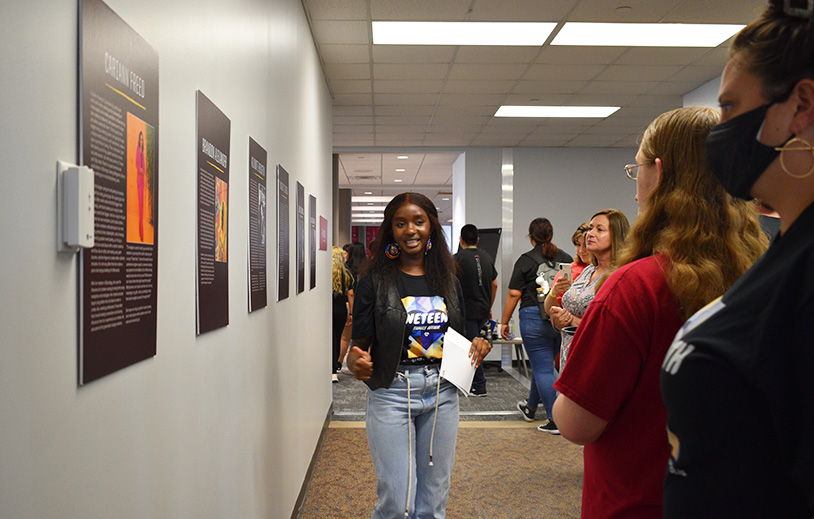
Yacine Tilala Fall is an interdisciplinary conceptual artist working predominantly in performance and installation based in Washington, D.C. Yacine received a BFA from the Corcoran School of the Arts and Design. Inspired by her Senegalese and Mauritanian heritage, her work and practice speaks to the human body and its entangled relationship with the environment, labor, history, and faith. Using natural materials she investigates concepts of self, ritual, and function through performance, sculpture, painting, and installation.
On exhibit is her work titles Hereditary created by drawing and Fall says, “Drawing and painting is crucial to my practice, many of my earlier works can be displayed up-right as well as upside-down. My drawings and painting tend to visualize future performance or installation works but also represent a space for mt hands to think freely,” says Fall.
Born in Kingston, Jamaica, Cesone Clemmings is a force to recon in her work with activism through art collection. She recalls being a collector from a tender age and hoping the trinkets collected would serve a purpose in the future. She currently pursues a master’s degree in strategic leadership and design at the University of Indianapolis. “I am an academic and I admit that I have had the privilege in my family of working to earn my master’s degree. I am a believer in education by any means necessary,” Cesone remarked.
Cesone exhibits her collection of prints titled Where Art Meets Activism which speak about social issues, service learning and volunteering to build and strengthen communities. She takes us into the importance of voluntary work saying, “in today’s capitalist society, we push for compensated production and forget the importance of learning. We have to look into the past, our civil rights movement leaders for example. They gave their time to the movement not because they were compensated but because they understood the vitality of a movement. What it means to be educated and be of service to our community.” Artists featured in Cesone’s collection contains quotes that talk about activism, and they include: Johanna Jackson, Dylan Muldrew, Kyle Pellet, Rosten Woo, and Paul Morgan.
Omoruyi Eghosa famously known as Tobydphotographer is a Nigerian-based photographer. Born on June 19, 1997, in Lagos Nigeria, he earned a bachelor’s degree in mechanical engineering from the Petroleum Training Institute in Delta State, Nigeria. After completion of his undergraduate education, he served in the National Youth Service Corps; a program started by the Nigerian government to involve their youth in nation building and the development of their country for a year. Toby’s artistic practice involves modernizing the renaissance as a self-taught photographer that blur the line between a photograph and a painting.
When asked why this modernization was vital, he said, “I want to maintain and appreciate renaissance ideals while representing the Black body as the focal point of the viewer. For me, it is taking inspiration from idealized old renaissance masters, adding a twist to it, and manipulating my art using modern technology. The Black body in my work can be seen as one that represents emotion, beauty, and royalty.” This year, Toby is set to have his first solo exhibit; Painterly on June 19, marking his birthday and double exhibitions in Nigeria and the University of Indianapolis Intercultural Center.
Chicago-born artist Kivonte Houston is a digital artist and owner of Vitaloveclothing which has a purpose of not only providing fashionable clothes but reminding us that Love is Vital. He is currently a student at the University of Indianapolis and an avid leader for underrepresented groups as a delegate of the Office of Inclusion and Equity. As the creative director of the Intercultural Center at UIndy, he has been able to work on the curation of events that are culturally significant to minority groups including Juneteenth and Cinco de Mayo .
Kivonte’s interest in the arts was initiated by his love for music videos and clothing brands so coming into college, he knew he going to academically pursue a path in the arts. His influences come from icons such as Nigo who is known as the godfather of streetwear. Kivonte is a self-taught artist with his works depicting the fusion between fashion, music, and fine art. The subjects he represents are underrepresented artists from the city of Chicago. He is famously known as Activixt and on his journey of activism, he adds, “I believe my art is necessary because of the subjects I show to the audience contrary to how the music industry capitalizes on the trauma of the Black body. I want my audience to know the importance of Black creatives and the influences they can make in both the fashion and music industry that is monopolized by white people.”
On exhibit is Optics which contains two photographic works inspired by creating a counter image of how Black womanhood is notoriously represented in mainstream media, he provides a lens into their lives in different environments. The first one depicts Iyonna Evans as mother nature in her purest form inhabiting her natural habitat, she is in a local park surrounded by trees and grassland. The second shows a woman on a train in the inner city of Chicago. This piece shows the strength and independence of a Black woman in an environment that tends to be at odds with her, where she is seen as not having the ability to protect herself.
For Kivonte, art has been a medium of expression and he has used it to give insight to his everyday reality. He says, “it is a continued process of depicting past thoughts with present day situations.” He will be having his first solo exhibit this December and more of his woks can be found on activixt.com.
Brandon Alexander is a mix media artist working mostly with wood sculpture. He is an art handler and assistant proprietor working with light engineering at the Eskenazi Museum of Art in Bloomington, Indiana. For as long as he could remember, he had always wanted to be an artist and old pictures of him in elementary school with scribbles of how he wanted to be artist when he grew older serve as a memory of how far Brandon has come in his artistic practice.
Art is about expression and its creation is what we humans best know how to do. It is a way of living and experiencing what it means to be human,” Brandon says. He takes on a variety of subject matters in his works and recently, he began creating series about his work and has thus far created four. On exhibit is Soultions, a series about self-expression and taking us into how he processes with his heart and brain to bring about solutions to his audience. Brandon also works in metal work which he learned through his interactions with coworkers at the museum. This year, he has exhibited at the Murphy Art Center as part of the first Friday tradition. On top of that, Brandon is part of the Wildnueva Clothing brand where he creatively supports his friends. More works by him can be found on Instagram @cloud_scholar.
CariAnn Freed (b. in Columbia City, IN) is an artist and writer working at the University of Indianapolis. Her artistic practice is influenced by her mother to allow for self-expression through art when words fall short. “I find myself at the height of my creativity when I am going through a deep mental process, and sometimes I make a piece and throw it away. This is because it gets the feeling out of my system onto the canvas, and afterwards, I do not have use for it,” CariAnn says. By trade, CariAnn is a poet and has had publications in the Etchings Literary Magazine. She is also working on a multidisciplinary zine.
Machaila Gray is a multi-disciplinary artist from Indianapolis, Indiana. She graduated from Herron School of Art+Design where she studied illustration and sculpture. Gray works primarily as a visual artist, specializing in mediums such as oil pastel, chalk, ink, and pencil. She aims to create visual narratives that are vibrant, detailed, and able to encompass various subjects in ways that aren't entirely complicated. Gray's sculptural works teeter on the symbolic and the literal, being assembled from natural and man-made objects, which is often dependent on what she feels will get the message across.
She draws inspiration from artists such as Diego Rivera, Lorna Simpson, John Steptoe, and Betye Saar. The three selected works are illustrations created by the artist in early 2021, during the last semester of her senior year at Herron. The pieces exhibited are drawn on square cardboard panels with a layered technique consisting of oil pastel and ink brush. In this series of works, Gray utilizes original(ish) characters, real-life observation, and bold visual design to bring a sense of magic to seemingly normal, if not mundane activities. She also puts emphasis on individual and collective power.
Emmanuel Massillon (b. 1998 in Washington D.C.) is an African American conceptual artist who works in several different mediums including painting, photography, and sculpture. With these varying mediums, He explores the complex history of race, identity, culture and it's the relation to people of African descent. Massillon's upbringing in the inner city of Washington D.C. shapes the unique narrative that he strives to convey through his work, which is introducing others to new ideas by creating work from day-to-day life to politically charged topics. With this, he aims for his viewers to start and explore conversations that may or may not have been previously spoken about. Language and materials is very much an important part of his work; he uses many visual puns and many examples of street vernacular which adds to the overall experience of his artwork.
The use of language and puns is directly inspired by many genres of African- American music such as Jazz, R&B and Rap music which Massillon believes to be one of the main preservers of black culture in America. The materials used in his work vary from bullet shells, dirt, found objects and wood which act as a way to express his perception of the world by using materials found in his own environment and cultural history. With influences as diverse as folk art, music, art history and African history. Massillon uses many reference points to get his ideas across to his viewers, in a simple yet evoking manner. When he isn't working on creating artwork Massillon can be found curating shows to shed light on artists looking to share a similar narrative as him. Massillon currently attends The School of Visual Arts (SVA) in New York City and is pursuing a BFA in Fine Arts.
In recognition of his academic and artistic accomplishments, Massillon was selected as a recipient of the Silas H. Rhodes Scholarship and is a recipient of the District of Columbia Commission on the Arts and Humanities Exhibitions (Curatorial) Grant. Massillon currently lives and works between New York City & Washington DC.
Sam Onche is an oil painter and illustrator and a recent graduate of Maine’s Colby College where he studied studio art with a concentration in oil painting. Sam was born in Benue State in Nigeria and moved to the United States in 2015. At the start of his academic route at Colby College, he played basketball but soon after, he decided to focus more on telling stories through his art. On display with the University of Indianapolis are two of his pieces, Lady Kwame, and Colored Lines. Both pieces are representations of Black women, each telling different stories but overall, acting as a way for his to be an activist for his community.
Lady Kwame, one of his earlier works, was inspired by his mother but as he progressed in its making, he added elements that also paid homage to his grandmother who smoked pipes. Sam says, “This work was experimental as I worked on abstraction while also representing the women important in my life. Often, I avoid representing my family in my works, but this work represents the memories I hold onto as well as values and the vitality of women in our society.” This work also represents Sam’s experimentation with colors and the progress he has made thus far into using vibrant colors. Colored lines is about frustration, pain, and finding ways out of these feelings. In his continued experimentation with color and abstraction, he depicts a young woman whose eyes one cannot see.
“Taking out the eyes was a deliberate choice that represents the Black community being seen but not seen. I want to represent social issues in nonviolent ways because my intention is not to add pain to my community that is already in pain from the trauma around us,” says Sam. The world is divided by color and Sam talks about color mixing in a fascinating way, “people only see what is on the surface. If you were looking at an object, take for example a black kettle, your ability to see the black color comes from the mixing of several colors together.” The message he puts across is togetherness in our experience as human beings and the beauty of blackness and color. Sam also has another exhibit coming up in June at the Lewis gallery, Portland featuring his afro-futurist pieces and to see more from Sam are on sogoarts.net.
Through Their Eyes by Dr. Saksena
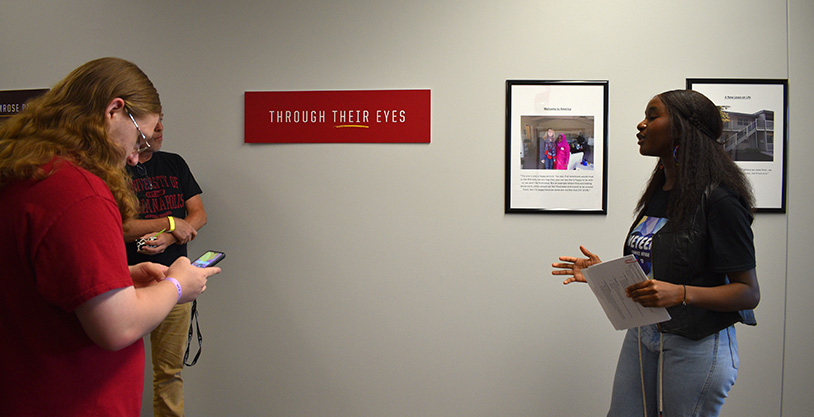
Dr. Saksena’s "Through Their Eyes: Health and Social Integration Experience of Congolese Refugee in Indianapolis”
This exhibit is a research that was carried out by Dr. Saksena (UIndy) and Dr. McMorrow (Western Michigan University). The photographs were taken by the women participating in the research and captions narrated by them.
Some themes you will find in this research relate to immigration to America, comparisons to their old life, the challenges of learning English, Healthcare in America, reminders of War in other countries, what life used to be, and the future of life in America.
The images and words depicted in this series are from the women themselves hence it is understanding their experience from their point of view.
Dr. Jyotika Saksena is a professor of International Relations at the University of Indianapolis. Using photographs taken by the Congolese refugee women themselves, Drs. Saksena and McMorrow share their experience with integration and healthcare in Indianapolis, IN. This Photovoice research was conducted in Indianapolis in 2016 and 2019 and was funded by Indiana Minority Health Coalition. They used Photovoice methodology, a unique and innovative research method, that views participants as co-researchers, to conduct a study of Congolese refugee women living in Indianapolis. They conducted an initial study in 2016 and then a follow-up study in 2019. In the initial study, the women had been in the country for 2 years or less.
Using Community Based Participatory Research they worked closely with Exodus Refugee Inc., a local refugee resettlement agency, in all aspects of the research. As part of the study, the participants were asked to take photographs of anything that made them happy, sad, or healthy. The exhibition displays photographs taken by the women themselves. The accompanying captions, as narrated by the women, provide a context for the photographs. This Photovoice research was conducted in Indianapolis in 2016 and 2019 and was funded by Indiana Minority Health Coalition.
Where Art Meets Activism by Cesone Clemmings
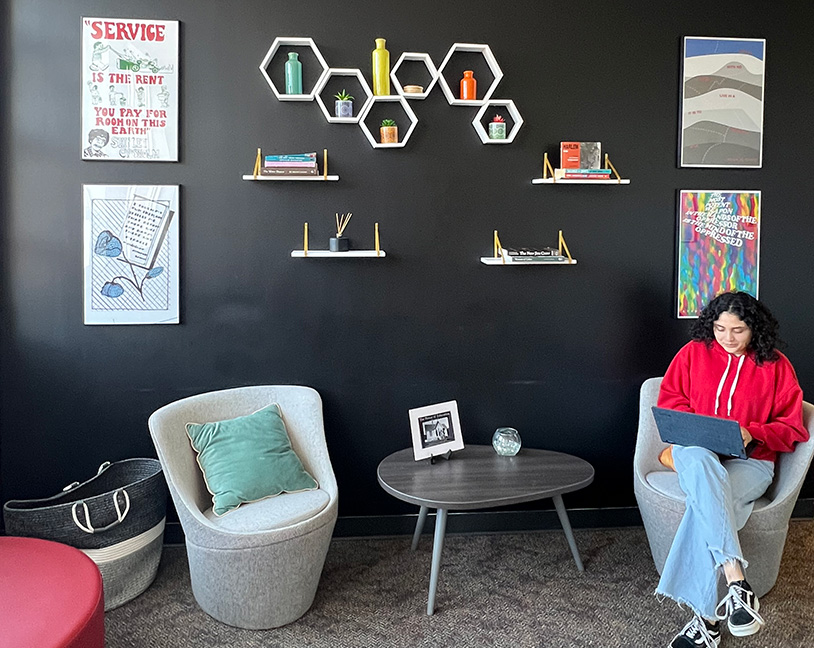
This exhibit centralizes the Black body and through it, we get an insight on the Black experience where art acts as an activism medium. Every piece of work represents the Black body or a symbolic representation of it.
The work is a part of a larger collection entitled “Classet'' by Jessalyn Aaland who was an elementary teacher who lacked resources. She offers these prints for free so that teachers would be able to bring life into their classrooms even with little to no funding.
These prints collectively tell the story of the intersection of art and activism and we offer this space to our campus community as an area to reflect, respond, and reset.
Moon Magic created using oil pastels and a thrifted frame which gives the overall feeling of antiquity. Mysticism is seen by the choice of the moon as a source of light, contrary to how we normally think of the sun as the source of light and a condition necessary for the growth of plants. The moon as a mystical entity helps the girl grow as she helps the plant grow and the cycle of growth continues. Butcher Lady addresses police brutality with the severing of the pig and its head placed on the lady’s table. She makes eye contact with the viewer from the corners of the eye as though confronting the stereotypes that we have of black women in contemporary media today. The imagery of Black jesus to show jesus can be just like you and does not have to fit the eurocentric jesus many of us saw growing up.
Works on exhibit: Ein STÜCK (work of art), Black Königin. He takes digital photographs and manipulates them to make them look like paintings hence playing around with visual perception of the viewer. The illusion created is one of mimicking brushstrokes of old masters from the renaissance.Here, we are challenged to look at art and appreciate its representation of beauty without over analyzing the social commentary that one may think the artist is trying to say.
- SOULutions Series #5
- Girl on Fire by CariAnn is a spoken word poem that talks about a girl who was born into a chaotic life, and learned how to harness that chaos as power to navigate the world. Inspired by the poem, Brandon went on to make the SOULtions series that consists of a sculpture and 3 acrylic paintings. The sculpture is made of concrete, ceramic and wood. The broken pieces of the ceramics incorporated into the concrete come together to sit on the wood. Line from the poem “chaos a muse” can be used as a guide in understanding the chaotic nature of the sculpture and how different mediums work together harmoniously. There is apparent chaos on the left side of the sculpture where the ceramic tiles sit in the dark concrete that conjoins with red colored wood (a color often associated with love). Yellow is also painted on the wood and complements the red. The outpouring of the sculpture’s concrete to the viewer indicates the overflowing act of love or the heart of a girl who is maybe hard and sharp on the outside and burning and dangerous on the inside. The SOULutions Series #5, #7 and #8 depicts the heart in what seems to be a mechanical nature. There seems to be a challenge to the loneliness we often feel in today’s society due to individualism in the age of technology. Here we are transformed into mechanical beings.
- Colored lines is about frustration, pain, and finding ways out of these feelings. In his continued experimentation with color and abstraction, he depicts a young woman whose eyes one cannot see. “Taking out the eyes was a deliberate choice that represents the Black community being seen but not seen. I want to represent social issues in nonviolent ways because my intention is not to add pain to my community that is already in pain from the trauma around us,” says Sam. The world is divided by color and Sam talks about color mixing in a fascinating way, “people only see what is on the surface. If you were looking at an object, for example a black kettle, your ability to see the black color comes from the mixing of several colors together.” The message he puts across is togetherness in our experience as human beings and the beauty of blackness and color.
- Lady Kwame, one of his earlier works, was inspired by his mother but as he progressed in its making, he added elements that also paid homage to his grandmother who smoked pipes. Sam says, “This work was experimental as I worked on abstraction while also representing the women important in my life. Often, I avoid representing my family in my works, but this work represents the memories I hold onto as well as values and the vitality of women in our society.” This work also represents Sam’s experimentation with colors and the progress he has made thus far into using vibrant colors. Walking closer to the painting helps the eye view the color diversity in his work.
Optics 1 is a photograph that plays with illusion by layering images on each other. These works are inspired by creating a counter image of how Black womanhood is notoriously represented in mainstream media, he provides a lens into their lives in different environments. The first one depicts a woman on a train in the inner city of Chicago. This piece shows the strength and independence of a Black woman in an environment that tends to be at odds with her, where she is seen as not having the ability to protect herself. For Optics 2, the viewer should walk across the photograph to see how the subject blends into the environment and the environment to her, creating a unity of the black woman as mother nature. The black woman as mother nature in her purest form is inhabiting her natural habitat.
Hereditary is a figurative drawing on a wooden panel which shows the reincarnation of the Black body repeatedly as a cycle that goes on to infinity. The viewing of hereditary can be done up or down and both give different perspectives creating a stimulating visual experience.
Salty (Study #1) is a mixed medium work where sampling is used by taking works from other artists and transforming it to make it a personal narrative inspired by lived experience. This work addresses the food deserts in the inner city and it becomes even more relevant and personal in relation with the University of Indianapolis’ location in a food desert. Additionally, the point of the work is for the viewer to ask why did the artist make the work they did because of the materials used to present the subject.
Blackness, drenched in whiteness attacks ongoing social issues of how Black people are often drowned in spaces, assimilation and the feeling like they have to change or conform into someone or something less like themselves.