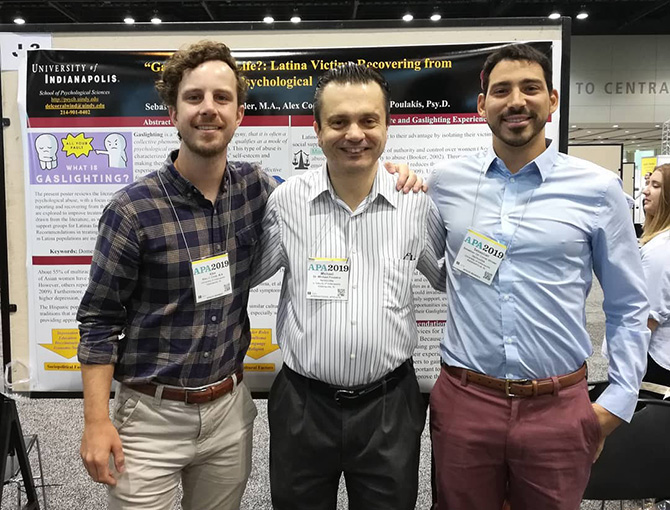
Dr. Michael Poulakis's Lab

Michael Poulakis, Psy.D.
Dr. Michael (Michalis) Poulakis is an Assistant Professor in the Department of Psychological Sciences. He is a Clinical Psychologist by training and he received his doctorate in Clinical Psychology from the University of Indianapolis (UIndy). He immigrated to the United States from Greece in 1992 and graduated from the University of Indianapolis with a degree in Clinical Psychology. Dr. Poulakis conducts qualitative research using Consensual Qualitative Research Methods. His research interests lie in the areas of multiculturalism, diversity, South Asian psychology, and LGBT issues.
Please visit the faculty bio page for additional information
Selected Publications
*Bold names indicate student authors.
Bertram, D. M., Poulakis, M., Elsasser, B. S., & Kumar, E. (2014). Social support and acculturation in Chinese international students. Journal of Multicultural Counseling and Development, 42(2), 107-124.
This study investigated the effects of social support on acculturation and ac- culturative stress in Chinese international students. A consensual qualitative research method analysis was performed on data gathered from semistructured interviews with 8 Chinese international students. Results indicated that the students experienced differences between their pre- and postsojourn perceptions of the United States, encountered various forms of acculturative stress, and sought support from multiple sources. Study implications, limitations, and directions for future research are discussed.
Dubosh, E., Poulakis, M., & Abdelghani, N. (2015). Islamophobia and law enforcement in a post 9/11 world. Islamophobia Studies Journal, 3(1), 138-157.
This study investigated the personal beliefs and attitudes of law enforcement officers toward Muslims and Islam. A consensual qualitative research method analysis (Hill) was performed on data gathered from semi-structured interviews with twelve police officers in training. Qualitative themes emerged from the cross analysis of participant interviews. Nearly all participants endorsed having personally or professionally interacted with Muslims, having previously referred to Muslims as foreigners (un-American others, or belonging to a ethnic/racial group), and expressed willingness and interest in learning more about Muslim culture in order to better serve their communities. Additional typical and variant themes were also found through analysis of the interviews. Study implications, limitations and directions for future research are discussed.
Poulakis, M., Dike, C. A., & Massa, A. C. (2017). Acculturative Stress and Adjustment Experiences of Greek International Students. Journal of International Students, 7(2), 204-228.
This study investigated eight Greek international college students’ experiences of acculturation and acculturative stress at a mid-western university in the United States. Semi-structured interviews were conducted with participants and Consensual Qualitative Research methodology was utilized for data analysis to identify contextual themes and domains expressed by participants. Seven domains relevant to extant literature were revealed: presojourn perceptions of the United States; postsojourn perceptions of the United States; acculturative stress problems in the United States; coping strategies for acculturative stress problems; peer and family networks: English language usage and difficulties; and cultural concerns regarding the United States or native country. Implications, areas for future research, and the study’s limitations are also discussed.
Vergo, J. M., Poulakis, M., Lesher, T. J., & Khondker, S. (2018). African American Students' Perceptions of Influential Factors for Attendance in Doctoral Psychology. Journal of the Indiana Academy of the Social Sciences, 20(1), 27.
This study explores African American undergraduate students’ perceptions of factors influencing their decision to attend doctoral programs in psychology. There is a scarcity of literature examining perceptions held by specific minority groups in regard to influential factors used to make a significant step toward their career development. Eight undergraduate students interested in pursuing a doctoral degree in psychology were interviewed. A semi-structured interview and two paper- pencil measures were used. Interviews were analyzed utilizing the consensual qualitative research (CQR) method. The following themes emerged: reasons for pursuing a doctoral degree, navigating the application process, factors influencing interest in psychology, perception of a program’s commitment to diversity, importance of ethnic minority representation in a program, financial concerns, family view of psychology, most important factor for attendance, and prior school experiences outside of psychology. The study found that issues related to African American representation and research, as well as the presence of financial aid, are highly relevant in students’ evaluation of which doctoral programs they prefer to attend. This information will pave the way for further studies focusing on how to increase the number of African American students in doctoral programs around the country.
For a more comprehensive list of publications, please visit Dr. Poulakis’ Google Scholar page.
Lab Requirements
Contact Dr. Poulakis (poulakism@uindy.edu) for more information.
Photos