The Crossings Mural
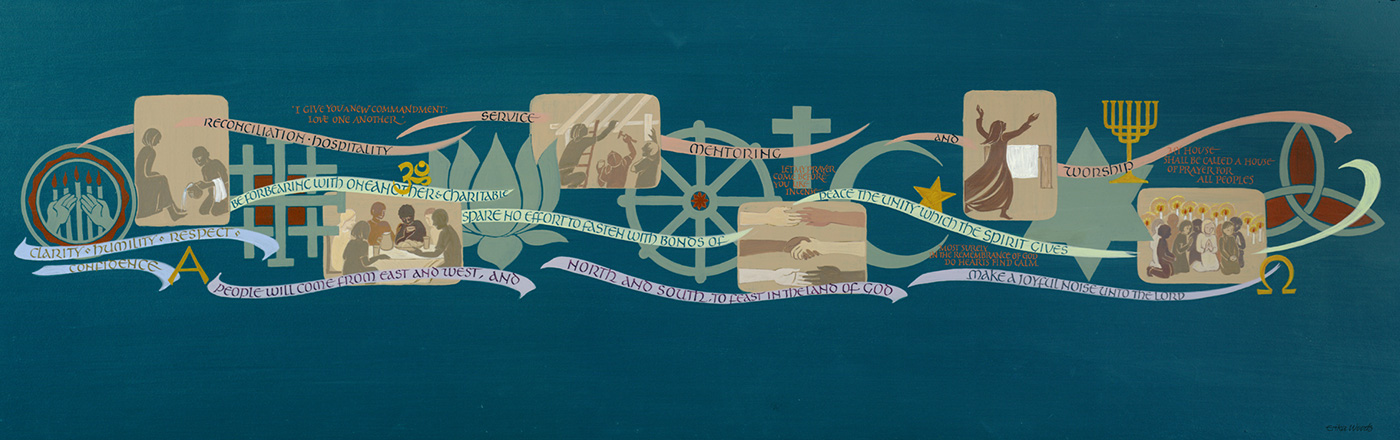
"Reaching Out – Gathering In – Loving One Another"
The mission of the University of Indianapolis includes a commitment to "enable students to gain a deeper understanding of the teachings of the Christian faith and respect and appreciation for other religious traditions." "The Crossings Mural" is an evocative reminder of the aspiration of this United Methodist-related university to provide enriched opportunities for students to engage in Christian formation and interfaith exploration as part of the educational experience.
The Crossings Mural Explanation
The mission of the University of Indianapolis includes a commitment to “enable students to gain a deeper understanding of the teachings of the Christian faith and respect and appreciation for other religious traditions.” “The Crossings Mural” is an evocative reminder of the aspiration of this United Methodist-related university to provide enriched opportunities for students to engage in Christian formation and interfaith exploration as part of the educational experience. The following explanations are intended to provide background information for persons who are interested in particular features of the mural, but the definitions cannot provide the last word in these matters.
For example, while the symbol of the wheel can and does represent the Buddhist community on this campus, that symbol may also evoke other associations for persons from Jewish, Christian, Muslim, and Hindu traditions: some members of this community may be reminded of the Hebrew prophet Ezekiel’s vision of the four living creatures, each of which were transported by “the wheel within the wheel,” while those of us who treasure monastic wisdom may recall the aphorism of Abba Dorotheus about human relationships being like a wheel—“God is the hub and we are the spokes; the closer we get to God, the closer we get to one another.” Conversation lies at the heart of what it means to be a university, and we invite you to join the dialogue about the ways different members of our campus community find this mural to be evocative. We invite you to send your thoughts and reflections to lbrownlee@uindy.edu or jhorner@uindy.edu. Periodically, a selection of these reflections will be posted on the Ecumenical & Interfaith Programs web page.
Six images of people engaging one another (from left to right).
- Humility in Serving One Another. The image of a person washing the feet of another person. As Jean Vanier has observed in his book The Scandal of Service, this simple gesture is the one of the most interfaith of sacraments. For Christians, it is a profound reminder of what it means for Jesus to wash the feet of his disciples (John 13), but we do not think that this is the only significance that the image has for persons on this campus. In what ways do you find this scene to be a meaningful expression of your own religious tradition and self-understanding?
- Table Fellowship. The symbol of “breaking bread together” points to honest, mutual relationship-building, which may occur in the contexts of the dining hall, in residence life, or at the gathering table (at the monthly celebrations of University Community Communion). What scenes of breaking bread together does this image evoke in your memory or life at this University?
- Service Endeavors. Throughout our University’s history of “Education for Service,” students, faculty, and staff have engaged in ventures such as the Appalachia Service Project, Habitat for Humanity (local as well as international endeavors), and international travel/study service projects that have been led by Jennifer Fogo, Charlie Guthrie, Lang Brownlee, and others. What service activities does this scene evoke for you? Beyond service activities like these, consider how this tableaux image leads you to think in terms of living a life of service.
- Hands reaching out to one another. For some of us, this is a simple but profound way to represent the kind of mentoring relationships that foster unity in the midst of diversity. The pair of clasped hands at the center evokes the memory of the notion of “unity” imaged in the United Brethren in Christ, the religious tradition that founded this University in 1902. How does this image fit your own journey of faith and practice?
- Liturgical Dancing. The embodiment of praise in liturgical dance by one or more persons is another way that religious beliefs can be expressed. Can you recall times when you or others have expressed religious convictions in dance? Dance is but one way to represent the expressiveness and power of the arts in the religious life of our campus. How does this image remind you of other expressions of the arts in religious activities?
- Prayer, Praise, and Worship. Four days a week students gather in McCleary Chapel for evening prayer. Twice a month, students from various Christian affiliations gather for student-led Praise & Worship experiences. On Sunday evenings, students gather with candles in semidarkness to sing hymns and read scripture as part of Taizé worship. Other worship experiences occur regularly, and persons utilize the chapel for personal prayer and quiet meditation. What scenes of worship does this image evoke for you?
We have designated this work of art by Erika Woods as “The Crossings Mural” as a way of reminding ourselves of the kinds of “crossings” that members of this community of learning make in reaching out, gathering in, and loving one another. The mural also commemorates the work of The Crossings Project, a program for theological exploration of vocation on our campus that was funded by the Religion Division of Lilly Endowment, Inc. We are grateful for the Lilly Endowment’s support of religious life programs at the University of Indianapolis, which began with the creation of the Lantz Center for Christian Vocations (1998–2001), was continued with The Crossings Project (2001–2006) and will be extended (2006–2009) as part of the Phase III Vocation Initiative grant.
Ribbon across the top of the mural: These five words designate the major themes of religious life on this campus: Reconciliation, Hospitality, Service, Mentoring, and Worship.
The ribbon of words moving through the center of the mural comprise an imperative: “Be forbearing with one another and charitable; spare no effort to make fast with bonds of peace the unity which the spirit gives.” (From Paul’s Letter to the Ephesians, 4:3.)
The ribbon of words moving across the bottom of the mural: Clarity, humility, respect, and confidence: The first four words indicate some of the noteworthy virtues or “marks of excellence” that we hope students, faculty, and staff display in their interactions between one another in the midst of differences in religious convictions and self-understandings. For example, some recipients of the Jerry Israel Interfaith Service Medallion (found on the right side of the mural) display these virtues. What other virtues would you name to describe excellence in interfaith relationships on this campus?
The second set of words along the bottom of the mural: These hopeful words are taken from the Gospel according to Luke 13:29, who in turn was drawing upon the prophecy of Isaiah. “People will come from east and west and north and south to feast in the land of God.” These words are particularly fitting for a university that was founded as “Indiana Central” whose student body came from east and west and north and south (see first fight song). The flags in the atrium of the Schwitzer Student Center serve as a visible reminder of the fact that more than sixty nations are represented on this campus today, and all fifty states in the USA are represented in the UIndy alumni association.
The third set of words along the bottom are another imperative: “Make a joyful noise unto the Lord” (Psalm 100). Across the years, generations of students have offered their voices in song as members of choral groups, a capella ensembles, and praise bands gathered for worship. Can you recall particular times when you and others have made a joyful noise in worshiping God?
Jerry Israel Interfaith Service Medallion: Named for our seventh president (1998–2005), who was known for encouraging students, faculty, and staff to engage one another in searching conversations (with honesty, respect, and humility) in the midst of living out their religious convictions, each aspiring to clarity and understanding in the mutual quest for truth.
Jerusalem Cross: This image, which is a recognized image for Christians in both Eastern (Greek Orthodox) and Western (Catholic and Protestant) traditions, reflects the unity of the Body of Christ, gathered from all over the world and more specifically as a reminder of our collaborative relationships with Christians in the Middle East (Mar Elias University in Israel).
Lotus with Om: Two images representing the Hindu religious traditions on our campus. The lotus flower is a life-affirming image, and the word “om” is used in Hindu meditation and represents the religious mysteries of that religious tradition.
Dharma Wheel: An image representing Buddhist religious traditions on our campus that signifies the wheel of life.
Latin Cross: An image representing the Christian traditions on our campus, the Latin cross is associated with both Protestant and Catholic traditions of Western Christianity.
Crescent & Star: An image representing Islamic traditions on our campus.
Star of David: An image that represents Jewish traditions on our campus.
Holy Trinity: The triquetra image is one of the ways that Christians represent the relationship of the three persons—Father, Son, and Holy Spirit—of the Triune God. While the preceding descriptions provide an explanation of the significance of these images for the religious traditions represented on the University of Indianapolis campus, such definitions do not exhaust the possible ways in which such images are found to be meaningful.
Interspersed throughout the mural, moving from left to right, the references are: “I give you a new commandment: love one another” (the Gospel According to John, 13:34). “Let my prayer come before you like incense” (Psalm 141). “Most surely in the remembrance of God do hearts find calm” (Sura 13:28 of the Qur’an). “My house shall be called a house of prayer for all peoples” (Isaiah 58:7).
The Greek letter alpha appears near the right side of the mural and the Greek letter omega is displayed on the left side. Students from our Athens campus will easily recognize these symbols, but Christians around the world will recall the words of Jesus—“I am the alpha and the omega, the first and the last, the beginning and the end”—in the Revelation of St. John, 22:13.
These words and statements taken from the sacred writings of the Jewish, Christian, and Muslim traditions display some of the aspirations of our campus community in our ongoing journey of learning as we actively attempt to “make room” for one another in the midst of acknowledging the presence of various religious identities and respecting significant differences in the practices of one another’s faith traditions.
In giving and receiving hospitality with one another, we recognize our differences. Through our differences, we find opportunities to seek the common good. In the midst of our communal search for truth, however, we present these affirmations and imperatives as expressions of our respective religious convictions. We invite all who enter our community of learning to engage these texts as they evoke hospitality and bring us closer to loving one another.
We invite all persons who view “The Crossings Mural” to recognize that this work of art is deliberately incomplete. In fact, we have taken advantage of the shape of the 180-degree semicircular wall on the second floor of the Schwitzer Student Center at our University to display an ongoing journey. Just as none of us are in a position to take in the whole of the mural as a result of the curvature of the wall, so also none of us are in a position to tell the whole story of the religious pilgrimages of all members of this community of learning, which continues to be affiliated with the United Methodist Church while welcoming students, faculty, and staff from other Christian communions as well as various other religious traditions from around the world.
Generations of students, faculty, and staff still to come will make their own contributions to religious vitality at this church-related university. Accordingly, we anticipate that additional sets of images and texts will be added as religious life continues to be enriched by the contributions of various faith traditions that are represented on this campus. In the meantime, we invite you to join our community as—together—we take the risk and embrace the challenges of reaching out, gathering in, and loving one another.
—Michael G. Cartwright, Former Dean of Ecumenical & Interfaith Programs