Curriculum and Courses for the Master of Science in Exercise Science (MEXS)
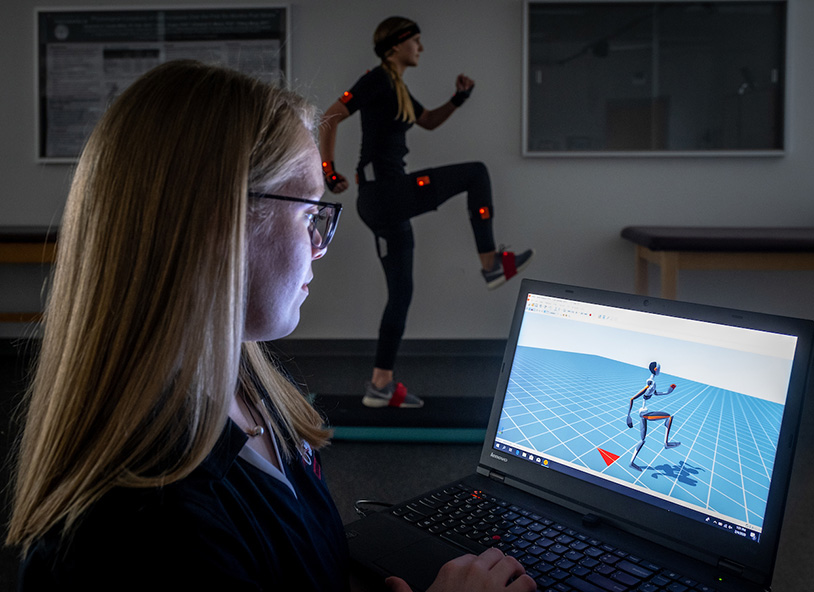
The Master of Science in Exercise Science program at the University of Indianapolis (UIndy) requires 34.5 credit hours and students have the option to choose between two concentrations: human performance or clinical exercise physiology. The accelerated curriculum has students register for a full-time schedule (9-13 credit hours) over the course of 3 academic semesters, allowing them to complete the program in one academic year (fall, winter and summer). Please read each course description to see which concentration it applies to.
Semester 1
Concentrations: Human Performance Concentration, Clinical Exercise Physiology Concentration
The course involves a multi-disciplinary study of human functioning and performance related to behavior with content from sport and exercise psychology theoretical frameworks and strategies and common to those seeking either the clinical exercise physiology or sports performance tracks.
Concentrations: Human Performance Concentration, Clinical Exercise Physiology Concentration
The course is a multi-disciplinary study of human performance with content from exercise physiology and sport/exercise psychology. The initial portion of the course will present advanced content in exercise physiology common to clinical exercise physiology and sports performance. During the remainder of the course, the psychological aspects of exercise in these populations will be examined.
Concentrations: Human Performance Concentration, Clinical Exercise Physiology Concentration
The course will present principles and practices related to measurement and evaluation of human performance. This is a hands-on laboratory designed so students can perform laboratory and field tests in the area of exercise science. Students will learn to run all equipment in the Human Performance Laboratory (including ECG stress testing, DEXA (for body composition), force determination, cycle and treadmill ergometry.
Concentrations: Human Performance Concentration, Clinical Exercise Physiology Concentration
This course is part one of two courses in the Master’s program dedicated to research method and design. In this course, the emphasis is on research methodology and design.
Course Objectives: To introduce research design and biostatistics to the Master’s level student in order to assist with their portfolio (Project) or Thesis option.
- To review research design in exercise science
- Develop research questions and hypothesis statements
- Review Research, citing, and annotated bibliography
- To review ethics in Research
Concentrations: Human Performance Concentration, Clinical Exercise Physiology Concentration
Students will complete 450 hours of practicum over three courses. Areas for practicum include Research, Teaching, Athletic Wellness, Assessment Technology, Data Analytics, Seminar and Research Presentations.
Student will engage in a multi-disciplinary study of human performance in both sport and clinical contexts. Specifically, students will discuss and implement core exercise concepts of endurance performance as well as various clinical conditions.
Semester 2
The course involves an advanced multi-disciplinary study of human functioning and performance related to behavior with content from sport and exercise psychology theoretical frameworks and strategies and common to those seeking either the clinical exercise physiology or sports performance tracks.
Concentrations: Human Performance Concentration, Clinical Exercise Physiology Concentration
This course will involve a multi-disciplinary study of neuromuscular performance with content from exercise physiology, biomechanics, motor control, pathomechanics, and neuroscience.
- Neurophysiology
- Neuroanatomy
- Neurobiology/cell physiology
- Sensation Processing
- Motor System
- Life Span Adaptations
- Motor Control and Biomechanics
- Ecological dynamics concepts (motor control and skill acquisition)
- Postural control
- Locomotion
- Neuromuscular power
Concentrations: Human Performance Concentration, Clinical Exercise Physiology Concentration
Students will learn specific assessments to measure and evaluate neuromuscular performance.
Laboratory
- Medical History Review and Pre-Screening
- 1 RM testing
- Strength testing (Isokinetic)
- EMG
- Nerve Conduction Testing
- Pain testing
Concentrations: Human Performance Concentration, Clinical Exercise Physiology Concentration
To introduce research design and biostatistics to the Master’s level student in order to assist with their portfolio (Project) or Thesis option.
- Be able to use excel, SAS, SPSS or other programs to calculate the following:
- Central tendency, mean, median mode, standard deviation
- Pearson Product Moment Correlations
- Standard Error in Linear and Multiple regression
- T-tests, ANOVA
- Relative risk, Odd’s ratio’s, Hazard ratio’s
- Be able to distinguish between validity and reliability (internal and external)
Concentrations: Human Performance Concentration, Clinical Exercise Physiology Concentration
Students will complete 450 hours of practicum over three courses. Areas for practicum include Research, Teaching, Athletic Wellness, Assessment Technology, Data Analytics, Seminar and Research Presentations.
This course will involve a multi-disciplinary study of human performance with content from exercise physiology and sport and exercise prescription. During this course, students will extend the foundational concepts learning in Programming I, and learn how to improve the performance of both sport performance and clinical populations. Special emphasis will be given to the neuromuscular aspects of sports performance and chronic disease.
Concentrations: Human Performance Concentration, Clinical Exercise Physiology Concentration
This course considers physical activity and fitness in the context of physical growth, biological maturation and behavioral development during childhood and adolescence and through the aging process (>50 years). The students will receive an overview of the concepts of growth, maturation and development, effects of physical activity on these parameters, and understand general concepts in motor development as they relate to physical activity. The course will examine the biological and environmental factors that influence aging and physical performance. Particular attention will be focused on system physiology.
Summer
Concentrations: Human Performance Concentration, Clinical Exercise Physiology Concentration
The purpose of this course is to learn to manage and administrate exercise and sports performance programs. Topics include:
- Learn how to maintain patient
- Learn how to conduct a program
- Learn how to implement strategies to improve a
- Learn how to maintain relationships with other health care
- Learn how to effectively manage
- Learn how to manage
- Learn how to develop and implement facility
- Learn clinical standards for
- Learn how to promote patient
- Learn effective communication and promotion of a program
- Learn important legal
Concentrations: Human Performance Concentration, Clinical Exercise Physiology Concentration
Students will complete 450 hours of practicum over three courses. Areas for practicum include Research, Teaching, Athletic Wellness, Assessment Technology, Data Analytics, Seminar and Research Presentations.
Concentrations: Human Performance Concentration, Clinical Exercise Physiology Concentration
This course will involve the study of professionalism within the exercise science field including emphasis on communication, professional etiquette/work conduct, networking, and resume building. In addition, students will receive mentoring regarding entering the exercise science field as a professional (employment opportunities, salary and benefits, certifications and continuing education, etc).