Greyhound Parents & Supporters

Partnering with You for Your Student’s Success

Parents and supporters play a big role in their student’s academic journey, and we are here to support you through every step!

Why UIndy?


Small Class Sizes & Personalized Attention

At UIndy, your student will be known and recognized for the person they are rather than a number on a roster. With our average class size of 16 and student-to-faculty ratio of 12:1, your student will get to know their professors and classmates, making lifelong connections and friendships. 

Strong Outcomes

Your students will be set up for success from their first day on campus.  

Campus Support Services

On campus, your student will have access to tutoring services, career services from our Stephen F. Fry Professional Edge Center, support from our Center for First-Year Experience & Student Success, and more!

Stay Connected with the Greyhound Family Portal

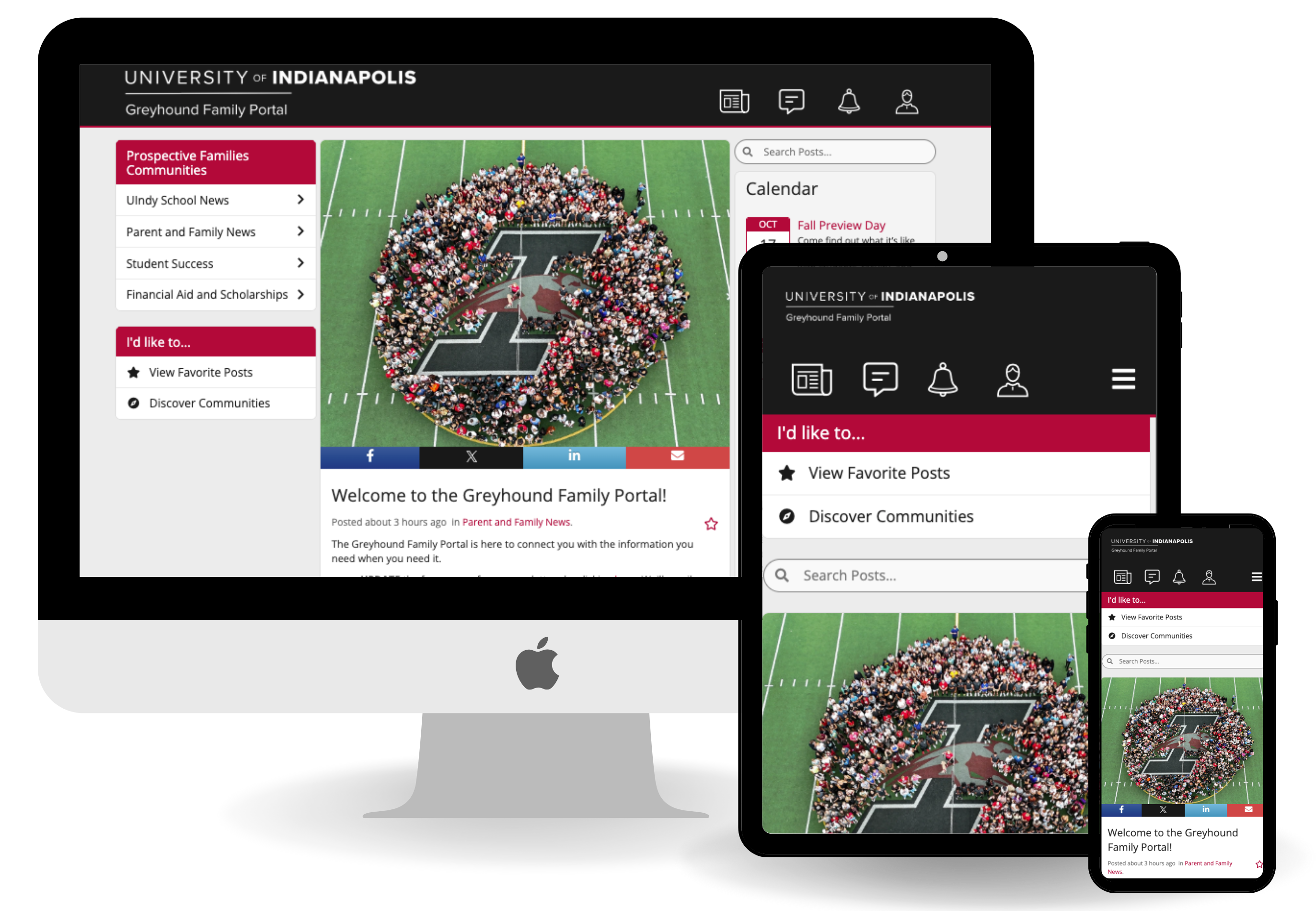
Greyhound Family Portal interface on a computer monitor, tablet, and mobile device

To help you and your student transition to the University of Indianapolis, we offer the Greyhound Family Portal, a parent and family portal powered by CampusESP designed specifically for families of new and incoming students. This portal serves as a one-stop shop for the information you need to support your student’s success. You can customize the type and frequency of updates you receive from UIndy, as many departments across campus share important announcements, deadlines, and resources. You can also join communities to explore topics of particular interest. For the latest updates, create a Greyhound Family Portal account — you can log in anytime or receive a digest at your preferred frequency.

Melissa V.
Parent of Peyton V. ’28 (Mechanical Engineering)

As a parent, it melts my heart to see how happy my student is on campus. He smiles when he talks about things he has done or classes he found interesting. I fully expected to get that first semester phone call where my student was freaking out or just missing home, but that did not happen. He genuinely loves it here! He has made so many friends already and finds things to do to occupy his time. UIndy does an amazing job at communicating with students about things happening on campus and an even better job at keeping the students engaged. I know deep down that UIndy was exactly the right choice for my student.

Important Admissions Information

Below are important details to help you and your student stay on track throughout the admissions process for Fall 2026.

Key Dates

  • Application Opens: August 1, 2025
  • FAFSA Opens: October 1, 2025
  • Priority Application Deadline: November 1, 2025
  • Fall 2026 Deposit Opens: December 1, 2025
  • Housing Application Opens: February 2026
  • FAFSA Priority Deadline (for Indiana residents): April 15, 2026

Application Process

Our Greyhound Express application (opens Aug. 1) takes about  10 minutes to complete! A few things to know about our application:

  • No test (SAT/ACT) scores required
  • No letter or recommendation or essay required
  • Free to apply
  • Receive your decision in two weeks

Learn more about the admissions process

We're Here to Help

Have questions about the UIndy admissions process? Contact us at admissions@uindy.edu or at 317-788-3216.

Affordability & Financial Aid

We are committed to making a high-quality education manageable for your family through a combination of scholarships, grants, and other financial resources. 

When your student applies to UIndy, they will automatically be considered for merit-based scholarships (up to $20,000). Your family will receive more information about this in their acceptance letter. 

Tip: Have your student ask their high school counselor about scholarships offered by local or national organizations.

Learn more about all scholarship options

The deadline to complete the Free Application for Federal Student Aid (FAFSA) each year for Indiana residents is April 15th. By filing the FAFSA, your student will be considered for:

  • Federal and state grants
  • Work-study opportunities
  • Federal student loans

UIndy’s FAFSA code is 001804. Families are encouraged to complete the FAFSA early for priority consideration. If you have any questions about the FAFSA process, contact your student’s UIndy admissions counselor.

Safety, Wellness, & Student Support Services

Student safety and well-being at the University of Indianapolis is our top priority. We have created a campus environment where your student will feel safe, supported, and empowered to succeed. 

  • 24/7 campus police department staffed by trained officers that is also a branch of the Indianapolis Metropolitan Police Department (IMPD)
  • Watchdog Safety Message Alert System (sign up for WatchDog alerts)
  • ID-secured residence halls

Learn more about campus safety and security

  • The Health and Wellness Center has three full-time nurse practitioners and one part-time physician to provide care. 
  • The Counseling Center offers free, confidential mental health services for students.
  • The Center for Applied Health (CAPS) is conveniently located on the second floor of the Schwitzer Student Center in the heart of UIndy’s campus. CAPS allows students, faculty, and staff to identify their health and wellness goals and then tap into UIndy resources to achieve them.

Learn more about the Health, Wellness, and Counseling Center

  • The Center for First-Year Experience & Student Success offers enriching experiences and endless opportunities to enhance your student’s educational journey from the moment they attend their New Hounds Day (new student orientation)!
  • The Stephen F. Fry Professional Edge Center (Pro Edge) assists with career assessment, career mentoring, linking students to professionals and experiences in their major, and finding work-study jobs.
  • The Office of Disability Resources & BUILD supports those who need physical or academic accommodations or other assistance.
  • The Phil and Janet Terry Center for Campus Connections is a “one-stop shop " that helps students seeking financial, academic, and social support access resources from multiple offices across campus.
  • Tutoring: UIndy offers a variety of tutoring options from math to writing that your student can utilize during their time on campus.

How You Can Support Your Student

This next chapter in your student’s life is an exciting milestone. Your guidance and encouragement will make a meaningful difference as your student explores their college options and what is next for them!

Here are ways you can support your student through each step.

  1. Stay Organized and Informed Together.
    Help manage key deadlines by creating a shared calendar for application due dates, financial aid forms (like FAFSA), campus visits, and scholarship opportunities. Offer to review essays or help with forms, but let your student take the lead. Read communications from schools together to ensure nothing is missed.
  2. Visit Campus!
    Visiting campus is the best way for your student to get to know a college. It’s best to visit while school is in session so that your student can get a feel for what campus life is like.
  3. Provide Guidance, Not Pressure.
    You can serve as a sounding board—asking thoughtful questions and helping your student reflect on what they want in a college (location, size, majors, campus culture). Encourage exploration without steering them toward a specific choice just because it’s familiar or prestigious. Support their independence in this decision.
  1. Stay Organized Together.
    1. Set up a shared calendar for deadlines, test dates, and recommendation requests.
    2. Gently remind them of due dates—but avoid micromanaging.
  2. Support, Don’t Write.
    1. Offer to proofread essays for clarity, grammar, and tone—but don’t write or rewrite them.
    2. Encourage authenticity in their application voice.
    3. Help brainstorm stories or strengths they might include.
  3. Assist with Forms and Logistics.
    1. Help keep track of materials submitted or still needed, application fees, transcript requests, and test score submissions.
    2. Help complete the FAFSA and other financial aid forms accurately and on time.
    3. Monitor your email too—some schools communicate important steps through the parent email on file.
  1. Attend Admitted Student Events.
    1. Go with them to admitted student days or revisit campuses to get a better feel for the environment.
    2. Ask questions about housing, support services, and next steps.
    3. Let them lead the visit while you observe and support.
  2. Discuss Finances Honestly and Early.
    1. Be upfront about what your family can realistically afford. 
    2. Talk through the cost of attendance, potential aid, and student loans so your student can make informed choices. 
    3. Attend financial aid sessions together and compare financial aid offers when the time comes.
  3. Be Reassuring and Supportive.
    1. Remind your student that there’s no single “perfect” school—it’s about what they make of the experience.
    2. Be patient if they feel overwhelmed, conflicted, or uncertain.
    3. Celebrate their choice and encourage a strong start, wherever they land.
  1. Attend their New Hounds Day (new student orientation) with them.
    1. New Hounds Days will be announced in the spring. All new, first-year students are required to attend one New Hounds Day. This day is mandatory because students meet with an academic advisor to review their materials and build connections with professionals on UIndy's campus. Special sessions will also be held for parents and guests to learn more about how to support their student during their time at UIndy.
  2. Build Life Skills Together.
    1. Help your student gain confidence in basic life tasks they'll need on campus:
      1. Practice budgeting and managing a bank account.
      2. Teach them to do laundry, cook simple meals, and schedule appointments.
      3. Encourage self-advocacy, like reaching out to professors, asking for help, or managing their own calendar.
  3. Keep Communication Strong but Flexible.
    1. Students need support, but also space to grow:
      1. Talk about how often you’ll stay in touch via calls, texts, and visits.
      2. Let them know you're always in their corner, but give them room to handle challenges.
      3. Encourage independence, even if it means letting them make mistakes.